


10 Audience Segmentation Strategies for Explosive Growth in 2025

In a saturated market, shouting your message to everyone is the fastest way to be heard by no one. Growth-focused marketers and SMBs understand that the key to unlocking superior ROAS, scalable demand, and lasting customer loyalty is not about casting a wider net. It's about using a more precise spear. This is where mastering audience segmentation strategies becomes a non-negotiable competitive advantage.
The modern marketing landscape demands a move away from generic campaigns towards precision. A key first step in this shift is understanding how to identify your target audience with clarity. Once you have that foundation, segmentation allows you to speak directly to the unique needs, behaviors, and motivations of different customer groups. Moving beyond generic demographics, today's winning strategies leverage a multi-layered, data-driven approach that combines behavioral patterns, psychographic insights, and real-time intent signals.
This comprehensive roundup dissects 10 powerful audience segmentation strategies that transform advertising from a guessing game into a predictable growth engine. We will provide actionable examples for e-commerce, local services, coaches, and more, giving you the exact blueprints to find, attract, and convert your most valuable customers. Each strategy is designed to be a practical tool, not just a theory, equipping you to build more relevant, resonant, and profitable marketing campaigns immediately.
1. Demographic Segmentation
Demographic segmentation is one of the most foundational and widely used audience segmentation strategies. It involves dividing your market into distinct groups based on observable, people-based data points. This method provides a clear, quantitative snapshot of who your customers are, serving as an essential first layer for more complex targeting.
This strategy works by organizing audiences based on shared statistical traits, allowing you to tailor messaging, product offers, and creative assets to align with their specific life stages, economic positions, and cultural backgrounds. For growth-focused SMBs, demographic data offers a straightforward way to create initial customer personas and allocate marketing budgets efficiently.
How It Works in Practice
Demographic segmentation relies on easily accessible data to create broad but meaningful audience buckets. The most common variables include:
- Age: A skincare brand might target users aged 18-24 on TikTok with ads featuring user-generated content about acne-focused products, while targeting users aged 45-60 on Facebook with carousel ads showcasing anti-aging serums.
- Gender: An e-commerce apparel store can create separate campaigns for its men's and women's clothing lines. For example, showing ads for suits and ties to a male audience and dresses and handbags to a female audience, using different imagery and ad copy.
- Income Level: A luxury car dealership might use Meta's income targeting to show ads for its newest high-end model only to households in the top 10% of US zip codes.
- Education Level: A consultant offering executive coaching services could target professionals on LinkedIn with a "Master's Degree" or "MBA" listed in their education, as they are more likely to invest in career development.
- Family Status: A local dentist can promote "Back to School" family check-up deals on Facebook by specifically targeting users identified as "Parents with grade school kids (6-8 yrs)."
Actionable Tips for Implementation
To get the most out of demographic segmentation, move beyond basic assumptions and integrate data for a more precise approach.
- Layer with Behavioral Data: Combine demographic information with purchase history. For example, target high-income females (demographic) who have previously purchased luxury handbags (behavioral) with a new designer collection.
- Validate with First-Party Data: Use information from your CRM, email signups, and customer surveys to confirm or refine the demographic assumptions provided by ad platforms like Google or Meta.
- Create Distinct Funnels: Develop separate marketing funnels for different age groups. The messaging, visuals, and social media channels you use to reach Gen Z will differ significantly from those used to engage Baby Boomers.
2. Behavioral Segmentation
Behavioral segmentation moves beyond who your customers are and focuses on what they do. This powerful strategy groups audiences based on their actions, interactions, and engagement patterns with your brand, such as purchase history, website browsing, email clicks, and app usage. Unlike static demographic data, behavioral insights reveal user intent, interest level, and readiness to convert in real-time.
For growth-focused SMBs, this is one of the most critical audience segmentation strategies because it directly correlates with conversion likelihood. By understanding user actions, you can create highly relevant, timely, and automated marketing campaigns that guide customers through the funnel more effectively, significantly boosting return on ad spend (ROAS).

How It Works in Practice
Behavioral segmentation relies on tracking user interactions across your digital properties to identify patterns and create dynamic audience groups. To effectively implement this, it's crucial to understand what behavioral targeting is and how it works. Common variables include:
- Purchase Behavior: An e-commerce store can create a segment of "repeat coffee buyers" who have purchased coffee beans more than three times and automatically send them an email when a new blend is released.
- Engagement Level: A SaaS company might send an in-app pop-up offering a 20% discount on an annual plan to free trial users who have logged in 5+ times in a week, while sending re-engagement emails to those with low activity.
- Benefit Sought: A skincare brand can segment users who browse "anti-aging" product pages separately from those who view "acne treatments," tailoring Google Shopping ad creative to their specific goals.
- Cart Abandonment: A direct-to-consumer brand can automatically trigger an email or SMS sequence with a limited-time 15% discount to users who added items to their cart but did not complete the purchase within three hours.
- Content Consumption: A financial advisor can segment webinar attendees who watched over 75% of the "Retirement Planning" presentation into a high-intent audience, then follow up with a personalized email inviting them to a one-on-one consultation.
Actionable Tips for Implementation
To maximize the impact of behavioral segmentation, integrate it deeply into your marketing automation and analytics workflows.
- Create Funnel-Stage Segments: Build distinct audiences for each stage: awareness (e.g., blog readers), consideration (e.g., product page viewers), and decision (e.g., cart abandoners). This allows for precise messaging that matches their journey.
- Use RFM Analysis: Regularly analyze Recency, Frequency, and Monetary value to identify your best customers (high RFM score) and those at risk of churning (low RFM score). Create VIP loyalty campaigns and win-back offers accordingly.
- Set Up Automated Exclusions: Ensure you aren't wasting ad spend by retargeting recently converted customers with acquisition ads. Automatically exclude recent purchasers from top-of-funnel campaigns for a set period (e.g., 30-60 days).
- Layer with Dynamic Creative: Combine behavioral segments with dynamic ads to show users the exact products they viewed. This level of personalization is a cornerstone of high-performance e-commerce advertising.
3. Psychographic Segmentation
Psychographic segmentation moves beyond the "who" to uncover the "why" behind customer behavior. This strategy involves dividing your market based on psychological traits like values, lifestyle, interests, attitudes, personality, and aspirations. It provides a deeper, more nuanced understanding of your audience, explaining what truly motivates their purchase decisions.
This approach works by identifying shared belief systems and life philosophies, allowing brands to create emotionally resonant messaging that aligns with those core values. For businesses offering premium services, coaching, or lifestyle-focused products, psychographic segmentation is essential. It is particularly powerful for high-ticket items where an emotional connection and value alignment are the primary drivers of conversion.
How It Works in Practice
Psychographic segmentation relies on qualitative data to understand the internal motivations of your audience. Common variables include:
- Lifestyle: A wellness brand can segment its audience into those who see health as a holistic, mindful practice (targeting them with yoga and meditation content) versus those who are performance-driven and goal-oriented (targeting them with ads about hitting personal records).
- Values: An e-commerce clothing brand might create a Facebook ad campaign targeting users interested in "Sustainability" and "Ethical Fashion," with ad copy that highlights its use of recycled materials and fair-labor practices.
- Interests & Hobbies: A travel company could create separate Instagram campaigns for "adventure seekers" who follow accounts like National Geographic, and "relaxation enthusiasts" who follow luxury spa and resort accounts.
- Aspirations: A financial coaching service can target ambitious professionals on LinkedIn who follow influencers like Tony Robbins and list "personal growth" as an interest, using ad copy that speaks to achieving financial independence.
- Attitudes: A B2B software company might segment leads from a webinar into "early adopters" who asked questions about new features (and get a follow-up about the beta program) and "risk-averse" decision-makers who asked about security (and get a case study on data protection).
Actionable Tips for Implementation
To effectively implement psychographic segmentation, you need to gather insights that go deeper than surface-level data.
- Conduct Customer Interviews: Use surveys and one-on-one interviews to ask open-ended questions about your customers' goals, challenges, and motivations. Uncover the "why" behind their purchase.
- Analyze Social Media Conversations: Use social listening tools like Sprout Social or Brandwatch to identify the shared language, interests, and values expressed by your ideal customers online.
- Develop Aspirational Creative: Create ad campaigns and content that reflect the lifestyle your audience aspires to, not just the features your product offers. Showcase transformation and emotional outcomes.
- Layer with Behavioral Data: Combine psychographic insights with user actions. Target users who value sustainability (psychographic) and have recently viewed your eco-friendly product line (behavioral).
4. Geolocation & Hyper-Local Segmentation
Geolocation segmentation targets audiences based on their physical location, from broad areas like countries and cities down to highly specific neighborhoods or even real-time GPS coordinates. This strategy moves beyond who your customers are to focus on where they are, enabling businesses to deliver timely, contextually relevant messages that drive immediate action.
For local service businesses, multi-location retailers, and real estate professionals, this is one of the most powerful audience segmentation strategies available. Hyper-local tactics like geofencing, which creates a virtual perimeter around a specific location, allow you to engage potential customers with unparalleled precision, boosting foot traffic and maximizing local ad spend.

How It Works in Practice
Geolocation segmentation uses location data to trigger ads and offers when a user enters, exits, or spends time within a predefined geographic area. This allows for dynamic, real-world engagement based on a user's current context.
- Restaurants: A pizza shop can set up a geofence with a two-mile radius around its location to trigger a mobile ad with a "Free Drink with Any Slice" offer for users in the area between 11 AM and 2 PM.
- Local Gyms: A fitness center can geofence the addresses of three major competitors in January, serving ads promoting a "Switch and Save: 25% Off Your First 3 Months" membership deal to people on-site.
- Real Estate: An agent can create a geofence around an open house they are hosting. When attendees enter the radius, they can be targeted with a follow-up ad later that day showing other similar properties the agent has listed.
- Retail Franchises: A national coffee chain can run a "Hot Coffee, Half Price" promotion in Chicago when the temperature drops below freezing, while simultaneously running an "Iced Latte Special" in Miami where it's sunny and warm.
- Healthcare Clinics: A dental practice can segment by zip code to target affluent neighborhoods with Facebook ads for cosmetic services like teeth whitening, while targeting family-oriented zip codes with ads for pediatric dentistry.
Actionable Tips for Implementation
To maximize ROI, combine geolocation with other data points and optimize your campaigns based on real-world behavior.
- Combine with Dayparting: Schedule your geofenced ads to run only during relevant times. A bar could target users in a nearby business district only during happy hour (4-7 PM) on weekdays for maximum efficiency.
- Create Location-Specific Creative: Reference local landmarks, street names, or events in your ad copy and visuals. An ad saying "Tired of the traffic on Main Street? Pop in for a coffee!" is far more effective than a generic message.
- Use Location Exclusions: Save your budget by setting up exclusion zones around your own office to avoid showing ads to employees, or around the homes of loyal, existing customers who don't need the same offer. Learn more about the benefits of hyperlocal advertising for small businesses.
- Track Foot Traffic: Utilize location analytics to measure how many people saw your ad and subsequently visited your physical store. This provides a direct link between your digital spend and real-world results.
5. Firmographic Segmentation (B2B)
Firmographic segmentation is the B2B equivalent of demographic segmentation, focusing on company characteristics rather than individual consumer traits. It involves grouping business audiences based on organizational attributes to identify the most promising accounts. This method is essential for any company selling to other businesses, as it ensures marketing and sales efforts are concentrated on organizations that are the best fit for their products or services.
This strategy works by classifying companies using clear, verifiable data points like industry, size, and revenue. For businesses offering specialized B2B solutions, from enterprise software to white-label agency services, firmographics provide a roadmap to find and engage high-value clients. It moves beyond generic prospecting to a structured, data-driven approach that aligns your value proposition with a company's specific operational profile and needs.
How It Works in Practice
Firmographic segmentation uses company-level data to create precise target account lists, enabling highly relevant outreach and account-based marketing (ABM) campaigns. Common variables include:
- Industry: An AI-powered logistics software provider can use LinkedIn Ads to target users with the job title "Supply Chain Manager" who work at companies in the "E-commerce," "Retail," and "Manufacturing" sectors.
- Company Size (Employee Count): A human resources platform might offer a lean, self-service solution for startups with 10-50 employees, while its direct sales team focuses on booking demos with VPs of HR at companies with over 1,000 employees.
- Annual Revenue: A corporate consulting firm could use a data provider like ZoomInfo to build a list of companies with over $500M in annual revenue, then target their C-suite executives with personalized email outreach.
- Geographic Location: A commercial cleaning service in NYC can target ads to "Facilities Managers" at companies headquartered within the five boroughs of New York City.
- Growth Stage: A venture capital firm might use PitchBook data to identify and reach out exclusively to high-growth SaaS companies that recently closed their Series B funding round, as they have different capital needs than seed-stage startups.
Actionable Tips for Implementation
To maximize the impact of your B2B targeting, enrich basic firmographic data with more dynamic signals that indicate readiness to buy.
- Combine with Technographic Data: Target companies based on the technology they currently use. For example, a marketing agency could pitch its advanced HubSpot services to companies that are already using the platform but may not be maximizing its potential.
- Leverage Job Change and Growth Alerts: Use platforms like LinkedIn Sales Navigator to identify companies that are rapidly hiring for sales roles. This is a strong indicator that they need a CRM solution and are ready to invest.
- Layer with Intent Signals: Monitor which target accounts are visiting your website, downloading content, or engaging with your ads. Prioritize outreach to companies showing both the right firmographic profile and active buying intent. If you're looking for more guidance, see these proven B2B advertising strategies on silverspoonagency.com for a deeper dive.
6. Purchase Intent Segmentation
Purchase intent segmentation moves beyond who your audience is to focus on what they are about to do. It involves identifying and grouping users based on signals that suggest they are actively considering a purchase. This powerful strategy allows you to prioritize marketing efforts on leads who are closest to converting, directly boosting efficiency and return on ad spend (ROAS).
This method works by analyzing behavioral cues, keyword searches, and content engagement to score a user's likelihood to buy. For SMBs and growth-focused businesses, this is one of the most effective audience segmentation strategies because it shifts budget from passive browsers to active shoppers, ensuring your most compelling offers reach the most receptive audience at the perfect moment.
How It Works in Practice
Purchase intent segmentation uses data-driven signals to pinpoint users in the final stages of the decision-making process. Common indicators include:
- Keyword Searches: On Google Ads, a user searching for "emergency plumber near me" shows much higher intent than someone searching "how to fix a leaky faucet." You would bid more aggressively for the first keyword.
- On-Site Behavior: A visitor on an e-commerce site who uses the "Compare Models" tool for three different laptops and then visits the checkout page demonstrates strong purchase intent and can be retargeted immediately.
- Content Consumption: A potential client for a business coach who downloads a "Pricing and Packages Guide" from the website is showing far stronger buying intent than someone who only reads a top-of-funnel blog post. This lead should be prioritized for a sales call.
- Third-Party Data: A car dealership can use programmatic advertising to target users who have recently visited websites like Kelley Blue Book or Autotrader to research specific car models.
- Trial or Demo Signups: For a SaaS company, a user who signs up for a free trial is a high-intent lead. One who requests a personalized live demo is an even higher intent lead and should be contacted by sales within the hour.
Actionable Tips for Implementation
To effectively leverage purchase intent, you must act on these signals quickly and precisely.
- Layer with RFM Data: Combine purchase intent signals with Recency, Frequency, and Monetary (RFM) data. Target a high-intent user who is also a recent, frequent, high-value customer with an exclusive upsell offer.
- Utilize Real-Time Bidding Modifiers: In platforms like Google Ads, increase your bids by 50% for auctions involving users who have previously added an item to their cart. This ensures your ad gets priority placement when it matters most.
- Create Intent-Based Retargeting: Segment your retargeting audiences. Show cart abandoners a dynamic ad featuring the exact product they left behind with a 10% discount code, while retargeting visitors who viewed a specific product page with testimonials for that item.
7. RFM Segmentation (Recency, Frequency, Monetary)
RFM segmentation is a powerful, data-driven strategy that classifies customers based on their transaction history. It analyzes three key dimensions of behavior: how Recently they purchased, how Frequently they purchase, and the Monetary value of their purchases. This method moves beyond who customers are to understand how they act, enabling businesses to identify their most valuable patrons.
This approach is highly effective for e-commerce brands and service-based businesses looking to optimize lifecycle marketing and boost retention. By scoring customers on these three factors, you can instantly pinpoint your VIPs, identify customers who are at risk of churning, and find ideal candidates for re-engagement or upsell campaigns, making it a cornerstone of profitable audience segmentation strategies.
How It Works in Practice
RFM analysis assigns a score (e.g., 1-5, with 5 being best) to each customer for Recency, Frequency, and Monetary value. These scores are then combined to create distinct, value-based segments that guide marketing actions.
- Recency (R): A customer who bought last week (R=5) is more likely to buy again than one who hasn't purchased in a year (R=1). An e-commerce store might send a "We Miss You" 20% discount email to customers with a recency score of 1 or 2.
- Frequency (F): Customers who purchase often (F=5) are more engaged and loyal. A subscription coffee service could offer early access to a new limited-edition blend to all customers with a frequency score of 5.
- Monetary (M): High spenders contribute disproportionately to revenue (M=5). A B2B software company can assign a dedicated account manager to its clients with the highest monetary value score to ensure satisfaction and encourage contract renewals.
- Practical Example Segment: A customer with an RFM score of 555 is a "Champion" — they bought recently, buy often, and spend a lot. They should get exclusive VIP perks. A customer with a 155 score is a "Loyal Customer At Risk" — they used to be great but haven't purchased in a while. They need a strong win-back offer.
Actionable Tips for Implementation
To maximize the impact of RFM, integrate it directly into your marketing automation and customer relationship management systems.
- Automate Your RFM Segments: Use tools like Klaviyo or a CRM that can automatically calculate and update RFM scores. This allows you to create dynamic segments like "Champions" (high R, F, M) or "At-Risk" (low R, high F/M).
- Build Lookalikes from VIPs: Export your highest-scoring RFM segment (your "Champions") and use it to create a lookalike audience on platforms like Meta or Google. This helps you acquire new customers who share traits with your best ones.
- Layer RFM with Product Affinity: Combine RFM data with what customers buy. For example, target high-value customers (M=5) who frequently buy skincare (product affinity) with a new premium anti-aging line.
- Inform Your Win-Back Strategy: Don't treat all lapsed customers the same. Focus your most aggressive win-back offers on customers who were previously high-value (high F and M) but now have a low recency score.
8. Lifecycle Stage Segmentation
Lifecycle stage segmentation organizes your audience based on their current position in the customer journey. This strategy moves beyond who customers are and focuses on where they are in their relationship with your brand, from initial awareness to loyal advocacy. It recognizes that a potential customer needs different information and offers than a long-time, repeat buyer.
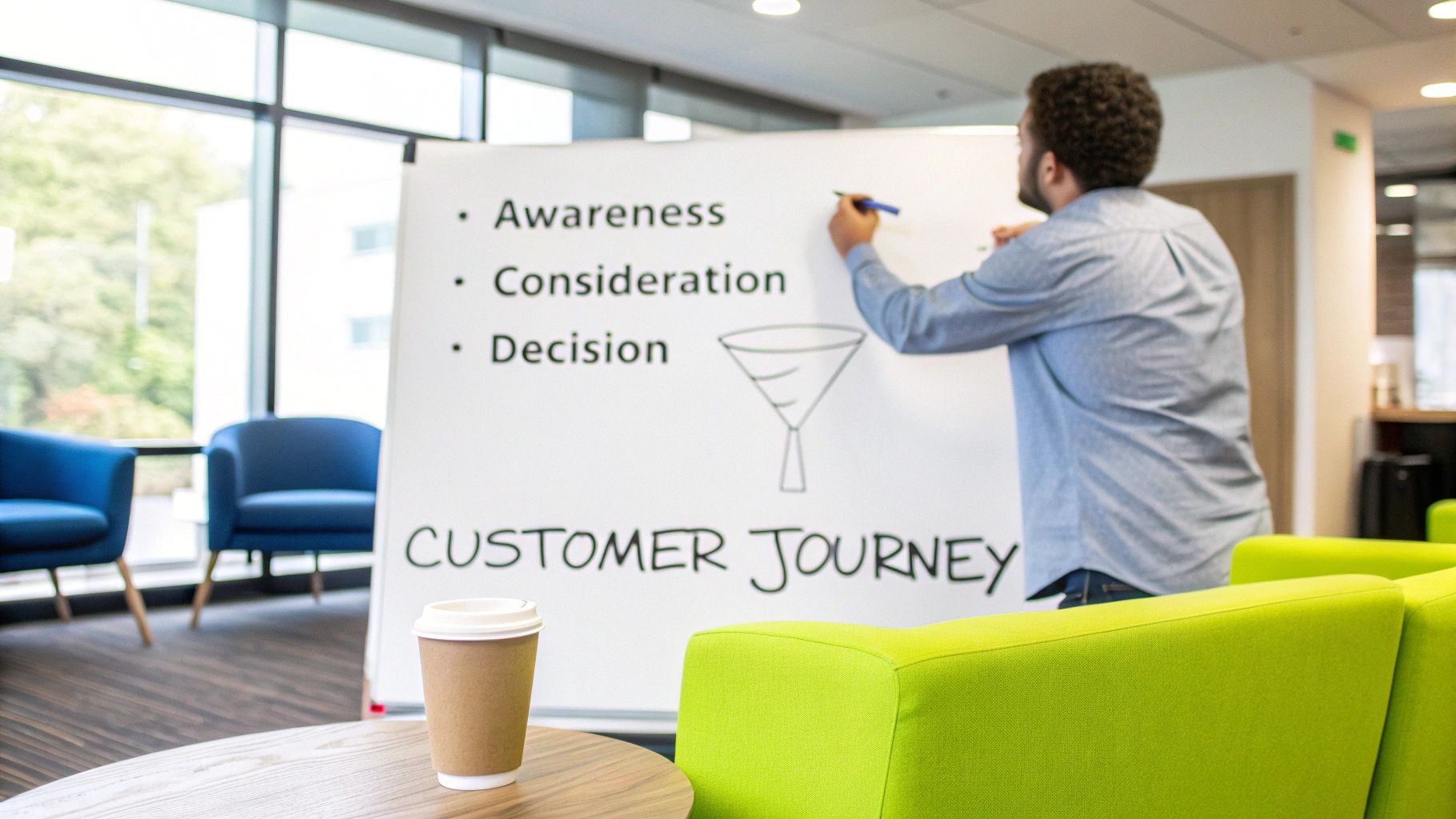
For growth-focused SMBs, this is one of the most powerful audience segmentation strategies because it aligns marketing actions directly with sales funnel progression. By tailoring messaging to a user's specific stage, you can orchestrate a cohesive journey that nurtures leads, drives conversions, and fosters long-term loyalty and expansion.
How It Works in Practice
This method requires mapping your customer journey and creating distinct segments for each key phase. The goal is to deliver the right message at the right time to guide users smoothly to the next stage.
- Awareness: A real estate agency runs broad Facebook ads targeting renters in their city with a downloadable guide: "5 Things to Know Before Buying Your First Home."
- Consideration: Once someone downloads the guide, they are moved to the "Consideration" segment and are retargeted with testimonial videos from happy first-time homebuyers the agency helped.
- Decision: An e-commerce brand sends a 15% off discount code via email and SMS to users who abandoned their shopping cart in the last 24 hours. This offer is not shown to users who are only browsing.
- Retention: A SaaS company sends an automated onboarding email sequence to new signups, highlighting key features to drive activation. After 30 days, they send a follow-up asking for feedback to reduce churn.
- Advocacy: A coaching business invites its most successful long-term clients into an exclusive affiliate program, offering them a 10% commission for referring new clients.
Actionable Tips for Implementation
To implement lifecycle stage segmentation effectively, you need to define clear triggers and build automated workflows that respond to customer behavior.
- Map Your Funnel Stages: Detail every touchpoint, from the first ad impression to a repeat purchase and referral. Define the specific actions (e.g., page visit, content download, purchase) that move a user from one stage to the next.
- Automate Stage Triggers: Use your marketing automation platform to move contacts between stages automatically. For example, a user who signs up for a webinar is tagged "Awareness," while one who visits the pricing page is moved to "Consideration."
- Create Stage-Specific Content: Develop unique messaging, creative assets, and offers for each segment. A user in the consideration phase needs testimonials and case studies, not a generic brand awareness ad.
9. Lookalike & Similarity Audience Segmentation
Lookalike and similarity audience segmentation is a powerful strategy that leverages machine learning to find new prospects who mirror your best existing customers. Instead of manually defining targeting parameters, you provide a “seed” audience, and platforms like Meta, Google, and TikTok automatically identify users with shared behaviors, interests, and demographic traits.
This approach automates top-of-funnel prospecting by moving beyond guesswork and using data to predict who is most likely to convert. For growth-focused SMBs, lookalike segmentation is a critical audience expansion tool that dramatically improves customer acquisition efficiency and scales advertising efforts with a higher probability of success.
How It Works in Practice
This strategy works by analyzing a source (or seed) audience and creating a new, larger audience of people who are statistically similar. The process is native to most major ad platforms.
- E-commerce: An online store can upload a list of its 1,000 highest lifetime value (LTV) customers into Meta Ads Manager to create a 1% Lookalike Audience, effectively prospecting for new, high-spending buyers at scale.
- Coaching & Consulting: A business coach can create a seed audience of everyone who completed their premium, high-ticket video course, then generate a lookalike audience from that list to find similar professionals ready to invest.
- SaaS: A software company can create a lookalike audience based on users who converted from a free trial to a paid subscription within 14 days, targeting new companies with a high propensity to convert quickly.
- Real Estate: An agent can build a lookalike audience from a list of leads who submitted a "Schedule a Viewing" form on their website to find other high-intent home seekers in their target market.
- Local Services: A multi-location gym can create a lookalike audience of its members who have a check-in frequency of 3+ times per week, and then layer that with geographic targeting to find new, highly motivated local fitness enthusiasts.
Actionable Tips for Implementation
To maximize the ROI of this audience segmentation strategy, the quality of your seed audience is paramount. A precise seed list leads to a high-performing lookalike.
- Seed with Your Best Customers: Don't use your entire customer list. Create a seed audience from your highest LTV, highest average order value (AOV), or most frequently purchasing customers. Quality trumps quantity.
- Test Different Seed Sources: Experiment with lookalikes built from different segments: recent converters, users with high-margin purchases, or long-term retained customers. Each will attract a slightly different profile.
- Adjust Your Audience Percentage: Start with a 1-3% lookalike for high-ticket or niche offers, as this group is most similar to your seed. For broader, mass-market products, you can test expanding to 5-10%.
- Keep Your Seed Data Fresh: Refresh your seed audiences monthly or quarterly with new customer data. This ensures your lookalike models adapt to market changes and evolving customer profiles.
10. Channel & Device Segmentation
Channel and device segmentation groups audiences based on where and how they interact with your brand. This strategy acknowledges that a user’s context, mindset, and expectations change dramatically depending on whether they are scrolling on a mobile app, researching on a desktop computer, or clicking a link from an email. It provides a powerful framework for optimizing the user experience by aligning the creative, offer, and landing page to the specific channel and device.
This method works by organizing your audience based on their digital touchpoints, such as social media versus search, or mobile versus desktop. For growth-focused businesses, understanding these preferences is critical for allocating budget effectively and reducing friction in the conversion path. It allows you to meet customers where they are with an experience tailored to their immediate environment, which is a key component of modern audience segmentation strategies.
How It Works in Practice
Channel and device segmentation relies on tracking data from analytics platforms and ad managers to create context-aware campaigns. The most common variables include:
- Channel Source: A B2B software company might run lead-generation ads on LinkedIn (channel) targeting desktop users, leading them to a long-form landing page with a detailed demo video, while using TikTok to run short, top-of-funnel brand awareness videos.
- Device Type: An e-commerce brand can promote impulse-buy items under $50 via mobile-optimized Instagram Story ads (designed for quick taps), but use desktop retargeting ads for higher-priced items over $500 that require more consideration and research.
- Operating System (OS): An app-first brand could run mobile-only campaigns with deep links into their app, creating separate creative assets for iOS and Android users to match the native UI elements and App Store/Play Store branding.
- Browser vs. App: A news publisher might target users reading articles on its mobile website with a pop-up campaign offering "the first month free" to download its native app for a better, ad-free experience.
- Email Client: An email marketer can use responsive email templates that automatically render a large, thumb-friendly call-to-action button for users opening on a mobile Gmail app versus a smaller, cursor-friendly button for those on a desktop Outlook client.
Actionable Tips for Implementation
To maximize the impact of this segmentation, go beyond default settings and actively tailor the entire user journey to the specific context.
- Design Mobile-First, Test Desktop Variants: Always start creative and landing page design with the mobile experience in mind. However, for high-consideration products or B2B services, create and test dedicated desktop versions with more detailed information.
- Allocate Budget by Channel-Device Performance: Instead of just looking at channel-level ROI (e.g., "Google Ads"), analyze performance by channel and device combination (e.g., "Google Search on Mobile" vs. "Google Display on Desktop") to find your most profitable segments.
- Improve Cross-Device Attribution: Use analytics tools and server-side tracking to stitch together user journeys across multiple devices. This helps you understand how a mobile discovery leads to a desktop purchase, giving you a more accurate view of your marketing impact.
Audience Segmentation: 10-Point Comparison
| Strategy | 🔄 Implementation Complexity | 💡 Resource Requirements | 📊⭐ Expected Outcomes | ⚡ Ideal Use Cases | ⭐ Key Advantages |
|---|---|---|---|---|---|
| Demographic Segmentation | Low — simple audience buckets and platform targeting 🔄 | Low — platform demographics, basic analytics 💡 | Baseline targeting; predictable reach and scalable ROAS when layered 📊 ⭐⭐ | Broad campaigns, budget allocation, omnichannel foundations ⚡ | Easy, cost‑effective, widely supported; good seed for lookalikes ⭐ |
| Behavioral Segmentation | High — real-time tracking, pixel/server-side setup and maintenance 🔄 | High — tracking infra, data engineering, analytics, privacy controls 💡 | Strong conversion lift, micro-personalization, predictive gains 📊 ⭐⭐⭐⭐ | Retargeting, dynamic funnels, ROAS-driven e‑commerce & SMBs ⚡ | Best signal of intent; reduces wasted spend; enables dynamic optimization ⭐ |
| Psychographic Segmentation | Medium–High — qualitative research and modeling required 🔄 | Medium — surveys, social listening, persona work, creative testing 💡 | Deeper brand resonance and higher LTV for premium offers 📊 ⭐⭐⭐ | Premium brands, coaches, personal brands, rebranding efforts ⚡ | Drives emotional fit and pricing power; builds loyalty and differentiation ⭐ |
| Geolocation & Hyper-Local Segmentation | High — geofencing, location APIs and maintenance 🔄 | High — location vendors, mobile integrations, foot‑traffic attribution 💡 | Immediate foot-traffic lifts and localized ROAS improvements 📊 ⭐⭐⭐ | Local services, franchises, retail, real estate focused on visits/conversions ⚡ | Converts nearby intent; reduces wasted geo‑spend; enables competitive conquest ⭐ |
| Firmographic Segmentation (B2B) | Medium — data integration and ABM setup 🔄 | Medium–High — B2B data providers, CRM integration, sales alignment 💡 | Higher deal sizes and clearer account-level ROI for B2B sales 📊 ⭐⭐⭐ | B2B SaaS, enterprise sales, account‑based marketing campaigns ⚡ | Targets decision‑makers; improves enterprise conversion efficiency and LTV ⭐ |
| Purchase Intent Segmentation | High — intent scoring, real‑time updates and validation 🔄 | High — search/behavioral data, CRM, predictive modeling tools 💡 | Highest conversion probability; prioritized budget allocation and ROI 📊 ⭐⭐⭐⭐ | Bottom‑funnel prospecting, time‑sensitive offers, bid optimization ⚡ | Directly correlates with buy‑likelihood; maximizes short‑term ROAS ⭐ |
| RFM Segmentation (Recency, Frequency, Monetary) | Medium — scoring logic and periodic recalculation 🔄 | Medium — CRM/transactional data, analytics, scoring engines 💡 | Identifies VIPs and churn risk; improves retention and CLTV 📊 ⭐⭐⭐ | E‑commerce retention, VIP programs, re‑engagement campaigns ⚡ | Value‑based segmentation; strong for lifecycle and LTV optimization ⭐ |
| Lifecycle Stage Segmentation | High — cross‑channel orchestration and attribution 🔄 | High — CRM, automation, content per stage, analytics 💡 | Better funnel progression, reduced CAC, stronger retention 📊 ⭐⭐⭐⭐ | Funnel-driven businesses, SaaS, services with multi‑step journeys ⚡ | Matches message to buyer psychology; improves conversion velocity ⭐ |
| Lookalike & Similarity Audience Segmentation | Low–Medium — platform-native but seed audience prep required 🔄 | Low–Medium — quality seed lists, CRM exports, testing tools 💡 | Scalable prospecting with lower CPA; fast statistical learning 📊 ⭐⭐⭐⭐ | Prospecting for e‑commerce, SMB growth, audience expansion ⚡ | High-performing prospecting at scale; minimal ongoing tuning if seeds are good ⭐ |
| Channel & Device Segmentation | Medium — device detection and channel strategy setup 🔄 | Medium — analytics, creative variants, cross‑device attribution tools 💡 | Improved UX and conversion by aligning creative and funnels per context 📊 ⭐⭐⭐ | Mobile-first apps, high‑consideration purchases, cross‑device journeys ⚡ | Optimizes experience and bids per context; reduces wasted impressions ⭐ |
Unlocking Your Growth Potential Through Smart Segmentation
The era of one-size-fits-all marketing is definitively over. As we've journeyed through the diverse landscape of demographic, behavioral, psychographic, and technological segmentation, one truth has become crystal clear: relevance is the new currency of business growth. The most successful audience segmentation strategies are not about choosing one method but about artfully layering multiple approaches to create a composite, high-definition picture of your ideal customer.
Moving beyond surface-level demographics is no longer a competitive advantage; it's a foundational requirement for survival and scale. By embracing a multi-faceted approach, you transform your marketing from a speculative broadcast into a series of precise, value-driven conversations. This strategic shift is what separates brands that struggle with high customer acquisition costs from those that build efficient, predictable, and profitable growth engines. The core principle is simple: when you speak directly to someone's needs, motivations, and context, they are far more likely to listen, engage, and convert.
From Theory to Tangible ROI
The true power of these strategies emerges when you put them into practice. Think of the local Med Spa that stops wasting budget on a broad "women aged 30-55" demographic. Instead, they layer geofencing to target users within a 5-mile radius, behavioral data to identify individuals who have previously searched for skincare treatments, and psychographic insights to craft ad copy that speaks to a desire for self-care and confidence. This is how you turn a generic ad into a compelling local invitation.
Similarly, consider the e-commerce store that moves past simply segmenting by past purchases. They implement RFM (Recency, Frequency, Monetary) analysis to identify their VIP customers, creating an exclusive segment that receives early access to new products and personalized thank-you offers. Simultaneously, they use lifecycle stage segmentation to re-engage "at-risk" customers with a targeted "we miss you" discount, preventing churn before it happens. These are not just clever tactics; they are fundamental components of a robust customer retention and lifetime value optimization plan.
Your Actionable Path Forward
Mastering these audience segmentation strategies requires a commitment to three key pillars: data, testing, and continuous optimization. Your journey to segmentation excellence begins now with these concrete next steps:
- Conduct a Data Audit: Start by assessing the data you already have. Review your CRM, email platform analytics, Google Analytics, and social media insights. What do you know about your best customers? Where are the gaps? This initial audit will reveal your most immediate opportunities.
- Define Your Primary Segments: Based on your audit and the strategies we've discussed, choose 2-3 high-impact segments to build first. For a B2B SaaS company, this might be firmographic (small businesses vs. enterprise) and behavioral (trial users vs. paid subscribers). For a life coach, it could be psychographic (ambitious career-changers) and lifecycle stage (new leads vs. past clients).
- Launch a Pilot Campaign: Don't try to overhaul everything at once. Select one channel, like email or Facebook Ads, and run a test campaign targeting one of your newly defined segments. Craft messaging tailored specifically to that group and measure its performance against your previous, broader campaigns. Analyze the click-through rates, conversion rates, and cost per acquisition to validate your approach.
By implementing this iterative process, you create a feedback loop that constantly refines your understanding of the customer. You will learn which messages resonate, which offers convert, and which channels deliver the highest ROI for each specific audience. This is the essence of data-driven marketing and the most reliable path to eliminating wasted ad spend, building brand loyalty, and achieving scalable, sustainable growth.
Ready to stop guessing and start targeting with the pinpoint precision that drives measurable results? The team at Silver Spoon Agency leverages a proprietary, AI-powered omnichannel framework to build, manage, and optimize sophisticated audience segmentation strategies that deliver superior ROAS. If you're ready to unlock your brand's full growth potential, schedule a discovery call with Silver Spoon Agency today and see how a data-first approach can transform your business.