


10 Augmented Reality Marketing Examples Redefining Customer Engagement in 2025

Augmented reality is no longer a futuristic gimmick. It's a powerful marketing tool actively reshaping how brands connect with customers. By overlaying digital information onto the real world, AR transforms passive viewing into active participation, bridging the gap between physical and digital storefronts.
This shift creates memorable, personalized experiences that drive measurable results. We're seeing everything from higher conversion rates and lower product returns to viral social media engagement. For businesses in e-commerce, local services, and even B2B, AR offers a direct path to a more engaged and confident buyer. It answers critical customer questions like "How will this look on me?" or "Will this fit in my space?" before a purchase is ever made. This capability turns a simple advertisement into a tangible, interactive, and highly effective growth engine.
In this article, we dissect 10 powerful augmented reality marketing examples from leading brands across various industries. We will move beyond surface-level descriptions to provide a deep strategic analysis of each campaign, breaking down the specific goals, the technology used, and the tangible results achieved. Most importantly, we'll distill each case study into actionable takeaways and replicable strategies. You will learn how businesses of any size, from local shops to global retailers, can adapt these methods to create their own immersive and profitable customer journeys.
1. Virtual Try-On for Fashion and Accessories
Virtual Try-On (VTO) is an augmented reality marketing strategy that bridges the gap between digital browsing and physical shopping. It allows customers to use their smartphone or desktop camera to overlay digital versions of products onto their own image in real-time. This interactive experience simulates an in-person fitting room, giving users a realistic preview of how clothing, glasses, makeup, or accessories will look on them.
By integrating VTO, fashion and beauty brands significantly enhance the online shopping journey. For example, eyewear giant Warby Parker’s app lets users realistically see how different frames fit their face shape. Similarly, Nike’s SNKRS app used AR to project a new shoe release onto a user's feet, creating an immersive and exclusive preview. More recently, Amazon introduced "Virtual Try-On for Shoes," allowing customers to visualize sneakers from brands like New Balance and Adidas directly on their feet. These campaigns do more than just showcase a product; they build purchase confidence and dramatically reduce the uncertainty that often leads to cart abandonment and high return rates.
Strategic Goal & Implementation
The primary goal of VTO is to increase conversion rates and decrease product returns by helping customers make more informed decisions. It transforms a passive browsing session into an engaging, personalized experience.
- Implementation: Brands typically use specialized AR platforms like Snap’s Camera Kit, Meta’s Spark AR, or dedicated solutions like Perfect Corp. These SDKs are integrated into a brand's mobile app or website. High-quality, true-to-scale 3D models of the products are created and then deployed through the AR software, which uses the device's camera to track the user's face or body and accurately place the digital item.
Key Insight: Virtual Try-On isn’t just a gimmick; it’s a powerful sales tool. According to Shopify, interactions with products having 3D/AR content showed a 94% higher conversion rate than for products without it.
Actionable Takeaways for Your Brand
- Start with a Single Product Category: If you sell multiple items, pilot your VTO efforts with a high-consideration category like sunglasses, lipstick, or shoes, where fit and appearance are critical.
- Prioritize High-Fidelity 3D Models: The realism of the try-on experience depends entirely on the quality of your 3D assets. Invest in accurate modeling to ensure colors, textures, and dimensions reflect the physical product perfectly.
- Integrate with Social Media: Leverage platforms like Snapchat and Instagram where users are already accustomed to AR filters. Create a branded "Try-On" lens or filter and promote it through social ads to reach a wider audience.
2. Interactive Product Packaging and Unboxing Experiences
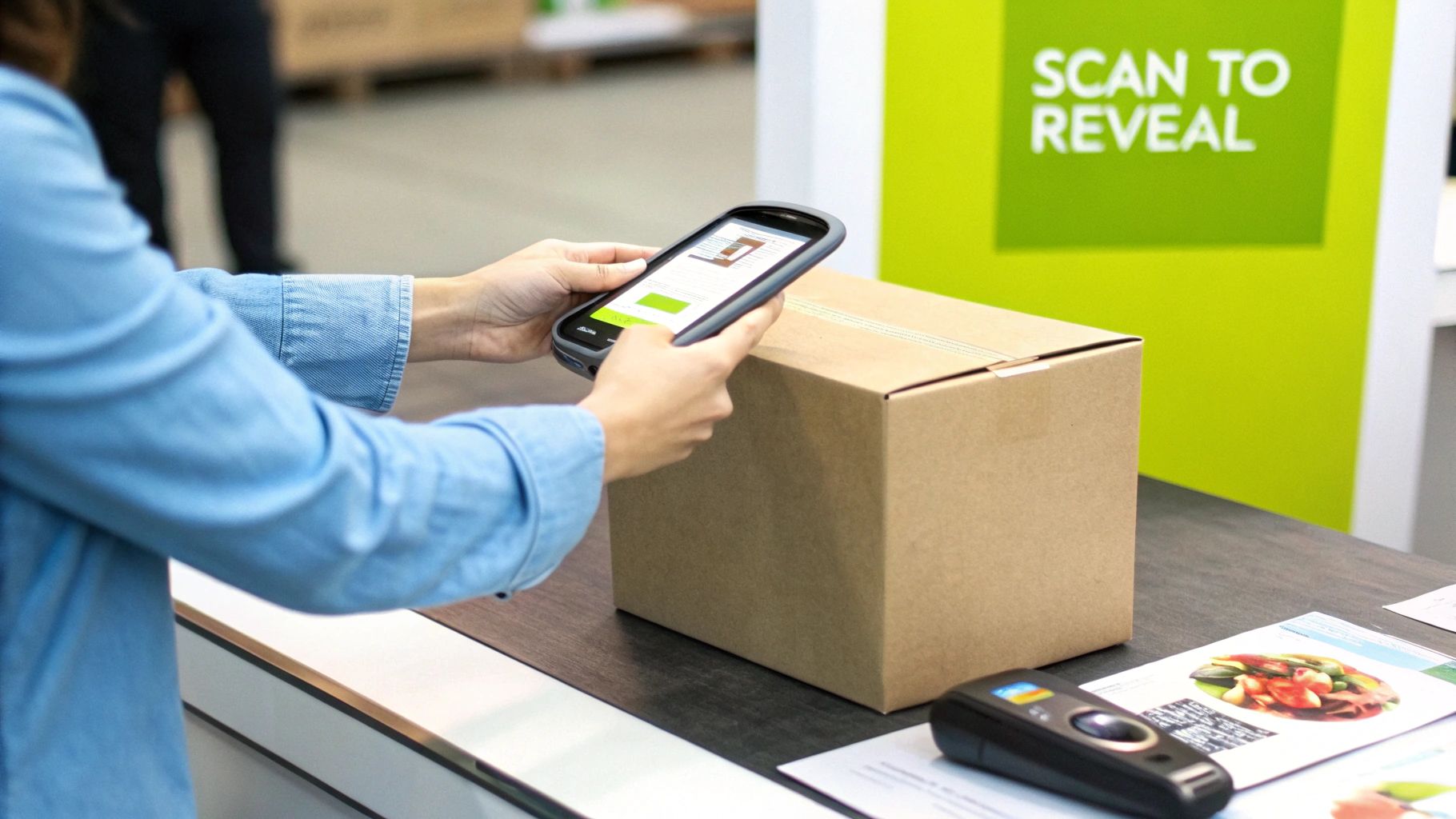
Interactive product packaging transforms a static container into a dynamic digital gateway. Using augmented reality, brands can embed hidden content within their labels, boxes, or bottles that customers activate with their smartphone cameras. This strategy turns the simple act of unboxing or holding a product into a memorable, interactive experience that deepens brand engagement and bridges the physical-digital divide.
This technique is a powerful tool for storytelling and adding value post-purchase. For instance, the Treasury Wine Estates brand 19 Crimes brings the historical figures on its wine labels to life, where they tell their stories when scanned with a phone. Similarly, LEGO uses AR to show customers fully-built models of the set inside a box, helping kids and parents visualize the final product right in the store aisle. These augmented reality marketing examples extend the brand conversation beyond the point of sale, creating a shareable "wow" moment that drives social buzz.
Strategic Goal & Implementation
The primary goal is to increase customer engagement, build brand loyalty, and create a shareable experience that generates organic marketing. It adds a layer of digital value to a physical product, encouraging repeat interaction and differentiating the brand from competitors on the shelf.
- Implementation: This is typically achieved using web-based AR (WebAR) platforms like 8th Wall or Zappar, which are accessible via a QR code scan without requiring an app download. Brands design a digital experience, such as a 3D animation, a mini-game, or an informational overlay. This experience is then linked to a "trigger image" (the product label or packaging design) and deployed through a URL accessed by the QR code.
Key Insight: Packaging AR turns your product into its own media channel. It creates a direct line of communication with the customer at the moment of peak interest, perfect for delivering tutorials, brand stories, or exclusive content.
Actionable Takeaways for Your Brand
- Link the AR Experience to Product Use: Don't just create an animation. Design content that adds value, such as a recipe that uses your food product, a makeup tutorial for your cosmetic, or a setup guide for your electronic device.
- Prioritize WebAR for Accessibility: Remove friction by using WebAR. Customers are far more likely to scan a QR code and launch an experience in their browser than they are to download a dedicated brand app for a single-use interaction.
- Make the Call-to-Action Unmistakable: Clearly print "Scan Me for a Surprise!" or a similar directive with a prominent QR code on your packaging. The user needs to be explicitly told that an interactive experience is available.
3. In-Store Navigation and Product Location AR
In-Store Navigation and Product Location AR enhances the physical retail experience by using a customer's smartphone to provide digital directions and information within a store. This technology acts as a virtual guide, overlaying navigational paths, product details, and promotional offers directly onto the live camera view of the aisles. It solves the common customer pain point of not being able to find specific items in large, complex store layouts.
Major retailers are leveraging this technology to merge digital convenience with brick-and-mortar shopping. For example, Walgreens rolled out an AR feature in its app to help shoppers find products and even see where items on their shopping list are located on shelves. Similarly, home improvement giant Lowe's introduced an in-store navigation app that guides customers turn-by-turn to the exact aisle and shelf for specific tools or materials. These applications transform a potentially frustrating search into an interactive and efficient journey, boosting customer satisfaction and encouraging in-store discovery.
Strategic Goal & Implementation
The primary goal of in-store AR is to reduce friction in the shopping journey, increase the time customers spend engaging with products, and drive sales of promoted items. It makes the physical store smarter, more responsive, and easier to navigate, directly improving the customer experience.
- Implementation: This is typically achieved by integrating an AR SDK into the retailer’s existing mobile app. Brands create a detailed digital map of the store layout, often using technologies like Bluetooth beacons or Visual Positioning Systems (VPS) for precise indoor location tracking. When a user opens the AR feature, the app uses the device's camera and sensors to orient itself within the store and overlay the navigational data onto the real-world environment.
Key Insight: In-store AR isn’t just about directions; it's a platform for contextual marketing. By guiding a customer, a brand can also serve up relevant promotions, product information, or complementary item suggestions in the exact physical location where the purchase decision is made. This is a powerful use of location-based targeting, similar to what you might see in geofencing marketing but on a micro-scale.
Actionable Takeaways for Your Brand
- Integrate with Your Loyalty App: Don’t build a separate app. Add AR navigation as a valuable feature within the app your customers already use for rewards and coupons, increasing adoption and engagement.
- Use Beacons for Accuracy: For large or multi-level stores, rely on Bluetooth Low Energy (BLE) beacons to ensure precise and reliable indoor positioning. GPS is ineffective indoors, and beacon technology provides the necessary accuracy for turn-by-turn directions.
- Gamify the Experience: Encourage app usage by creating AR-based scavenger hunts for discounts or special offers. This turns a simple shopping trip into a fun, interactive experience that builds brand affinity.
4. Virtual Furniture and Home Decor Placement
Virtual Furniture Placement is a transformative augmented reality marketing example that allows customers to visualize home goods directly in their own living spaces. Using a smartphone or tablet camera, users can place true-to-scale 3D models of sofas, tables, rugs, and artwork into their room, effectively creating a digital showroom. This technology removes the guesswork from online furniture shopping, letting customers check for size, style, and color fit before committing to a purchase.

Major retailers like IKEA with its "Place" app (now integrated into their main app) and Wayfair with its "View in Room 3D" feature have pioneered this approach. These applications overlay a digital product onto the user’s real-world environment, allowing them to walk around the item and see it from different angles. Even home improvement stores like The Home Depot use this tech for larger items like patio furniture and appliances. This interactive preview bridges a critical gap in e-commerce, addressing the common customer concern: "Will this actually look good in my home?" For real estate and home decor, a significant application of AR is seen in the rise of virtual home staging apps, which apply the same principles to entire rooms.
Strategic Goal & Implementation
The primary goal is to boost sales and reduce returns by giving shoppers unparalleled purchase confidence. By visualizing a product in context, customers are more likely to convert and less likely to be dissatisfied with their purchase upon delivery.
- Implementation: Brands leverage AR development kits native to mobile operating systems, such as Apple's ARKit and Google's ARCore. These frameworks are integrated into the brand's mobile e-commerce app. The process requires creating highly detailed, photorealistic 3D models of each product. These models are then deployed through the app, which uses the phone's sensors and camera to scan the floor and place the virtual object with accurate scale and lighting.
Key Insight: This AR application solves a high-stakes problem. Furniture is a significant investment, and the inability to visualize it is a major barrier to online sales. By removing this friction, brands can unlock a massive e-commerce opportunity.
Actionable Takeaways for Your Brand
- Focus on High-Consideration Items First: Begin your AR journey with big-ticket items like sofas, beds, or dining tables. Customers spend more time deliberating these purchases, making them the perfect candidates for an AR confidence boost.
- Invest in Photorealistic 3D Assets: The success of the experience hinges on the quality of your 3D models. Work with 3D artists to ensure every texture, color, and shadow appears lifelike, as poor-quality models can break immersion and erode trust.
- Simplify the User Experience: Ensure your "View in Room" feature is easy to find and use. A simple, one-click button on the product page is far more effective than burying the feature in a complex menu. Guide users with on-screen prompts on how to scan their space and place the item.
5. Virtual Makeup and Beauty Product Testing
Virtual Makeup and Beauty Product Testing is a highly effective augmented reality marketing strategy that lets customers "try on" cosmetics using their device's camera. This technology overlays digital makeup products, such as lipstick, eyeshadow, and foundation, onto a user's face in real-time. It accurately simulates how different shades and products will look on their unique skin tone, effectively creating a personal, digital beauty counter.
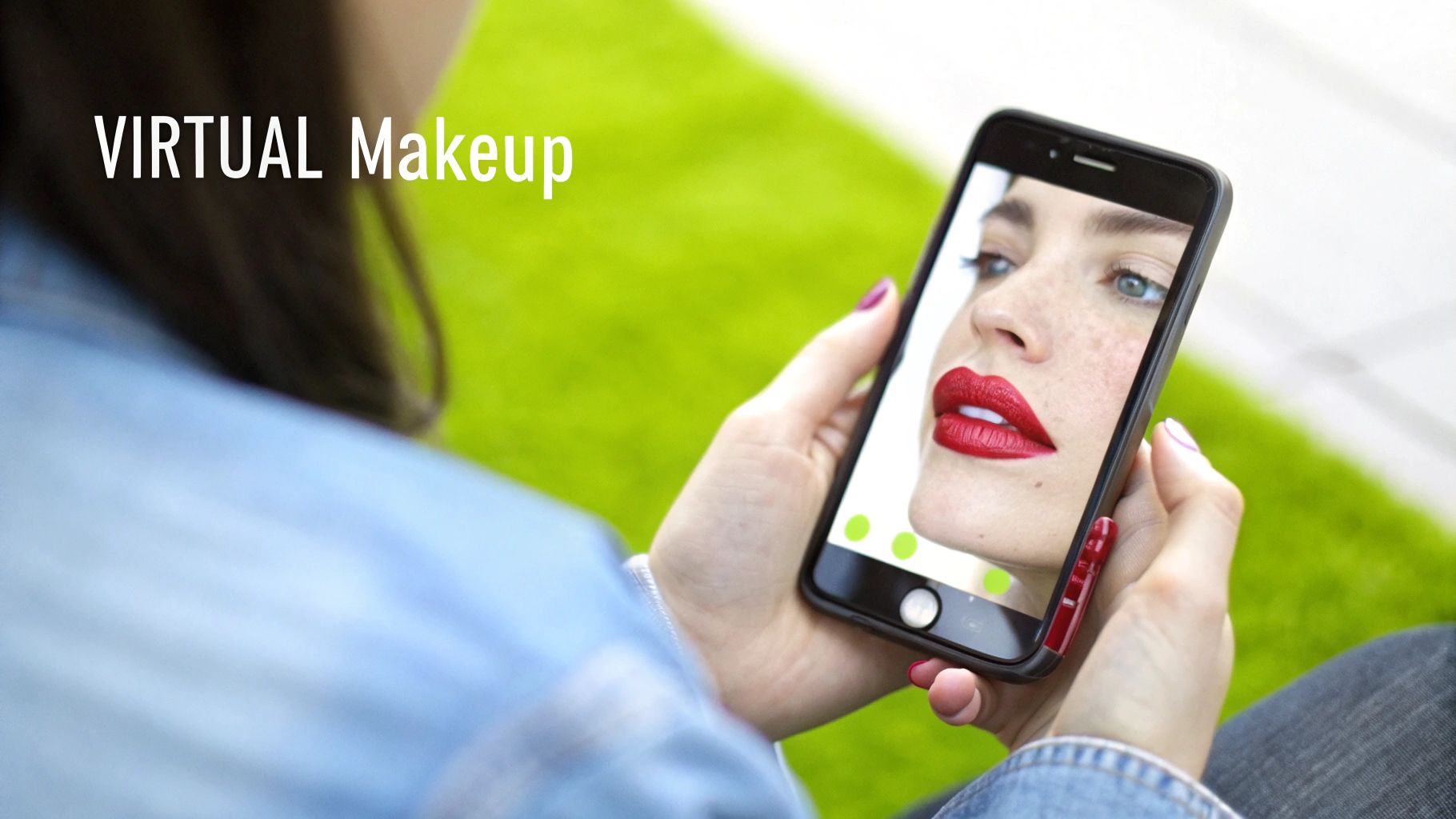
Beauty industry leaders like L'Oréal, with its ModiFace technology, and retailers like Sephora, with its Virtual Artist, have pioneered this approach. These tools allow users to experiment with dozens of products in seconds without the hygiene concerns or physical limitations of in-store testers. You can now use YouTube's AR Try-On feature to test M·A·C lipstick shades while watching a beauty tutorial, blending content and commerce seamlessly. This immersive experience not only makes shopping fun but also provides the confidence needed to purchase a new shade online, sight unseen.
Strategic Goal & Implementation
The core goal is to boost online sales and reduce returns by eliminating the biggest friction point in digital beauty shopping: color and shade uncertainty. It also increases user engagement and time spent with the brand's products.
- Implementation: Brands typically license AR beauty technology from specialists like ModiFace (L'Oréal) or Perfect Corp. and integrate it into their websites or dedicated mobile apps. The process requires developing highly realistic, color-accurate digital swatches and 3D product models. The software then uses advanced facial recognition and tracking to map the user's features and apply the virtual makeup seamlessly.
Key Insight: Virtual try-on solves a critical business problem. Ulta Beauty reported that customers who used their GLAMlab virtual try-on tool were twice as likely to make a purchase compared to those who did not.
Actionable Takeaways for Your Brand
- Focus on Color-Critical Products: Begin by implementing AR for products where shade matching is paramount, such as foundation, concealer, and lipstick. These high-consideration items benefit most from a virtual trial.
- Ensure Inclusivity and Accuracy: Your AR technology must accurately detect and adapt to a diverse range of skin tones, face shapes, and lighting conditions. Invest in a platform known for its inclusive AI to ensure a positive experience for all customers.
- Create a "Save and Share" Feature: Allow users to save their favorite virtual looks, create wishlists, and easily share photos on social media. This turns your customers into brand advocates and generates valuable user-generated content.
6. Automotive Visualization and Car Configuration
Augmented reality marketing transforms the high-stakes process of car buying by allowing customers to place a full-scale, virtual vehicle in their own real-world environment. Using just a smartphone, potential buyers can park a photorealistic 3D model of a car in their driveway, garage, or any open space. This AR experience moves beyond static images, enabling users to walk around the vehicle, inspect details, and even configure options like paint color, wheel styles, and interior finishes in real time.
Premium brands like Porsche and BMW have pioneered this technology to great effect. The Porsche AR Visualizer app lets users not only place a car in their space but also explore its interior and activate an "X-Ray" mode to see the engine and drivetrain. Similarly, Jeep’s "Build & Price a Jeep" AR tool allows customers to configure a Wrangler and place it in their driveway, then seamlessly transition to find a local dealer with that model in stock. These augmented reality marketing examples bridge the emotional and practical gaps in the customer journey, making the abstract concept of a new car feel tangible and personal before ever stepping into a showroom.
Strategic Goal & Implementation
The primary goal is to shorten the sales cycle and increase lead quality by providing an immersive, high-impact visualization tool. This pre-dealership experience builds excitement and allows customers to arrive with a clear idea of their desired configuration, leading to more productive sales conversations.
- Implementation: Automotive AR apps are typically built using native mobile development frameworks (iOS with ARKit, Android with ARCore) to ensure optimal performance. The process requires creating exceptionally detailed, true-to-scale 3D models of each vehicle and its customizable parts. These assets are then integrated into a branded mobile app that uses the phone’s camera and sensors to track surfaces and place the virtual car accurately in the user's environment.
Key Insight: For high-consideration purchases like a car, AR visualization is a powerful tool for overcoming buyer hesitation. It provides a level of personalization and certainty that static web configurators cannot match, turning passive interest into active consideration.
Actionable Takeaways for Your Brand
- Focus on Ultimate Realism: In the automotive sector, accuracy is non-negotiable. Invest heavily in creating 3D models that are indistinguishable from the physical vehicle, paying close attention to paint reflections, material textures, and precise scale.
- Integrate a Clear Call-to-Action: The AR experience should seamlessly guide the user to the next step. Include buttons to "Save Configuration," "Find a Dealer," or "Get a Quote" directly within the AR interface to convert engagement into a measurable lead.
- Showcase Functional Features: Go beyond simple visualization. Allow users to tap on the car to open doors, turn on the headlights, or even hear the engine sound. These interactive elements make the experience more memorable and informative.
7. Social Media AR Filters and Branded Lenses
Social Media AR Filters and Branded Lenses are custom-designed augmented reality effects that brands create for platforms like Instagram, Snapchat, and TikTok. Users can apply these interactive overlays to their photos and videos, turning them into brand ambassadors. This strategy leverages user-generated content to achieve massive organic reach and build a fun, engaging connection with the audience.
From Taco Bell's iconic giant taco head filter on Snapchat which was viewed over 224 million times, to Netflix creating AR portals that transported users into the world of Stranger Things, these experiences transform passive social media scrolling into active brand participation. They are powerful tools for brand recall, as users directly associate a fun or useful effect with the company that created it. This type of augmented reality marketing turns every user's social network into a potential advertising channel.
Strategic Goal & Implementation
The primary goal is to drive brand awareness and engagement at scale by creating shareable, entertaining experiences. These filters encourage user-generated content, which is often perceived as more authentic and trustworthy than traditional advertising. It's a low-cost, high-reach strategy for getting a brand into everyday social conversations.
- Implementation: Brands use platforms like Meta's Spark AR (for Instagram and Facebook), Snap's Lens Studio, and TikTok's Effect House to build and publish their AR effects. The process involves designing 2D or 3D assets, adding interactive logic, and submitting the filter for platform approval. Successful filters often tie into cultural moments, holidays, or viral trends to maximize adoption and shareability.
Key Insight: Virality is driven by entertainment, not by sales pitches. An effective branded AR lens makes the user the focus of a fun experience, with the brand playing a supporting role. The most successful filters are those people would use even if they weren't branded.
Actionable Takeaways for Your Brand
- Focus on Fun and Utility: Design a filter that is genuinely entertaining or useful. This could be a quirky face effect, a branded mini-game, a beautiful color-grading filter, or a virtual try-on for a specific product.
- Launch with an Influencer Campaign: Partner with influencers in your niche to kickstart the usage of your filter. Their initial promotion can create the momentum needed for the filter to start trending organically.
- Incorporate a Call-to-Action (CTA): While the filter itself shouldn't be a hard sell, you can subtly guide users. Add a tap-to-change feature that reveals a product, or include a link back to your website in your filter’s promotional story or post.
8. Educational and Training AR Experiences
Educational and Training AR Experiences use augmented reality to transform how knowledge is transferred, making complex information tangible, interactive, and easier to comprehend. Instead of reading static manuals or watching passive videos, users can engage with 3D models and step-by-step visual overlays in their real-world environment. This method is exceptionally powerful for product education, corporate training, and customer onboarding.
Leading industrial and medical companies have pioneered this approach. For example, Hyundai provides a Virtual Guide app that lets car owners point their phone at the engine bay to get AR overlays explaining what each part is and how to check fluid levels. Similarly, medical students use apps like Complete Anatomy to project a full-sized human body into a room, allowing them to explore muscles, organs, and bones in 3D space. These augmented reality marketing examples demonstrate a shift from simply selling a product to providing an entire ecosystem of support and education.
Strategic Goal & Implementation
The primary strategic goal is to improve learning retention, reduce errors, and accelerate proficiency. AR achieves this by catering to visual and kinesthetic learners, turning abstract concepts into hands-on practice. This enhances customer satisfaction, ensures product compliance, and empowers employees to perform complex tasks with greater accuracy and confidence.
- Implementation: These experiences are often delivered through custom mobile or tablet apps, or specialized AR headsets like the Microsoft HoloLens. Development relies on AR platforms such as Vuforia, Wikitude, or ARKit. The core components are high-fidelity 3D models of products or machinery and marker-based or markerless tracking to overlay digital information accurately onto physical objects.
Key Insight: AR-based training can be profoundly effective. A Boeing study found that AR-guided trainees were 30% faster and 90% more accurate on their first attempt compared to those using traditional 2D diagrams and instructions.
Actionable Takeaways for Your Brand
- Identify Complex Onboarding Steps: Pinpoint the most challenging part of your product setup or usage for customers. Develop a simple AR guide for that single step to prove the concept and measure the reduction in support calls.
- Gamify the Learning Process: Incorporate interactive elements like quizzes, checklists, and progress tracking within the AR experience. This keeps users engaged and provides measurable data on their comprehension and completion rates.
- Create "Bite-Sized" Training Modules: Don't try to explain everything at once. Break down complex processes into short, focused AR modules (e.g., "Changing the Filter," "Assembling Part A"). This makes learning more manageable and accessible.
9. Experiential Event Marketing and Pop-Up Activations
Experiential event marketing uses augmented reality to transform physical spaces like trade shows, pop-ups, and live events into immersive, interactive brand worlds. Instead of passively receiving information, attendees use their smartphones to engage with dynamic digital content overlaid onto the real environment. This captivates audiences, encourages social sharing, and creates a powerful, memorable connection with the brand.
Major brands have successfully used this strategy to generate significant buzz. For instance, AT&T created an AR experience at its flagship store in Chicago where visitors could point their phones at a model of the city to see how 5G technology would impact different areas. At Comic-Con, AMC brought The Walking Dead to life with an AR app that let fans pose for photos with virtual zombies. These augmented reality marketing examples turn a simple event presence into a headline-worthy experience, driving foot traffic and organic social media amplification. For a deeper look at similar campaigns, you can find more innovative augmented reality campaigns in NYC and see how brands are transforming urban spaces.
Strategic Goal & Implementation
The primary goal is to cut through the noise of a crowded event by creating a unique, "can't-miss" experience that deepens brand engagement and generates user-generated content. It turns attendees into active participants and brand ambassadors.
- Implementation: These experiences are often built using platforms like Unity or Unreal Engine for complex interactions, or more accessible tools like 8th Wall for web-based AR that requires no app download. Brands design a physical installation or space and then create digital AR triggers, such as QR codes, image targets (like a logo or product), or even location-based markers. When attendees scan these triggers with their devices, it launches the AR content, creating a seamless blend of physical and digital worlds. To further illustrate the potential of immersive technologies in live settings, you can explore how virtual reality for events is being utilized.
Key Insight: Event-based AR is a powerful tool for data capture. By offering a digital reward, coupon, or content download at the end of the experience, brands can seamlessly collect valuable attendee information like emails or social media handles for post-event follow-up.
Actionable Takeaways for Your Brand
- Design for Quick, Shareable Moments: In a high-traffic event setting, interactions must be fast and intuitive. Focus on creating a visually striking "wow" moment that takes less than 60 seconds and is perfectly framed for a photo or video to be shared on social media.
- Integrate a Hashtag Campaign: Create a unique, memorable event hashtag and prominently display it within the physical installation and the AR experience itself. Encourage users to share their AR photos and videos with the hashtag for a chance to be featured or win a prize.
- Train On-Site Staff: Have brand ambassadors on hand who are well-versed in the technology. They can assist attendees, troubleshoot any technical issues, and guide them through the experience to ensure everyone can participate successfully.
10. Restaurant Menus and Food Visualization AR
Restaurant Menus and Food Visualization AR transforms a standard paper or digital menu into an interactive, visual feast. This augmented reality marketing strategy allows diners to use their smartphones to see realistic, life-sized 3D models of dishes right on their table before ordering. This removes the guesswork from menu descriptions, showing customers exactly what to expect in terms of portion size, ingredients, and presentation.
Leading food and beverage brands have used this technology to enhance the dining experience and drive sales. For instance, Bareburger allows customers to scan a QR code at their table to see a photorealistic AR version of any burger on the menu, helping them decide on their order. Similarly, some high-end cocktail bars use AR to show elaborate drink presentations, complete with smoke effects and garnishes, before the bartender even starts mixing. By offering a "try before you buy" for food, restaurants increase customer satisfaction, encourage upsells to more visually appealing dishes, and create a memorable, shareable dining moment.
Strategic Goal & Implementation
The primary goal is to boost order value and enhance customer confidence by providing a clear, engaging preview of menu items. It helps overcome "order anxiety" and encourages patrons to try new or premium dishes they might otherwise overlook.
- Implementation: This is typically achieved through web-based AR (WebAR), which doesn't require an app download. Restaurants use QR codes on menus that link to the AR experience. Platforms like 8th Wall, Zappar, or custom-built solutions using ARKit and ARCore are common. High-resolution photos are taken from multiple angles (photogrammetry) or 3D artists meticulously model the dishes to create photorealistic digital assets.
Key Insight: Visual appeal directly impacts sales. A study found that adding AR visualizations to a menu can increase sales by up to 50% for the featured items, as customers are more compelled to order what they can see.
Actionable Takeaways for Your Brand
- Start with Your Signature Dishes: You don't need to digitize your entire menu at once. Begin by creating 3D models for your most popular, visually impressive, or high-margin items to maximize initial ROI.
- Optimize for Realism and Speed: The success of food AR depends on how appetizing the model looks. Invest in professional photogrammetry or 3D modeling. Crucially, ensure the models are optimized for fast loading times over a typical restaurant Wi-Fi or cellular connection.
- Incorporate Upsell Triggers: Use the AR experience to suggest drink pairings or side dishes. When a user views a 3D steak, a small pop-up could suggest a recommended wine, adding an interactive upselling component directly into the visualization.
10 AR Marketing Use Cases Compared
| Solution | Complexity 🔄 | Resources ⚡ | Expected Outcomes ⭐📊 | Ideal Use Cases 💡 | Key Advantages ⭐ |
|---|---|---|---|---|---|
| Virtual Try-On for Fashion and Accessories | High 🔄 — advanced body mapping & real-time rendering | Medium–High ⚡ — 3D models, device testing, calibration | 📊 Reduces returns ~30–40%; ↑ conversion and purchase confidence | Online apparel, eyewear, footwear, omnichannel retail | Eliminates sizing guesswork; lowers logistics costs |
| Interactive Product Packaging & Unboxing | Medium 🔄 — trigger detection + animated content | Medium ⚡ — packaging design, AR content creation | 📊 Increases engagement & social shares; improves recall | FMCG, beauty, limited editions, promotions | Creates memorable unboxing; captures customer data |
| In-Store Navigation & Product Location AR | High 🔄 — store mapping, beacons, real‑time positioning | High ⚡ — infrastructure, map maintenance, beacons | 📊 Reduces search time; ↑ dwell time and impulse purchases | Supermarkets, big-box retailers, large stores | Improves satisfaction; provides foot-traffic insights |
| Virtual Furniture & Home Decor Placement | Medium–High 🔄 — room scanning and scaling accuracy | High ⚡ — precise 3D models, lighting simulation | 📊 Lowers returns; ↑ average order value and design confidence | Furniture, home décor ecommerce and showrooms | Realistic scale/placement; better purchase decisions |
| Virtual Makeup & Beauty Product Testing | High 🔄 — facial mapping, shade matching, layering | Medium–High ⚡ — inclusive models, privacy & performance | 📊 ↑ engagement (~70%); reduces returns ~25–30% | Cosmetics brands, beauty retail, online try‑ons | Accurate color preview; personalized recommendations |
| Automotive Visualization & Car Configuration | High 🔄 — large detailed models and environment placement | High ⚡ — detailed 3D vehicles, testing across settings | 📊 Shortens sales cycle ~20–30%; ↑ showroom leads | Automakers, dealers, high‑consideration vehicle buyers | Remote visualization of configs; richer pre‑sales info |
| Social Media AR Filters & Branded Lenses | Low–Medium 🔄 — creative builds; platform SDKs | Low–Medium ⚡ — creative assets, influencer support | 📊 Potential for viral reach; high impressions/engagement | Brand awareness, youth targeting, campaigns | Mass organic reach; cost‑effective UGC generation |
| Educational & Training AR Experiences | High 🔄 — interactive lessons, assessments, simulations | High ⚡ — subject matter experts, content updates | 📊 Improves retention ~70%; reduces training time 30–40% | Healthcare, industrial maintenance, corporate training | Scalable, consistent hands‑on learning; measurable outcomes |
| Experiential Event Marketing & Pop‑Ups | Medium–High 🔄 — onsite installations & live interactions | High ⚡ — setup, staff, durable hardware | 📊 Generates 3–5x more social mentions vs. traditional activations | Events, product launches, brand activations | Memorable experiences; strong social amplification |
| Restaurant Menus & Food Visualization AR | Medium 🔄 — realistic 3D food models and overlays | Medium ⚡ — food photography, 3D modeling, updates | 📊 ↑ order accuracy 15–20%; higher order confidence/AOV | Restaurants, delivery apps, fine dining visualization | Shows portion & presentation; reduces order dissatisfaction |
Integrating AR Into Your Marketing: The Next Steps for Growth
The diverse collection of augmented reality marketing examples we've explored, from IKEA’s practical furniture placement to Gucci's virtual sneaker try-on, reveals a powerful, unifying theme: immersion is the new conversion. AR is no longer a futuristic gimmick but a proven tool that bridges the gap between the digital and physical worlds, directly influencing purchasing decisions and enhancing brand loyalty. By moving beyond passive advertisements and creating interactive, valuable experiences, these brands have effectively eliminated critical points of friction in the customer journey.
The core lesson from these successful campaigns is that AR’s true power lies in its ability to solve tangible customer problems. For e-commerce brands, it demolishes the uncertainty of online shopping by letting customers "try before they buy," drastically reducing return rates. For local service businesses, it can visualize the end result of a project, building trust and accelerating the sales cycle. For B2B companies, it transforms complex products into interactive 3D models, making technical demonstrations more engaging and understandable.
Strategic Takeaways to Guide Your First Campaign
To translate these insights into action, it's crucial to focus on the strategic function of your AR experience rather than just the technology itself. The most impactful augmented reality marketing examples did not start with the question, "How can we use AR?" Instead, they asked, "What is the biggest obstacle preventing our customers from making a confident purchase?"
Consider these three primary strategic pillars derived from the examples:
- Utility and Visualization: Focus on practical applications that provide immediate value. Think of the real estate agent using AR to stage an empty home or the automotive brand allowing customers to configure a car in their driveway. These experiences answer customer questions visually and build purchase confidence.
- Engagement and Virality: Leverage the interactive and shareable nature of AR. Branded social media filters and gamified packaging experiences don't just entertain; they turn your customers into active brand advocates, creating organic reach that traditional advertising cannot match.
- Education and Simplification: Use AR to demystify complex products or processes. A B2B company can use AR to showcase intricate machinery in a client's own facility, or a healthcare provider can create an interactive educational tool. This builds authority and makes your solution feel more accessible.
Your Actionable Roadmap to AR Implementation
Getting started with augmented reality marketing doesn't require a blockbuster budget. The key is to begin with a focused, measurable project that aligns with a specific business goal. Identify the single biggest point of friction in your sales funnel. Is it product visualization? Customer engagement? Post-purchase support?
Once identified, you can map out a phased approach:
- Phase 1 (Low-Lift Experiment): Start with accessible platforms like social media AR filters (Snapchat Lens Studio, Meta Spark AR). This is a low-cost way to test creative concepts, engage your audience, and gather valuable data on user interaction.
- Phase 2 (Web-Based Integration): Implement a web-based AR experience for a flagship product. This eliminates the need for an app download, making it seamless for users to visualize a product directly from your e-commerce site.
- Phase 3 (App-Based or In-Store Experience): For deeper engagement or utility, develop a dedicated app feature or an in-store AR activation. This is ideal for retailers wanting to enhance the physical shopping experience or for brands with complex products requiring more robust visualization.
By adopting this strategic, problem-solving mindset, you can ensure your investment in AR is not just an innovative marketing tactic but a powerful engine for measurable business growth. The future of customer engagement is experiential, and with the right approach, augmented reality can be your brand’s most compelling tool for building connections and driving revenue.
Ready to move from inspiration to implementation? The team at Silver Spoon Agency specializes in developing performance-driven augmented reality marketing campaigns that connect with your audience and deliver tangible results. We combine strategic creative with data-driven insights to build immersive experiences that not only capture attention but also accelerate your sales funnel.