


10 Best Digital Marketing Strategies to Dominate in 2025

In an era of AI-driven platforms and increasingly discerning consumers, simply being present online is no longer a viable growth strategy. Generic tactics lead to wasted ad spend and stagnant results, leaving business owners and marketing managers wondering why their efforts consistently fall flat. The gap between activity and achievement widens, and the path to scalable, profitable growth becomes obscured by digital noise and outdated advice. This is where a focused, strategic approach becomes non-negotiable.
This guide cuts directly through that noise. We are breaking down the 10 best digital marketing strategies that are delivering measurable ROI right now. This isn't a collection of vague theories or fleeting trends. Instead, each strategy is presented as a practical blueprint, complete with a clear explanation of what it is, why it works, and who it’s best for. You will find actionable implementation steps, key performance indicators (KPIs) to track, and real-world examples to illustrate how these concepts drive tangible results. For businesses in their nascent stages looking for a comprehensive roadmap to success, a detailed digital marketing for startups guide can provide an excellent foundational framework to build upon.
Whether you're an e-commerce brand optimizing for return on ad spend, a local service business aiming to dominate your geographic area, or a high-ticket coach building a client acquisition funnel, this is your roadmap. We will show you how to move beyond guesswork, turn your advertising budget into predictable revenue, and build a resilient, future-proof brand that thrives in a competitive market.
1. Omnichannel Marketing Strategy
An omnichannel marketing strategy orchestrates campaigns across multiple channels to create a single, unified customer experience. Unlike multi-channel marketing where channels operate in silos, an omnichannel approach ensures that a customer's journey from social media and search ads to email, SMS, and even in-store visits is seamless and consistent. This integration is why it ranks as one of the best digital marketing strategies available today.
By unifying customer data, you can meet your audience exactly where they are, providing relevant messaging that adapts in real-time. This method moves beyond simple brand awareness to create a cohesive conversation that guides customers toward conversion, regardless of how or where they interact with your brand.
Why It Works & Who It's For
Omnichannel marketing works because it mirrors modern customer behavior. Consumers no longer follow a linear path; they might see a Facebook ad on their phone, research it on their laptop, and visit a physical store. An integrated strategy ensures your messaging remains consistent and helpful at every step.
This approach is highly effective for:
- E-commerce Brands: A practical example is a shopper who browses for running shoes on a mobile app, adds them to their cart but doesn't buy. Later, they see a retargeting ad on Instagram for those exact shoes. They then receive an email with a 10% discount to complete their purchase, creating a seamless journey.
- Multi-Location Retailers: Using geofencing ads to drive foot traffic, followed by SMS promotions for in-store discounts.
- Service-Based Businesses: Combining local search ads for initial discovery with automated email and SMS appointment reminders.
Quick Implementation Steps
- Map the Customer Journey: Identify all potential touchpoints and pinpoint where customers drop off.
- Unify Your Data: Implement a Customer Data Platform (CDP) or robust CRM to create a single view of each customer.
- Launch a Pilot Campaign: Start with a simple sequence, such as a Google Ad click that triggers an email follow-up and a social media retargeting ad.
- Analyze and Optimize: Use cross-channel attribution to understand which touchpoints deliver the most value and reallocate your budget accordingly. For a deeper dive into building these powerful systems, explore this comprehensive guide to an Omnichannel Marketing Strategy.
2. Conversion-Optimized Funnel Design
A conversion-optimized funnel is a strategic methodology for designing customer journeys that minimize friction and maximize conversions at every stage. Instead of hoping for sales, this approach systematically guides users from awareness to purchase and retention by analyzing behavior, removing barriers, and testing incremental improvements. This focus on efficiency is why it’s one of the best digital marketing strategies for maximizing return on ad spend (ROAS).
By mapping out the ideal path, you can create a frictionless experience that addresses user needs at the perfect moment. This transforms your website from a simple brochure into a powerful, automated sales machine designed to convert visitors into loyal customers.
Why It Works & Who It's For
Conversion-optimized funnels work because they are built around the customer's psychology and behavior, not the business's assumptions. By identifying and eliminating points of friction, such as a confusing checkout process or too many form fields, you make it easy for customers to say "yes." This scientific approach turns marketing into a predictable system for growth.
This strategy is a game-changer for:
- E-commerce Brands: A practical example involves an online store noticing a 70% drop-off at the shipping information page. By implementing an address auto-fill feature and adding a "Continue with PayPal" button, they reduce friction and increase completed checkouts by 30%.
- SaaS Companies: Using progressive profiling forms in demo funnels to gather lead data without overwhelming new prospects.
- Coaches and Consultants: Creating automated "lead magnet -> webinar -> consultation -> sale" funnels to consistently book high-ticket clients.
Quick Implementation Steps
- Map Your Current Funnel: Use tools like heatmaps and session recordings to identify exactly where users drop off.
- Segment and Personalize: Create different funnel paths for distinct traffic sources and audience segments (e.g., a unique funnel for Facebook ad traffic vs. organic search traffic).
- Test One Variable at a Time: Launch A/B tests on critical elements like headlines, calls-to-action (CTAs), button colors, or price anchoring to get clear data on what works.
- Optimize and Retain: Implement post-purchase upsell offers and automated email/SMS sequences to increase customer lifetime value. To explore this further, check out this guide on what a sales funnel is and how it works on silverspoonagency.com.
3. Geofencing & Hyperlocal Targeting
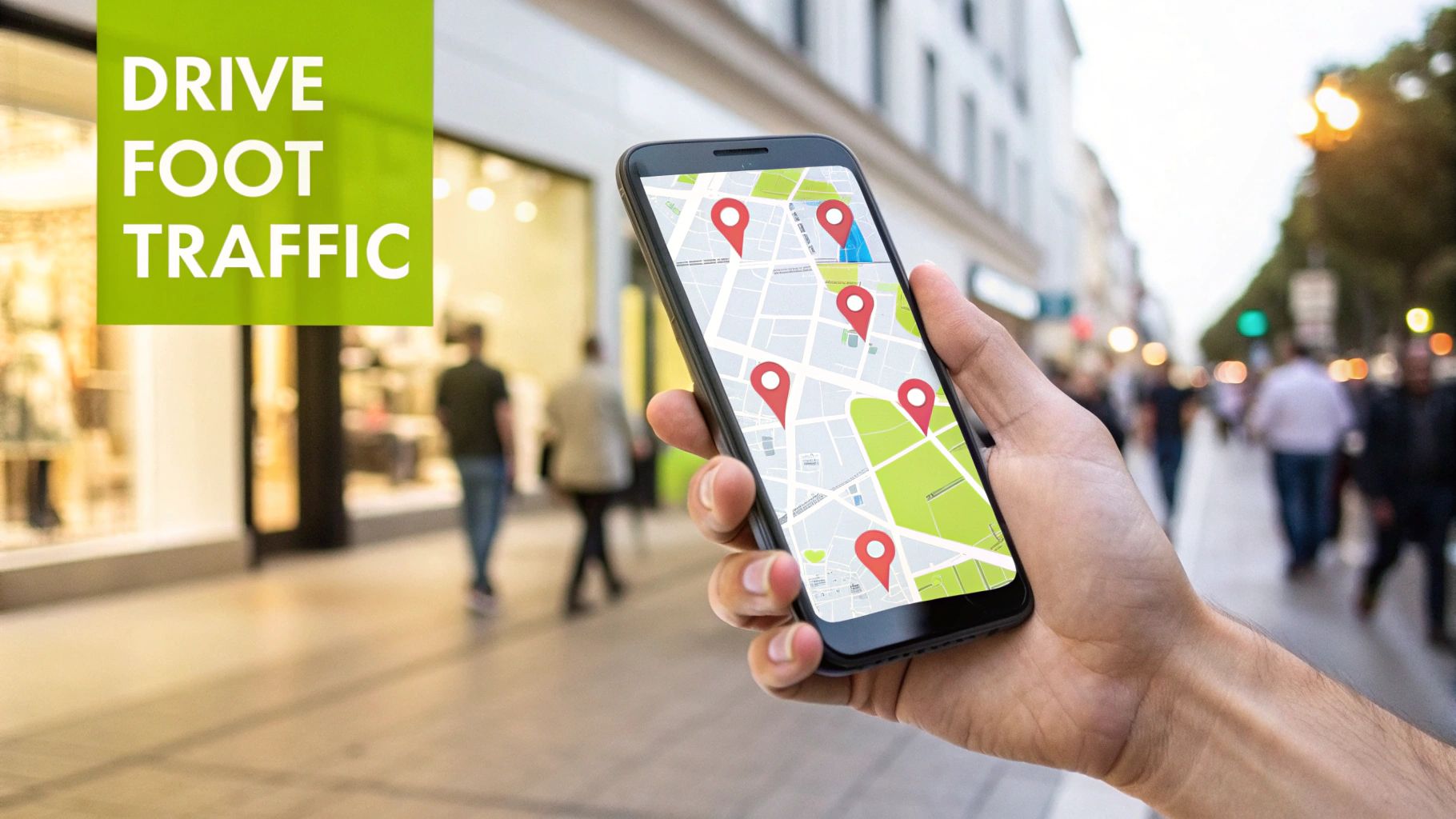
Geofencing and hyperlocal targeting is a location-based digital marketing strategy that uses GPS, RFID, and mobile data to trigger ads, notifications, or content when a user's device enters a predefined virtual geographic boundary. This technology transforms physical locations into digital marketing opportunities, allowing businesses to engage customers with pinpoint accuracy, making it one of the best digital marketing strategies for driving offline action.
By setting up virtual perimeters around specific locations like your storefront, a competitor's business, or a local event, you can deliver highly relevant and timely messages directly to potential customers. This strategy bridges the gap between digital advertising and real-world results, providing measurable foot traffic and offline conversions.
Why It Works & Who It's For
This strategy works because it capitalizes on two key factors: proximity and intent. A user physically near your business is often a high-intent prospect. By delivering a timely offer, you can influence their immediate purchasing decisions and steer them away from competitors.
This approach is highly effective for:
- Multi-Location Restaurants & Retailers: Sending a "15% off lunch" coupon to users who enter a one-mile radius of a specific franchise location between 11 AM and 1 PM.
- Local Service Businesses: A practical example is a car dealership setting a geofence around a competitor's lot. When a potential car buyer enters that zone, they receive a targeted ad on their phone showcasing the dealership's superior financing offer or current promotions, aiming to intercept the sale.
- Real Estate Agents: Geofencing an open house to send property details and virtual tour links to anyone who enters the immediate neighborhood during the event.
- Event Venues & Promoters: Targeting attendees at a large conference with ads for a nearby after-party or restaurant.
Quick Implementation Steps
- Define Your Geographic Zones: Identify key locations. Start with a 50-meter radius around your own business and then create separate geofences around competitor locations for conquesting campaigns.
- Choose a Geofencing Platform: Use tools within Google Ads, social media platforms, or specialized mobile marketing platforms like Gimbal to set up your virtual boundaries.
- Create Compelling, Contextual Offers: Develop dynamic creative that changes based on location or time. A message for someone near your store should be different from one for someone near a competitor.
- Track In-Store Visits and Offline Conversions: Connect your campaigns to your POS system or use platform-specific foot traffic metrics to measure how many ad viewers visited your physical location. This allows you to calculate true ROI beyond online clicks.
4. AI-Powered Audience Targeting & Predictive Analytics
Leveraging machine learning to predict customer behavior is no longer a futuristic concept; it's a core component of today's best digital marketing strategies. AI-powered targeting analyzes vast datasets to identify patterns, segment audiences with incredible precision, and predict future actions. It moves beyond simple demographics to understand who is most likely to convert, when, and why.
This technology transforms raw data into actionable intelligence, enabling real-time bid optimizations and allocating marketing budgets to the highest-probability conversions. Platforms like Google's Performance Max and Meta's Advantage+ use AI to automate targeting, finding high-value customers you never knew existed and dramatically improving campaign efficiency.
Why It Works & Who It's For
AI-powered targeting works because it uncovers subtle correlations in user behavior that humans cannot. It identifies micro-signals that indicate purchase intent, churn risk, or high lifetime value, allowing for hyper-personalized messaging at scale. This proactive approach ensures your marketing efforts are focused on the most receptive audiences.
This strategy is a game-changer for:
- E-commerce Brands: A practical example is an online furniture store uploading its list of past purchasers to an ad platform. The AI analyzes thousands of data points and builds a "lookalike" audience of new users who share the subtle behavioral traits of the store's highest-spending customers, resulting in more efficient ad spend.
- SaaS Companies: Implementing predictive lead scoring to help sales teams prioritize outreach to leads most likely to close.
- Coaches and Consultants: Identifying prospects with the highest potential lifetime value based on past client data and engagement patterns.
- Real Estate Platforms: Using churn prediction models to identify at-risk agents or clients and proactively re-engage them.
Quick Implementation Steps
- Integrate Your Data: Ensure your ad platforms have access to high-quality conversion data. This includes sales, lead form submissions, and revenue figures.
- Start with an AI-Driven Campaign: Launch a campaign using a platform's native AI tool, like Google's Performance Max or Meta's Advantage+ Shopping Campaigns.
- Define Your Highest-Value Segment: Create a core audience based on your best customers (e.g., highest LTV, repeat purchasers) and use it to seed the AI's learning.
- Continuously Feed the Model: Regularly upload offline conversion data and customer lists to refine the AI's understanding of your ideal customer profile. To explore this topic further, discover how to leverage predictive marketing analytics.
5. Augmented Reality (AR) Experiences & Immersive Marketing
Augmented Reality (AR) marketing creates interactive digital experiences that blend virtual elements with the real world. This strategy transforms passive viewers into active participants, allowing them to visualize products, try services, or engage with a brand in a completely novel way. By overlaying digital information onto a user's physical environment via their smartphone, AR boosts engagement and purchase confidence.
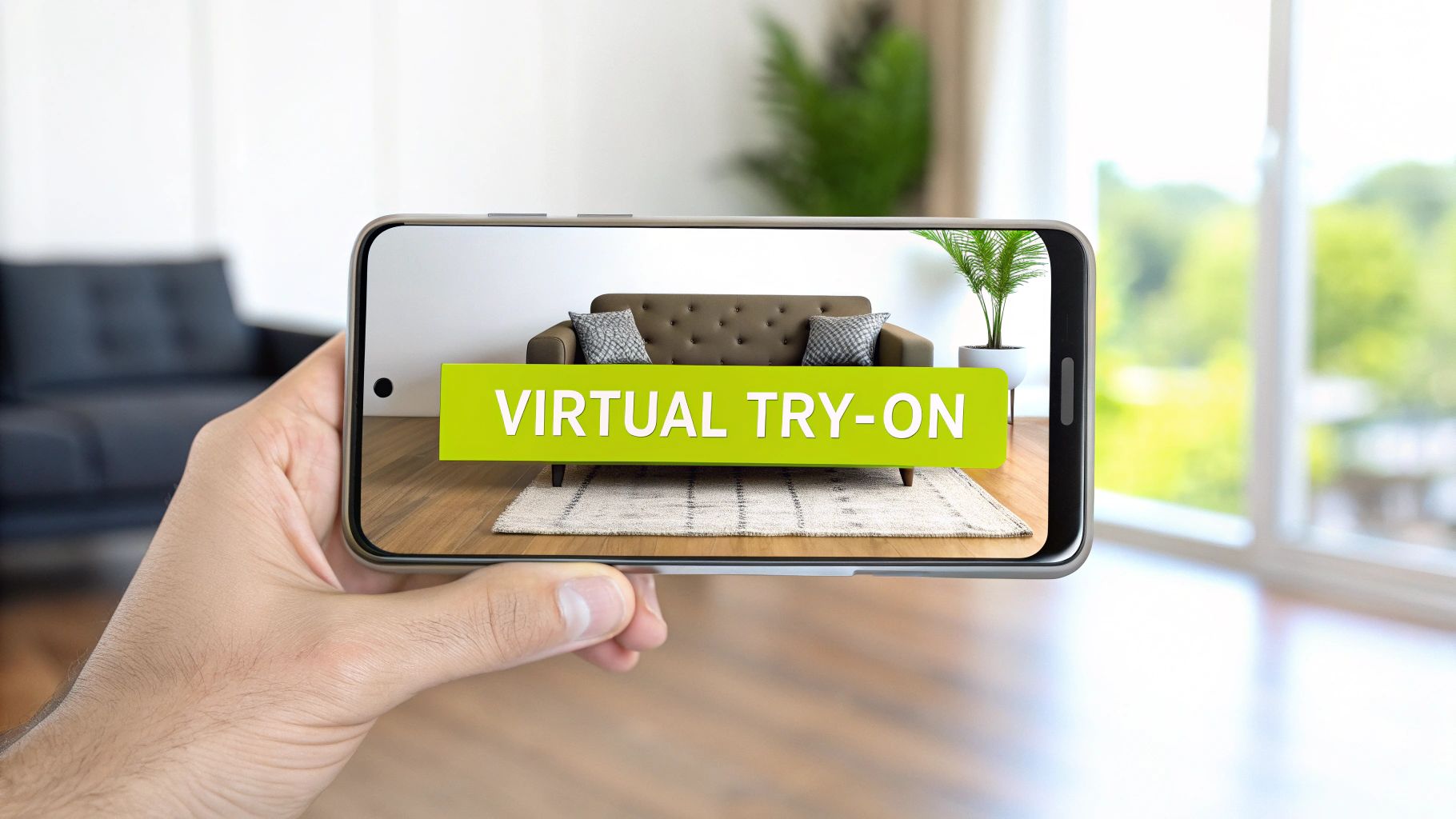
This immersive approach is one of the best digital marketing strategies because it directly addresses the "imagination gap" in online shopping. Instead of just looking at photos, customers can see how a new sofa would look in their living room or virtually try on a pair of sunglasses. This tangible experience reduces purchase hesitation and significantly improves brand recall.
Why It Works & Who It's For
AR marketing works by creating a memorable, utility-driven brand interaction that is both fun and functional. It moves marketing from a one-way broadcast to a two-way experience, leading to deeper emotional connections and higher conversion rates. This powerful tool solves real customer problems, like uncertainty about size, fit, or style.
This strategy is particularly effective for:
- E-commerce & Home Goods: Brands like IKEA and Wayfair let customers use AR to place virtual furniture in their homes, increasing purchase confidence.
- Beauty and Fashion Retailers: A practical example is a cosmetics brand creating an Instagram filter that allows users to "try on" different shades of lipstick. Users can see how it looks in real-time, share the look with friends, and click a link to purchase the exact shade directly from the filter.
- Automotive Brands: Companies can create AR showrooms, allowing potential buyers to explore a car's features from their own driveway.
Quick Implementation Steps
- Define a Single Use Case: Start small. Focus on one clear goal, like a virtual try-on for a best-selling product or a branded social media filter for a new campaign.
- Choose Your Platform: Leverage existing AR tools on platforms like Instagram, Snapchat, or TikTok for initial tests before investing in a custom app.
- Optimize for Performance: Ensure the AR experience loads quickly (under 2 seconds) and is compatible with common devices (iPhone 8+ and Android 7+).
- Incentivize and Amplify: Pair the AR experience with a call-to-action, such as a discount code. Encourage users to share photos or videos of their experience to boost organic reach and track key engagement metrics.
6. Performance-Based Paid Advertising (ROAS Optimization)
Performance-based paid advertising is a data-driven approach that prioritizes measurable return on ad spend (ROAS) over vanity metrics like impressions or clicks. By continuously testing, analyzing, and optimizing campaigns across Google Ads, Facebook, and other platforms, this strategy ensures every advertising dollar drives quantifiable business results. It transforms ad spend from an expense into a direct, predictable revenue driver.
This method shifts the focus from simply getting attention to acquiring customers profitably. Instead of asking, "How many people saw my ad?" performance marketers ask, "How much revenue did my ad generate for every dollar spent?" This discipline makes it one of the best digital marketing strategies for businesses focused on scalable growth and profitability.
Why It Works & Who It's For
This strategy works because it aligns advertising efforts directly with financial outcomes. By leveraging powerful ad platform algorithms and robust conversion tracking, businesses can automate bidding for conversions and high-value customers, systematically eliminating wasted spend on campaigns that don't deliver a positive return.
This approach is highly effective for:
- E-commerce Brands: A practical example is an online retailer running two sets of Facebook ads for a new product. Ad set A gets many clicks but few sales (1.5x ROAS), while ad set B gets fewer clicks but more sales (5x ROAS). A performance marketer immediately cuts the budget for A and scales up B, maximizing profitability.
- B2B SaaS Companies: Generating high lifetime value (LTV) leads from LinkedIn Ads by focusing on cost-per-demo.
- Coaches and Consultants: Scaling revenue through high-converting Facebook Ads funnels that target specific client avatars.
- Local Service Businesses: Acquiring new customers at a profitable cost-per-acquisition (CAC) using geo-targeted Google and Facebook ads.
Quick Implementation Steps
- Establish End-to-End Tracking: Implement conversion tracking (e.g., Google Ads tag, Meta Pixel, Conversions API) and connect it to your CRM to accurately measure sales and lead value.
- Define Your Target ROAS: Calculate your break-even ROAS based on your profit margins. A 3X ROAS, for example, means you retain 67% of the revenue after ad costs.
- Launch Conversion-Focused Campaigns: Build campaigns optimized for conversions or conversion value, not traffic or engagement. Start by testing 3-5 different audiences and creative variations.
- Review and Optimize Weekly: Analyze performance data weekly. Cut underperforming ads and audiences, and reallocate the budget to the top-performing campaigns to maximize your overall ROAS.
7. Content Marketing & Thought Leadership
A content marketing and thought leadership strategy focuses on creating and distributing valuable, relevant, and consistent content to attract and retain a clearly defined audience. Rather than directly pitching your products or services, you provide genuinely useful information through blogs, whitepapers, case studies, and webinars. This approach establishes your brand as an authority, builds trust, and drives high-intent organic traffic over time.
By consistently answering your audience's most pressing questions, you create an inbound engine that nurtures leads and builds a loyal following. It's a long-term asset that positions your brand as the go-to resource in your niche, making it one of the best digital marketing strategies for sustainable growth.
Why It Works & Who It's For
Content marketing works because it aligns with modern buyer behavior. Today's consumers are self-educated; they research solutions extensively before making a purchase. By providing the answers they seek, you meet them early in their journey and build credibility long before they are ready to buy. This strategy is essential for businesses with complex sales cycles or high-ticket offers.
This approach is highly effective for:
- Coaches & Consultants: Publishing weekly tips, case studies, and guides to build an email list and establish expertise.
- SaaS Companies: A practical example is a project management software company that creates a comprehensive blog post titled "The Ultimate Guide to Agile Methodologies." This content attracts project managers searching for information, establishes the company as an expert, and naturally introduces its software as a solution.
- Service-Based Businesses (e.g., Real Estate, Law): Creating hyper-local market reports and neighborhood guides to attract a targeted clientele.
Quick Implementation Steps
- Identify Evergreen Content Pillars: Pinpoint 5-10 core topics your ideal customer consistently searches for.
- Create Cornerstone Content: Develop a long-form, comprehensive guide (2,000+ words) for each pillar that covers the topic exhaustively.
- Optimize for Search Intent: Build supporting content (blogs, videos) around your cornerstone pieces that answer specific "how-to," "what-is," and "best" queries.
- Repurpose and Distribute: Turn a single piece of cornerstone content into multiple formats, such as a blog post becoming a video, a podcast episode, social media snippets, and an email newsletter.
- Gate Premium Content: Offer your most valuable assets (e-guides, webinar recordings, templates) in exchange for an email address to build your lead nurturing list.
- Track Performance Beyond Views: Measure success by tracking traffic, leads generated, and influenced revenue to understand your content's true ROI.
8. Email & SMS Marketing Automation
Email and SMS marketing automation is a powerful strategy that uses software to send personalized, triggered messages to customers at scale. Instead of manual broadcasts, this approach leverages behavioral data, segmentation, and pre-built sequences to deliver the right message at the perfect time, nurturing leads and driving repeat purchases with minimal ongoing effort. This system is a cornerstone of modern customer retention, making it one of the best digital marketing strategies for maximizing lifetime value.
By automating critical touchpoints like welcome messages, abandoned cart reminders, and post-purchase follow-ups, you create a personalized journey for every subscriber. This method transforms your email and SMS lists from simple communication channels into automated revenue engines that build lasting customer relationships.
Why It Works & Who It's For
This strategy works because it is timely, personal, and relevant. Customers receive messages directly related to their actions, such as viewing a product or making a purchase, which leads to significantly higher engagement and conversion rates than generic campaigns. Automation ensures no opportunity is missed, whether it's recovering a sale or re-engaging a dormant customer.
It is a mission-critical strategy for:
- E-commerce Brands: A practical example is an automated three-part "abandoned cart" email sequence. The first email, sent one hour after abandonment, is a simple reminder. The second, sent 24 hours later, highlights customer reviews. The third, sent 48 hours later, offers a 10% discount. This automated flow can recover 10-20% of otherwise lost sales.
- Service-Based Businesses: Automating appointment reminders via SMS to reduce no-shows and sending email newsletters to nurture leads.
- Coaches and Consultants: Building email sequences to convert webinar attendees or lead magnet downloads into high-ticket clients.
- Subscription Companies: Implementing automated check-ins and re-engagement campaigns to reduce customer churn.
Quick Implementation Steps
- Choose an Automation Platform: Select a tool like Klaviyo, ActiveCampaign, or HubSpot that integrates with your website or CRM.
- Set Up Foundational Automations: Begin with the highest-impact flows: a welcome series for new subscribers, a cart abandonment sequence, and a post-purchase follow-up.
- Segment Your Audience: Create segments based on purchase history, engagement level, and lifecycle stage to send more targeted messages.
- Incorporate SMS Strategically: Use SMS for high-urgency messages like flash sale alerts or shipping notifications, where its high open rates are most effective.
- Analyze and Optimize: Track metrics like open rates, click-through rates, and conversion revenue for each automation. A/B test subject lines, content, and send times to improve performance.
9. Search Engine Optimization (SEO) & Organic Search Strategy
A search engine optimization (SEO) strategy is the practice of improving your website's visibility in organic search results on platforms like Google. Unlike paid ads, SEO drives qualified traffic by optimizing your site's architecture, content, and authority. This approach focuses on earning rankings for relevant keywords, providing long-term, sustainable traffic growth that reduces your reliance on continuous ad spend.
By creating high-value content that directly answers user questions and ensuring your website is technically sound, you build a powerful asset that attracts customers organically. An effective SEO plan is a foundational component of the best digital marketing strategies because it generates a consistent stream of high-intent visitors looking for exactly what you offer.
Why It Works & Who It's For
SEO works because it aligns your business directly with active consumer demand. When someone searches for a solution, being one of the top results establishes immediate credibility and captures leads at the most critical point in their journey. This creates a highly efficient, inbound marketing engine.
This approach is highly effective for:
- Local Service Businesses: A practical example is a plumber in Denver optimizing their Google Business Profile and website pages for keywords like "emergency plumber Denver" and "Denver water heater repair." By ranking in the top 3 local search results, they generate a consistent flow of high-intent calls without paying for every click.
- SaaS Companies: Ranking for high-intent keywords like "best project management software" to capture users ready to buy.
- E-commerce Sites: Securing top spots for product reviews and comparison keywords to drive ready-to-purchase traffic.
- Healthcare Providers: Ranking for patient education and symptom-related searches to build trust and attract new patients.
Quick Implementation Steps
- Identify Low-Competition Keywords: Start by targeting 50-100 long-tail keywords you can realistically rank for to build initial momentum.
- Conduct Competitor Analysis: Analyze top-ranking competitor pages to understand their content structure, keyword usage, and backlink profile.
- Create Superior Content: Develop comprehensive content that satisfies search intent more thoroughly than existing results. Focus on clarity, depth, and unique insights.
- Optimize On-Page & Technical Elements: Ensure your site has fast load speeds, a mobile-friendly design, and clean architecture (Core Web Vitals).
- Build Authority with Backlinks: Earn links from reputable sites through guest posting, public relations, and creating valuable, link-worthy resources. To stay ahead in organic search, mastering AI SEO strategies to dominate search rankings is crucial for dominating search rankings in the evolving digital landscape.
10. Community Building & Social Media Engagement Strategy
A community building and social media engagement strategy shifts the focus from broadcasting promotional messages to fostering genuine relationships. Instead of treating social media as a one-way billboard, this approach creates a dedicated space for customers, fans, and prospects to connect with the brand and each other. It turns passive followers into an engaged, loyal community built on shared values and two-way conversations.
This strategy prioritizes providing value through content, sparking discussions, and celebrating user contributions. By creating a sense of belonging, brands can generate powerful user-generated content (UGC), build a legion of brand advocates, and drive organic, word-of-mouth growth. This method is one of the best digital marketing strategies for building long-term brand equity and customer loyalty.
Why It Works & Who It's For
Community building works because modern consumers crave connection and authenticity. They want to buy from brands they trust and feel a part of. An engaged community provides invaluable social proof, offers direct customer feedback for product development, and creates a defensive moat that competitors cannot easily replicate.
This approach is highly effective for:
- Coaches and Personal Brands: Building engaged Facebook groups or email communities to nurture leads and establish thought leadership.
- Fitness and Wellness Brands: A practical example is a yoga apparel brand creating a private Facebook group for customers. They host monthly yoga challenges, feature member photos on their main Instagram page, and ask for feedback on new product designs, turning customers into loyal brand ambassadors.
- Direct-to-Consumer (DTC) Brands: Fostering cult-like followings, similar to how brands like Glossier and Dollar Shave Club built their empires on fan communities.
- Tech Companies: Growing user adoption through community-led platforms, as seen with Slack and Discord, where users help each other and drive product innovation.
Quick Implementation Steps
- Choose Your Core Platforms: Select 1-2 channels where your ideal audience is most active (e.g., a Facebook Group, Discord server, or Instagram). Don't spread yourself too thin.
- Define Your 80/20 Content Mix: Dedicate 80% of your content to providing value (education, entertainment, inspiration) and only 20% to direct selling.
- Engage Proactively and Consistently: Reply to every comment and message, preferably within the first 24 hours. Post consistently (3-5 times a week) and create themed content or monthly challenges to encourage participation.
- Amplify User-Generated Content (UGC): Actively feature community members, share their stories, and repost their content. This not only provides social proof but also encourages more users to contribute.
Top 10 Digital Marketing Strategies Comparison
| Strategy | 🔄 Implementation Complexity | ⚡ Resource Requirements | 📊 Expected Outcomes / Effectiveness | 💡 Ideal Use Cases | ⭐ Key Advantages |
|---|---|---|---|---|---|
| Omnichannel Marketing Strategy | High — cross-channel integration, CDP required | High — CDP, martech stack, analytics, media spend | ⭐⭐⭐⭐ — Integrated funnel lifts; ~4X ROAS, ↑150% conversions | Multi-channel retailers, franchises, enterprise brands | Consistent messaging; improved attribution; higher LTV |
| Conversion-Optimized Funnel Design | Medium‑High — iterative testing and CRO processes | Medium — A/B tools, analytics, creative resources | ⭐⭐⭐⭐ — ~150% conversion lift (case benchmarks); lower CAC | E‑commerce, SaaS, coaches, purchase-focused campaigns | Higher conversion rates; scalable revenue; data-driven gains |
| Geofencing & Hyperlocal Targeting | Medium — geofence calibration, privacy constraints | Low‑Medium — location platform, CRM integration, local creative | ⭐⭐⭐ — 20–40% foot-traffic uplift; 5–10X ROI possible with proper targeting | Local stores, franchises, events, real estate open houses | High-intent local reach; measurable offline attribution |
| AI-Powered Audience Targeting & Predictive Analytics | High — model training, data pipelines, monitoring | High — historical data, ML tooling, specialist expertise | ⭐⭐⭐⭐ — ~4X ROAS; 2–3X improvement in CPA via predictive bids | Data-rich e‑commerce, SaaS, scaling paid acquisition | Predictive optimization; personalization at scale; faster insights |
| Augmented Reality (AR) Experiences | High — 3D assets, dev, cross-device testing | High — production costs, developers, creative teams | ⭐⭐⭐ — ↑engagement 200–400%; 30–50% reduction in returns for try-on use cases | Furniture, fashion, beauty, experiential brands | Differentiation; strong engagement; increased purchase confidence |
| Performance-Based Paid Advertising (ROAS Optimization) | Medium — tracking, attribution, ongoing optimization | Medium — ad spend, tracking setup, campaign ops | ⭐⭐⭐⭐ — ~4X ROAS (benchmarked); scalable, measurable growth | E‑commerce, local services, direct-response scaling | Clear ROI; scalable revenue; continuous performance improvement |
| Content Marketing & Thought Leadership | Medium — strategic planning and consistent production | Medium — writers, SEO tools, distribution, time | ⭐⭐ — Slow to start (3–6 months); long-term organic value; ↓CAC over time | Coaches, consultants, B2B SaaS, brands building authority | Builds trust; compounding organic traffic; qualified inbound leads |
| Email & SMS Marketing Automation | Low‑Medium — flow setup, segmentation, deliverability | Low‑Medium — ESP, copy, list growth & hygiene | ⭐⭐⭐⭐ — Very high ROI ($42 per $1 avg); ↑retention 30–40% | E‑commerce, subscriptions, appointment-driven businesses | Best channel ROI; personalized scale; strong retention & repeat revenue |
| SEO & Organic Search Strategy | Medium‑High — technical SEO + content + link building | Medium — content creators, SEO tools, link outreach | ⭐⭐⭐ — 120%+ traffic gains over time; 30–50% CAC reduction long-term | Local services, SaaS, e‑commerce seeking sustainable traffic | Long-term sustainable traffic; owned asset; high-intent visitors |
| Community Building & Social Media Engagement | Medium — ongoing moderation and authentic engagement | Low‑Medium — community managers, content, time | ⭐⭐ — Slower direct ROI; increases retention, referrals, UGC | Personal brands, coaches, lifestyle/DTC brands | Loyalty & advocacy; user-generated content; lower CAC via referrals |
Turning Strategy into Revenue: Your Next Step
Navigating the landscape of digital marketing can feel like assembling a complex puzzle. We've explored a comprehensive toolkit of today's best digital marketing strategies, from the broad reach of an Omnichannel Marketing Strategy to the precision of Geofencing and the futuristic power of AI-Powered Audience Targeting. Each strategy represents a powerful lever for growth, but the true masterstroke lies not in using one, but in orchestrating them into a cohesive, revenue-generating engine.
The core takeaway is this: isolated tactics produce isolated results, but integrated strategies build empires. An effective SEO strategy doesn't just earn rankings; it fuels your content marketing and provides organic traffic for your conversion-optimized funnels. Similarly, Performance-Based Paid Advertising becomes exponentially more powerful when informed by the predictive analytics of AI and supported by targeted Email & SMS Marketing automation that nurtures leads who didn't convert on the first click.
From Blueprint to Bottom Line: Your Action Plan
The difference between a company that stagnates and one that scales is the commitment to execution. Reading this article is the first step; now it's time to translate this knowledge into tangible action. Here’s a practical framework to get started without feeling overwhelmed:
Conduct a Strategic Audit: Before adding anything new, assess your current efforts. Where are the biggest gaps? Are you driving traffic with paid ads but have no system to capture leads? Are you creating great content that nobody can find because your SEO is weak? Identify the single biggest bottleneck that, if solved, would have the largest positive impact on your revenue.
Select Your "Keystone" Strategy: You don’t need to implement all ten strategies at once. Choose one or two that directly address your bottleneck.
- For a local service business struggling with foot traffic: Geofencing & Hyperlocal Targeting is your obvious starting point.
- For an e-commerce brand with a high cart abandonment rate: Focus on Conversion-Optimized Funnel Design and Email & SMS Marketing automation to recover those sales.
- For a consulting firm aiming for authority: Double down on Content Marketing & Thought Leadership, supported by a robust SEO strategy.
Define a Pilot Project: Turn your chosen strategy into a small, measurable, 90-day project. For instance, instead of "launching email marketing," your goal could be "Implement a 3-part abandoned cart email sequence to recover 15% of lost sales by the end of the quarter." This makes the initiative manageable and allows you to prove ROI quickly.
Why Mastering This Matters Now
In today's hyper-competitive market, your ability to efficiently attract, convert, and retain customers is your primary advantage. The best digital marketing strategies are no longer a "nice-to-have"; they are the fundamental mechanisms of modern business growth. Mastering these approaches means you can create predictable revenue streams, build a resilient brand that isn't dependent on a single channel, and gain a decisive edge over competitors who are still relying on outdated, scattershot tactics. By moving from a reactive to a proactive marketing posture, you take control of your growth trajectory and build a more profitable, sustainable business.
Orchestrating these advanced strategies to deliver consistent, high-impact results is what we do every day. If you're ready to move beyond theory and implement a cohesive growth engine, the team at Silver Spoon Agency specializes in turning the best digital marketing strategies into measurable revenue. Let us help you build the powerful, performance-driven marketing system your business deserves.