


10 Brand positioning strategies You Should Know

In a crowded market, simply having a great product or service is no longer enough. Your brand must occupy a distinct, memorable, and valuable space in the minds of your target customers. This is the core purpose of effective brand positioning strategies. Getting this right means your audience doesn't just see you; they understand exactly why you are the best choice for them. A strong position acts as your brand’s north star, guiding everything from product development and pricing to your marketing messages and customer service interactions.
This article cuts straight to the actionable methods that drive growth. We will explore ten proven brand positioning strategies designed for today's competitive environment. You'll find practical implementation steps, real-world examples, and key performance indicators (KPIs) to measure success. From hyperlocal geofencing for local businesses to AI-powered personalization for e-commerce stores, these frameworks provide a clear roadmap. The goal is to move beyond theory and give you the tools to build a brand that not only attracts customers but also commands loyalty and defends its market share. When embarking on brand positioning strategies, it's essential to consider all touchpoints where your brand can make a lasting impression. Explore how unforgettable corporate event entertainment ideas can be a strategic tool for brand building and engagement.
1. Value-Based Positioning
Value-based positioning is one of the most direct and effective brand positioning strategies for businesses whose customers prioritize measurable results. Instead of focusing on product features or company history, this approach anchors your brand identity to the specific, quantifiable outcomes you deliver. It answers the client's most critical question: "What tangible return will I get from this investment?"
This strategy is especially powerful for B2B services, SaaS companies, and performance marketing agencies where ROI is the primary decision-making factor. It shifts the conversation from cost to value, framing your service as an investment with a predictable return. For a practical example, a financial advisory firm might position itself not as "wealth managers" but as a service that "delivers a 2% higher average annual return than the S&P 500." Similarly, a logistics company can position itself around "reducing shipping costs by 15% through optimized routing," a direct and compelling value proposition.
How to Implement This Strategy:
- Gather Proof: Systematically collect performance data from your most successful clients. Document specific before-and-after metrics like cost savings, revenue growth, or efficiency gains. For example, create a case study showing Client A's lead cost dropped from $50 to $25 in 90 days.
- Craft Your Message: Build your core marketing messages around these hard numbers. Use case studies and testimonials that highlight specific data points. For instance, your website headline could be "We Help SaaS Companies Achieve a 3:1 LTV:CAC Ratio."
- Segment Your Claims: Tailor your value propositions for different audiences. An e-commerce client cares about ROAS, while a local service business might prioritize cost-per-lead or appointment booking rates. A law firm client values "cases won," while a manufacturer values "downtime reduced."
Key Insight: Value-based claims must be both compelling and verifiable. Regularly audit your performance data (quarterly is a good cadence) to ensure your marketing claims remain accurate and defensible. This builds trust and reinforces your position as a results-driven partner.
2. Omnichannel Integration Positioning
Omnichannel integration positioning frames your brand as the master orchestrator of a seamless customer journey. Instead of operating in silos, this strategy unifies every touchpoint, from social media and search to email, SMS, and even in-store experiences. It shifts the brand’s role from a single-channel operator to a provider of a cohesive, frictionless experience, answering the customer's need for convenience and consistency.
This approach is powerful for retail and e-commerce brands, as well as service businesses with multiple customer contact points. It positions the brand as exceptionally customer-centric, reducing friction and coordinating messaging for maximum impact. A practical example is Disney's MagicBand program. A single wristband acts as a hotel room key, park pass, and payment method, all while linking photos taken by park photographers directly to the user's account—a perfect, unified experience. This is a core component of an effective omnichannel marketing strategy.

How to Implement This Strategy:
- Unify Customer Data: Implement a customer data platform (CDP) to create a single view of each customer. This allows you to see that a customer who clicked a Facebook ad later opened an email and then made an in-store purchase.
- Map the Journey: Create a channel hierarchy based on where your audience is in their customer journey. For example, use TikTok and Instagram Reels for top-of-funnel awareness, then use Google Search ads and email marketing to capture intent and drive conversions.
- Maintain Message Cohesion: Develop channel-specific creative variations that adapt to the platform's format but maintain a consistent core brand message, offer, and aesthetic. If your campaign is "20% off Summer Styles," that message should be consistent on your website banner, in your emails, and in your social media ads.
- Measure Holistically: Set up cross-channel attribution modeling to understand how different channels assist each other. This helps you see that while email got the final click, the customer was first introduced to the brand via a YouTube ad.
Key Insight: True omnichannel positioning isn't just about being on all channels; it's about making those channels work together intelligently. The goal is for the customer to feel like they are having one continuous conversation with your brand, no matter how they choose to interact.
3. Hyper-Local / Geofencing Positioning
Hyper-local positioning connects your brand with customers based on their precise physical location, making it one of the most powerful brand positioning strategies for businesses with a brick-and-mortar presence. It moves beyond broad city-level targeting to engage consumers within specific neighborhoods, buildings, or even competitor locations using geofencing technology. This approach allows you to deliver timely, relevant messages that drive immediate, real-world actions like store visits or local inquiries.
This strategy is ideal for multi-location franchises, local service businesses, retailers, and real estate professionals. It thrives on proximity and immediacy. For a practical example, a home improvement store like Home Depot can set a geofence around its location and send a push notification to app users entering the area: "DIY project this weekend? Get 15% off all paint when you shop in-store today." Similarly, a quick-service restaurant can trigger a mobile order promotion for users who enter a geofence around one of its stores, encouraging a purchase they might not have otherwise made.
How to Implement This Strategy:
- Define Your Zones: Identify key geographic areas to target. This includes your own locations (to drive loyalty), competitor locations (to conquest customers), and complementary businesses (e.g., a pet supply store targeting users at a local dog park).
- Craft Compelling, Timely Offers: Your message must be relevant to the location and time. For instance, a coffee shop can serve an ad for an iced latte to people within a 1,000-foot radius between 2 PM and 4 PM on a hot day. A real estate agent can target users at a "first-time homebuyer" seminar with an ad offering a free consultation.
- Measure Foot Traffic: Use platform features like store visit conversions (available in Google Ads and Meta Ads) or unique, location-specific QR coupon codes to directly measure how many digital impressions translate into physical visits.
Key Insight: The power of hyper-local positioning is in its context. A generic ad is easily ignored, but an offer for a hot coffee delivered to someone standing outside in the cold is highly compelling. Combine geofencing with strong creative and a time-sensitive call to action to maximize impact.
4. Authority & Thought Leadership Positioning
Authority and thought leadership positioning establishes your brand as the go-to expert in your field. This strategy builds credibility by demonstrating deep expertise through original insights, educational content, and proprietary systems. Instead of directly selling a product, you are selling trust and intellectual capital, which makes the eventual sale a natural conclusion.
This is one of the most powerful brand positioning strategies for consulting firms, coaches, and high-ticket service businesses where client confidence is paramount. For example, McKinsey & Company doesn't run ads for its consulting services; it publishes the McKinsey Quarterly, a respected journal with in-depth analysis on global business trends. This positions them as thinkers, not just service providers. Similarly, Brian Dean of Backlinko built his SEO empire by creating detailed, data-backed guides on topics like "How to Get More Backlinks," becoming the authority that others cite.
How to Implement This Strategy:
- Develop a Proprietary Framework: Create a unique methodology or system that solves a client's problem, like a "5-A Content Marketing Cycle" or a "Peak Performance Pyramid." This gives your expertise a memorable structure.
- Publish Original Research: Conduct a survey of 500 professionals in your industry and publish the findings as an "Annual State of [Your Industry] Report." This becomes a valuable, linkable asset that generates media attention.
- Create a Signature Point of View: Don't just repeat industry talking points. If everyone says "hustle harder," your contrarian take might be "The Power of Strategic Rest." This unique angle attracts a dedicated following.
Key Insight: True thought leadership requires consistency and a commitment to providing genuine value. The goal is to become the source others cite. A regular publishing cadence (e.g., weekly articles, monthly data reports) is critical to building and maintaining this top-of-mind status.
5. Conversion-Optimized / Results-Driven Positioning
Conversion-optimized positioning focuses a brand’s entire identity on its proven ability to turn prospects into customers. This approach moves beyond generating awareness or traffic, concentrating instead on the mechanics of the sales funnel and maximizing customer value. It directly addresses the client's core need: "How will you help me get more sales and customers from the audience I already have?"
This strategy is highly effective for e-commerce stores, SaaS companies, and coaches where profitability is tied directly to conversion rates. It establishes the brand as a specialist in optimization, testing, and continuous improvement. A practical example is an e-commerce agency positioning itself with the tagline, "We turn your browsers into buyers." They showcase case studies not about traffic growth, but about increasing the average order value by 25% through strategic upselling or boosting checkout completion rates from 60% to 75% by redesigning the cart page.
How to Implement This Strategy:
- Establish a Baseline: Before starting, conduct a funnel audit using tools like Google Analytics or Hotjar. A practical finding might be: "Our product pages have a high bounce rate, and heatmaps show users aren't scrolling to the reviews section."
- Isolate and Test: Build your process around systematic A/B testing. For example, test one element at a time: "Button color red vs. green" on the 'Add to Cart' button. Then test the headline: "Buy Now" vs. "Get Your Solution." Use statistical significance to validate results.
- Showcase the Process: Frame your brand around this meticulous, data-backed methodology. Create a case study titled: "How We Lifted a Client's Demo-Request Rate by 40% with a 3-Step Headline Test." This shows your method, not just the result.
Key Insight: This strategy is about demonstrating a repeatable system, not just a one-time result. Document every test and its outcome in a shared repository to build a library of proof that reinforces your expertise and justifies your premium positioning.
6. Experiential & Immersive Technology Positioning
Experiential positioning uses emerging technologies like augmented reality (AR) and virtual reality (VR) to create memorable brand interactions. Instead of just telling customers about a product, this strategy allows them to experience it digitally, forging a deeper connection and positioning the brand as a forward-thinking leader. It’s about transforming passive viewers into active participants, moving beyond traditional advertising to create engaging, shareable moments.
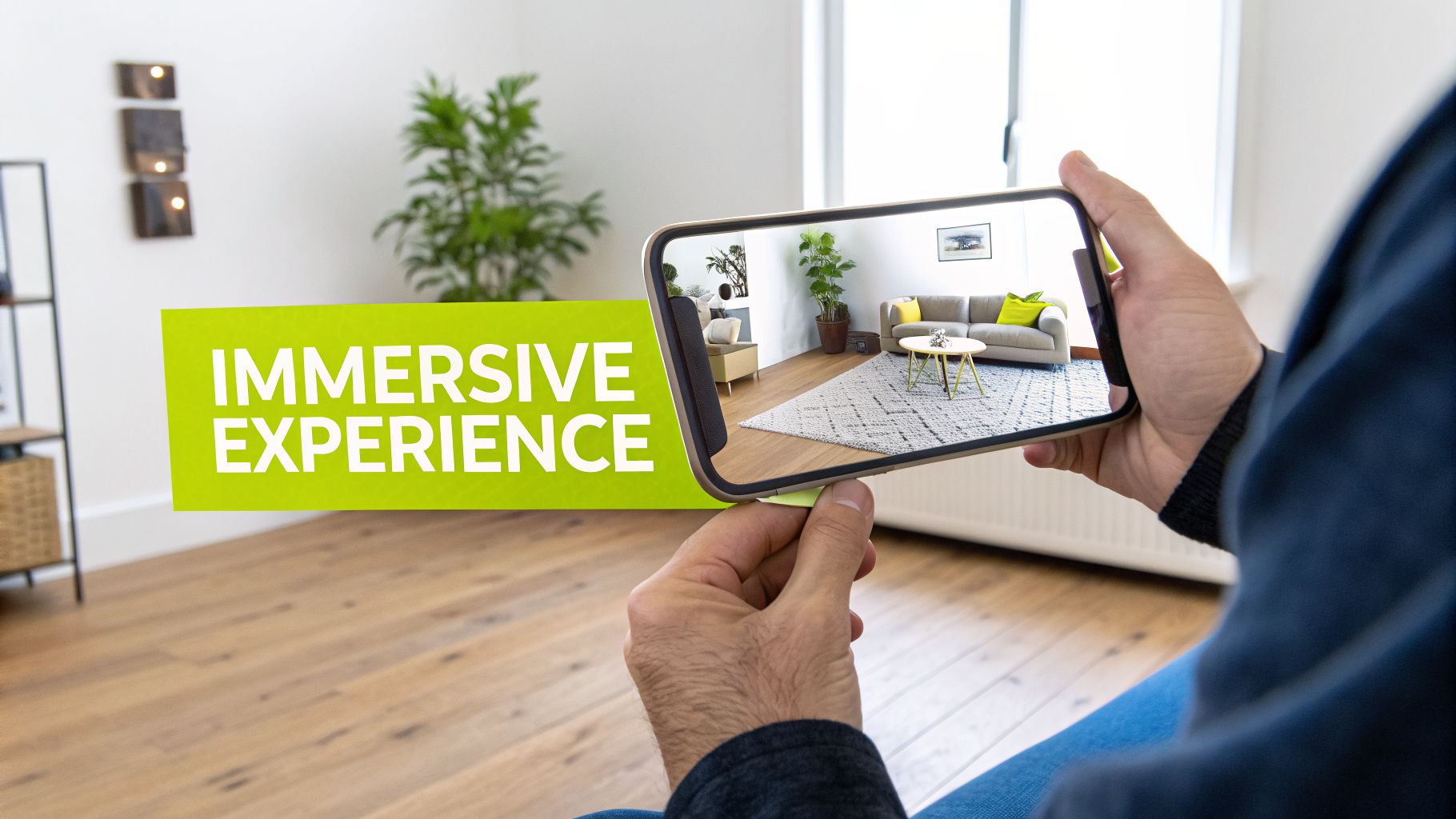
This approach is highly effective for e-commerce, beauty, and retail brands where visualization is key to the buying decision. For instance, IKEA’s Place app lets users point their phone camera at their living room and place a true-to-scale 3D model of a sofa to see how it fits. Similarly, Sephora's Virtual Artist feature allows customers to use their phone’s camera to digitally try on hundreds of lipstick shades, solving the problem of not being able to test products online. These immersive brand positioning strategies turn a customer’s personal space into a showroom.
How to Implement This Strategy:
- Start with Practical Use Cases: Begin with proven AR applications like virtual try-on for glasses (like Warby Parker's app), product visualization for furniture, or branded Instagram/TikTok filters for a movie release.
- Focus on a Flawless User Experience: An immersive experience should be intuitive and fast. The AR feature should load in under 3 seconds and track a user's face or room smoothly. If it’s slow or buggy, it will create frustration.
- Integrate into the Funnel: Don't treat AR as a standalone gimmick. After a user virtually tries on a pair of sunglasses, include a prominent "Add to Cart" button directly within the AR experience to guide them toward a purchase.
Key Insight: Immersive technology should solve a customer problem or add real value, not just serve as a novelty. The most successful AR campaigns simplify the decision-making process, like visualizing a sofa in your living room or trying on sunglasses, which bridges the gap between digital browsing and real-world confidence.
7. Niche / Vertical-Specific Positioning
Niche positioning is a brand positioning strategy centered on serving a narrowly defined, often underserved, market segment. Instead of competing broadly, this approach directs all marketing efforts toward dominating a specific vertical by becoming the go-to expert. It works by building deep industry knowledge, creating specialized solutions, and speaking the unique language of that audience.
This strategy is highly effective for SaaS companies, specialized agencies, and consultants. For a practical example, a generic marketing agency might struggle to stand out. But an agency that positions itself as "The Marketing Partner for Independent Dental Practices" can thrive. They can create content on "How to get more Invisalign patients" and attend dental conferences, becoming the obvious choice for that specific audience. Similarly, Veeva is a CRM platform built exclusively for the pharmaceutical and life sciences industry, making it far more valuable to those companies than a generic CRM like Salesforce.
How to Implement This Strategy:
- Select Viable Niches: Identify 2-3 verticals with strong growth potential. For example, instead of targeting all "small businesses," you could target "veterinary clinics," "craft breweries," or "plumbers." These have specific needs and communities.
- Develop Deep Expertise: Immerse your team in the vertical. Subscribe to Veterinary Economics magazine, join Facebook groups for plumbers, and create case studies showing how you helped a brewery increase foot traffic by 50%.
- Tailor Your Marketing: Create vertical-specific content. Instead of a generic "SEO guide," write "A Veterinarian's Guide to Local SEO." Use keywords like "pet wellness marketing" or "plumbing lead generation" across your website and ad campaigns.
Key Insight: True niche dominance requires more than just targeted messaging; it demands genuine specialization. Develop proprietary frameworks or methodologies that solve the vertical's core challenges to build an unshakable competitive advantage and command premium pricing.
8. Data-Driven / AI-Powered Positioning
Data-driven positioning showcases a brand's dependence on analytics, artificial intelligence, and algorithmic decision-making to deliver superior results. This strategy frames the brand as an intelligent, tech-forward partner that replaces guesswork with precision. It appeals to clients who want optimization backed by machine learning and real-time data insights, ensuring every action is calculated for maximum impact.
This approach is a cornerstone for big tech platforms and modern marketing agencies. A practical example is Stitch Fix, which uses AI algorithms and data from millions of users to predict which clothing items a customer will love, positioning itself as a "personal stylist powered by data." It’s not just fashion; it’s a personalized, intelligent service. For B2B, using tools like AI demand forecasting allows a company to position itself as a strategic partner that helps clients "eliminate stockouts and reduce inventory waste."
How to Implement This Strategy:
- Invest in a Tech Stack: A genuine AI-powered position requires solid data infrastructure. For example, use a tool like Segment to collect customer data and a platform like Google's BigQuery to analyze it.
- Translate Tech into Benefits: Avoid jargon. Instead of saying you use a "collaborative filtering algorithm," explain that "our system analyzes purchases from customers with similar tastes to recommend products you're likely to love."
- Showcase the 'Human + AI' Synergy: Position your team as strategic experts augmented by AI. A practical example: "Our AI identifies the top 5% of your most valuable customer segments, so our strategists can design bespoke campaigns just for them."
Key Insight: Transparency is critical. Don't present your AI as a mysterious black box. Create dashboards and reports that visualize how the AI is making decisions and demonstrate its performance against goals. This builds trust and proves the value of your data-first approach.
9. White-Label / B2B Partnership Positioning
White-label positioning establishes your company as the expert engine working behind the scenes for other businesses. Instead of marketing to end-consumers, this strategy targets B2B partners like agencies, resellers, or consultants who want to expand their service offerings without developing the capabilities in-house. It’s a powerful approach for scaling through other companies’ client relationships.
This method is common for Martech and SaaS platforms. A perfect practical example is a local web design agency. They are great at design and client relationships, but not SEO. They partner with a specialized white-label SEO company. When the agency sells an "SEO Package" to their client, the SEO work is done by the partner, but all reports and communication come from the design agency. This allows the agency to offer more services and the SEO company to gain clients without direct marketing.
How to Implement This Strategy:
- Develop Partner Tiers: Create structured partnership levels. For example: a "Silver Partner" gets a 15% discount, while a "Gold Partner" who brings in over $100k/year gets a 25% discount and a dedicated account manager.
- Build Partner Resources: Equip your partners for success. Create unbranded sales decks they can add their logo to, pre-written email templates for prospecting, and video tutorials on how to sell your services.
- Establish Clear SLAs: Define Service Level Agreements (SLAs) for service delivery. For example: "All client reports will be delivered to the partner by the 1st of every month," and "Critical client inquiries will be answered within 4 business hours."
Key Insight: The core of white-label positioning is making your partner look good. Your success is directly tied to their ability to sell and deliver your service seamlessly. Invest in their enablement and support just as much as you invest in your own product.
10. Rebranding / Elevation Positioning
Rebranding or elevation positioning is a strategic move for established businesses aiming to modernize their image, enter new markets, or align their identity with a new business direction. This approach goes beyond a simple logo change; it involves a fundamental shift in how the brand communicates its purpose, values, and promise. It answers the market's question: "How has this brand evolved to meet my current needs?"
This strategy is crucial for companies that have outgrown their original identity. A powerful practical example is CVS Health. The company changed its name from "CVS/pharmacy" to "CVS Health" and, most importantly, stopped selling tobacco products. This single action powerfully repositioned the brand from a simple retail pharmacy to a legitimate healthcare company, aligning its business practices with its new "Health" identity.
How to Implement This Strategy:
- Define Clear Objectives: Start by determining the business goal. Is it to attract a younger demographic, justify a premium price point, or signal a major shift in services? For example, your goal might be: "Increase our share of the 18-25 market by 10%."
- Conduct Stakeholder Research: Interview key internal and external stakeholders. A practical step is to run a focus group with your target new audience to see how they perceive your current brand and what they're looking for in a modern alternative.
- Develop a Rollout Plan: Create a phased launch strategy. Week 1: Internal launch with employee training. Week 2: Update website and all social media profiles simultaneously at 9 AM ET. Week 3: Launch a PR campaign announcing the change and the reasons behind it.
Key Insight: A rebrand’s success is measured by more than just aesthetics. Track brand perception, media sentiment, and key business metrics (like new customer acquisition or sales in a target market) both before and after the launch to measure the true impact of your new brand positioning.
10-Point Brand Positioning Comparison
| Positioning | Implementation Complexity 🔄 | Resource Requirements ⚡ | Expected Outcomes ⭐📊 | Ideal Use Cases 💡 | Key Advantages |
|---|---|---|---|---|---|
| Value-Based Positioning | 🔄 Medium — needs robust tracking, case studies | ⚡ Moderate — analytics, attribution, proof assets | ⭐ High — clear ROI claims; 📊 measurable ROAS & conversion lifts | B2B, performance agencies, e‑commerce, SMBs demanding ROI | Builds trust with quantifiable claims; differentiates from vague promises |
| Omnichannel Integration Positioning | 🔄 High — CDP, integrations, cross‑team orchestration | ⚡ High — unified tech stack, AI tools, multi‑channel creatives | ⭐ High — cohesive journeys; 📊 improved efficiency & reduced waste | Multi‑channel e‑commerce, retailers, brands scaling customer journeys | Reduces channel silos; enables real‑time budget reallocation |
| Hyper‑Local / Geofencing Positioning | 🔄 Medium — location setup, privacy compliance | ⚡ Moderate — location data providers, mobile creatives, tracking | ⭐ Medium — localized foot‑traffic lifts; 📊 measurable in‑market conversions | Brick‑and‑mortar, franchises, restaurants, real estate agents | Drives nearby foot traffic; minimizes out‑of‑area spend |
| Authority & Thought Leadership Positioning | 🔄 Medium‑High — sustained content & PR cadence | ⚡ Moderate — content, research, events, PR support | ⭐ High (long‑term) — premium pricing & inbound leads; 📊 brand equity growth | Coaches, consultants, high‑ticket B2B, professional services | Commands premium pricing; builds defensible credibility |
| Conversion‑Optimized / Results‑Driven Positioning | 🔄 Medium — testing framework and CRO processes | ⚡ Moderate — A/B tools, dev support, analytics | ⭐ High — direct revenue impact; 📊 improved conversion rates & LTV | E‑commerce, SaaS, businesses where conversion = revenue | Small improvements yield outsized ROI; iterative, measurable gains |
| Experiential & Immersive Technology Positioning | 🔄 High — AR/VR production and UX integration | ⚡ High — specialized developers, design, platform partnerships | ⭐ Medium‑High — strong engagement; 📊 potential PR and conversion uplift | Luxury retail, beauty, furniture, automotive, product launches | Differentiates brand; creates highly shareable, memorable experiences |
| Niche / Vertical‑Specific Positioning | 🔄 Low‑Medium — build vertical playbooks and assets | ⚡ Moderate — industry expertise, tailored case studies | ⭐ High (in niche) — stronger conversions & referrals; 📊 higher relevance metrics | Specific verticals (e‑commerce segments, healthcare, real estate) | Less competition; premium pricing and strong referral networks |
| Data‑Driven / AI‑Powered Positioning | 🔄 High — data infrastructure, model governance | ⚡ High — data engineers, ML tools, clean datasets | ⭐ High — scalable optimization; 📊 real‑time performance & predictive insights | Growth‑focused SMBs, e‑commerce, performance marketers | Algorithmic optimization; improves with scale and data |
| White‑Label / B2B Partnership Positioning | 🔄 Medium — partner ops, SLAs, branded delivery | ⚡ Moderate — account management, partner portals, reporting | ⭐ Medium — recurring partner revenue; 📊 expanded reach via resellers | Agencies, consultants, platforms wanting turnkey services | Scales via partner networks; lower direct sales overhead |
| Rebranding / Elevation Positioning | 🔄 High — stakeholder alignment, phased rollouts | ⚡ High — strategy, design, copy, web, change management | ⭐ Medium‑High — brand lift and market repositioning; 📊 longer‑term impact | Established mid‑market firms, companies seeking premium repositioning | Higher‑margin engagements; enables entry to new market segments |
Final Thoughts
The journey through these distinct brand positioning strategies reveals a fundamental truth: effective positioning is not a one-time decision but a continuous, active process. From the deep-rooted trust built through Value-Based Positioning to the high-tech precision of AI-Powered Personalization, each approach offers a unique lens through which you can define your brand’s place in the market. The goal is no longer just to be seen; it's to be seen as the only viable choice for a specific audience.
Consider how a local wellness clinic might combine Hyper-Local Geofencing to attract nearby clients with Authority & Thought Leadership content to build trust before a patient ever books an appointment. Or how a startup can use Conversion-Optimized Positioning to prove its immediate value, securing early adopters and crucial market traction. These strategies are not isolated tactics but interconnected components of a larger brand architecture.
Your Actionable Path Forward
Mastering your market position requires moving from theory to implementation. The most impactful takeaway is that the best brand positioning strategies are born from a deep understanding of both your customer's world and your own unique capabilities.
Your immediate next steps should be to:
- Conduct a Positioning Audit: Where does your brand currently stand in the minds of your customers? Use customer surveys, review competitor messaging, and analyze your sales data to get an honest baseline.
- Identify the Primary Strategy: Which of the strategies detailed in this article aligns most powerfully with your business goals and audience needs? Select one primary approach to serve as your North Star.
- Layer Secondary Strategies: Choose one or two secondary strategies that complement your primary choice. For instance, an e-commerce brand focused on Niche Positioning can amplify its reach with Experiential AR try-on features. This creates a multi-dimensional brand that is both focused and engaging.
Ultimately, a strong position in the market provides more than just a competitive edge; it creates clarity. It simplifies your marketing messages, focuses your product development, and builds a loyal community that advocates on your behalf. By deliberately choosing and executing one or more of these brand positioning strategies, you are not just selling a product or service. You are architecting a memorable, meaningful, and profitable brand identity that can stand the test of time.
Feeling ready to move from planning to execution? Silver Spoon Agency specializes in building and implementing the precise brand positioning strategies needed to attract profitable customers and scale your business. We help you define your unique market position and then construct the high-performance marketing funnels to make it a reality.