


Mastering community engagement strategy for rapid growth

A community engagement strategy is more than just a buzzword; it's the intentional, ongoing process of building real relationships with a specific group of people to chase down a shared goal.
It’s not about shouting your message from the rooftops. It’s a complete shift from a brand monologue to a collaborative conversation with your audience—one that builds trust, loyalty, and genuine brand advocacy.
Why a Community Strategy Is Your Greatest Business Asset
Let's be real: traditional advertising is running out of steam. People today are drowning in ads and are desperate for genuine connection. This is where a strong, authentic community becomes your secret weapon, your competitive edge.
This isn’t some fluffy, ‘nice-to-have’ marketing tactic. It's a powerful, revenue-driving engine that builds a protective moat around your business.
When you focus on building an authentic community, you stop just selling things and start fostering relationships. It doesn’t matter if you're an e-commerce brand turning customers into loyal fans or a local gym creating a tight-knit fitness family. The result is always the same: a level of unwavering brand loyalty that your competitors simply can't buy or replicate.
The Tangible Business Impact of Community
A well-nurtured community is a serious business asset, directly fueling crucial outcomes like improved and proven customer retention strategies. When customers feel like they're part of something bigger than just a transaction, they stick around longer and spend more.
Here’s a breakdown of the key benefits you can expect:
- Increased Customer Lifetime Value (CLV): Engaged community members don't just buy once. They come back again and again because they trust your brand, leading to a much higher CLV and insulating you from churn. For example, a SaaS company might find that members of its user community are 40% less likely to churn because they get quick answers from peers and feel invested in the product's future.
- Organic Referrals and Advocacy: A fired-up community becomes your most potent marketing channel. Members can't help but share their positive experiences, acting as credible, walking billboards for your brand. You can pour fuel on this fire with dedicated efforts like building effective brand ambassador programs. A practical example is Glossier, which famously built its empire on the backs of everyday users sharing their "shelfies" and product reviews online, creating a massive, authentic marketing engine.
- Direct Product Feedback: An active community is a goldmine of honest, real-time feedback. You get raw insights to improve your products and services, which helps you dodge development missteps and build what your audience actually wants. For instance, the gaming company LEGO uses its "LEGO Ideas" platform to let fans submit and vote on new set designs. This directly sources product ideas from their most passionate users, ensuring a built-in market for new releases.
An engaged community is a direct line to your customers. It creates a powerful feedback loop that fuels innovation and deepens loyalty, turning passive consumers into active partners in your brand's journey.
You can see the power of a well-played community strategy everywhere. Take UNICEF, for example. They've built a robust 2025-2026 digital community strategy specifically to fight misinformation and bolster public health initiatives. They do it by tracking online conversations and tailoring their messages to what different communities actually need and are talking about. You can read more about how they leverage community engagement for social impact.
Mapping Your Community Blueprint
You wouldn't build a house without a blueprint, right? The same goes for building a community that actually lasts. A winning community engagement strategy isn't something you stumble into; it’s carefully planned, starting with a deep dive into who your people really are and where they already hang out online.
Jumping straight to picking a platform is a classic mistake. It's like trying to sell snow gear in the desert. You might have the best product in the world, but if you're in the wrong place talking to the wrong people, your message is going to fall on deaf ears.
Define Your Community Personas
To build a real connection, you have to get past those vague, surface-level demographics. Knowing your average customer is a 35-year-old woman is a start, but it doesn't tell you a thing about why she buys from you, what problems she’s wrestling with, or what truly gets her excited. This is where creating detailed user personas is non-negotiable.
These aren't just make-believe character sheets; they're practical tools that give a face and a voice to the different segments of your audience. The process forces you to get inside their heads and understand their goals, their challenges, and their habits.
Let's make this real with a couple of examples:
- For an E-commerce Store (selling sustainable home goods): Don't just create one "eco-conscious shopper" persona. Break it down. You've got "The Budget-Conscious Beginner," who's just starting their sustainability journey and needs affordable, easy swaps. Then you have "The Zero-Waste Veteran," who's an expert looking for innovative, high-end, plastic-free products. Their needs, questions, and the content that grabs their attention are miles apart.
- For a Wellness Coach (specializing in nutrition for busy professionals): Your audience isn't monolithic. You might have "The Burned-Out Executive" who desperately needs quick, simple meal prep hacks. Contrast that with "The New Parent," who is running on fumes and struggling to find energy and balance. Each one needs a totally different communication style and support system.
A well-defined persona becomes your north star. Every piece of content you write, every conversation you start, and every feature you build should be filtered through the question, "What would [Persona Name] think of this?"
To get started, dig into the data you already have. Look at customer purchase histories, comb through survey responses, read your social media comments, and analyze support tickets. You're looking for patterns in their goals, their frustrations, and the exact words they use. This research is the bedrock of any community strategy that gets results.
This decision tree helps visualize how your core business goal—whether it's to drive sales or build fierce loyalty—should steer your community strategy from day one.
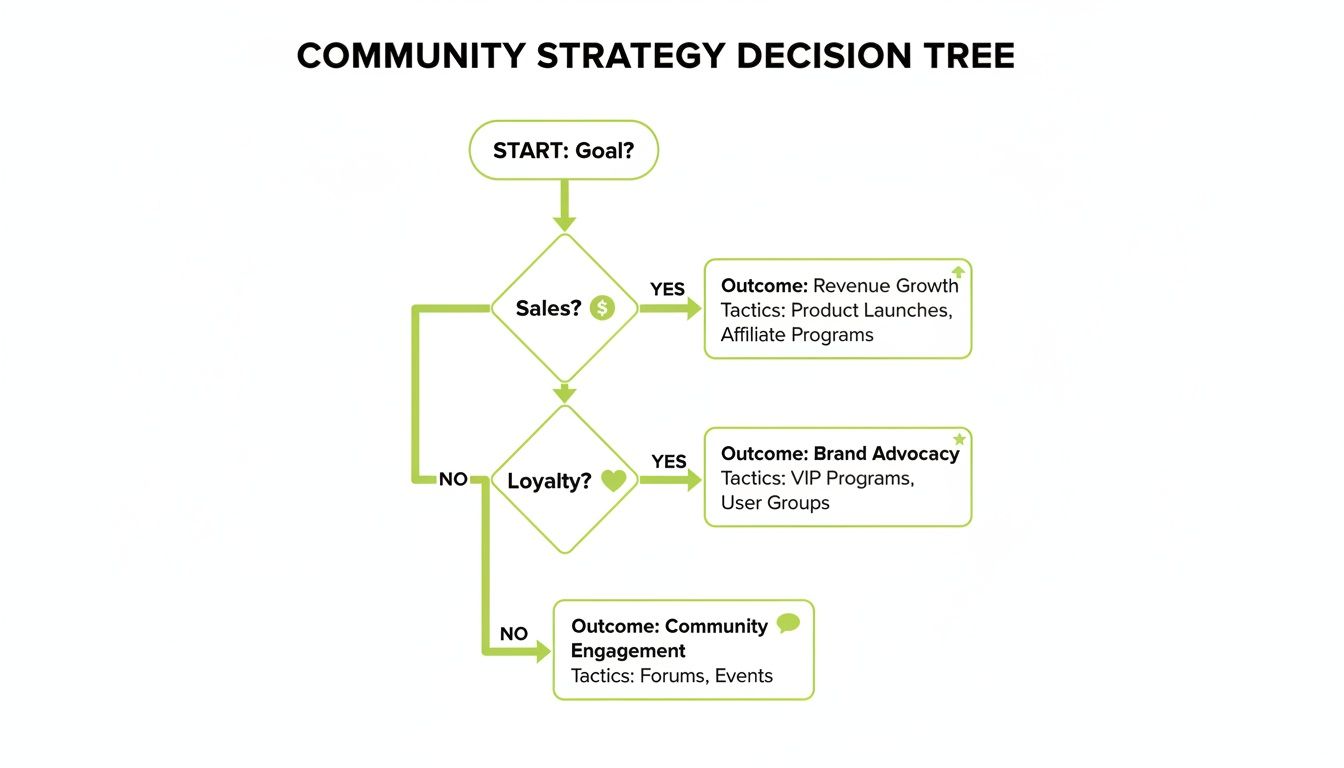
The big takeaway here is that your goals dictate your tactics. A sales-focused community will lean into offers and product deep-dives, while a loyalty-driven community is all about exclusive content and sparking connections between members.
Create Your Channel Blueprint
Once you have a crystal-clear picture of who you're talking to, the next logical question is where to have the conversation. Choosing the right platform is one of the most critical decisions you'll make, and it’s not about chasing the latest trend. It’s about picking the digital home where your specific personas will feel the most comfortable and eager to participate.
Your Channel Blueprint is your strategic guide for making this choice. You need to weigh the pros and cons of each option against your audience's tech-savviness, their current online habits, and, of course, your business goals.
Let's walk through a real-world scenario. Imagine an agency offering high-ticket coaching to seasoned entrepreneurs. They need a space for deep, focused discussions and high-value networking.
- A Facebook Group seems easy, but it’s full of distractions from the main feed, and the algorithm can be a nightmare, burying important posts.
- A Discord Server is fantastic for real-time chat, but it can feel chaotic and overwhelming for an audience that prefers structured, thoughtful dialogue over rapid-fire messages.
- A dedicated platform like Circle or Mighty Networks offers a focused, brandable space free from outside noise. It lets you organize topics, host courses, and run events—a much better fit for that "busy entrepreneur" persona.
To help you decide, it's useful to compare the most common options side-by-side.
Choosing Your Primary Community Platform
This table breaks down some of the most popular platforms to help you find the right fit for your goals, audience, and technical needs.
| Platform | Best For | Key Feature | Potential Downside |
|---|---|---|---|
| Facebook Groups | Businesses with an existing, large Facebook audience and a need for quick setup. | High user familiarity and built-in discovery features. | Algorithm unpredictability, numerous distractions, and limited customization. |
| Discord | Gaming, tech, or creator communities that thrive on real-time, informal chat. | Excellent voice channels and robust moderation bots. | Can be overwhelming for new users and lacks threaded, long-form discussion. |
| Slack | B2B communities, coaching groups, or internal teams needing project-based collaboration. | Powerful integrations and organized channels for specific topics. | Can become expensive with scale, and the focus is on productivity over social connection. |
| Dedicated Forums (Circle, Mighty Networks) | Brands wanting full control, monetization options, and a premium, focused experience. | Brandable interface, integrates courses/events, no distractions. | Higher cost and requires migrating users to a new platform. |
Ultimately, your choice of platform is a huge factor in shaping your community's culture. It dictates how members interact, how content is consumed, and what the overall vibe feels like. By carefully matching your personas to the right channel, you create an environment where your community doesn't just exist—it thrives.
Creating Your Content and Conversation Playbook
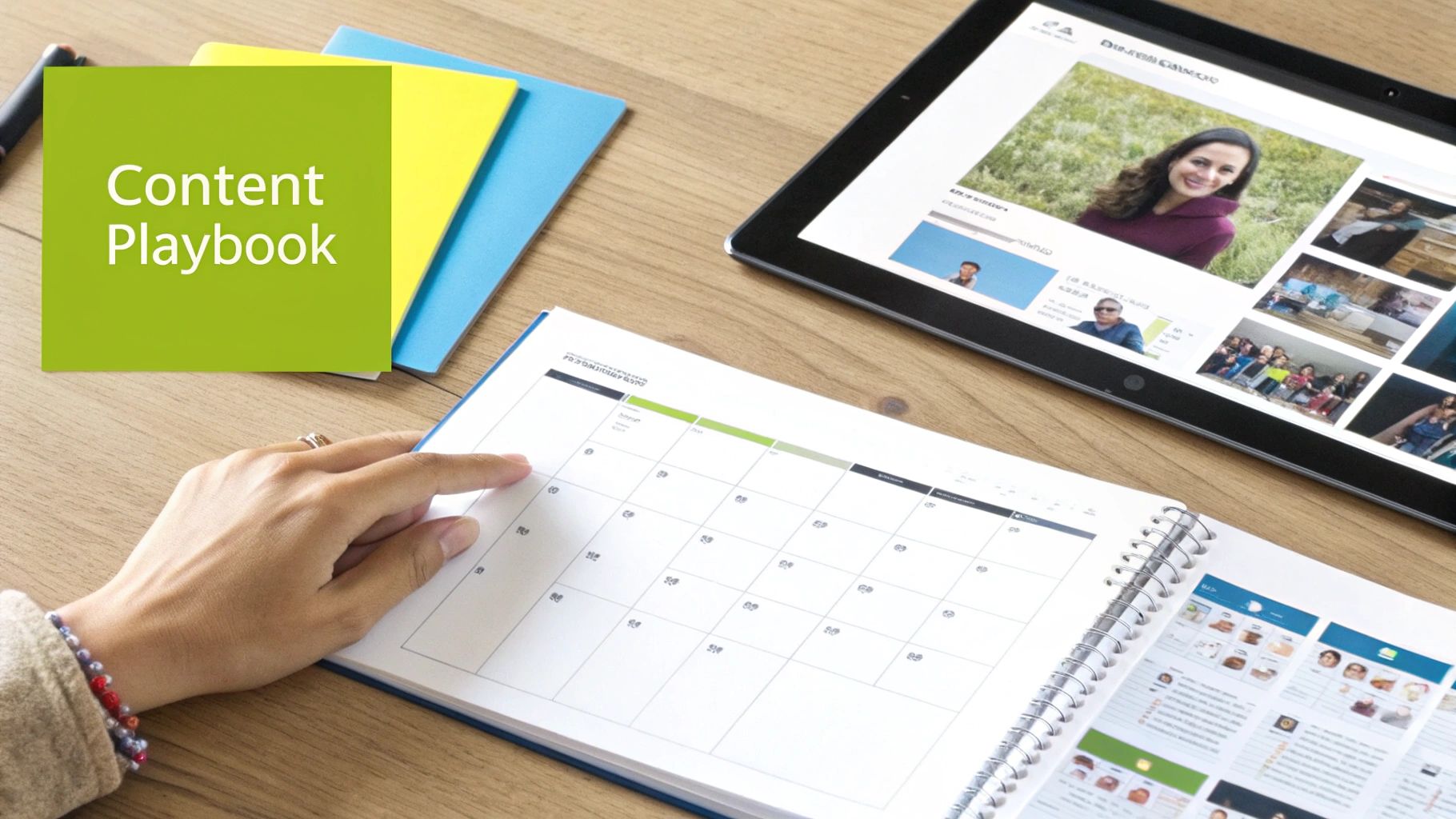
An engaged community doesn't just happen on its own—it needs fuel. Consistent, valuable content and genuine conversation are the engine that powers daily interaction. Once you’ve figured out who your members are and where they hang out online, it's time to build that engine. This is your content and conversation playbook, the practical guide that will turn passive observers into active, loyal fans.
Forget vague advice like "post more often." A powerful community strategy is built on specific content pillars that are a perfect match for your brand and your audience's interests. Think of these pillars as the core themes you’ll hit again and again, ensuring your content always feels relevant and true to who you are.
Establish Your Core Content Pillars
Your content pillars are your North Star. They keep you from falling into the trap of posting random, disconnected stuff that confuses your audience. A solid set of pillars should always balance value, connection, and a light touch of promotion.
Let's see how this works in the real world:
For a Local Business (like a boutique fitness studio):
- Behind-the-Scenes Peeks: Show off new equipment, introduce your amazing instructors, or give a glimpse of class prep. Make people feel like they're part of the inner circle.
- Client Success Spotlights: Celebrate a member's milestone (with their permission, of course!). Share their journey to inspire others.
- Local Wellness Guides: Post about the new farmer's market, a healthy café down the street, or a great local hiking trail. Become the go-to resource for a healthy lifestyle in your town.
For an E-commerce Brand (selling a direct-to-consumer skincare line):
- User-Generated Content (UGC) Features: Run contests asking customers to share their skincare routines using a branded hashtag. Feature the best ones!
- Live Q&As with the Founder: Host a session where the founder gets real about product ingredients, the brand's mission, or their own skincare struggles.
- Exclusive Product Previews: Give your community the first look at what’s coming next. This makes them feel like true insiders and builds serious hype.
These pillars give you a repeatable formula. When you’re stuck on what to post, just circle back to one of your core themes. It’s a surefire way to stay consistent.
Design a Simple Weekly Content Calendar
Consistency is the lifeblood of any community. A content calendar is what turns your big ideas into a concrete, actionable plan. And it doesn't need to be some monster spreadsheet, either. Often, a simple weekly template is all you need to get the ball rolling.
A balanced calendar makes sure you're not just selling 24/7. A great rule of thumb is the 4-1-1 rule: for every one promotional post, share one piece of relevant content from another source and four pieces of your own original, value-packed content.
Here’s a sample weekly rhythm for a coaching business:
| Day | Theme | Content Example |
|---|---|---|
| Monday | Motivation & Mindset | A short, punchy post with a powerful quote, asking members to drop their #1 goal for the week in the comments. |
| Tuesday | Tactical Tip | A 90-second video explaining a quick productivity hack they can use today. |
| Wednesday | Community Spotlight | A "Win of the Week" thread where everyone can share a recent success, no matter how small. |
| Thursday | Live Q&A | A 20-minute live session answering pre-submitted questions on a specific, juicy topic. |
| Friday | Curated Resource | A link to a must-read article or podcast episode from another expert in your field. |
| Saturday | Promotional | A soft-sell post about an upcoming workshop or a limited-time coaching spot. |
| Sunday | Connection & Reflection | An open-ended question like, "What was the biggest lesson you learned this week?" |
This kind of structure creates a predictable rhythm that your members will start to look forward to. For a deeper dive, check out our guide on building a https://silverspoonagency.com/social-media-content-calendar/ that plugs right into your bigger marketing picture.
Spark Conversations and Create Rituals
Posting great content is only half the job. The other half? Getting people talking. Proactive engagement is what turns a quiet group into a buzzing, dynamic community. Your role is to be the host of the party—sparking discussions and making everyone feel seen and heard.
The best community managers don't just post content; they architect conversations. They ask compelling questions, celebrate members, and create shared experiences that build genuine bonds.
You need to move beyond lazy questions like, "How's everyone doing?" Go deeper. Ask questions that get people telling stories and connecting on a real level.
- Instead of "What are your goals?" ask, "What's one goal you're secretly terrified to pursue, and why?"
- Instead of "Any questions?" ask, "What's the #1 thing holding you back from [achieving X] right now?"
Better yet, create community rituals. These are the unique traditions that build culture and give members a reason to keep coming back. A "Win of the Week" thread, "Member Monday" spotlights, or even a fun weekly poll can become beloved staples. Running a poll that asks members to vote on the next blog topic not only drives engagement but also gives you priceless market research.
To make your life easier, find ways to work smarter, not harder. You can easily repurpose long-form videos into a pipeline of engaging short-form clips for social media. A great tutorial on How to Create YouTube Shorts From Existing Video can show you how to get the most mileage out of every piece of content, making your community strategy both effective and sustainable.
Using Technology to Create Deeper Connections
While real conversations are the heart of any community, the right technology is the nervous system—it creates faster, deeper, and more memorable connections that stick. These days, powerful tools aren't just for massive corporations with bottomless budgets. Smart, accessible tech now lets local businesses, e-commerce stores, and coaches create genuine "wow" moments that build fierce loyalty and actually drive sales.
The point isn't to use tech just for the sake of it. It’s about being strategic. We want to bridge the gap between the digital and physical worlds, making your community members feel uniquely seen and valued. When you get this right, it feels less like marketing and more like a little bit of magic.
Hyper-Local Engagement with Geofencing
Imagine being able to connect with people the very moment they’re most likely to engage with your business. That’s the power of geofencing. It’s a location-based tech that triggers an action—like a push notification—when someone’s phone enters a virtual boundary you’ve defined.
It’s not as sci-fi as it sounds, and for a local business, it’s an absolute game-changer.
Practical Example: The Neighborhood Coffee Shop
A coffee shop owner is trying to get more people in the door during the slow afternoon lull. She uses a simple geofencing tool to draw a two-block virtual circle around her shop. Now, when a customer from her loyalty program walks into that zone between 2 PM and 4 PM, their phone buzzes.
The notification is personal: "Hey, you're nearby! Pop in for a free pastry with your next latte."
This works because it’s timely, relevant, and feels exclusive. A generic promotion just became a helpful, serendipitous nudge that feels like it was meant just for them. It’s all about providing real value at the perfect moment.
Immersive Experiences with Augmented Reality
Beyond just location, you can create immersive experiences that let your community play with your products in their own space. Augmented Reality (AR) overlays digital information onto the real world through a smartphone camera. It’s become a surprisingly practical tool for brands of all sizes.
AR’s real magic is how it removes friction from the buying process. It answers the crucial question every online shopper has: "But how would this look in my life?" This is huge for e-commerce brands where customers can’t physically touch the products.
By allowing customers to visualize products in their own environment, AR transforms the abstract idea of a purchase into a tangible, personal experience. This visualization builds confidence and dramatically shortens the path to conversion.
Practical Example: The Online Furniture Brand
An e-commerce furniture brand wants to help its community make confident buying decisions. They create a simple AR filter for Instagram that lets users "place" a virtual version of a new sofa right in their living room.
A community member can then snap a picture of the virtual sofa in their space and share it in the brand’s private Facebook group. They post, "What do you all think of this color in my living room?" Suddenly, they get instant, trusted feedback from fellow design lovers.
What was once a lonely shopping decision has just become a collaborative community event. This doesn’t just drive sales; it deepens engagement by sparking peer-to-peer conversations centered around the brand’s products. That’s a modern community strategy in action.
Of course, to deliver these kinds of personalized experiences at scale, you need a unified view of your audience. You can learn more about how brands consolidate information by exploring the role of customer data platforms in modern marketing.
Measuring Community Health and Business Impact
So, you've laid the groundwork and rolled out your playbook. Now for the big question: how do you know if any of it is actually working? To keep the higher-ups happy and justify your budget, you need to draw a straight line from community chatter to business results. That means moving way past vanity metrics like total member count.
Forget the superficial numbers. We're focusing on Key Performance Indicators (KPIs) that tell the real story about your community's health and, more importantly, its impact on the bottom line. A great strategy isn't just about sparking conversations; it's about proving a tangible return on investment (ROI).
Tracking Core Community Health Metrics
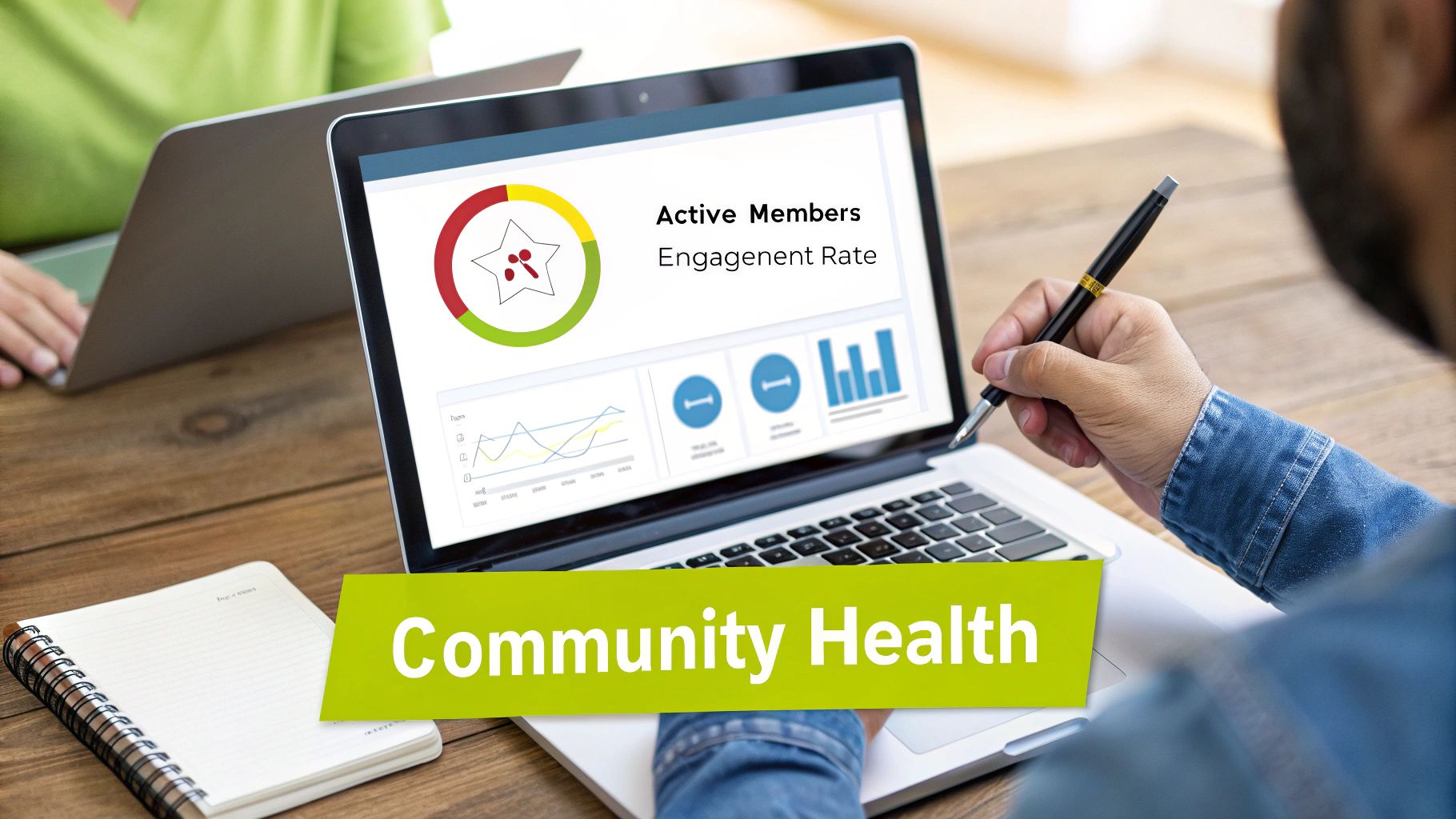
Before you can ever connect community to revenue, you have to get a feel for its pulse. Is it thriving or just… there? A healthy community is an active one, and tracking who is participating—and how often—is your real-time checkup.
These foundational metrics are your canary in the coal mine. They tell you if your content is hitting the mark and if members are genuinely connecting. Get these right, and you can spot problems long before they start hurting your business goals.
Here are the essential health metrics I always keep an eye on:
- Active Member Rate: This isn't your total member count. It’s the percentage of members who posted, commented, or reacted in a specific window, like the last 30 days. A high rate here means you've got a genuinely participatory group.
- Engagement Rate: Take your total number of engagements (posts, comments, likes) and divide it by your number of active members. This shows you how deep the interaction goes. Are people just lurking, or are they diving in?
- User-Generated Content (UGC) Percentage: What slice of the content pie is coming from members versus your team? A high UGC rate is a golden sign that your community is becoming self-sustaining and members feel a real sense of ownership.
A healthy community isn't just large; it's alive. I'd take an engaged group of 100 over a silent army of 10,000 any day. The ratio of active-to-total members tells you so much more than the total count ever will.
Connecting Community Activity to Business Goals
Once you've got a solid read on community health, it's time to connect the dots to actual business outcomes. This is where you prove the ROI and show stakeholders how engaged members behave differently than everyone else.
It takes a bit of strategic tracking, but the payoff is huge. By isolating the behavior of community members, you can put a real dollar value on their impact on sales, retention, and customer value.
This is where the industry is heading. Bevy's top metrics for 2025 are all about tracking daily, weekly, and monthly active users to see if a community's pulse is organic or just propped up by scheduled events. Leadership wants proof that engagement builds loyalty and drives revenue. The days of chasing likes are over. For a deeper look, you can learn more about these key community engagement metrics.
Here are two powerful ways to measure business impact:
- Measure Community-Influenced Revenue: The simplest method? Create exclusive discount codes or unique affiliate links just for your community. Every time a sale comes through that code, you can directly attribute that revenue to your efforts. Simple and effective.
- Compare Customer Lifetime Value (CLV): This one is the gold standard. Segment your customer data to compare the average CLV of community members against non-members. If the CLV for members is significantly higher, you have definitive proof that your community builds loyalty and encourages repeat business.
A Simple Framework for A/B Testing Your Tactics
A great community strategy isn't set in stone; it breathes and evolves. The only way to get better is to constantly test your assumptions with real data. A/B testing lets you make small, controlled tweaks and see what actually moves the needle on engagement.
This doesn't have to be some complex, lab-coat-and-goggles experiment. The goal is to isolate one variable, see how your community responds, and then double down on what works.
Here’s a dead-simple testing framework you can start using today:
- Formulate a Hypothesis: Start with an "if-then" statement. For example: "If we post a short video instead of a text-based question on Fridays, then we will see a higher comment rate."
- Run the Test: Make the change for a set period, like four weeks. Post a video every Friday and keep everything else consistent.
- Analyze the Results: At the end of the test, compare the average number of comments on the video posts to your baseline average from the old text posts.
- Iterate or Adopt: Did the videos crush it? Great, that's your new Friday plan. If not, no big deal—stick with what you were doing or cook up a new hypothesis to test.
By constantly testing things like post format, timing, and question types, you can systematically dial in your approach. This data-driven process gives you the confidence to report on your progress and prove your community’s growing value.
Common Questions on Building a Community Strategy
Jumping into community building always brings up a ton of questions. It's completely natural to wonder about the "what ifs" when you're putting real time and money into a new game plan. This section tackles the most common hurdles with direct, no-fluff answers to help you move forward with confidence.
How Do I Handle Negative Feedback or Conflict?
First rule: don't panic. And definitely don't hit that delete button.
Publicly addressing conflict or negative feedback with transparency is one of the most powerful ways to build trust. Everyone is watching to see how you react, and a calm, fair response shows you're a strong leader, not a dictator.
Acknowledge the person's feelings and immediately aim to move the conversation to a private channel like DMs or email. A simple, "I hear your frustration, and I want to understand this better. I'm sending you a DM right now so we can sort this out," works wonders. It shows the community you’re on it without letting the issue turn into a public spectacle.
What If No One Is Engaging at the Start?
It's going to be quiet at first. Every single great community starts out as a bit of a ghost town. The key is patience and persistence. In the beginning, you and your team will likely have to be the life of the party.
Here are a few tactics to get that initial spark going:
- Tag specific members you think would have a great answer to a question. A personal nudge can make all the difference. For example: "Great question about email deliverability! Tagging @JaneDoe because she's a pro at this."
- Ask super specific, low-effort questions. Instead of a vague "What's on your mind?" try something like "What's one tool you can't live without for [your niche]?" or "Share a photo of your workspace right now."
- Recruit a small crew of "founding members." Personally invite a handful of your most loyal customers to join first and ask them to help get conversations rolling. Give them early access or a special title to make them feel valued.
How Do I Prove the ROI of My Community?
This is the big one, isn't it? To prove your community's value, you have to connect its activity directly to business outcomes. While engagement metrics are great for a health check, leadership wants to see the impact on revenue and retention.
Start by tracking community-influenced revenue. You can do this with member-exclusive discount codes or dedicated links. You should also be comparing the customer lifetime value (CLV) of your community members against non-members. If your members stick around longer and spend more, you've got a powerful story to tell. For instance, you could run a report showing that community members buy, on average, 2.5 times per year, while non-members buy only 1.2 times. That's a hard number you can take to the bank.
The ultimate goal is to shift the conversation from "How many members do we have?" to "How are our members contributing to business growth?" This focus on tangible outcomes is what separates a cost center from a revenue driver.
The creator economy has already proven how powerful engaged communities can be for monetization. Influencer marketing, a key community-led tactic, is projected to hit $37 billion in U.S. ad spend by 2025. This trend positions community partnerships as critical trust-distribution engines—something we see daily with clients from e-commerce brands to coaches who need scalable leads. As customer experience continues to evolve, community-led engagement is becoming a core part of the infrastructure, as you can see from these emerging trends in community and social engagement.
At Silver Spoon Agency, we specialize in building performance-driven community and advertising strategies that turn engagement into measurable growth. If you're ready to create a loyal audience that fuels your bottom line, let's connect.