


10 Powerful Data Driven Marketing Examples to Inspire You in 2025

In a market where every click and impression counts, 'data-driven' has evolved from a popular buzzword into the fundamental standard for achieving measurable growth. Traditional marketing strategies, often guided by intuition, are giving way to precise, predictive models that transform advertising from a cost center into a reliable revenue-generating science. The core question is no longer if data should guide decisions, but how to apply it for maximum impact. This shift requires moving beyond abstract concepts to see what high-performance campaigns look like in the real world.
This article is designed to do exactly that. We will dissect 10 practical and powerful data driven marketing examples from various industries, including e-commerce, local services, and healthcare. Instead of offering vague success stories, we provide a detailed strategic breakdown for each case. You will learn about the specific objectives, the data sources utilized, the exact tactics deployed, and the concrete results achieved. We will also explore the creative and technological tools behind these wins, from AI-powered personalization engines to hyperlocal geofencing and advanced sales funnels.
Each example is structured to provide actionable takeaways you can adapt for your own business. You’ll see how integrating the right data points can lead to significant performance boosts, such as a 4X return on ad spend (ROAS). Prepare to see how raw information is refined into a powerful, predictable growth engine that drives tangible business outcomes.
1. Predictive Analytics for Customer Behavior
Predictive analytics uses historical data, statistical algorithms, and machine learning techniques to identify the likelihood of future outcomes. Instead of reacting to customer actions, this data-driven marketing example allows businesses to anticipate them. By analyzing past behaviors, such as purchase history, website navigation patterns, and email engagement, marketers can forecast which customers are most likely to convert, which are at risk of churning, and what products they will want next.
This proactive approach transforms marketing from a broad-stroke effort into a series of precise, targeted interventions. It empowers businesses to allocate resources more effectively, focusing on high-value segments and personalizing outreach to prevent customer loss before it happens.
Practical Example: An E-commerce Fashion Retailer Reduces Churn
A mid-sized online fashion retailer noticed its customer churn rate was increasing, impacting overall revenue. They decided to implement a predictive model to identify at-risk customers proactively.
- Objective: Reduce customer churn by 15% within six months by identifying customers likely to stop purchasing and re-engaging them with targeted incentives.
- Data Sources: The retailer analyzed customer data from the past two years, including purchase frequency, average order value, time since last purchase, product categories browsed, and email engagement (opens and clicks).
- Tactics Used: Using their customer data platform, they built a predictive model that assigned a "churn risk score" to each customer. Customers with a score above 80% were automatically entered into a re-engagement workflow. This workflow sent a personalized email offering a 20% discount on their next purchase, followed by an SMS message a week later highlighting new arrivals in their favorite category if they didn't convert.
- Results: After six months, the retailer successfully reduced churn among the targeted high-risk segment by 18%, exceeding their goal. The campaign generated a 4:1 return on investment, accounting for the discounts offered.
Actionable Takeaways
- Start with a Clear Goal: Define the specific outcome you want to predict, such as customer churn, purchase likelihood, or lifetime value. This focus ensures your model is built for a clear business purpose.
- Gather Relevant Data: Collect clean, consistent data related to your goal. For an e-commerce store, this includes purchase frequency, average order value, cart abandonment rates, and product browsing history.
- Segment and Personalize: Use predictive scores to create dynamic audience segments. For example, target users with a high "likelihood to buy" score with aggressive offers, while sending re-engagement content to those with high churn risk.
Predictive analytics is a powerful tool for any business looking to move from reactive to proactive marketing. To dig deeper into the models and strategies, you can learn more about predictive marketing analytics and how to apply them.
2. Personalization and Dynamic Content Optimization
Personalization delivers customized content, product recommendations, and messaging to individual users based on their real-time behavior, preferences, and historical data. Instead of showing every visitor the same static webpage or ad, this data-driven marketing example uses dynamic optimization to tailor the experience to each person. By analyzing browsing history, past purchases, and demographic information, marketers can present the most relevant content instantly.
This approach transforms digital properties from one-size-fits-all platforms into unique, individual-centric experiences. It boosts engagement, increases conversion rates, and fosters customer loyalty by making users feel understood and valued.
Practical Example: A Travel Website Increases Booking Value
A travel booking website wanted to increase its average booking value by cross-selling relevant add-ons like rental cars, travel insurance, and guided tours. A generic approach was failing to convert.
- Objective: Increase the average order value (AOV) by 10% through personalized recommendations during the booking process.
- Data Sources: The website analyzed real-time browsing behavior (destination searched, travel dates, number of travelers) and combined it with historical data (past bookings, preferred airlines/hotels) and demographic information from user profiles.
- Tactics Used: They implemented a dynamic content engine on their booking confirmation page. For a user booking a family vacation to Orlando, the page would dynamically display offers for a minivan rental and theme park passes. In contrast, a user booking a solo trip to a ski resort in Colorado would see offers for ski equipment rental and travel insurance for adventure sports. The specific offers were tailored based on the context of the trip.
- Results: The personalized recommendations led to a 12% increase in AOV within three months. The take-up rate for add-on services more than doubled compared to the previous, non-personalized system.
Actionable Takeaways
- Combine Behavioral and Contextual Data: Use a mix of data signals for more effective personalization. Combine a user's past purchase history (behavioral) with their current location or device (contextual) to deliver highly relevant offers.
- Implement Fallback Content: Always have a default or generic version of content ready. This ensures a seamless user experience for new visitors or those for whom you have insufficient personalization data.
- Test and Iterate: Use A/B testing to validate your personalization strategies. Test different product recommendations, headlines, or calls-to-action on specific customer segments to see what drives the best results.
Personalization is crucial for cutting through the noise in a crowded digital landscape. To explore how this technology can be applied to ad creatives, you can learn more about dynamic creative optimization and its strategic benefits.
3. Attribution Modeling and Multi-Touch Analysis
Attribution modeling is a data-driven marketing approach used to determine which marketing touchpoints deserve credit for a conversion. Instead of simplistically assigning 100% of the value to the final interaction (last-click), multi-touch analysis tracks the entire customer journey to understand how different channels and campaigns work together to drive a final outcome. This provides a holistic view of the marketing funnel, revealing the true value of top-of-funnel awareness campaigns and mid-funnel nurturing efforts.
This sophisticated analysis allows marketers to optimize their budget allocation, investing more in channels that effectively assist conversions, even if they aren't the final click. By understanding the complete path a customer takes, businesses can craft more effective, integrated campaigns that guide prospects from initial awareness to final purchase. It's a critical example of using data to answer the fundamental question: "Which marketing efforts are actually working?"
Practical Example: A B2B SaaS Company Optimizes Ad Spend
A B2B software company selling a project management tool was struggling to justify its content marketing budget. Their last-click model in Google Analytics attributed most conversions to branded search and direct traffic, making their blog and social media efforts seem ineffective.
- Objective: Accurately measure the ROI of top-of-funnel content marketing and reallocate the budget based on a more holistic view of the customer journey.
- Data Sources: They integrated data from Google Analytics, their CRM (HubSpot), and their advertising platforms (Google Ads, LinkedIn). They tracked touchpoints like blog post views, webinar sign-ups, social media clicks, and paid search interactions.
- Tactics Used: The company switched from a last-click to a position-based attribution model. This model assigned 40% of the credit to the first interaction, 40% to the last, and distributed the remaining 20% among the interactions in between. This immediately highlighted the value of their blog posts and LinkedIn ads in introducing new users to their brand.
- Results: The new model revealed that their blog content influenced over 30% of all eventual demo requests, even though it was rarely the final click. Armed with this data, they confidently doubled their content marketing budget, which led to a 25% increase in qualified leads the following quarter.
Actionable Takeaways
- Implement Comprehensive Tracking: Ensure you have robust tracking in place for every marketing touchpoint. Use UTM codes for all campaigns to feed clean data into your analytics platform.
- Start Simple, Then Evolve: Begin by comparing basic models like first-click and last-click to understand the full scope of your customer journey. As you gather more data, you can graduate to more complex models like time-decay or data-driven attribution.
- Align Models with Business Goals: Choose an attribution model that reflects your primary objective. If your goal is new customer acquisition, a first-touch model might be more insightful. If it's about closing deals with nurtured leads, a position-based model could be more appropriate.
4. Cohort Analysis and Behavioral Segmentation
Cohort analysis groups customers into segments, or "cohorts," based on shared characteristics or experiences within a specific timeframe. Instead of looking at all users as one monolithic group, this data-driven marketing example allows you to track how different cohorts behave over time, revealing powerful patterns in the customer lifecycle, product adoption, and long-term retention. By analyzing users who signed up in the same month, for instance, a business can see how product updates or marketing campaigns impact their engagement differently than earlier or later cohorts.
This method transforms raw user data into a compelling narrative about your customer journey. It highlights when and why users engage, churn, or upgrade, enabling marketers to move beyond surface-level metrics like overall monthly active users and focus on the underlying health and stickiness of their customer base.
Practical Example: A Mobile Gaming App Improves Onboarding
A mobile gaming company noticed that while downloads were high for their new game, a large percentage of users stopped playing after the first week. They used cohort analysis to diagnose the problem.
- Objective: Improve the 30-day user retention rate by identifying and fixing drop-off points in the new user experience.
- Data Sources: They analyzed user data, grouping players into weekly cohorts based on the week they installed the game. They tracked metrics like tutorial completion rate, level progression, and in-app purchase behavior for each cohort.
- Tactics Used: The analysis showed that the "Week 1" cohort, who signed up right after launch, had a much higher drop-off rate after reaching Level 5 than subsequent cohorts. They discovered a difficult boss at Level 5 was causing frustration and churn. For the "Week 4" cohort, they A/B tested a new version of the game that made this level slightly easier.
- Results: The cohort that experienced the easier Level 5 had a 40% higher 7-day retention rate. By comparing the behavior of these distinct cohorts, the company was able to pinpoint a specific product issue and deploy a data-informed fix, significantly improving long-term player engagement.
Actionable Takeaways
- Define Meaningful Cohorts: Group users by a shared, significant event. Common cohorts include acquisition date (e.g., "January 2024 Signups"), acquisition channel (e.g., "Facebook Ads Cohort"), or first action taken (e.g., "First Purchase Cohort").
- Track Key Metrics Over Time: Monitor how metrics like retention rate, average purchase value, or feature adoption evolve for each cohort over weeks or months. This reveals long-term value, not just initial conversion.
- Establish a Baseline: Always compare new cohorts against a historical baseline. This helps you determine if your marketing changes are genuinely improving user behavior or if you're just seeing normal fluctuations.
5. Marketing Mix Modeling (MMM) and Econometric Analysis
Marketing Mix Modeling (MMM) uses comprehensive statistical analysis of historical data to quantify the impact of various marketing and non-marketing activities on a specific business outcome, typically sales. Instead of isolating a single channel, MMM provides a panoramic view, helping businesses understand how different elements like TV ads, digital spend, pricing, and even external factors like economic trends work together. This is a powerful data-driven marketing example for strategic budget allocation.
This holistic approach allows marketers to answer critical questions: What was the ROI of my last TV campaign? How much should I allocate to social media versus search next quarter? By modeling these complex relationships, businesses can optimize their entire marketing budget for maximum impact, moving beyond channel-specific metrics to understand true incremental contribution.
Practical Example: A Retail Chain Optimizes Holiday Ad Spend
A large retail chain with both a physical and online presence needed to plan its marketing budget for the critical holiday shopping season. They wanted to know the most effective mix of TV, radio, digital, and print advertising.
- Objective: Optimize the holiday marketing budget to maximize total sales across both in-store and online channels.
- Data Sources: The company compiled three years of historical data, including weekly ad spend by channel, weekly sales data (broken down by region and online/offline), promotional calendars, competitor advertising data, and economic indicators like consumer confidence.
- Tactics Used: They built an econometric model to determine the contribution of each marketing channel to overall sales. The model revealed that while TV advertising was expensive, it had a significant halo effect, driving increases in both branded search traffic and in-store footfall. It also identified a point of diminishing returns for their search advertising budget, where additional spend was generating minimal extra revenue.
- Results: Based on the model's insights, they reallocated 15% of their search budget into a targeted regional TV campaign and digital video ads. This data-driven shift in their marketing mix resulted in a 10% year-over-year increase in holiday season sales with no increase in the total marketing budget.
Actionable Takeaways
- Prioritize Data Consistency: Effective MMM requires clean, consistent data spanning at least two years. Ensure your data on spend, sales, and promotions is gathered uniformly over time.
- Incorporate External Factors: Your marketing doesn't exist in a vacuum. Include external variables like competitor actions, seasonality, and economic conditions in your model to get a more accurate picture of what truly drives performance.
- Validate and Update Regularly: Don't treat your model as a one-time project. Validate its predictions against actual results using holdout data and update the model quarterly or semi-annually as new data becomes available and market dynamics shift.
6. Customer Segmentation and Micro-Targeting
Customer segmentation is the practice of dividing a broad customer base into distinct subgroups based on shared characteristics. Instead of a one-size-fits-all approach, this data-driven marketing example allows businesses to tailor messaging, offers, and products to the specific needs and motivations of each group. By analyzing demographic data, purchase history, online behavior, and even psychographic traits, marketers can create highly relevant campaigns that resonate on a personal level.
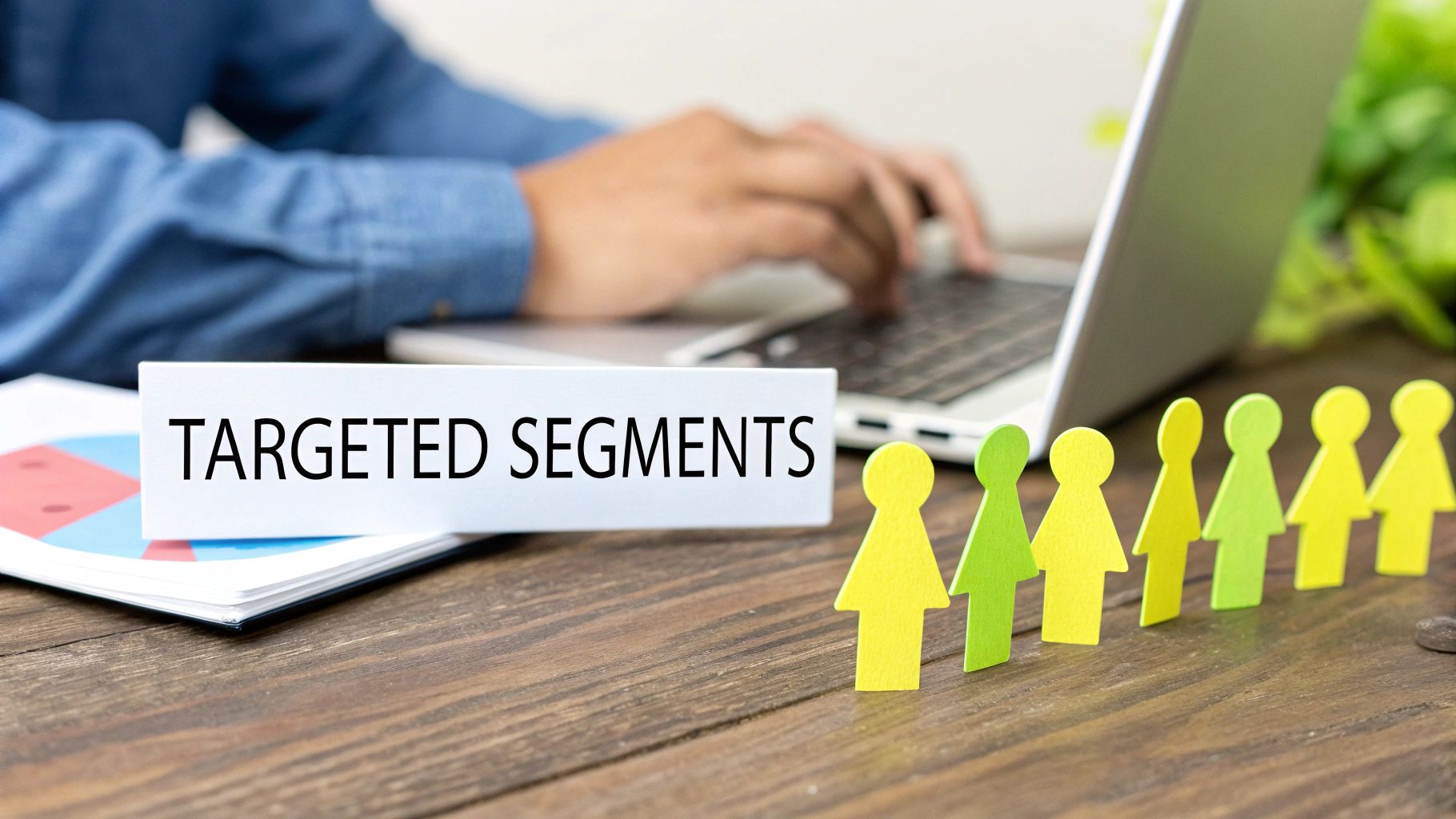
This method moves beyond generic campaigns to enable micro-targeting, where marketing efforts are precisely aimed at small, well-defined audience segments. The result is a more efficient use of marketing budgets, higher engagement rates, improved customer loyalty, and ultimately, a significant lift in conversions and revenue.
Practical Example: A Home Improvement Store Boosts Project Sales
A national home improvement retailer wanted to move beyond selling individual products and instead sell complete project solutions (e.g., "Kitchen Remodel Package").
- Objective: Increase sales of high-value project packages by targeting homeowners with relevant, timely offers.
- Data Sources: They analyzed loyalty card data, identifying customers who had recently purchased items indicative of a specific project (e.g., paint samples, drywall, and spackle for a painting project). They also used third-party data to identify recent homebuyers in specific zip codes.
- Tactics Used: They created distinct customer segments. The "DIY Painter" segment received targeted emails with "how-to" video content for painting a room and offers on painter's tape and brushes. The "New Homeowner" segment was sent a direct mail piece with a welcome discount and a guide to common first-year home projects. This was far more effective than sending a generic weekly circular to everyone.
- Results: The segmented campaigns achieved a 3x higher conversion rate than the company's mass-market promotions. The average order value for the "New Homeowner" segment was 25% higher, as they were more likely to purchase complete project bundles.
Actionable Takeaways
- Start with Value-Based Segmentation: Begin by grouping customers using the RFM (Recency, Frequency, Monetary) model. This identifies your high-value, loyal, and at-risk customers, providing an immediate focus for your marketing efforts.
- Develop Clear Segment Personas: For each segment, create a detailed persona that includes their motivations, pain points, and preferred communication channels. This ensures your messaging is always relevant and empathetic.
- Test and Refine Offers: Before a full campaign rollout, A/B test different offers and messages with a small portion of a segment. Use the results to optimize your approach for maximum impact and ROI.
Effective segmentation requires a unified view of the customer. To learn more about the technology that makes this possible, you can explore the role of Customer Data Platforms in modern marketing.
7. Real-Time Bidding and Programmatic Advertising
Real-Time Bidding (RTB) is a subset of programmatic advertising where digital ad inventory is bought and sold on a per-impression basis, through instantaneous auctions. Instead of buying ad space in bulk, this data-driven marketing example allows advertisers to bid on individual impressions for specific users in real-time. This ensures that ad spend is hyper-focused on reaching the most relevant audience, maximizing efficiency and return on investment.
This automated process leverages user data like browsing history, location, and demographics to decide which ad to show to which user and at what price. The entire auction, from bid to ad display, happens in the milliseconds it takes for a webpage to load. This precision targeting makes programmatic a cornerstone of modern digital advertising.
Practical Example: A Local Car Dealership Drives Foot Traffic
A regional car dealership wanted to increase test drives for a specific SUV model. They needed to reach in-market buyers within a 25-mile radius of their showroom.
- Objective: Increase qualified showroom foot traffic by 20% by targeting local consumers actively researching SUVs.
- Data Sources: The campaign used third-party audience data to identify users who had recently visited automotive review sites like Kelley Blue Book or Edmunds. They combined this with location data (geofencing) to target users physically located within their sales territory.
- Tactics Used: They ran a programmatic display campaign using a demand-side platform (DSP). When a user from their target audience and geographic area visited a website or app with available ad space, the DSP would bid in real-time to show them an ad. The ad creative dynamically displayed the distance to the dealership and a map, with a clear call-to-action to "Book a Test Drive."
- Results: The highly targeted campaign led to a 25% increase in online test drive appointments and a measurable lift in showroom visits. The cost per lead was 40% lower than their previous campaigns using traditional radio and newspaper ads.
Actionable Takeaways
- Leverage First-Party Data: Start with your most valuable asset: your own customer data. Create custom audiences based on website visitors, past purchasers, or CRM lists to build powerful retargeting and lookalike campaigns.
- Test and Optimize Creatives: Programmatic advertising is not just about a single ad; it's about matching the right message to the right person. For instance, programmatic advertising is increasingly sophisticated, leveraging tools such as AI ad creative generators to produce multiple variations for different audience segments, allowing for continuous A/B testing and optimization.
- Implement Brand Safety Measures: Use whitelists, blacklists, and brand safety filters to ensure your ads appear on reputable sites and next to brand-appropriate content. This protects your brand's reputation and prevents wasted ad spend.
8. Customer Lifetime Value (CLV) Optimization
Customer Lifetime Value (CLV) optimization shifts the marketing focus from short-term wins, like a single purchase, to long-term profitability. This data-driven marketing example involves predicting the total revenue a business can reasonably expect from a single customer account throughout the business relationship. By identifying which customer segments will generate the most value over time, marketers can optimize acquisition spending and personalize retention strategies accordingly.
This approach allows businesses to invest more confidently in acquiring high-value customers and tailor experiences to keep them engaged. Instead of treating all leads and customers equally, CLV modeling provides a financial framework for prioritizing marketing efforts, leading to more sustainable and profitable growth. It answers the critical question: "Which customers are worth our biggest investment?"
Practical Example: A Subscription Box Service
A monthly subscription box service, like one for gourmet coffee or beauty products, is a perfect model for CLV optimization. Acquiring a new subscriber has a cost, and profitability depends entirely on how long that subscriber stays and their average order value.
- Objective: Increase overall profitability by focusing acquisition spend on channels that deliver high-CLV subscribers and reduce churn among the most valuable existing customers.
- Data Sources: The model would integrate data from multiple sources, including customer purchase history (subscription length, add-on purchases), acquisition channel data (e.g., Google Ads, Facebook, influencer referral), and customer engagement metrics (email opens, website logins, survey responses).
- Tactics Used: The company first calculates CLV for different customer segments, broken down by the channel they came from. They discover that subscribers acquired via an influencer collaboration have a 30% higher CLV than those from generic paid search ads. Consequently, they reallocate a larger portion of their ad budget to influencer marketing. Simultaneously, they use CLV scores to identify their top 10% of customers and enroll them in an exclusive VIP program, offering early access to new products and personalized discounts to foster loyalty.
- Results: This strategic shift leads to a 25% increase in average customer lifetime value within six months. The company acquires more profitable customers from the start and successfully reduces churn in its most valuable segment, directly boosting long-term revenue.
Actionable Takeaways
- Calculate CLV by Channel: Don't just calculate a single, company-wide CLV. Analyze and break down CLV by the original acquisition channel (e.g., organic search, social media, email). This reveals which channels bring in the most profitable long-term customers, not just the most initial conversions.
- Segment for Retention: Use CLV data to create tiered customer segments. High-CLV customers should receive your best retention efforts, such as loyalty programs, exclusive offers, or dedicated customer support, to protect your most significant revenue sources.
- Guide Acquisition Spending: Let predicted CLV dictate your Customer Acquisition Cost (CAC) limits. You can justify a higher CAC for channels that consistently deliver high-CLV customers, ensuring your marketing spend is an investment in future profitability.
9. A/B Testing and Multivariate Experimentation
A/B testing, also known as split testing, is a controlled experimentation method where two versions of a single marketing asset are compared to see which performs better. Multivariate testing takes this a step further by testing multiple variables and their combinations simultaneously. This data-driven marketing example removes guesswork from optimization, allowing marketers to make decisions based on statistical evidence rather than intuition.

This scientific approach is fundamental for iterative improvement. By methodically testing elements like headlines, calls-to-action, images, or email subject lines, businesses can continuously refine their campaigns for higher engagement, conversions, and ROI. It’s a direct way to understand what truly resonates with an audience.
Practical Example: A Non-Profit Increases Donations
A national charity wanted to increase online donations during its end-of-year fundraising campaign. Their landing page conversion rate was lower than they hoped.
- Objective: Increase the conversion rate on the main donation landing page by 20%.
- Data Sources: They used Google Optimize to run the A/B test and Google Analytics to measure the results, specifically tracking the donation form completion rate and the average donation amount.
- Tactics Used: They formed a hypothesis that the headline "Support Our Cause" was too generic. They ran an A/B test where 50% of visitors saw the original page (Version A) and 50% saw a new page (Version B) with a more specific, impact-oriented headline: "Your $50 Gift Can Provide a Week of Hot Meals." Everything else on the page remained identical.
- Results: Version B with the impact-focused headline had a 35% higher conversion rate. Furthermore, the average donation amount on Version B was 15% higher. This simple, data-validated change generated tens of thousands of dollars in additional donations during the campaign.
Actionable Takeaways
- Test One Variable at a Time: In a standard A/B test, isolate a single change (e.g., the button color or the headline) to ensure you can clearly attribute the performance difference to that specific element.
- Determine Statistical Significance: Don't end a test prematurely. Use a sample size calculator to understand how much traffic you need, and run the test long enough to achieve statistical significance (typically 95% confidence) to ensure results aren't due to random chance.
- Document and Learn: Create a repository of all your test results, including both winners and losers. Failed tests provide valuable insights into what your audience doesn't respond to, helping to shape future hypotheses and avoid repeating mistakes.
10. Social Listening and Sentiment Analysis
Social listening involves using technology to monitor and analyze conversations and mentions related to a brand across social media and the web. By applying natural language processing (NLP) and machine learning, this data-driven marketing example moves beyond simple mention tracking to gauge public sentiment, providing real-time insights into customer opinions, emerging trends, and potential PR crises.
This allows marketers to understand the "why" behind the data, gaining a qualitative understanding of brand perception at scale. Instead of waiting for surveys, businesses can tap into authentic, unsolicited feedback to inform product development, refine messaging, and improve the customer experience.
Practical Example: A Fast-Food Chain Discovers a New Product Idea
A major fast-food chain was monitoring social media conversations to track brand sentiment and campaign performance. They were not actively looking for product ideas.
- Objective: Monitor brand health and identify key conversation themes among their customer base.
- Data Sources: They used a social listening tool like Brandwatch to track mentions of their brand name and key products across X (formerly Twitter), Instagram, TikTok, and public forums like Reddit.
- Tactics Used: The tool's sentiment analysis algorithm flagged a growing number of posts where users were combining two existing menu items: their spicy chicken sandwich and their macaroni and cheese. These user-generated "menu hacks" had overwhelmingly positive sentiment, and some were even going viral on TikTok. The marketing team noticed this unsolicited, organic trend.
- Results: Instead of ignoring the trend, the company embraced it. They launched a limited-time official "Spicy Mac & Cheese Chicken Sandwich" based directly on the social listening data. The product was an instant hit, generating massive social media buzz and exceeding sales projections by 50%, all thanks to paying attention to organic customer conversations.
Actionable Takeaways
- Set Up Crisis Alerts: Configure your social listening tool to send immediate alerts for keywords indicating a crisis (e.g., "outage," "unsafe," "recall"). A rapid response plan is critical for reputation management.
- Combine with Demographics: Analyze sentiment across different audience segments (age, location, gender) to understand how brand perception varies. This can reveal specific regional issues or opportunities. For brands seeking to leverage advanced analytics in their social listening efforts, exploring the latest AI social listening tools can provide deeper insights.
- Inform Your Content Strategy: Use sentiment analysis to identify topics and themes that resonate positively with your audience. If customers are praising a specific feature or benefit, create more content around it to amplify that message.
Comparison of 10 Data-Driven Marketing Tactics
| Approach | Implementation Complexity 🔄 | Resource Requirements ⚡ | Expected Outcomes ⭐📊 | Ideal Use Cases 📊 | Key Advantages & Tips 💡 |
|---|---|---|---|---|---|
| Predictive Analytics for Customer Behavior | High — ML pipelines, retraining required | High — large clean datasets, ML engineers, compute | High predictive accuracy for churn/CLV; proactive targeting (⭐⭐⭐) | Churn reduction, CLV forecasting, upsell/cross-sell | Enables proactive retention; start with core outcome, monitor drift |
| Personalization & Dynamic Content Optimization | High — real-time systems & integrations | High — CDP, personalization engines, infra | Significant conversion uplift (20–30% typical) (⭐⭐) | Ecommerce recommendations, personalized email/website | Improves AOV and engagement; balance personalization with privacy |
| Attribution Modeling & Multi-Touch Analysis | High — cross-channel tracking and modeling | Medium–High — unified tracking, analytics expertise | Clearer channel ROI and budget allocation (⭐⭐) | Multi-channel campaigns, marketing budget optimization | Reveals true channel contribution; align model to business goals |
| Cohort Analysis & Behavioral Segmentation | Medium — longitudinal tracking and grouping | Medium — historical data, analytics tools | Clear retention and lifecycle insights; cost-effective (⭐) | Product adoption, retention analysis, feature impact | Reveals cohort trends; combine with qualitative research |
| Marketing Mix Modeling (MMM) & Econometrics | High — complex statistical and seasonal modeling | High — 2+ years data, econometric/statistical expertise | Strategic long-term budget allocation; accounts for external factors (⭐⭐) | Cross-channel spend planning, offline + online optimization | Good for executive strategy; validate with incrementality tests |
| Customer Segmentation & Micro-Targeting | Medium — clustering and dynamic segmenting | Medium — demographic/behavioral data, segmentation tools | Better targeting and efficiency; higher conversion rates (⭐) | Targeted campaigns, lookalike audiences, RFM-based offers | Enables relevant messaging; avoid over-segmentation and stale segments |
| Real-Time Bidding & Programmatic Advertising | High — complex vendor ecosystem & integrations | High — DSPs, data partnerships, technical ops | Efficient scale and improved ROI vs. traditional display (⭐⭐) | Retargeting, prospecting at scale, programmatic video/display | Prioritize first‑party data and brand safety; monitor fraud/viewability |
| Customer Lifetime Value (CLV) Optimization | Medium–High — predictive CLV modeling & segmentation | Medium — historical transactions, analysts | Increases long-term profitability (25–40% over years) (⭐⭐) | Acquisition spend optimization, retention prioritization | Focus on long-term value; recalc CLV regularly and by channel |
| A/B Testing & Multivariate Experimentation | Medium — experiment design and statistical rigor | Low–Medium — traffic, testing platform, analyst | Reliable incremental improvements; evidence-based wins (⭐) | Landing pages, emails, UX, conversion funnel tests | Ensure sample size and run-time; document learnings for scale |
| Social Listening & Sentiment Analysis | Medium — NLP, monitoring and human review | Low–Medium — listening tools, analyst moderation | Real-time brand and trend insights; early warnings (⭐) | Brand monitoring, crisis detection, product feedback | Validate sentiment samples manually; focus on key channels |
Putting Data to Work: Your Next Steps to Smarter Marketing
Throughout this exploration of data driven marketing examples, a powerful, unifying theme emerges: data is no longer just a byproduct of business operations; it is the central engine of growth, efficiency, and customer connection. We've seen how e-commerce brands use predictive analytics to anticipate customer needs, how local service businesses leverage geofencing and cohort analysis to dominate their markets, and how multi-location retailers apply attribution modeling to optimize a complex web of touchpoints.
The journey from raw information to strategic action is the defining characteristic of modern marketing success. It's about transforming abstract numbers into concrete narratives about your customers. These narratives tell you not just what they buy, but why they buy, when they are most likely to convert, and what truly drives their loyalty. The examples of Customer Lifetime Value (CLV) optimization and A/B testing aren't just academic exercises; they are practical roadmaps to building more resilient, profitable businesses that thrive by deeply understanding the people they serve.
From Insight to Impact: Your Action Plan
Seeing these powerful examples is inspiring, but turning inspiration into implementation is what separates market leaders from the competition. The path forward doesn't require a complete organizational overhaul overnight. Instead, it begins with a commitment to a new mindset, one rooted in curiosity, measurement, and continuous improvement.
Your next steps should be methodical and focused on generating momentum. Here’s a practical framework to get started:
Start with a Single, High-Impact Question: Don't try to boil the ocean. Instead of asking, "How can we use data better?" ask a specific, answerable question. For example: "Which of our marketing channels delivers customers with the highest lifetime value?" or "What is the primary friction point causing cart abandonment in our checkout funnel?" Focusing on one critical question makes the process manageable and delivers a tangible early win.
Audit Your Existing Data Stack: You likely have more data than you realize. Take inventory of your current analytics platforms, CRM software, e-commerce backend, and social media insights. Map out where your customer data lives. Identify the gaps, but more importantly, identify the low-hanging fruit-the readily available data you can activate immediately.
Choose One Example to Replicate: Select one of the data driven marketing examples from this article that most closely aligns with your business goals. If you're a local business, perhaps start with a micro-targeting campaign based on behavioral segmentation. If you're an e-commerce brand, a simple A/B test on your product page headline or call-to-action button is a perfect entry point. The goal is to build a repeatable process and prove the concept's value internally.
Define Your KPIs Before You Begin: Success must be measurable. Before launching any new data-driven initiative, clearly define what success looks like. Is it a 10% increase in conversion rate? A 15% reduction in customer acquisition cost? A 5% lift in average order value? Having clear Key Performance Indicators (KPIs) turns your marketing efforts from an expense into a measurable investment.
The core lesson from these examples is that data empowers you to move from guessing to knowing. It allows you to replace broad, expensive marketing shots in the dark with precise, efficient, and highly personalized campaigns that resonate with your audience on a deeper level. This strategic shift is no longer a luxury for large corporations; it is an accessible and essential strategy for any business aiming for scalable, predictable growth in today's competitive landscape.
If you're ready to transform these insights into a powerful growth engine for your business, the team at Silver Spoon Agency can help. We specialize in implementing the very omnichannel, AI-powered strategies detailed in these data driven marketing examples to deliver measurable ROI. Let's build your custom roadmap to smarter, more profitable marketing today at Silver Spoon Agency.