


Unlocking Growth with Data Science Marketing

Data science marketing isn't about collecting mountains of data for the sake of it. It’s the art and science of using that data—through statistical methods, clever algorithms, and machine learning—to understand your customers on a deeper level, predict what they’ll do next, and make smarter, automated decisions that drive real growth.
This approach goes way beyond traditional analytics, which just tells you what happened. Data science marketing aims to predict what will happen and even prescribe the best way to make it happen. It’s the engine that powers smarter, more effective campaigns that consistently deliver better results.
What Is Data Science Marketing
Think of old-school marketing like fishing with a giant, heavy net. You cast it out into the ocean, hope for the best, and pull in whatever you happen to catch. It's broad, inefficient, and relies heavily on luck.
Now, imagine you had a high-tech sonar system. It doesn’t just show you where the fish are; it pinpoints the exact location of the most valuable schools, predicts their swimming patterns, and even tells you which lure will work best. That’s data science marketing.
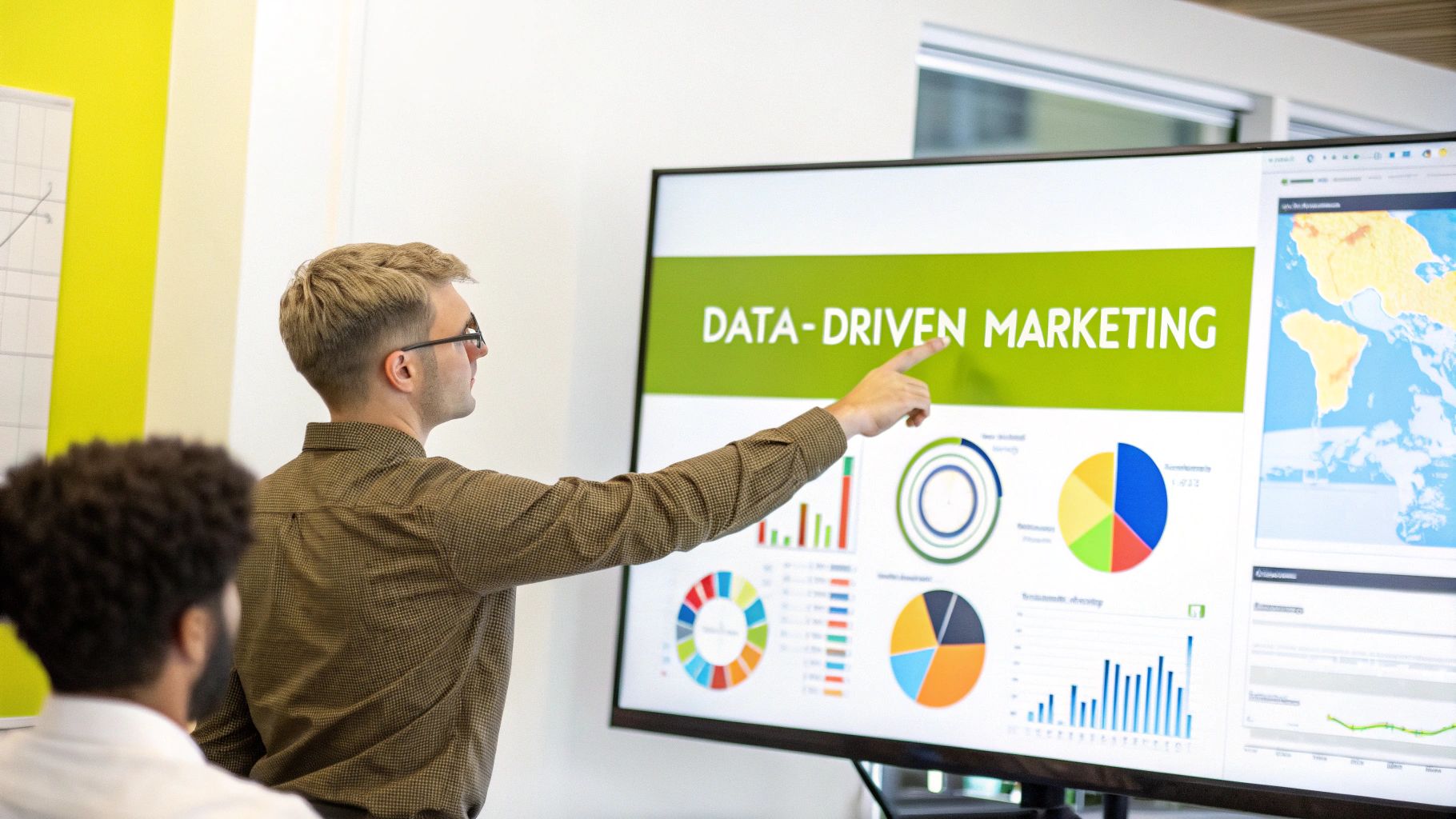
It’s a powerful discipline that transforms raw customer data—from website clicks and purchase history to social media likes—into a strategic roadmap. Instead of running on gut feelings or simply repeating last year's plan, data science marketing uses sophisticated models to find hidden patterns and forecast outcomes with stunning accuracy. This shift from reactive to proactive decision-making is a game-changer for any modern business.
From Guesswork to Growth
For decades, marketers relied on experience and intuition. While those things still have value, they have their limits in a complex digital world. Data science injects mathematical certainty into the creative process, allowing businesses to fine-tune their efforts with incredible precision.
Here’s what that looks like in the real world:
- Predicting Behavior: A subscription box company uses a data model to analyze which customers haven't logged in for 30 days and have low engagement with emails. The model flags them as "high risk for churning," triggering an automated, personalized offer to win them back before they cancel.
- Deep Personalization: Instead of just sending a "Happy Birthday" email, a beauty retailer's AI analyzes a customer's past purchases and recommends a specific new lipstick shade that complements products she already owns.
- Budget Optimization: An e-commerce brand's algorithm analyzes ad performance across Google, Facebook, and TikTok in real-time. It automatically shifts budget away from underperforming TikTok ads and pushes more funds into a high-converting Google Shopping campaign, maximizing return without manual intervention.
This scientific approach means you finally stop wasting money on audiences that will never convert and start doubling down on the opportunities that actually move the needle.
Data science in marketing isn't about collecting more data; it's about asking smarter questions of the data you already have to get better answers. It transforms information into a competitive advantage.
Why It Matters More Than Ever
Today’s customer journey is a tangled web of interactions across countless devices and channels. A potential customer might see your ad on Instagram while on their phone, read reviews on their laptop at work, and finally walk into a store to make a purchase.
Without data science, connecting all those dots is nearly impossible. Marketers are left with a fragmented, often misleading, picture of what actually works.
Data science marketing builds that unified customer view, letting you understand the entire journey from start to finish. For an e-commerce brand, this might mean discovering the exact sequence of touchpoints that creates a high-value, repeat buyer. For a local service business, it could mean predicting which zip codes are poised to generate the most qualified leads next quarter.
Ultimately, businesses that embrace this data-driven mindset don't just compete; they dominate. They adapt to market shifts faster, create intensely relevant customer experiences, and achieve measurable growth that is both predictable and repeatable. This isn't just another trend—it's the new standard for winning at marketing.
The Core Techniques Driving Modern Marketing Success
Data science marketing isn't a single, magical button you press. It’s a collection of powerful, interconnected techniques that work together to turn raw data into actual revenue. Think of it like a master mechanic’s toolbox, where each tool has a specific job designed to make your marketing smarter, faster, and more effective.
Once you get a handle on these core methods, you can start to see how data goes from a simple spreadsheet to a predictable growth engine for your business.

These techniques are the bedrock of modern marketing. They let businesses move past broad, gut-feel assumptions and start engaging with customers on a profoundly personal level. Each one tackles a critical marketing question, from "Who are my really my best customers?" to "What message will actually get their attention right now?"
Advanced Customer Segmentation
Old-school segmentation usually stops at basic demographics like age or location. Data science takes this a giant leap forward, grouping customers based on their behaviors, their actions, and their predicted interests. This creates dynamic, subtle segments that you can actually do something with.
Instead of a vague group like "males aged 25-40," a data model can pinpoint a segment of "late-night browsers who view high-end products but always abandon their carts." That level of detail is where the magic happens, allowing for incredibly specific targeting.
A perfect real-world example is a clothing e-commerce store that used a clustering algorithm to analyze its website activity. The system spotted a group of customers who consistently browsed a specific brand, added items to their cart, but never pulled the trigger. Rather than a generic "You left something behind!" email, the system automatically sent a time-sensitive offer just for that brand. The result? A 35% increase in conversions from that segment alone. You can find more of these kinds of stories in our guide to data-driven marketing examples.
Predictive Modeling and Lead Scoring
Predictive modeling is the closest thing marketing has to a crystal ball. It uses your historical data and machine learning to forecast what's likely to happen next—like which leads are about to convert or which customers are at risk of leaving.
For sales and marketing teams, this is a game-changer. It allows them to focus their limited time and energy where it will make the biggest impact. After all, why treat every lead the same when you know some are ten times more valuable than others? According to recent studies, a whopping 71% of high-performing companies use predictive analytics to get ahead of the competition.
Imagine a local home renovation company. They use a predictive model to score incoming leads based on factors like the lead source (a specific Google search vs. a general Facebook ad), the services they inquired about, and their zip code. High-scoring leads get an immediate, personal phone call. Lower-scoring ones get an automated email nurture sequence. This simple prioritization doubled the appointment-setting rate for their small sales team.
At its core, predictive modeling shifts your marketing from a reactive stance to a proactive one. You stop waiting for customers to act and start anticipating their needs before they even express them.
Multi-Touch Attribution Modeling
The modern customer journey is a winding road, not a straight line. A buyer might see a social media ad, click an email link a week later, do a Google search, and read a blog post before ever making a purchase. Attribution modeling is the science of giving proper credit to each of these touchpoints along the way.
Simple models like "last-click" attribution are often flat-out wrong because they ignore everything that built awareness and trust beforehand. Data science opens the door to more sophisticated models (like linear, time-decay, or data-driven attribution) that paint a far more accurate picture of what’s truly driving sales.
A B2B software company provides a great case study. Using a data-driven attribution model, they discovered that while email marketing got the "last click" for most demo requests, their technical blog posts and LinkedIn ads were crucial early on. By shifting a portion of their budget from last-click email tactics to top-of-funnel content, they boosted qualified demo requests by 20% without spending a penny more.
Customer Lifetime Value (LTV) Modeling
Let's be honest: not all customers are created equal. Some make one small purchase and disappear forever. Others become loyal, high-spending advocates for your brand. Lifetime Value (LTV) modeling is the technique that predicts the total profit you can expect to make from a customer over their entire relationship with you.
Once you can reliably identify your highest-LTV customers, you can invest more in keeping them happy. For example, a pet supply store could identify its top 10% of customers by predicted LTV and surprise them with an exclusive "VIP" early-access sale. Even better, they can then build a lookalike audience on Facebook to find new prospects who share similar buying habits, ensuring their ad spend is focused on attracting the most profitable new customers. It’s the key to building sustainable, long-term growth instead of just chasing short-term sales.
Personalization at Scale
This is where all the other techniques come together. Personalization at scale is the ability to deliver a unique, one-to-one experience for thousands—or even millions—of people at the same time. And no, this isn't just about using a customer's first name in an email.
We're talking about AI-powered systems that can dynamically change your website content, recommend specific products, and deliver customized ad creative in real-time. For a practical example, think of a travel booking website. When a user who has previously searched for family-friendly beach vacations returns to the homepage, the site automatically shows them deals on all-inclusive resorts in the Caribbean instead of the generic "Top Deals" shown to new visitors. This is all based on an individual's browsing history, purchase data, and predicted interests. When you personalize your campaigns with AI, you make each customer feel seen and understood, which fosters a much deeper connection with your brand.
To make these concepts even clearer, here’s a quick breakdown of how these techniques apply to a small business.
Core Data Science Marketing Techniques Explained
This table breaks down each core technique, its main business goal, and what it looks like in action for a typical small business.
| Technique | Primary Goal | Practical Example for a Small Business |
|---|---|---|
| Advanced Customer Segmentation | Group customers by behavior to create highly relevant marketing messages. | An online coffee roaster segments customers into "Single Origin Fans," "Subscription Lovers," and "First-Time Buyers" to send targeted promotions and content. |
| Predictive Modeling | Forecast future outcomes like lead quality or customer churn to prioritize efforts. | A local gym uses a model to predict which new members are most likely to cancel after 3 months, then proactively engages them with personal training offers. |
| Multi-Touch Attribution | Accurately assign credit to all marketing touchpoints that influence a sale. | A boutique agency realizes their podcast isn't driving direct sign-ups but is a key first touchpoint for their highest-value clients, justifying the investment. |
| LTV Modeling | Identify and focus on the most profitable long-term customers. | A subscription box company identifies customers with the highest predicted LTV and invests in surprising them with free gifts to boost loyalty and referrals. |
| Personalization at Scale | Deliver unique, individualized experiences to every customer automatically. | An e-commerce site uses a plugin to show recently viewed items and personalized product recommendations on its homepage for every returning visitor. |
As you can see, these aren't just abstract theories for mega-corporations. Each technique offers a practical way for any business to stop guessing and start making data-backed decisions that directly lead to growth.
How Data Science Marketing Works in the Real World
The theories behind data science marketing—segmentation, attribution, predictive modeling—sound impressive, but their real magic happens when they're put to work solving actual business problems. Seeing these methods in action is the best way to grasp just how powerful they are. What’s truly remarkable is how adaptable this approach is, working just as well for a global e-commerce store as it does for a local wellness clinic.
Let's shift from the "what" to the "how" and look at some concrete examples. Every industry has its own unique headaches, and data science offers specific, tailor-made solutions that deliver results you can actually measure.
E-commerce: Precision Selling at Scale
For any e-commerce brand, the digital storefront is a goldmine of behavioral data. Every click, every search, every abandoned cart tells a part of a story. The biggest challenge is turning that firehose of information into actual sales, especially when you're dealing with razor-thin margins and cutthroat competition.
A classic e-commerce nightmare is cart abandonment, which hovers around a staggering 70% worldwide. This is where data science steps in to do more than just send a generic reminder.
- The Problem: A customer adds a high-end coffee maker to their cart but gets distracted and leaves the site. The standard "You left something in your cart!" email is easy to ignore and often ends up in the trash.
- The Data Science Solution: Instead of a one-size-fits-all email, a predictive model instantly analyzes this specific customer's profile. It sees they've bought premium coffee beans before and have a history of responding to discount offers. The system automatically triggers a personalized email with a subject line like, "A 10% Welcome Discount on Your Breville Espresso Machine."
- The Result: This smart, data-informed nudge can dramatically increase the chance of that customer coming back to complete the purchase, turning a likely lost sale into real revenue.
This same logic powers smarter product recommendations. Forget showing generic "bestsellers." A sophisticated recommendation engine can analyze a user's viewing history to suggest products that genuinely complement their interests, boosting the average order value in the process.
Local Services: Hyper-Targeting for Main Street
Local service businesses—think wellness clinics, home repair companies, or yoga studios—play on a completely different field. Their entire success hinges on reaching the right people within a tight geographic radius. Pouring ad money into audiences miles away is just setting cash on fire.
This is where geofencing and location-based data become game-changers.
Data science gives local businesses the power to draw a digital fence around their service area, targeting potential customers with surgical precision. It ensures every single ad dollar is pulling its weight.
Imagine a new yoga studio opening in a bustling urban neighborhood.
- The Problem: The studio needs to fill classes but has a shoestring marketing budget. Blanketing the whole city with ads is out of the question—it’s too expensive and wildly inefficient.
- The Data Science Solution: Using geofencing, the studio targets ads only to mobile devices that come within a 3-mile radius. But it gets smarter. The model is refined to prioritize people whose phones are often spotted at nearby gyms, health food stores, or parks. When these high-potential customers are near the studio, they get an ad for a "Free Intro Class for Neighbors."
- The Result: The ad spend is laser-focused on the most relevant, geographically desirable audience. This maximizes foot traffic and new sign-ups while slashing wasteful spending.
Coaches and Consultants: Scoring High-Ticket Leads
For coaches and consultants, the pipeline is often full of leads, but only a tiny fraction are truly ready to invest in a high-ticket program. The real work is sifting through the noise to find the serious prospects without wasting countless hours on dead-end qualification calls.
This is a perfect job for predictive lead scoring.
A lead scoring model acts like a gatekeeper, analyzing every new lead and assigning them a score based on how ready they are to buy.
- The Problem: A business coach hosts a webinar and gets 100 sign-ups. Their team simply doesn't have the bandwidth to call every single person to gauge their interest.
- The Data Science Solution: A model scores each lead based on their actions. Did they watch the whole webinar? Download the workbook? Click over to the pricing page afterward? It can even factor in data like their job title or company size.
- The Result: The system instantly highlights the top 10% of leads with the highest scores. Now, the sales team can pour all their energy into these prime prospects, who are statistically far more likely to become high-ticket clients.
Multi-Location and Franchises: Scaling Success Intelligently
Franchises face a unique challenge: how to replicate a successful formula across dozens or even hundreds of locations while still respecting local market nuances. A marketing campaign that crushes it in Miami might completely bomb in Minneapolis.
Data science is the key to balancing a centralized strategy with local flexibility. By analyzing sales data, customer demographics, and campaign results from every single location, a central marketing team can develop "success templates."
For instance, a national pizza franchise can use data to identify the core ingredients of its most effective promotions (like a "Two for Tuesday" deal). It then uses local data to fine-tune the offer. In a college town, the ads might feature students and run heavily on Instagram. In a suburb, the creative might feature families and be delivered through local digital radio. This data-driven approach keeps the brand consistent while making it feel personal and relevant to each community.
Building Your Data-Driven Marketing Engine
Moving from theory to practice can feel like the biggest hurdle, but building a data-driven marketing engine isn't about flipping a switch overnight. It’s a methodical, step-by-step process of weaving data science into what you’re already doing. This roadmap will get you started without the overwhelm.
The whole journey kicks off with one simple but critical question: What are you actually trying to accomplish? You have to know your destination before you start pulling data or picking out tech.
Step 1: Define Your Business Objectives
Before you even glance at a spreadsheet, you need to define what a "win" looks like. Your marketing goals are the compass for your entire data science strategy. They tell you what data matters, which models to build, and how you’ll measure success.
Are you trying to:
- Increase customer retention? Then your focus should be on building a churn prediction model.
- Boost customer value? You’ll want to develop a Customer Lifetime Value (LTV) model.
- Generate more high-quality leads? A predictive lead scoring model will be your top priority.
Pick one clear, high-impact goal to tackle first. For example, an e-commerce store might decide its main objective is to cut its 70% cart abandonment rate by 15% in the next quarter. A target that specific gives you a clear path forward.
Step 2: Collect and Unify Your Data
Right now, your customer data is probably scattered across a dozen different platforms, creating isolated pockets of information. To see the full picture, you have to break down those silos and pull everything into one central place.
This means gathering data from sources like:
- Your Customer Relationship Management (CRM) system (like HubSpot or Salesforce).
- Your website analytics platform (like Google Analytics).
- Your advertising platforms (Google Ads, Facebook Ads).
- Your e-commerce platform (Shopify, WooCommerce).
The amount of data marketers are dealing with has exploded. Teams are now processing 230% more data per query than they did in 2020. This flood of information comes from juggling an average of 10 different customer touchpoints—everything from social media chatter to ad bids.
Step 3: Assemble Your Essential Technology Stack
You don't need a massive, enterprise-level tech stack to get going. The key is to pick tools that can handle data collection, analysis, and visualization without overcomplicating things. A lean, powerful stack is often more than enough.
Your tech stack is the workbench where you shape raw data into actionable insights. The goal isn't to have the most tools, but the right tools that work together seamlessly.
A solid foundational stack could look something like this:
- Data Warehouse: This is the central hub for all your unified data. Google BigQuery or Amazon Redshift are popular starting points.
- Analysis & Modeling Tool: This is where the real data science happens. Python (using libraries like Pandas and Scikit-learn) is the industry standard for a reason.
- Visualization Tool: You need a way to make sense of the results and share them with your team. Tools like Looker Studio or Tableau are perfect for building insightful dashboards.
To give your marketing engine an extra boost, you can also explore the top AI content creation tools to automate and scale your content efforts based on what the data tells you.
Step 4: Launch a Pilot Project
You’ve got your objective, your data is in one place, and your tools are ready. Now it’s time to prove the concept with a small, manageable pilot project. The goal here is to get a quick win that demonstrates real ROI and builds momentum for bigger things.
Start small and stay focused. Instead of trying to predict churn for your entire customer base, build a model for just one high-risk segment. Rather than overhauling your entire lead process, implement a lead scoring model for a single campaign. For example, a software company could apply a lead scoring model only to leads generated from a recent webinar, track the conversion rate lift, and use those results to justify a wider rollout. This focused approach is the cornerstone of a strong predictive marketing analytics strategy because it lets you test, learn, and refine your models with much lower risk.
This flow chart shows how different industries can apply the same core process.
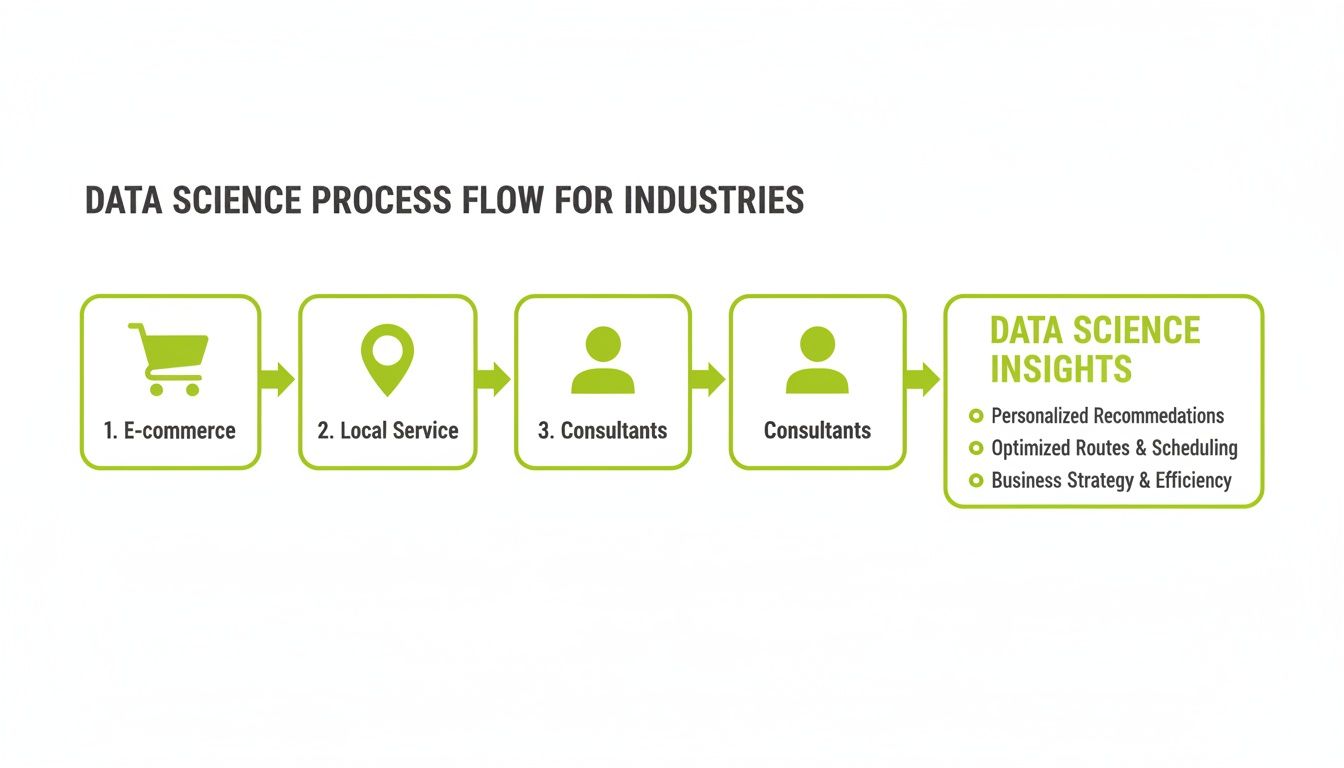
As the visual shows, it doesn't matter if you're in e-commerce, local services, or consulting—the fundamental flow of collecting data, analyzing it, and taking action stays the same. A successful pilot project builds the confidence and buy-in you need to scale your data science marketing across the entire business.
Overcoming Common Data Science Marketing Challenges
Jumping into data science marketing is exciting, but let's be real—it's not always a smooth ride. Like any initiative that promises big returns, this one has its share of hurdles that can stop you in your tracks before you even get going. Knowing how to navigate these challenges is what separates the companies that just talk about data from the ones that actually profit from it.
The biggest roadblocks usually aren't about wrestling with complex algorithms. They're much more fundamental: things like messy data, not having the right people on the team, and a lack of support from the top. Tackling these issues head-on is the only way to build a data-driven strategy that lasts. Think of this as your field guide to getting it right from the start.
Taming the Problem of Dirty Data
You could have the most brilliant predictive model ever created, but it's completely useless if you feed it garbage. This is the classic "garbage in, garbage out" problem, and it's the number one reason data science projects crash and burn. Dirty data—information that’s incomplete, duplicated, or just plain wrong—will poison your insights and lead you to make some very expensive mistakes.
Imagine trying to segment your customers using a CRM packed with old email addresses and duplicate contacts. The results would be a mess. You'd end up throwing your marketing budget at campaigns targeting people who don't exist or couldn't care less. Good data hygiene isn't a one-and-done task; it's a commitment.
To get a handle on it, you need a solid process:
- Audit Your Sources: Get in the habit of reviewing where your data is coming from. Find the leaky faucets and fix them. For example, if your webinar sign-up form doesn't validate email addresses, you'll end up with a high bounce rate.
- Standardize Formats: Make sure basic info like names, addresses, and dates are entered the same way across every single platform. A classic example is state abbreviations: ensure all entries are "CA," not a mix of "CA," "Calif.," and "California." Consistency is key.
- Implement Validation Rules: Set up automated rules at the point of data entry to stop bad information from ever getting into your system. This could be a simple rule on a form that requires a phone number to have 10 digits.
A lot of businesses are turning to specialized tools to automate this cleanup. Well-structured platforms are often the best bet, since they’re built to pull in, centralize, and clean customer information from all over the place. To see how this works in practice, check out our insights on the role of customer data platforms in building a rock-solid foundation.
Bridging the Data Science Talent Gap
Another huge challenge is simply finding people with the right skills. The demand for data scientists and analysts is through the roof, which has created a hiring market that's both competitive and pricey. For many companies, especially smaller ones, bringing a full-time data scientist on board just isn't in the budget.
But a talent gap doesn't have to be a showstopper. There are smart ways to get the expertise you need without breaking the bank.
You don't necessarily need an in-house team of PhDs to get started with data science marketing. The key is to access the right skills strategically, whether that's through upskilling, smart hiring, or finding the right external partner.
Here are a few routes you can take:
- Upskill Your Current Team: Look for the analytically-minded people already on your marketing team and invest in their growth. Giving them access to courses on data analysis, visualization tools, or basic modeling can turn them into an incredible internal asset.
- Hire for "T-Shaped" Skills: Keep an eye out for marketers who have a broad understanding of marketing but also go deep in one analytical area, like data visualization or SQL. They are incredibly versatile.
- Partner with an Agency: The most direct path is to work with a specialized agency. You get instant access to a full team of experts and high-end tools without the overhead of hiring. This lets you focus on strategy while they handle the heavy technical lifting.
Securing Leadership Buy-In and Proving ROI
Finally, you can have perfect data and a brilliant team, but if leadership isn't on board, your data science initiative is dead in the water. Decision-makers are rightly hesitant to pour money into projects they don't fully grasp, especially when the return isn't immediately obvious. The trick to winning them over is to speak their language: results.
Forget trying to explain the nuts and bolts of a machine learning algorithm. Instead, focus on translating your data insights into clear, tangible business outcomes. Start with a small, focused pilot project designed to score a quick, measurable win.
For example, you could kick off a project to:
- Identify a High-Value Segment: Use data to pinpoint your top 10% of customers based on their predicted lifetime value.
- Run a Targeted Campaign: Create a specific, high-touch retention campaign just for that small group.
- Measure the Impact: Track the lift in purchases and loyalty from that segment and present the crystal-clear financial return to your leadership.
By proving the value on a small scale, you build trust and create the momentum you need. That early win is often the key to unlocking the budget and support for bigger, more ambitious data science marketing projects down the road.
How to Measure Your Data Science Marketing ROI
So, you've launched a few campaigns powered by data science. The results feel good, but how do you prove they're actually working? To show you're driving real business growth, you have to look past flimsy metrics like clicks and impressions and zero in on the numbers that actually hit the bottom line.
Measuring the Return on Investment (ROI) from your data science marketing is what connects your team’s hard work directly to revenue. It’s how you translate complex models and sophisticated strategies into the one language everyone in the C-suite understands: dollars and cents.
This isn't about fuzzy math or guesswork. It's about using hard data to prove your value, justify your budget, and show leadership that data-driven marketing isn't a cost center—it's a serious profit driver.
Calculating Your Core Growth Metrics
When you strip everything else away, two numbers tell the most important story about your marketing health: Customer Acquisition Cost (CAC) and Customer Lifetime Value (LTV). Data science lets you calculate these with a scary new level of precision, giving you a crystal-clear snapshot of your profitability.
Customer Acquisition Cost (CAC) is simply the total amount you spend on sales and marketing to land one new customer.
Let's make this real. Imagine a local gym spends $5,000 on a targeted geofencing ad campaign for the month.
- That campaign brings in 50 brand-new members.
- The math is straightforward: $5,000 / 50 = $100 CAC per member.
Knowing your CAC tells you exactly how much you can afford to spend to get someone in the door while still turning a profit.
On the flip side, you have Customer Lifetime Value (LTV). This is a prediction of the total net profit you'll earn from a customer over the entire time they do business with you.
Let's stick with our gym example:
- The average member pays $50 a month and sticks around for 18 months.
- After factoring in costs, the gym has a gross margin of 60% per member.
- The LTV calculation is: $50/month × 18 months × 60% = $540.
The magic happens when you put these two numbers side-by-side. If the gym's LTV is $540 and it costs $100 to acquire a member, you’ve got a healthy 5.4-to-1 LTV to CAC ratio. This simple comparison proves your marketing isn't just an expense—it's a profitable investment generating a fantastic return.
Proving Impact with Attribution Modeling
Knowing your core financials is huge, but you also need to figure out which marketing channels are pulling their weight. This is where attribution modeling comes in. Instead of just giving all the glory to the very last ad someone clicked, modern attribution models intelligently spread the credit across the entire customer journey.
Think about the path someone might take to buy a pair of high-end running shoes online:
- First Touch: They scroll past a brand awareness ad for the shoes on Instagram.
- Middle Touch: A week later, they find and read a blog post on "the best shoes for marathon training" that features your brand.
- Final Touch: Two days after that, they click a Google Shopping ad and finally make the purchase.
A basic, last-click model would give 100% of the credit to that Google ad, completely ignoring the crucial roles the Instagram ad and blog post played in building trust and interest.
But a data-driven attribution model sees the whole picture. It analyzes thousands of similar customer paths to assign a more accurate weight to each step. It might determine that Instagram deserves 25% of the credit, the blog post gets 35%, and the final Google ad gets 40%.
This level of insight lets you prove the value of those top-of-funnel activities that don't lead directly to a sale but are absolutely essential for building a pipeline. When you can show exactly how each channel contributes to the final conversion, you can defend your budget with confidence and fine-tune your entire marketing mix for maximum impact.
Still Have Questions About Data Science Marketing?
Jumping into data science marketing can feel a bit like learning a new language. It seems complex from a distance, but once you learn the basic vocabulary, it's far more approachable than you'd think. We get a lot of questions about it, so let's tackle the most common ones we hear.
Our goal here is to clear up any confusion and give you the confidence to take the next step.
How Much Data Do I Really Need to Get Started?
This is, without a doubt, the number one question we're asked. The answer almost always comes as a relief: you can start with the data you already have. There's a common misconception that you need a perfectly clean, massive database before you can even begin. That's just not true. Starting small is actually the smartest way to go.
Think about the tools you use every day—Google Analytics, your email platform, your CRM. Each of these is a goldmine of information about how customers behave, what they buy, and how they engage with you. This is more than enough to get your first pilot project off the ground.
The point isn't to wait until you have "perfect" data. It's to start asking smarter questions of the data you're already collecting. A simple analysis of your current website traffic and sales patterns can uncover powerful insights that will immediately sharpen your strategy.
Is This a "Big Company Only" Kind of Thing?
Not at all. While the corporate giants with massive budgets tend to grab the headlines, the tools and strategies of data science marketing are more accessible than ever for small and medium-sized businesses. The core principles—understanding your customers and making decisions based on evidence—are universal.
For a smaller business, "data science" doesn't mean you need to build a complex AI from the ground up. It’s about being practical and focused. For instance:
- A local service business can use website data to figure out which blog posts are actually bringing in qualified leads.
- An e-commerce store can analyze purchase history to create a simple "you might also like…" feature.
- A coach or consultant can look at email engagement to see which subscribers are showing all the signs of being ready for a high-ticket offer.
The trick is to zero in on high-impact projects that solve a specific business problem without getting bogged down in complexity. For a small business, one well-executed data project can create a serious competitive advantage.
What’s the Difference Between Data Analytics and Data Science Anyway?
This is a great question, and the distinction is important. People often use the terms interchangeably, but they serve very different functions. Knowing the difference helps you understand what each can do for your business.
Let's use a driving analogy. Data analytics is like looking in your rearview mirror. It's all about examining historical data to understand what has already happened. It answers questions like:
- "What were our top-selling products last quarter?"
- "Which channel drove the most website traffic last month?"
- "How did our email open rates change after that last campaign?"
Analytics gives you the essential reports and dashboards that summarize past performance. It tells you the score of the game.
Data science, on the other hand, is like looking at your GPS and the road ahead. It uses that same historical data to build models that predict what’s likely to happen next and suggests actions to influence those outcomes. It’s about answering forward-looking questions:
- "Which of my current customers are most likely to churn in the next 90 days?"
- "What's the predicted lifetime value of this new customer group?"
- "Which marketing message will most likely convert this specific person into a buyer?"
While analytics is descriptive (what happened), data science is predictive (what will happen) and prescriptive (what should we do about it). Both are absolutely vital, but data science marketing is what gives you the power to actually shape the future, not just create reports about the past.
Ready to stop guessing and start building a predictable growth engine? The team at Silver Spoon Agency specializes in using AI-powered, omnichannel marketing to turn your data into measurable revenue. We orchestrate campaigns that adapt in real time, ensuring your message reaches the right audience at the perfect moment for maximum impact.
Discover how we can help you scale with data-driven precision at silverspoonagency.com