


Demand Capture Vs Demand Generation What’s Best for Growth

The real difference between demand generation and demand capture boils down to a simple question: are you trying to create future buyers or convert current buyers?
It’s the classic farming versus hunting analogy. Demand generation is the farmer, carefully cultivating interest over a long season. Demand capture is the hunter, zeroing in on prey that’s ready to be caught right now. To build a business that lasts, you absolutely need both.
Create vs. Capture: Understanding the Dynamic
At its heart, the demand capture vs demand generation conversation isn't about picking a side. It’s about knowing how each one fuels your growth engine. They target completely different people on completely different timelines.
Practical Example: A company selling a new AI-powered project management tool might run a LinkedIn thought leadership campaign (Demand Generation) to educate managers on the future of workflow automation. At the same time, they run Google Ads targeting the keyword "best alternative to Asana" (Demand Capture) to snag buyers who are already in the market for a switch.
Demand generation is the long game. It’s about educating an audience that might not even know your type of solution exists yet. You're building trust and establishing yourself as the go-to expert, so when they do have a problem, your name is the first one that comes to mind.
Demand capture, on the other hand, is all about capitalizing on interest that's already there. It targets the tiny slice of the market—industry wisdom puts this at around 5% of buyers at any given time—who are actively looking for a fix and ready to pull the trigger. This is about showing up at the exact moment someone is looking to buy.
Key Distinctions in Strategy
To really get it, think about their core functions. Demand generation is proactive; you're building the pipeline for tomorrow. Demand capture is reactive; you're harvesting the leads that are hot today.
To give you a clearer picture, let’s lay out the foundational differences between these two crucial strategies.
Demand Generation vs Demand Capture at a Glance
| Attribute | Demand Generation (Creating Demand) | Demand Capture (Harvesting Demand) |
|---|---|---|
| Primary Purpose | To create awareness and educate a market about a problem and your solution. | To convert existing, high-intent buyers who are actively seeking a solution. |
| Target Audience | Unaware or problem-aware prospects who are not yet looking to buy. | Solution-aware prospects who are actively evaluating their options. |
| Time-to-Impact | Long-term (6-12+ months) with compounding returns over time. | Short-term (days or weeks) with immediate, measurable results. |
This table shows just how different their missions are. One is a marathon that builds brand equity, while the other is a sprint that drives immediate revenue.
A business that only focuses on demand capture will eventually run out of active buyers, and growth will stall. But a business that only generates demand might starve for cash while waiting for those nurtured leads to finally be ready.
Why a Balanced Approach Is Non-Negotiable
A truly successful marketing strategy has to do both. Without generation, your capture channels get more crowded and expensive as you fight over the same small pool of in-market buyers. Without capture, you're just leaving money on the table from people who are ready to sign up right now.
Practical Example: A B2B SaaS company might publish an insightful industry report on "The State of Cybersecurity in 2024" to create demand among IT leaders. To capture existing demand, they also run Google Ads targeting keywords like "endpoint security software" for people who are actively looking to buy a solution. The report fills the top of the funnel for next year, while the ads drive demos this week. For a deeper dive into these concepts, it’s worth understanding push and pull marketing dynamics.
This dual approach is how you build a powerful brand for the future while driving the revenue you need to keep the lights on today.
Demand Generation Strategy for Long-Term Growth

Demand generation is the art of creating a market for your product before anyone is actively looking for it. It’s a long-game investment, focused on audiences who don't even know they have a problem you can solve. This strategy is all about building trust and establishing authority, planting the seeds for future revenue.
Instead of chasing down immediate sales, demand generation aims to educate, inform, and engage potential customers. The goal is to become the first name they think of when the problem you solve finally becomes a priority. It's the foundational work that makes every other marketing effort hit harder.
Core Tactics for Creating Demand
Effective demand generation means providing real value long before you ever ask for a sale. This requires a multi-pronged approach that positions your brand as a helpful expert, not just another vendor.
Here are the key tactics with practical examples:
- Insightful Blog Content: A financial planning firm writes an article titled, "How to Start Investing in Your 20s," which targets a broad audience not yet looking for a financial planner but interested in the topic.
- Educational Webinars: A software company hosts a live session on "Mastering Remote Team Collaboration," providing value to managers and building a list of potential future customers for their product.
- Strategic SEO: An HR tech company targets the informational keyword "employee retention strategies." This gets their brand in front of HR professionals long before they start searching for specific "employee engagement software."
- Community Building: A fitness apparel brand creates a private Facebook group where members can share workout tips and progress photos, fostering loyalty and turning customers into advocates.
These tactics work together to create a powerful engine for organic growth. A fintech brand, for instance, might create a video series that simplifies complex investment topics, attracting an audience that will eventually need its platform. Similarly, a B2B SaaS company could publish a data-backed industry report, becoming the go-to resource for market trends.
Demand generation is the patient architect of markets, crafting awareness from scratch for products or services in unaware audiences. It’s the difference between waiting for customers to find you and creating an environment where they inevitably do.
The Impact on Your Sales Pipeline
This long-term strategy is absolutely essential for building a sustainable and predictable sales pipeline. A pivotal Forrester study drives this point home: firms that excel at lead nurturing—a core part of demand generation—generate 50% more sales-ready leads at 33% lower costs. This approach fuels growth without burning cash on cold traffic that isn't ready to buy.
The results aren't always immediate, but they are compounding. As you build a library of valuable content and a strong brand presence, you create a moat around your business. You become far less reliant on expensive, short-term ads because you own your audience's attention. To do this right, you need a deep understanding of who you're talking to, which is why effective audience segmentation strategies are non-negotiable.
When to Prioritize Demand Generation
While every business needs a balance, some scenarios cry out for a heavier focus on creating demand. Innovators and new market entrants, in particular, must prioritize it. If you're launching a product that solves a problem people don't know they have, you have no choice but to educate them first.
Practical Example: When the first smart home devices like Amazon Echo were released, a huge part of the marketing was demand generation. They had to first create content and ads explaining what a smart speaker is and why you would want one before they could ever capture demand for specific models.
To build a solid foundation for long-term growth, it's crucial to understand precisely what lead generation in marketing entails. This knowledge helps you design campaigns that don't just grab attention but systematically guide potential customers toward a future purchase. Ultimately, a strong demand generation strategy ensures your business isn't just surviving—it's set up to thrive for years to come.
Demand Capture: Mastering the Art of the Immediate Conversion
While demand generation is the long game of cultivating future customers, demand capture is all about winning the sprint for buyers who are ready to pull the trigger right now. This strategy isn't about education; it's about conversion. You're intercepting prospects at the exact moment they’re actively looking for a solution like yours. It’s about being there, being persuasive, and making the sale frictionless when buying intent is red-hot.
The whole philosophy behind demand capture is built on efficiency and speed. Instead of nurturing a relationship over months, you’re jumping in front of people who already know they have a problem and are actively comparing their options. The sales cycle is incredibly short, and the ROI is often immediate and dead simple to measure.
This is the lifeblood for any business that needs predictable revenue and immediate cash flow. By targeting high-intent keywords and behaviors, you connect directly with the most motivated slice of your market.
Essential High-Conversion Tactics
Successfully capturing demand requires a toolkit built for action. These tactics are less about painting with a broad brush for awareness and more about using a scalpel for surgical precision, making sure your brand shows up at that critical decision-making moment.
Here are a few key tactics with practical examples:
- Precision-Targeted Google Ads: A local contractor bids on the keyword "emergency ac repair" to catch homeowners at their moment of urgent need. A SaaS company targets "[competitor name] alternative" to intercept users who are actively shopping for a replacement.
- Paid Social Ads for Competitor Audiences: A project management software company uses LinkedIn ads to target users who follow Asana or Trello, presenting their solution as a more advanced alternative to an already-qualified audience.
The Power of Retargeting and Practical Scenarios
One of the most potent tools in the demand capture arsenal is retargeting. This technique is laser-focused on re-engaging users who’ve already visited your website or interacted with your brand. It’s a simple but powerful reminder of their initial interest, nudging them back to finish what they started. For a deeper look, you can explore what retargeting is in digital marketing to really get into the nuts and bolts.
Let's put this into practice with more examples.
Imagine an e-commerce store sees a visitor add a specific pair of running shoes to their cart but then leave the site. A dynamic retargeting ad can automatically pop up in that user's social media feed, showing them the exact shoes they left behind, perhaps with a 10% discount code to seal the deal. This timely nudge is often all it takes to recover a sale.
Or, consider a local plumbing contractor. They could set up a Google Ads campaign to run only during evenings and weekends, bidding aggressively on the keyword "24/7 emergency plumber near me." This captures urgent, high-value leads at the precise moment of need, driving business through the door immediately.
Demand capture zeroes in on the ready-to-buy crowd—those 5% of prospects actively hunting for solutions—using tactics like paid search, retargeting, and PPC ads. Companies mastering sales and marketing alignment, which amplifies demand capture efforts, clocked a whopping 20% annual revenue growth, while misaligned teams saw revenues plummet by 4%. Discover more insights about demand capture strategies on experiencewelcome.com.
Ultimately, mastering demand capture means you own the bottom of the funnel. It's about being the most visible, most compelling answer when a potential customer asks, "Who can solve my problem right now?" When you nail that, you secure immediate revenue and build serious momentum for your business.
Balancing Your Strategy for Optimal Results
Knowing the difference between demand capture and demand generation is the easy part. The real challenge? Figuring out how to split your time, money, and effort between them. There’s no magic 50/50 formula; the right mix is a moving target that shifts with your company's age, industry, and what you’re trying to accomplish right now. Striking this balance is the key to building a marketing engine that not only brings in cash today but also fuels predictable growth for years to come.
Too many businesses fall into the trap of betting everything on one horse. A startup might go all-in on demand capture with a huge ad spend, see a quick win, then slam into a wall when they’ve exhausted the tiny pool of people already looking for their product. On the flip side, a company purely focused on generation might create incredible, award-winning content but starve for cash flow while waiting for that audience to be ready to buy.
Key Factors That Dictate Your Mix
Your ideal allocation between creating and capturing demand isn't something you can copy from a competitor. It’s deeply personal to your business. While there's no universal recipe, a few key factors will always guide the decision.
- Business Stage: A disruptive startup launching a new type of wearable tech might need to put 80% of its budget into demand generation (e.g., influencer reviews, educational YouTube videos) because nobody knows the product category exists. An established e-commerce brand, however, might use a 50/50 split, running brand-building social campaigns while aggressively capturing sales with Google Shopping ads.
- Product Maturity: If you're selling a complex B2B data analytics platform, you need to educate first with webinars and whitepapers (generation). But if you're a local pizzeria, the game is almost entirely about capture—showing up first on Google Maps when someone searches "pizza near me."
- Industry Competitiveness: In the crowded mattress industry, winning on demand capture alone (bidding on "buy mattress online") is a costly war. Building a trusted brand through demand generation (content about sleep science, positive reviews) becomes a crucial differentiator. In a new niche, like selling AI-powered gardening tools, you have no choice but to create the demand yourself first.
Thinking through these factors is like a quick audit of your current strategy. Are you burning cash on ads while ignoring the customers you'll need next year? Or are you churning out content that never actually turns into revenue?
A Practical Framework for Allocation
Let's get practical. To move from theory to action, just ask one simple question: "What is our number one growth goal for the next 90 days?" The answer will tell you exactly where your focus should be.
Practical Example: A SaaS company needs to hit a specific revenue target this quarter to secure its next funding round. Their immediate priority is cash flow. Their mix might temporarily skew to 80% demand capture, focusing heavily on paid search for demo requests and competitor campaigns. Next quarter, with funding secured, they might shift to 60% demand generation to build a more sustainable long-term pipeline.
This flowchart breaks down the decision-making process. It all depends on whether you have high-intent traffic to convert now or if you need to build an audience from the ground up.
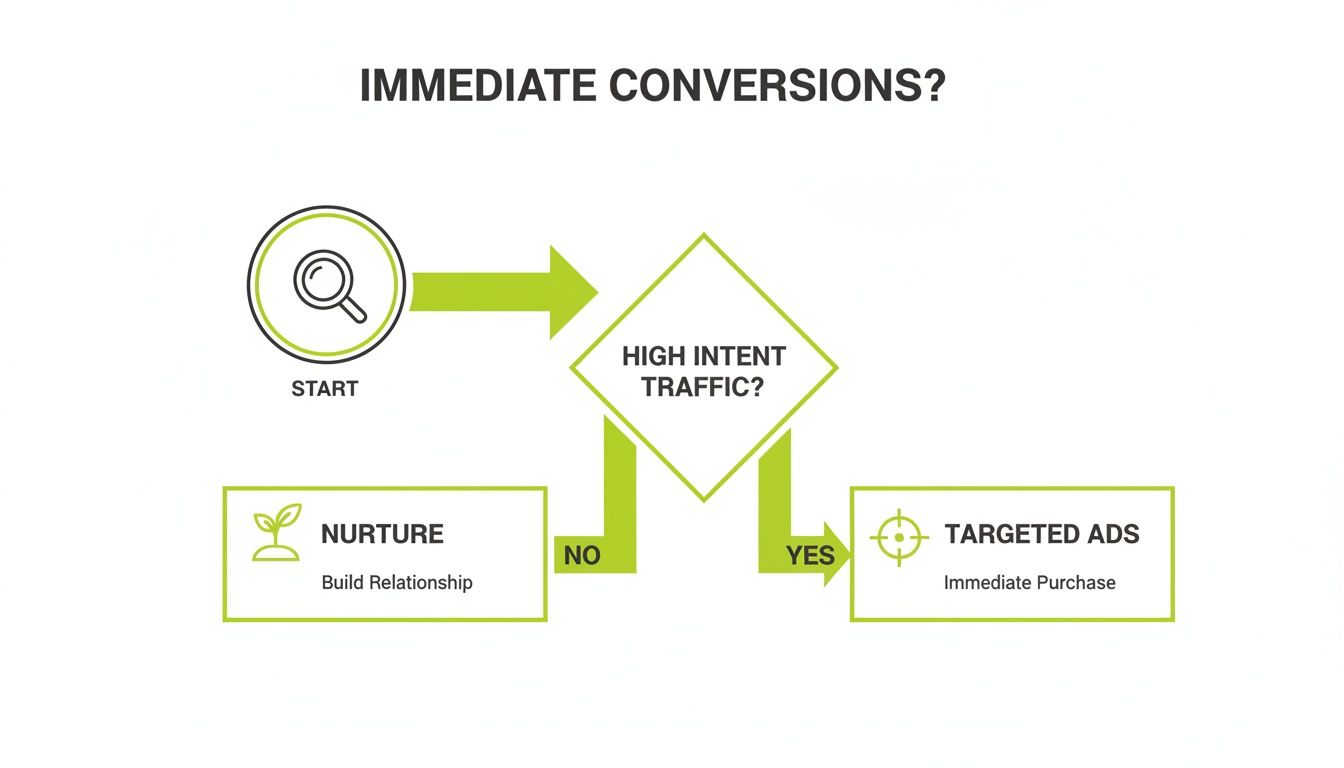
As you can see, the path forks immediately. When you need conversions right away, targeted ads are the answer. Otherwise, your focus has to shift to the longer-term game of nurturing an audience.
This strategic balance is where real, sustainable growth happens. The numbers back it up, too. Research consistently shows that companies who get demand generation right produce 50% more sales-ready leads at a 33% lower cost. When these efforts are paired with smart demand capture, aligned businesses can achieve 20% annual growth, while those who keep them in separate silos often see revenues shrink. You can read the full research about balancing these growth strategies to dig into how a unified approach always wins.
The perfect strategy isn't static. It's a living thing that you must constantly audit and adjust. Your budget allocation this quarter might not be right for the next. The goal is to create a responsive system where generation and capture work together, feeding each other for compounding results.
Ultimately, the whole demand capture vs demand generation debate presents a false choice. The real question isn't which one to do, but how to make them work in perfect harmony. Demand generation fills the pipeline for tomorrow, while demand capture converts the opportunities that exist today. By thoughtfully balancing both, you build a resilient business that can handle market shifts and scale predictably.
Putting It All Together: Playbooks for Your Business Model
Theory is great, but rubber-meets-the-road application is what actually grows your business. The right mix of demand generation and demand capture isn't one-size-fits-all; it shifts dramatically based on who you sell to, how long it takes them to buy, and where you sit in the market.
Let's move from the abstract to the actionable. Below are a few practical playbooks for common business models, designed to give you a concrete starting point. Each one breaks down the strategic blend, specific tactics, a sample budget split, and the core KPIs you should be obsessing over.
Playbook for E-commerce Brands
E-commerce is a dogfight. You're constantly balancing the need for immediate, profitable sales with the long-term goal of building a brand people genuinely love. The winners are the ones who can snag an impulse buyer today while also creating a community that feels loyal enough to come back tomorrow.
The Strategy: Your game plan is a two-pronged attack. Use top-of-funnel content to educate and build trust, then deploy aggressive, bottom-of-funnel ads to convert shoppers who have their credit cards out and ready.
Demand Generation Tactics:
- Video Tutorials & How-Tos: Get your products on YouTube and TikTok in a real-world context. A skincare brand shouldn't just run ads; they should create a tutorial on "Building a 5-Minute Morning Skincare Routine," featuring their products naturally.
- Influencer Collaborations: Find creators who actually align with your brand's vibe and let them create authentic content. This is about borrowing their audience's trust to introduce your products.
- User-Generated Content (UGC) Campaigns: Turn your customers into your marketing team. Run a campaign with a unique hashtag encouraging people to share photos using your product. This builds powerful social proof and gives you a library of authentic content.
Demand Capture Tactics:
- Hyper-Targeted Google Shopping Ads: This is your bread and butter. Make sure you own the top spots for high-intent, long-tail keywords like "buy waterproof running shoes size 10."
- Dynamic Retargeting Ads: Someone looked at a specific product or added it to their cart? Follow them around the internet with ads for that exact product. With cart abandonment rates hovering around 70%, this isn't optional.
- Email & SMS Marketing: These are your warmest leads. Use targeted promotions, back-in-stock alerts, and exclusive content to drive repeat purchases and build lifetime value.
Key Insight: For e-commerce, demand generation builds the audience that your capture efforts monetize. If you only focus on capture, you're stuck in a hamster wheel of paying to acquire one-time buyers, which is a slow and expensive way to die.
Sample Budget & KPIs:
- Suggested Budget Split: 40% Demand Generation / 60% Demand Capture
- Generation KPIs: Video View-Through Rate, Social Engagement Rate, Branded Search Volume
- Capture KPIs: Return on Ad Spend (ROAS), Conversion Rate, Customer Acquisition Cost (CAC)
Playbook for Local Service Businesses
If you're a plumber, dentist, or gym owner, your world is your zip code. The entire game is about being the first and most obvious choice for anyone in your community when they need what you offer. This means building local trust while being instantly findable the second a pipe bursts or a tooth aches.
The Strategy: Pair community-focused brand building and local SEO with ruthlessly efficient paid search campaigns targeting "near me" and emergency searches.
Demand Generation Tactics:
- Local SEO & Content: Write blog posts that answer real questions your community has. A physical therapist could write about the "Best Hiking Trails in [Your City]," while a plumber could detail "DIY Home Plumbing Fixes to Avoid." This builds authority and pulls in valuable local search traffic.
- Community Sponsorships: Sponsoring the local little league team or a town festival isn't just charity; it's brand building. It gets your name out there in a positive, trusted context.
- Google Business Profile Optimization: Treat your Google Business Profile like a second website. Constantly update it with new photos, posts, and Q&A sessions to dominate the local map pack.
Demand Capture Tactics:
- 'Near Me' Paid Search Campaigns: Run Google Ads that are laser-focused on high-intent local searches like "emergency dentist near me" or "HVAC repair [Your Town]."
- Local Services Ads (LSAs): Get on Google's LSA platform. Appearing at the very top of results with a "Google Guaranteed" badge is one of the fastest ways to build instant trust and get the phone to ring.
- Click-to-Call Ads: In local search, friction is the enemy. Optimize your ads for mobile so a user can call you directly from the search results page.
Sample Budget & KPIs:
- Suggested Budget Split: 30% Demand Generation / 70% Demand Capture
- Generation KPIs: Local SEO Rankings, Google Business Profile Views, Website Traffic from Organic Search
- Capture KPIs: Cost Per Lead (CPL), Phone Call Conversions, Appointment Booking Rate
Playbook for B2B SaaS Companies
The B2B SaaS sale is a marathon, not a sprint. It's often a long process involving a whole committee of decision-makers. Your strategy has to be two-fold: educating the entire market to build deep, industry-wide trust over time, while also being there to catch the handful of companies that are actively looking for a solution right now.
The Strategy: Your foundation is in-depth, authoritative content that cements you as a thought leader. You'll pair this with surgical ad campaigns that target competitor keywords and demo requests.
Demand Generation Tactics:
- In-Depth Industry Reports & Whitepapers: Don't just write another blog post. Publish original research or a definitive guide that becomes the go-to resource in your space. This generates high-quality leads who already see you as an expert.
- Educational Webinars: Host webinars that genuinely solve a major pain point for your ideal customer. Focus on teaching, not pitching, until the very end.
- Thought Leadership on LinkedIn: This is non-negotiable. Your executives and subject matter experts need to be actively posting valuable insights, not just company news. They're building their personal brands and your company's brand at the same time.
Demand Capture Tactics:
- Competitor Keyword Bidding: Go after users searching for your competitors by name (e.g., "[Competitor] alternatives"). They've already identified a need; your job is to show them a better way to solve it.
- G2 & Capterra Optimization: Your profile on software review sites is critical. With over 92% of B2B buyers using them to do research, you can't afford to ignore them. Encourage reviews and keep your profile polished. Check out G2 and Capterra for more.
- Demo Request Landing Pages: Build high-conversion landing pages with a crystal-clear value prop and run highly targeted ads on LinkedIn and Google to drive demo sign-ups from prospects who are ready to talk business.
Sample Budget & KPIs:
- Suggested Budget Split: 60% Demand Generation / 40% Demand Capture
- Generation KPIs: Content Downloads, Webinar Registrants, Marketing Qualified Leads (MQLs)
- Capture KPIs: Demo-to-Close Rate, Customer Acquisition Cost (CAC), Sales Qualified Leads (SQLs)
Measuring Success with the Right KPIs
To run a winning strategy, you have to measure what actually matters. The key performance indicators (KPIs) for demand generation and demand capture are fundamentally different—because their goals are worlds apart.
One of the most common pitfalls I see is businesses judging their long-term generation efforts with short-term capture metrics. It's a surefire way to kill sustainable growth before it even has a chance to get going.
Practical Example: A company launches a brilliant podcast (Demand Generation). After two months, the CFO asks for the ROAS (Return on Ad Spend) of the podcast. This is the wrong question. You can't measure a brand-building effort with a direct-response metric. The right KPIs would be audience growth, download numbers, and eventually, an increase in branded search volume.
Demand generation is all about building an audience and creating future opportunities. You measure its success with leading indicators that show brand health and audience engagement building over time.
For demand capture, the focus is immediate and transactional. Success is measured by direct-response metrics tied directly to revenue and efficiency. You're looking for cold, hard proof that your investment is converting high-intent prospects into customers right now.
KPIs for Demand Generation vs. Demand Capture
Knowing which metrics to track for each strategy is crucial. If you apply the wrong KPIs, you'll find yourself abandoning effective, long-term brand-building activities simply because they don't produce the instant results you see in capture campaigns.
A classic mistake is measuring demand generation with last-touch attribution. This model gives 100% of the credit to the final click, completely ignoring the months of content consumption and brand engagement that created the demand in the first place.
Here’s a side-by-side look at the right KPIs for each approach:
| Demand Generation KPIs (Creating Demand) | Demand Capture KPIs (Harvesting Demand) |
|---|---|
| Organic Traffic Growth | Customer Acquisition Cost (CAC) |
| Content Downloads & Gated Asset Views | Return on Ad Spend (ROAS) |
| Email Subscriber Rate & Growth | Lead-to-Close Conversion Rate |
| Branded Search Volume | Cost Per Lead (CPL) |
This comparison really drives home the core difference: generation metrics are about audience growth and influence, while capture metrics focus on conversion efficiency and profitability.
But to truly understand the customer journey, you have to move beyond simple measurement. Exploring the nuances of first touch vs last touch attribution gives you a much clearer picture of how both strategies contribute to your bottom line. Using the right lens for each ensures you build for tomorrow while winning today.
Got Questions? We’ve Got Answers.
Juggling demand capture and demand generation can bring up some real-world questions. Let's clear up a few of the most common ones.
Can a Small Business Just Pick One and Stick with It?
It’s a tempting thought, especially when resources are tight, but focusing on just one is a classic trap. If you go all-in on demand capture, you'll eventually exhaust the small pool of people already looking for you, and your growth will flatline. Go the other way with only demand generation, and you might burn through your cash waiting for those newly-aware prospects to finally be ready to buy.
Even for the smallest businesses, the best move is a smart mix. Practical Example: A solo freelance graphic designer could write one helpful blog post a month on "logo design principles for startups" (generation) while running a very small, targeted Google Ads campaign for the keyword "hire a freelance designer" in their local city (capture).
Where Does SEO Fit into All of This?
SEO is your secret weapon because it does both jobs beautifully. When you create in-depth content that answers broad, informational questions like “how to improve team productivity,” you’re playing the long game of demand generation. You're building authority and getting on the radar of future customers.
But when you optimize for specific, transactional keywords like “best project management software,” you're squarely in demand capture territory. You’re meeting an active buyer at the exact moment they’re ready to make a decision. A well-rounded SEO strategy is one of the single most powerful ways to build a marketing engine that creates and captures demand simultaneously.
Seriously, How Long Until Demand Generation Actually Works?
Look, demand generation isn't about instant gratification; it's about building an asset that pays dividends for years. You’re building an audience that knows, likes, and trusts you. While you might see early signs of life like a bump in website traffic within a few months, it typically takes a solid 6-12 months to see a real, measurable impact on qualified leads and revenue.
Unlike the immediate feedback from a capture campaign, the value here compounds. Practical Example: A B2B company starts a podcast. For the first six months, the only metric is a slow but steady increase in listeners. By month nine, sales reps start hearing prospects say, "Oh yeah, I listen to your podcast." By month twelve, they can directly attribute several large deals to leads who were long-time listeners. That's the compounding effect in action.
Ready to build a marketing engine that both creates and captures demand with precision? Silver Spoon Agency combines AI-powered ad management and conversion-optimized funnels to turn your marketing spend into measurable growth. Discover how we can elevate your strategy today.