


Digital Marketing for Business Growth Your Ultimate 2026 Guide

Digital marketing for growth isn't about throwing ads at a wall and hoping something sticks. It’s about building a unified system of online channels engineered to produce predictable revenue and scale your business. This approach moves past scattered campaigns into an AI-enhanced omnichannel strategy, where every customer interaction is fine-tuned for real-world outcomes like better ROAS and higher lifetime value.
What Is Digital Marketing for Business Growth

Think of strategic digital marketing less like a checklist and more like a high-performance engine. It's a finely-tuned, coordinated system built for one primary purpose: creating measurable, repeatable, and scalable growth.
This modern approach rejects isolated tactics. Instead, it treats every channel—search, social media, email—as an instrument in an orchestra. Each one must play its part in perfect harmony to create a seamless customer experience that actually drives results.
The Shift From Scattered Tactics to a Growth Engine
True digital marketing for business growth is not about running a random Facebook ad or sending a monthly newsletter. It’s about architecting a system where every component amplifies the others. This guide is your strategic blueprint for building that system and achieving tangible outcomes.
We’re focused on the core metrics that deliver real financial returns:
- Higher Return on Ad Spend (ROAS): Making every single advertising dollar work harder and smarter.
- Increased Customer Lifetime Value (LTV): Transforming one-time buyers into loyal, high-value brand advocates.
- Scalable Demand Generation: Building a predictable pipeline of qualified leads and sales.
The scale of this opportunity is staggering. Global digital ad spend is on a trajectory to blast past $1 trillion, projected to hit $1.02 trillion in 2026 and account for over 65% of all media spending. For businesses that master omnichannel strategies across search, social, and display, the payoff is a 4X average ROAS.
An Orchestra of Channels
Let's put this into practice. Picture a local wellness clinic. A potential client might first find them through a targeted Google search for "physical therapy near me" (Search). After browsing the website, they see a retargeting ad on Instagram for a free consultation (Social). The moment they sign up, an automated email sequence kicks in, explaining the clinic’s unique benefits and getting them excited for their first visit (Email).
This is omnichannel orchestration in action. It’s a seamless journey where each touchpoint reinforces the message and moves the customer closer to a purchase, proving why digital marketing is important for your business growth. When executed correctly, this strategy ensures no marketing dollar is wasted and every interaction has a purpose.
Your Core Digital Marketing Growth Channels
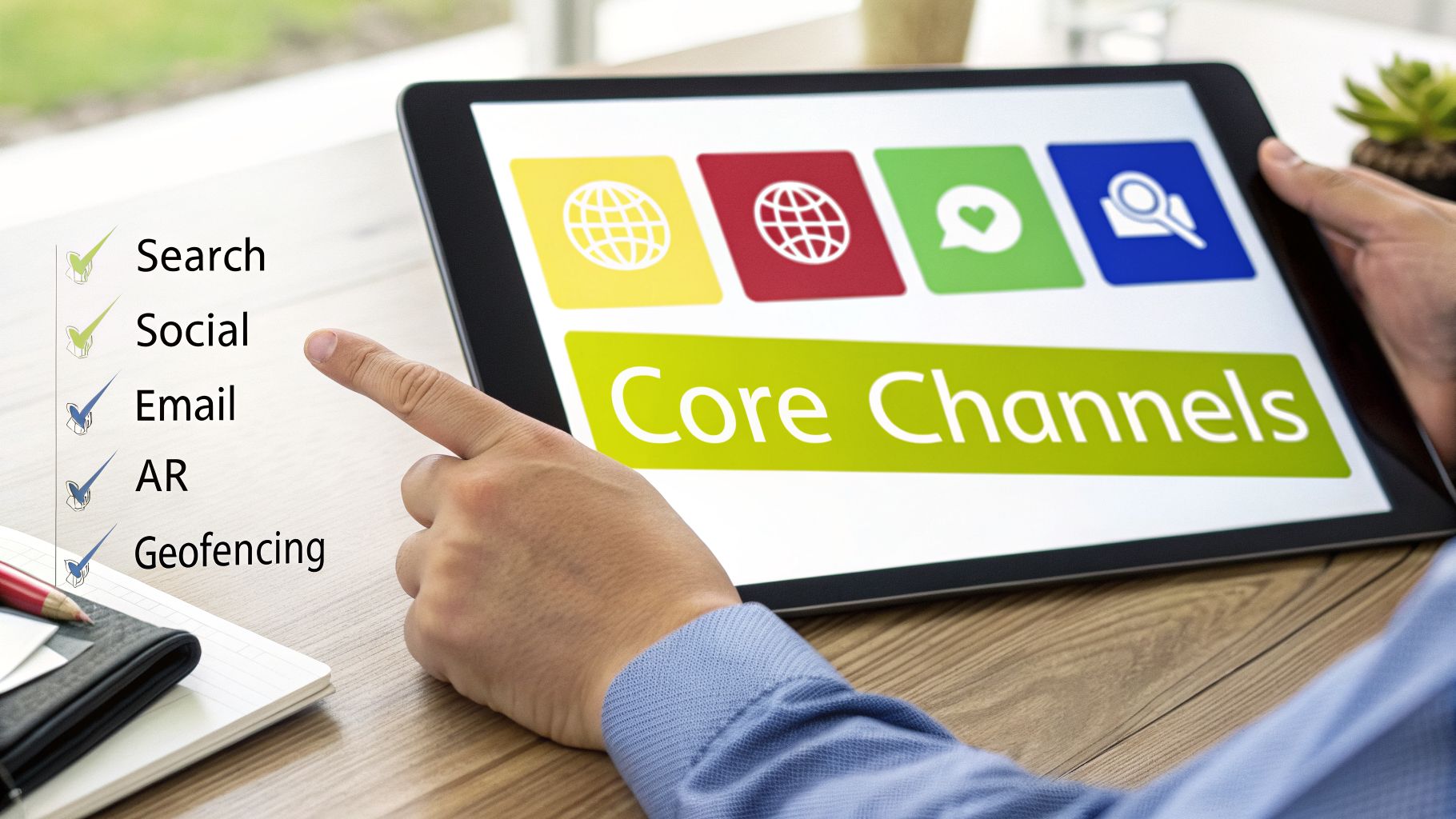
Think of your digital marketing channels as a builder’s specialized toolkit. Each tool has a very specific job, and knowing which one to grab—and when—is the secret to constructing a powerful business. The real magic happens when you orchestrate these channels together, creating a unified impact that’s far greater than using any single one on its own.
The foundation of any modern digital marketing for business growth strategy is built on a handful of core channels. These are the workhorses that consistently grab attention, build relationships, and drive revenue. Let's break down how each one works with some real-world examples.
Search Engine Marketing: Capturing Active Demand
Search Engine Marketing (SEM) is your direct line to customers who are already looking for what you sell. It’s not about convincing someone they have a problem; it’s about showing up when they’re actively searching for a solution. SEM splits into two key disciplines: Search Engine Optimization (SEO) for organic, long-term traffic and Pay-Per-Click (PPC) for immediate, paid visibility.
SEO Example: A boutique law firm specializing in intellectual property knows their clients have specific questions. They write detailed blog posts answering queries like "how to trademark a business name." By ranking high on Google for these terms, they attract highly qualified leads without paying for every single click, all while building trust and authority.
PPC Example: An e-commerce store selling custom running shoes uses Google Ads to target people searching for "best marathon running shoes for flat feet." Their ads appear right at the top of the search results, connecting them with a motivated buyer at the precise moment of intent.
Social Media Marketing: Building Communities and Driving Sales
Social media is so much more than a place to post company updates. It’s a dynamic, living environment where you can build a genuine community and drive sales directly. The trick is to show up on the platforms where your audience actually spends their time and create content that speaks their language.
A B2B software company, for example, will find its audience on LinkedIn, sharing industry case studies to connect with decision-makers. Meanwhile, a fashion brand will flourish on Instagram, using stunning visuals and influencer collaborations to inspire purchases directly within the app.
A local gym can use geofencing ads on Facebook and Instagram to target users within a two-mile radius of its front door. By running a promotion for a "first class free" to this hyper-local audience, they can drive immediate foot traffic and new memberships.
Email and SMS Marketing: Nurturing and Maximizing Value
Email and SMS are your owned channels. Unlike social media or search, you control the list and have a direct line of communication to your most engaged audience. This makes them incredibly powerful for nurturing leads and maximizing customer lifetime value (LTV).
Imagine someone downloads a free guide from a financial advisor’s website. This simple action triggers an automated email sequence. The first email delivers the guide, a follow-up shares a compelling client success story, and a third invites them to a free webinar. This process systematically builds trust and guides them toward booking a consultation.
Advanced Channels for Accelerated Growth
Once you’ve mastered the core channels, you can layer in advanced tactics to create unforgettable experiences. Augmented Reality (AR) and video are two prime examples, transforming passive viewers into active participants in your brand story.
The impact of video is undeniable. Video advertising spend is projected to hit $214.76 billion by 2025, with short-form video claiming $115.75 billion of that. By 2026, video will make up 38% of total digital ad budgets, and it's already an essential tool for 91% of marketers. For service-based businesses, a well-optimized video funnel can produce 150% lifts in conversions, while the AR market is expected to reach an incredible $461.25 billion by 2030. You can explore more of these fascinating digital marketing industry statistics to see where the market is headed.
- Augmented Reality (AR) Example: A furniture retailer builds an AR feature into its mobile app. A customer can now use their phone’s camera to place a virtual sofa directly in their living room, seeing exactly how it looks and fits in their space. This immersive experience removes doubt, reduces friction, and has been proven to dramatically boost conversion rates.
How AI and Automation Are Powering Real-World Growth
AI and automation aren't just buzzwords anymore; they’re practical tools that businesses are using right now to get a serious leg up on the competition. It helps to think of them as two sides of the same coin.
Think of automation as your tireless digital assistant, the one who handles all the repetitive, time-sucking tasks 24/7. This frees up your actual team to focus on strategy, creativity, and building relationships. AI, on the other hand, is the brain behind the operation. It chews through mountains of data to make your marketing smarter, faster, and ultimately, more profitable.
Together, they're a force multiplier for digital marketing for business growth. This isn't just theory—studies show that a staggering 85% of marketing tasks can now be automated, which can lead to productivity jumps of up to 32%. The market for AI-driven digital services is expected to hit $1.3 trillion by 2033, which tells you everything you need to know about where the industry is headed. For more context, check out these digital marketing statistics and trends on Incremys.com.
And this isn't just for the big players. Small and mid-sized businesses are using these exact tools to compete at a level that was once unimaginable.
Using Automation to Nurture Leads and Empower Your Team
Marketing automation is all about putting your routine tasks and workflows on autopilot. It makes sure no lead ever slips through the cracks, working tirelessly in the background to build relationships at scale. All while your team stays focused on closing deals and making customers happy.
Here's what that looks like in the real world:
- A Service Business: Imagine a local HVAC company. When someone requests a quote on their site, an automated system immediately takes over. It sends a series of perfectly timed emails and texts with testimonials, financing options, and a direct link to book a consultation, nurturing that lead without anyone lifting a finger.
- A Coach or Consultant: A prospect downloads your new guide. Instantly, an automation sequence kicks in. They get a welcome email, a relevant case study two days later, and an invite to a webinar the following week. It's a systematic way to build trust and authority on autopilot.
Simply put, automation is your most reliable employee. It never calls in sick, works around the clock, and executes your follow-up strategy flawlessly every single time. This frees up your people for the work that requires a human touch—creativity, empathy, and strategic insight.
Harnessing AI for Smarter Decisions and Deeper Personalization
If automation is the hands, AI is the head. While automation executes the tasks you give it, AI provides the intelligence to make those tasks exponentially more effective. AI-powered platforms analyze massive datasets to spot hidden patterns, predict customer behavior, and optimize your campaigns in real time.
This is what leads to hyper-personalization—the kind that feels genuinely helpful, not creepy. For a closer look at how data can be used to forecast what customers will do next, you'll want to read our guide on predictive marketing analytics.
AI-Powered Personalization in Action:
An e-commerce store selling skincare products uses an AI tool on its website. A visitor starts looking at a product for oily skin. The AI instantly and dynamically adjusts the "recommended products" on the page to feature complementary items like toners and lightweight moisturizers. That simple, intelligent adjustment can dramatically increase the average order value.
This intelligence also transforms how you approach SEO, one of the most powerful channels for growth. Understanding and applying ecommerce SEO best practices is non-negotiable for getting seen. AI tools now analyze the top-ranking content for your target keywords and suggest topics, angles, and even specific phrases to help you create content that search engines and people will love, making your SEO efforts far more potent.
Measuring the Metrics That Actually Matter
Chasing vanity metrics like social media likes is a recipe for stagnation. Real growth is measured by its impact on your bottom line. To make every dollar accountable, you need a C-suite-level view of the key performance indicators (KPIs) that actually drive profit.
These aren't just numbers; they're the vital signs of your business. We're talking about Return on Ad Spend (ROAS), Customer Acquisition Cost (CAC), Lifetime Value (LTV), and Conversion Rate. Understanding them isn't enough—you need to know the story they tell about your financial health.
Return on Ad Spend (ROAS)
Return on Ad Spend (ROAS) is the ultimate measure of your advertising profitability. It answers one simple, powerful question: for every dollar you put into ads, how many dollars did you get back?
The calculation is straightforward: ROAS = Revenue from Ads / Cost of Ads.
- Practical Example: A local gym spends $1,000 on a targeted Facebook campaign. That campaign brings in $5,000 in new annual memberships. Their ROAS is $5,000 / $1,000 = 5x. For every dollar they spent, they made five back. A clear win.
A 4x ROAS is often seen as a strong benchmark, but this number can shift depending on your industry and profit margins. If your ROAS is below 1x, you're actively losing money on your ads.
Customer Acquisition Cost (CAC)
While ROAS looks at ad profit, Customer Acquisition Cost (CAC) tells you exactly what it costs to land one new customer. This includes all your sales and marketing expenses, not just ad spend, over a given period.
You can find it with this formula: CAC = Total Sales & Marketing Costs / Number of New Customers Acquired.
A high ROAS combined with a low CAC is the holy grail of profitable marketing. It proves your campaigns are not only generating revenue but are doing so efficiently, acquiring customers at a sustainable cost.
Practical Example: An e-commerce brand spends $10,000 in a month on Google Ads, social media, and email marketing. In that same month, they gain 500 new customers. Their CAC is $10,000 / 500 = $20 per customer. Knowing this number is vital for budgeting and scaling your growth.
Customer Lifetime Value (LTV)
Customer Lifetime Value (LTV) shifts your focus from a single sale to the entire long-term relationship. It projects the total revenue you can expect from a single customer over their entire time with your business.
A rising LTV is proof you're building a loyal customer base, not just chasing quick, transactional wins.
A simplified formula is: LTV = Average Purchase Value x Average Purchase Frequency x Average Customer Lifespan.
For a deeper look at the specifics of performance tracking, our guide on measuring marketing effectiveness provides an excellent framework.
- Practical Example: A subscription box finds its average customer pays $50 per month and stays for 18 months. The LTV is $50 x 18 = $900. If their CAC is only $100, they know each new customer is incredibly profitable over the long haul.
Conversion Rate
Your Conversion Rate is the percentage of people who take the specific action you want them to. This "conversion" isn't always a purchase—it could be a newsletter signup, a guide download, or a booked consultation.
It's the ultimate test of your website, landing pages, and calls-to-action.
The formula is simple: Conversion Rate = (Number of Conversions / Total Visitors) x 100.
Practical Example: A consultant’s webinar landing page gets 2,000 visitors from a LinkedIn campaign. Out of those, 200 people sign up. The conversion rate is (200 / 2,000) x 100 = 10%. If that's below their industry benchmark, it’s a clear signal to optimize the page copy, design, or offer.
To truly master your growth marketing, you need a clear view of these KPIs and what they mean for your specific business. Tracking just one or two won't give you the full picture.
Here's a quick reference table breaking down the essential metrics and what you should be aiming for.
Essential Growth Metrics and Industry Benchmarks
| Metric (KPI) | What It Measures | Good Benchmark (Example) | Business Type Example |
|---|---|---|---|
| ROAS | Profitability of ad campaigns. | 4:1 (or 4x) | E-commerce Brand |
| CAC | Cost to acquire one new customer. | <$300 | SaaS (Software) Company |
| LTV:CAC Ratio | Long-term value vs. acquisition cost. | 3:1 or higher | Subscription Box Service |
| Conversion Rate | % of visitors who complete a goal. | 2%-5% | Lead Generation Website |
| CPA | Cost Per Acquisition/Action. | <$50 | B2C Service Provider |
These benchmarks provide a starting point, but the most important thing is to track your own metrics over time. The goal is continuous improvement—lowering your costs while increasing the value you generate from every single customer.
Your Phased Roadmap to Digital Marketing Mastery
Knowing the channels and metrics is one thing, but executing a strategy that actually drives growth requires a clear, actionable plan. Real digital marketing success isn’t an accident; it's the result of a deliberate, phased approach.
This roadmap breaks that journey down into five manageable phases, turning complex theory into a tangible plan you can start on today.
Phase 1: Foundation and Audit
Before you build anything new, you have to inspect the ground you’re building on. This foundational phase is about taking a brutally honest look at your current digital presence and getting crystal clear on who you’re trying to reach. Think of it as a contractor inspecting bedrock before pouring a skyscraper's foundation.
Start by auditing your existing assets:
- Website Performance: Is your site fast, mobile-friendly, and easy to use? Use tools like Google PageSpeed Insights to get a baseline.
- SEO Health: What keywords do you currently rank for? Are there technical SEO problems holding you back from visibility?
- Social Media Presence: Which channels are you on? What's your engagement like? Is your branding consistent?
- Current Customer Data: Who are your best customers, really? Where did they come from?
The second part of this phase is creating a detailed Ideal Customer Profile (ICP). Go way beyond basic demographics. You need to pinpoint their pain points, their goals, where they spend their time online, and what triggers their decision to buy. A sharp ICP ensures every dollar you spend and every piece of content you create is aimed at the right person.
Phase 2: Strategy and Funnel Design
With a solid foundation in place, it’s time to architect your growth engine. This phase is all about mapping the customer journey and choosing the right channels to move people from awareness to action. This is where you design your sales funnel.
A sales funnel isn’t some rigid, one-size-fits-all structure. It's a flexible pathway that guides potential customers toward a purchase. You’ll need to define what each stage looks like for your business—Top of Funnel (TOFU), Middle of Funnel (MOFU), and Bottom of Funnel (BOFU)—and select the marketing channels that will engage people at each step.
Mini Case Study: Local Service Business
A local plumbing company designed a simple lead-generation funnel. They used Google Ads targeting "emergency plumber near me" (BOFU) to capture urgent demand. At the same time, they created blog content on "how to prevent frozen pipes" (TOFU) to build local SEO authority and attract homeowners before they have a problem, nurturing them with an email newsletter.
Phase 3: Omnichannel Campaign Launch
Now for the execution. It’s time to launch your campaigns across the channels you selected in Phase 2. The key here isn't just launching, but omnichannel integration—making sure a customer gets a seamless and consistent brand experience everywhere they interact with you.
Your messaging, your visuals, and your offers have to feel connected.
For example, a prospect who clicks on a Facebook ad for a 20% discount should land on a page that mirrors that exact offer and branding. If they abandon their cart, an automated email should follow up, reminding them what they left behind. This cohesive experience builds trust and has a massive impact on conversion rates.
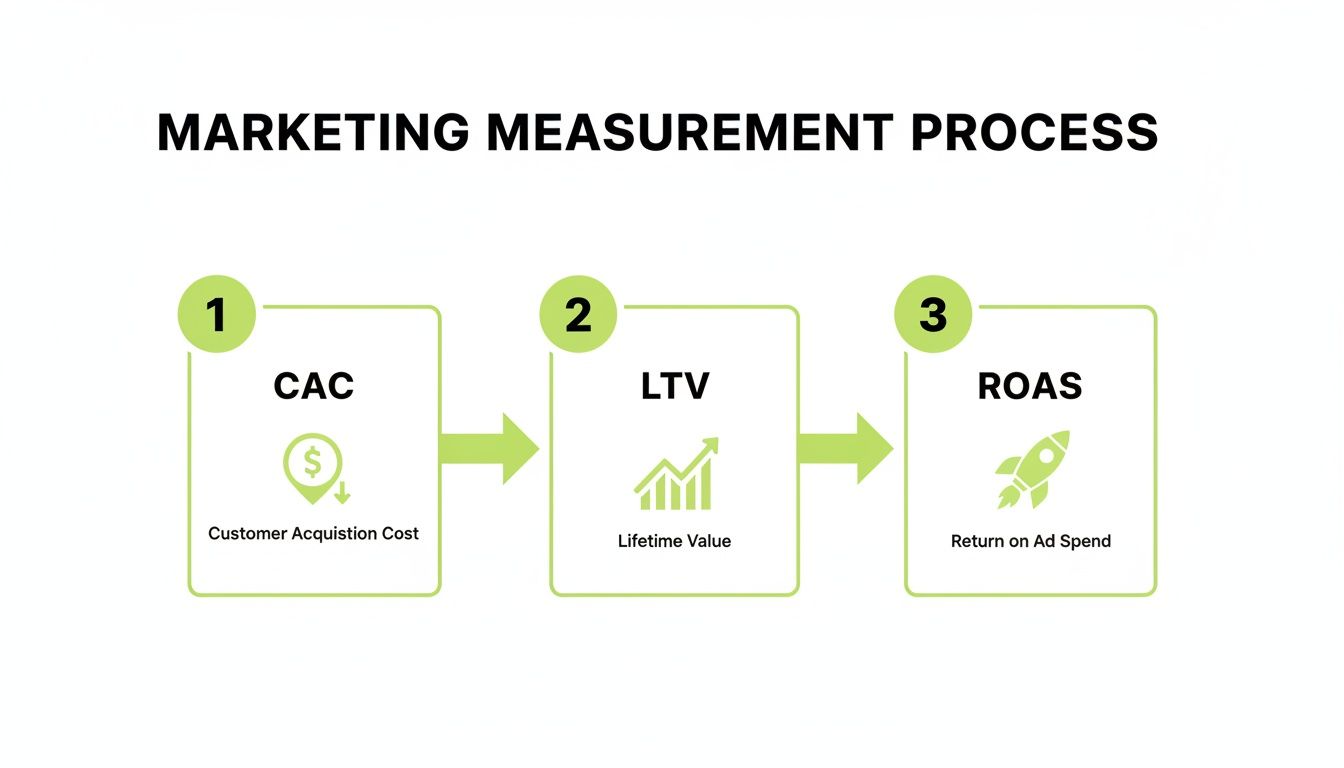
This process shows how sustainable growth happens when the lifetime value of a customer significantly outweighs the cost to acquire them, fueling a positive Return on Ad Spend.
Phase 4: AI-Powered Optimization
Once your campaigns are live and data is flowing in, the real work begins. This is where AI becomes your most powerful ally. Modern marketing platforms can analyze performance data in real time—far beyond human capability—to make automatic adjustments that boost efficiency.
AI can:
- Reallocate Ad Spend: Automatically shift your budget to the best-performing ads, audiences, and platforms without you lifting a finger.
- Personalize Experiences: Show different website content or product recommendations to users based on their specific behavior.
- Predict Outcomes: Use predictive analytics to identify which leads are most likely to convert, allowing your sales team to focus their efforts where it counts.
Mini Case Study: E-commerce Retailer
An online fashion retailer used an AI optimization tool for its Google Ads. The AI analyzed thousands of data points and found that ads featuring user-generated content (photos from real customers) had a 35% higher conversion rate on weekends. It automatically pushed more budget to these specific ads from Friday to Sunday, maximizing their ROAS without any manual intervention.
Phase 5: Measurement and Scaling
The final phase is a continuous loop of measurement, refinement, and scaling. Here, you're constantly monitoring those key metrics we talked about—CAC, LTV, ROAS, and conversion rates. This data tells you what's working, what's not, and where your biggest growth opportunities are hiding.
Based on this analysis, you make strategic decisions. Do you double down on a profitable channel? A/B test a new landing page to improve your conversion rate? Or is it time to cut a campaign that’s just burning cash?
Scaling is the final, crucial step. Once you have a proven, profitable funnel, you systematically increase your investment to grow your results. This isn't just about spending more money; it's about intelligently reinvesting profits back into a system you know works. This is how you create a predictable engine for business growth.
Frequently Asked Questions About Digital Marketing
Diving into digital marketing for business growth always brings up a few key questions. We’ve heard them all. Here are the straight, practical answers you need to move forward with confidence.
How Much Should a Small Business Budget for Digital Marketing?
A solid starting point is to dedicate 7-12% of your total revenue to your marketing budget. But the real key isn’t the total amount you spend—it’s where you spend it. Spreading a small budget across every channel is a recipe for failure.
Instead, concentrate your investment on the 2-3 channels that will deliver the biggest impact for your specific business model.
- Practical Example: A local dental clinic looking for more patient bookings should pour its budget into Google Local Service Ads and Local SEO. On the other hand, a direct-to-consumer e-commerce brand selling apparel will see far better results by prioritizing Meta (Facebook and Instagram) Ads and email marketing to drive immediate sales.
Start with a test budget, become obsessed with tracking your ROAS (Return on Ad Spend), and then double down on the channels that are actually making you money.
How Long Does It Take to See Real Results?
The time it takes to see tangible results depends entirely on the channels you’re using. Paid advertising and organic marketing run on completely different clocks, and a truly smart strategy leverages both.
Paid channels like Google Ads or Meta Ads can bring in leads and sales almost instantly—sometimes within 24-48 hours of a campaign launch. However, optimizing those campaigns for maximum profitability and a low CAC (Customer Acquisition Cost) is a process that usually takes 1-3 months of consistent testing and fine-tuning.
Think of organic strategies like SEO and content marketing as long-term assets, like planting a tree. You won't get shade overnight. You can expect to see significant, needle-moving results in traffic and leads after about 6-12 months of dedicated effort.
The most powerful approach is a hybrid one. Use paid ads to generate immediate cash flow and fund your growth, while you build your organic presence in the background for sustainable, long-term dominance.
Can I Do Digital Marketing Myself or Should I Hire an Agency?
Handling marketing yourself is a fantastic way to start, especially when you’re bootstrapping and just learning the fundamentals. As your business grows, however, the complexity of an effective digital marketing for business growth strategy expands exponentially.
Managing multiple channels, analyzing performance data, and running optimization tests quickly becomes a full-time job—not for one person, but for a team of specialists.
You should seriously consider hiring an agency when you reach one of these points:
- You’re spending more time on marketing tasks than on running the core parts of your business.
- Your results have flatlined, and you can’t seem to break through the plateau on your own.
- You want to tap into advanced strategies like AI optimization or sophisticated sales funnels to scale your growth far beyond what you can manage alone.
Ready to stop guessing and start growing with a predictable, data-driven marketing system? The team at Silver Spoon Agency specializes in turning advertising into measurable revenue. Let's build your growth engine together.