


A Practical Guide to Digital Marketing for Local Business

For any local business today—whether you're a contractor, a clinic, or a corner cafe—a smart digital marketing strategy is the difference between thriving and just surviving. It’s no longer some optional add-on; it’s the main way you’ll connect with the people in your neighborhood who are actively looking for what you offer. This guide is a practical playbook, designed to drive real-world results like more foot traffic and booked appointments.
Why Your Local Business Needs a Digital Playbook
Running a local business can feel like you’re up against giants with bottomless marketing budgets. But here’s the reality: digital marketing for local businesses levels that playing field. It gives you a direct line to the customers in your area who are searching for your exact services right now. Your biggest advantages are your community focus and your proximity—something the big guys can't replicate.
The numbers don't lie. Digital marketing spend is projected to soar past $800 billion by 2026, and video is a huge part of that, with 91% of businesses already using it. But here’s the kicker: a shocking 17% of small businesses are using search engine optimization (SEO). That’s not a threat; it’s a massive opportunity for you to get ahead of the competition.
The Core Pillars of Local Success
To build a strategy that actually works, you need a clear framework. Forget about complex theories and buzzwords. Real growth comes from mastering the fundamentals that turn online visibility into actual revenue.
This table breaks down the essential components you need to focus on.
| Pillar | Objective | Key Channels |
|---|---|---|
| Local Search Presence | Be the top result when customers search "near me." | Google Business Profile, Local SEO, Online Directories |
| Targeted Advertising | Reach specific local customers with compelling offers. | Google Ads, Facebook/Instagram Ads, Geofencing |
| Conversion Funnel | Turn website visitors into leads and customers. | Landing Pages, Website UX, Lead Forms, E-commerce |
| Customer Nurturing | Build long-term relationships and encourage repeat business. | Email Marketing, SMS Campaigns, Loyalty Programs |
These pillars aren't just a random list; they form an integrated system. Our guide will break down each one into actionable steps.
One of the biggest mistakes I see local businesses make is treating digital marketing like a checklist of separate tasks. A powerful strategy weaves SEO, paid ads, and your customer funnel into a single, cohesive system designed to attract and convert local customers.
This guide is built to move you from theory to action, giving you a step-by-step roadmap to build and scale a powerful omnichannel presence. For more foundational ideas, check out these excellent small business online marketing tips for growth. You can also dive deeper into why digital marketing is so important for modern businesses.
Mastering the 'Near Me' Search with Hyperlocal SEO
Let's get straight to the point: winning in local search is where the rubber meets the road for your business. When someone in your neighborhood pulls out their phone and types "emergency AC repair near me" or "best coffee downtown," you have a split second to be the answer they’re looking for.
This isn't about some complicated, global SEO strategy. It’s about mastering the hyperlocal signals that scream to Google: "We are right here, and we are the best choice for this person, right now."
It all starts with your Google Business Profile (GBP). Think of it as the digital front door to your business. For many potential customers, it's the very first interaction they'll have with your brand. A half-baked profile isn't just a missed opportunity; it’s a closed door. A fully optimized GBP, on the other hand, is probably your single most powerful tool for capturing high-intent local customers.
A well-managed Google Business Profile makes a powerful first impression, putting your reviews, location, and key info front and center. It’s an instant trust-builder that gives customers everything they need to call, visit, or book.
Optimizing Your Google Business Profile
Your GBP is so much more than your address and phone number. To truly stand out, you need to use every feature Google gives you to paint a vivid picture of who you are and what you do.
Treat your business description like your elevator pitch. Don't just list services—tell a story. For instance, an HVAC company in Austin could go from "We fix air conditioners" to this:
"For over 15 years, our family-owned team has provided fast, reliable emergency AC repair in downtown Austin and surrounding neighborhoods. We guarantee transparent pricing and 24/7 service when you need it most."
See the difference? One is a statement; the other is a promise.
Next, get proactive with the Q&A section. So many businesses ignore this, but it’s a goldmine for getting ahead of customer questions. You can even seed this section yourself by posting and answering common queries.
- Question: "Do you offer free estimates for new dental patients?"
- Answer: "Absolutely! All new patients in the Crestview neighborhood receive a complimentary consultation and X-rays. You can book yours directly through our website."
This not only helps customers but also lets you naturally weave in location-specific keywords.
The Power of Local Proof
Nothing builds trust faster than seeing your neighbors rave about a business. In fact, research shows that 72% of consumers say positive reviews make them trust a local business more. In a crowded market, this social proof is your secret weapon.
Make responding to every single review—positive or negative—a non-negotiable part of your weekly routine. A thoughtful response to a negative review can often win over more future customers than a dozen positive ones. It shows you care and are committed to customer satisfaction.
Getting a steady stream of reviews doesn't have to be awkward. A local plumber can leave a small card with a QR code that links directly to their Google review page after a successful job. A coffee shop can put a small sign on the counter with a similar QR code: "Love our lattes? Let us know on Google!" The goal is to make it incredibly easy for happy customers to share their experience.
Consistency is Key with NAP
Beyond Google, your business info is scattered across dozens of online directories like Yelp, Angie's List, and others. Inconsistent information confuses both customers and search engines. Your NAP (Name, Address, Phone Number) must be identical everywhere.
For example, if your Google profile says "123 Main Street" but your Yelp profile says "123 Main St.", that small difference can hurt your local search authority. A local contractor named "J. Smith & Sons LLC" must ensure it isn't listed as "J Smith and Sons" or "J. Smith & Son's" elsewhere. This consistency signals to search engines that your business is legitimate and established. You can dig deeper by checking out our guide on the top three things your business listings must have.
Building Links Within Your Community
Finally, start thinking about local link building. This just means getting other reputable local websites to link back to yours, which is a massive signal to Google that you're a trusted part of the community.
Here are a few practical ideas:
- Sponsor a local youth sports team and get your logo and website link on their page.
- Partner with a non-competing local business (like a coffee shop if you're a bakery) for a joint promotion and cross-link on your blogs.
- Host a community event or workshop and get featured in local news outlets or event calendars.
These local signals, combined with a perfectly tuned Google Business Profile, are the cornerstones of dominating "near me" searches. It's how you drive real, local customers through your door. With the rise of voice search, this is more critical than ever—a staggering 76% of voice search queries have local intent. When someone asks their device for a service, they want an immediate answer. A strong local SEO presence makes you that answer.
Driving Immediate Leads with Geofencing and Paid Ads
While a strong local SEO presence builds an incredible long-term foundation, let's be honest—sometimes you just need the phone to ring now. This is where paid advertising completely changes the game. It’s a direct, controllable way to get your business in front of high-intent local customers the moment they need you.
Unlike the slow-and-steady build of SEO, a well-crafted ad campaign can start driving calls and website traffic in a matter of hours. You get to jump the line, bypassing the gradual climb up the search rankings to place your business right at the very top. For a local business, that means capturing a customer's attention at the exact moment they're searching for your services.
Hyper-Targeting with Geofencing
One of the most powerful tools in a local advertiser's kit is geofencing. Think of it like drawing an invisible, virtual fence around a specific, real-world location. When a potential customer carrying a smartphone steps inside that boundary, they instantly become eligible to see your ads on their social media feeds and other apps.
But this isn't just about targeting your own city; it's about surgical precision.
- A Local Gym: Imagine setting up a two-mile geofence around your gym. Anyone who drives or walks into that zone could start seeing an ad for a "Free 7-Day Pass," pulling in immediate foot traffic.
- A Pizzeria: A clever pizza shop could draw a geofence around a competitor's location. When someone visits that rival restaurant, they might later see an ad on their phone: "Tired of the same old slice? Try our award-winning pizza, just 5 minutes away!"
Geofencing takes advertising from a wide-net approach to a finely-tuned instrument. You’re not just hoping the right people see your ad; you're actively showing it to them based on their physical location and behavior. This skyrockets relevance and slashes wasted ad spend.
Structuring Your First Local Google Ads Campaign
When a customer has a problem that needs solving now, they turn to Google. Searches like "plumber near me" or "emergency roof repair" are packed with intent. Your goal is simple: be the first solution they see. Google Ads remains a powerhouse for this.
A successful local campaign really boils down to three core elements:
- Location-Based Keywords: Forget bidding on broad terms like "roofer." You need to get hyperlocal. A contractor in Denver should be targeting keywords like "roof repair Cherry Creek," "Denver hail damage roofer," or even "emergency roof leak service 80206." This focuses your budget exclusively on the most relevant searchers.
- Negative Keywords: Just as important is telling Google who not to show your ads to. If you’re a high-end kitchen remodeler, you’d want to add negative keywords like "cheap," "DIY," or "repair parts" to stop wasting money on clicks from people who aren't your ideal customers.
- Ad Extensions: These are free add-ons that make your ad bigger, more informative, and far more effective. For local businesses, the Location Extension (showing your address and a map pin) and the Call Extension (adding a clickable phone number) are non-negotiable. They make it ridiculously easy for someone on a mobile phone to find or call you with a single tap.
Winning on Social Media with Hyperlocal Ads
Platforms like Facebook and Instagram offer incredibly granular targeting options that feel tailor-made for local businesses. You can go way beyond simple geography and start layering in interests, life events, behaviors, and demographics to dial in your perfect customer profile.
The key is to think critically about who you want to reach and where they spend their time (both online and off). For instance, a local boutique specializing in high-end women's fashion could run an Instagram ad campaign targeting:
- Location: Women aged 30-55 living in specific affluent zip codes.
- Interests: Users who have shown interest in brands like Tory Burch or Kate Spade, or follow well-known fashion influencers.
- Behavior: Users who have a history of engaging with "Shop Now" buttons on other posts.
This level of detail ensures your ad budget is spent reaching people who are not only nearby but are also genuinely interested in what you have to offer. You can see how powerful this gets by checking out these geofencing advertising examples.
By combining the immediate, intent-driven power of Google Ads with the precise audience targeting of social media, you can build a paid ad strategy that delivers a steady, predictable stream of qualified local leads.
Converting Website Clicks into Paying Customers
Getting traffic from your slick SEO and paid ad campaigns is a great start, but let's be honest—it’s only half the job. A click doesn't pay the bills. A paying customer does.
The most critical step is turning that initial flicker of interest into a decisive action. This is where a well-thought-out sales funnel becomes your most powerful tool. And no, a "funnel" isn't some complex corporate monstrosity. For a local business, it’s just a simple, logical path that makes it dead easy for a potential customer to say "yes," whether that’s booking a consult, grabbing a coupon, or walking through your door.
It's all about removing friction and building momentum.
Mapping the Local Customer Journey
Every click comes from a real person with a real need. Your goal is to anticipate that need and lay out a clear, irresistible solution. Let's walk through a real-world example for a service-based business, like a local law firm that specializes in estate planning.
- The Spark (Awareness): A potential client, we'll call her Sarah, is scrolling through Facebook when she sees a targeted ad. It speaks directly to her: "Protect Your Family's Future. Free Estate Planning Consultation for Austin Residents."
- The Bridge (Interest): Intrigued, Sarah clicks. But she doesn't land on the firm's cluttered homepage. Instead, she’s taken to a dedicated landing page that's all about one thing: the free consultation.
- The Action (Decision): This page is clean, focused, and gets straight to the point. It has a simple form asking for her name, email, and phone number, right next to a big, bold button: "Claim My Free Consultation Now."
- The Follow-Up (Nurture): The moment she hits submit, an automated system jumps into action. Sarah instantly gets a confirmation email and a text message thanking her and letting her know the firm will call within 24 hours to get her scheduled.
This entire sequence is a simple but incredibly effective sales funnel. It just took a passive social media user and turned her into a qualified lead in your system—all without you or your team lifting a finger.
Designing a Funnel for a Service Business
If you run a med spa, HVAC company, or consulting firm, your funnel's main job is usually to generate a high-quality lead or book an appointment. Your landing page is the star of this show.
Your landing page needs to have one job and one job only. If your offer is a free roof inspection, then every single element—the headline, the text, the images, the form—must be laser-focused on getting that visitor to sign up for it. Kill all other distractions.
A high-converting landing page for a service business always includes:
- A Benefit-Driven Headline: Don't just say "Contact Us." Try something like, "Get Your Free, No-Obligation Roof Inspection Quote Today."
- Clear Social Proof: Feature a few powerful testimonials from happy local customers. Seeing positive reviews from neighbors can boost conversion rates by over 270%.
- A Compelling Call-to-Action (CTA): Your button text has to be specific and action-oriented. "Schedule Your Appointment" is worlds better than a generic "Submit."
Driving In-Store Traffic for Retailers
Think funnels are just for service businesses? Think again. The concept is just as powerful for local retailers, but the goal shifts. Here, you want to get people to physically walk into your store. The trick is to create a little urgency and an offer they can't refuse.
Let's say a local boutique wants to pack the store over the weekend.
- The Ad: They could run an Instagram ad targeting users within a 5-mile radius. The offer is simple and compelling: "Show this ad this weekend and get 25% off your entire purchase!"
- The Funnel: The "funnel" here is brilliantly simple. The ad itself is the entire funnel. No clicks to a website, no forms to fill out.
- The Conversion: The magic happens when a customer walks into the boutique, phone in hand, and shows the ad at the register. You've just created a direct, measurable line between your digital ad spend and actual in-store sales.
This kind of frictionless funnel is what modern local marketing is all about. It uses the instant, mobile nature of social media to create a powerful incentive that drives real-world action. By building these simple, clear paths, any local business can turn digital eyeballs into tangible revenue.
Scale Your Efforts with Marketing Automation and AI
Managing all the moving parts of an omnichannel strategy can feel like a full-time job. The good news? You don't need a massive team to scale your marketing. This is where accessible automation and Artificial Intelligence (AI) tools become your secret weapon.
Forget the intimidating tech jargon. For a local business, this is simply about putting repetitive tasks on autopilot. It's about building systems that nurture leads, analyze data, and sharpen your campaigns while you focus on actually running your business. These tools aren't just for massive corporations anymore; they're affordable, easy to use, and built for businesses just like yours.
Automate Your Lead Nurturing
Picture this: a potential customer fills out your "Request a Quote" form at 10 PM on a Friday. Without automation, they might not hear from you until Monday morning. By then, their interest has cooled, or worse, a competitor has already swooped in.
Automation flips this scenario completely. You can set up a simple sequence that triggers the second they hit "submit."
- Instantly: An automated email confirms their request was received and outlines what's next. At the same time, an SMS message adds a personal touch: "Hi [Name], thanks for reaching out to [Your Business]! We'll be in touch with your quote shortly."
- 24 Hours Later: If they haven't booked a call or replied, a follow-up email can share a link to a powerful case study or testimonials from happy local clients. This builds your credibility while you sleep.
- 3 Days Later: A final, friendly check-in can ask if they have any questions, keeping your business top of mind without being pushy.
This entire process works for you 24/7, making sure every single lead gets immediate, professional attention. It’s a powerful way to build trust and boost conversion rates without any manual effort.
Using simple automation for lead follow-up isn't just about efficiency; it's about delivering a superior customer experience. Prompt, consistent communication makes potential customers feel valued from their very first interaction with your business.
Use AI for Smarter Advertising
Artificial intelligence might sound like a buzzword, but its practical use in local marketing is surprisingly straightforward. One of the most powerful applications is optimizing your paid ad campaigns. AI tools can analyze performance data far faster and more accurately than any human ever could.
Think of it like having a super-intelligent assistant who can:
- Monitor your campaigns across Google and Facebook in real-time.
- Pinpoint which ad copy, images, or audiences are generating the most clicks and leads.
- Automatically reallocate your budget, shifting more spend toward the top-performing ads and pausing the ones that aren't delivering.
This means a local plumber running ads in three different zip codes doesn't have to guess which area is most profitable. The AI can see that the "emergency services" ad in zip code 80206 is crushing it and automatically push more of the budget there to maximize your return.
Choose the Right Tools for the Job
Getting started with automation and AI doesn’t require a massive budget. Many platforms are built specifically for small and local businesses, offering affordable plans and user-friendly interfaces that don't require a computer science degree to figure out.
Here’s a quick look at some essential tool categories and what they can do for your business.
Essential AI & Automation Tools for Local Businesses
Jumping into automation doesn't have to be overwhelming. The key is to start with tools that solve your most immediate and time-consuming problems. This table breaks down a few key categories to help you identify where you can get the biggest wins, fast.
| Tool Category | Example Tool | Key Use Case for Local Business |
|---|---|---|
| Email & SMS Automation | Mailchimp, Constant Contact | Set up automated "welcome" sequences for new leads and send appointment reminders via text. |
| Social Media Scheduling | Buffer, Hootsuite | Plan and schedule all your social media posts for the week or month in a single session. |
| AI Ad Optimization | Madgicx, AdEspresso | Automatically test different ad variations and optimize your budget for the best-performing campaigns. |
| AI Content Creation | Jasper, Copy.ai | Help you brainstorm blog post ideas, write social media captions, or draft ad copy when you have writer's block. |
By strategically implementing just one or two of these tools, you can reclaim dozens of hours each month and make your marketing dollars work significantly harder. This is how you scale your digital marketing as a local business without scaling your payroll.
Your Prioritized 90-Day Local Marketing Action Plan
Theory is great, but action is what actually grows a local business. Instead of getting buried under a mountain of tasks, let's distill everything we've covered into a clear, prioritized 90-day roadmap.
Think of this as three focused 30-day sprints. Each one builds on the last, creating momentum and delivering results you can actually see and measure.
This timeline gives you a bird's-eye view of how to scale your marketing efforts, moving from simple automation to deep, growth-focused optimization.
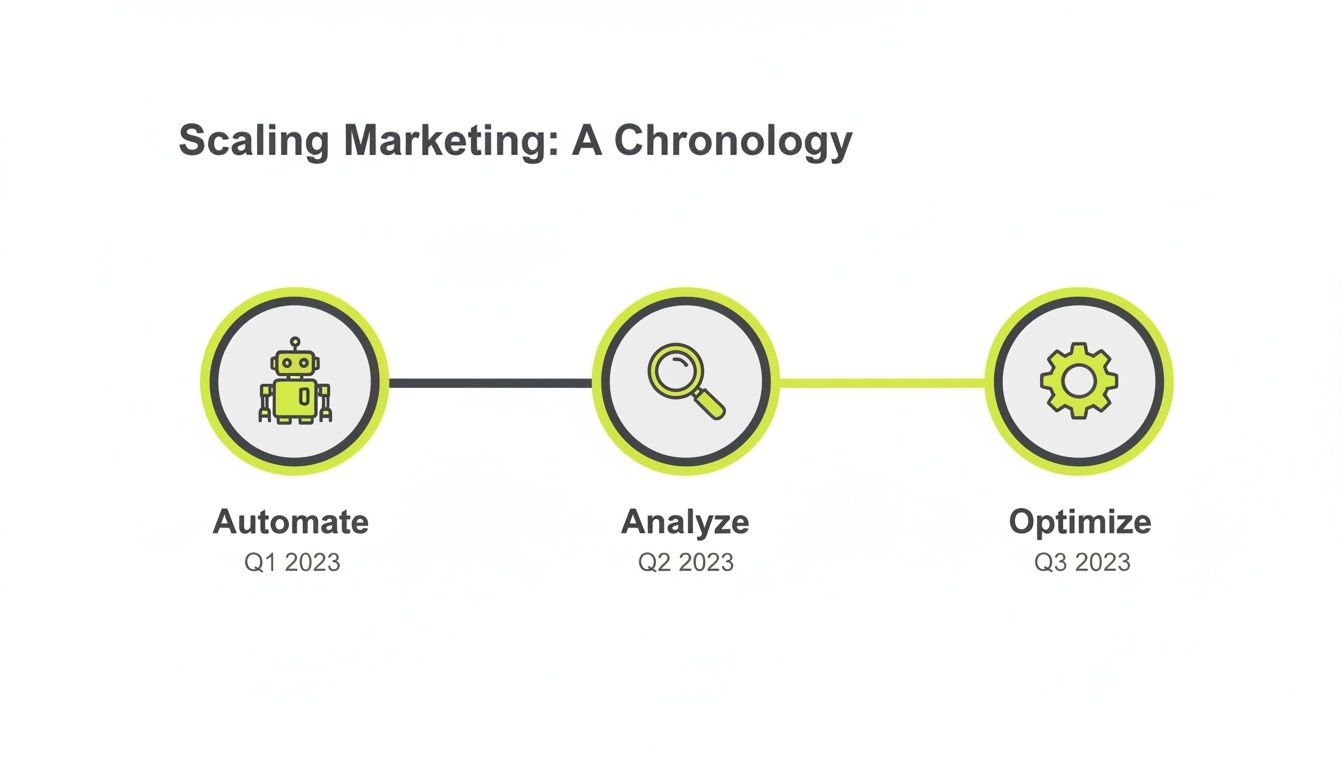
True, sustainable growth isn't a one-time campaign. It's a continuous cycle of automating what works, analyzing the results, and optimizing your entire marketing system.
Month 1: The Foundation
The first 30 days are all about pouring a rock-solid foundation. Get this right, and everything you build on top of it will be stronger. The goal here is simple: own your local search presence and make sure potential customers find accurate, compelling information about you.
- Audit Your Digital Footprint: Time for a deep dive. Scour the web and check for your NAP (Name, Address, Phone) consistency across all the major directories. Think Yelp, Angie’s List, and any industry-specific sites. For a local dental clinic, this means ensuring "Dr. Jane Smith, DDS" is listed exactly the same way everywhere, not as "Jane Smith Dentistry" on one site and "Dr. Jane's Dental" on another.
- Fully Optimize Google Business Profile: Don't just set it and forget it. You need to go all in. Upload at least 10 high-quality photos of your business, your team, and your work. For a landscaping company, this means showing before-and-after shots of recent projects, photos of your crew in uniform, and pictures of your branded trucks.
I see this mistake all the time: businesses launch paid ads before locking down their foundation. Sending traffic to an incomplete or inconsistent online presence is like pouring water into a leaky bucket. It's a massive waste of money and effort.
Month 2: Launch and Capture
With your foundation secure, month two is when we get proactive. It’s time to start reaching new customers and building a system to turn their initial interest into a real lead.
- Launch Your First Hyperlocal Ad Campaign: You don't need a huge budget to start. A local restaurant, for example, could run a simple Facebook ad campaign targeting users within a 3-mile radius who have shown an interest in "dining out" or similar local spots. Keep it small, targeted, and measurable.
- Build a Simple Lead Funnel: Don't send ad traffic to your homepage. Create a dedicated landing page built for one thing and one thing only: converting that click. For a local personal trainer, the ad might offer a "Free First Fitness Assessment." The landing page would then feature a simple form to book that session, testimonials from clients, and nothing else to distract the visitor.
Your Top Questions, Answered
Navigating digital marketing for a local business always brings up a few key questions. We hear these all the time from business owners just like you, so let's get you some straight answers.
How Much Should a Local Business Really Budget for Ads?
There’s no one-size-fits-all number, but a smart starting point is anywhere from $300 to $500 per month. That's enough skin in the game to run a targeted local campaign on Google or Facebook, get real data back, and actually see what’s moving the needle.
It's not about a massive budget; it's about spending smart. For example, a local pizzeria could drop just $100 and potentially get their ad in front of 20,000 people in their delivery zone. The key is focusing on a tight geographic area where your actual customers are.
Think of your ad budget as an investment, not an expense. The goal is to start small, prove that it works by measuring your Return on Ad Spend (ROAS), and then confidently pour more fuel on the fire.
What's More Important: Local SEO or Social Media?
This isn't an "either/or" situation—they're two different tools for two different jobs, and you need both in your toolbox.
Local SEO is your foundation. It’s what captures customers who are actively looking for a solution right now. Think about the person frantically searching "emergency plumber near me." That's high-intent, and you need to be there.
Social media is where you build your brand and create future demand. It's how you stay top-of-mind, connect with your community, and engage with people who aren't searching for you today but might need you next month. A local ice cream shop, for example, uses social media to post daily flavor specials and fun photos to build a loyal following that will think of them first on the next sunny day.
How Do I Know If My Digital Marketing Is Actually Working?
Forget about vanity metrics. "Likes" and "followers" are nice, but they don't keep the lights on. You need to focus on the numbers that directly tie back to your bottom line.
Here are the key performance indicators (KPIs) that truly matter:
- Cost Per Lead (CPL): If a local law firm spends $500 on ads and gets 10 qualified consultation requests, their CPL is $50.
- Conversion Rate: If a bakery's website gets 1,000 visitors and 50 of them place an online order for pickup, their conversion rate is 5%.
- Customer Acquisition Cost (CAC): If that same law firm converts 2 of those 10 leads into paying clients, their CAC for that campaign is $250 per client.
When you track these, you stop guessing and start making decisions based on what's actually driving growth for your business.
Ready to stop guessing and start growing? Silver Spoon Agency builds high-performance digital marketing systems that deliver measurable results for local businesses. Let's create a strategy that turns your clicks into customers. Learn more about our performance-driven services.