


10 Proven Digital Marketing Strategies for E-commerce Growth in 2026

The e-commerce landscape is fiercely competitive. Relying on basic ad tactics and generic funnels is a recipe for wasted ad spend and stagnant growth. To scale profitably, modern brands need a sophisticated, integrated approach that transforms every touchpoint into a conversion opportunity. Simply running a few ads or sending occasional newsletters is no longer enough to cut through the noise and capture consumer attention.
This guide moves beyond surface-level advice to provide a comprehensive roundup of high-impact digital marketing strategies for e-commerce, complete with actionable playbooks and real-world examples. We'll break down exactly how to orchestrate seamless omnichannel campaigns, leverage AI for predictive audience targeting, and build conversion-optimized funnels that consistently turn browsers into buyers. Each strategy is designed not just to be understood, but to be implemented immediately.
You will gain a clear blueprint for mastering everything from advanced paid search and social media advertising to innovative tactics like hyperlocal geofencing and augmented reality experiences. We'll explore how to automate your customer journey with intelligent email and SMS sequences, drive organic traffic through strategic content marketing, and partner with creators to build authentic brand advocacy. Consider this your definitive playbook for elevating your brand from just another online store to an undeniable industry leader, equipped with the tools to drive predictable revenue and achieve sustainable growth. Prepare to move beyond the basics and start building a resilient, high-performance marketing engine.
1. Strategy #1: Omnichannel Marketing & Campaign Orchestration
Omnichannel marketing goes beyond simply being present on multiple platforms; it’s about weaving those channels into a single, unified customer experience. This approach orchestrates every touchpoint, from social media and search ads to email and SMS, to deliver consistent, context-aware messaging. It ensures your brand meets customers wherever they are in their buying journey with a message that feels personal and relevant.
Unlike siloed approaches, a true omnichannel strategy allows you to understand which combinations of channels drive conversions. A foundational element of a strong omnichannel presence is a well-defined multi-channel marketing strategy. This deeper understanding leads to predictable ROI and significantly less ad waste, making it one of the most powerful digital marketing strategies for e-commerce brands today.
How to Implement Omnichannel Marketing
A successful omnichannel playbook requires data unification and strategic coordination. By integrating customer data across platforms, you can trigger automated campaigns based on specific user actions, ensuring seamless transitions from one channel to the next.
Practical Implementation Steps:
- Start Small: Begin by integrating your two highest-converting channels. For many e-commerce stores, this is often a combination of Facebook/Instagram Ads and Klaviyo email/SMS flows.
- Centralize Your Data: Use a marketing automation platform like HubSpot, Klaviyo, or ActiveCampaign to unify customer data. This allows you to track a customer's journey from their first ad click to their post-purchase email engagement.
- Track Everything: Implement UTM parameters on all campaigns and use unique discount codes for different channels. This helps you attribute sales accurately and identify which channel combinations are most effective.
- Segment Audiences: Group customers by their lifecycle stage (e.g., new visitor, cart abandoner, repeat buyer). Tailor your messaging on each channel to guide them to the next step in their journey.
Practical Example: A customer clicks a Google Shopping ad for a specific pair of hiking boots, browses the product page, but doesn't buy. An omnichannel sequence would trigger:
- Hour 1: They see a retargeting ad on Instagram featuring a video of someone wearing those exact boots on a trail.
- Hour 4: They receive an automated email with the subject "Still thinking it over?" showing the boots they viewed and customer reviews.
- Day 2: If they still haven't purchased, they receive an SMS with a limited-time offer for free shipping on their first order, creating a cohesive and persuasive recovery sequence.
2. AI-Powered Audience Targeting & Predictive Analytics
AI-powered audience targeting moves beyond manual segmentation by using machine learning to find high-intent buyers. These algorithms analyze vast datasets, including first-party customer history and real-time engagement signals, to predict which prospects are most likely to convert. This automated approach allows e-commerce brands to deliver hyper-personalized ads and allocate budgets with precision, focusing spend on the highest-probability customers.

Instead of relying on broad demographic rules, predictive analytics forecast which specific audience segments will respond best to certain messages or offers. For an e-commerce store, this means AI can identify potential checkout abandoners before they leave or flag past customers who are statistically ready for a repeat purchase. This makes AI-driven targeting one of the most effective digital marketing strategies for e-commerce, as it directly optimizes for conversions and ROAS.
How to Implement AI-Powered Audience Targeting
Integrating AI into your targeting strategy is more accessible than ever, thanks to built-in tools on major ad platforms. The key is to start with clean, high-quality data and let the algorithms learn from it.
Practical Implementation Steps:
- Leverage Platform-Native AI: Start with Google’s Smart Bidding and Meta’s Advantage+ campaigns. These tools use machine learning to find conversions without extensive manual setup.
- Feed the Machine Your Best Data: Your first-party data (email lists, purchase history, website visitors) is your most valuable asset. Regularly upload clean customer lists to ad platforms to fuel their predictive models.
- Start with 1% Lookalikes: When creating lookalike or modeled audiences, begin with a tight 1% similarity match based on your best customers (e.g., repeat buyers or high-AOV purchasers). Expand to 3%, 5%, and 10% only after validating performance.
- Create Holdout Groups: To prove the AI’s effectiveness, exclude a small portion (e.g., 10%) of your target audience from seeing the AI-driven ads. Compare their conversion rates to the targeted group to measure the incremental lift.
Practical Example: An online coffee subscription service uploads its list of customers who have made at least three repeat purchases to Meta. They then create a 1% Advantage+ Lookalike audience. The AI analyzes thousands of data points—like online publications they read, other pages they follow, and their browsing habits—to find new users who exhibit similar behaviors to these loyal subscribers. The ad creative shown to this new audience highlights the convenience and quality of the subscription, speaking directly to the values their best customers share.
3. Conversion-Optimized Sales Funnels & Funnel Frameworks
A conversion-optimized sales funnel is a structured, data-driven customer journey designed to guide prospects from awareness to purchase. Each step systematically removes friction and boosts conversion probability by combining optimized landing pages, sequenced messaging, and powerful trust-building elements like social proof and guarantees. This is one of the most vital digital marketing strategies for e-commerce because it transforms passive website traffic into predictable revenue streams.
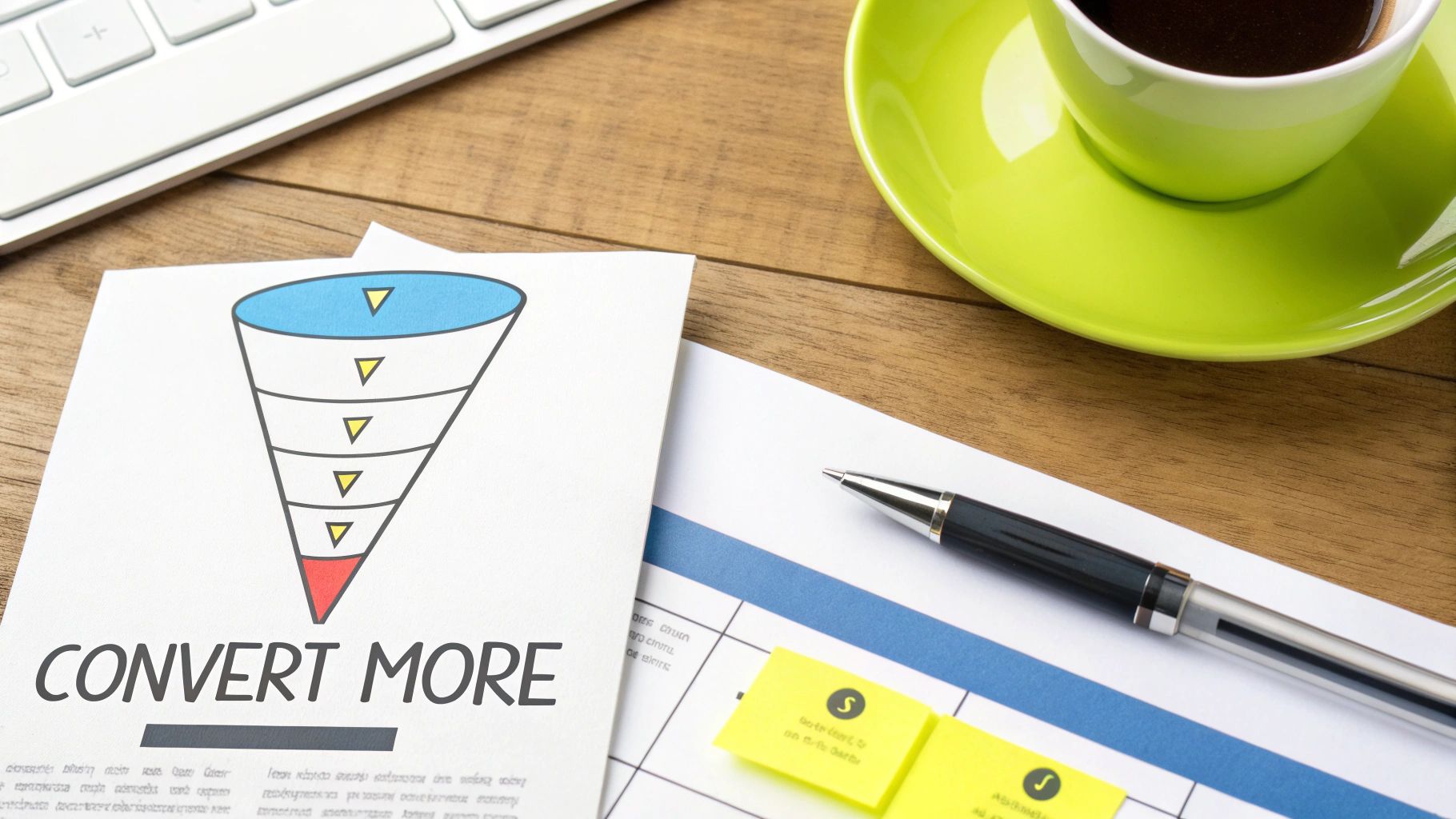
Unlike a standard website, a true sales funnel is dynamic and adaptive. It tailors offers and messages based on user behavior, traffic source, and device. This personalized approach, popularized by thought leaders like Russell Brunson and specialized agencies, ensures you present the right offer to the right person at the perfect time, dramatically increasing the likelihood of a sale.
How to Implement Conversion-Optimized Sales Funnels
Building a high-performing funnel requires a strategic map and a commitment to data-driven testing. By defining a clear goal for each stage, you can systematically improve performance and maximize your return on ad spend (ROAS).
Practical Implementation Steps:
- Map Your Funnel Stages: Define 3–5 distinct stages (e.g., Awareness, Consideration, Conversion, Loyalty) and set a specific conversion goal for each one. This provides clarity and a framework for optimization.
- Establish a Baseline: Before making changes, measure your current conversion rate from traffic source to sale. To help quantify potential improvements from optimizing funnels, consider utilizing a practical conversion rate calculator to model different scenarios.
- Segment by Traffic Source: Recognize that a user from a Google search ad has different intent than one from a TikTok video. Build separate funnel entry points (landing pages) tailored to the mindset of each audience segment.
- Test One Element at a Time: To get clear results, isolate your tests. Start with high-impact elements like the headline on your landing page, the call-to-action button color, or the number of fields in your checkout form.
Practical Example: A brand selling a high-ticket blender runs a TikTok ad showing a creator making a smoothie. The link clicks through to a dedicated landing page (not the homepage) that features the same video, 5-star reviews, and a clear "Buy Now" button above the fold. After purchase, the customer is immediately presented with a one-time offer for discounted smoothie recipe e-books (an upsell). This entire path is a specific funnel designed for TikTok traffic, ensuring a consistent message and maximizing the average order value from that specific ad campaign.
4. Paid Search Advertising (Google Ads & Bing) Optimization
Paid search advertising places your brand directly in front of high-intent customers at the exact moment they are searching for products like yours. By bidding on specific keywords on platforms like Google Ads and Bing, you can display targeted ads at the top of search engine results pages (SERPs) and drive qualified traffic to your optimized landing pages. This strategy targets users who are actively looking for a solution, making it a cornerstone of effective digital marketing strategies for e-commerce.
Modern paid search has evolved beyond simply bidding on high-volume keywords. Success now depends on precise intent matching, building robust negative keyword lists to filter out irrelevant traffic, and leveraging automated bid strategies. This dynamic approach allows for real-time optimization of bids, ad copy, and landing pages based on live conversion data, ensuring your budget is spent on clicks most likely to convert into sales.
How to Implement Paid Search Advertising
A successful paid search campaign requires a meticulous setup and continuous management. By focusing on relevance and user intent, you can significantly improve your Return On Ad Spend (ROAS) and acquire customers profitably.
Practical Implementation Steps:
- Start with Branded Keywords: Begin by bidding on your own company and product names. This is a low-cost way to capture high-intent traffic and establish a baseline ROAS while protecting your brand from competitors.
- Build from Organic Wins: Analyze your top organic search queries in Google Search Console. These are proven terms your audience uses, making them ideal candidates for your initial keyword lists.
- Use Strategic Match Types: Start with Exact Match for high-intent keywords (e.g., "buy red running shoes size 10") to control costs. Use Phrase and Broad Match to discover new search terms and expand your reach once you have a profitable foundation.
- Create Strong Negative Keyword Lists: Continuously add terms that are not relevant to your products to prevent wasted ad spend. For a premium brand, this might include adding "free," "cheap," or "used" to your negative list.
Practical Example: A store selling sustainable, non-toxic cleaning supplies targets the phrase match keyword "eco-friendly kitchen cleaner." To avoid wasted clicks, they add negative keywords like "-jobs," "-diy," and "-homemade" to their campaign. Their ad copy reads, "Plant-Powered Kitchen Cleaner. Ships in 24 Hrs. Shop Now!" This specific ad directs users to a landing page featuring only their kitchen cleaning products, not the entire store catalog, ensuring the user journey is fast and relevant to their initial search.
5. Social Media Advertising & Retargeting Campaigns
Social media advertising places your brand directly in front of engaged users on platforms like Facebook, Instagram, and TikTok, using highly detailed demographic, behavioral, and interest-based targeting. This strategy moves beyond passive visibility, allowing you to reach ideal customers while they are actively consuming content. Its true power is unlocked with retargeting, which re-engages previous website visitors with tailored ads, drastically improving conversion rates and return on ad spend (ROAS).
Unlike broader advertising methods, social media platforms use advanced pixel tracking and AI-driven bidding to optimize for performance. By analyzing user actions on your website, platforms can build powerful lookalike audiences and serve dynamic product ads to users who have already shown interest. This makes it one of the most effective and measurable digital marketing strategies for e-commerce brands aiming for scalable growth.
How to Implement Social Media Advertising
A successful social media advertising strategy requires a clear understanding of your audience, compelling creative, and a data-driven approach to optimization. By segmenting audiences and testing different ad formats, you can create a high-performance system that consistently drives sales.
Practical Implementation Steps:
- Install Your Pixel Immediately: Set up the Meta Pixel (for Facebook/Instagram) and TikTok Pixel on your website from day one. These tools need time to collect data on visitor behavior, which is essential for effective retargeting and conversion tracking.
- Segment Your Audiences: Create distinct audiences for different stages of the funnel: all website visitors, product page viewers, add-to-cart abandoners, and past purchasers. Tailor your ad creative and offers to each group's intent level.
- Prioritize Video and UGC: Use video creative whenever possible, as it generates 2-3 times higher engagement than static images. Ads featuring user-generated content (UGC) often outperform polished studio creative because they feel more authentic and trustworthy.
- Test and Refresh Creative: Launch campaigns with 3-5 creative variations per ad set. Monitor performance closely and pause underperforming ads. Refresh your winning creative every 3-4 weeks to combat ad fatigue and maintain high engagement.
Practical Example: A pet supply brand runs an Instagram Reels ad showing a dog struggling to get a treat out of a boring bowl, followed by the dog happily using their new puzzle feeder. They target this ad to users interested in "dog training" and "pet enrichment." Then, they create a retargeting audience of anyone who watched 75% of that video. This highly engaged audience is shown a second ad featuring customer testimonials and a direct link to purchase the puzzle feeder, moving them efficiently from awareness to consideration.
6. Email Marketing & SMS Automation Sequences
Email and SMS marketing are the cornerstones of direct-to-consumer communication, enabling brands to deliver personalized, timely messages triggered by specific user behaviors. These owned channels are not subject to algorithmic changes, giving e-commerce stores a direct line to their most valuable audiences. Modern automation platforms like Klaviyo allow for deep segmentation, ensuring every message resonates with the recipient's lifecycle stage, from their first visit to their tenth purchase.
Well-executed automation sequences, such as cart abandonment and post-purchase flows, are a primary revenue driver, often accounting for 20-40% of an online store's total sales. When combined, email and SMS create a powerful duo: email excels at storytelling and detailed education, while SMS, with its near-perfect 98% open rates, is unmatched for delivering urgent, action-oriented messages like flash sale alerts and shipping updates. This synergy makes it one of the highest-ROI digital marketing strategies for e-commerce.
How to Implement Email & SMS Automation
Effective automation relies on a "trigger-and-response" framework. By setting up sequences that activate based on user actions (or inaction), you can guide customers through the buying journey with minimal manual effort, maximizing conversions and lifetime value.
Practical Implementation Steps:
- Build Your List Aggressively: Start collecting emails and phone numbers from day one. Use website pop-ups offering a first-purchase discount, lead magnets like style guides, or gated content to grow your subscriber base.
- Create a Powerful Welcome Series: Immediately engage new subscribers with a 3-5 part automated sequence. The first email should deliver the promised offer, followed by emails that introduce your brand story, showcase best-selling products, and address common customer questions.
- Implement a Multi-Step Cart Abandonment Flow: This is non-negotiable. Trigger the first email one hour after abandonment to create urgency. Follow up at 24 hours with a simple reminder, and send a final email or SMS at 48 hours with a small, compelling offer to close the sale.
- Segment Your Audience: Go beyond a single list. Create dynamic segments for new customers, repeat buyers, high-AOV shoppers, and lapsed customers. Tailor campaigns to each group; for instance, send a "we miss you" campaign to users who haven't purchased in 90 days.
Practical Example: A brand selling high-performance workout supplements sets up a post-purchase automation.
- Immediately after purchase: The customer receives an order confirmation email.
- 5 days later: An email arrives with the subject "Get the Most From Your Order" and includes tips on how to use the supplement for best results.
- 25 days later: Knowing the 30-day supply is running low, an automated SMS is sent: "Running low on Fuel? Reorder now and get a free shaker bottle with your next purchase. Link expires in 24h!" This timely, personalized sequence boosts customer lifetime value.
7. Content Marketing & SEO-Optimized Blog Strategy
Content marketing builds lasting authority and organic traffic by creating valuable, SEO-optimized content that directly answers your target audience's questions. Unlike paid ads that stop delivering results the moment you turn them off, a high-ranking blog post is a long-term asset that generates qualified visitors indefinitely. This strategy positions your brand as a trusted industry expert, building credibility long before a customer is ready to buy.
By focusing on user intent and search engine optimization, content becomes a powerful lead generation machine. A well-executed blog post ranking for a keyword with 1,000 monthly searches can consistently drive hundreds of organic visitors each month. This makes it one of the most cost-effective and scalable digital marketing strategies for e-commerce, capable of generating leads at a fraction of the cost of paid advertising.
How to Implement a Content & SEO Strategy
A successful content strategy begins with deep keyword research and a commitment to creating genuinely helpful resources. The goal is to become the go-to source for information in your niche, capturing users at every stage of their buying journey.
Practical Implementation Steps:
- Start with Keyword Research: Use tools like Ahrefs or SEMrush to identify topics your audience is searching for. Prioritize long-tail keywords (3+ words) like "best waterproof hiking boots for women," as they have lower competition and higher purchase intent.
- Build Topic Clusters: Create a comprehensive "pillar" post (e.g., "The Ultimate Guide to Home Coffee Brewing") and surround it with shorter "cluster" posts that cover related subtopics (e.g., "How to Choose a Coffee Grinder," "Best Beans for Pour-Over"). Internally link these pages to build topical authority.
- Write for Humans First: Create content that is genuinely valuable, easy to read, and solves a problem. High-quality content leads to better engagement signals like longer dwell time, which Google rewards with higher rankings.
- Promote and Refresh: Promote every new post across your email list and social media channels. Every quarter, identify your top-performing blog posts in Google Search Console and update them with new information, statistics, and internal links to keep them fresh and maintain their rankings.
Practical Example: A company that sells high-end kitchen knives writes a blog post titled "How to Sharpen a Chef's Knife: A Beginner's Guide." The post includes a step-by-step video, clear photos, and answers common questions. Within the article, they naturally link to their own best-selling knife sharpener and their line of premium chef's knives. This post attracts users searching for a solution, establishes the brand as an expert, and seamlessly guides readers toward a relevant purchase without a hard sell.
8. Geofencing & Hyperlocal Location-Based Advertising
Geofencing transforms physical locations into digital marketing opportunities, allowing you to trigger ads on a user's mobile device the moment they enter a predefined geographic area. This technology uses GPS, Wi-Fi, and cellular data to create virtual "fences" around competitor stores, event venues, or specific neighborhoods. It is one of the most direct digital marketing strategies for e-commerce brands with a physical presence or those looking to capture high-intent customers from specific real-world locations.
By targeting prospects based on where they are, hyperlocal advertising delivers exceptionally relevant messaging at the perfect moment. This strategy is ideal for driving foot traffic, promoting local events, and capturing competitor market share. The attribution is clear and powerful, as you can directly link digital ad exposure to in-store visits, appointment bookings, or localized online purchases, making it a highly accountable tactic for boosting ROI.
How to Implement Geofencing
A successful geofencing campaign hinges on precise location targeting and compelling, urgent ad creative. By identifying high-value zones, you can serve ads that feel incredibly personal and timely, capturing attention in a way that broader targeting cannot.
Practical Implementation Steps:
- Identify High-Intent Locations: Start by geofencing 3–5 key areas. This could include your top competitors' storefronts, industry trade shows, or affluent neighborhoods where your target customers live and work.
- Set a Tight Radius: Begin with a small geofence, typically 300–500 feet around your target location. This ensures you are reaching the most relevant audience and makes foot traffic attribution more accurate.
- Create Urgent Ad Creative: Your ads must inspire immediate action. Use copy like "Visit Us Today for 20% Off," or location-specific messaging such as, "Shopping at the Grove? Stop by for a free sample."
- Track Relevant Conversions: Focus on conversion actions that align with hyperlocal goals, such as in-store visits, mobile app installs, or "click-to-call" for appointments. Platforms like Gimbal or AdRoll can help track this.
- Retarget Geofenced Audiences: Visitors who entered your geofence are a warm audience. Create retargeting campaigns to reach them for up to 30 days after their initial visit, as they convert at a much higher rate than cold traffic.
Practical Example: A luxury bridal boutique wants to attract newly engaged couples. They set up a geofence around a popular local wedding expo venue for the entire weekend of the event. Any attendee who enters the expo is served a Facebook ad with an exclusive offer: "Planning your big day? Book a private consultation at our boutique this month and receive a complimentary veil. Show this ad to redeem." This hyper-targeted approach reaches the perfect audience at the exact moment they are making buying decisions.
9. Augmented Reality (AR) & Immersive Brand Experiences
Augmented reality (AR) integrates interactive digital elements into a customer's real-world environment through their smartphone camera. This strategy transforms passive product viewing into an active, immersive experience, allowing shoppers to visualize how a product will look and fit in their life before they commit to a purchase. It effectively bridges the gap between online shopping and the tangible confidence of in-store experiences, directly addressing buyer hesitation.
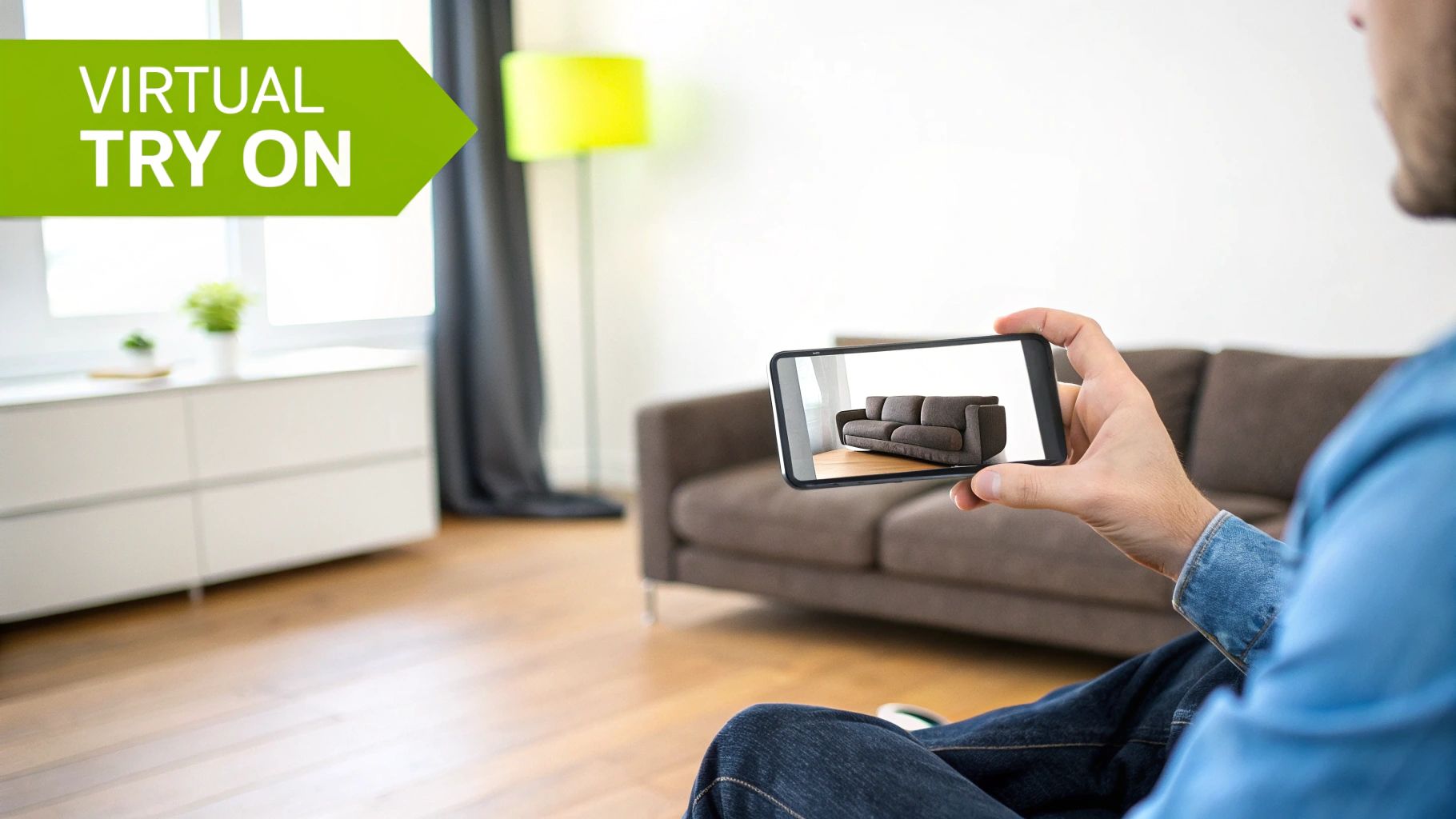
From virtual furniture placement to makeup try-ons, AR marketing creates memorable touchpoints that significantly boost engagement and conversion rates. Brands that leverage AR often see a dramatic reduction in product returns, as customers make more informed and confident decisions. This technology is a powerful tool for differentiation, building brand affinity, and encouraging social sharing, making it one of the most innovative digital marketing strategies for e-commerce.
How to Implement Augmented Reality
Successful AR implementation focuses on reducing friction and directly connecting the experience to a conversion action. The goal is to make product visualization seamless, intuitive, and instantly accessible without requiring users to download a separate application.
Practical Implementation Steps:
- Prioritize WebAR: Start with web-based AR (WebAR) which works directly in a mobile browser. This removes the major barrier of needing an app download, dramatically increasing adoption rates.
- Optimize 3D Assets: Ensure your 3D product models are optimized for mobile. Keep file sizes small and polygon counts low to guarantee fast loading times, preventing user drop-off.
- Integrate Clear CTAs: Embed "Buy Now," "Add to Cart," or "Share with a Friend" buttons directly within the AR interface. This converts the immersive experience into a direct path to purchase.
- Test on Key Products First: Roll out AR functionality on a small subset of high-consideration or best-selling products. Measure engagement time and conversion lift to build a business case before scaling to your entire catalog.
Practical Example: An online art gallery uses Shopify's native AR features. On each product page for a painting, there's a "View in Your Room" button. A customer can tap this on their phone, and their camera opens. They can then point their phone at a blank wall in their home to see the painting virtually hanging there, allowing them to instantly judge its size, scale, and how it complements their decor. This removes the biggest uncertainty of buying art online and directly boosts conversion rates.
10. Influencer Marketing & Creator Partnerships
Influencer marketing leverages the trust and authenticity of content creators to build brand awareness, generate social proof, and drive direct sales. This strategy moves beyond traditional advertising by partnering with individuals whose followers align with your target audience. Partnerships can range from one-off sponsored posts and unboxing videos to long-term ambassadorships, affiliate programs, and co-created product lines.
By collaborating with creators, e-commerce brands can tap into niche, highly engaged communities with a message that feels like a trusted recommendation rather than a disruptive ad. This approach is a cornerstone of modern digital marketing strategies for e-commerce, as it integrates seamlessly into both organic content feeds and paid amplification efforts. When executed correctly, it produces high-performing, authentic content that resonates deeply with potential customers.
How to Implement Influencer Marketing
A successful creator partnership strategy requires clear goals, careful vetting, and a focus on authentic collaboration. The key is to find influencers whose personal brand and audience genuinely match your product, allowing for creative freedom while tracking performance.
Practical Implementation Steps:
- Start with Micro-Influencers: Begin by partnering with creators in the 5k–100k follower range. They often have higher engagement rates, a more dedicated niche audience, and are more cost-effective than macro-influencers.
- Track Performance with Unique Codes: Provide each creator with a unique discount code or a trackable affiliate link. This allows you to measure direct ROI and identify your top-performing partners for future campaigns.
- Provide Clear Briefs with Creative Freedom: Outline campaign goals, key messaging points, and necessary disclosures (e.g., #ad). However, allow the creator to produce content in their authentic style to ensure it resonates with their audience.
- Negotiate Content Usage Rights: Secure the rights to repurpose high-performing creator content in your own marketing channels. This user-generated content (UGC) often outperforms studio-shot creative in paid social ads, on product pages, and in email campaigns.
Practical Example: A company selling ergonomic office chairs partners with a remote work and productivity expert on YouTube (a micro-influencer with 50k subscribers). The creator produces an in-depth "My Honest Review" video showcasing the chair's features and how it improved their posture. The brand provides a unique discount code "PRODUCTIVITY15" for the creator to share. This drives direct sales and provides the brand with a high-quality video asset they can repurpose into shorter clips for their Facebook and LinkedIn ad campaigns.
E‑Commerce Digital Marketing: 10-Strategy Comparison
| Strategy | 🔄 Implementation Complexity | ⚡ Resource Requirements | ⭐ Expected Effectiveness / 📊 Impact | 💡 Ideal Use Cases | Key Advantages |
|---|---|---|---|---|---|
| Omnichannel Marketing & Campaign Orchestration | High — cross-channel integration, attribution modeling | High — CDP/martech, data engineers, creative resources | ⭐ High; 📊 Predictable ROI, higher LTV, reduced ad waste | E‑commerce, retail, multi‑location, service enterprises | Cohesive messaging, cross‑channel attribution, scalable orchestration |
| AI‑Powered Audience Targeting & Predictive Analytics | Medium‑High — model training, data pipelines, validation | Medium — historical data, ML tools or agency/data science | ⭐ High; 📊 Lower wasted spend, faster optimization, precision targeting | SMBs scaling ads, high‑volume ad accounts, e‑commerce | Automated lookalikes, propensity scoring, budget reallocation |
| Conversion‑Optimized Sales Funnels & Frameworks | Medium — mapping, A/B testing, CRO iteration | Medium — landing builders, CRO expertise, steady traffic | ⭐ High; 📊 Significant conversion lifts, predictable stage metrics | Coaches, consultants, high‑ticket services, e‑commerce checkouts | Measurable stages, friction reduction, repeatable optimization |
| Paid Search Advertising (Google & Bing) Optimization | Medium — keyword strategy, bid automation, account structure | Medium — CPC budget, keyword tools, optimized landing pages | ⭐ High; 📊 Immediate high‑intent traffic, clear CPA/ROAS tracking | Immediate sales, service bookings, high‑intent purchase queries | Intent‑based targeting, fast launch, granular ROI measurement |
| Social Media Advertising & Retargeting Campaigns | Medium — creative cadence, pixel/ID setup, audience hygiene | Medium — creative production, ad spend, platform tooling | ⭐ High; 📊 Strong retargeting ROAS, brand engagement uplift | DTC, e‑commerce, awareness→conversion flows, content‑driven brands | Engaging creative formats, lookalikes, cost‑efficient reach and retargeting |
| Email Marketing & SMS Automation Sequences | Low‑Medium — automation flows, deliverability setup | Low‑Medium — ESP/SMS provider, copywriting, list management | ⭐ Very High; 📊 Highest ROI, strong repeat revenue contribution | E‑commerce, subscriptions, appointment‑based services | Owned audience, personalization at scale, cost‑effective retention |
| Content Marketing & SEO‑Optimized Blog Strategy | Medium‑High — keyword research, content production, technical SEO | Medium — writers, SEO tools, time investment | ⭐ High (long‑term); 📊 Compounding organic traffic and qualified leads | Lead gen, authority building, high‑consideration purchases, B2B | Compound ROI, credibility, supports paid & funnel efforts |
| Geofencing & Hyperlocal Location‑Based Advertising | Medium — geofence design, location data integration, attribution | Medium — location platform, creative, multi‑location ops | ⭐ Medium‑High; 📊 Strong local conversions, measurable foot traffic lift | Brick‑and‑mortar, local services, franchises, events | Moment‑of‑decision targeting, clear offline attribution, local dominance |
| Augmented Reality (AR) & Immersive Brand Experiences | High — 3D asset creation, dev, optimization for mobile | High — 3D designers, developers, testing, platform integration | ⭐ High for high‑consideration SKUs; 📊 Conversion lift, lower returns | Furniture, beauty, apparel, automotive, high‑consideration retail | Try‑before‑you‑buy, differentiation, high engagement and shareability |
| Influencer Marketing & Creator Partnerships | Medium — creator sourcing, contracting, compliance management | Medium — creator fees, management tools, tracking systems | ⭐ Variable; 📊 Strong awareness and social proof; measurable if tracked | DTC, beauty, lifestyle, niche B2B thought leadership | Authentic reach, scalable content creation, access to engaged niche audiences |
From Strategy to Scale: Implementing Your E-commerce Growth Engine
You now possess a comprehensive blueprint of the most powerful digital marketing strategies for e-commerce available today. We've navigated the interconnected world of omnichannel campaigns, delved into AI-driven audience targeting, mapped out high-converting sales funnels, and explored the immersive potential of Augmented Reality. From the foundational pillars of SEO and content marketing to the precision of hyperlocal geofencing, each strategy represents a vital component of a modern, resilient, and profitable online store.
However, the true power of these strategies isn't found in isolation. It's unlocked through integration. An AI-optimized Google Ads campaign becomes exponentially more effective when its traffic is captured by an automated email sequence. An influencer partnership drives immediate sales but also provides long-term value through user-generated content that fuels social media ads for months. This synergy is where sustainable growth happens.
Your Actionable Next Steps: Moving from Knowledge to Results
Reading about strategy is the first step; implementation is what builds empires. Avoid the common pitfall of "analysis paralysis" by trying to execute all ten strategies at once. Instead, adopt a focused, phased approach to build your marketing engine systematically.
Conduct a 90-Day Audit & Prioritization: Start by evaluating your current marketing efforts against the strategies listed. Where are your biggest gaps and opportunities? A home decor brand with strong organic traffic but no retargeting is leaving money on the table. A fashion startup with a great Instagram presence but a leaky, non-optimized checkout funnel is burning cash. Identify the one or two areas that promise the highest immediate impact. For many, this is often Conversion Rate Optimization (CRO) within your existing sales funnel or implementing a robust omnichannel retargeting campaign.
Master One Funnel, Then Diversify: Choose one core customer acquisition channel and build an end-to-end funnel around it. For instance, you might focus on a "Facebook Ads to Landing Page to Email Nurture Sequence" funnel. Document every step, A/B test your ad creative, refine your landing page copy, and optimize your email open rates. Once this single funnel is profitable and predictable, you can replicate the proven framework across other channels like Google Ads or TikTok. This methodical approach prevents wasted ad spend and creates a reliable baseline for growth.
Integrate Your Data & Technology: The magic of a cohesive system relies on data flowing seamlessly between platforms. Ensure your Google Analytics is properly configured, your Facebook Pixel is tracking all key conversion events, and your email platform is integrated with your e-commerce store (like Shopify or BigCommerce). This data-centric foundation allows you to make informed decisions, understand your customer journey, and unlock advanced tactics like predictive analytics and dynamic retargeting. Without clean data, you're flying blind.
The Ultimate Goal: Building a Predictable Growth Machine
Mastering these digital marketing strategies for e-commerce transforms your business from one that simply survives to one that thrives with predictable, scalable revenue. It's about moving beyond sporadic sales and creating a systematic engine that consistently attracts, converts, and retains high-value customers. Each optimized campaign, automated sequence, and data-driven insight adds another gear to this machine, increasing its power and efficiency over time.
This journey from disparate tactics to a fully integrated growth engine is the defining characteristic of today's most successful e-commerce brands. It requires a commitment to continuous learning, testing, and optimization. By focusing on strategic implementation and the powerful synergy between these channels, you are not just marketing a product; you are building a lasting, profitable digital enterprise ready to dominate its niche.
Ready to skip the trial-and-error and implement an expert-built, AI-powered growth engine? At Silver Spoon Agency, we specialize in integrating these advanced digital marketing strategies for e-commerce into a cohesive system that delivers predictable ROI. Let us build the machine that drives your growth, so you can focus on running your business.