


Digital Marketing Strategies for Ecommerce to Unlock Growth

In the wild west of online retail, the sharpest digital marketing strategies for ecommerce don't just focus on one thing. They weave together the power of search engine visibility, smart paid advertising, and direct-to-customer channels like email and social media. This isn't just about having a great product anymore; it's about building a powerful, revenue-generating engine that actually gets you noticed.
Why a Digital Marketing Strategy is Your Ecommerce Lifeline

Welcome to the modern ecommerce battlefield. Throwing up a beautiful online store with a quality product is just the ticket to enter the arena. The real fight is for the attention of your ideal customers—building a brand they trust enough to buy from again and again. Let's be honest: a great product no longer sells itself.
The global ecommerce market has absolutely exploded, hitting around $5.8 trillion in 2023. And it’s not slowing down. Projections show that number could rocket past $9.6 trillion by 2027, a mind-boggling 47.6% jump. With over 30.7 million ecommerce stores now competing for eyeballs worldwide, the digital shelf is more crowded than a Black Friday sale. A deliberate, well-executed marketing plan is your only shot at survival and growth.
The Big Shift: From "What We Sell" to "Who We Sell To"
It wasn't that long ago that marketing felt like an afterthought. You built the thing, then you figured out how to sell it. Today, marketing is the engine. It's the core of your entire growth plan. To cut through the noise, you have to master the core principles of successful ecommerce marketing strategies. That means a fundamental shift in focus from what you sell to who you're selling to and how you're going to reach them.
A powerful strategy is so much more than just boosting a few posts. It’s your complete playbook for:
- Attracting the Right Crowd: Using channels like SEO and paid search to show up when people are actively hunting for what you offer. For example, a new mom searching for "hypoallergenic baby laundry detergent" is a high-intent buyer you can target.
- Engaging and Earning Trust: Turning social media and content into a community hub that proves your brand's value. A practical example is a skincare brand creating video tutorials on how to use their products for a nighttime routine.
- Turning Browsers into Buyers: Fine-tuning your website and checkout to make buying from you a no-brainer. This could be as simple as adding Apple Pay to reduce the number of clicks needed to purchase.
- Creating Raving Fans: Using email and SMS to build real relationships that bring customers back for more, such as sending a "Happy Birthday" discount or a personalized restock reminder.
Think of your digital marketing strategy as a GPS for your business. Without it, you're just driving blind, hoping to stumble upon your destination. With it, you have a clear, data-backed path to profitable growth, turning one-time buyers into loyal advocates.
This guide will give you a practical, channel-by-channel breakdown of the tactics you need to win. We're skipping the high-level theory and diving straight into actionable advice and real-world examples—from foundational SEO to the smart use of AI—to help you get real, measurable results.
Building Your Foundation with Core Marketing Channels
Every powerhouse ecommerce brand is built on a rock-solid marketing foundation. This isn't about hopping on every new trend that pops up on TikTok; it’s about mastering the core channels that work together, guiding customers from that first flicker of interest all the way to checkout.
Think of these channels as the essential pillars holding up your entire business. Your digital marketing strategy really begins here, with the smart, deliberate execution of tactics across search, social, and your own direct lines of communication.
Let's break down how to build each of these pillars with practical, actionable steps you can start using today.
Master Search Engine Optimization for Product Discovery
Search Engine Optimization (SEO) is the art and science of being the answer when someone is actively looking for what you sell. This isn’t just about getting clicks; it’s about attracting shoppers with high intent—the ones who are already halfway to buying. For ecommerce, this whole process starts with laser-focused keyword research.
Forget trying to rank for broad, generic terms. Your goldmine is in long-tail keywords, the longer, more specific phrases that signal someone is ready to pull out their credit card. A person searching "shoes" is just browsing. But someone searching for "women's waterproof hiking boots size 8"? They're ready to buy.
- Practical Example: If you're selling specialty coffee beans, don't just go after "coffee beans." Optimize your product pages for phrases like "single origin Ethiopian Yirgacheffe coffee beans" or "best whole bean espresso for latte art." Weave these specific terms into your product titles, descriptions, and even the image alt text to pull in that highly qualified traffic.
Structure Paid Search for Maximum ROAS
While SEO is your long game for organic growth, Paid Search (think Google Ads) gets you immediate visibility at the top of the page. The secret to making it profitable is building a tightly structured campaign that stops you from burning cash on irrelevant clicks. A huge mistake we see is lumping all keywords into a single campaign, which is a recipe for disaster.
A much smarter way to play is by splitting your campaigns based on what the searcher is actually trying to do. The most important division you can make is between branded and non-branded search terms.
A branded campaign targets people who are already looking for you by name (e.g., "Glossier makeup"). These searches convert at an incredibly high rate and are vital for defending your brand against competitors who might be bidding on your name. A non-branded campaign goes after product-related searches (e.g., "hydrating facial serum"), which is how you capture new customers who haven't heard of you yet.
By separating them, you can manage your budget way more effectively. You can demand a higher Return on Ad Spend (ROAS) from your non-branded campaigns while making sure you always show up for your own brand searches at a much lower cost. A strong online presence is always a mix of tactics; you can explore other actionable clothing brand marketing strategies that help set the stage for success.
Build Community with Social Media
Social media is where your brand's personality comes alive. It's less about collecting customers and more about building a genuine community. And while paid ads definitely have their place, a powerful organic presence is what creates that unshakable, long-term loyalty. One of the best organic strategies out there is tapping into User-Generated Content (UGC).
- Practical Example: Imagine a fashion brand launching an Instagram campaign with a unique hashtag, like #StyleMyTee. They could encourage customers to post photos wearing their shirts for a chance to get featured on the brand's main feed or win a gift card. Suddenly, your feed is flooded with authentic social proof, you have a library of relatable content, and your customers feel like they're a real part of your story.
On the paid side of things, dynamic retargeting on platforms like Facebook and Instagram is non-negotiable. These ads are smart—they automatically show people the exact products they just looked at on your site. It’s a powerful nudge that works wonders for bringing them back to complete their purchase.
Convert Subscribers with Email and SMS Automation
Email and SMS are your direct channels. They’re where you get to build real relationships and drive those all-important repeat purchases, away from the noise of social media. The most powerful way to use them is with automated flows that kick in based on what a user does.
There are two automated sequences that every single ecommerce store needs to have running, no exceptions. You can get the full rundown on setting these up in our guide to email marketing automation strategy.
Here are the two must-have automations:
- The Welcome Series: When someone signs up, don't just send one email and call it a day. Set up a 3-part series. The first email delivers their discount code. The second introduces your brand's story and what makes you special. The third shows off your best-sellers to help guide them toward that first purchase.
- The Cart Abandonment Flow: Someone adds items to their cart but gets distracted and leaves. An automated sequence can bring a huge chunk of those sales back. Send the first email about an hour later as a friendly reminder. If they still don't buy, a second email 24 hours later can add a little urgency or offer a small perk, like free shipping, to seal the deal.
Advanced Tactics to Convert High-Intent Shoppers
Once you’ve got a solid foundation attracting shoppers, the game shifts. Now, the real work begins: turning those interested visitors into loyal, paying customers. This is where you move beyond just driving traffic and start maximizing the value of every single click with more sophisticated, high-impact strategies.
These advanced methods are all about fine-tuning the user journey, making it so seamless and compelling that a purchase becomes the natural next step. We'll get into optimizing your site for conversions, following users across platforms, and using new tech to create shopping experiences they won't forget.
Think of your marketing channels as a funnel. Your foundational efforts in SEO, Ads, and Social Media are at the top, bringing people in. The advanced tactics are further down, guiding them toward the sale.
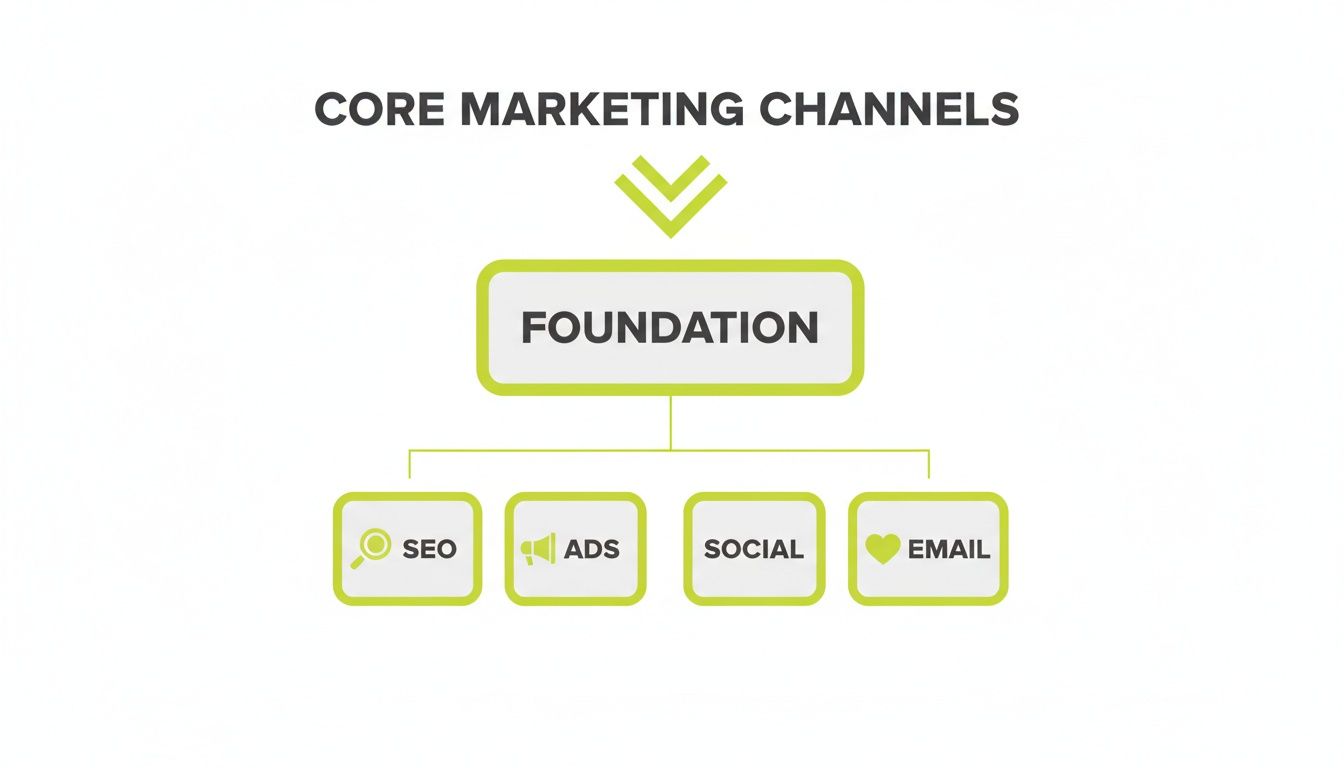
This diagram shows how a strong base in these core areas is essential. Without it, your advanced conversion tactics won't have enough traffic to work their magic.
Master Conversion Rate Optimization
Conversion Rate Optimization (CRO) is the science—and art—of getting more visitors to take the action you want them to take. For ecommerce, that action is almost always making a purchase. It involves making small, data-driven tweaks that can lead to significant lifts in sales without needing to spend a dollar more on traffic.
Think of your product page as a digital salesperson. If that salesperson is confusing, pushy, or unconvincing, you lose the sale. CRO is about methodically improving their pitch. The primary tool for this is A/B testing, where you show two versions of a page to different groups of visitors to see which one performs better.
Here are a few practical elements to test on your product pages:
- Call-to-Action (CTA) Button: Don't just settle on a design. Test everything—the color, size, and even the text. Does "Buy Now" create more urgency than "Add to Cart"? You might be surprised to find a simple color change from blue to green increases clicks by a noticeable margin.
- Trust Badges: Place logos of secure payment options (like Visa or PayPal) or security seals (like Norton) near your CTA. Testing their placement and visibility can ease checkout anxiety and give customers the confidence boost they need to complete their purchase.
- Product Images vs. Videos: Try A/B testing a stunning primary product image against a short, punchy product demonstration video. For a complex or high-ticket item, a video can often answer questions and build trust far more effectively than a static photo ever could.
Deploy Omnichannel Remarketing
Have you ever looked at a product online, only to see ads for that exact item following you across the internet? That’s remarketing. And when done right, it's incredibly effective. Omnichannel remarketing takes this concept a step further by creating a connected, cohesive journey across multiple platforms.
The goal here is to stay top-of-mind without being creepy or intrusive. A customer who viewed a specific product on your website is a high-intent shopper. A well-timed, relevant reminder is often the exact nudge they need to come back and buy.
Imagine a customer browses a pair of running shoes on your site but doesn't buy. An omnichannel sequence could look like this:
- 3 hours later: They see a carousel ad on Instagram stories featuring the exact shoes they viewed.
- 24 hours later: They get an email with the subject line, "Still Thinking It Over?" showcasing the shoes along with some 5-star customer reviews.
- 48 hours later: A display ad appears on a popular news website they visit, offering free shipping on their order.
This coordinated approach ensures your message reaches them wherever they are online, reinforcing their initial interest and guiding them back to your store. These campaigns are powerful because they target users who have already shown clear buying signals.
Use Technology to Create Immersive Experiences
Today's shoppers crave more than just a grid of static product images. Technologies like Augmented Reality (AR) and Geofencing are no longer just for massive brands; they've become accessible tools that create memorable, conversion-focused experiences for businesses of all sizes.
Augmented Reality (AR) masterfully bridges the gap between online and in-store shopping by letting customers "try before they buy" right from their own homes. AR tackles one of the biggest hurdles in ecommerce: uncertainty.
- Practical Example: A furniture store like IKEA uses an AR app that lets you place a virtual sofa in your living room to see how it fits with your decor. A makeup brand like Sephora lets users virtually try on different shades of lipstick using their phone's camera. This completely removes the guesswork and dramatically increases purchase confidence.
Geofencing is a location-based marketing tactic that triggers an action—like sending a push notification or showing an ad—when a user enters a specific geographic area.
- Practical Example: A local sporting goods store could set up a geofence around a competitor's location. When a customer who has their app enters that zone, they could receive a targeted push notification: "15% off all baseball gear, just a mile away!" This is a direct, timely, and hyper-relevant way to potentially capture a competitor's foot traffic.
As you begin to master these conversion tactics, you'll naturally want to find ways to get each customer to spend more. If you're ready to dive deeper, you can learn all about how to increase average order value in our detailed guide.
Winning on Retail Media and Digital Marketplaces
Let’s talk about one of the biggest shifts in ecommerce advertising: learning to meet customers exactly where they’re already shopping. Getting your products seen on major retail platforms like Amazon, Walmart Marketplace, and Target+ isn't just a nice-to-have anymore; it's a non-negotiable part of a modern ecommerce strategy.
Think of it like paying for that premium, eye-level shelf space in a crowded supermarket. You’re putting your products directly in the line of sight of shoppers who are already in a buying mood.
This strategy has quickly become a beast in the digital world. Online retail platform advertising now pulls in more than 1 in 5 digital ad dollars spent globally, grabbing 21.2% of the total pie in 2024. That market share has nearly doubled in just five years, which tells you everything you need to know about how essential this channel is for growth. (You can dig into the full report on global digital ad spend trends from datareportal.com if you want to see the raw numbers.)
Understanding Retail Media Ad Types
To get this right, you first need to know the difference between the main ad formats on these marketplaces. Each one has a specific job to do, and a smart budget split between them is the key to maximizing your return.
- Sponsored Product Listings: These are the bread and butter of marketplace ads. They’re keyword-targeted ads that push your product higher up in search results and onto competitor product pages. Simple and effective.
- Sponsored Display Ads: These ads are more about audience targeting and are a lot more versatile. They can show up both on and off the marketplace, letting you retarget shoppers who checked out your products or go after audiences based on their shopping habits and interests.
Think of it this way: Sponsored Products are like winning the best spot on the shelf in the "organic coffee beans" aisle. Sponsored Display is like putting a promotional sign for your coffee in the snack aisle, reminding shoppers of your brand while they're looking at something else.
Allocating Your Budget for the Best Return
A well-run retail media plan can give your products a massive visibility boost, drive sales you wouldn't have gotten otherwise, and give you a real edge as traditional ad platforms get more crowded and expensive. But it all starts with the right budget strategy.
A good starting point is to put the bulk of your budget—somewhere around 60-70%—into Sponsored Product listings. These ads are designed to capture bottom-of-the-funnel demand from people actively searching for exactly what you sell. Unsurprisingly, they typically deliver the highest immediate return on ad spend (ROAS).
Use the remaining 30-40% of your budget on Sponsored Display ads. This slice of the pie is for building brand awareness, retargeting shoppers who’ve shown interest, and cross-selling to your existing customers. This balanced approach makes sure you’re not just capturing the demand that’s already there, but actively creating new demand for your products.
Your Mobile Experience Isn't Just a Channel—It's Your Entire Storefront
Let's be blunt: mobile isn't just another channel in your ecommerce playbook. It's the main event. It's the battlefield where most of your sales are won or lost. Simply having a "responsive design" checked off a list isn't going to cut it anymore. Winning here requires a dedicated, mobile-first mindset that obsesses over every single tap, scroll, and click your customers make on their phones.
The data couldn't be clearer. Mobile commerce is the dominant force in retail, with smartphones driving nearly 80% of all retail website visits globally in 2024 and generating the lion's share of online orders. The trend is even more pronounced in Asian markets, where countries like China and South Korea see over 70% of total online sales happen on mobile. If you want the full picture, Statista offers a complete breakdown of online shopping statistics. This makes nailing the mobile journey an absolutely critical part of any ecommerce marketing strategy.
Design For Thumbs, Not Cursors
Think about how you actually hold your phone. You’re likely navigating with your thumb, which means the most important buttons and links need to be within easy reach—right at the bottom and center of the screen. Forcing someone to stretch their thumb to a tiny "Menu" icon in the top-left corner is a classic rookie mistake. It’s a perfect example of a desktop design awkwardly shoved onto a mobile screen.
- Real-World Example: Imagine a fashion retailer scrapping its traditional top navigation bar. Instead, they implement a "sticky" bottom menu with clear icons for Home, Search, Cart, and Account. Suddenly, navigating the store feels fluid and natural, keeping shoppers engaged instead of frustrated.
Slash Friction at Mobile Checkout
The mobile checkout is where countless sales go to die. It's a graveyard of abandoned carts, killed by long forms, impossibly tiny text fields, and a dozen different steps. Your one and only goal here is to make paying for something so ridiculously easy it feels like an impulse.
The single biggest lever you can pull to slash mobile cart abandonment is integrating one-click payment options. Services like Apple Pay, Google Pay, and Shop Pay let customers buy with just a fingerprint or face scan. This completely bypasses the soul-crushing chore of manually typing in card numbers and shipping addresses.
This one change can have a staggering impact on your conversion rates, turning casual browsers into confirmed buyers in the blink of an eye.
Optimize for Speed and Vertical Video
Let's face it, mobile users have zero patience. A slow-loading site is an abandoned site. Period. Use tools like Google PageSpeed Insights to get ruthless about optimization. Compress your images, minify your code, and do whatever it takes to get your mobile pages loading in under three seconds. Every millisecond you shave off matters.
Beyond speed, your ad creative has to feel native to the mobile world. This means embracing vertical video for platforms like TikTok and Instagram Stories.
- Real-World Example: Instead of running a awkwardly cropped version of their widescreen TV ad, a home goods brand should create a 15-second vertical video specifically for Instagram Stories. It could be a quick, snappy tutorial showing how to style a bookshelf, shot on a phone to feel authentic and fit right into a user's feed. This is how you stop the scroll and drive real engagement.
Using Data and AI to Measure and Scale Your Success
A marketing strategy without measurement is just a guess. To build a truly profitable ecommerce business, you need to move beyond surface-level numbers and turn your data into a clear roadmap for growth.
This is where you connect your actions to real, bottom-line results. It’s about using smart metrics and powerful technology to stop guessing and start scaling.
Defining the KPIs That Actually Matter
Vanity metrics like likes and impressions feel good, but they don't pay the bills. The best digital marketing strategies for ecommerce are measured against key performance indicators (KPIs) that directly reflect the health and profitability of your business.
Instead of getting lost in spreadsheets full of meaningless numbers, successful brands obsess over a few core metrics:
- Customer Acquisition Cost (CAC): This is the total amount you spend on marketing and sales to get a single new customer. Simple enough. But if your CAC is higher than what a customer spends, you’ve got a big problem.
- Customer Lifetime Value (LTV): This metric predicts the total revenue a single customer will generate over their entire relationship with your brand. The real magic happens when your LTV is at least 3x your CAC.
- Return on Ad Spend (ROAS): For every dollar you put into advertising, how many dollars in revenue do you get back? A ROAS of 4:1 is a common benchmark, meaning you're generating $4 for every $1 spent.
Understanding Marketing Attribution
Marketing attribution is simply figuring out which channels get credit for a sale. A customer might see your Instagram ad, click a Google search result a week later, and finally buy after getting a cart abandonment email. So which channel was most important?
Think about attribution like a soccer team. The striker who scores the goal (last click) gets the glory, but what about the midfielder who made the crucial pass (first click) or the defender who started the whole play? A good attribution model gives credit to the whole team, helping you see how different channels work together to drive conversions.
Putting AI to Work for Scalable Growth
Artificial intelligence is no longer some futuristic buzzword; it’s a practical tool that gives ecommerce brands a serious competitive advantage. AI can process vast amounts of data to make smarter, faster decisions than any human ever could. For a deeper look, check out our insights on how data science in marketing is changing the game.
Here’s how AI works in the real world:
- Automated Ad Bidding: Tools like Google's Performance Max use AI to automatically adjust your ad bids in real-time. The AI analyzes thousands of signals—like time of day, device, and user behavior—to show your ad at the perfect moment to maximize your ROAS.
- Personalized Product Recommendations: AI engines analyze a user's browsing history and past purchases to show them products they're highly likely to buy. This is the technology behind Amazon's "Customers who bought this also bought…" feature, a massive driver of increased average order value.
- Predictive Analytics: This is where things get really interesting. AI can analyze your customer data to identify patterns and predict future trends. It can tell you which customer segments are most likely to churn or which products are about to trend, allowing you to act proactively instead of just reacting.
Common Questions About Ecommerce Marketing
Jumping into ecommerce marketing brings up a lot of the same questions for everyone. Getting straight, practical answers is the only way to invest your budget and time with confidence. Let's tackle some of the most common hurdles we see ecommerce owners face.
How Much Should We Really Spend on Marketing?
There’s no magic number, but a decent starting point for many brands is 7-12% of total revenue. A much smarter way to think about it, though, is to work backward from your goals. It all comes down to your Customer Acquisition Cost (CAC) and Lifetime Value (LTV).
A brand-new company trying to make a splash might pour 15-20% of revenue into marketing just to get its name out there and carve out some market share. An established brand, on the other hand, is usually dialing in a very specific Return on Ad Spend (ROAS) target. The big takeaway here? Start with a test budget, track everything obsessively, and then double down on what actually works.
What's the Best Channel to Start With for a New Store?
When you’re just starting out, you need to go where the customers already are. Your goal is to capture existing demand and get fast feedback on your products. For that, nothing beats the one-two punch of Google Shopping Ads and Meta Ads (Facebook/Instagram).
Google Shopping gets your products right in front of people who are actively searching for them—that’s as high-intent as it gets. Meta Ads are incredible for finding your niche audience based on their interests and building that crucial initial brand awareness.
Once those channels start bringing in consistent revenue, you can reinvest those profits into long-term assets. This is when you start building out your SEO and a killer email list that you own.
How Long Does SEO Actually Take to Work?
Let's be clear: SEO is a marathon, not a sprint. While you might see some small ranking bumps in the first three months from fixing technical issues and optimizing your pages, the real, meaningful results take time.
You're typically looking at 6 to 12 months of consistent, quality work to start seeing first-page rankings for competitive keywords and a serious uptick in organic traffic. The timeline really depends on how competitive your niche is, your site's current authority, and the caliber of your SEO strategy. It demands patience, but SEO often delivers the highest long-term ROI of any channel you'll touch.
Ready to stop guessing and start growing? Silver Spoon Agency turns your advertising into measurable, revenue-producing growth. Our AI-powered, omnichannel approach ensures your campaigns are optimized for pinpoint targeting and superior ROAS. Discover how we can elevate your brand and build funnels that convert.