


Proven Ecommerce Growth Strategies for Scaling Your Store

Growing an ecommerce brand isn't about finding one magic bullet. A truly effective growth strategy is a cohesive system—one that artfully blends smart customer acquisition, relentless conversion optimization, and strategic, long-term retention. It's about building a profitable, scalable engine where every part works in sync to pump up your customer lifetime value.
Your Blueprint for Sustainable Ecommerce Growth
Forget the old-school approach of siloed marketing. Modern growth demands a unified framework that turns one-time buyers into lifelong fans. This playbook will shift your focus from chasing vanity metrics to building a resilient business with a predictable revenue machine.
This all comes down to mastering three core pillars that create a powerful flywheel effect for your brand:
- Hyper-Targeted Acquisition: Stop wasting ad spend. It’s about reaching the right customers on the right channels with the right message. This turns your marketing budget into a true investment, not just an expense.
- Relentless Conversion Optimization: Methodically improve every single touchpoint, from the product page to the final click at checkout. This is how you turn casual website visitors into paying customers.
- Maximizing Customer Lifetime Value (LTV): Build a loyal community and encourage repeat purchases through smart email, SMS, and loyalty programs. This is where the real profit is made.
This interconnected system, which you can see below, shows exactly how acquisition, conversion, and retention work together as one cohesive growth engine.
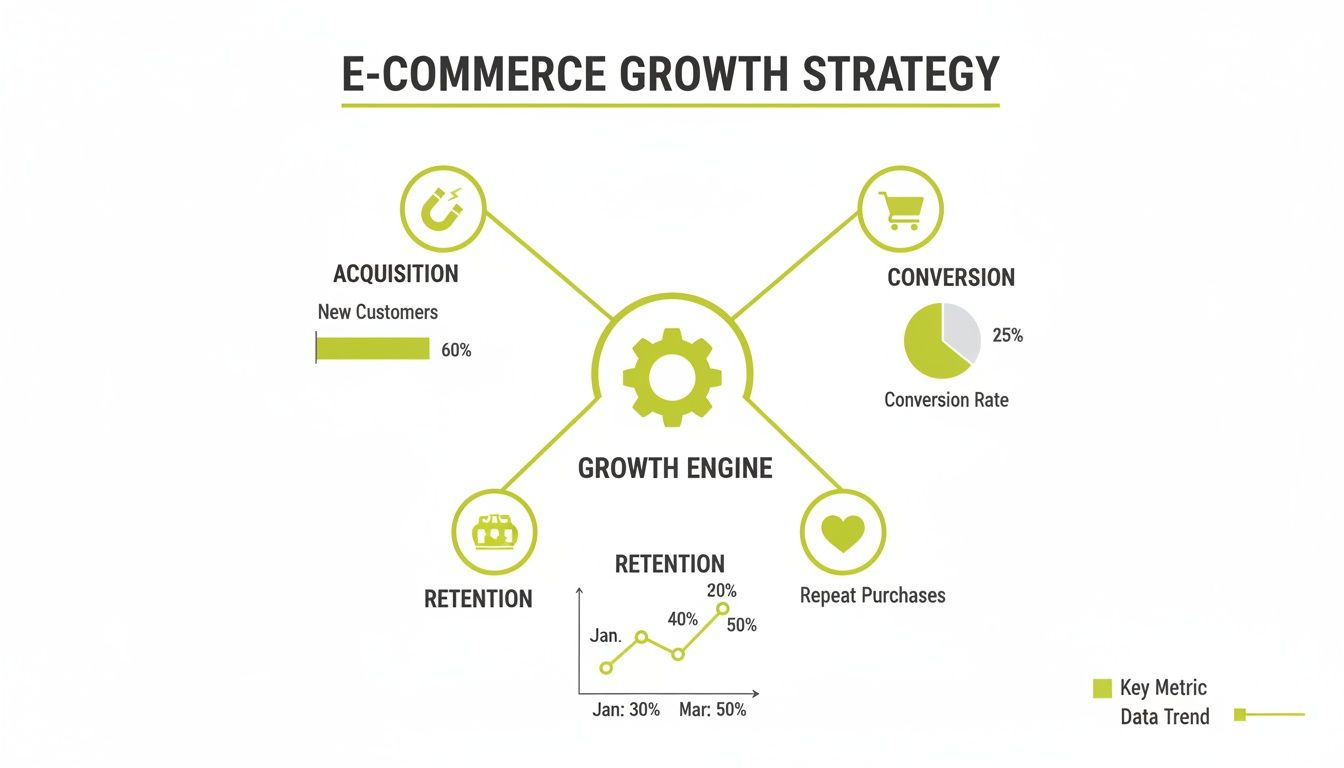
As the diagram illustrates, each stage feeds the next. It’s a self-sustaining cycle that drives profitable, long-term growth.
To give you a clearer picture of how these pieces fit together, here’s a quick-reference table outlining the key levers, metrics, and typical budget splits for a brand that's serious about scaling.
Core Ecommerce Growth Levers and KPIs
| Growth Lever | Primary Channels | Key KPIs | Sample Budget Allocation |
|---|---|---|---|
| Acquisition | Paid Social (Meta, TikTok), Paid Search (Google), Display | Cost Per Acquisition (CPA), Return on Ad Spend (ROAS), Click-Through Rate (CTR) | 50-60% |
| Conversion | Website, Landing Pages, Funnels | Conversion Rate (CVR), Average Order Value (AOV), Cart Abandonment Rate | 10-15% (on tools & talent) |
| Retention | Email Marketing, SMS, Subscriptions, Loyalty Programs | Customer Lifetime Value (LTV), Repeat Purchase Rate, Churn Rate | 30-35% |
This table provides a high-level view, but the magic is in the execution. Each of these levers requires a dedicated strategy, constant testing, and a deep understanding of your customer.
Understanding the Modern Growth Landscape
The opportunity right now is massive. Global ecommerce sales are on track to blow past $6.88 trillion in 2026, which is a huge 7.2% jump from 2025. This explosion is being fueled by sophisticated brands that blend social media ads, search mastery, and targeted email campaigns to connect with shoppers at every single turn. The brands winning today don't just advertise; they predict and adapt in real-time to capture customer intent.
The real goal is to create a system where each new customer becomes more valuable over time. This happens when your acquisition cost is significantly lower than the lifetime value a customer brings to your business.
Getting that LTV:CAC balance right is everything. It demands a deep dive into your data and a commitment to continuous testing and optimization. The strategies we're about to cover will give you the tools to build this exact system, ensuring every decision you make is backed by cold, hard data. If you’re looking to sharpen your acquisition skills, you might also find our guide on lead generation for small business a useful complement to these principles.
Mastering Profitable Customer Acquisition
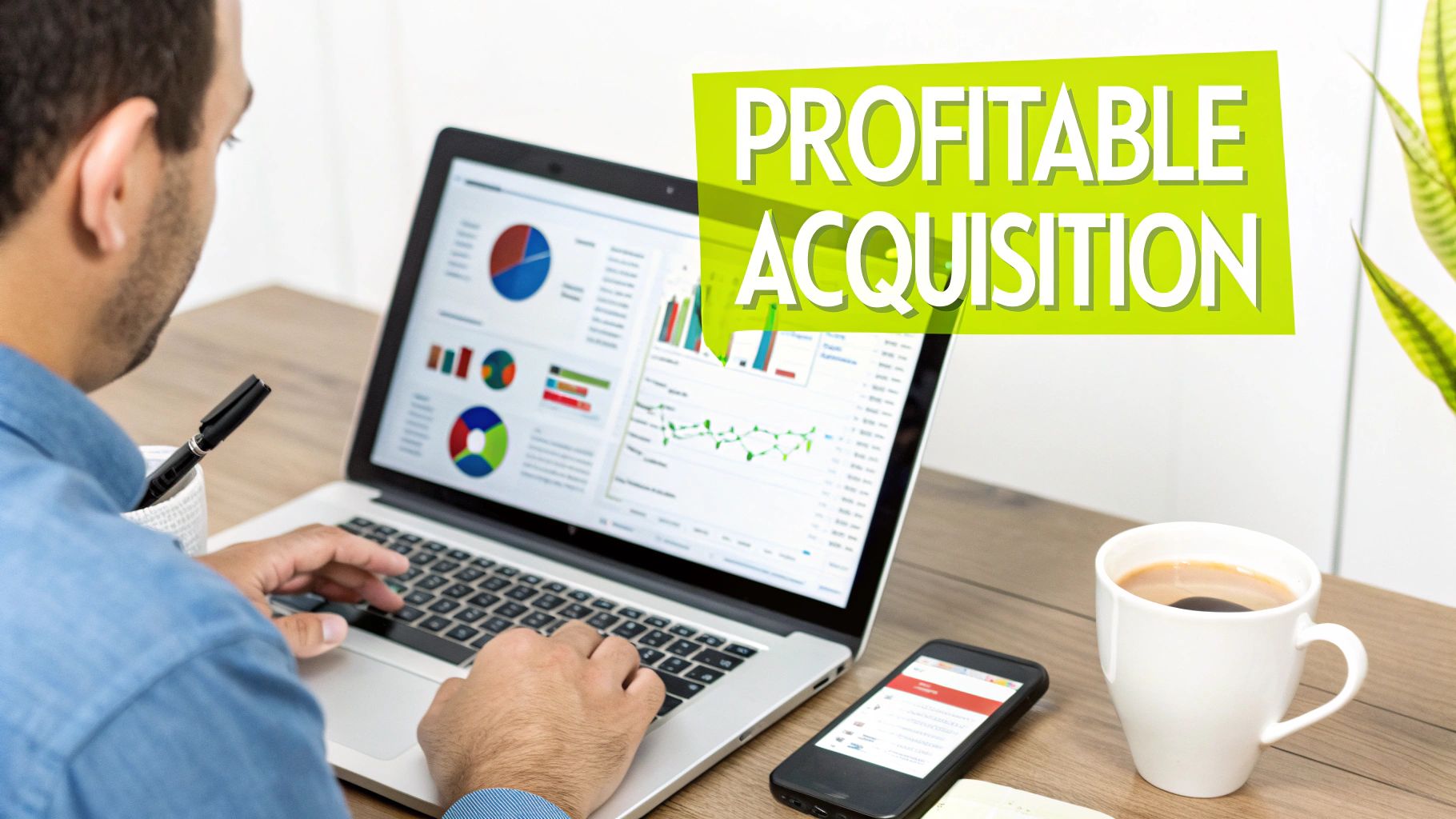
Let's be honest: getting new customers is the lifeblood of any ecommerce brand. But just driving a ton of traffic to your site won't cut it. The real game is about acquiring them profitably. That means building a smart, multi-channel acquisition machine that cuts out wasted ad spend, cranks up your Return on Ad Spend (ROAS), and, most importantly, finds people who will actually stick around.
Effective acquisition is so much more than just hitting "launch" on a basic campaign. It demands a layered, full-funnel strategy that connects with potential buyers at every single stage of their journey. One of the most powerful moves you can make is to build your campaigns around the best customers you already have.
Building Audiences That Convert
Your most valuable weapon in the acquisition game is your own first-party data. Forget guessing who your ideal customer is. You can tap into the data from your most loyal buyers to find thousands more people just like them.
A perfect real-world example comes straight from the DTC apparel world. A fashion brand can pull a list of their top 10% of customers based on lifetime value (LTV) right out of their Shopify or BigCommerce backend. That simple CSV file is then uploaded to a platform like Meta (for Facebook and Instagram ads) to create a high-octane Lookalike Audience.
By building a Lookalike Audience from your highest LTV customers, you're giving the ad platform a crystal-clear directive: "Go find me more people who look and act exactly like my best repeat buyers." This is infinitely more powerful than targeting based on broad interests alone.
This single tactic ensures your ad dollars are laser-focused on reaching users who are statistically primed to become profitable, long-term customers, not just one-and-done buyers. It’s a foundational play for scaling your brand the right way.
Crafting Ad Creative That Stops the Scroll
Once your audience is dialed in, your creative is the next piece of the puzzle. Generic stock photos and boring, robotic ad copy are dead. Your ads have to feel real and strike an emotional chord with the people you're trying to reach.
Think about a wellness supplement company. What's their best-performing ad? It's almost never a glossy, professional studio shot. More often than not, it's user-generated content (UGC), maybe a raw, unedited video testimonial from a real customer.
- Authenticity Sells: A quick clip of a customer genuinely sharing how a supplement boosted their energy feels far more trustworthy than a scripted ad.
- Social Proof is Powerful: When potential buyers see people just like them loving a product, it vaporizes their purchase anxiety.
- Platform-Native Feel: UGC just blends in. It looks like the organic content people are already scrolling through on TikTok and Instagram, making it way less likely to get skipped over.
This approach builds instant trust and provides the social proof needed to convince a hesitant visitor to finally make that first purchase.
Structuring a Full-Funnel Campaign
A classic mistake is dumping the entire acquisition budget into bottom-of-funnel, "buy now" ads. While those are crucial, this approach completely ignores the huge pool of potential customers who just aren't ready to buy yet. A true acquisition machine guides people from that first "hello" all the way to checkout.
Here’s a simple way a brand selling high-end kitchen knives could structure this:
- Top of Funnel (ToFu) – Awareness: The goal here is pure introduction. The brand might run some fun, engaging, short-form TikTok videos showing a chef effortlessly slicing through a tomato. The key metric isn't sales—it's video views and engagement.
- Middle of Funnel (MoFu) – Consideration: Now it's time to retarget anyone who watched 50% or more of that video. They could be served a Facebook Carousel ad that dives into the specific steel used, the handle ergonomics, and a link to a blog post on "Choosing the Right Chef's Knife." You're building trust by adding value.
- Bottom of Funnel (BoFu) – Conversion: This is where you seal the deal. For anyone who has visited a product page or added a knife to their cart, you serve them Google Shopping dynamic product ads. These ads are brilliant because they show the exact knife they were just looking at, creating a powerful nudge to come back and finish their purchase.
By building out this multi-stage journey, you systematically walk users from discovery to conversion. Every dollar has a purpose: moving a potential customer to the next stage. As you scale, channels like SMS also become a critical part of your strategy; you can learn more by checking out our guide on SMS marketing for ecommerce. This integrated approach is how you turn cold traffic into loyal, profitable customers.
Turning Website Visitors Into Customers
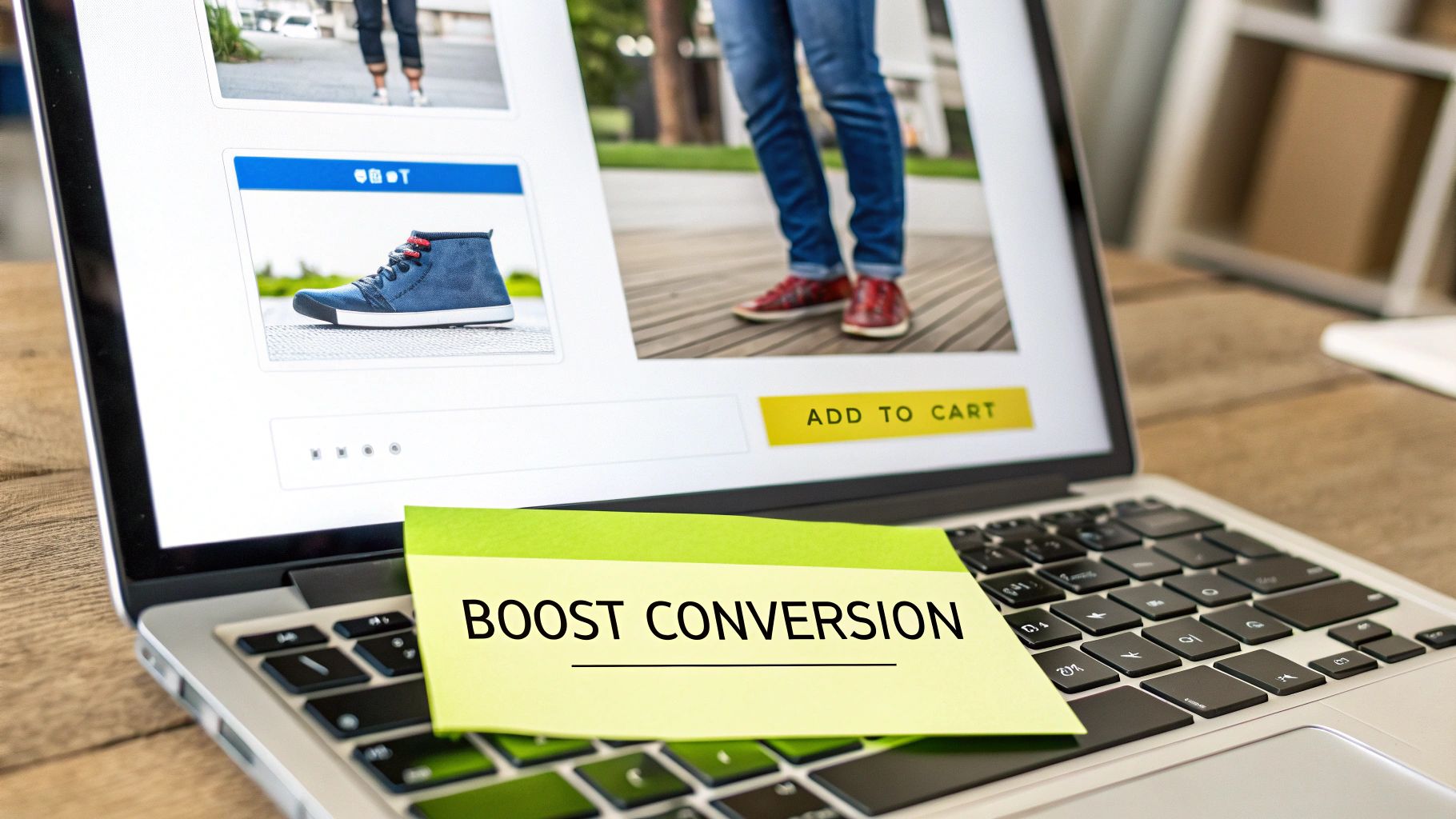
Getting traffic to your site is a great start, but it's only half the battle. The real magic happens when you get good at turning those clicks into paying customers. This whole process is called Conversion Rate Optimization (CRO), and it's all about making small, data-backed tweaks that can lead to huge jumps in revenue.
This isn't about throwing things at the wall to see what sticks. It's a methodical way of figuring out what your visitors actually want and getting rid of any friction that's stopping them from buying. A big part of this is constantly working on how to improve ecommerce conversion rates. This commitment to constant improvement is what separates the stores that scale from the ones that stall out.
What a High-Converting Product Page Looks Like
Think of your product page as the final sales pitch before a customer makes their decision. You've got just a few seconds to build trust, answer their unspoken questions, and make them want what you're selling. Let’s imagine how a skincare brand could build a page that converts like crazy.
- Powerful Visuals: Forget just showing a picture of the bottle. Use compelling before-and-after photos. For an anti-aging serum, that kind of visual proof is way more convincing than a paragraph of text could ever be.
- Ingredient Transparency: Don’t just list what's inside—explain it. A simple tooltip that pops up to say "Hyaluronic Acid hydrates and plumps skin" builds a ton of confidence and shows you know your stuff.
- Real Social Proof: Put your best customer reviews and ratings front and center. Even better, add a feed of user-submitted photos showing off their results. That’s a layer of authenticity you just can't fake.
When all these pieces work together, they systematically break down a customer's doubt. Someone lands on the page, sees undeniable proof the product works, understands exactly what’s in it, and sees that hundreds of other people are loving it. Suddenly, the decision to buy feels a lot less like a risk.
A/B Tests You Can Run Tomorrow
CRO is built on testing. Sometimes the smallest changes can lead to the biggest wins, but you’ll never know what works without looking at the data. A/B testing—where you show two versions of a page to different groups of users to see which one performs better—is your secret weapon here.
Here are a couple of simple, high-impact tests you could start right away:
- Test Your Main Call-to-Action (CTA): Pit your standard "Add to Cart" or "Add to Bag" against something more direct, like "Buy Now." A subscription box company, for instance, might test "Get Your Box" against "Start My Subscription" to see which phrase creates a stronger sense of commitment.
- Highlight Payment Options: Near the price of a $200 office chair, add a small badge that says, "Or 4 interest-free payments of $50 with Klarna." This one little addition can make the price feel much more manageable and give conversions a serious boost, especially for higher-priced items. For a deeper dive on how these tests fit into the bigger picture, check out our guide on https://silverspoonagency.com/sales-funnel-optimization-strategies/.
The golden rule here is to test one thing at a time. If you change the button color, the button text, and the product image all at once, you’ll have no clue which change actually made the difference. Keep your variables isolated to get clean, actionable data.
Tapping into Customer Psychology
Understanding why people buy is just as crucial as knowing what they buy. The best growth strategies use psychological triggers to gently nudge people toward a decision without being aggressive.
A fashion brand, for example, can use urgency and scarcity to drive sales. Adding a low-stock countdown ("Only 3 left at this price!") or a simple label like "Selling fast!" on a popular dress creates a powerful sense of FOMO (fear of missing out). This can be just the push someone "on the fence" needs to buy now instead of later.
Building Loyalty and Maximizing Lifetime Value
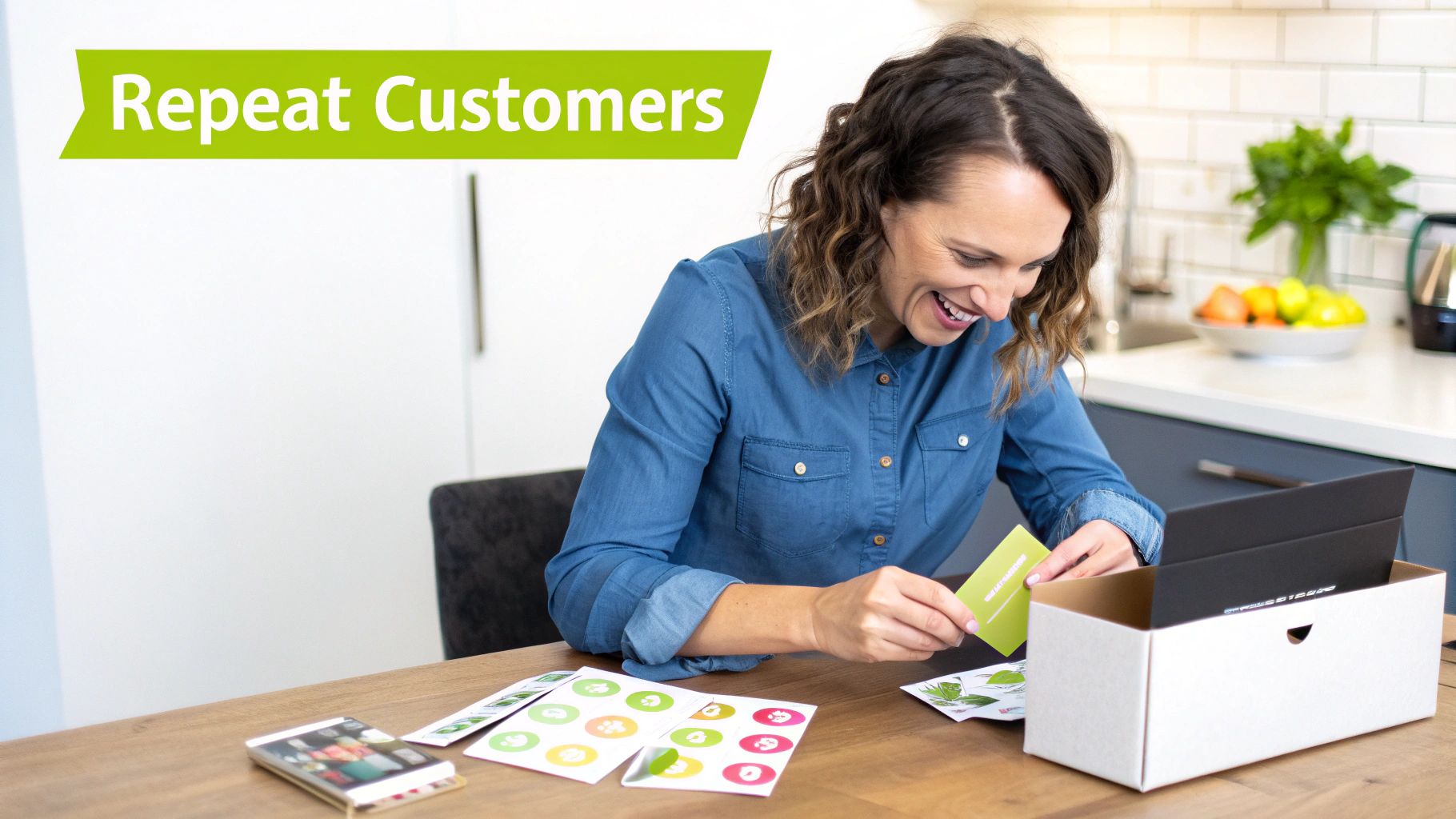
Pouring money into a leaky bucket is a terrible way to grow a business, but that’s exactly what an acquisition-only mindset does. While getting new customers in the door is obviously important, the real, sustainable growth comes from repeat business. This is where you stop chasing endless new faces and start focusing on Customer Lifetime Value (LTV)—the total amount a customer is likely to spend with you over their entire relationship.
The magic happens in the post-purchase experience. If you make it so seamless, personal, and valuable that customers don't even think about looking elsewhere, you’ve won. To really build that kind of loyalty and pump up your LTV, your focus has to be on constantly improving ecommerce customer experience. That means hitting them on the right channels, with the right message, at exactly the right time.
Driving Repeat Sales with Automated Flows
Think of automated email and SMS campaigns as your 24/7 retention team. They work tirelessly in the background, building relationships and clawing back lost revenue without you lifting a finger. If you’re scaling, two of these flows are completely non-negotiable.
First up is the Welcome Series. This is so much more than a simple "thanks for signing up" email. It's your first real shot to make an impression and nudge them toward that crucial first purchase.
- Email 1 (Immediately): Deliver the goods. If you promised a discount for their email, give it to them right away. No games. A subject line like "Here's Your 15% Off Code!" is direct and effective.
- Email 2 (Day 2): Tell your story. Who are you? What's your mission? Maybe share a picture of the founder. People buy from people, so this is your chance to build a human connection.
- Email 3 (Day 4): Flex your best stuff. Show off your best-sellers and sprinkle in some glowing customer reviews or user-generated content. This social proof is gold for building trust with a hesitant new subscriber.
The second must-have is the Abandoned Cart Sequence. People abandon carts for a million reasons. This flow is your safety net, designed to gently reel a huge chunk of them back in.
Don't just send a generic "You left something behind!" message. Get smarter. An abandoned cart email that includes a top-rated review for the exact product they were looking at can be incredibly persuasive. It tackles their last-minute doubts head-on.
Imagine a customer ditches a pair of running shoes. An email with the subject, "Still thinking it over? See what runners are saying…" followed by a 5-star review for those specific shoes? That’s not just a reminder; it’s powerful validation.
Re-Engaging Customers with Targeted Campaigns
Beyond the core automations, you need targeted campaigns to stay top-of-mind. One of the most effective is the "We Miss You" or Win-Back Campaign.
This is for customers who have gone quiet—maybe they haven't bought anything in 90 days. Don't just blast them with a generic coupon. Dig into their purchase history to make it personal.
Here’s a practical example for a coffee brand:
- Subject: Is your coffee mug empty? Let's fix that.
- Body: Hi [First Name], we've missed you! We noticed it's been a while since you picked up your favorite Ethiopian Yirgacheffe blend. We just got a fresh roast in that we think you'll love. Use code COMEBACK15 for 15% off your next order.
This little bit of personalization shows you're paying attention. It makes the offer feel less like a mass-market blast and more like a helpful, personal suggestion from a brand that gets them.
Structuring a Loyalty Program That Works
Loyalty programs are one of the best tools for turning customers into a true community and slashing churn rates. They reward people for sticking with you, making them feel appreciated and giving them a concrete reason to choose you over a competitor every single time.
Let’s map this out with a hypothetical coffee subscription box. Instead of a boring, flat "earn points" system, they could create a tiered program with progressively better perks.
| Tier | Points to Enter | Key Rewards |
|---|---|---|
| Bronze Bean | 0 (All Subscribers) | Earn 1 point per dollar spent |
| Silver Brewer | 500 Points | Free shipping on all marketplace orders |
| Gold Roaster | 1,500 Points | Early access to new coffee blends |
See how that works? The structure creates a game-like sense of progression. As customers climb the ladder, the rewards become more meaningful. The "Gold Roaster" tier isn't just about saving a few bucks—it's about status and getting exclusive access to new products. For your biggest fans, that’s a massive motivator.
Using Data and AI for Intelligent Scaling
Gut feelings have no place in a modern ecommerce growth strategy. The brands that win—the ones that scale intelligently—treat data not as some byproduct of doing business, but as their most valuable asset. Using data and Artificial Intelligence (AI) isn't a futuristic concept anymore. It's the engine you need for making smarter, faster decisions.
This isn't about hiring a team of data scientists, either. It’s about grabbing accessible tools to understand your customers on a much deeper level and automating decisions that directly pump up your bottom line. From predicting which customers are about to leave to showing the perfect product at the perfect time, data is your unfair advantage.
Personalization Powered by AI
One of the quickest ways to see AI make a real impact is through personalization. Generic homepages and one-size-fits-all product recommendations are dead. AI-powered tools can analyze a user's real-time behavior—what they’re clicking on, what they’re searching for, what they bought last time—to create a shopping experience that feels like it was built just for them.
Think about an online home decor store. An AI recommendation engine on their homepage might show a first-time visitor the store's best-sellers to cast a wide net. But for a returning customer who was just browsing mid-century modern coffee tables, that engine will dynamically swap those best-sellers for matching armchairs, floor lamps, and rugs from that same collection.
This isn't just about bumping up your Average Order Value (AOV). It's about making the customer feel seen and understood. You're turning a simple transactional website visit into a curated shopping experience, and that's how you build real brand affinity.
Moving Beyond Last-Click Attribution
As you add more marketing channels, figuring out what’s actually working gets messy. If you're only looking at the last click before a sale—usually a branded Google search or a retargeting ad—you're missing most of the story. To scale smartly, you need a more sophisticated measurement framework.
Multi-touch attribution models give you the full picture of the entire customer journey. Instead of giving one channel all the glory, they distribute credit across multiple touchpoints, revealing how your channels work together to land a conversion.
For an online furniture store, a typical customer journey might look like this:
- First Touch: Discovered the brand through a gorgeous Pinterest pin (Awareness).
- Middle Touch: Searched Google for "solid wood dining tables" and clicked an organic link a week later (Consideration).
- Last Touch: Saw a dynamic retargeting ad on Instagram and finally clicked "buy" (Conversion).
With last-click attribution, that Instagram ad gets 100% of the credit. But a multi-touch model shows that Pinterest and SEO were absolutely critical for building that initial awareness and trust. This insight stops the brand from underfunding its top-of-funnel channels and helps them spread their budget more intelligently across the entire customer journey.
Predicting Customer Behavior with Data
Another game-changer is predictive analytics. Instead of just reacting to what your customers do, you can start anticipating their next move. AI tools can chew through your customer data, find hidden patterns, and identify segments of people who are highly likely to take a specific action.
- Predicting Churn: The system can flag customers whose engagement has dipped or whose buying frequency has changed, signaling they’re at risk of churning. This lets you proactively hit them with a special offer or a "We miss you" campaign before they're gone for good.
- Identifying High-Value Prospects: By analyzing the traits of your best customers, predictive models can score new leads and website visitors on their likelihood to become high-LTV buyers. This means you can focus your marketing spend on the prospects with the highest potential from day one.
This predictive power is becoming the cornerstone of growth, and not just in B2C. The B2B ecommerce world is set to explode, projected to hit $36 trillion by 2026 with a staggering 14.5% CAGR. This boom is fueled by the fact that over 90% of B2B firms have swapped face-to-face sales for virtual models since 2020, arming themselves with slick software to close deals. Agencies are pouring fuel on this fire with omnichannel strategies—think AI-optimized ads across search, display, and SMS that are pulling in 4X ROAS.
This is powerful proof that integrated tech and data are driving massive growth. You can dive deeper into these projections and learn about ecommerce sales and forecasts from the U.S. International Trade Administration. It all circles back to the same truth: data isn't just for consumer brands; it’s the critical fuel for any business looking to scale efficiently.
Integrating AI isn't a flip-the-switch process. It’s a phased journey that should align with your company's growth and maturity. Here’s a practical roadmap to get you started.
AI Implementation Roadmap for Ecommerce
| Growth Stage | Recommended AI Tools & Tactics | Primary Goal | Key Metric to Improve |
|---|---|---|---|
| Foundation (0-12 months) | AI-powered product recommendations (e.g., Nosto), automated email flows (e.g., Klaviyo AI), chatbot for basic support. | Automate repetitive tasks and deliver initial personalization. | Conversion Rate, AOV |
| Growth (12-24 months) | Dynamic pricing tools, predictive audience segmentation for ads, multi-touch attribution software (e.g., Triple Whale). | Optimize marketing spend and deepen customer understanding. | ROAS, LTV:CAC Ratio |
| Scale (24+ months) | Predictive churn models, AI-driven inventory forecasting, advanced customer journey analytics. | Proactively retain customers and optimize operations for profitability. | Customer Churn Rate, Gross Margin |
This roadmap provides a clear path from implementing foundational tools that provide immediate lift to adopting advanced analytics that drive long-term, sustainable growth. The key is to start small, prove the value, and build from there.
Answering Your Most Common Ecommerce Growth Questions
As you start to scale, you’re going to run into some recurring questions. How much should I really be spending? When do I shift focus? What does “good” even look like? Let’s tackle some of the most common hurdles ecommerce founders face with straight, actionable answers.
How Much Should I Spend on Marketing?
There’s no magic number, but a solid rule of thumb for a growing ecommerce brand is to earmark 15-25% of your total revenue for marketing. What matters more than the exact percentage, though, is how you spend it.
A smart allocation follows the playbook we've been discussing. Pour the biggest chunk (50-60%) into your acquisition engine—think paid ads that bring in fresh faces. The rest gets split between keeping your existing customers happy (30-35%) and investing in tools to improve your site's performance (10-15%).
Let’s make it real. Say your store is doing $50,000 a month. A 20% marketing budget gives you $10,000 to work with. Here’s one way to break that down:
- $5,500 for your Google and Meta ad campaigns.
- $3,500 to power your email/SMS platform and any loyalty programs.
- $1,000 for CRO software and A/B testing tools like VWO or Hotjar.
When Should I Focus on Retention Over Acquisition?
The honest answer? You should always be working on retention. But the intensity shifts once you have a predictable flow of new customers coming in the door.
The key metric to watch is your LTV:CAC ratio. Once your Customer Lifetime Value is at least 3x your Customer Acquisition Cost, it’s a massive green light to double down on your retention strategy.
Think about it: if it costs you $50 to acquire a customer (your CAC) and, on average, they spend $150 with you over time (your LTV), your acquisition machine is humming along nicely. At this stage, boosting your repeat purchase rate by a mere 5% through smarter email flows or a loyalty program will often skyrocket your profits more than chasing another handful of first-time buyers.
What Is a Good Conversion Rate for Ecommerce?
The industry average hovers around 2-3%, but frankly, that number is almost useless without context. Your industry, average order value, and traffic quality all play a huge role. A luxury furniture brand could be incredibly profitable with a 0.5% conversion rate, while a shop selling cheap phone cases might need to hit 5% just to stay afloat.
Instead of getting hung up on industry benchmarks, get obsessed with your own baseline. If you’re converting at 1.5% right now, your one and only goal should be hitting 2%. That 0.5% jump can translate into a massive revenue boost without spending another dime on ads.
How Do I Know if My Ads Are Actually Working?
Your north star metric here is Return on Ad Spend (ROAS). The formula is simple: Total Revenue from Ads / Total Ad Spend. For most ecommerce brands, a 4:1 ROAS (that’s $4 in revenue for every $1 you spend) is a healthy target that signals you're ready to scale.
But don't stop there. A simple ROAS calculation doesn't tell the whole story. You need to look at multi-touch attribution to see how different channels work together. An ad might have a low direct ROAS but be the critical first touchpoint that introduces hundreds of high-value customers to your brand. Seeing the full picture prevents you from prematurely killing top-of-funnel campaigns that are quietly fueling your growth.
Ready to stop guessing and start growing with a data-driven partner? The team at Silver Spoon Agency builds and manages the profitable, omnichannel systems that turn ad spend into predictable revenue. Let's talk about your growth strategy.