


Facebook Ads Agency: A Practical Guide to Vetting and Hiring Your Growth Partner

Before you even start interviewing a Facebook ads agency, you need to do some critical homework. Jumping into calls without a clear definition of success is like hiring a contractor without a blueprint. You'll get something, but it almost certainly won't be the business growth you're picturing.
Aligning Your Goals Before You Hire an Agency
Hiring an agency with vague requests like "more leads" or "boost sales" is a recipe for disappointment. The best agencies are strategic partners, not just button-pushers. They need a destination to build you a roadmap. Without one, you can't properly evaluate their proposals or hold them accountable for what truly matters.
This isn't about vanity metrics. It’s about defining tangible, measurable outcomes that directly impact your revenue and growth. Success looks different for every business, so you need to know exactly what it looks like for yours.

Nail Down Your Key Performance Indicators
Your Key Performance Indicators (KPIs) are the numbers that tell you if your ad spend is actually working. Before you talk to a single agency, you need to have these baselines figured out. This is non-negotiable.
Here’s what this looks like with practical examples:
For E-commerce Brands: Don't just ask for sales. Get specific. A solid goal is to hit a 4x Return on Ad Spend (ROAS) while keeping your Cost Per Acquisition (CPA) under $30. This tells an agency exactly what success looks like: for every $1 you spend, they need to bring in $4 in revenue, without ever paying more than $30 for a new customer.
For Service-Based Businesses: "More leads" is a useless metric. A concrete goal is to generate 50 marketing-qualified leads per month at a Cost Per Lead (CPL) of less than $75. This focuses the agency on delivering both volume and quality, not just filling your pipeline with junk. For example, a law firm might define a qualified lead as someone who fills out a "free case evaluation" form for a specific practice area, not just a generic "contact us" submission.
Setting these benchmarks upfront completely changes the conversation. You’re no longer just buying a service; you're collaborating on a specific, measurable business objective.
Before you can set these targets, you need a firm grasp of your own business numbers. Knowing your current metrics is the only way to measure the "before and after" of hiring an agency.
Here’s a quick look at how different business types might define their starting points:
| Example Business Goals Before Hiring an Agency | |||
|---|---|---|---|
| Business Type | Primary Goal | Key KPI | Target Metric |
| E-commerce (Skincare) | Increase Sales | Return on Ad Spend (ROAS) | 3.5x |
| SaaS (Project Management) | Generate Trials | Cost Per Trial Sign-Up | <$50 |
| Local Service (HVAC) | Book Appointments | Cost Per Booked Appointment | <$80 |
| B2B (Cybersecurity) | Acquire Leads | Cost Per Qualified Lead (MQL) | <$120 |
Having this table filled out for your own business gives a potential agency partner everything they need to build a meaningful proposal. It shows you've done your homework and are ready for a serious growth conversation.
Map Out Your Ideal Customer Profile
An agency could create the most brilliant ad campaign ever seen, but it will fall flat if it’s shown to the wrong people. You know your customers better than anyone. It’s your job to document this knowledge so an agency can hit the ground running.
Get granular with practical examples. Think about details like:
- Demographics: Age, location, income, job title. For a financial advisor, this could be "dual-income households, ages 45-60, with investable assets over $500k."
- Psychographics: Their values, hobbies, where they hang out online, what they struggle with. For a sustainable fashion brand, this might be "values ethical production, follows zero-waste influencers, and struggles to find stylish, eco-friendly clothing."
- Behaviors: Are they on Instagram Reels or in Facebook Groups? Do they read blogs or watch YouTube videos? For a B2B software company, this could be "active in LinkedIn groups for their profession and consumes long-form content on industry blogs."
For instance, a boutique yoga studio isn't just targeting "women ages 25-45." A better profile is: "Women aged 30-55 with a household income over $100k, living within a 10-mile radius. They follow wellness influencers like Tara Stiles, shop at Whole Foods, and value sustainability and community." That’s a profile an agency can actually work with.
Determine a Realistic Ad Budget
Your budget has two distinct parts: the agency's management fee and your actual ad spend (the money that goes directly to Meta). Be ready to discuss both numbers openly.
A common mistake is having massive expectations on a shoestring budget. For example, expecting to acquire 100 new customers for a $50 product with just $500 in ad spend is a fantasy in most industries, as it implies an unrealistic $5 Cost Per Acquisition. Understanding your budget helps frame the conversation within reality and informs the broader digital marketing tips for small business you'll be applying.
A good agency will help you set a realistic starting budget based on your goals. But coming to the table with a number in mind demonstrates that you're serious and ready to invest in growth. This prep work is what separates businesses that hire a campaign manager from those that find a true growth partner.
Identifying a High-Performing Facebook Ads Agency
When you're vetting a Facebook ads agency, you're not just hiring someone to push buttons. You're looking for a genuine strategic partner. The best ones don't just talk a big game—they back it up with cold, hard proof. Your job is to tell the difference between the talkers and the real growers.
A top-tier agency won't hesitate to show you their track record. And I don't mean vague testimonials. I'm talking about specific, relevant results. If you're a D2C apparel brand, they better have case studies from similar ecommerce businesses that lay out the clear "before" and "after." For instance, a practical case study would show they took a similar brand from a 2.1x ROAS to a 3.8x ROAS over six months while scaling ad spend from $10k to $30k per month.

They Think Full-Funnel, Not Just Clicks
Any decent agency can manage your ads. A high-performing one understands how those ads plug into your entire business. They won't just drone on about CPC or impressions. Instead, they'll be talking about how your Facebook campaigns can build your email list, complement your SEO, and ultimately drive up Customer Lifetime Value (LTV).
For instance, they should be able to sketch out a campaign structure that shows they get the whole customer journey. A practical example for an online course provider would be:
- Top of Funnel (TOFU): Broad awareness campaigns hitting cold audiences with engaging video ads that offer a free webinar or a downloadable checklist to introduce the course topic.
- Middle of Funnel (MOFU): Retargeting campaigns that serve up student testimonials or a detailed course outline video to people who registered for the webinar but didn't enroll.
- Bottom of Funnel (BOFU): Dynamic Product Ads (DPAs) or direct offer ads that follow people who visited the course sales page, reminding them of the key benefits and perhaps offering a limited-time bonus to drive enrollment.
This isn't just jargon. It’s a multi-layered approach that proves they’re thinking about nurturing a relationship from that first impression all the way to a loyal, repeat customer.
They Have a Serious Creative Process
In today's crowded Meta landscape, your ad creative is the single biggest lever you have for success. Period. If an agency’s creative brief is, "Just send us whatever photos and videos you have," that's a massive red flag. Run.
A real partner has a structured, data-backed process for both creating and testing ad creative.
The methodical testers will inevitably pull ahead, while casual advertisers fall behind. Your agency's approach to creative testing is a direct indicator of their ability to scale your results profitably.
They should be able to walk you through their testing framework with a practical example. They might explain a phased approach where they first test three completely different creative concepts—say, a user-generated content (UGC) video, a polished studio photo, and an animated graphic—against each other in a controlled ad set. Only after a clear winner emerges (e.g., the UGC video gets the lowest CPA) do they pit that new ad against your established, top-performing "champion" ad.
This methodical process prevents a promising new creative from being unfairly crushed by a "champion" ad that has months of pixel optimization behind it. It’s a non-negotiable step if you want to understand https://silverspoonagency.com/how-to-scale-facebook-ads/ without burning through your budget.
They Live and Breathe the Tech Stack
The modern marketing agency is really a technology company in disguise. They should have a clearly defined tech stack—a set of tools that gives them a serious edge in optimization, reporting, and lead management. Don't be shy. Ask them what platforms they use for analytics, project management, and creative reporting.
A savvy agency often sets itself apart with its tech choices, right down to the tools they use for their own client lead generation. You might even ask them about their choice for the best form builder for agencies to see how deeply they think about conversion points. The tools they pay for reveal their commitment to efficiency and data integrity.
Beyond that, they absolutely must be experts in advanced tracking, especially the Facebook Conversions API (CAPI). In our post-iOS 14 world, relying on the pixel alone is a recipe for disaster. A practical sign of expertise is if they can discuss specific implementation methods, like using a native integration through Shopify, a Google Tag Manager server-side container, or a third-party tool like Stape.io. An agency that can confidently discuss and implement server-side tracking is one that's actually equipped for the reality of advertising today.
Critical Questions to Ask on a Discovery Call
Finding the right Facebook ads agency is a lot like hiring a key employee. The discovery call is your interview, and you need to get past the polished sales pitch to see how they really operate.
Asking generic questions will only get you generic, rehearsed answers. If you want to find a true partner who will drive results, you need to ask pointed, operational questions. These questions are designed to reveal their actual process, their level of transparency, and how they think strategically.
Digging into Strategy and Onboarding
Your first line of questioning should focus on what happens the moment you sign the contract. You’re looking for a clear, battle-tested process—not a vague promise to simply "start running ads."
Throw this at them: “Walk me through your first 90 days with a new client in the [Your Industry] space.”
A great agency will light up. Their answer won’t be fuzzy; it will be structured and confident, with practical examples like this:
- First 30 Days (Discovery & Data Gathering): “We’ll kick off with a deep dive into your customer data, brand assets, and past performance. From there, we launch several small-budget campaigns to test 3-4 core audience hypotheses (e.g., 'Lookalikes of Past Purchasers' vs. 'Broad Interests in Fitness' vs. 'Competitor Fans') and a variety of creative angles. The goal here isn't immediate profit; it’s gathering clean data on what actually works.”
- Next 60 Days (Optimization & Scaling): “By day 60, we’re analyzing the data from our initial tests. We'll cut the losers (like the 'Competitor Fans' audience that had a high CPA) and start doubling down on the winning 'Lookalikes' and creative concepts. This is when we introduce retargeting for website visitors and begin to strategically scale the budget on what’s proven to work, not just what we think will work.”
A weak, concerning answer sounds like this: “We’ll get your campaigns live within a week and start driving traffic.” This is a huge red flag. It signals a focus on activity over results and a complete lack of strategic depth.
Uncovering Their Creative Process
On Meta's platforms, creative is everything. It's the number one lever for performance. An agency's ability to manage creative fatigue is a direct predictor of their ability to sustain results beyond the first month.
Ask this question point-blank: “How do you handle creative fatigue and refresh underperforming ads?”
You're listening for a systematic, data-driven approach.
A top-tier Facebook ads agency has a structured testing framework. They don't just throw new ads at the wall to see what sticks; they methodically test new concepts against each other before pitting them against established winners.
An excellent response will outline a deliberate, multi-phase process with a practical example:
- Pre-Flight Testing: They test a batch of new creative concepts only against other new concepts. For a SaaS client, this might mean testing a video testimonial against a feature-benefit graphic and a screen-recording demo. This identifies a true winner from the new batch without the unfair influence of a long-running "champion" ad that has tons of social proof.
- New vs. Existing: The winning new creative (the video testimonial) is then put in a head-to-head battle against the current best-performing ad. The goal is to see if it can deliver comparable or, ideally, better results (e.g., a lower cost-per-trial).
- Scaling Winners: Once the new creative is validated as a winner, it’s rolled into active campaigns to refresh performance and allow for increased ad spend.
If their answer is, "We just ask you for new images when the ads stop working," run. It’s a tell-tale sign that they lack a sophisticated process and will put the creative burden entirely on you. You can learn more about what a proper process looks like by exploring established Facebook ads best practices.
Assessing Communication and Transparency
Finally, you have to know how they’ll communicate—especially when things aren’t going perfectly. Misaligned expectations around reporting and communication can turn a promising partnership sour very quickly.
Ask these two critical questions:
- “What does your reporting dashboard show, and how often do you report?”
- “How do you communicate bad news or underperformance?”
The right partner will offer much more than a static PDF with basic metrics. They should describe a live dashboard (often built in a tool like Looker Studio) that tracks your most important KPIs—like ROAS or CPA—in real-time. They should also have a set cadence for strategy calls (weekly or bi-weekly) to discuss what the numbers actually mean and what the plan is for the coming week.
For the second question, you’re looking for one thing: accountability. A great answer sounds like, "If performance dips, our first move is to dive into the data to diagnose the cause. For example, if we see creative fatigue, audience saturation, or a technical issue like a broken checkout link, we'll come to you with our findings and a clear action plan to get us back on track."
Be wary of agencies that deflect blame. An answer like, "Sometimes the algorithm is just unpredictable," might have a sliver of truth, but a great partner always takes ownership and comes to the table with a solution. These questions will help you separate the talkers from the doers and find a Facebook ads agency that is both proactive and accountable.
Decoding Agency Pricing and Spotting Red Flags
Figuring out how a Facebook ads agency charges isn't just about the bottom line. Their pricing model tells you a story about their incentives, their confidence, and how they see your partnership. Get this part wrong, and you could end up with misaligned goals and a whole lot of frustration.
You'll mostly run into three models: a percentage of ad spend, a flat monthly retainer, or performance-based fees. Each has its pros and cons, and the right one for you really depends on your business, budget, and how fast you’re looking to grow.
A good agency will be an open book about their pricing, explaining exactly why they believe their model is the best way to hit your targets.
Understanding Common Pricing Models
Let’s break down what these models look like with practical examples.
Percentage of Ad Spend: Here, the agency takes a cut of what you spend on ads each month, typically between 10-20%. This is a popular model for e-commerce brands that are scaling hard and have fluctuating budgets. For example, if you spend $50,000 on ads in a strong month, a 15% fee means you’re paying them $7,500. It incentivizes the agency to grow your spend, and as long as performance is scaling with it, everybody wins.
Flat Monthly Retainer: Simple and predictable. You pay the same fixed fee every month, no matter what your ad spend is. A local service business (like a plumber) with a steady $5,000 monthly ad budget might pay a $2,500 flat retainer. It works beautifully for businesses that need a consistent flow of leads, not necessarily explosive growth.
Performance-Based: This is where the agency’s pay is tied directly to results—think a fee per lead or a slice of the revenue they generate. It sounds like the perfect deal, but it’s not without its catches. To cover their own risk, agencies often charge a premium for this model. For instance, a mortgage broker might partner with an agency that charges $100 for every single qualified lead they deliver.
A hybrid model often creates the best of both worlds. It usually involves a smaller flat retainer to cover the agency's base costs, plus a performance bonus for crushing specific goals. For example: a $2,000/month retainer plus a 10% bonus on all revenue generated above a 3.5x ROAS. This ensures the agency is paid for their time but is highly motivated to knock it out of the park for you.
Choosing the right structure is a strategic move. Never hesitate to have an open conversation about which model feels right for your business during those initial calls.
Critical Red Flags You Cannot Ignore
As you vet potential partners, you need to keep your eyes peeled for warning signs. Some are subtle, but others are giant, flashing red lights telling you to run the other way.
Here are the non-negotiables that should make you walk away immediately.
1. They Guarantee a Specific ROAS or Results
No one—and I mean no one—can guarantee a specific Return on Ad Spend (ROAS). If an agency casually promises a "guaranteed 4x ROAS," they're either brand new to the game or they're lying. The Facebook auction is a live, unpredictable market. A seasoned agency can show you their track record and set realistic targets, but guarantees are pure fantasy. Our guide on what is return on ad spend breaks down exactly why this metric is so fluid.
2. They Refuse to Give You Ownership of the Ad Account
This is the mother of all red flags. You must always own your ad account and your data. Period. An agency insisting on running ads through their own account is taking your business hostage. The minute you decide to part ways, you lose everything—your pixel data, your audience insights, your campaign history. You’re left with nothing, even though you paid them to build it all.
3. They Blame the Algorithm Without an Action Plan
Performance will dip. It happens. When it does, it's easy to point a finger at "the algorithm." A weak partner offers excuses. A great partner brings solutions.
A bad agency says, "Facebook is just being weird this week."
A great agency says, "We're seeing CPA increase by 15%. Our diagnosis points to creative fatigue in our main prospecting campaign. We're launching a test with three fresh ad concepts tomorrow to get us back on track." One is a dead end; the other is a roadmap.
To help you keep track of these factors and compare your options objectively, we've put together a simple scoring matrix.
Facebook Ads Agency Evaluation Scorecard
Use this scorecard during your vetting process. Rate each agency on a scale of 1 to 5 (where 1 is poor and 5 is excellent) for each criterion. It’s a straightforward way to move past gut feelings and make a data-informed decision.
| Evaluation Criterion | Agency A (Score 1-5) | Agency B (Score 1-5) | Notes |
|---|---|---|---|
| Proven Case Studies & Results | Do they have clear, measurable results? | ||
| Industry & Business Model Fit | Have they worked with businesses like mine? | ||
| Strategic Approach | Did they offer a plan or just a sales pitch? | ||
| Communication & Reporting | Is their reporting clear and actionable? | ||
| Team Expertise & Experience | Who will actually be working on my account? | ||
| Pricing Model & Value | Is the pricing fair and aligned with my goals? | ||
| Ad Account Ownership Policy | Do I retain full ownership? (Non-negotiable) | ||
| Overall Gut Feeling | Do I trust them as a strategic partner? | ||
| Total Score |
Once you've filled it out for your top contenders, the stronger partner should become much clearer. This simple exercise can save you from a world of headaches down the road.
Setting Up for Success with a Seamless Onboarding
You’ve signed the contract. The search is over, and you've picked your new Facebook ads agency. But let’s be clear: this is where the real partnership begins. That initial onboarding period is more than just a series of administrative tasks; it’s the bedrock of your entire relationship. Get it right, and you’re set up for growth. Get it wrong, and you'll spend months untangling miscommunications and technical glitches.
A great agency doesn’t just ask for your passwords. They lead a structured, collaborative onboarding that kicks off with a formal meeting. This isn’t just a meet-and-greet. It's where you'll align on the initial goals, lock in the KPIs that actually matter, and map out a realistic plan for the first 30, 60, and 90 days.
This is also where the nitty-gritty technical work happens. Your new partner needs the right keys to the kingdom to run your campaigns and, more importantly, to track every dollar and every conversion with precision.
The Technical Handover
Handing over access can feel a little nerve-wracking, but a professional agency will make this painless and secure. The goal is to give them the access they need to do their job, not to give them the ownership of your assets. If they ask for your personal login or want to be the sole admin, that’s a huge red flag we've already talked about.
Here’s a practical checklist for a proper technical handover:
- Facebook Business Manager Access: This is non-negotiable. You should grant them “Partner” access through your Facebook Business Manager. This is the professional standard. It lets them manage your ad account and Page without you ever sharing a password. They will request the specific permissions they need for your ad account, pixel, and product catalog.
- Tracking Pixel Installation: Your Facebook pixel is the heart of your campaign tracking. The agency will immediately audit your existing pixel to make sure it’s firing correctly everywhere it should be—from the "View Content" event on a product page to the "Add to Cart" button and the final purchase confirmation. If it's a mess, they’ll handle the cleanup or a fresh installation.
- Conversions API (CAPI) Setup: With iOS updates and browser privacy changes, pixel tracking alone isn't enough. The server-side Conversions API is now essential. A top-tier agency won't just mention CAPI; they'll have a clear, proven process for implementing it. This sends data directly from your server to Facebook, giving you a much more accurate and reliable picture of what’s really working.
- Brand Asset Transfer: This is simple but crucial. They’ll likely set up a shared folder in Google Drive or Dropbox for all your brand assets. Think logos in every format, brand color codes (#FFFFFF), font files, and a library of your best images and videos to get the first ads rolling.
The first 30 days are for learning and testing, not for breaking profit records. Anyone who promises you the moon in the first month is either naive or lying. Setting realistic expectations here is vital for a healthy, long-term partnership.
This initial phase is all about gathering clean data. The agency is finding its footing—testing different audiences, creative angles, and ad copy to see what your customers actually respond to. For example, expect to see several small-budget campaigns designed specifically to gather data fast, like an ad set testing "yoga enthusiasts" vs. an ad set testing "meditation app users." This is the intel that will fuel the bigger, scalable campaigns later on.
This onboarding stage is the direct result of the evaluation process you just completed, which includes sorting through pricing and red flags.
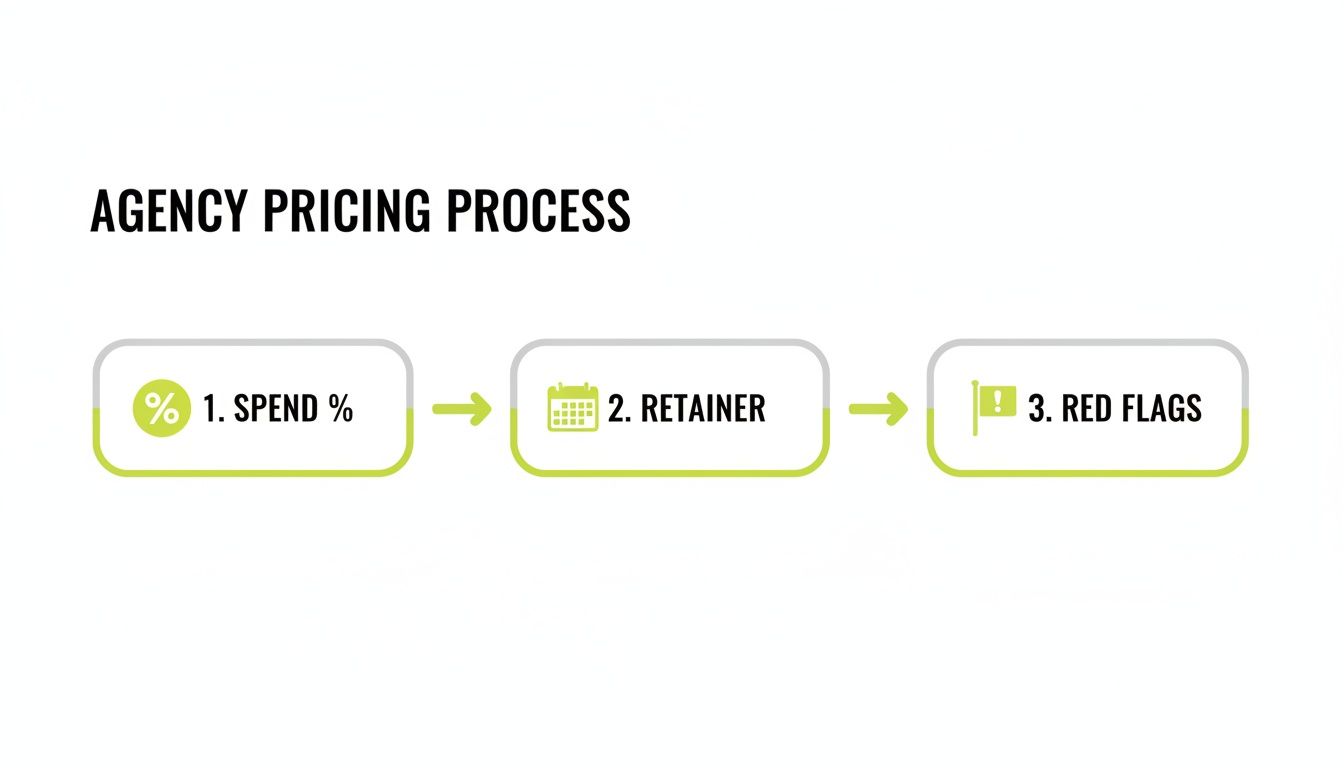
As this flowchart shows, understanding an agency's financial structure and spotting warning signs before you sign is what allows you to move into this onboarding phase with confidence.
Establishing Communication Norms
Getting the tech right is only half the equation. How you and your agency talk to each other is just as critical. A strong onboarding process defines the rhythm of your communication right from the start, so there are no surprises down the line.
Your communication structure should include:
- A Shared Communication Channel: Forget endless email chains. A dedicated channel in Slack or Microsoft Teams is a must for quick questions, ad approvals, and real-time updates. For example, the agency can post a new ad creative in the channel with a message like "@Client, here are two new video ads for your review before we launch them tomorrow." It keeps everything organized and conversation fluid.
- Scheduled Strategy Calls: A recurring weekly or bi-weekly call is your time to go deep. This is where you review performance, discuss what the numbers are really telling you, and plan your next moves. It’s a strategy session, not just a data dump.
- A Defined Reporting Cadence: Decide upfront how and when you'll get reports. The best agencies will give you access to a live reporting dashboard you can check anytime. This is usually supplemented with expert commentary and insights during your scheduled calls—they tell you the story behind the data.
By running through this onboarding checklist, you and your new Facebook ads agency build a shared foundation. You both know the goals, you have the right tools in place, and you’ve agreed on the rules of engagement. This is the kind of structured start that paves the way for sustainable, measurable growth.
Common Questions About Hiring a Facebook Ads Agency
Choosing the right Facebook ads agency is a high-stakes decision. Get it right, and you build a powerful growth engine. Get it wrong, and you burn cash with little to show for it. It's only natural to have a few questions before you sign on the dotted line.
We field these questions all the time from businesses looking for a partner, not just a vendor. Getting straight answers is the first step toward building a profitable relationship and avoiding those costly missteps. Let's get into what you need to know.
What Is a Realistic Budget for a Facebook Ads Agency?
This is always the first question, and the answer is simple: your budget has to match your ambition. It’s a direct reflection of your goals, your industry, and how quickly you want to see results. Your total investment is split into two parts: your ad spend (the money paid directly to Meta) and the agency management fee.
For any serious effort, you should plan for at least $3,000 to $5,000 per month in ad spend. Anything less than that starves the agency of the data it needs to find winning ad combinations and audiences quickly. As for management fees, a reputable agency will typically charge between $1,500 and $5,000+ per month, often structured as a flat retainer or a percentage of your ad spend.
Here's a practical example: An ecommerce brand wants to validate a new product line. A smart starting point is a $4,000 monthly ad spend plus a $2,000 agency retainer, for a total investment of $6,000. This gives the agency enough runway to test creative, nail down the target audience, and find a profitable path forward. Expecting to generate $20,000 in revenue from a $500 ad spend just isn't grounded in reality.
What Results Can I Realistically Expect in the First 90 Days?
The first 90 days are about laying the foundation for scalable, predictable growth. It's not about hitting home runs on day one. A top-tier Facebook ads agency will treat this critical period as a structured, three-phase process.
Month 1 (Days 1-30) The Data & Testing Phase: The entire goal here is learning. Your agency will launch a series of small, controlled campaigns to test their core assumptions about your audience, messaging, and creative. Success in this phase is measured by the quality of the data they collect, not ROAS. A practical outcome is a report stating, "Audience A had a 50% lower Cost Per Click than Audience B, and Creative X generated twice the engagement of Creative Y."
Month 2 (Days 31-60) The Optimization Phase: Armed with data from month one, the agency starts making decisive moves. They’ll cut the underperforming ads and start funneling the budget into the concepts that are showing promise. You should begin to see key metrics like Cost Per Acquisition (CPA) trend downward as the first signs of profitability start to appear. For example, your CPA might drop from $45 to $35.
Month 3 (Days 61-90) The Scaling Phase: With proven ads and audiences identified, the focus shifts to strategic scaling. The agency will carefully increase the budget on winning campaigns while simultaneously introducing new creative to combat ad fatigue. By the end of this 90-day sprint, you should have a crystal-clear, data-backed picture of your customer acquisition cost (e.g., a stable $32 CPA) and a predictable return on your investment (e.g., a consistent 3.2x ROAS).
Rushing this foundational process is the fastest way to burn through your budget. Patience during the first 90 days pays massive dividends down the road.
Should I Own the Facebook Ad Account or Should the Agency?
You must always own your Facebook ad account, Meta Pixel, and all the data associated with them. This is completely non-negotiable.
Any agency that suggests running ads through their own Business Manager is essentially holding your business assets hostage. The ad account is a valuable asset you are paying them to build and enrich. It contains your pixel history, your customer lists, and all the performance insights from your campaigns. If you part ways with an agency that owns the account, you lose everything and have to start from scratch.
A professional, trustworthy agency will simply request “Partner” access via your Facebook Business Manager. This gives them all the permissions they need to do their job without ever compromising your ownership of your data.
How Do I Know if My Current Agency Is Underperforming?
It’s easy to get that nagging feeling that things aren't working, but you need to look past a temporary dip in sales and focus on specific, objective indicators.
Here are the clear warning signs that your agency might be dropping the ball:
Poor Communication & Vague Reporting: Are your reports filled with vanity metrics like impressions and clicks, but no real analysis of what it means for your bottom line? A great partner doesn't just send data; they explain the "why" behind the numbers. For example, instead of just saying "clicks are up," they should say "clicks are up, but our landing page conversion rate dropped 10%, which suggests a disconnect between our ad copy and the page."
Blaming the Algorithm Without an Action Plan: Performance ebbs and flows. That's normal. A good agency, however, comes to you with a diagnosis and a solution. They'll investigate if it’s creative fatigue, audience saturation, or a technical tracking issue. An excuse is not a strategy. A practical example of a good response is: "Our ROAS dipped this week. We've traced it to our top-performing ad, whose frequency has jumped to 4.5. This indicates creative fatigue. We're launching three new video ads tomorrow to combat this."
No Proactive Creative Testing: Are you always the one pushing for new ads? That’s a massive red flag. A high-performing agency has a structured, ongoing system for testing new creative concepts. They are always working to beat their own control and prevent performance dips from ad fatigue. If they can’t show you their testing framework, they aren't growing your account—they're just managing it.
A common pitfall is mistaking activity for progress. If an agency is constantly "launching campaigns" but can't articulate their testing methodology or how they're systematically finding winners, they are just guessing with your money.
If these signs feel familiar, it's time for a direct conversation about performance and expectations. A strong partner will welcome the feedback and collaborate on a plan to get things back on track. A weak one will get defensive.
Ready to partner with a performance-driven agency that turns your advertising into measurable growth? At Silver Spoon Agency, we combine data-backed strategy with relentless optimization to deliver superior ROAS. Schedule a discovery call with us today and let's build your growth engine.