


First Touch vs Last Touch Attribution a Definitive Guide

The core difference between first touch vs last touch attribution really just boils down to timing. Are you giving all the credit to the very first interaction someone has with your brand, or the final one right before they converted? That’s it.
Your choice here directly reflects your priorities. Do you want to reward the channel that sparked the initial awareness, or the one that finally pushed the customer over the finish line?
Understanding The Core Attribution Models
Before we get into the weeds, let's zoom out. Marketing attribution is simply the rulebook you use to assign credit to the different touchpoints that lead to a sale. It’s the answer to the age-old question: "Which of our marketing efforts are actually working?"
There are a ton of different marketing attribution models out there, but First Touch and Last Touch are the foundational "single-touch" models. They're straightforward to set up and give you a clear, if somewhat narrow, picture of what's happening.

A Practical Example
Let’s make this real. The best way to grasp the difference is to walk through a typical customer’s path to purchase. Mapping out these steps is a critical part of understanding the customer journey—something we live and breathe in our customer journey mapping work.
Imagine a customer named Alex who is in the market for a new pair of running shoes:
- January 10 (First Touch): Alex is scrolling through their Facebook feed and sees a video ad from "StridePro Shoes" showcasing their new trail running model. Intrigued, Alex clicks the ad and browses the product page for a few minutes.
- January 15: A few days later, Alex Googles "best trail running shoes for beginners" and clicks on a blog post from StridePro titled "5 Things to Look for in Your First Pair of Trail Runners."
- January 20: Alex receives a promotional email from StridePro offering "15% Off Your First Order" and clicks the link to check out the sale.
- January 21 (Last Touch): Ready to buy, Alex clicks a retargeting ad on Instagram that shows the exact shoes they were looking at and completes the purchase.
In this scenario, First Touch attribution would give 100% of the credit to that initial Facebook ad. On the flip side, Last Touch attribution would assign 100% of the credit to the final Instagram retargeting ad.
This simple example immediately exposes the core conflict. One model champions the channel that introduced Alex to your brand, while the other gives all the glory to the channel that sealed the deal. Neither tells the whole story, but each gives you a very distinct lens through which to view your marketing funnel.
First Touch vs Last Touch at a Glance
For a quick side-by-side, this table breaks down the fundamental differences between these two foundational attribution models.
| Attribute | First Touch Attribution | Last Touch Attribution |
|---|---|---|
| Credit Assignment | 100% credit to the very first touchpoint | 100% credit to the very last touchpoint |
| Strategic Focus | Identifies top-of-funnel channels that drive awareness | Highlights bottom-of-funnel channels that close deals |
| Primary Question | "How are customers first discovering my brand?" | "What is the final trigger for a conversion?" |
| Common Use Cases | Brand awareness campaigns, demand generation | Direct response, flash sales, short sales cycles |
As you can see, the model you choose completely changes which channels get the budget and which get cut. One prioritizes discovery, the other prioritizes the final decision.
When to Use First Touch Attribution
First Touch attribution gives 100% of the conversion credit to the very first interaction a customer has with your business. It's all about rewarding the channel that made the initial introduction—the one that lit the first spark of interest. This model is built to answer one fundamental question: where are our best customers really coming from?
By zeroing in on that first point of contact, you get an unfiltered view of which channels are actually generating new demand and filling the top of your marketing funnel. It tells you, "How are people discovering us in the first place?"
Identifying Your True Growth Engines
For any business focused on serious expansion, brand building, or breaking into new markets, First Touch attribution is a game-changer. It shines a spotlight on the channels that other models, especially Last Touch, consistently undervalue. We're talking about the slow-burn, awareness-building activities that don't always drive an immediate sale but are absolutely critical for long-term health.
Practical Example: A B2B software company might find that many of its biggest enterprise clients first discovered them through a detailed, non-promotional blog post they found via organic search. Months later, after multiple demos and sales calls, they finally sign a contract. Last Touch would credit the "Book a Demo" click on the pricing page. But First Touch correctly gives credit back to that initial organic search, revealing the true, long-term ROI of their content marketing strategy.
This model is your best tool for justifying investment in top-of-funnel marketing. It provides hard data to prove the value of awareness campaigns, SEO, and content creation—activities that build your audience and fill the pipeline for future success.
Without this perspective, it's dangerously easy to slash the budgets for the very channels that are creating your customers of tomorrow.
When First Touch Attribution Shines
So, when is this model the right tool for the job? Certain business goals and marketing scenarios are a perfect match for the insights First Touch provides.
- Launching a New Brand or Product: When your main goal is just to get your name out there, First Touch tells you which channels are best at introducing your brand to a fresh audience.
- Demand Generation Campaigns: If your marketing is all about creating new leads rather than converting existing ones, this model helps you optimize for discovery and that initial engagement.
- Understanding Customer Origins: For businesses wanting to map Lifetime Value (LTV) back to acquisition channels, First Touch provides that clean link from revenue all the way back to the original source.
- Long Sales Cycles: In industries where the path to purchase takes weeks or even months, knowing the initial point of contact is crucial for understanding how to attract the right prospects from the very start.
The Impact on Channel Measurement
Switching to a First Touch model will dramatically change how you see your channel performance. Industry analyses consistently show that when credit shifts to the first interaction, top-of-funnel channels get a major—and deserved—lift in their reported contribution. Organic search, paid social, and display ads often see their importance jump by 30–40% compared to a Last Touch report.
For example, a benchmark study found that First Touch attribution boosted the credit assigned to LinkedIn by about 35% relative to Last Touch, since it so often appears early in complex B2B buying journeys. You can dig deeper into these kinds of findings by exploring the full analysis on first and last touch attribution reporting.
This shift gives you a more balanced view, ensuring your budget reflects the entire customer journey, not just the final click. By valuing these initial introductions, you can build a more resilient and effective marketing strategy that consistently brings new customers through the door.
When to Use Last Touch Attribution
Last Touch attribution is the default model in many analytics platforms for a reason: it’s simple, direct, and laser-focused on what prompted the final action. This model gives 100% of the conversion credit to the very last interaction a customer has with your business before they buy. Think of it as rewarding the "closer"—the channel that successfully pushed the customer over the finish line.
The core question Last Touch answers is brutally simple: "What was the final trigger that led to this conversion?" It gives marketers a clear, though admittedly narrow, view of which channels are most effective at the absolute bottom of the funnel.

Highlighting Your Conversion Drivers
While First Touch is all about discovery, Last Touch is all about the decision. It shines a bright light on your most direct, action-oriented marketing efforts—the channels that capture existing demand and get an immediate response from people already familiar with your brand and ready to act.
This makes it an incredibly valuable tool for optimizing campaigns where the goal is an instant conversion, not long-term nurturing. It helps you fine-tune the final steps of the customer journey by pinpointing which messages, offers, and platforms are most persuasive at the moment of truth.
By focusing exclusively on the final touchpoint, Last Touch attribution provides a clean, actionable signal for optimizing direct-response campaigns. It tells you precisely which ads, emails, or links are most effective at closing deals, allowing for rapid budget allocation to your best-performing closers.
Practical Example: An e-commerce store runs a 24-hour flash sale. They send out a promotional email with the subject "Last Chance: 40% Off Ends Tonight!" A customer who has visited the site before sees the email, clicks the "Shop Now" button, and makes a purchase within minutes. Last Touch correctly identifies the email campaign as the definitive trigger, giving the marketing team a crystal-clear signal that the urgency and offer in that email were effective.
Scenarios Where Last Touch Excels
Last Touch attribution is most useful when the path from consideration to conversion is short and sweet. Its simplicity becomes a huge strength in a few specific business contexts.
Here are some situations where this model gives you the most actionable insights:
- Short Sales Cycles: For products that are impulse buys or have a super-quick decision process (think fast fashion, food delivery), the last interaction is often the most significant one.
- Direct-Response Campaigns: When you're running campaigns with a clear call-to-action like "Buy Now" or "Sign Up Today," Last Touch shows you exactly which CTAs are hitting the mark.
- Branded Search and Retargeting: This model is perfect for measuring the performance of ads targeting users already searching for your brand name or those being retargeted after a previous visit.
- Affiliate Marketing: It clearly shows which affiliate links are directly driving sales, making it a breeze to calculate commissions and assess partner performance.
Understanding Its Built-in Bias
The main drawback of Last Touch is also its defining feature: it completely ignores every single touchpoint that came before the last one. This creates a massive blind spot, overlooking all the awareness-building and trust-building activities that made the final conversion possible in the first place.
This model systematically inflates the value of bottom-of-funnel interactions. Because Last Touch gives 100% of conversion credit to the final click, channels like paid search and retargeting often see their measured share of conversions jump by 20–40 percentage points compared to first-touch models. In one analysis, PPC's share rocketed from 22% under first-touch to 33% under last-touch—a 50% relative increase—simply because it's so often the last click before a purchase. You can dive deeper into how attribution models impact channel performance on Prescient AI.
This concentration of credit is critical to understand. While Last Touch is excellent for optimizing your closing tactics, relying on it exclusively will almost certainly lead you to underinvest in the top-of-funnel channels that are essential for long-term growth.
Choosing the Right Model for Your Business
Picking between first-touch and last-touch attribution isn't some abstract academic debate. It's a practical decision that comes down to your business model, how long it takes a customer to buy from you, and what you’re actually trying to achieve with your marketing.
There’s no single “right” answer here. The best model is simply the one that gives you the clearest, most actionable insights for your specific situation. The whole point is to answer a real business question: are you trying to figure out how new customers find you in the first place, or are you obsessed with what finally pushes them over the finish line? Your answer points you directly to the best model to start with.
E-commerce Brands: High-Volume vs. High-Value
For e-commerce, the choice often boils down to the product's price tag and how much thought goes into buying it. Not all online stores are built the same, and their attribution needs are worlds apart.
- For High-Volume, Low-Consideration Items: Think flash sales on t-shirts or a limited-time offer on lipstick. The sales cycle here is lightning fast—sometimes just a few minutes. Last Touch attribution is king in this scenario because it pinpoints the final trigger, like a promo email or a retargeting ad, that drove the immediate purchase. It gives you quick, actionable data to double down on what’s working right now.
- For High-Value, Long-Consideration Items: Now, imagine someone buying a custom sofa or a premium electric bike. This journey can take weeks of research. It might start with a blog post they found on Google, followed by a few of your social media ads, and end with them searching your brand name directly. Relying only on Last Touch here would be a massive mistake, as it completely ignores all the crucial work that built awareness. In this case, First Touch is a much better starting point for understanding what first brought these valuable customers into your world, even if your ultimate goal is a more advanced multi-touch model.
B2B and SaaS Companies: The Long Game
Business-to-Business (B2B) and Software-as-a-Service (SaaS) companies live and breathe long, complex sales cycles. We're talking months, sometimes even years. The path to a signed contract is paved with multiple stakeholders, demos, and a whole lot of nurturing.
In this kind of environment, Last Touch attribution is basically useless. It would almost always give credit to a final demo confirmation email or a branded search, wiping out the value of the months of relationship-building that came before it.
For B2B and SaaS, First Touch attribution is essential. It’s the only way to really understand lead origins and justify your top-of-funnel investments. It tells you which channels—like your organic content, LinkedIn campaigns, or industry webinars—are actually filling your pipeline with quality prospects.
But even First Touch has its limits. It tells you where leads came from, but it offers zero insight into what pushed them through the funnel. B2B marketers should use First Touch as a baseline but plan on graduating quickly to multi-touch models that can credit those critical mid-funnel interactions.
Local Service Businesses: Immediate Need
Local service businesses—plumbers, electricians, emergency dentists—operate on a totally different wavelength. They thrive on capturing immediate, high-intent demand. When a pipe bursts, nobody is embarking on a long research journey; they need a solution, and they need it five minutes ago.
For these businesses, Last Touch attribution provides the clearest insights, hands down. The final interaction, which is almost always a click on a "near me" Google search ad or a Google Business Profile listing, is the deciding factor. This model directly shows what’s making the phone ring and filling the appointment book.
By focusing on that last click, local businesses can pour their budget into the bottom-of-funnel channels that deliver immediate, measurable results. It helps answer the most critical question they have: "Which of my ads are making the phone ring right now?" Connecting these digital touchpoints to a final sale is the mark of a great omnichannel customer experience, making the transition from search to service totally seamless.
Attribution Model Selection by Business Type
To make this even simpler, the table below maps common business types to their typical sales cycles, primary goals, and the best starting attribution model. Think of it as a cheat sheet for aligning your measurement strategy with your business reality.
| Business Type | Typical Sales Cycle | Primary Goal | Recommended Starting Model |
|---|---|---|---|
| E-commerce (Flash Sales) | Short (Hours/Days) | Drive immediate conversions | Last Touch Attribution |
| E-commerce (High-Value) | Long (Weeks/Months) | Understand initial discovery | First Touch Attribution |
| B2B / SaaS | Very Long (Months/Years) | Generate qualified leads | First Touch Attribution |
| Local Services | Very Short (Minutes/Hours) | Capture immediate demand | Last Touch Attribution |
At the end of the day, the goal is to choose a model that gives you clarity, not more complexity. Start with the single-touch model that makes the most sense for your business, master the insights it gives you, and then you’ll be ready to explore more advanced methods down the road.
While First Touch and Last Touch models give you a clean, simple answer, their simplicity is also their biggest flaw. Each one tells you a story, but it’s just a single chapter from a much longer book. If you rely only on one touchpoint, you’re working with a dangerously incomplete picture of a customer journey that almost never moves in a straight line.
The reality is that most conversions happen after a series of interactions spread across different channels over time. When you give 100% of the credit to just one of those moments, you completely ignore the critical role every other touchpoint played in building awareness, earning trust, and creating the final push to buy. To really get what’s working, you have to look at the entire journey.
This is where more sophisticated attribution models come into play. They ditch the all-or-nothing approach of single-touch models. Instead, they spread the credit across the whole customer journey, giving you a much more balanced and honest view of how your marketing channels actually work together.
The flowchart below gives a simple framework for deciding when a single-touch model might be an acceptable starting point, usually depending on your sales cycle.
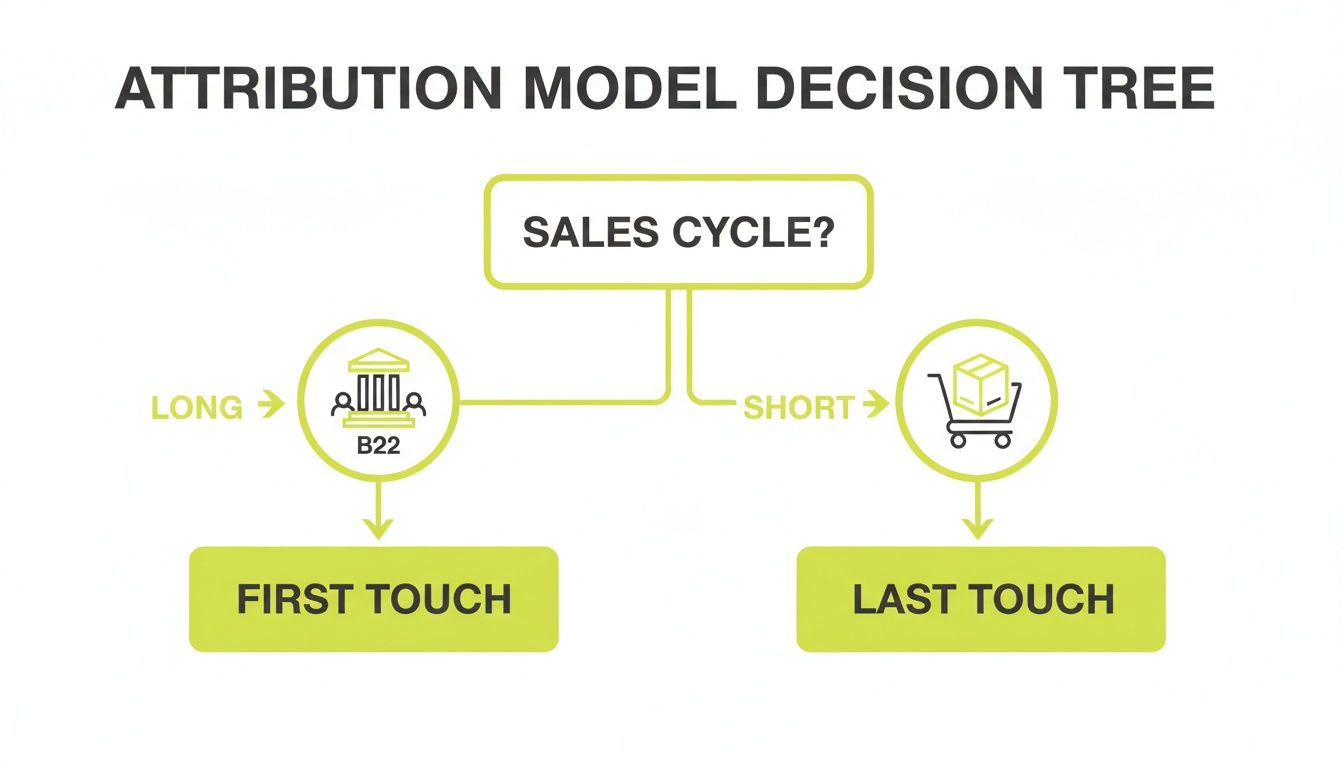
As the decision tree shows, even when single-touch models are a good place to start, they are just that—a start. True measurement maturity means moving beyond them.
Exploring Multi-Touch Attribution Models
Multi-touch models are built to give credit where it’s due across the board. They operate on the principle that the first touch, the last touch, and every interaction in between had some impact on the final sale. The only difference between them is the logic they use to slice up the credit.
Here are a few of the most common rule-based models you’ll encounter:
- Linear Model: This is the most straightforward and democratic approach. It splits the credit evenly across every single touchpoint. If a customer had five interactions before converting, each one gets exactly 20% of the credit. Example: The Facebook ad, blog post, email, and Instagram ad from our earlier scenario would each receive 25% of the credit.
- Time-Decay Model: This model operates on the idea that touches closer to the sale are more important. The interaction that happened the day of the conversion gets the most credit, while the first ad they saw a month ago gets the least. Example: The final Instagram ad would get the largest share of credit, followed by the email, then the blog post, with the initial Facebook ad getting the smallest share.
- U-Shaped (Position-Based) Model: This model heroes the two moments marketers often care about most: the beginning and the end. It typically gives 40% of the credit to the very first touch, 40% to the final touch, and sprinkles the remaining 20% across all the interactions that happened in the middle. Example: The first Facebook ad and the last Instagram ad would each get 40% of the credit. The blog post and the email would split the remaining 20% (10% each).
These models are a huge step up from single-touch attribution and provide a far more nuanced view of your marketing funnel. Their one weakness? They still depend on pre-set rules that you define, which may or may not reflect how customers are actually influenced.
The real goal of moving beyond single-touch attribution isn't just to use a more complex model; it's to get closer to the truth of what is actually driving business results. This requires embracing methods that can analyze performance without human bias.
The Gold Standards of Modern Measurement
For marketers who are serious about accuracy, the conversation has to shift away from simple, rule-based models and toward more advanced, data-led methodologies. These approaches use heavy-duty analysis to measure true impact, not just correlation.
Data-Driven Attribution (DDA)
Think of this as the smartest kid in the multi-touch class. Instead of following rigid, pre-set rules, Data-Driven Attribution uses machine learning to crunch the numbers on all your converting and non-converting customer paths. It then assigns credit based on how much each touchpoint statistically increased the probability of a conversion.
Marketing Mix Modeling (MMM)
MMM zooms out to take a top-down, statistical view of your entire marketing ecosystem. It analyzes aggregate data over long periods, looking at marketing spend, sales revenue, and even external factors like seasonality, promotions, or economic trends. This model is fantastic for understanding the overall impact of different channels—including offline ones like TV or radio—on your bottom line.
Incrementality Testing
Often called the holy grail of measurement, incrementality testing is all about proving cause and effect. It answers the one question every marketer wants to know: "What would have happened if I hadn't run this ad at all?" By running controlled experiments (like a classic A/B test where one group sees an ad and a control group doesn't), you can measure the true, incremental lift your campaigns are generating. This is the ultimate way to separate what’s actually causing sales from what’s just happening alongside them.
Practical Setup and Analysis Checklist
Moving from theory to practice is where the real work begins. Your attribution model—whether it’s a simple first touch or a complex multi-touch system—is only as reliable as the data it’s built on. A messy setup doesn't just give you bad data; it leads to misleading conclusions and, ultimately, wasted ad spend.
This checklist covers the absolute must-haves for building a measurement system you can actually trust. The goal is simple: track every dollar from the initial click all the way to a conversion. Without getting these fundamentals right, any debate over first touch vs last touch attribution is purely academic.
Essential Technical Prerequisites
Before you can even think about analysis, your data collection needs to be completely airtight. These technical steps are the bedrock of any credible attribution report. Get them right, and you'll capture the customer journey with far greater accuracy.
- Establish a Consistent UTM Tagging System: This is non-negotiable and easily the most critical step. Every single URL you use in a campaign—from emails and social ads to affiliate links—must be tagged with UTM parameters (utm_source, utm_medium, utm_campaign). Create a standardized naming convention and stick to it religiously. This simple discipline prevents your data from splintering into a dozen confusing categories and ensures every touchpoint gets properly identified.
- Correctly Configure Conversion Events: You have to tell your tools what a "win" looks like. In Google Analytics 4 (GA4) or your platform of choice, you must explicitly define what counts as a conversion. Is it a form submission? A purchase? A demo request? These events need to be configured to fire accurately every single time, ensuring you're measuring against real business outcomes.
- Integrate Your CRM: For many businesses, especially B2B, this is a game-changer. Connecting your analytics platform to your Customer Relationship Management (CRM) system links marketing touchpoints not just to initial leads, but to what really matters: closed deals and actual revenue. It’s how you get a complete, dollar-for-dollar view of your ROI.
The accuracy of any attribution model is a direct reflection of your data hygiene. Inconsistent UTM tagging or poorly configured conversion goals will render your analysis useless, regardless of the model you choose.
Strategic Setup and Analysis
With the technical plumbing in place, you can shift to the strategic side. This is where you define the rules for your analysis and structure reports to pull out insights you can actually act on.
- Define Appropriate Lookback Windows: Your lookback window (sometimes called a conversion window) is the period during which a touchpoint is eligible to get credit for a conversion. If your business has a one-day sales cycle, using a 30-day window is pointless. You need to align this setting with the typical length of your customer's journey to get relevant data.
- Leverage Server-Side Tracking: Ad blockers and browser privacy restrictions are chipping away at data accuracy. Implementing server-side tracking has become essential to fight back. It sends data directly from your server to your analytics platforms, bypassing many of the client-side issues and resulting in a more complete dataset. It's worth your time to explore different platforms by comparing leading analytics and personalization platforms like Sitecore CDP, Personalize, and Google Analytics.
Once this is all set up, you can build a straightforward comparison report. Start with a simple table: list your channels in the first column, then add columns for "Conversions (First Touch)" and "Conversions (Last Touch)." This side-by-side view instantly shows you which channels are great at starting conversations versus those that are masters at closing deals. It’s a foundational step to optimizing your ROAS with genuine clarity.
For more powerful options, looking into various marketing analytics tools can unlock much deeper insights.
Frequently Asked Questions
Putting attribution theory into practice always brings up a few tricky questions. Let's tackle some of the most common ones marketers run into when they start digging into first and last touch data.
What Attribution Model Is Best for a Small Business?
For a small business, the goal is simple, actionable data. You don't need a complex, ten-touch model when you're just starting out. It's overkill.
A fantastic place to start is the Last Non-Direct Click model, which is a standard option in Google Analytics 4. This model gives credit to the last marketing channel a customer came from before converting, but it smartly ignores 'Direct' traffic. This is a huge win because it stops untagged visits from getting credit that should have gone to a specific campaign you're running.
How Should I Handle Direct Traffic in Attribution?
Direct traffic is the black hole of analytics. It’s where data goes to die. It's often a mix of people typing your URL, using bookmarks, or clicking on untagged links in PDFs or emails. The truth is, it's rarely "direct."
Your best defense is a good offense. The most effective strategy is to minimize it by getting religious about your UTM tagging strategy. Every link you put out there—in emails, social posts, ads, partner sites—needs a UTM tag. The more disciplined you are, the smaller your 'Direct' traffic bucket becomes, and the clearer your actual channel performance will be.
Think of 'Direct' traffic not as a real channel, but as a report card on your tracking discipline. Your goal is to shrink this category as much as possible by tagging every touchpoint you can control.
Can I Use Both First and Last Touch Models Simultaneously?
Not only can you, but you absolutely should. Looking at First and Last Touch models side-by-side is one of the most powerful diagnostic tools you have. It paints a complete picture of your funnel, not just the start or the end.
When you run comparison reports, you can clearly see:
- Your Openers: These are the channels that shine under a First Touch model. They're your best bet for introducing your brand to new people and growing your audience. Practical example: You might see that your Organic Social Media channel has a high number of first-touch conversions but very few last-touch conversions. This means it's great for discovery, but not for closing.
- Your Closers: These channels dominate the Last Touch reports. They are your heavy hitters, the ones that are most effective at getting people to pull the trigger and convert. Practical example: Conversely, your Branded Paid Search campaign might have a massive number of last-touch conversions but almost zero first-touch. This tells you it’s excellent at capturing existing demand from people who already know you.
This dual view stops you from making catastrophic mistakes, like cutting the budget for a top-of-funnel channel just because it isn't directly closing the deal.
Ready to stop guessing and start growing with data-driven precision? Silver Spoon Agency transforms your advertising into measurable revenue. Our AI-powered, omnichannel approach ensures every marketing dollar works harder, delivering superior ROAS and scalable growth. Schedule your free consultation today!