


8 Powerful Geofencing Advertising Examples to Inspire Your 2025 Strategy

Imagine delivering the perfect ad to the right person at the exact moment they're most likely to buy. That's the core promise of geofencing, but moving from abstract theory to tangible results requires a clear blueprint. Many businesses hear about location-based marketing but struggle to see how it applies directly to their goals, whether that's increasing foot traffic, acquiring new patients, or outselling a nearby competitor.
This guide closes that gap. We're moving beyond surface-level descriptions to provide a deep, strategic dive into powerful and practical geofencing advertising examples. Instead of just telling you what brands did, we will dissect how they did it, why it worked, and provide the specific frameworks you can replicate for your own campaigns.
You'll explore the behind-the-scenes details of successful campaigns across multiple industries, from retail and real estate to healthcare and automotive. We will analyze the specific campaign goals, the precise geofence setup, the ad creatives that drove action, and the key performance indicators (KPIs) that measured success. Each example is structured to give you actionable takeaways and strategic insights that you can implement immediately. Get ready to learn from the campaigns setting the new standard for hyper-local advertising, turning precise location data into predictable, measurable revenue.
1. Retail Store Foot Traffic Conversion
The most classic and direct application of geofencing marketing is driving foot traffic to physical retail stores. This strategy involves setting up a virtual perimeter around a specific store location. When a potential customer from a predefined audience segment enters this geofenced area, a targeted ad is triggered on their mobile device, compelling them to visit the store immediately.
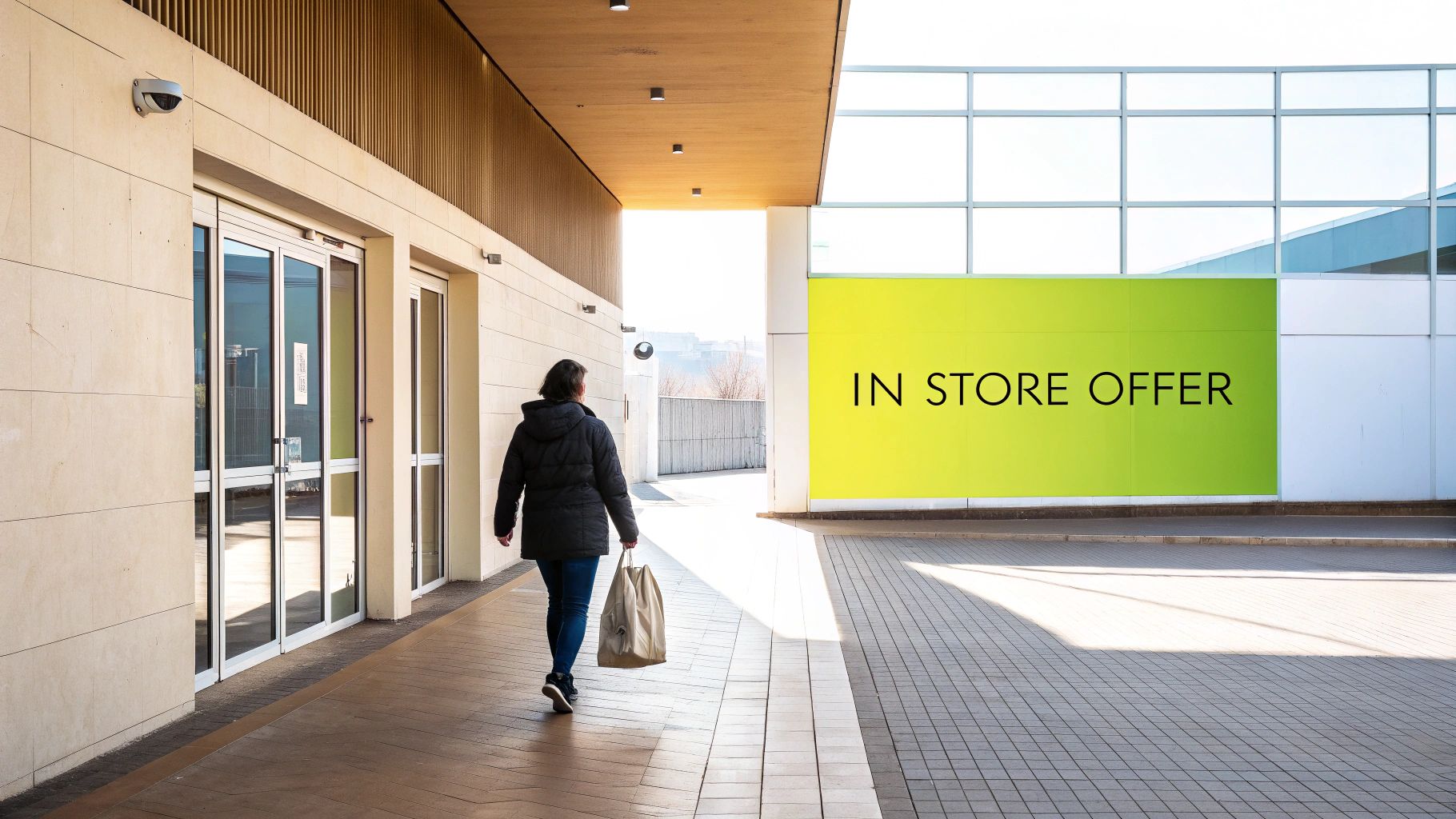
For example, a big-box retailer like Target geofences its store parking lots and nearby shopping centers. A user who previously browsed for home goods on the Target app might see an ad like, “You’re just steps away! Get 15% off any single home item when you use Drive Up. Offer valid today only.” Similarly, a clothing boutique could geofence the local mall. When a shopper who has previously visited their website enters the mall, they receive a push notification: "Here for some retail therapy? Stop by Aura Boutique (near the food court) and get a free tote bag with any purchase today!" Understanding the fundamentals of this location-based technology is key, and you can get an in-depth overview by exploring this guide about what geofencing marketing is and how it drives results.
Strategic Breakdown
- Goal: Increase in-store visits and same-day sales.
- Geofence Setup: A tight radius of 200-500 meters around the physical store, including its parking lot and adjacent high-traffic areas like neighboring popular stores.
- Audience Targeting: Segment users based on past purchase history (e.g., targeting customers who haven't visited in 60 days) or recent online behavior (e.g., users who abandoned a shopping cart).
- Ad Creative: Use clear, concise copy with a strong call-to-action (CTA). Highlight an irresistible, time-sensitive offer. For instance, "In the area? Stop by Best Buy for 20% off all headphones, today only!"
Actionable Takeaways & Replicable Strategy
To replicate this success, focus on a high-value, low-friction offer. A small discount or a free item with purchase can be enough to convert a nearby user into a customer.
Key Insight: The power of this strategy lies in its immediacy. The user is already physically close to the point of sale, making the decision to visit much easier. The ad serves as the final nudge.
Create specific "conquesting" campaigns by geofencing your direct competitors. A home improvement store could target shoppers inside a rival's location with a compelling price-match guarantee or a superior offer, aiming to intercept the sale at the final moment. This is one of the most effective geofencing advertising examples for capturing market share.
2. Competitor Store Interception
One of the most aggressive and effective geofencing advertising examples is competitor store interception, often called "conquesting." This strategy involves setting up a geofence not around your own business, but directly around your rivals' locations. When a potential customer enters a competitor's store, parking lot, or immediate vicinity, they receive a targeted ad from you designed to lure them away with a better offer.
This tactic is famously used by quick-service restaurants. For years, Burger King has geofenced McDonald's locations, famously offering a Whopper for just one cent to anyone who ordered it via their app while within 600 feet of a McDonald's. On a local level, imagine a pet supply store called "Paws & Play." They could geofence the parking lot of a nearby PetSmart. When a shopper enters that area, they see an ad: "Wait! Before you shop, Paws & Play is 2 blocks away and offers locally-made, healthier pet treats. Show this ad for 20% off your first purchase." This approach capitalizes on a customer's high purchase intent at the exact moment they are about to make a decision. To see how this fits into a broader strategy, you can explore the fundamentals of geofencing marketing for business growth.
Strategic Breakdown
- Goal: Intercept competitor customers, capture market share, and drive immediate sales from high-intent audiences.
- Geofence Setup: A tight radius (100-600 feet) drawn directly around competitor storefronts, parking lots, and shared shopping center entrances.
- Audience Targeting: Target all users who enter the competitor's geofence. Further refine by layering demographic or behavioral data, such as targeting users who have also previously visited your own store.
- Ad Creative: The offer must be disruptive and clearly superior. Use direct, comparative language like, "Thinking about them? Try us instead and get 25% off" or "Get a better deal just two minutes away."
Actionable Takeaways & Replicable Strategy
To make this work, your value proposition must be compelling enough to make someone change their immediate plans. Research your top three to five local competitors and identify their peak business hours to time your campaigns for maximum impact.
Key Insight: Conquesting is effective because it targets customers at the final stage of the buying journey. Your ad becomes the last, most persuasive argument before they make a purchase from your rival.
Be sure to highlight your unique selling proposition. If a competitor is known for low prices, your ad could focus on superior quality or service. If they are known for quality, you can compete on price or convenience. This is one of the most powerful geofencing advertising examples for businesses in highly competitive local markets.
3. Event-Based Attendance and Promotion
Geofencing marketing excels at capturing highly engaged, temporary audiences gathered for a specific purpose. This strategy leverages major events like concerts, sports games, festivals, and trade shows by creating a virtual perimeter around the venue. Advertisers can then deliver hyper-relevant messages to attendees before, during, and after the event to drive sales, promote services, or gather feedback.
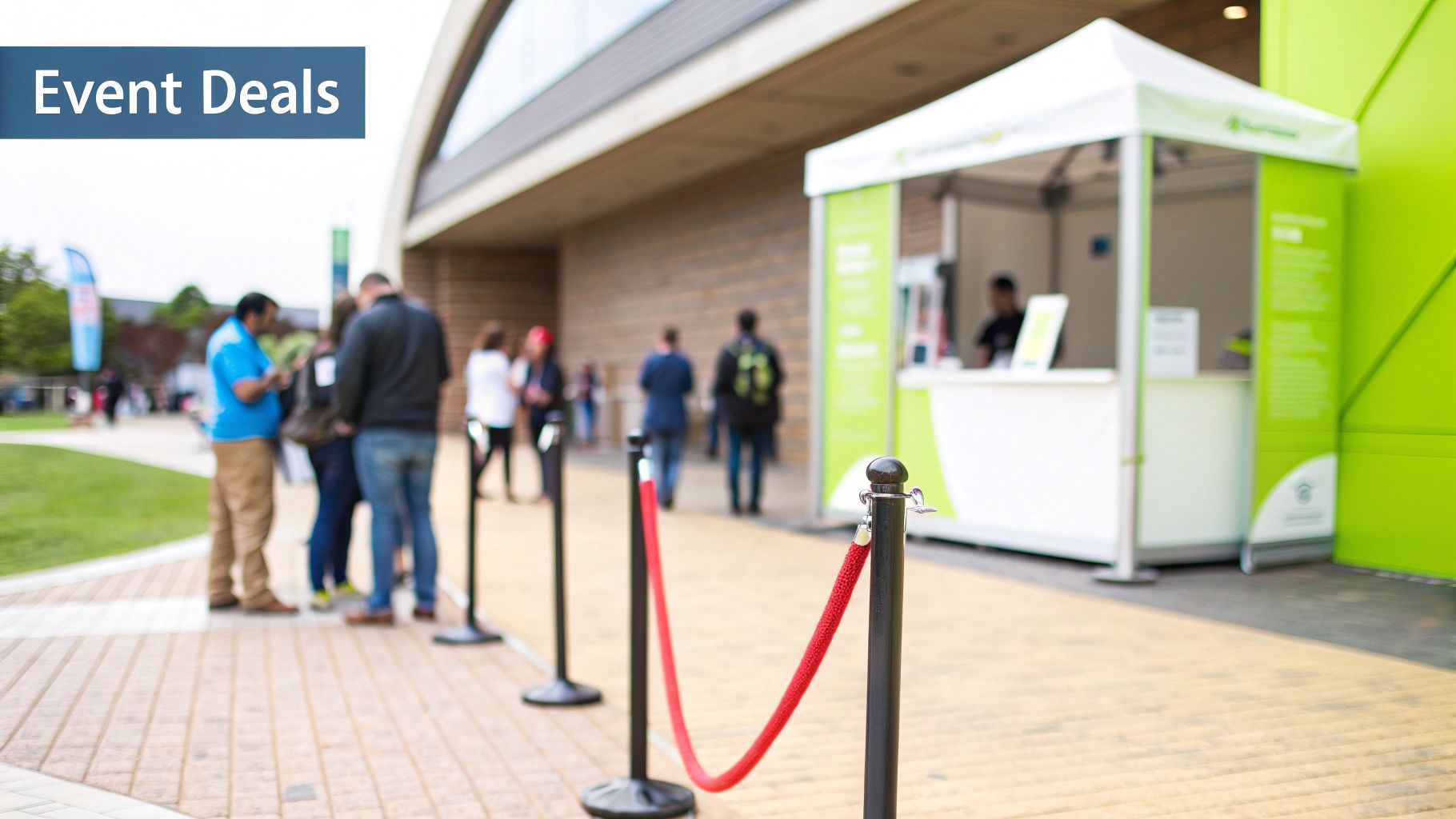
For instance, a local brewery could geofence the stadium during a college football game. As the fourth quarter begins, they could push an ad to everyone in the stadium: "Celebrate the win (or mourn the loss) with us! Show your ticket stub at The Hoppy Monk for your first pint free. We're a 5-minute walk from the stadium!" Similarly, a B2B software company at a large marketing conference can geofence the expo hall. Attendees inside see a LinkedIn ad: "Tired of walking the floor? Visit Booth #542 for a comfy chair, a free espresso, and a 5-minute demo that will change your lead gen strategy." These timely promotions are incredibly effective. When planning special offers or sales, implementing modern automotive event marketing strategies can amplify your local reach and drive attendance.
Strategic Breakdown
- Goal: Drive booth traffic, promote event-specific offers, increase post-event sales, and capture leads from a niche audience.
- Geofence Setup: A multi-layered approach. A large geofence around the venue and surrounding hotels can run for weeks pre-event. A tighter fence around the venue itself is activated during event hours, with micro-fences around specific booths or stages.
- Audience Targeting: Target devices seen within the geofence during event hours. This audience can then be retargeted for days or weeks after the event concludes.
- Ad Creative: Tailor the ad creative to the event itself. Use event-specific hashtags, imagery, and language. A compelling ad for a concert attendee might be, "Keep the music going! Visit our booth for a chance to win noise-canceling headphones."
Actionable Takeaways & Replicable Strategy
To replicate this, partner with event organizers for premium placements or co-branded messaging. Start your campaign 2-3 weeks before the event to build awareness among those who have purchased tickets and are planning their trip.
Key Insight: The value of an event-based audience is its shared interest. Every person inside the geofence is a qualified lead for related products or services, making ad spend highly efficient.
A powerful application of this is post-event retargeting. Capture the device IDs of everyone who attended a trade show and continue to serve them ads for your B2B service for the next 30 days. This makes event-based geofencing one of the most potent geofencing advertising examples for lead generation and nurturing. You can learn more about how to refine these time-sensitive campaigns with these geofencing marketing tips to supercharge your sales.
4. Real Estate Property Showcase Campaigns
Geofencing provides real estate agents and developers with a powerful tool to engage potential buyers in the hyper-local context of a property search. This strategy involves creating virtual perimeters around specific homes for sale, open houses, or even entire neighborhoods. When a user who fits the homebuyer profile enters one of these zones, they receive a targeted ad on their device, bringing the property directly to their attention at the most relevant moment possible.
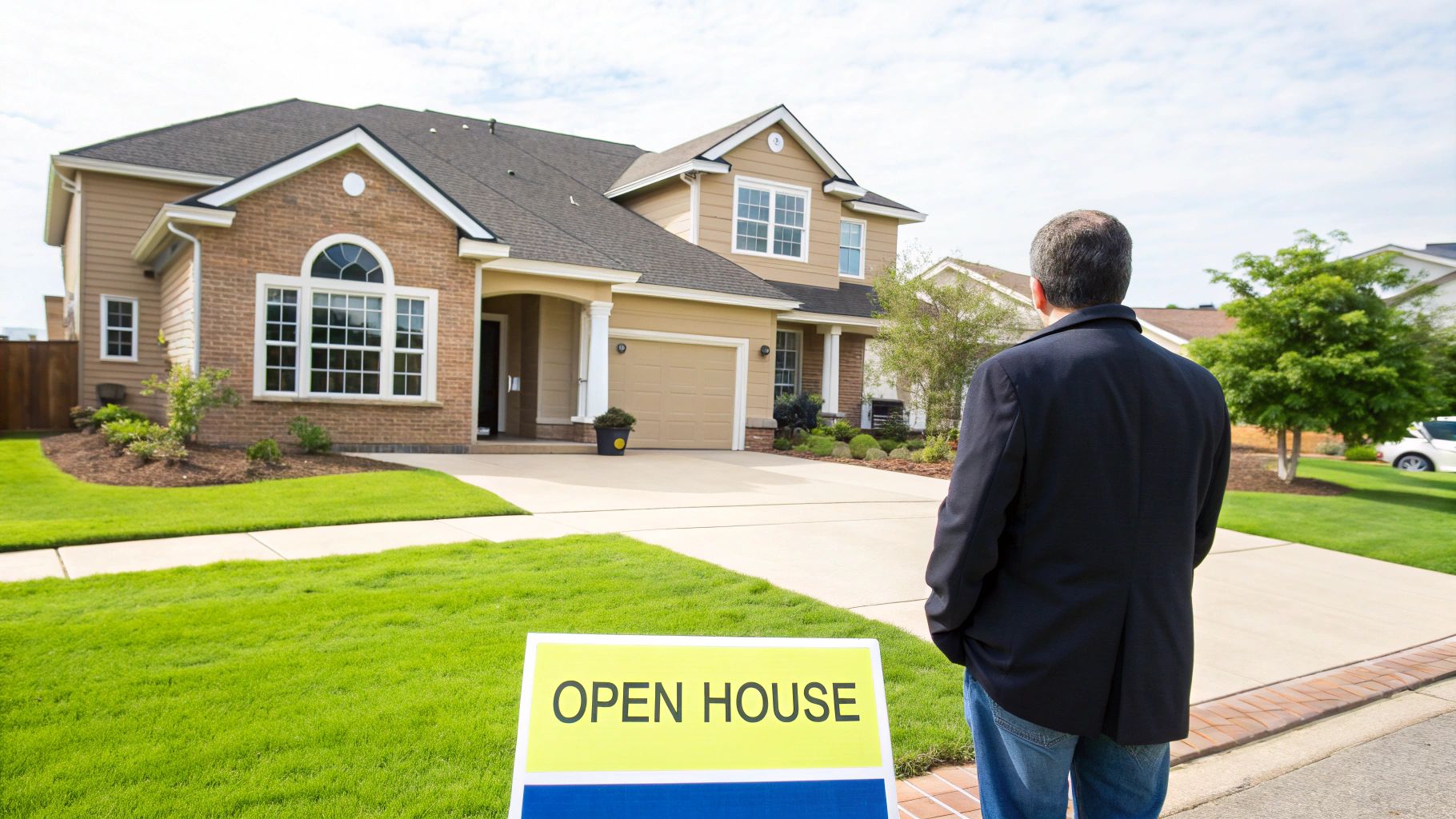
For instance, a real estate agent holding an open house on a Saturday from 1-4 PM can set up a geofence around a 1-mile radius of the property. When a potential buyer who has the Zillow app installed drives into this zone, they could see an ad: “House hunting today? An open house for a 4-bed, 3-bath modern farmhouse is happening now, just around the corner. Tap for photos and directions to 123 Oak Lane.” Similarly, a luxury condo developer can geofence the city's most expensive zip codes and business districts, serving ads to high-income individuals showcasing the new development's exclusive amenities and panoramic views. This turns a simple drive into a lead generation opportunity.
Strategic Breakdown
- Goal: Drive open house attendance, generate qualified buyer leads, and increase property showing requests.
- Geofence Setup: A radius of 500 meters to 1 km around individual listings or new development communities. Also, consider "conquesting" competitor open houses and brokerages.
- Audience Targeting: Segment users based on browsing history on real estate portals like Zillow or Redfin, mortgage pre-qualification signals, or demographic data indicating likely homebuyers (e.g., age, income, life events).
- Ad Creative: Feature high-quality, professional photos of the property. The ad copy should be direct and compelling, such as, "You're nearby! Discover 123 Maple St. Tap for a virtual tour or schedule a showing now."
Actionable Takeaways & Replicable Strategy
To make this campaign effective, link your ad directly to a high-value landing page. This page should feature a photo gallery, a virtual tour, property details, and a simple lead capture form to book a private viewing.
Key Insight: Timing and context are everything in real estate. Serving an ad for a specific home to someone who is physically in that exact neighborhood creates a powerful sense of discovery and urgency.
One of the most effective geofencing advertising examples for real estate is time-sensitive targeting. Run your ads heavily during peak house-hunting hours, like weekends and weekday evenings. You can also create campaigns that retarget users who visited an open house with ads for similar properties in your portfolio, keeping your listings top-of-mind throughout their search.
5. Healthcare Provider Patient Acquisition
Geofencing offers healthcare providers a powerful, hyper-local method to connect with potential patients in their immediate community. This strategy involves creating virtual perimeters around specific locations to deliver timely, relevant messaging about health services. When individuals within a defined audience enter these zones, they receive targeted ads promoting anything from urgent care availability to preventative screenings, encouraging them to schedule appointments.
This approach is highly effective for healthcare systems and private practices alike. For example, a pediatric dental office can geofence local elementary schools, daycares, and playgrounds. During the afternoon pickup hours, parents in those zones could see a Facebook ad: "Is it time for their check-up? Sunshine Pediatrics is accepting new patients and offers after-school appointments. Book now—we're 5 minutes away!" Similarly, an urgent care clinic can target the areas around competing hospital emergency rooms, offering a more affordable and faster alternative with an ad like, “Long wait at the ER? Get seen in minutes for minor illnesses and injuries. We’re just around the corner.”
Strategic Breakdown
- Goal: Increase patient appointments, drive registrations for specific services, and build local awareness for new or existing clinics.
- Geofence Setup: Create geofences around competing clinics, hospitals, pharmacies, fitness centers, and large residential communities. The radius can vary from a tight 200 meters around a competitor to a broader 1-2 miles around a new housing complex.
- Audience Targeting: Segment audiences based on demographic data (e.g., families near a pediatric clinic) or contextual location (e.g., users visiting a local gym for a sports medicine ad). It's crucial to comply with all HIPAA and healthcare advertising regulations, focusing on services rather than specific conditions.
- Ad Creative: Use reassuring and professional copy that highlights trust and expertise. A compelling call-to-action (CTA) should direct users to an easy-to-use online booking portal. Example: "Don't let the flu slow you down. Book your appointment online at our new downtown clinic. Same-day visits available!"
Actionable Takeaways & Replicable Strategy
To replicate this, focus on building trust and reducing friction. Healthcare decisions are sensitive, so ad copy should emphasize credentials, patient testimonials, and the convenience of your services. Always link directly to a scheduling page rather than a generic homepage.
Key Insight: The strategy succeeds by reaching patients at their point of consideration. By targeting locations where health is top-of-mind (like pharmacies or gyms), providers can introduce their services as a convenient and relevant solution.
For a specialized practice, such as a dermatology clinic, you can geofence local spas, salons, and wellness centers. The ad can promote a free cosmetic consultation or a seasonal skin check-up, capturing individuals who are already invested in their personal care. These context-aware geofencing advertising examples are key to acquiring high-intent patients.
6. Automotive Dealership Visit Incentives
For high-consideration purchases like automobiles, moving an online researcher into a physical showroom for a test drive is the most critical conversion point. Geofencing advertising provides automotive dealerships and manufacturers with a powerful tool to bridge this digital-to-physical gap. This strategy involves targeting potential buyers when they are physically near a dealership, delivering timely incentives that encourage an immediate visit.
Imagine a prospective car buyer has been researching the new Ford F-150 online. When they drive within a one-mile radius of a local Ford dealership, a geofence triggers an ad on their phone: “See the All-New F-150 in person. You’re just down the road! Stop in for a test drive today and get a $50 gift card.” Even more powerful is conquesting. A Toyota dealership can geofence the lot of the Honda dealership across town. A user who has researched the Honda CR-V and then visits the Honda lot could see an ad: "Considering the CR-V? Test drive the Toyota RAV4 before you decide. It has better fuel economy and a higher resale value. We're 5 minutes away and will give you an extra $500 for your trade-in."
Strategic Breakdown
- Goal: Increase showroom visits, schedule test drives, and boost on-lot sales conversions.
- Geofence Setup: A larger radius of 1-5 miles around the dealership to capture users in the immediate area. Also, create conquesting fences around competing brand dealerships (e.g., a Toyota dealer targeting a nearby Honda dealer).
- Audience Targeting: Segment users who have visited the dealership's website, engaged with online inventory, or visited automotive research sites like Edmunds or Kelley Blue Book. Layer with demographic and financial data to target qualified buyers.
- Ad Creative: Use high-quality visuals or short videos of the specific models in stock. The copy should feature a clear, compelling incentive like "Exclusive 1.9% APR financing offer, this weekend only" or "Get an extra $1,000 for your trade-in when you visit today."
Actionable Takeaways & Replicable Strategy
Focus on offers that address key points in the car-buying journey: financing, trade-in value, or the test drive experience. The message must be valuable enough to divert a potential customer from their planned route and into your showroom.
Key Insight: The path to purchasing a car often involves multiple dealership visits. Intercepting a competitor's customer while they are actively shopping is one of the most effective geofencing advertising examples for the automotive industry.
Deploy a "service-to-sales" strategy by geofencing your own service department waiting area. Target customers waiting for their vehicle maintenance with ads showcasing new models or exclusive loyalty trade-in offers. This captures a highly relevant audience at a moment when they are already on your property and thinking about their current vehicle's condition.
7. Quick-Service Restaurant Drive-Thru Optimization
Quick-service restaurants (QSRs) leverage geofencing to streamline operations and capitalize on convenience-driven consumer behavior by promoting their drive-thru and mobile ordering services. This strategy involves creating geofences around restaurant locations to trigger timely ads on the mobile devices of nearby consumers, encouraging them to place an order for quick pickup. This not only boosts sales but also enhances the customer experience by reducing wait times and encouraging app adoption.
For instance, a major chain like McDonald's or Chick-fil-A can geofence its locations and the surrounding high-traffic commuter routes. When a user who has their app installed drives into the geofenced area during the lunch rush, they might receive a push notification: “Skip the line! Order ahead on the Chick-fil-A app and head straight to the drive-thru.” Similarly, a local coffee shop could geofence a 1-mile radius around their store. At 7:30 AM on a weekday, commuters entering that zone could see an ad: "Morning commute dragging? Order your latte now on our app and we'll have it ready when you pull up. No lines, just coffee." These campaigns perfectly blend proximity, timing, and a low-friction offer.
Strategic Breakdown
- Goal: Increase drive-thru sales, boost mobile app order volume, and promote limited-time menu items.
- Geofence Setup: A 1-2 mile radius around each QSR location, specifically covering major roads, business parks, and shopping centers that feed into the restaurant's drive-thru.
- Audience Targeting: Target existing app users, past customers who haven't ordered in 30 days, or broader segments based on demographic data (e.g., commuters during morning and evening rush hours).
- Ad Creative: Focus on speed, convenience, and value. Use compelling copy like, “Hungry? Order your Chipotle bowl now and pick it up at the drive-thru in minutes.” Highlight app-exclusive offers or new items.
Actionable Takeaways & Replicable Strategy
To implement this, QSRs should align their geofence activation times with peak meal hours (e.g., 11:30 AM – 1:30 PM for lunch). The offer should be simple and easy to redeem via the mobile app, such as a free drink with a mobile drive-thru order.
Key Insight: This strategy succeeds by intersecting a customer's daily routine (like their commute home) with a convenient solution to a common need (like deciding on dinner). The ad acts as a timely and helpful suggestion, not an interruption.
A powerful tactic is to send notifications just before peak hours to get ahead of the rush. For example, a push notification at 4:30 PM can prompt a commuter to order dinner for their family before the drive-thru line gets long. This is one of the most effective geofencing advertising examples for shaping customer behavior and improving operational efficiency.
8. Tourism and Destination Marketing Campaigns
Geofencing is a powerful tool for destination marketing organizations (DMOs), tourism boards, and hospitality businesses to engage travelers in real time. This strategy involves creating virtual perimeters around key tourist hubs like airports, popular attractions, and hotel districts. When a visitor enters these zones, they receive targeted ads and information designed to enhance their trip and guide their spending.
For instance, the Las Vegas Convention and Visitors Authority could geofence McCarran International Airport. As tourists land and turn on their phones, they might receive a welcome message with a link to a "Show of the Week" discount or a guide to the best new restaurants on The Strip. A more targeted example: a boat tour company in Charleston, SC, could geofence the City Market and historic waterfront park. Tourists walking through these areas would see an Instagram ad with a stunning video of dolphins and a caption: "See this in person! Our next dolphin-watching tour leaves in 1 hour from the marina, just a 5-minute walk from where you are now. Tap to book last-minute seats!"
Strategic Breakdown
- Goal: Enhance visitor experience, increase spending at local businesses, and drive bookings for tours, hotels, and attractions.
- Geofence Setup: Large geofences around airports, convention centers, and entire tourist districts. Smaller, more targeted geofences around specific landmarks, museums, or popular restaurants.
- Audience Targeting: Segment based on visitor origin (international vs. domestic), device language, or interests demonstrated by the locations they visit (e.g., targeting art museum visitors with ads for gallery tours).
- Ad Creative: Offer immediate value with real-time information. Use compelling visuals and copy like, "Just arrived in Barcelona? Skip the line at Sagrada Familia. Book tickets now!" or "Exploring Times Square? Catch a Broadway matinee with 30% off last-minute seats."
Actionable Takeaways & Replicable Strategy
To make this strategy effective, focus on providing timely, contextually relevant information that solves a problem for the traveler. A visitor in Miami might be looking for things to do beyond the beach. For effective tourism strategies, consider how geofencing can promote a comprehensive guide to Miami's top attractions and activities to visitors within specific geographical zones.
Key Insight: Tourism geofencing excels by acting as a real-time digital concierge. The goal isn't just to sell, but to assist, which builds goodwill and encourages engagement.
Partner with local businesses to create bundled offers. A tourism board can collaborate with restaurants, tour operators, and shops to create an exclusive "Visitor Pass" advertised via geofencing. This creates a cohesive destination experience and is one of the most effective geofencing advertising examples for boosting the local economy.
Geofencing Advertising: 8 Use-Case Comparison
| Strategy | Implementation Complexity 🔄 | Resource Requirements ⚡ | Expected Outcomes ⭐📊 | Ideal Use Cases 💡 | Key Advantages ⭐ |
|---|---|---|---|---|---|
| Retail Store Foot Traffic Conversion | Moderate 🔄🔄 — geofence setup, multi-location mgmt | Medium ⚡⚡ — location data, creatives, ad spend | Immediate in-store visits; measurable footfall conversions | Local retail promos, time-sensitive in-store offers | High relevance; easy online→offline attribution |
| Competitor Store Interception | Medium–High 🔄🔄🔄 — competitor mapping, legal checks | Medium ⚡⚡ — targeting data, creative, monitoring | Acquires high-intent shoppers; short-term conversions | Poach customers near rival locations during peak hours | High acquisition ROI; targets shoppers in-consideration |
| Event-Based Attendance and Promotion | High 🔄🔄🔄 — multi-phase coordination, timing | High ⚡⚡⚡ — partnerships, premium bids, staffing | Strong engagement; ticket/merch sales; post-event insights | Festivals, sports, conferences, sponsor activations | Captive audience; multi-touchpoint lifecycle impact |
| Real Estate Property Showcase Campaigns | Moderate 🔄🔄 — property-level updates, CRM sync | Medium ⚡⚡ — listings, photos, lead capture tools | Qualified leads; scheduled showings; measurable open-house visits | Open houses, neighborhood discovery, new developments | Targets proximate high-intent buyers; efficient lead gen |
| Healthcare Provider Patient Acquisition | High 🔄🔄🔄 — compliance (HIPAA), sensitive messaging | High ⚡⚡⚡ — compliance, bookings integration, vetted creatives | Increased appointments and registrations; careful attribution | Clinics, urgent care, preventative screenings, local services | Reaches nearby patients in-need; drives bookings directly |
| Automotive Dealership Visit Incentives | Moderate 🔄🔄 — inventory sync, test-drive booking | High ⚡⚡⚡ — inventory feeds, CRM, creative assets | Test drives and showroom visits; high-value but longer sales cycle | New model launches, trade-in events, inventory moves | Drives qualified high-value traffic; measurable sales touchpoints |
| Quick-Service Restaurant Drive-Thru Optimization | Moderate 🔄🔄 — app integration, precise timing | Medium ⚡⚡ — app features, offers, ops alignment | Immediate orders; higher mobile adoption; reduced wait times | Peak meal hours, app adoption, limited-time menu pushes | Fast revenue lift; high proximity conversion rates |
| Tourism and Destination Marketing Campaigns | High 🔄🔄🔄 — multi-stakeholder coordination, localization | High ⚡⚡⚡ — network setup, multi-language creatives, partners | Increased visitor engagement and bookings; local economic impact | Destination-wide promotions, travel hubs, seasonal campaigns | Benefits entire ecosystem; drives cross-business revenue |
Putting Geofencing to Work: Your Next Steps
We've journeyed through a powerful collection of geofencing advertising examples, moving from theory to tangible, real-world application. From the clever competitor conquesting tactics used by retailers to the hyper-focused patient acquisition strategies of healthcare clinics, the evidence is clear: geofencing is no longer a fringe marketing tool. It has become an essential component of any modern, location-aware advertising strategy.
The campaigns we analyzed, whether for real estate agents showcasing properties or quick-service restaurants optimizing drive-thru traffic, all share a common DNA. They succeed not by simply drawing a digital perimeter, but by deeply understanding the context and intent of the audience within it. Success lies in the strategic layers built upon that simple circle on a map.
Synthesizing the Core Lessons
Across every industry and use case, from automotive dealerships to event promotions, several core principles emerged as non-negotiable for geofencing success. These are the strategic pillars that separate a forgettable ad from a campaign that drives measurable foot traffic and revenue.
- Intent is Everything: The most effective campaigns target locations that signify high purchase intent. This means going beyond your own storefront to consider competitor locations, complementary businesses, event venues, and even specific travel hubs. A geofence around a rival dealership is far more powerful than one around a random city block.
- The Offer Must Be Contextual: A generic brand message will fall flat. The ad creative and offer must align with the user's immediate context. An event attendee receives a limited-time offer related to the event; a potential car buyer near a competitor's lot gets an aggressive trade-in incentive. The message must feel timely and relevant to their physical location.
- Timing and Sequencing are Critical: Geofencing isn't a one-off tactic; it's a sequence. It starts with serving an ad when a user enters a geofence and continues with retargeting them after they leave. This multi-touch approach nurtures the initial interest and keeps your brand top-of-mind as they move through their decision-making process.
- Measurement Defines Success: The ultimate value of geofencing lies in its trackability. The most insightful geofencing advertising examples don't just measure clicks; they measure what truly matters. This includes tracking foot traffic attribution (conversion zones), cost per visit, and the lift in in-store sales, tying digital ad spend directly to physical world actions.
Your Action Plan for Geofencing Implementation
Moving from inspiration to implementation is the next crucial step. Don't let the technical aspects feel intimidating. You can start small, test, and scale what works.
- Define Your Primary Goal: What is the single most important action you want a user to take? Is it visiting your store, scheduling an appointment, or attending your event? Your entire strategy, from geofence placement to ad copy, must serve this one objective.
- Identify Your High-Intent Zones: Brainstorm a list of physical locations where your ideal customers are likely to be when they are considering a purchase. Think like your customer. Where do they go right before they need you?
- Craft Your Contextual Offer: Develop a compelling, location-specific offer that feels exclusive and urgent. A "Show this ad for 15% off your purchase today" is far more effective than a generic brand awareness message.
- Establish Your Measurement Framework: Before launching, decide exactly how you will measure success. Will it be an increase in tracked store visits? A rise in calls from a specific geographic area? Set up your conversion tracking to capture this data from day one.
Mastering these strategies transforms your marketing from a broadcast into a precision-guided tool. It allows you to connect with potential customers at the peak of their interest, delivering a relevant message that respects their context and prompts immediate action. This is how you win in a crowded local marketplace.
Ready to move beyond reading geofencing advertising examples and start creating your own success story? The team at Silver Spoon Agency specializes in designing and executing data-driven geofencing campaigns that deliver measurable foot traffic and ROI. We handle the complex targeting, creative, and analytics so you can focus on serving your new customers. Learn how we can build a high-performance geofencing strategy for your business at Silver Spoon Agency.