


Mastering Local Search With a Google Map SEO Service

A Google map SEO service is your secret weapon for dominating local search. It’s a highly focused marketing effort that tunes up your company's Google Business Profile (GBP) to climb the ranks in local search results and, most importantly, the Google Map Pack. This isn't just about listing your address; it’s about refining every detail, managing your reputation through reviews, and building local authority to pull in nearby, ready-to-buy customers. For instance, a plumber using this service won't just list "Plumbing" as a service; they'll detail "emergency leak repair," "drain unclogging," and "water heater installation" to capture specific, urgent customer searches.
Why Google Map SEO Is a Non-Negotiable Local Strategy
Picture this: your ideal customer is just around the corner, phone in hand, searching for "rooftop bar with a view." What do they see first? It’s almost always the Google Map Pack—that prime real estate at the very top of the search results showing three local businesses.
That map isn't just a map. It’s the new digital storefront, and a Google map SEO service is what hands you the key. An unoptimized Google Business Profile is like having a shop on a busy street with no sign, no hours posted, and boarded-up windows. People will walk right on by, completely oblivious that you exist.
From Digital Visibility to Real-World Revenue
The real power of Google Maps is how it connects a high-intent local search directly to actions that make you money. When someone searches "emergency plumber near me" or "best coffee shop downtown," they aren't just window shopping. They have an immediate need, and effective Google Map SEO makes sure your business is the one they find and choose.
To really get why this is so critical, just look at the extensive local SEO benefits it brings to any business trying to attract customers in their area. Every single piece of your profile is optimized to drive a real-world result.
- Phone Calls: That prominent "Call" button lets a customer reach you with a single tap. A plumbing company, for example, can see a flood of calls for burst pipes coming directly from its map listing, especially during a cold snap.
- Direction Requests: This is a direct measure of incoming foot traffic. When a tourist requests directions to a "sushi restaurant nearby," they are making a clear choice to visit that physical location for dinner.
- Website Clicks: Your GBP is often the first handshake. From there, users click through to your website to get more details, book an appointment, or make a purchase. For a hair salon, this could mean a user clicking through to view a stylist's portfolio and booking a color service online.
The Cost of Invisibility
Ignoring Google Map SEO isn't just a missed opportunity—it’s actively handing business over to your competition. Every single time a potential customer searches and finds a rival in the Map Pack, you've lost a sale. It's a known fact that those top three listings in the Map Pack grab the overwhelming majority of all clicks.
An optimized Google Business Profile does so much more than list your address. It builds trust and acts as a powerful conversion tool, answering customer questions before they even think to ask. It’s the difference between being a top contender and being completely invisible.
For instance, a local bakery with a basic, untouched profile might get a few customers who stumble upon it. But a bakery using a Google Map SEO service to show off daily specials with Google Posts ("Fresh Strawberry Croissants Today!"), highlight five-star reviews ("Best sourdough in town!"), and feature mouth-watering photos of its pastries will absolutely dominate the search for "bakeries near me." That's the power of strategic local optimization.
This strategic presence turns your profile from a passive online directory listing into an active, aggressive customer acquisition machine.
What a Google Map SEO Service Actually Does
Let's cut through the noise. A Google map SEO service isn't about some secret "hack" to game the map itself. It's a focused, systematic process dedicated entirely to optimizing your Google Business Profile (GBP), which is fundamentally different from the broad SEO work done on your website.
Think of it this way: traditional SEO is like renovating your entire flagship store. Google Map SEO, on the other hand, is like designing and managing the most vibrant, impossible-to-miss digital storefront on the busiest corner in your city. It’s a specialized discipline aimed at one thing—making your business the most visible and trusted choice for local customers searching on Google Maps.
The Core Activities of Map Optimization
This isn't a one-and-done setup. True map optimization is an ongoing effort involving critical, recurring activities that build your local authority and drive real-world action. These actions are the engine that pushes your profile into the coveted Google Map Pack, signaling to Google that your business is active, credible, and the best answer for a local searcher's needs.
The power here is immense. A staggering 88% of consumers who perform a local search on their smartphone will either call or visit a business within 24 hours. You can dig into more data on how local searches translate to immediate customer action on SEOProy.com. This makes a managed GBP an essential tool for capturing customers at their highest point of intent.
A quality service will consistently focus on four key areas:
- Perfecting Profile Data: This means ensuring every single field is flawlessly accurate. For a restaurant, this isn't just the address; it's confirming the "Dine-in," "Takeout," and "Delivery" attributes are correct and the menu link is up to date.
- Building Local Citations: This involves creating a consistent network of your business's name, address, and phone number across other trusted online directories, from Yelp to niche industry sites like Avvo for lawyers.
- Managing Customer Reviews: Actively encouraging new reviews and professionally responding to all feedback is crucial. A great response to a negative review might be, "We're so sorry your experience wasn't perfect. Please contact our manager, Jane, at [phone number] so we can make it right."
- Engaging with Features: This is about using tools like Google Posts, Photos, and the Q&A section. An auto repair shop might use Google Posts to share a "10% off brake service" coupon.
An Example of a Local Dental Clinic
To see the real-world impact, let's contrast two local dental clinics.
Clinic A (Basic Profile): This clinic has a "bare-bones" GBP. It shows a name, address, and phone number, but that's it. There are no recent photos, a handful of old reviews with no replies, and zero posts. To a potential patient, the business looks neglected or even closed.
Clinic B (Managed by a Service): This clinic's profile is a vibrant, active hub. It showcases:
- High-quality photos of the modern office, smiling staff, and advanced dental equipment.
- A steady stream of new patient testimonials ("Dr. Smith was so gentle!"), each with a thoughtful, personalized response from the clinic.
- Weekly Google Posts announcing a "New Patient Whitening Special" or a blog post on "The Benefits of Invisalign."
- A fully built-out Q&A section that proactively answers common questions like, "Do you accept Delta Dental insurance?" and "Do you offer emergency appointments?"
The difference is stark. Clinic A is just a name on a digital list. Clinic B is a trusted, engaging, and professional local authority. It’s not just providing information; it's actively building confidence and giving new patients every reason to book an appointment—which is the ultimate goal of any Google map SEO service.
How To Build a Google Business Profile That Ranks and Converts
A powerful Google Business Profile is the absolute engine of any successful Google Maps SEO service. Simply having the correct name, address, and phone number (NAP) is table stakes. What separates profiles that just exist from those that truly dominate is moving beyond the basics. This is your blueprint for turning a simple listing into a machine that consistently brings in local customers.
Think of it this way: a basic profile is just a digital business card. An optimized one is an interactive, 24/7 salesperson working tirelessly on your behalf. It builds trust, answers questions before they're asked, shows off your best work, and guides customers straight to your front door or phone line.
Choosing Your Categories Is Mission-Critical
The very first, and arguably most important, step is picking the right business categories. This single decision tells Google exactly what you do and, therefore, which searches you deserve to show up for. Get this wrong, and you'll be invisible to your most valuable potential customers.
Your primary category is the one that matters most. It needs to be the single best description of your core business. For example, if you're a restaurant, "Italian Restaurant" is far more powerful than the generic "Restaurant."
From there, use secondary categories to cast a wider net. This is where you add all the other relevant services you provide. That Italian restaurant, for instance, could add "Pizza Restaurant," "Caterer," and "Bar" to show up in searches for those specific needs.
Writing a Business Description That Actually Sells
Your business description is your elevator pitch. You have a few seconds to grab a potential customer's attention, so don't waste it on generic fluff. You need a compelling, keyword-rich summary that clearly explains who you are, what you do, and why they should choose you over the competition.
Instead of, “We are a local bakery offering delicious treats,” try something with more flavor: “Your friendly downtown bakery serving artisanal sourdough bread, custom cakes for birthdays and weddings, and fresh-brewed single-origin coffee. We use locally sourced ingredients to create the best cupcakes and pastries in the neighborhood.” This version isn't just more descriptive; it naturally weaves in terms people are actually searching for.
These foundational pieces are the core of a strong profile. From there, you can move on to more advanced strategies like managing reviews and building citations, which are key parts of the overall process.
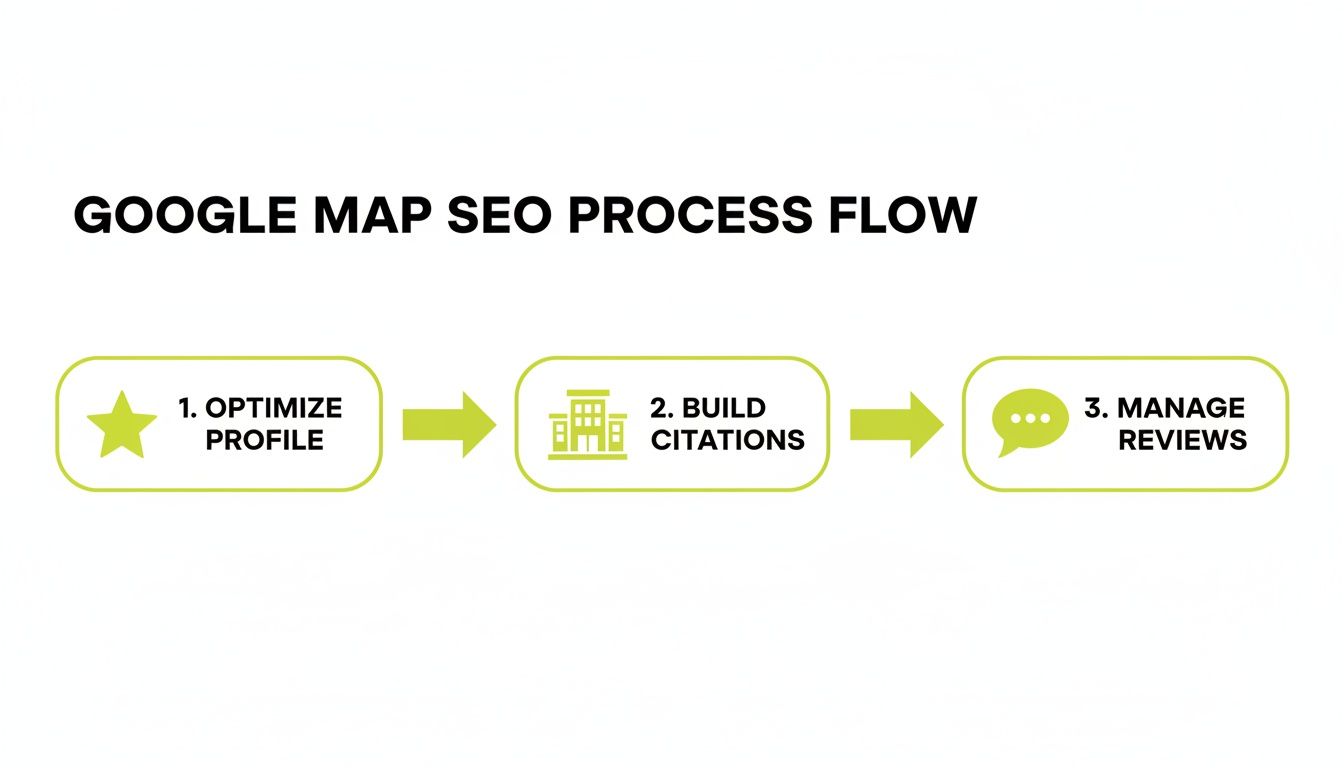
This visual breaks down the three essential pillars of Google Maps SEO. It all starts with the complete optimization of your profile—which is what we're focused on here—before expanding into the ongoing work of citation building and review management.
Bringing Your Profile to Life With Photos and More
Photos and videos are what change your profile from a dry, text-based listing into a rich, visual experience. The data doesn't lie: businesses with photos get 42% more requests for driving directions and 35% more clicks to their websites than businesses without them.
Photos aren't just decoration; they are trust signals. They are proof that you're a real, active business. A profile with no recent photos feels abandoned, making potential customers think twice before engaging.
Upload high-resolution images of everything: your storefront (exterior shot), your team (smiling faces), your products (in use), and your services in action (a landscaper's finished garden). For an extra signal to Google, geotag your photos with your location data before uploading them. It's a small detail, but it's another powerful clue about where you're located.
A Practical Google Business Profile Audit Checklist
Now, let's put this into action. Use this checklist to run a quick audit on your own Google Business Profile and spot opportunities for immediate improvement. We've laid out the key areas, the specific action to take, and why it's so important for your local ranking.
| Optimization Area | Action Item | Why It Matters |
|---|---|---|
| Business Information | Ensure your NAP (Name, Address, Phone) is 100% accurate and consistent everywhere online. Example: "Main Street" vs. "Main St." must match perfectly. | This is the foundation of local SEO. Inconsistencies confuse Google and erode trust, hurting your ranking. |
| Categories | Select the most specific Primary Category possible (e.g., "Pediatric Dentist" not just "Dentist") and add all relevant Secondary Categories. | This is the most critical ranking factor. It tells Google exactly what searches you are relevant for. |
| Photos & Videos | Upload at least 10-15 high-quality, geotagged photos and add new ones regularly. Include a video tour of your office or shop. | Visuals dramatically increase engagement and build trust. Google's data shows they directly lead to more clicks and direction requests. |
| Products & Services | Fully populate your Products and Services sections with detailed descriptions, pricing, and images. Example: A spa lists "60-Minute Deep Tissue Massage" with a price and description. | This adds keyword-rich content directly to your profile, helping you rank for specific, long-tail searches (e.g., "emergency roof repair"). |
| Google Posts | Publish Google Posts at least weekly to share updates, offers, events, or new blog content. Example: A bookstore posts about an upcoming author signing event. | Consistent activity signals to Google that your business is active and relevant. It keeps your profile fresh and engaging for users. |
| Q&A Section | Pre-emptively add and answer your own Frequently Asked Questions in the Q&A section. Example: A gym owner adds and answers, "Do you offer a free trial pass?" | This lets you control the narrative, provide helpful information 24/7, and strategically include important keywords. |
Once you've gone through this checklist, your profile will be miles ahead of the competition. It's about moving from a passive listing to an active, conversion-focused marketing tool.
For a deeper dive, consider this example: a local bakery's profile was a ghost town before optimization—no posts, a few old reviews, and some blurry phone pictures. After a full optimization, it started featuring "Cupcake of the Week" specials in Google Posts, displayed dozens of glowing reviews with owner responses, and showcased a gallery of professionally shot, geotagged photos.
The result? The bakery jumped to the top of the Map Pack for "bakery near me," and weekend sales shot up by 30% from the surge in foot traffic. That's the real-world impact of a fully optimized profile.
The Pillars of a Powerful Google Map SEO Strategy

A perfectly polished Google Business Profile is a great first step, but that's all it is—a start. Nailing a top spot in the Google Map Pack is one thing, but holding onto it is a completely different game that demands a relentless, ongoing strategy.
Sustaining that prized visibility means you have to constantly send the right signals to Google. You need to prove your business is active, credible, and the undisputed best choice for local searchers. This long-term dominance rests on three core pillars: consistent local citations, powerful review management, and active content signals.
Think of these as the recurring tasks a Google map SEO service handles to protect and grow your local search presence long after the initial setup is done. Getting these right is how a one-time ranking bump turns into a reliable, consistent stream of local customers.
Pillar 1: Local Citations and NAP Consistency
Imagine your business is leaving a trail of digital breadcrumbs across the internet. Each crumb is a mention of your business's Name, Address, and Phone number (NAP). We call these local citations, and they show up on online directories like Yelp, industry-specific sites like Houzz for contractors, and pages for your local chamber of commerce.
To Google, these citations are verification points. The algorithm cross-references this data to confirm that your business is real, that it's located where you say it is, and that your GBP information is accurate.
The single most important rule here is absolute consistency. A tiny variation—like using "Street" on one site and "St." on another, or "Suite 100" vs. "#100"—can confuse Google's algorithm. That confusion erodes trust and can actively drag down your Map Pack ranking.
A core job of any Google map SEO service is running a citation audit. For example, they might find your old office address listed on YellowPages and an incorrect phone number on a minor local directory. They then hunt down and fix all these incorrect listings while building new, high-quality ones to create a perfectly uniform digital footprint. This meticulous work signals to Google that your business is established and trustworthy. To build a truly dominant strategy, it pays to understand the broader local SEO best practices that work alongside your Google Maps efforts.
Pillar 2: Proactive Review Management
Reviews are the lifeblood of your local reputation and a massive ranking factor. They offer the social proof customers depend on, but they also feed Google a constant stream of fresh, user-generated content about your business. The data is clear: profiles with more reviews, and more owner responses to those reviews, rank significantly higher.
Just sitting back and waiting for reviews is a recipe for mediocrity. An effective strategy is proactive and has two key parts:
- Encouraging New Reviews: Don't just hope happy customers leave feedback. You have to ask for it systematically. A simple text or email with a direct link to your GBP review page, sent right after a successful job, can massively increase your review volume. For example, a home cleaning service could text, "Thanks for choosing us! If you loved our service, would you mind leaving a quick review? It helps our small business a lot!"
- Responding to All Reviews: This is non-negotiable. Thanking a customer for a positive review ("Thanks, Mark! We're so glad you enjoyed the brisket.") shows you appreciate them. A professional, empathetic response to a negative review demonstrates your commitment to customer satisfaction and can even turn a bad situation around. This engagement tells Google you're an active, attentive business owner.
Pillar 3: Fresh Content Signals
Your Google Business Profile isn't a static listing in a phone book; it's a dynamic micro-platform. Consistently adding new content is one of the strongest signals you can send to Google that your business is active, relevant, and deserves a top spot.
A stale profile that hasn't been touched in months looks abandoned—both to users and to the algorithm. You might be interested in a deeper exploration of how this ties into a broader strategy by reading our guide on what is location-based marketing.
There are two main tools for generating these critical content signals:
- Google Posts: Use this feature at least once a week. Think of it as a mini-blog or social feed right on your profile. Share special offers, announce new products, highlight a "project of the week," or link to your latest blog post. A local restaurant, for instance, could create a Post every Friday announcing its weekend dinner specials with a mouth-watering photo.
- Google Q&A: This section is a goldmine for demonstrating expertise, but it's often overlooked. Don't wait for customers to ask questions. Proactively populate this section yourself by asking and answering your business's most common questions. For example, a pet groomer could add the question "Do you groom large dogs?" and answer it with details about their services for bigger breeds. This lets you control the narrative and strategically work in important keywords.
How to Measure Your Google Map SEO Success
How can you actually tell if your investment in a Google map SEO service is paying off? The answers are sitting right inside your Google Business Profile (GBP) Performance report, but you have to know which numbers truly matter. It’s far too easy to get lost in a sea of data.
This isn't about chasing vanity metrics. It's about connecting specific data points to revenue-generating outcomes. A seasoned agency will zero in on the key performance indicators (KPIs) that demonstrate a clear return on your investment, separating empty stats from the actionable data that actually drives your bottom line.
How Customers Find Your Business Profile
Diving into your GBP Performance report, the first thing you'll see is a breakdown of how users discovered your profile. This data is critical because it reveals both your existing brand strength and your visibility in general searches where new customers are looking.
The report splits this into two core categories: Direct and Discovery. Understanding the difference is the key to evaluating your SEO strategy’s true effectiveness.
Direct Searches: These are people who searched for your business name or address (e.g., "Silver Spoon Agency" or "123 Main Street"). A high number here indicates strong brand recognition—think loyal customers and direct referrals. It's a sign your reputation is working for you.
Discovery Searches: This is where the magic of a Google map SEO service really shows. These users found your profile by searching for a category, product, or service you offer (e.g., "digital marketing agency near me" or "best tacos in downtown"). A growing number of discovery searches means your optimization is successfully capturing new customers who didn't even know you existed.
A steady increase in Discovery traffic is one of the clearest signs that your Google Map SEO is expanding your reach to new audiences. It proves you're becoming more competitive for the high-value, non-branded keywords that define your local market.
Where Customers View Your Business Profile
Your GBP report also shows where people are seeing your profile: on Google Search or on Google Maps. This simple distinction tells a powerful story about user intent and behavior.
Search vs. Maps Views:
Views on Search: This typically captures users who see your business in the Local Pack on a standard Google search results page. Think of this as your digital storefront window—it’s often the first point of contact.
Views on Maps: This shows users who found you directly within the Google Maps app or on the Maps website. This often signals a much higher intent to visit, as users on Maps are frequently looking for directions or actively exploring a specific area with the intent to go somewhere.
An effective strategy will boost your visibility in both places. For example, a coffee shop might see a spike in Maps views on weekend mornings, a strong indicator that it's winning "coffee near me" searches from mobile users who are already out and ready to buy.
Measuring What Truly Matters: Customer Actions
While views and searches are important leading indicators, the most valuable metrics are the ones that measure direct engagement. These are the "Actions" taken on your profile—the tangible interactions that lead directly to new business.
A top-tier Google map SEO service focuses on relentlessly driving these three core actions:
- Website Clicks: Each click represents a warm lead landing directly on your website, ready to learn more, book a service, or make a purchase.
- Phone Calls: For many service-area businesses, this is the ultimate prize. A call generated from your GBP is a high-intent lead actively seeking help or information right now.
- Direction Requests: This metric is a direct measure of foot traffic. It represents someone making a conscious decision to travel to your physical location, a clear signal of imminent commerce.
Let’s put this into a real-world context. Imagine a plumbing company runs a promotion for "emergency leak repair" using Google Posts. In their GBP Performance report, they see a 30% spike in Phone Calls that month. This isn't just a random number; it's a direct, measurable link between their map optimization and a surge in profitable service jobs.
This is how you measure real ROI.
Google Map SEO KPI Breakdown
To really grasp what's driving growth, you need to look past surface-level numbers and focus on metrics that signal real customer behavior. The table below breaks down the difference between vanity metrics and the actionable KPIs that truly reflect performance.
| Metric Category | Example Metric | What It Tells You |
|---|---|---|
| Awareness (Vanity) | Profile Views | How many times your profile appeared. Useful, but doesn't guarantee engagement. |
| Reach (Actionable) | Discovery Searches | How many new potential customers found you through non-branded searches. A direct measure of SEO success. |
| Engagement (Vanity) | Photo Views | Shows people are looking, but doesn't directly translate to a business action. |
| Conversion (Actionable) | Phone Calls & Direction Requests | The number of high-intent leads generated. A direct link to potential revenue and foot traffic. |
Ultimately, a successful Google Maps SEO strategy moves beyond simply getting seen. It focuses on turning that visibility into measurable actions that fill your sales pipeline and bring customers through your door.
Finding a Google Map SEO Partner That Actually Delivers
Picking a partner for your Google map SEO service is a make-or-break decision for your local growth. The right agency can turn your Google Business Profile into a lead-generating machine, while the wrong one can waste your budget and leave you invisible. You need to know how to spot a true performance-driven ally.
A great agency doesn't just see your GBP in a vacuum. They see it for what it is: the central hub of your local customer acquisition strategy. Their goal isn't just to climb the Map Pack rankings; it's to make your phone ring, drive foot traffic through your door, and ultimately, grow your revenue. This requires a strategic mind, not just a task-oriented one.
How to Vet a Potential Agency
Before you sign any contracts, you need to ask sharp, specific questions that cut through the sales pitch and reveal an agency's real process and expertise. If you get vague, hand-wavy answers, that’s a huge red flag. A confident, skilled partner will have straightforward responses ready to go.
Here are the essential questions you should be asking any potential Google Map SEO provider:
- Strategy & Process: "Can you give me an example of how you'd audit and clean up local citations for a business like mine?" "How will you decide on the best primary and secondary categories for a business in my specific industry?"
- KPIs & Reporting: "Show me an example of a monthly report. How do you connect metrics like Discovery Searches and Phone Calls back to our business goals and ROI?"
- Review Management: "What is your specific process for generating new reviews? How would you handle a detailed, negative 1-star review?"
- Engagement & Content: "Can you show me an example of a Google Post you've created for another client that drove results? What's your plan for using the Q&A section?"
The answers you get will tell you everything you need to know. You'll quickly see whether they're offering a one-size-fits-all package or a genuinely customized strategy. A real partner will be excited to talk about how their work will directly impact your specific goals, like boosting appointment bookings for your clinic or increasing in-store sales at your boutique.
Major Red Flags to Run From
Just as important as knowing what to look for is knowing what to avoid. Some agencies rely on smoke, mirrors, and shady tactics that can do more harm than good. Keep your eyes peeled for these warning signs.
"Guaranteed" #1 Rankings
This is the oldest trick in the book. No one can guarantee a #1 spot on Google, period. Rankings are influenced by hundreds of factors, including your competitors' moves and Google's own algorithm updates. Any agency making this promise is either dishonest or naive.
Vague, Fluffy Reporting
If their reports are filled with vanity metrics like "impressions" but are suspiciously light on data for phone calls, direction requests, or website clicks, they're hiding a lack of real results. Demand reports that show a clear line between their work and your bottom line.
No Holistic View
A firm that only wants to talk about your GBP without asking about your overall business goals, your target customer, or your other marketing efforts is thinking way too small. Powerful Google Map SEO isn't a standalone gimmick; it’s a crucial part of a cohesive growth plan.
Choosing the right firm is a direct investment in your local market dominance. A true performance agency will act as a strategic partner, working tirelessly to ensure your gains in local visibility translate into measurable, long-term business success.
Frequently Asked Questions About Google Map SEO
When you start digging into Google map SEO services, a lot of questions pop up. Business owners want to know what they're really getting into. Here are some straight answers to the most common queries we hear, so you can set clear expectations and make the right call for your local marketing.
How Long Does It Take to See Results?
While you might see some small wins within a few weeks of a full profile optimization, significant, stable ranking improvements typically take 3 to 6 months. For example, a brand-new restaurant might see an uptick in direction requests within the first month after optimization, but cracking the highly competitive Map Pack for "best restaurants downtown" will take several months of consistent review generation and citation building.
Google needs time to crawl, process, and ultimately trust the new signals you’re sending. It has to index your consistent business listings, register the steady flow of new reviews, and recognize the fresh content you're adding. The results are gradual, but they build on each other, creating a powerful foundation for long-term visibility.
Is Google Map SEO Different From Regular Local SEO?
Yes, they're connected, but they are not the same thing. Think of local SEO as the general contractor for your entire online presence. It covers everything from optimizing your website’s service and location pages ("Plumber in Brooklyn, NY") to building local backlinks and more.
A Google map SEO service is a specialized trade within that larger field, like a master electrician focusing on one critical system. It centers almost exclusively on optimizing your Google Business Profile and all the specific factors—like categories, reviews, and Google Posts—that directly influence your ranking in the Google Map Pack.
Think of it this way: Local SEO helps your entire business get found online. Google Map SEO is what ensures your front door is the first one people see on the busiest digital street in town.
Does My Business Need a Physical Storefront?
No, you absolutely do not need a physical storefront to get massive value from this. While businesses like retail shops and restaurants are obvious fits, service-area businesses (SABs) are often the ones who see the most dramatic results. We're talking about plumbers, electricians, consultants, home cleaners, and other professionals who travel to their customers.
Instead of optimizing for a single pin on a map, your profile is built around a defined service area. For an electrician, a dedicated service will work to make them the top result for searches like "rewire house" across multiple towns (e.g., "Arlington, Fairfax, and McLean"). This effectively turns your entire service area into a hotbed for high-intent leads.
Ready to stop being invisible to local customers and start dominating the Map Pack? The team at Silver Spoon Agency uses a performance-driven approach to turn your Google Business Profile into a consistent source of leads and revenue. Learn how we can drive measurable growth for your business at https://www.silverspoonagency.com.