


How to Build a Marketing Funnel: Quick Guide (how to build a marketing funnel)

Ever tried to sell something to a complete stranger the moment you met them? It usually doesn't go well. A marketing funnel is the exact opposite of that—it’s a strategic roadmap for guiding people from "who are you?" to "take my money!"
It’s all about creating a deliberate, step-by-step system that turns strangers into paying customers, and then into raving fans.
Your Blueprint for a High-Converting Marketing Funnel
Forget the abstract diagrams you’ve seen in textbooks. A real-world marketing funnel is a practical blueprint for generating predictable revenue. It’s the tool that separates campaigns that actually make money from the ones that just burn through your budget.
This approach is about building a relationship, not just pushing for a transaction. Each stage is carefully designed to bring someone closer to a purchase, ensuring you don’t ask for the sale too soon or, just as bad, lose their attention along the way.
The AIDA Model as a Foundation
While the tactics have definitely evolved, the core psychology behind a good funnel hasn't changed much. The classic AIDA model still provides a powerful and simple framework for mapping out the customer's journey.
- Awareness: This is the first "hello." Your prospect discovers your brand exists. For example, they see a Facebook ad for noise-canceling headphones while scrolling their feed.
- Interest: They’re intrigued. They lean in a little closer. For example, they click the ad and read a blog post titled "The 5 Features Every Commuter Needs in a Headphone."
- Desire: Now it gets serious. They start seeing your product as the solution to their problem. For example, they watch a video review comparing your headphones to a competitor and start to prefer your product's features and design.
- Action: This is the finish line. They’re finally ready to pull out their credit card. For example, they see a retargeting ad with a 15% discount, click through, and complete the purchase.
This flow is all about moving a potential customer from one stage to the next in a natural, logical progression.
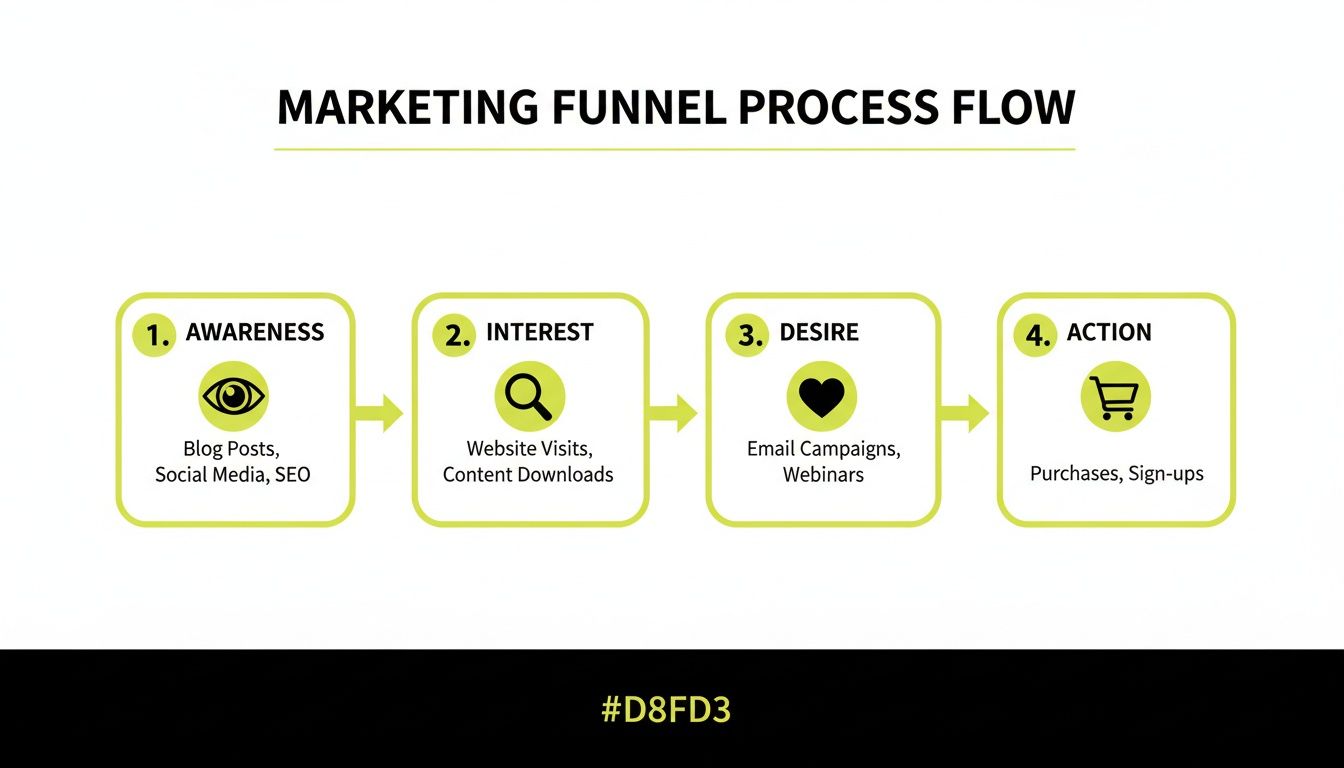
As you can see, your audience naturally gets smaller at each stage. That's totally normal. The goal is to optimize every step to keep as many qualified people moving through as possible.
A well-structured funnel doesn't just find customers; it creates them. By delivering the right message at the right time, you build the trust and authority needed to turn a casual browser into a loyal advocate.
To really nail this, it helps to start with the fundamentals. For a deeper dive into the core concepts, this guide on understanding what a sales funnel is and how to build one that converts is a great resource.
By the time you're done with our playbook here, you’ll see exactly how all these pieces fit together to build a powerful engine for growth.
Define Your Audience and Craft Irresistible Offers
A marketing funnel built on a shaky foundation is doomed from the start. That foundation? A deep, almost obsessive understanding of who you’re talking to. Forget basic demographics like age and location—that's amateur hour.
The most profitable funnels are precision-engineered for a specific person. You need to know their secret frustrations, their biggest ambitions, and the exact words they use when they complain to their friends. Once you have that, crafting an offer they can't refuse becomes less of a guessing game and more of a science.
Building Detailed Customer Avatars
A customer avatar (or persona) is a semi-fictional character representing your ideal client. This isn't just some fluffy creative exercise; it's a strategic weapon. It ensures every ad, every email, and every piece of copy hits home with the right person.
Practical Example: E-commerce Brand
Let's say you sell sustainable activewear. Your avatar isn't just "women aged 25-40." It’s "Eco-Conscious Chloe."
- Who is she? A 32-year-old yoga instructor who moonlights as a graphic designer.
- Her values? Ethical production and natural, planet-friendly materials are non-negotiable. She actively avoids fast fashion and will gladly pay a premium for quality and sustainability.
- Her pain points? She's sick of brands that "greenwash" their marketing and struggles to find activewear that's both stylish and legitimately eco-friendly.
- Where does she hang out online? You'll find her following sustainability influencers on Instagram, participating in eco-conscious Facebook groups, and reading blogs about mindful living.
This level of detail dictates everything. Your ads suddenly feature earthy tones, not neon. Your copy uses phrases like "ethically crafted" and "plant-based," not "huge sale." Your offers appeal to her values, not just her wallet.
Practical Example: Local Service
Now, let's build an avatar for a local accounting firm that wants more small business clients. Meet "Stressed-Out Steve."
- Who is he? Steve's 45 and owns a booming construction company. He's a master of his trade but a total novice when it comes to finance.
- His pain points? He’s completely overwhelmed by quarterly taxes, lives in fear of a costly IRS mistake, and wastes precious hours on bookkeeping instead of running his crew. His current big-box accountant is basically a ghost.
- What he really wants? Peace of mind. He’s desperate for a proactive advisor who can simplify his finances, find tax savings, and give him actual strategic guidance.
Your funnel for Steve won't use jargon like "comprehensive accounting solutions." It'll scream headlines like, "Stop Drowning in Receipts." The perfect lead magnet would be a guide titled, "5 Common Tax Mistakes Construction Business Owners Make." You'd target him on platforms like LinkedIn, where he’s looking for real business advice.
The core of a powerful funnel is empathy. When you can articulate your customer's problem better than they can, they'll automatically assume you have the solution.
Structuring a Compelling Value Ladder
Once you truly know your avatar, you can map out a "value ladder." This is just a sequence of offers, each increasing in price and value, that walks someone from a curious prospect to your best customer. It's all about building trust, one step at a time.
A great value ladder always starts with a high-value lead magnet. This isn't just any old freebie. It has to solve a specific, nagging problem for your avatar and give them an immediate win.
- For a business coach: Ditch the generic "e-book." Instead, offer an interactive "Business Bottleneck Quiz" that diagnoses their biggest growth hurdle and spits out a custom report.
- For an e-commerce brand: A simple 10% off coupon is lazy. A much better offer is an exclusive "Style Guide for Your Body Type" that empowers them to make a confident purchase.
From that first free offer, you guide them up the ladder.
Practical Example: Business Coach Offer Stack
Here's how this plays out for a coach targeting online entrepreneurs:
- Lead Magnet (Free): The "5-Day Scale Your Sales Challenge." This delivers quick, tangible wins and instantly showcases the coach's expertise.
- Tripwire Offer ($47): A low-cost, high-value digital product like the "Perfect Offer Toolkit." This is a crucial step—it converts a lead into a paying customer and breaks that initial purchase barrier.
- Core Offer ($1,997): The main event—an 8-week group coaching program called "The Client Acquisition Accelerator."
- Premium Upsell ($10,000+): A high-touch, one-on-one "Mastermind" or a "Done-For-You" service for top-tier clients.
This structure allows you to serve clients at every level of commitment and budget. But here's the real magic: the low-cost offers at the front end can actually pay for your ad spend. This lets you acquire customers profitably, making it possible to scale your funnel to the moon.
Choosing Your Channels to Drive High-Quality Traffic
Alright, you’ve done the hard work of figuring out who you’re selling to and what you’re offering them. Now for the million-dollar question: where do you actually find these people?
This is where you connect your irresistible offer to your ideal audience. Choosing your marketing channels isn't just about picking a platform; it's a strategic decision that dictates how your entire funnel will operate.
It's easy to get paralyzed by choice here. Should you dump your budget into Google Ads? Go all-in on Facebook? Or play the long game with SEO? The right answer is always the same: it depends on who you're trying to reach and what you're selling.
Paid Social Media: The Engine for Awareness and Retargeting
Think of paid social platforms like Facebook and Instagram as the ultimate top-of-funnel machines. Their targeting is so powerful you can get in front of people who don't even know your solution exists yet, all based on their interests, job titles, and online behaviors.
Paid social is your conversation starter. You use scroll-stopping videos, slick carousel ads, or beautiful images to introduce your brand to a cold audience. The magic happens next. Once someone interacts—watches a video, clicks a link, visits your profile—they're no longer a stranger. They're now part of a warm audience you can retarget with a different, more specific message.
Practical Example: A SaaS Trial Signup
Let's say a SaaS company wants more project managers signing up for a free trial of their new software.
- Top-of-Funnel (Awareness): They could run a Facebook and Instagram ad campaign targeting users with job titles like "Project Manager" or interests in competitors like Asana or Trello. The creative? A short, punchy video showing how the software crushes a common project management headache.
- Middle-of-Funnel (Retargeting): Anyone who watched 50% or more of that video now gets a completely different ad. This one offers a free case study, "How We Helped a Marketing Agency Cut Project Timelines by 20%," in exchange for their email.
- Bottom-of-Funnel (Conversion): Once they've downloaded the case study, they get the final push: a set of ads with a direct CTA to "Start Your Free 14-Day Trial," featuring testimonials from other project managers.
Paid Search: Capturing High-Intent Demand
While social is fantastic for creating demand, paid search platforms like Google Ads are masters at capturing it.
When someone types a search into Google, they have a problem and are actively looking for a solution right now. This makes them some of the most qualified traffic on the planet. Your ad shows up at the exact moment your ideal customer is raising their hand for help. This is why paid search is a powerhouse for the middle and bottom of your funnel, targeting keywords that scream purchase intent, like "best accountant for small business" or "buy sustainable activewear online."
Your channel choice will make or break your funnel's performance. Recent data shows referrals are the clear winner with a 25.56% conversion rate, followed by email at 22.83% and SEO at 21.22%. Even paid search, averaging a 3.2% conversion rate, is a beast for capturing high-intent leads when used correctly. You can explore more detailed insights on how different channels stack up.
Practical Example: A Local Home Service Business
Imagine an HVAC company that needs more leads for AC repairs in Phoenix during a heatwave.
- Google Ads Campaign: They'd build a campaign targeting keywords like "AC repair Phoenix," "emergency air conditioner service," and "fix my broken AC."
- Ad Copy: The ads need to hit the key selling points hard and fast: "24/7 Emergency AC Repair in Phoenix | Licensed & Insured | Get a Free Estimate Now!"
- Landing Page: Clicks don't go to the homepage. They go to a dedicated landing page built for one purpose: getting a lead. It has a huge click-to-call button and a dead-simple "Request Service" form.
Organic Content Marketing: The Long-Term Trust Builder
Organic channels like SEO and content marketing are about playing the long game. Instead of paying for every single click, you invest your time and resources into creating genuinely valuable content that attracts your ideal customer naturally. It's an approach that builds trust and authority in a way that paid ads just can't replicate.
When you create blog posts, videos, or guides that answer your audience's most burning questions, you stop being a vendor and start being the go-to expert.
For most businesses, the sweet spot is a blend of paid and organic. You get the immediate impact of paid ads while building a long-term asset with your content. This is the heart of creating effective multi-channel marketing strategies that ensure you’re meeting your audience wherever they are.
The key is to match the channel to the funnel stage and your goals. Don't try to boil the ocean. Start with one or two channels, get really good at them, and then expand. This focused approach will fill your funnel with the right people and give you the best possible return on your effort.
Building Your Funnel Pages and Automating the Journey
Okay, you've figured out who you're talking to and where to find them. Now for the fun part: building the actual machine. This is where your strategy gets translated from notes and ideas into a tangible, revenue-generating asset that works for you 24/7.
A high-performing funnel isn't just a collection of pages slapped together. It's a meticulously choreographed experience, designed to guide your prospects from one logical step to the next without friction or confusion.
This process really boils down to two critical, interconnected jobs. First, you have to build the pages themselves—the landing pages, order forms, and thank you pages that create the customer-facing journey. Second, you need to set up the automated engine that runs behind the scenes, nurturing leads and closing sales while you sleep.
Crafting High-Impact Funnel Pages
Let's get one thing straight: every single page in your funnel has one—and only one—job to do. The moment you start overloading a page with mixed messages or multiple calls-to-action, you've lost. Clarity and focus are everything.
The Landing Page: Think of this as your digital handshake. Its sole purpose is to convert a visitor into a lead by convincing them to take a single, specific action (like downloading your guide). It needs a killer headline that hits your avatar's pain point square between the eyes, compelling copy that sells the benefit of the download, and a dead-simple form with an unmissable call-to-action button.
The Sales/Order Page: Once you've earned their email address, this is where you ask for the sale. This page should be packed with persuasive copy, social proof like testimonials and reviews, and a checkout form that’s an absolute breeze to fill out. Friction is your enemy here. Every unnecessary field you add to that form is another reason for someone to abandon their cart.
The Thank You Page: This is probably the most underutilized—and most valuable—piece of real estate in marketing. Don't just say "thanks" and call it a day. Use this page to immediately deliver the lead magnet they asked for, tell them what to expect next ("Check your inbox for an email from me in the next 5 minutes!"), and even make a low-cost, one-time offer to turn that brand-new lead into a paying customer right then and there.
Think of your funnel pages as a real-world conversation. The landing page asks, "Want this free guide?" The user says yes. The thank you page continues the dialogue: "Awesome! Here's your guide. And hey, while you're here, you might be interested in this special offer…" Each step flows logically from the last, building trust and momentum along the way.
Automating the Journey with the Right Tech
A modern marketing funnel is powered by automation. This is the magic that lets you build relationships and drive sales at scale, without having to manually send every single email or follow up with every lead. Building out your tech stack doesn't need to be a nightmare, either.
For most businesses, you just need a few core components:
- A Landing Page Builder: Tools like Leadpages or Instapage let you build and A/B test high-converting pages without needing a developer.
- An Email Marketing Platform: This is the heart of your entire automated system. Platforms like ActiveCampaign or Mailchimp allow you to tag subscribers based on their actions and send hyper-targeted email sequences.
- A Payment Processor: You need a way to get paid. Services like Stripe or PayPal are the industry standards for securely processing payments on your order forms.
The goal is to wire these tools together so they talk to each other. For example, when someone fills out the form on your Leadpages landing page, they should be automatically added to ActiveCampaign and tagged as a new lead. Many businesses find that digging into marketing automation for small businesses is the key to creating these powerful, hands-off systems.
Practical Examples of Automated Sequences
Once your tech is humming along, you can build automated email sequences that work tirelessly for you. These are just pre-written series of emails that get sent automatically when a user takes a specific action.
Example 1: The 5-Day Welcome Series
The moment someone downloads your lead magnet is when they are most engaged with your brand. A welcome series is designed to capitalize on that excitement and build a real relationship, fast.
- Day 1: Deliver the goods! Send the lead magnet and give a brief, personal introduction.
- Day 2: Share a super valuable tip directly related to the topic of the lead magnet.
- Day 3: Tell a quick story that builds your authority and helps them connect with you.
- Day 4: Bust a common myth in your industry to position yourself as a trusted expert.
- Day 5: Make a soft pitch for your core offer with a clear call-to-action.
Example 2: The E-commerce Abandoned Cart Sequence
Did you know that studies show nearly 70% of all online shopping carts are abandoned before purchase? That’s a staggering amount of lost revenue. An automated email sequence is the single most effective way to claw a huge chunk of that back.
- Email 1 (Sent 1 hour after abandonment): A simple, friendly reminder. "Did you forget something? Your cart is waiting for you."
- Email 2 (Sent 24 hours later): Handle their objections. "Still thinking it over? Here's our FAQ and no-hassle return policy." Sprinkle in some customer testimonials.
- Email 3 (Sent 48 hours later): Create a little urgency. "Your cart expires soon! Complete your order now and get 10% off."
By combining pages that are built to convert with smart, trigger-based automation, you transform your funnel from a static diagram into a living, breathing system that actively nurtures leads into paying customers.
Tracking Performance and Optimizing for Profitability
Getting your funnel live is just the first step. The real money is made in the follow-through—treating that funnel not as a static "set it and forget it" asset, but as a living, breathing system that needs constant attention. This is where you graduate from just building a funnel to truly mastering one that prints money. You have to put on your data scientist hat and let the numbers, not your gut, guide the way.
Without solid tracking, you're just gambling. You could be burning cash on ads that are duds or, even worse, have a massive leak on a page you’d never suspect. Good tracking and a smart optimization plan are what turn your funnel from a hopeful expense into a predictable revenue machine.

Setting Up Your Tracking Foundation
Before you can fix anything, you have to see what’s broken. That means getting a few non-negotiable tracking tools in place to paint a clear picture of user behavior, from the very first ad click all the way to the final thank-you page.
Your two most critical tools here are the Meta Pixel (for Facebook and Instagram) and Google Analytics. These are tiny snippets of code that you install on your website, but they're incredibly powerful. They watch everything users do—page views, add-to-carts, leads, and purchases—giving you the raw data you need.
On top of that, you absolutely must use UTM parameters. These are simple tags you tack onto the end of your URLs that tell your analytics exactly where your traffic is coming from.
Real-World Example: Why UTMs Are a Game-Changer
Let's say you're running three different Facebook ad campaigns to promote a new webinar. Without UTMs, Google Analytics just lumps all that traffic together under "facebook.com." Pretty useless, right? But if you add specific UTM tags to each ad's link, you can see precisely which campaign, ad set, and even which specific ad creative is driving the most sign-ups. Now you know exactly where to put more budget.
Key Metrics to Watch at Each Funnel Stage
Don’t let yourself get bogged down by "analysis paralysis." You only need to obsess over a handful of Key Performance Indicators (KPIs) at each stage to know exactly how your funnel is performing.
Top of Funnel (TOFU – Awareness): The goal here is to grab attention efficiently. The metrics that matter are Click-Through Rate (CTR), which shows how compelling your ad is, and Cost Per Click (CPC), which tells you if you're overpaying for that attention.
Middle of Funnel (MOFU – Interest): This is where you separate the lookers from the leads. Your one true metric here is your Landing Page Conversion Rate. What percentage of people who hit your page actually take the action you want them to?
Bottom of Funnel (BOFU – Action): This is where profitability lives or dies. You need to know your Cost Per Acquisition (CPA) like the back of your hand—how much does it cost to get a paying customer? And, of course, your Return on Ad Spend (ROAS). If that number isn't healthy, nothing else matters.
It also helps to know where you stand. According to 2025 data, the average sales funnel conversion rate hovers between 2.35% and 2.9%, but the top 10% of performers are crushing it with conversion rates over 11.45%. In e-commerce, the average add-to-cart rate is 7.52%, yet purchase conversions on mobile are a measly 1.8%—talk about a clear optimization target!
The secret to a profitable funnel isn’t building a perfect one from day one. It’s a relentless commitment to finding and fixing the single biggest "leak" in your funnel at any given time. Solve one problem, then find the next one.
A Simple Framework for A/B Testing
Once your data starts telling you a story, you can begin optimizing. The gold standard for this is A/B testing (or split testing), where you scientifically test one change at a time to see what actually moves the needle.
Real-World Example: Plugging a Leaky Cart
Imagine your analytics show that a staggering 80% of people who add your product to their cart are abandoning it before paying. That’s a massive hole in your bucket. You might form a hypothesis: "I bet the surprise shipping cost is scaring people away."
Your A/B test would look like this:
- Version A (The Control): Your current order form.
- Version B (The Test): A new version of the order form that prominently features a banner saying "Free Shipping On All Orders!"
You'd then split your traffic 50/50 between the two pages and let the test run until you have enough data to declare a statistically significant winner. This methodical process is the heart of effective sales funnel optimization strategies.
By constantly monitoring your KPIs and running disciplined tests on your headlines, offers, ad creative, and calls-to-action, you can systematically improve every single step of your customer's journey. Mastering this is the final, crucial step, making a practical guide on how to increase online sales not just helpful, but essential for maximizing profit.
Key Funnel Metrics to Track by Business Type
Not all funnels are created equal, and the KPIs that matter most can shift depending on your business model. This table breaks down the most important metrics to watch at each stage, helping you focus on the numbers that truly drive growth for your specific business.
| Funnel Stage | E-commerce KPI | Local Service KPI | Coach/Consultant KPI |
|---|---|---|---|
| Top (Awareness) | Cost Per Click (CPC) | Cost Per Mille (CPM) | Cost Per Lead (CPL) |
| Middle (Interest) | Add to Cart Rate | Form Submission Rate | Webinar/VSL Sign-up Rate |
| Bottom (Action) | Return on Ad Spend (ROAS) | Cost Per Booked Appointment | Sales Call Close Rate |
| Retention | Customer Lifetime Value (LTV) | Repeat Customer Rate | Upsell/Cross-sell Rate |
By tailoring your KPI dashboard to your business type, you can get a much clearer signal of what's working and what's not. This allows for smarter, faster optimizations that directly impact your bottom line.
Answering Your Top Questions About Building a Marketing Funnel
Alright, as you start mapping out your first funnel, some very practical questions are bound to pop up. I see it all the time. Getting clear answers to these is often what separates a funnel that fizzles out from one that becomes a reliable growth engine for your business.
Let's cut through the noise and tackle the big ones: budgets, timelines, common screw-ups, and more.
How Much Should I Actually Budget for My First Funnel?
Think of your budget in two buckets: the tools you need and the ads you'll run.
For your tech stack, you can get a really solid start with a good landing page builder and an email marketing platform. All in, you’re probably looking at somewhere between $100 to $500 per month to get the essentials locked down.
Ad spend is where the real "it depends" comes in. Forget trying to find a magic number. The goal is to commit enough cash to get statistically significant data back.
- For a local service business: You can start making some waves and generating initial leads with $500 to $1,500 a month on a platform like Google Ads.
- For an e-commerce brand: You'll likely need to start a bit higher, somewhere in the $1,000 to $3,000 range, just to get enough traffic to properly test your product pages and checkout flow.
Here’s the key: frame this as a 90-day investment. That gives you enough runway to test, learn, and start seeing a real return. Once you've proven the model on one channel, you can pour gas on the fire with confidence.
What’s the Real Difference Between a Marketing Funnel and a Sales Funnel?
People throw these terms around interchangeably, but there's a classic distinction that’s still useful to know.
A marketing funnel is all about the top half of the journey—generating awareness, sparking interest, and ultimately, capturing a qualified lead. Its job is to generate and nurture.
A sales funnel, traditionally, picks up right where marketing leaves off. It’s focused on the high-intent actions needed to actually close the deal. Think sales calls, product demos, or navigating the final steps of a checkout.
But here's the modern reality: for most e-commerce and direct-to-consumer businesses, these two funnels have completely merged. The customer just experiences one smooth, automated path from the first ad they see to the final "thank you for your purchase" email.
How Long Does It Take to Actually See Results?
You can get a simple funnel built and live in a couple of days. But seeing predictable, profitable results? That’s a different game, and it requires some patience.
It's best to think about it in phases.
The first 30 days are purely for data collection. You’re just establishing your baselines—what's your cost-per-lead? What’s your landing page conversion rate? Profit isn't the goal yet. Learning is.
By the 60 to 90-day mark, after running consistent traffic and making data-backed tweaks, you should start seeing a stable and predictable Return on Ad Spend (ROAS). Of course, a simple e-commerce funnel for a low-cost, impulse-buy product will show its hand much faster than a complex B2B funnel for a high-ticket service with a six-month sales cycle.
What Are the Most Common Funnel-Building Mistakes?
Honestly, more funnels fail from a few common, totally avoidable mistakes than anything else. Just knowing what they are is half the battle.
These are the three big ones that sink most funnels:
- Not truly understanding the audience. This is the original sin of all marketing. If you don't deeply get your customer's pain points, fears, and desires, your messaging will be off, and your offers won't land.
- Selling too hard, too fast. A funnel is about building a relationship, even a quick one. Asking for a big commitment without first delivering value and earning trust is like proposing on a first date. It’s just not going to work.
- Forgetting to optimize. So many people build a funnel, switch on the ads, and just walk away. A great funnel isn't a "set it and forget it" machine. It’s a dynamic system that demands you constantly watch the data to find and fix the leaks.
Ready to build a high-converting funnel that turns ad spend into predictable revenue? The team at Silver Spoon Agency specializes in creating and optimizing performance-driven funnels powered by an AI-driven, omnichannel approach. Schedule a consultation today to see how we can help you scale.