


How to Choose a Marketing Agency That Delivers Real Results

Before you even think about shortlisting marketing agencies, the most important work happens right inside your own business. It's about getting crystal clear on what success actually looks like, defining a realistic budget, and nailing down the specific numbers that will tell you if your investment is paying off.
Define Your Finish Line Before the Race Starts

Rushing to hire an agency without a solid internal strategy is like handing a builder a pile of bricks and just saying, "Build something great." You're practically guaranteeing a mess of wasted money and unmet expectations. The groundwork you lay before your first discovery call is what separates a successful partnership from a frustrating one.
This isn't about vague wishes. A goal like "get more leads" isn't a strategy; it's a hope. It gives an agency nothing to work with and gives you no real way to measure if they're doing a good job.
From Vague Ideas to Specific Objectives
Let's get concrete. The first step is to translate those broad business needs into hard, measurable marketing goals. This means digging into your current performance, knowing your ideal customer inside and out, and facing your financial realities head-on. Forget tactics for a moment and focus on the numbers that actually move the needle for your business.
Here’s what that shift looks like in the real world:
Instead of: "I need to grow my online store."
Try: "I need to hit a 4X Return on Ad Spend (ROAS) for our new skincare line within Q3, targeting women aged 25-45."
Instead of: "We want more patients for our dental clinic."
Try: "We need to book 30 new patients per month for cosmetic dentistry through hyper-local Google Ads, keeping our Customer Acquisition Cost (CAC) under $250."
Instead of: "I want to scale my coaching business."
Try: "I need to bring in 200 qualified leads per month for my high-ticket coaching program by building a sales funnel that converts at least 3% of leads into customers."
A clearly defined goal acts as a filter. It instantly helps you disqualify agencies that don't have proven expertise in the specific channels or strategies needed to achieve your primary objective.
Setting a Budget That Makes Sense
Your budget is the other non-negotiable piece of this puzzle. It determines the caliber of agency you can afford and the scope of work they can realistically deliver. Don't just pull a number out of thin air; anchor your budget to your revenue and growth targets.
This is especially true right now. With marketing budgets hovering around just 7.7% of total company revenue and paid ads eating up over a third of that, every dollar has to work overtime. The C-suite is demanding efficiency, which means finding a partner that delivers a killer ROAS is non-negotiable. You can see more on these marketing budget stats from Marketing Dive.
When you can present an agency with a specific goal and a clear budget, you empower them to come back with a realistic, data-backed strategy. That foundation of clarity is the bedrock of a great partnership. To see how these goals fit into the bigger picture, check out our guide on the essential elements of a marketing plan.
Once you've done this internal homework—defining your customer, setting measurable KPIs, and establishing a firm budget—your search completely changes. You're no longer just looking for "a marketing agency." You're looking for a specialist partner equipped to deliver a very specific business outcome.
Find the Right Type of Agency for Your Business

The term "marketing agency" is a massive umbrella. It covers everything from a one-person SEO shop working out of a spare bedroom to a global firm with offices on every continent. Picking the right partner means you first have to understand this landscape and get brutally honest about what kind of help your specific goals demand.
Making that choice has never been tougher. The number of digital ad agencies in the U.S. has ballooned to over 60,000, with the market growing at a staggering 10.8% clip each year for the past five years. For businesses like yours, that means you have to be incredibly strategic to cut through the noise and find a partner with proven, specialized chops.
This crowded field makes it absolutely essential to know the key differences between agency types and which one truly fits your business.
Specialist vs. Full-Service Agency: Which Is Right for You?
The first big fork in the road is choosing between a specialist and a full-service partner. A specialist agency goes incredibly deep on one or two core services. Think of them as the surgeons of the marketing world—absolute experts in a very specific discipline.
A full-service or omnichannel agency, on the other hand, acts more like a general contractor for your growth. They manage the entire project, making sure all your marketing channels are working in concert to hit one unified goal. Each model has its place, and the right choice depends entirely on your situation.
This table breaks down the core differences to help you decide.
| Factor | Specialist Agency (e.g., SEO-Only) | Full-Service Agency (e.g., Omnichannel) |
|---|---|---|
| Best For | Businesses with a single, high-priority need or an in-house team that needs expert support in one area. | Companies seeking a unified strategy across multiple channels without managing multiple vendors. |
| Expertise | Deep, focused knowledge in a specific discipline like SEO, PPC, or email marketing. | Broad expertise across the marketing mix, with a focus on integrating channels for a cohesive customer journey. |
| Strategy | Tactic-focused, aiming to dominate a single channel. | Holistic, focused on the entire customer lifecycle and how different touchpoints influence each other. |
| Cost | Often lower for a single service, but costs can stack up if you hire multiple specialists. | Typically a higher single investment, but can be more cost-effective than hiring several separate agencies. |
| Example Scenario | An e-commerce brand with a strong social media presence hires an SEO agency to improve organic search rankings. | A multi-location retailer hires one agency to manage local SEO, geofenced ads, social media, and email campaigns. |
So, what does this mean for you? A specialist is the perfect hire if you’ve already pinpointed a clear bottleneck. If your website gets plenty of traffic but nobody buys, a conversion rate optimization (CRO) agency is a brilliant move. Likewise, if your main goal is getting more foot traffic into your brick-and-mortar stores, you might look at specialized social media marketing agencies with a track record in local engagement.
But if your customer journey is more complex—they see a Facebook ad, then do a Google search, then get an email from you—a full-service omnichannel agency is almost always the better bet. They prevent the disjointed, clunky experience that happens when different specialists work in silos, each blind to what the others are doing.
Key Takeaway: The choice isn't about which model is "better," but which one directly supports the goals you've already defined. A narrow, specific goal points to a specialist. A broad growth objective demands a full-service approach.
Evaluating Core Capabilities for Modern Growth
Beyond the agency model, you need to dig in and verify they have the modern capabilities required to compete today. Buzzwords are cheap; you’re looking for proven application and real-world results.
Here are the critical capabilities you need to probe for:
- True Omnichannel Strategy: This is so much more than just "doing" social media and email. It’s about creating a single, fluid conversation with your customer across every platform. For example, ask a potential agency how they would use data from a Meta ads campaign—like which creative angles resonated most with 35-44 year-old women—to personalize the subject lines in a follow-up email sequence. Their answer will tell you if they think in integrated systems or just check off a list of services.
- AI-Powered Ad Management: Today’s ad platforms are far too complex for anyone to manage by hand. Ask potential partners how they actually use AI to optimize bidding, find new audiences, and move budget in real-time. A practical example is using Google’s Performance Max to automatically test thousands of creative and audience combinations, identifying that video ads shown on YouTube Shorts are driving a 30% lower cost-per-acquisition than static images on the Display Network.
- Conversion Funnel Optimization: Getting traffic is only half the job. A top-tier agency is obsessed with what happens after the click. They should be able to design, build, and relentlessly optimize entire sales funnels—from landing pages and lead magnets to email automation and retargeting ads. Don't be shy; ask for case studies showing how they boosted a client's lead-to-customer conversion rate by 150% or more.
The right partner won't just have these skills—they'll be able to draw a straight line from their work to your business outcomes. For a deeper look at the different agency models and their specialties, check out our guide on exploring different types of ad agencies in NYC. Matching your real needs to an agency’s proven skills is the surest path to a successful partnership.
How to Properly Vet Potential Agency Partners

Alright, you've narrowed your list down to a few strong contenders. Now the real work begins. This is where you dig past the polished sales decks and separate the slick presenters from the true performers.
A great pitch is just the price of entry. What you need now is a reliable way to verify their claims and really get inside their strategic minds. The goal isn’t to hire a vendor; it's to find a partner who will think critically about your business. This means asking tough but fair questions that reveal how they operate under pressure, define success, and handle the inevitable challenges.
Get this part right, and you’re not just protecting your investment—you're laying the groundwork for a powerhouse partnership.
Asking Questions That Go Beyond the Pitch
Any agency can show you a highlight reel. The best ones, however, can articulate their process. Your questions need to push them from talking about what they did to explaining why they did it and what the actual business outcome was. Generic, fluffy answers are a massive red flag.
When you sit down with them, steer the conversation toward strategy with a few pointed questions.
- "Walk me through your strategic process for a new client in the first 90 days." A good answer might sound like this: "In Month 1, we focus on technical audits and customer research. Month 2 is for launching initial 'test' campaigns based on our findings. By Month 3, we're using that data to scale the winning strategies and cut the losers." This reveals a structured plan.
- "How do you connect marketing KPIs to our core business objectives, like lowering Customer Acquisition Cost (CAC)?" This question is a great test of their business acumen. A strong response would be, "We see your goal is a CAC under $250. We'll track Cost Per Lead daily, but also monitor the Lead-to-Sale conversion rate. If CPL is low but sales are also low, we'll know the lead quality is an issue and adjust targeting accordingly."
- "Who, specifically, from your team will be working on our account, and what is their experience?" You absolutely need to know if the A-team pitching you is the same team that will be managing your day-to-day activities.
A great agency won't just answer your questions; they'll fire back with even more of their own. They should be digging deep into your business model, sales process, and customer lifetime value. It's a two-way street.
Dissecting Case Studies and Testimonials
Case studies are an agency’s carefully curated trophy case, but you need to look at them with a critical eye. Don’t get distracted by big logos or flashy designs. Instead, look for the story behind the numbers and how it relates to your specific situation.
As you review a case study, ask yourself:
- Are the results specific and business-focused? A "200% increase in engagement" is a vanity metric. A "150% lift in qualified sales leads with a 30% reduction in cost-per-lead" is a real business result.
- Is the client's industry and business model similar to mine? Getting incredible results for a national e-commerce brand is a completely different ballgame than driving foot traffic for a local medical spa. You need experience that directly translates to your challenges.
- What was the timeline? Incredible results achieved over two years are very different from the same results achieved in three months. Context is everything.
Read testimonials with that same strategic eye. Look for patterns. If multiple clients keep mentioning the agency’s "proactive communication" or "deep data insights," that tells you a lot about their culture and what they truly value.
A killer interview tip: Ask an agency to walk you through a campaign that failed. Pay close attention to how they answer. Do they blame the client, the algorithm, or some other external factor? Or do they take ownership, explain what they learned, and detail the exact process changes they made to prevent it from happening again? Their response reveals everything about their accountability and commitment to improvement.
Using an RFP to Get Data-Backed Answers
For a more structured and fair evaluation, a Request for Proposal (RFP) is an invaluable tool. It standardizes the information you get back, making it much easier to compare agencies on an apples-to-apples basis. A well-crafted RFP forces agencies to provide concrete, data-backed answers instead of just their usual sales pitch.
Design your RFP to get the information you actually need to make a decision, not just a laundry list of their services.
Key Sections for Your RFP Template:
- Business Overview & Goals: Briefly explain your business, who you're trying to reach, and the specific, measurable goals you defined earlier. (e.g., "Achieve a 4X ROAS on a $25k/month ad spend.")
- Scope of Work: Clearly outline the services you need, such as omnichannel ad management, funnel optimization, and monthly performance reporting.
- Strategic Questions: Ask them to outline a high-level approach to achieving your primary goal. This is where you see how they think.
- Team & Process: Request details on the proposed account team, their roles, and the agency’s communication and reporting cadence.
- Case Studies & References: Ask for at least two relevant case studies with client contact information so you can check their references.
- Pricing Proposal: Request a detailed breakdown of their proposed fees, including management costs, one-time fees, and any ad spend requirements.
This structured approach brings clarity to the process and helps you score each candidate based on substance, not just style. Taking the time to properly vet your potential partners is the single most important step you can take to ensure you choose an agency that will become a true engine for your growth.
Understanding Agency Pricing Models and Red Flags
Agency pricing can feel like a mysterious black box, but getting it out in the open is critical before you sign anything. How an agency structures its fees tells you a lot about their confidence, their focus, and how they see you as a partner. Getting this right from the start helps you pick a model that actually aligns with your goals and protects your budget.
When you start looking at proposals, you’ll generally run into three main ways agencies bill for their work. Each one has a specific purpose, and knowing which is which is the first step toward a transparent financial relationship.
Decoding Common Pricing Structures
The goal isn't to find the "cheapest" option. It's about finding the model that creates the right incentives for the work you need done.
- Monthly Retainer: This is a fixed fee you pay every month for an agreed-upon scope of ongoing work. It’s the go-to model for services that need continuous effort, like SEO, content marketing, or managing your social media presence long-term. For example, a $5,000/month retainer might cover four new blog posts, on-page SEO for ten key pages, and monthly technical site monitoring.
- Project-Based Fee: You pay a flat fee for a specific, one-time project. Think a website redesign, a brand identity refresh, or building out a single, complex sales funnel. It has a clear start and end. For instance, an agency might quote a $15,000 flat fee to design and build a five-page website.
- Performance-Based Compensation: With this model, the agency’s pay is directly tied to hitting specific, pre-defined results. This could be a percentage of ad spend, a cost per lead, or a share of the revenue increase. For example, an agency might charge 15% of your monthly ad spend on Google Ads, or a flat fee of $50 for every qualified lead they generate.
So, a local wellness clinic looking to build its organic search presence over a year would be a perfect fit for a monthly retainer. On the other hand, an e-commerce brand spending $100,000 per month on ads might go for a performance model where the agency earns a percentage of that spend, pushing them to maximize every dollar. You can get a much deeper look by breaking down ad agency pricing models and seeing how they fit different budgets.
Red Flags That Scream "Walk Away"
Knowing the pricing models is one thing, but spotting the warning signs is what will truly protect your business. A slick proposal can easily hide a dysfunctional or even unethical operation. If you see any of these, it's time to pump the brakes, no matter how great their pitch was.
An agency’s willingness to be transparent about pricing, account ownership, and contract terms is a direct reflection of their integrity. Vague answers and high-pressure tactics are not just sales strategies; they are warning signs about the kind of partner they will be.
Here are the biggest red flags to watch for:
1. They Guarantee #1 Google Rankings
This is the oldest trick in the book. No one can ethically guarantee specific rankings because Google's algorithm is a complex, constantly changing beast. A promise like this is a huge red flag that they might use risky "black-hat" tactics that could get your site penalized.
2. They Refuse to Grant You Ownership of Your Accounts
Your ad accounts (Google Ads, Meta Ads, etc.) and your website are your assets. An agency that sets them up under their own name and won’t give you full admin access is holding your business hostage. You should always retain 100% ownership. Period.
3. Their Reporting is Vague and Lacks Business Context
If a report is just a data dump of clicks and impressions, it’s worthless. A real partner connects marketing metrics to what actually matters: your business outcomes. They should be able to explain how a 20% increase in click-through rate led to a 10% decrease in Customer Acquisition Cost (CAC).
4. They Push Long-Term Contracts Without an Exit Clause
Getting locked into a 12-month contract from day one with no clear way out is a massive risk. A good agency is confident enough in its work to offer a shorter initial term (like 90 days) or a contract with clear out-clauses if they don’t hit the agreed-upon KPIs.
Spotting these issues early can save you from a world of frustration, wasted money, and missed opportunities. A true partner operates with transparency, focuses on your business results, and empowers you with full ownership and clear data.
Making The Final Call And Ensuring A Smooth Start
You've done the homework. You’ve asked the tough questions and waded through proposals. Now you’re down to the final two or three candidates, and this is where it gets tricky.
This is the moment where a slick presentation or a charismatic founder can cloud your judgment. But making the right choice isn't just about picking the agency you like the most; it's about choosing the partner whose expertise, communication style, and culture genuinely align with yours.
Get this part right, and you can finally shift your focus from finding a partner to actually growing your business with one.
Using A Decision Matrix To Choose Your Agency
To strip away the emotion and make a truly objective comparison, a decision matrix is your best friend. This isn't some overly complex spreadsheet; it's a simple scoring system that forces you to weigh what actually matters and score each agency against those priorities. It’s how you turn a gut feeling into a calculated, data-backed decision.
First, list out your non-negotiables—the criteria that reflect the goals you set from day one.
- Industry Expertise: Do they truly get your market, your customer, and your unique challenges?
- Strategic Approach: Was their proposal a custom-fit strategy, or did it feel like a recycled template?
- Communication & Reporting: How proactive and data-driven is their communication? Will you get clarity or confusion?
- Team & Culture Fit: Can you see yourself collaborating with this team? Is there a genuine sense of partnership?
- Pricing & Value: Does their pricing model make sense for the value and results they’re promising?
With your criteria set, you can build a simple scoring table. It immediately helps you see who’s a front-runner and where potential weaknesses lie, making the final choice much clearer.
Speaking of pricing, you'll likely be comparing different models. This infographic breaks down the most common ones you'll encounter.
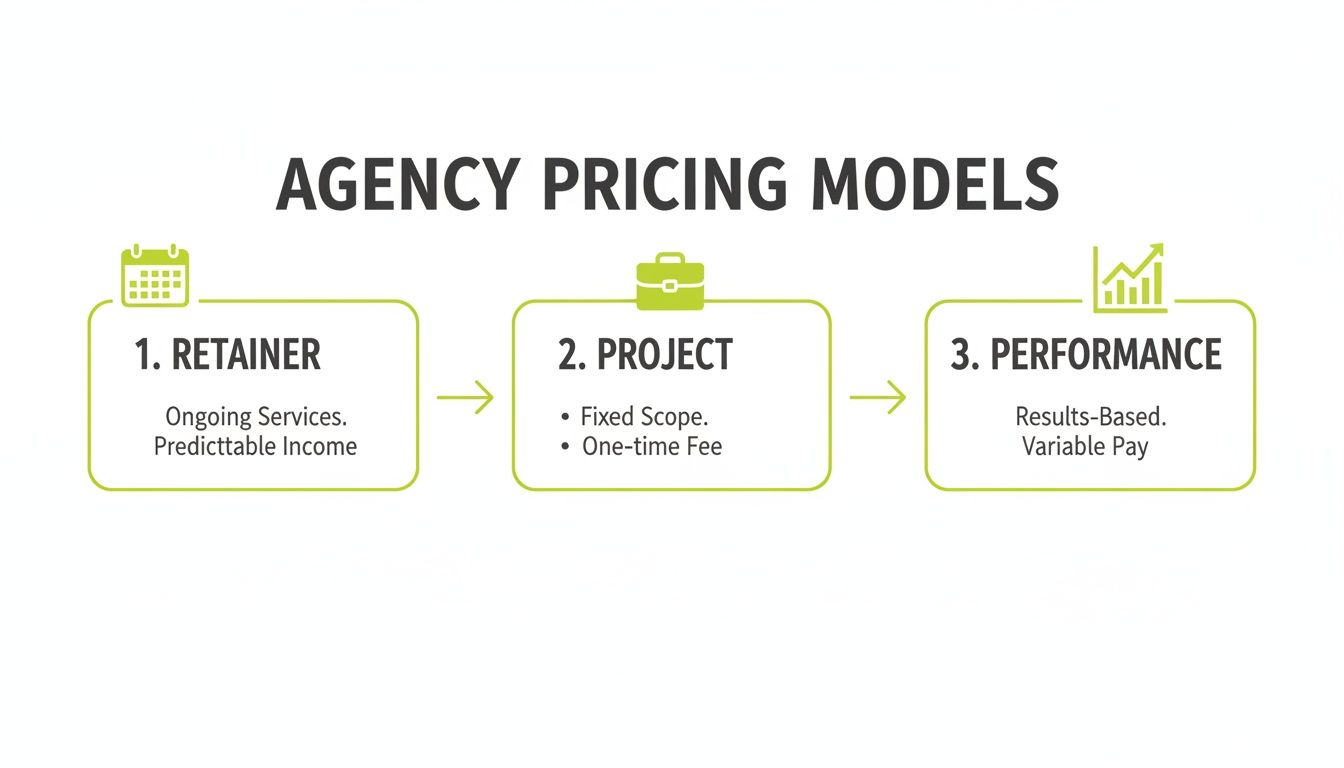
As you can see, a retainer works for ongoing, long-term collaboration. A project fee is perfect for a one-off task with a clear end date. And a performance model ties the agency’s pay directly to the results they generate.
Here's a sample matrix to get you started. This tool helps you assign a weight to each criterion based on its importance to your business, ensuring your final scores reflect what you value most.
Sample Agency Decision Matrix
| Criteria | Weight (1-5) | Agency A Score (1-10) | Agency B Score (1-10) | Agency C Score (1-10) |
|---|---|---|---|---|
| Industry Expertise | 5 | 9 | 7 | 8 |
| Strategic Approach | 5 | 8 | 9 | 7 |
| Team & Culture Fit | 4 | 9 | 8 | 9 |
| Communication & Reporting | 3 | 7 | 8 | 7 |
| Pricing & Value | 4 | 8 | 7 | 9 |
| Weighted Total | N/A | 172 | 166 | 166 |
To calculate the weighted total for each agency, multiply their score in each row by the weight, then sum the results. For example, Agency A's total is (5*9) + (5*8) + (4*9) + (3*7) + (4*8) = 174.
In this example, while Agency C offered better pricing, Agency A's superior industry expertise and cultural fit—the two most heavily weighted criteria—made them the clear winner. This objective score gives you the confidence to make the final call.
Creating A Seamless Onboarding Process
Congratulations, you’ve made your choice! But the real work is just beginning. The first 30 days of your partnership will set the tone for the entire relationship. A smooth, well-documented onboarding process is absolutely crucial for hitting the ground running and avoiding the early missteps that can doom a partnership.
Any great agency will take the lead here, but you should still have your own checklist to make sure nothing falls through the cracks.
Here’s what that looks like:
- Grant All Necessary Access: Securely provide access to your Google Analytics, ad accounts, website backend, and social media platforms.
- Establish Communication Channels: Decide on your tools. Will it be a shared Slack channel for quick updates? A project management tool like Asana for tracking tasks? Bi-weekly video calls for strategic reviews? Get it all decided upfront.
- Define Reporting Cadence and KPIs: Agree on the format, frequency, and key metrics for all reports. A weekly email summary paired with a detailed monthly performance review is a great place to start.
- Schedule a Deep-Dive Kickoff Session: This is the big one. It’s where you’ll align on the 90-day plan, finalize initial campaigns, and introduce the agency to all key stakeholders on your team.
- Share Brand Assets and Customer Insights: Arm them with your brand guidelines, logos, ideal customer profiles, and any past marketing data you have. The more context, the better.
Nailing this process isn’t about ticking boxes. It’s about building a foundation of clarity, trust, and shared expectations from day one. This initial investment of time is what transforms a new vendor into a true growth partner.
Common Questions About Choosing a Marketing Agency
Even after all the research, proposals, and meetings, a few lingering questions often stand between you and a final decision. That’s completely normal. Choosing a marketing partner is a major commitment, and you want to walk into the relationship with total confidence.
Let’s tackle some of the most common questions business owners have at this final stage, with the kind of direct answers you deserve.
How Soon Should I Expect to See Results?
This is the big one, and the honest answer is: it depends entirely on the strategy. Some tactics get traction much faster than others, and a great agency will be crystal clear about the timeline for each.
- Paid Ad Campaigns (PPC): You’ll see initial data like traffic and impressions almost right away. But turning that data into profitable action takes time. Expect it to take 30 to 90 days for an agency to gather enough performance data to really start optimizing your campaigns for high-quality leads and sales.
- SEO and Content Marketing: This is a marathon, not a sprint. It’s not unusual for it to take six months or more to see a meaningful jump in organic rankings and traffic. Early signs of life, like ranking for less competitive keywords or more pages getting indexed by Google, should start appearing after a few months.
A trustworthy partner won’t just give you a vague timeline; they’ll provide a 90-day plan that outlines specific milestones and leading indicators for both your short-term and long-term goals.
What Is a Typical Contract Length?
Initial contract terms can vary, but a common and fair starting point is a three to six-month initial agreement. This gives both sides enough time to get through onboarding, launch the first round of campaigns, and gather enough real-world data to prove the partnership is a good fit.
Be wary of any agency that pushes for a 12-month contract from day one, especially without a clear, performance-based way to exit the agreement. A confident agency is more than willing to prove its value in a shorter term before asking for a longer commitment.
After that initial period, contracts often roll into a more flexible month-to-month or quarterly renewal, which keeps the momentum going without locking you into an overly rigid arrangement.
How Much Communication Should I Expect from My Agency?
The right amount of communication is a balancing act—you need to be informed, not buried in emails. A well-defined communication rhythm is the mark of a pro agency.
Here’s what a solid communication plan usually looks like:
- Weekly Updates: A quick email or check-in call that covers performance highlights, key takeaways from the past week, and what’s on deck for the next seven days.
- Monthly Performance Reports: This is the deep dive. You should get a detailed report and a strategy call to review KPIs, discuss what worked (and what didn't), and align on priorities for the next month. Critically, this conversation should tie marketing metrics directly to your actual business goals.
- As-Needed Communication: You need a dedicated point of contact for urgent questions or quick approvals. This is often handled through a shared Slack channel or a project management tool like Asana or Trello.
The goal is proactive, transparent communication that gives you a clear view of your investment without dragging you into the day-to-day weeds. If you constantly feel like you’re chasing your agency for updates, that’s a huge red flag. The right partner will have a communication style that clicks with yours right from the start.
Feeling ready to choose a marketing agency that delivers real, measurable growth? The team at Silver Spoon Agency combines an AI-powered omnichannel approach with a relentless focus on your ROI. Schedule your free consultation today to see how we can build a strategy that turns your advertising into profit.