


How to Generate Online Leads That Actually Convert

Generating leads online is less about chasing one-off tactics and more about building a reliable system. It all starts with a simple but critical idea: deeply understanding who your ideal customer is, creating an offer they can't refuse, and then guiding them through a carefully planned journey. This is how you turn unpredictable website traffic into a steady stream of potential customers.
Your Blueprint for a Modern Lead Generation Engine
Forget about throwing disconnected strategies at the wall to see what sticks. If you want a predictable, profitable way to generate leads, you need to think bigger. It's time to move beyond just driving traffic and start building a complete engine—one that attracts the right people and converts them into genuine prospects. Before you even think about tactics, it's worth taking a moment to understand what lead generation marketing truly is, because it’s far more than just a buzzword.
The entire process hinges on one foundational question: What does a high-quality lead actually look like for your specific business? Is it an e-commerce shopper adding a product to their cart? Or maybe it's a local service business getting a booked consultation. Without that clarity, you’re just collecting email addresses, not creating real opportunities.
The Core Components of a Lead Engine
A modern lead generation engine really boils down to three core functions that work in harmony to create a smooth customer journey. You can think of it as a simple, powerful flow that takes you from initial strategy all the way to a final conversion.
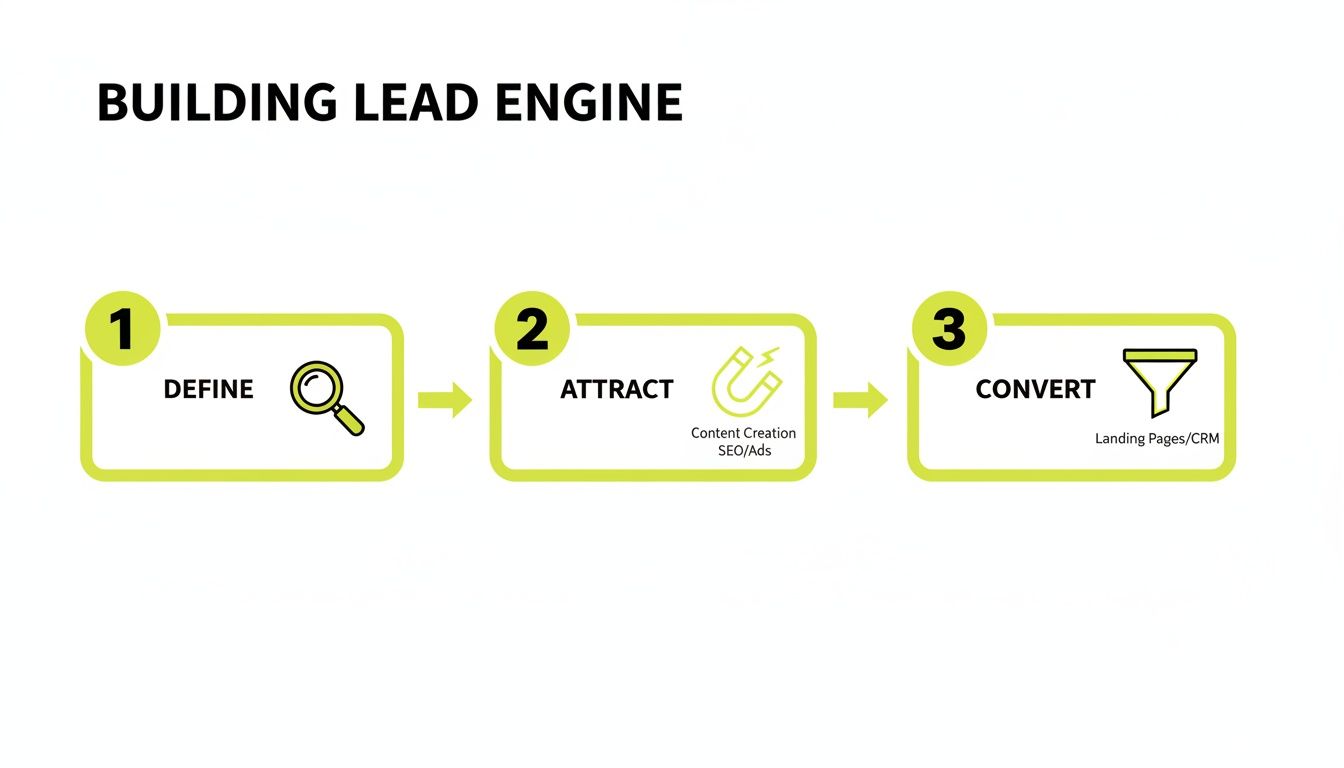
This visual makes it clear that a winning system isn’t just about the final sale. It’s about a methodical process that begins with deep customer understanding. This strategic alignment is what separates the high-growth businesses from everyone else struggling with inconsistent results. And the data backs this up.
Between 2023 and 2025, lead generation became the undisputed top priority for marketers everywhere. Recent surveys show that 91% of marketers now rank it as their number-one goal, with over half dedicating the majority of their budget to it.
But here’s the catch—volume isn’t the name of the game. With a staggering 80% of new leads never actually turning into sales, the real competitive edge comes from what you do after you get the lead. Marketers who nail their lead nurturing process generate 50% more sales-ready leads at a 33% lower cost. This proves, without a doubt, that a connected system is the secret to profitable growth.
To bring this concept to life, here's a quick look at how these components work together in what I call the "flywheel."
The Modern Lead Generation Flywheel
This table breaks down the core pieces of a successful lead generation system, showing how they function and what they might look like for a real-world business.
| Component | Primary Function | Example for a Local Gym |
|---|---|---|
| Strategy & Definition | Clarifying the ideal customer, offer, and business goals. | Defining the target member as a "busy professional, age 30-45, seeking stress relief and fitness." The offer is a free 7-day class pass. |
| Attraction Channels | Driving targeted traffic from various online sources. | Running geo-targeted Facebook ads showcasing member testimonials and a local SEO campaign for "gyms near me." |
| Conversion Funnel | Guiding visitors through a journey to become a lead. | A dedicated landing page for the 7-day pass with a simple form. A "thank you" page then upsells a discounted first month. |
| Nurturing System | Building relationships with leads who aren't ready to buy yet. | An automated email sequence sending workout tips, class schedules, and a final reminder before the free pass expires. |
| Tracking & Analytics | Measuring performance to optimize the entire system. | Using Google Analytics and CRM data to see which ad campaign delivered the most sign-ups for the 7-day pass. |
Ultimately, your goal is to create this flywheel where each part strengthens the others. This builds a powerful, self-sustaining source of qualified leads that keeps your business growing.
Choosing the Right Channels to Find Your Customers
Once you’ve got your blueprint, the next big question is: where do you actually find these people? This is where channel selection comes in, and it's absolutely critical for generating leads that don't just fill a spreadsheet but actually turn into paying customers.
Every platform—from Google to Instagram to that new app everyone’s talking about—demands its own unique playbook. You have to meet prospects where they are, not where you wish they were.
We've seen a massive shift toward content-led strategies, and for good reason. It’s completely changing the ROI game.
Studies show that smart content marketing pulls in about 3x more leads than old-school outbound campaigns, and it does it for roughly 62% less money. That makes it an absolute powerhouse for e-commerce brands, coaches, agencies, and local businesses looking for efficient growth.
35% of marketers report that SEO is their top source of high-quality leads. Even better, SEO leads close at an impressive 14.6%, compared to just 1.7% for outbound leads.
You can dig into the full research on lead generation statistics from DigitalSilk to Learn more about lead gen statistics.
Search Engine Tactics
Think of organic search as a long-term investment that pays compounding dividends. It’s not about quick wins; it’s about building a steady, reliable stream of leads.
We worked with a local florist who was completely invisible online. By simply optimizing their Google Business Profile, they went from zero to getting 45% of their new business from search. The magic happened when they started targeting high-intent phrases like “best wedding bouquet delivery near me,” which got them booked solid every weekend.
Here’s how you can replicate that success:
- Focus on long-tail keywords that signal someone is ready to buy, especially with location-based terms. For example, a roofer should target "emergency roof repair in Denver" instead of just "roofer."
- Structure your website pages around clear, single-topic clusters. For example, a central "Financial Planning" page that links out to more specific blog posts like "How to Save for Retirement" and "Beginner's Guide to Investing." This helps you rank much faster.
- Keep a close eye on your search query reports to find negative keywords. If you sell premium running shoes, add terms like "cheap," "discount," and "free" to your negative keyword list to stop wasting money on irrelevant clicks.
Social Media Tactics
Paid social media is your go-to for rapid-fire lead testing, but your creative has to be good enough to stop someone mid-scroll. You have milliseconds to make an impact.
A fitness coach we know used a simple Instagram carousel ad showing a powerful client transformation. The result? 120 qualified email sign-ups in just seven days. For B2B, LinkedIn Lead Gen Forms are a game-changer. A consultant client boosted their demo requests by 62% just by offering a one-click download of their "State of the Industry Report."
For more on creating ads that grab attention, check out our guide on Facebook Ads Best Practices.
Pro Tip: Run A/B tests on your headlines every single week. For instance, test "Learn How to Meal Prep" against "Save 5 Hours a Week with Meal Prepping." It's a low-effort way to find out what copy truly connects with your audience.
Email and SMS Sequences
Email is where you nurture leads at scale. It’s your chance to deliver real value and build a relationship before you ever ask for the sale.
A boutique bakery in the US did this perfectly. They created a simple three-email welcome series for new subscribers. The first email shared their most popular cookie recipe, the second offered a 10% discount, and the third highlighted a "baker's choice" of the week. That small effort led to a 28% conversion rate from sign-up to first order. Similarly, a local nail salon used SMS reminders to slash no-shows by 19% and drive more last-minute bookings.
A few quick tips for both:
- Your first line has to deliver a clear value proposition. Instead of "Welcome to Our Newsletter," try "Your Weekly Marketing Tips Have Arrived."
- Use personalization tokens like
{{first_name}}or{{city}}. It makes a huge difference. A simple "Hey,{{first_name}}" feels far more personal than a generic greeting. - Stagger your send times based on the user's local time zone. Sending an email at 10 AM local time is more effective than blasting your whole list at once.
Geofencing and Emerging Channels
Geofencing is a powerful tool for hyper-local businesses. It lets you draw a virtual "fence" around a location and trigger ads or offers when someone enters that zone.
A pizzeria used this to send SMS offers to people walking by during lunchtime, which bumped up their orders by 34%. Augmented Reality (AR) is another exciting frontier. It’s not just for games; it’s a way to create immersive experiences that attract curious shoppers.
Consider trying these out:
- Let customers use their phone camera to see a product demo in their own space. An online furniture store, for example, can let a user see how a new sofa looks in their living room.
- Offer a limited-time AR coupon they can redeem in your physical store. A coffee shop could have an AR experience where a virtual coupon appears when a customer points their phone at the storefront.
- Combine geofencing with targeted social ads for a powerful multi-touch campaign. A real estate agent could geofence an open house and later retarget attendees on Facebook with ads for similar properties.
Spreading your budget across search, social, email, and these newer channels will help you optimize both reach and lead quality. Start with small test budgets for each to see what sticks, then double down on the winners. This mix-and-measure approach is how you turn your marketing spend into a predictable growth engine.
| Channel | Ideal For | Key Metric |
|---|---|---|
| SEO | Organic traffic growth | Close rate |
| Paid Social | Rapid testing and scaling | CPL |
| Email/SMS | Nurturing and retention | Open rate |
| Geofencing | Hyper-local offers | Foot traffic lift |
Remember, your channel selection should always tie back to your customer persona. Where do they hang out online? Map each channel to a specific goal in your funnel. Use search ads to capture people actively looking for a solution, then use social ads for broader awareness. Nurture those leads with email or SMS to guide them toward a purchase.
You have to be relentless about analyzing your cost per lead and conversion rates. Reallocate your budget to the top performers without hesitation. A/B test your creative, audiences, and offers every couple of weeks to keep sharpening your approach.
No single channel is a silver bullet. The magic is in the mix. Test, measure, and iterate. Over time, you’ll build a lean, efficient lead generation machine that fuels steady, predictable growth.
Designing Landing Pages That Convert Traffic into Leads
Driving targeted traffic is a huge win, but let's be honest, it’s only half the game. The real magic happens when that traffic lands on a page built for one specific purpose: getting a conversion. This is where you architect a seamless journey that turns a click into a qualified lead, and it’s arguably the most critical step in your entire online lead generation effort.
A landing page isn't just another page on your website. Think of it as a focused, distraction-free environment designed to persuade a visitor to take a single, desired action. Whether you want them to download an ebook, book a demo, or claim a coupon, the page must be ruthlessly efficient.
Modern lead gen is all about the numbers: conversion rates, cost per lead (CPL), and finding the right mix of paid and organic traffic that actually scales. Across most industries, the average landing page conversion rate hovers around 10.76%. B2C businesses can often hit a view-to-submission rate near 10%, especially when the page is laser-focused on a single offer.
Even tiny technical details have a massive impact. For example, pages loading in 2.4 seconds convert at about 1.9%, but that rate plummets below 1% once load times creep past 4.2 seconds. It’s a stark reminder that performance isn’t just an IT issue; it’s a conversion issue. You can dive deeper into the data by exploring the full lead generation research on Inbeat.agency.
The Anatomy of a High-Converting Landing Page
Every single element on your landing page—from the headline to the button color—must work together to build trust, communicate value, and gently guide the user toward your call-to-action (CTA). It’s less of a brochure and more of a persuasive argument with a clear, unavoidable conclusion.
It all starts with a magnetic headline. The headline has one job: to immediately confirm to the visitor that they're in the right place by spelling out the primary benefit. "Grow Your Business" is just noise. "Get 5 New Local Customers This Week—Guaranteed" is a promise.
Next up is benefit-driven copy. Stop listing features and start explaining how those features solve your visitor's real-world problems. Instead of saying, "Our software has a 128-bit encryption," try this: "Keep your client data safe and secure with military-grade encryption." This simple shift from what it is to what it does for them makes all the difference.
Finally, the compelling CTA is the star of the show. It needs to be visually distinct—use a color that pops—and feature action-oriented text. Nobody gets excited to click "Submit." But "Get My Free Guide Now" or "Start My Free Trial"? That creates urgency and clarifies the payoff. Keeping visitors on the page is mission-critical; a high bounce rate will absolutely tank your conversion rates. For some practical tips on this, check out our guide on how to reduce the bounce rate on your website.
To help you get this right, I've put together a checklist of the essential elements every high-converting landing page needs. Go through this list every time you build a new page to make sure you haven't missed anything critical.
Landing Page Conversion Checklist
| Element | Why It Matters | Pro Tip |
|---|---|---|
| Magnetic Headline | Immediately grabs attention and confirms the visitor is in the right place. Answers the "What's in it for me?" question. | Match the headline copy to the ad that brought the visitor there. Consistency builds trust. |
| Benefit-Oriented Copy | Focuses on how the offer solves a problem or improves the visitor's life, not just on features. | Use bullet points to make benefits scannable. People rarely read long paragraphs online. |
| High-Quality Visuals | A relevant image or short video can communicate value faster than text and make the offer feel tangible. | Use authentic photos of your product, team, or happy customers. Avoid generic stock photos. |
| Social Proof | Testimonials, reviews, or client logos build credibility and reduce the visitor's perceived risk. | The more specific the testimonial, the better. "This software saved us 10 hours a week" beats "Great product." |
| Simple Form | A short, easy-to-fill form reduces friction and increases the likelihood of submission. | Only ask for the absolute minimum information you need. You can always collect more data later. |
| Compelling CTA Button | A clear, action-oriented button tells the user exactly what to do next. | Use a contrasting color that stands out from the rest of the page and use active text like "Get My…" or "Start Your…" |
Making sure these six elements are in place and optimized is the fastest way to turn more of your traffic into valuable leads.
Practical Examples for Different Business Models
There's no such thing as a one-size-fits-all landing page. The structure needs to be tailored to your business and your specific offer.
- For a Consultant (Lead Magnet Funnel): Here, the goal is simple: capture an email in exchange for a high-value resource like a PDF guide. The page should be clean and direct. Feature a strong headline like "The 5-Step Checklist to Double Your Sales," three bullet points summarizing what they'll learn, a nice visual of the guide (like a mockup of the cover), and a form asking only for a name and email.
- For a SaaS Company (Free Trial Funnel): To get someone to sign up for a trial, you need to build more trust and demonstrate value quickly. This page needs social proof. Include logos of well-known companies that use your software, a powerful testimonial like "Acme CRM cut our reporting time in half," and a clear, three-step "how it works" section. The CTA should be impossible to miss: "Start Your 14-Day Free Trial."
- For a Local Service Business (Quote/Consultation Funnel): A local plumber, electrician, or roofer needs to generate direct inquiries. This page must scream trustworthiness. Feature trust signals like "Licensed & Insured," customer reviews (ideally with photos), and pictures of your actual team on the job. The form can be a bit longer here, asking for a phone number and a brief description of the job they need done, such as a dropdown menu for "Service Needed."
The single biggest mistake I see businesses make is asking for too much information too soon. Your form should only request the absolute minimum required to deliver the offer. Every additional field you add creates friction and can slash your conversion rate by up to 11% per field.
Optimizing Your Way to More Leads
Look, building the page is just step one. The best marketers I know are relentless testers. Simple A/B tests—where you show two different versions of a page to your audience—can uncover powerful insights that dramatically increase your lead flow.
Not sure where to start? Test these elements first:
- Button Color: Seriously. Test a green button versus an orange one. I've seen a simple color change boost clicks by over 20%.
- Headline Copy: Pit a benefit-oriented headline against a question-based one. For example, "Get 5 New Customers" vs. "Ready for 5 New Customers?"
- Form Fields: Try a form with just two fields (name, email) against one that also asks for a phone number. You'll probably get fewer leads with the three-field form, but they might be higher quality. That's a trade-off you need to measure.
- Imagery: Test a generic stock photo against an authentic photo of your team or your product in action. Authentic images almost always win.
By continuously testing and refining these key elements, you transform your landing page from a static digital flyer into a dynamic, lead-generating machine that works for you 24/7.
How to Use AI for Smarter Lead Generation
Artificial Intelligence isn't some far-off concept anymore; it's a real-world tool that’s completely changing how businesses find new customers online. You don't need a degree in data science to get started. It’s all about using smart, accessible tools to work more efficiently, target customers with laser-like focus, and get a better return on your marketing spend.
Think of AI as your tireless marketing assistant, constantly digging through data to find patterns you'd never spot yourself. It can uncover hidden customer segments and even predict which prospects are most likely to convert, letting you put your budget exactly where it’ll make the biggest impact.
Uncovering High-Value Audiences
One of the most powerful things AI can do is pinpoint your ideal customers with incredible precision. AI algorithms sift through thousands of data points—from browsing behavior to past purchases—to build lookalike audiences that are light-years beyond basic demographics.
Let's take an e-commerce store that sells high-end running shoes. They might start by targeting people interested in "marathons." But an AI tool could analyze their best customers and discover they also share interests in organic food, sustainable brands, and certain tech podcasts. Suddenly, you have a much richer, more accurate targeting profile you never would have guessed on your own.
- Predictive Lead Scoring: AI gives every new lead a score based on how likely they are to buy. For example, a lead who visited the pricing page and downloaded a case study gets a score of 95/100, while someone who only downloaded a top-of-funnel ebook gets a 30/100. This helps your sales team stop guessing and start prioritizing the hottest prospects first.
- Dynamic Audience Creation: The AI is always learning, constantly refining your target audiences based on who is actually converting. This means your ads are always being shown to the most relevant people.
This automated approach to finding your audience is a true game-changer. The core principles of data science in marketing are now baked into user-friendly platforms, giving any business the power to make smarter, data-backed decisions.
Real-Time Campaign Optimization
Imagine launching an ad campaign and having it automatically tweak itself for the best possible performance. That’s exactly what AI-powered ad platforms do. They analyze results as they happen and shift your budget toward the ads, headlines, and images that are actually working.
A local gym, for instance, could run a campaign with five different ad images and three different headlines. The AI would quickly spot that an image of a yoga class paired with the headline "Find Your Balance" is getting the most sign-ups. It would then automatically push more of the budget to that winning combo, maximizing the gym's leads without anyone having to lift a finger.
While AI is great for automating tasks, its real magic is in personalization. Over 71% of consumers now expect personalized interactions, and AI is what makes it possible to deliver that kind of experience at scale.
This constant feedback loop means you aren't wasting money on ad variations that fall flat. It’s simply a smarter way to manage your ad spend and continuously improve your cost per lead.
Personalizing the Customer Journey
AI’s knack for personalization goes way beyond just ad targeting. It can turn your website and email marketing into dynamic experiences that adapt to each individual visitor, which is a huge piece of the puzzle for generating online leads.
This level of personalization makes every interaction feel more relevant and valuable to a potential customer.
Here’s how it looks in the real world:
- Dynamic Website Content: An AI tool can switch out the main image and headline on your homepage based on where a visitor came from. Someone who clicked from a Google search for "family dental plans" might see a picture of a family, while another person from an ad about cosmetic dentistry sees a bright, confident smile.
- AI-Powered Chatbots: Chatbots are on the clock 24/7, ready to answer common questions and qualify leads by asking the right questions. For example, a real estate chatbot could ask, "Are you looking to buy or rent?" and "What's your ideal budget?" to qualify leads before passing them to an agent. This frees up your team and ensures you never miss out on a potential customer. If you're looking to get started, a good guide can help you build a chatbot for lead generation that converts and captures quality leads.
- Personalized Email Sequences: Forget sending the same generic newsletter to your whole list. AI can trigger emails based on what a user actually does. If someone looks at your pricing page but doesn't sign up, the system can automatically send them a follow-up with a few case studies or a special offer to nudge them along.
By bringing AI into the mix, you shift from one-size-fits-all marketing to creating unique, one-to-one conversations. This tailored approach builds stronger connections and ultimately, drives more conversions.
Measuring the Metrics That Actually Matter
If you're not measuring your lead gen efforts, you're flying blind. It's that simple. Without clear data, you have no real idea which campaigns are driving growth and which ones are just burning through your budget.
This is where we cut through the noise. Forget vanity metrics like social media likes for a moment. We’re zeroing in on the Key Performance Indicators (KPIs) that have a direct, undeniable impact on your bottom line.
Understanding these numbers is what separates the pros from the amateurs. It’s how you make data-driven decisions, confidently double down on what works, and systematically cut what doesn’t.
Core KPIs for Lead Generation
To get a true picture of your marketing performance, you only need to obsess over a handful of crucial metrics. Think of these KPIs as the vital signs of your business—they tell the real story of your spending, your efficiency, and your ultimate profitability.
Cost Per Lead (CPL): This is your ground-zero efficiency metric. It tells you exactly how much you're shelling out to get one new lead from a specific campaign or channel. The math is easy: Total Ad Spend / Total Leads = CPL. For example, spending $500 on Facebook Ads and getting 50 leads means your CPL is $10.
Customer Acquisition Cost (CAC): This metric takes things a crucial step further. CAC measures the total cost to get a paying customer, not just a lead. It lumps in all your marketing and sales expenses over a period, divided by the number of new customers you actually signed. The formula: Total Marketing & Sales Costs / New Customers = CAC.
Return on Ad Spend (ROAS): This is the ultimate gut check for ad profitability. ROAS tells you how much revenue you’re generating for every single dollar you spend on advertising. A ROAS of 4:1 means you're making $4 for every $1 you put in. Not bad at all.
Here's a pro tip: Tracking these three metrics gives you a powerful, at-a-glance view of your entire acquisition engine. If your CPL is low but your CAC is high, that’s a massive red flag pointing to a problem with your sales process, not your marketing.
For example, a local gym might find their Facebook ads generate leads for just $15 (CPL). Awesome, right? But if it costs $150 (CAC) to actually sign up a new member, they know the issue isn't getting leads—it's closing them. That insight is pure gold.
Demystifying Marketing Attribution
So, which ad gets the credit? Marketing attribution is the science of figuring that out.
A customer's journey is rarely a straight line. Someone might see a Facebook ad, search for you on Google a week later, and finally buy after clicking a link in an email. So, who's the hero here? Facebook, Google, or your email campaign?
Understanding attribution helps you stop guessing where to put your money. Without it, you might kill a channel that’s actually critical for introducing people to your brand in the first place.
Here are the most common models people use:
- First-Touch Attribution: This model gives 100% of the credit to the very first interaction a customer had with you. It’s perfect for figuring out which channels are best at grabbing initial attention. For example, if a user first discovered you through an Instagram ad, Instagram gets all the credit for the sale.
- Last-Touch Attribution: The most common and simplest model. It gives 100% of the credit to the final touchpoint right before the conversion. If the final click before a purchase was from a Google search ad, that ad gets all the credit. It’s easy to track but often gives too much credit to channels at the very bottom of the funnel, like branded search.
- Multi-Touch Attribution: This is a more sophisticated, balanced approach. It distributes credit across multiple touchpoints. A simple "linear" model, for example, might give equal credit (25% each) to four different interactions (e.g., a blog post, a social media ad, an email, and a final Google search).
Choosing the right model really comes down to your goals. If you’re all about building brand awareness, first-touch makes a lot of sense. If you just want to know what closed the deal, last-touch or multi-touch will give you a much clearer picture.
Sample Dashboards for Different Businesses
A one-size-fits-all dashboard is a recipe for confusion. The metrics you track should be tailored to your specific business model. Here are a few real-world examples of how different businesses can set up their dashboards to track what really moves the needle.
| Business Type | Primary Goal | Key Metrics to Track |
|---|---|---|
| E-commerce Store | Product Sales | ROAS, CAC, Average Order Value (AOV), Cart Abandonment Rate |
| Local Service Business | Booked Appointments | CPL, Cost Per Booked Appointment, Lead-to-Appointment Rate |
| SaaS Company | Free Trial Sign-ups | Cost Per Trial, Trial-to-Paid Conversion Rate, Customer Lifetime Value (CLV) |
By setting up a simple dashboard in a tool you already use, like Google Analytics or your CRM, you can keep a constant pulse on your performance.
This is how you stop guessing and start making strategic, data-backed decisions. This measurement framework is the final, critical piece of the puzzle for learning how to generate online leads effectively and sustainably.
Common Questions About Generating Online Leads
Diving into the world of online lead generation always brings up a ton of practical questions. I get it. You're trying to figure out where to put your money, how long it'll take, and what actually works. Let's walk through some of the most common questions I hear from business owners to clear things up and help you build a smarter strategy.
How Much Should I Budget for Online Lead Generation?
There's no magic number here. The right budget depends completely on your industry, your specific goals, and the channels you choose to focus on. But for a small business just getting started, a good rule of thumb is to set aside 7-12% of your total revenue for marketing.
When it comes to paid channels like Google Ads or Facebook Ads, you'll want to start with a test budget you're okay with losing. Think somewhere in the $500 to $1,000 per month range. The whole point is to gather data, not to hit a home run on day one.
The real game-changer is shifting your focus from a fixed budget to your Cost Per Lead (CPL) and Customer Acquisition Cost (CAC). Once you know what a customer is actually worth to you, budgeting becomes a simple math problem based on ROI, not guesswork.
For instance, if a customer's lifetime value is $2,000 and your profit margin is 50%, you can spend up to $1,000 to acquire them and still break even. My advice? Start small, prove the model, then pour gasoline on the fire by scaling up the channels that deliver profitable results.
What Is a Realistic Timeframe to See Results?
This one varies wildly depending on the channel, so it's critical to set the right expectations from the start.
Paid advertising channels are built for speed. You can get a campaign on Google or social media live and start seeing leads roll in within a few days—sometimes even hours. But don't mistake activity for progress. It usually takes a solid 1-3 months of consistent testing and tweaking to really dial in these campaigns for maximum profitability.
Organic strategies like SEO and content marketing are the complete opposite. They're a long-term play. You should realistically expect it to take 6-12 months of dedicated effort before you see a significant, steady stream of traffic and leads. The payoff, though, is huge: these leads are often higher quality and come with a much lower long-term cost.
The smartest strategies use paid ads to get immediate wins and cash flow, while simultaneously building an organic foundation that will pay dividends for years to come.
Which Lead Generation Channel Is Best for My Business?
The best channel isn't a secret—it's simply wherever your ideal customers are already spending their time. There’s no one-size-fits-all answer.
- For B2B companies or anyone selling high-ticket services, LinkedIn and targeted SEO are almost always the top performers. A financial advisory firm could run LinkedIn ads targeting "CFOs in the tech industry" or create blog content optimized for "succession planning for small businesses."
- For e-commerce brands, it's all about visuals. Channels like Instagram, Facebook Ads, and Google Shopping are incredibly powerful for showing off products and driving people straight to checkout. A handmade jewelry brand would thrive with Instagram Reels showcasing their crafting process and targeted Facebook ads featuring their best-selling items.
- For local service businesses (plumbers, dentists, gyms), you need to be hyper-local. Google Local Service Ads, local SEO, and geofencing are your best friends for connecting with customers right in your neighborhood. A dentist should focus on ranking for "emergency dentist in [City]" and run ads that only show to people within a 10-mile radius of their office.
The biggest mistake I see is trying to be everywhere at once. Get really clear on who you're trying to reach, figure out their online habits, and then pick one or two channels to absolutely master. It's way more effective to dominate a single channel than to spread yourself thin across five.
How Do I Improve the Quality of My Leads?
Getting better leads boils down to one thing: being more specific at every step of your funnel. It all starts with your targeting. You need to narrow your ad audiences to be laser-focused and hyper-relevant.
Then, look at your messaging. In your ad copy and on your landing pages, be painfully clear about who your offer is for and what problem it solves. This alone will help pre-qualify people before they even think about clicking. For example, instead of a headline that says "Marketing Services," use "Content Marketing for B2B SaaS Companies."
Here's a pro tip: don't be afraid to add a little "friction" to your lead forms. Asking for more than just an email—like a phone number or company size—will naturally weed out the tire-kickers. Sure, you'll get fewer leads overall, but the ones you do get will be far more serious.
Finally, set up a lead scoring system in your CRM. You can assign points based on actions (like visiting your pricing page) and demographics to automatically flag your hottest, most sales-ready leads. This ensures your sales team can jump on the best opportunities immediately.
Ready to stop guessing and start generating predictable, high-quality leads? At Silver Spoon Agency, we build data-driven funnels and AI-powered ad campaigns that turn your marketing spend into measurable revenue. Schedule your free growth strategy session today!