


How to Get More Legal Clients: Practical Growth Strategies

Getting more clients for your law firm boils down to a pretty simple formula: show up where potential clients are looking, and give them an easy, clear path to contact you. It all starts with your website. Your site has to be more than a digital brochure; it needs to be a client-generation machine.
Building Your Firm's Digital Front Door
Before a potential client ever picks up the phone, you can bet they've already visited your digital front door—your website. This first touchpoint is your best shot at building trust and nudging a visitor toward scheduling a consultation. Think of your site less like a static listing and more like the very beginning of the client relationship.

This is critically important when you look at how people actually find legal help today. A staggering 96% of people looking for legal services start their search on Google. That stat alone makes a powerful online presence completely non-negotiable for any modern law firm.
Crafting a Client-Centric User Experience
Your website’s design and the words you use have to work in tandem to answer a visitor's immediate questions and calm their nerves. It’s all about creating an experience that feels both authoritative and approachable. A foundational first step is investing in comprehensive web design services that truly reflect your firm's brand and expertise.
To turn your site from a simple online presence into a real conversion tool, you need to nail these core elements:
- Drill Down on Practice Area Pages: Each page should speak directly to a specific client problem. Don't just have a generic "Family Law" page. Create detailed, helpful pages for "Child Custody Disputes" or "High-Asset Divorce," clearly outlining the process and how your firm tackles it. For example, a page on "Spousal Support in California" should detail state-specific guidelines, factors judges consider, and include a simple calculator tool.
- Humanize Your Attorney Bios: Go way beyond a dry list of credentials. Share each attorney's personal philosophy, a notable case success, or what connects them to their practice area. For instance, an immigration lawyer could share a brief story about their own family's journey, creating an immediate, powerful connection.
- Make Your Calls-to-Action (CTAs) Obvious: Every single page should have a clear next step. Use prominent buttons like "Schedule a Free Consultation" or "Download Our Divorce Checklist" to guide visitors forward. A bankruptcy attorney's site could feature a bright orange button that says "Find Out If You Qualify for Chapter 7 – Free Evaluation" on every page.
Turning Clicks into Consultations
A great website doesn't just inform; it actively converts visitors into leads. The entire goal is to make it incredibly simple for someone—often in a moment of high stress—to take that next step.
For instance, a personal injury firm can build instant credibility by embedding video testimonials from past clients right on the homepage. Hearing a success story in a client's own words is infinitely more powerful than reading a static review. This one addition can give your trust factor a massive boost.
Your website is your best salesperson, working 24/7. It must be designed to not only attract but also to engage and convert potential clients by building immediate trust and simplifying the path to contact.
Likewise, a family law practice might see its online inquiries triple just by replacing a cold, generic contact form with one that has a warm, reassuring message like, "Tell us a bit about your situation. We're here to listen." These small shifts in tone and accessibility make a world of difference.
By focusing on the importance of good website design for your business, you ensure every click brings a potential client one step closer to hiring your firm.
Winning the Local Search Battle in Your City
For most law firms, your best clients aren't scattered across the country; they're right down the street. The real money is in winning the local game—showing up when someone in your city desperately needs legal help and types "divorce lawyer near me" into their phone.
This is where you master local Search Engine Optimization (SEO). It's your most powerful tool for getting a steady stream of high-quality local clients.
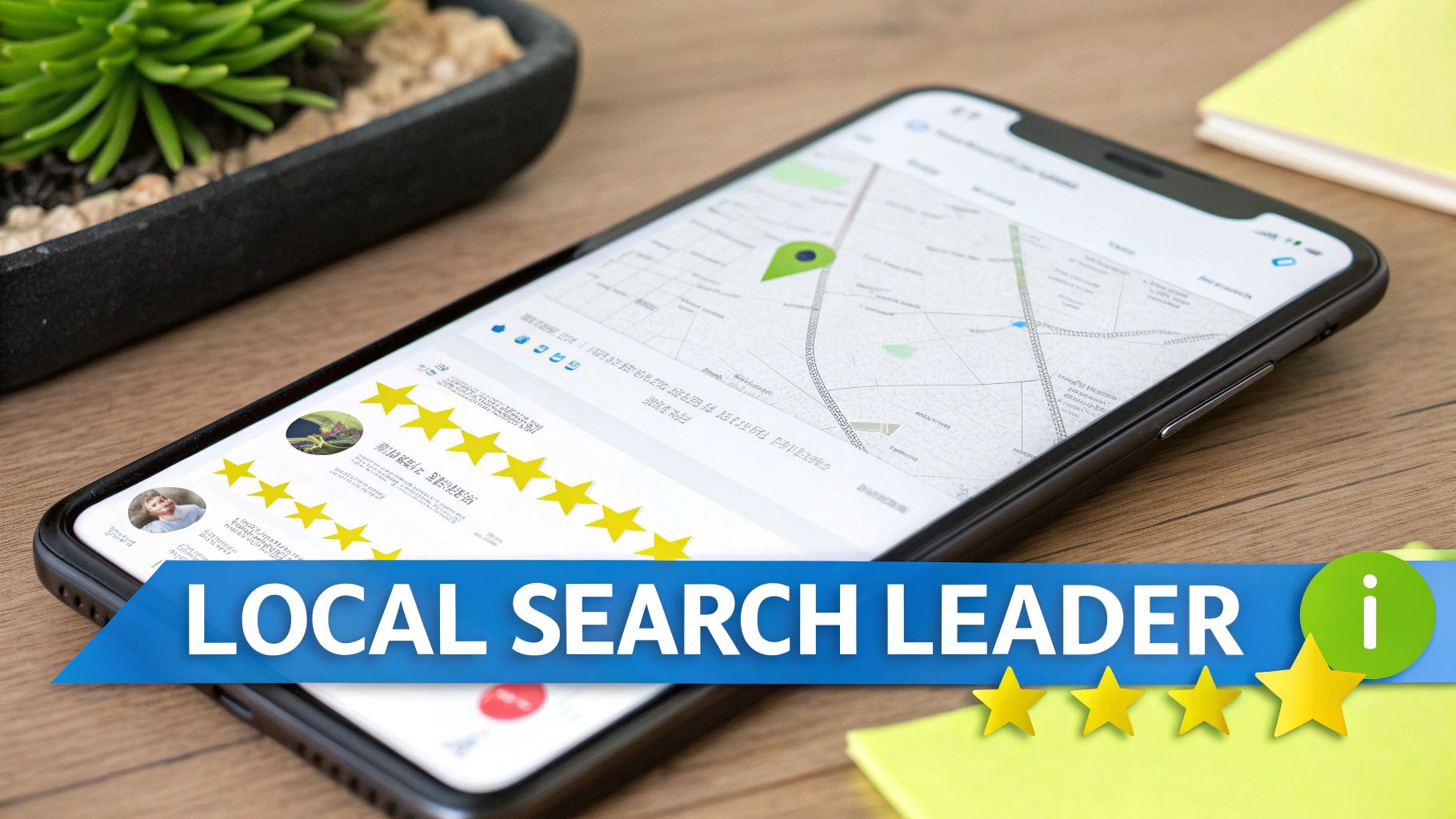
Don't worry, we're not diving into complex, technical jargon. This is about practical, get-it-done-today steps to dominate Google's "Local Pack." That's the valuable map section that pops up at the very top of local search results. Land your firm there, and you instantly become a top contender.
Turn Your Google Business Profile Into a Client Magnet
Your Google Business Profile (GBP) is far more than a simple online business card. It's the absolute cornerstone of your local SEO strategy and often the very first impression a potential client has of your firm.
Treat it like a dynamic, living showcase of your expertise. Simply listing your address and phone number isn't enough. You have to actively use its features to turn it into a genuine client-attraction machine.
Here's how:
- Post Regularly: Share firm updates, link to new blog articles, or announce your involvement in a local event. For example, post a picture of your team sponsoring a local charity 5K run with a caption like, "Proud to support the Annual Community Food Bank Run in downtown Denver this weekend!"
- Use the Q&A Feature: Get ahead of your clients' questions. Proactively add and answer common queries they might have. A family law firm, for example, could answer, "What's the process for an uncontested divorce in Texas?" This shows off your expertise before they even pick up the phone.
- Upload High-Quality Photos: Show, don't just tell. Post professional headshots, welcoming pictures of your office interior and exterior, and photos of your team. This simple step humanizes your firm and builds a crucial sense of trust. A shot of the actual conference room where consultations happen can make a potential client feel more comfortable.
The Undeniable Power of Client Reviews
Positive client reviews are digital gold. They provide the social proof that a hesitant person needs to feel confident about calling you. A consistent stream of recent, glowing reviews is one of the strongest signals you can send to both potential clients and Google that you're a trusted local authority.
Make it a standard part of your case-closing process. An automated email with a direct link to your Google review page can make it seamless for satisfied clients. And remember to respond to every review—good or bad. A practical response to a 5-star review could be: "Thank you for your kind words, Sarah. It was a privilege to help you with your estate plan. We wish you and your family all the best."
A well-managed Google Business Profile, fueled by consistent posts and a steady flow of positive client reviews, is the single most effective tool for dominating local search results.
Build Authority With Local Citations
Think of citations as digital endorsements. They are simply mentions of your law firm's Name, Address, and Phone number (NAP) on other websites.
When reputable directories like Avvo, FindLaw, or your local bar association's website list your firm, it sends a powerful signal to Google. It confirms that your business is legitimate, established, and a real part of the local community.
The key here is absolute consistency. Make sure your NAP information is exactly the same across every single directory. For example, if your Google Profile lists you as "123 Main Street, Suite 400," your Yelp profile cannot say "123 Main St., #400." That small variation can confuse search engines and weaken the power of your citations. Our guide on the top things your business listings must have digs deeper into why this precision is so critical.
To help you get started, we've put together a simple action plan. This table breaks down the foundational tasks and shows you exactly why they matter for bringing in more local clients.
Local SEO Action Plan for Law Firms
| Action Item | Why It's Important | Example for a DUI Lawyer |
|---|---|---|
| Fully Optimize GBP | This is your digital storefront. Completeness signals trust and relevance to Google for Local Pack rankings. | Adding "DUI Defense" as a primary service category and uploading photos of the local courthouse. |
| Encourage Reviews | Social proof is everything. A high review count and rating are major ranking factors and build trust with prospects. | Sending a follow-up email with a direct review link a week after a case concludes successfully. |
| Build Local Citations | Consistent NAP across directories verifies your location and legitimacy, boosting local search authority. | Ensuring the firm’s listing on the local Chamber of Commerce site matches the GBP info exactly. |
| Publish Hyper-Local Content | Content specific to your service area ranks for long-tail keywords and positions you as the local expert. | Writing a blog post titled: "What Are the First Steps After a DUI Arrest in Miami-Dade County?" |
| Respond to All Reviews | Shows you are engaged and value client feedback, which is a positive signal to both users and Google. | Replying to a positive review: "Thank you, John! We're glad we could help you navigate that difficult time." |
Following this checklist is the fastest way to build a strong local SEO foundation. It's not about doing everything at once, but about consistently executing these core tasks to build momentum and authority in your city.
A Real-World Scenario: Hyper-Local Content in Action
Imagine a DUI lawyer in a fiercely competitive market like Austin, Texas. She’s up against huge firms with massive advertising budgets she can't possibly match. Instead of trying to outspend them, she decides to outsmart them with a hyper-local content strategy.
She creates a detailed blog post titled, "Navigating a DUI Stop in Travis County: What to Know."
This article isn't just generic legal advice. It references specific local landmarks ("…if you are pulled over on I-35 near the Riverside exit…"), talks about the known procedures of the Austin Police Department, and even lists the addresses for the relevant county courthouses.
Because this content is incredibly specific and genuinely useful to someone searching for a DUI lawyer in that exact area, Google recognizes its high relevance. Before long, her small firm starts outranking larger competitors for valuable local searches. This proves that a smarter strategy often beats a bigger budget.
While only 3.0% of legal firm visitors from organic search convert into leads, it remains a critical channel. If your site isn't on Google's front page, you're effectively invisible to the 57% of prospects who begin their search for legal help online. You can find more insights like this from the legal marketing statistical research on Andava.com.
Generating Immediate Leads with Paid Ads
While SEO is your long game for building a sustainable practice, sometimes you just need the phone to ring right now. That's where paid advertising, especially Google Ads, comes in. Think of it less as a marketing expense and more as your most direct tool for getting qualified clients in the door, fast.
Let's get straight to the point: this isn't just theory. When done right, pay-per-click (PPC) campaigns are incredibly effective. We've seen conversion rates in the legal space hit as high as 4.3%. For firms working with experts, it's not uncommon to see a 4X average ROAS and a serious uptick in lead quality. If you want to dig into the numbers, Andava has some great legal marketing statistics worth exploring.
The whole process is actually pretty straightforward. It boils down to finding the right people, showing them the right message, and making it easy for them to contact you.
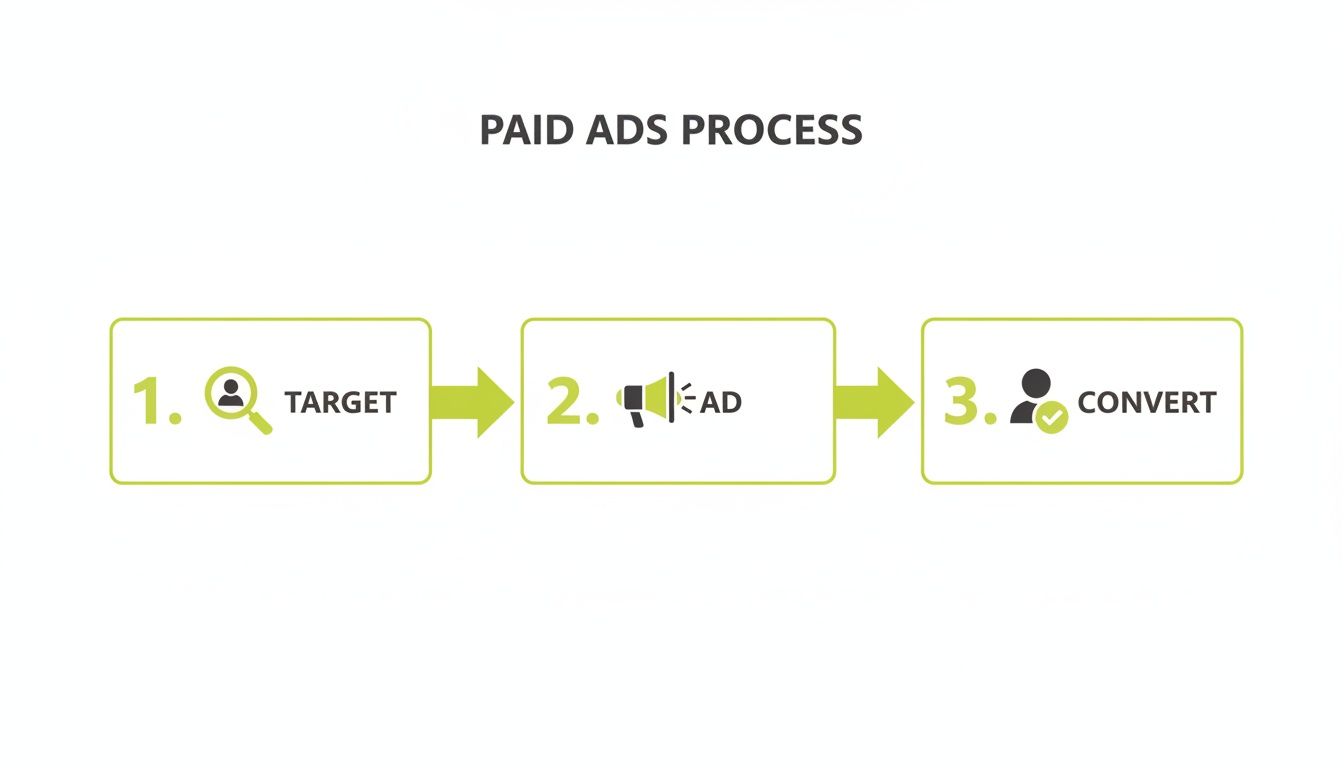
This visual really captures the core strategy: you target potential clients based on what they desperately need, hit them with a compelling ad that promises a solution, and then send them to a landing page built for one thing—conversion.
Structuring Campaigns by Client Intent
Here’s the secret to a winning PPC strategy: understand that not all your potential clients are in the same headspace. Their level of urgency and what they're searching for can be worlds apart, and your ad campaigns have to reflect that. The most effective way to do this is by structuring campaigns around both practice area and client intent.
Someone frantically typing "emergency bail bond lawyer" into their phone is in crisis mode. They need a phone number, and they need it now. Their decision will be impulsive. On the flip side, a person searching for a "divorce attorney consultation" is in a much more deliberate frame of mind, probably doing their homework and comparing a few different firms.
You need to build your campaigns to mirror these two realities:
- High-Urgency Campaigns: Go after keywords like "DUI lawyer near me" or "emergency custody order." The ads should be designed for immediate action. For example, a "Call-Only" ad for an arrest-related keyword will show a prominent phone number, making it incredibly easy for a panicked individual to connect directly from the search results page.
- Considered-Decision Campaigns: Focus on search terms like "best family law attorney" or "how to file for bankruptcy." These ads shouldn't just push for a call. Instead, they should lead to a dedicated landing page offering something of value, like a free guide ("Download Our 10-Point Chapter 7 Checklist"), a detailed FAQ, or a simple form to request a consultation.
Writing Ad Copy That Cuts Through the Noise
The legal ad space is crowded. Generic, boring copy is the fastest way to become invisible and waste your budget. Your ad is a direct promise to someone going through a tough time. It has to be clear, compelling, and show some empathy.
Let’s look at a real-world example for a personal injury attorney.
- Weak Copy: "Experienced Personal Injury Lawyer. We Fight For You. Call Today for a Free Consultation."
- Strong Copy: "Hurt in an Accident? No Fee Unless We Win. Get a Free Case Review with a Top-Rated PI Attorney Now. Available 24/7."
Why is the second one so much better? It immediately tackles the client's biggest fear—cost—with the "No Fee Unless We Win" promise. It also offers a clear, risk-free next step with "Free Case Review." Adding "Available 24/7" provides a sense of urgency and accessibility, which is exactly what someone dealing with a recent injury needs to see.
The goal of your ad isn't just to get a click; it's to get the right click. Your copy must pre-qualify the user by speaking directly to their specific legal problem and emotional state, promising a clear, immediate solution.
Advanced Targeting: Geofencing in Action
Keywords are just the beginning. To get truly surgical with your targeting, you need to use tactics like geofencing. This lets you draw a virtual perimeter around a real-world location and serve ads to mobile users who step inside that zone.
The applications for law firms are incredibly powerful.
Let’s imagine a workers' compensation attorney who wants to connect with injured construction workers. Instead of just bidding on broad keywords, they could geofence specific, high-value locations:
- Major active construction sites across the city
- Large industrial parks and manufacturing facilities
- Local union halls
- Urgent care clinics and hospital emergency rooms
Now, when a worker's mobile device enters one of these zones, they can be served a hyper-relevant ad: "Injured on a Job Site? Know Your Rights. Free Workers' Comp Consultation." This isn't just casting a wide net; it's using a precision tool to capture high-intent clients at the exact moment and location of their need. This is how you dramatically boost the quality and relevance of the leads you generate.
Designing a Flawless Client Intake Process
Generating a lead through clever SEO or a perfectly targeted ad is a huge win, but it’s only half the battle. The real challenge—and where many firms leak potential revenue—is converting that interested person into a signed client.
This is where you build an intake system that's both ruthlessly efficient for your team and deeply reassuring for your clients.

The journey from a website click to a signed retainer agreement is full of critical touchpoints. A single misstep, like a delayed callback or a confusing next step, can send a high-value case straight to your competitor. This is why a flawless client intake process is one of the highest-leverage activities you can focus on to get more legal clients.
Mapping the Critical First Steps
From the moment a potential client reaches out, the clock is ticking. Their first impression of your firm isn't formed by your legal skills, but by the responsiveness and professionalism of your intake process. A disorganized front end suggests a disorganized practice.
To fix this, you need to map out every single step a new lead takes:
- Initial Contact: How is the inquiry captured—phone, web form, chat? Does it get logged immediately into a central system? For example, all website form submissions should automatically create a new "lead" record in your CRM.
- First Response: How quickly does your team respond? We're talking minutes, not hours. A practical goal is a "5-Minute Rule": aim to make initial contact with every new web lead within five minutes of submission.
- Qualification: Who determines if this is a case your firm can and should take? You need a clear, repeatable script for this conversation. For a PI firm, this script might include mandatory questions like "When did the accident occur?" and "Have you received medical treatment?"
- Consultation Scheduling: How easy is it for a qualified lead to book a meeting? An online scheduler like Calendly can eliminate frustrating phone tag. Embed the scheduler directly on your "Thank You" page after they fill out a form.
- Follow-Up: What happens if a qualified lead doesn't book right away? Is there an automated email or a manual task assigned for a follow-up call? A simple automated 3-day follow-up email sequence can recapture leads who initially hesitated.
This workflow isn't just about administrative tasks; it’s about building momentum and trust from the very first interaction.
Using Simple Technology to Never Lose a Lead
The single biggest mistake firms make is relying on sticky notes and memory. Leads fall through the cracks every single day because of manual disorganization.
This is where a simple Client Relationship Management (CRM) tool becomes your most valuable asset.
A CRM acts as your firm's central nervous system for all new business. It logs every lead, tracks every interaction, and automates the follow-up process so no one is ever forgotten. Our guide on CRM management and why it matters explores how this technology can transform your client acquisition pipeline.
A well-structured intake process supported by a CRM isn't just about efficiency. It's about providing a superior client experience that demonstrates your firm's professionalism and care before they ever sign a retainer.
This isn't just a nice-to-have. Top firms investing in their digital funnels are pouring 65% of their marketing budgets into these efforts. The payoff is huge, with specialized agencies delivering 150% conversion lifts for clients simply by optimizing intake and follow-up processes. You can discover more insights about these legal marketing statistics on Andava.com.
A Practical Intake Workflow Example
Let's put this all together. Imagine a potential client fills out the contact form on your family law firm's website at 10 PM.
- Immediate (Automated): An automated email is instantly sent: "Thank you for contacting us. We've received your information and someone from our team will call you within one business day. In the meantime, here’s a link to schedule a consultation directly…"
- Next Morning (Team Action): Your intake specialist sees the new lead in the CRM. They call the prospect, following a script that focuses on empathy and gathering key facts. For example: "I see you're looking for help with a custody matter. I know this can be a difficult time. Could you tell me a bit about your situation so I can see how we can best assist you?"
- Post-Call (Automated): If the client scheduled a consultation, they receive an automated confirmation email and a reminder 24 hours before the meeting. If they didn't, the CRM automatically assigns a follow-up task for three days later.
This simple, repeatable system ensures every single lead gets a prompt, professional, and consistent experience, dramatically increasing the odds of turning that initial inquiry into a paying client.
Using AI to Outsmart Your Competition
Let's be blunt: technology is no longer a buzzword for the future. It's the decisive competitive advantage that helps you scale up your client acquisition without burning out your team. This is exactly how you outmaneuver the bigger firms with their massive budgets—by working smarter, not just harder.
This isn't about having a robot replace your legal expertise. It’s about letting technology handle the tedious, repetitive tasks so your team can focus on what they do best: practicing law and taking care of clients.
The shift is happening faster than most lawyers realize. With AI tools slashing cognitive loads by 25% and doubling accuracy, the firms that embrace them are scaling at an incredible pace. Just look at the numbers: 79% of firms are now using AI, a massive leap from only 19% in 2023. You can dig into more of these trends in the latest legal marketing statistical research on Andava.com.
Automate Your Lead Qualification 24/7
One of the quickest wins for getting more clients is making sure you never miss an opportunity, especially after your office has closed for the day. This is where an AI-powered chatbot on your website becomes your firm's most tireless employee.
Picture this: a potential client gets into a car accident and lands on your website at 2 AM. Instead of staring at a cold contact form, they’re greeted by a helpful chatbot. It can immediately start asking crucial pre-qualifying questions:
- "When did the accident occur?"
- "Were you injured?"
- "Has a police report been filed?"
Based on their answers, the bot can figure out if they're a good fit, grab their contact info, and even schedule a consultation directly on your calendar. When you walk into the office, you have a qualified lead already waiting for you, captured right when they needed help the most.
An AI chatbot transforms your website from a passive brochure into an active, round-the-clock intake specialist, ensuring no high-value lead is ever lost to the late-night search.
This simple addition stops potential clients from bouncing to a competitor who happens to be quicker on the draw. It delivers instant engagement and projects a level of accessibility that builds immediate trust with someone in a deeply stressful situation.
Drive Smarter Decisions with AI Analytics
Beyond the client-facing tools, AI is an absolute powerhouse for optimizing your marketing strategy behind the scenes. It can chew through campaign data faster and more accurately than any human ever could, spotting the hidden patterns that lead to better results and a much higher ROAS.
Take your Google Ads campaigns, for instance. An AI-driven analytics platform can monitor the performance of hundreds of keywords in real-time. It doesn’t just see clicks; it sees which search terms are actually turning into signed cases.
Then, the system gets to work, making automatic adjustments on the fly:
- It shifts your budget. The AI will automatically move your ad spend away from keywords that are just wasting money, like "free legal advice," and pour it into the ones that are actually driving valuable cases, like "hire car accident lawyer."
- It optimizes your bids. The platform can raise bids during the specific times of day or in the exact geographic locations where your ideal clients are most likely to be searching.
For example, the AI might detect that the keyword phrase "commercial truck accident lawyer" converts three times higher on weekday mornings. It will then automatically increase your bids during that window to dominate the search results when it matters most.
This is how you use technology to make surgically precise decisions, getting more high-value legal clients without having to increase your overall marketing budget.
Answering Your Top Client Acquisition Questions
Even with a killer strategy, specific questions always pop up once a firm gets serious about growth. We've pulled together the most common ones we hear from attorneys about getting more clients, along with direct, no-fluff answers to guide your next move.
How Much Should a Law Firm Spend on Marketing?
There’s no single magic number, but a good starting point is somewhere between 2% and 10% of your firm's gross revenue.
If you're a brand new solo practice trying to get established, you might be closer to that 10% mark for the first year. A more established firm with a strong referral base might only need 3-5% to maintain growth.
But honestly, the best firms move past fixed budgets. The real game-changer is focusing on Return on Ad Spend (ROAS). This is the metric that tells you what’s actually making you money.
Let’s say you spend $5,000 on Google Ads in a month, and those ads bring in cases worth $25,000 in fees. That’s a 5x ROAS. When you find a channel that profitable, you don't stick to an arbitrary budget—you pour gas on that fire and scale your investment.
What Is the Fastest Way to Get New Legal Clients?
For immediate, high-intent leads, nothing beats a well-run Pay-Per-Click (PPC) campaign. SEO is a fantastic long-term play, but it can take months to see real results. PPC puts you at the top of Google's search results within hours.
Picture this: someone gets arrested on a Friday night. They aren't casually browsing blogs; they need an attorney right now. A targeted ad for "emergency criminal defense attorney" that shows up on their phone can get your phone ringing with people in the middle of a crisis. It requires a direct budget, but for speed-to-lead, it’s in a class of its own.
For immediate client needs, paid search advertising is the accelerator pedal. It bypasses the slow build of organic strategies to connect your firm with clients in their moment of urgent legal crisis.
How Can I Get More High-Value Cases for My Firm?
Landing the big fish requires a shift in mindset. You have to stop being a generalist and start being a specialist. It’s a focused, multi-front strategy built on demonstrating deep expertise.
Instead of just being a "personal injury lawyer," you need to become the attorney for "commercial truck accident litigation" or the go-to expert for "catastrophic brain injuries." This sharp focus needs to be crystal clear across your entire digital footprint.
Here’s how you actually do it:
- Create Laser-Focused Content: Forget generic blog posts. Write incredibly detailed articles, case studies, and guides that prove you live and breathe this niche. For example, create a 5,000-word guide titled "The Complete Guide to Federal Trucking Regulations for Accident Victims" and promote it heavily.
- Cultivate Professional Referrals: Build real relationships with other professionals who encounter these clients first. A business litigation attorney should be regularly networking with local CPAs and commercial bankers. Take a key contact out to lunch once a quarter to stay top-of-mind.
- Use Sophisticated Ad Targeting: Platforms like LinkedIn are gold for this. A commercial litigator can target ads directly to C-level executives or in-house counsel at specific companies, getting right in front of the decision-makers for complex business disputes.
Is Social Media Effective for Getting Legal Clients?
It absolutely is, but you have to use it the right way. Its power depends heavily on your practice area and which platform you’re on. The secret is to stop thinking of social media as a direct sales channel and start seeing it as a trust-building engine.
For B2C fields like family law or estate planning, Facebook is fantastic for building a local community presence and running ads based on life events (like "newly engaged" or "recently moved"). For B2B areas like corporate or IP law, LinkedIn is the place to be, letting you establish thought leadership and network with other professionals.
A smart, practical approach is to share genuinely helpful content that doesn't feel like an ad. For example, a real estate attorney could post a quick video on Instagram covering the top three mistakes first-time homebuyers make at closing. Then, in the caption, they can link back to a comprehensive guide on their website, where the real lead capture happens.
To really nail this, you have to get inside the head of a potential client. Looking at guides on how to choose a personal injury attorney can give you incredible insight into what they’re thinking and what questions they need answered. Understanding their journey is the final piece of the puzzle.