


How to Improve Brand Awareness: A Playbook for Measurable Growth

Building brand awareness that actually sticks starts with a solid foundation. You have to nail down who your ideal customer is with detailed personas and then craft a powerful brand mission that solves their specific problems. When you get this right, every ad, post, and campaign you run will be precisely targeted and resonate deeply.
This turns your marketing spend into measurable recognition instead of just shouting into the void.
Laying Your Brand Awareness Foundation
Before you even think about launching an ad or publishing a piece of content, you need a crystal-clear answer to two huge questions: "Who are we actually talking to?" and "Why on earth should they care?"
Skipping this step is like building a house on sand. No matter how amazing the structure looks, it’s going to crumble. The goal here is to get way beyond generic demographics and build a strategy based on a deep, almost personal understanding of your audience and a brand promise that truly connects with them.
This is the phase where you turn abstract business goals into a real marketing roadmap. It’s less about wild creative brainstorming and more about strategic, deliberate definition. Do this right, and it will guide every single decision you make from here on out, ensuring everything you do is consistent and effective across all channels.
Define Your Ideal Customer with Detailed Personas
Look, you can't raise brand awareness if you don't know who you want to be aware of you. Vague targets like "millennials" or "small business owners" are just way too broad to be useful. You need to create detailed audience personas that feel like real people with real problems you can solve.
A persona is basically a semi-fictional profile of your ideal customer, built from market research and hard data about your existing customers. Go deeper than just age and location. Dig into their motivations, what keeps them up at night, their daily routines, and where they get their information.
For example, a local wellness clinic shouldn’t just target "women aged 30-45." That’s lazy. Instead, they could create a persona named 'Stressed Sarah':
- Who is she? A 35-year-old marketing manager, married with two young kids.
- What are her pain points? She’s constantly juggling work deadlines and family chaos, feels totally burnt out, has neck tension from being hunched over a desk, and has almost zero time for herself.
- Where does she hang out online? She mindlessly scrolls Instagram for relaxation tips, is a member of local parenting Facebook groups, and listens to wellness podcasts during her commute.
Boom. With that level of detail, the clinic now knows exactly how to reach Sarah. They can run targeted Facebook ads aimed at working mothers in their specific area, create blog content like "5-Minute Stress Relief for Busy Professionals," and even sponsor a local wellness podcast. This approach is infinitely more powerful than just blasting out generic ads.
To make this practical for your own business, here's a simple template. Think of a local gym trying to attract new members.
Audience Persona Template for a Local Service Business
| Persona Element | Example Data ('Busy Professional Brian') | Your Business Application |
|---|---|---|
| Demographics | Male, 42, married, 2 kids, Household Income: $150k+ | [Your Customer's Basic Info] |
| Job & Seniority | Senior Project Manager at a tech firm | [Their Profession & Role] |
| Goals | Lose 15 lbs, increase energy, find a healthy stress outlet | [What They Want to Achieve] |
| Pain Points | No time for long workouts, finds gyms intimidating, gets bored easily | [Their Key Frustrations] |
| Watering Holes | LinkedIn, tech news sites (like TechCrunch), listens to business podcasts | [Where They Spend Time Online] |
| Motivations | Wants to keep up with his kids, feel more confident, improve long-term health | [The 'Why' Behind Their Goals] |
| Objections | "Gyms are too expensive," "I don't have time," "I won't know what to do." | [Reasons They Might Say No] |
Filling this out forces you to think like your customer, which is the key to creating marketing that actually works.
Craft a Powerful Brand Mission and Value Proposition
Once you know who you're talking to, you have to get laser-focused on what you're saying. Your brand mission and value proposition are the absolute core of your messaging. They explain who you are, what you do, and why you're the only logical choice to solve your audience's problem.
This clarity is what makes you stand out. A great way to start is by exploring different brand positioning strategies that can help carve out your unique space in the market.
Your brand mission is your "why." It's the reason your business exists beyond just making money. It’s the north star that guides your company culture and every decision you make. For example, Patagonia's mission is "We're in business to save our home planet." This guides everything from their product materials to their activism.
Your value proposition is your "how." It's a clear, punchy statement that communicates the specific, unique benefit a customer gets by choosing you.
A strong value proposition should instantly answer a customer's unspoken question: "What's in it for me?" It has to be specific, focused on their pain, and something only your brand can deliver.
For instance, a startup with project management software could have the mission "to help teams eliminate administrative chaos and focus on creative work." Their value proposition might be: "The only project management tool that automates status updates and meeting summaries, saving your team 10 hours a week." That’s so much more compelling than a generic line like "the best project management software."
As you build this foundation, remember how your brand shows up visually is just as important. Understanding the role of essential corporate photography for business branding can make a massive difference in how your mission is perceived.
This focus on foundational branding isn't just a hunch; it's backed by industry trends. In a world where trust is the ultimate currency, a staggering 92% of marketers plan to maintain or increase their branding investments because they know visibility is non-negotiable. It's clear that building a strong brand isn't just a "nice-to-have"—it's a critical driver of growth.
Executing Your Omnichannel Playbook for Maximum Reach
You’ve done the hard work of laying your brand foundation. Now it’s time to shift from planning to execution.
An effective playbook isn’t about shouting from every rooftop. It’s about being in the right places with the right message, creating a seamless experience for your audience. This is where an omnichannel approach becomes your secret weapon, weaving together different channels to amplify your brand’s voice and impact.
This is the phase where strategy gets its hands dirty. Forget vague advice like "post more often." We're diving into specific, high-impact tactics tailored to different business models, showing you exactly how these strategies drive measurable growth.
The diagram below maps out the foundational process we've covered, linking your ideal customer persona to your mission and overarching strategy.
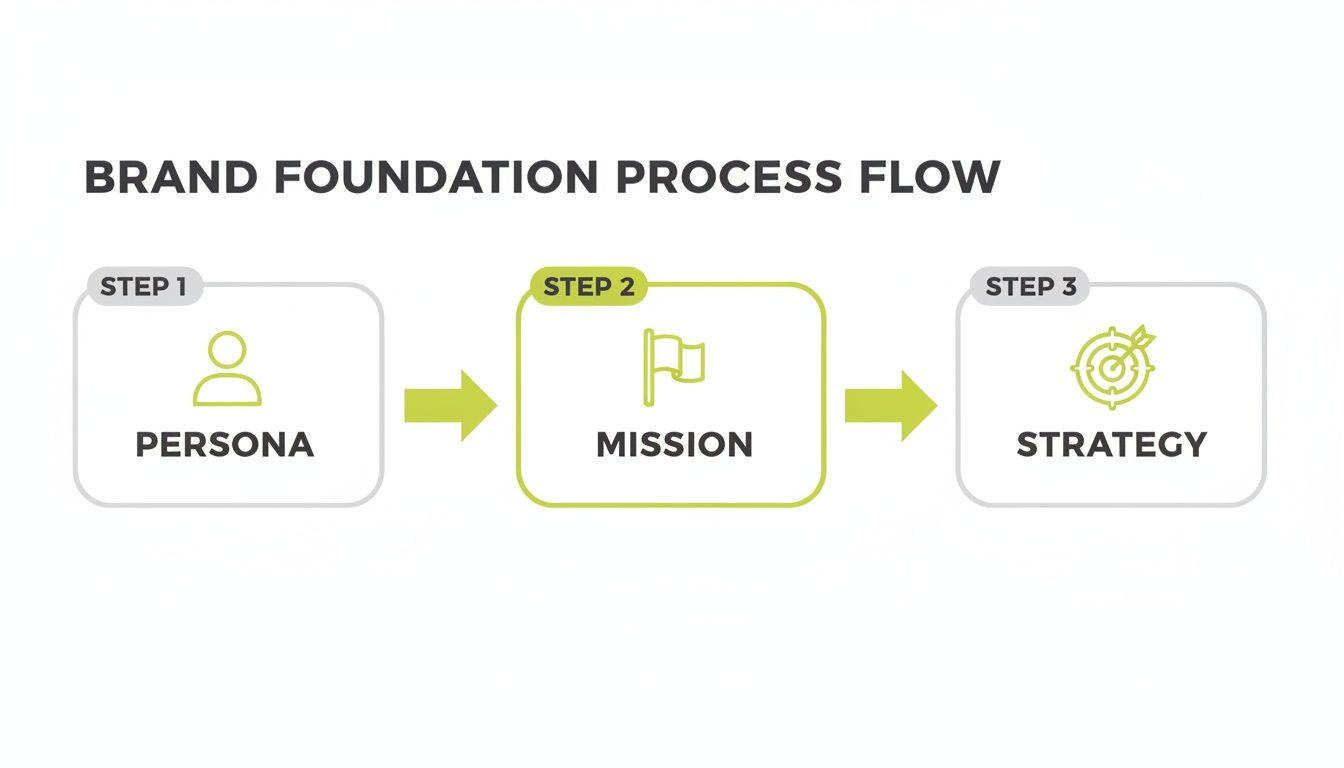
This roadmap is a constant reminder that every tactical decision must trace back to a deep understanding of your audience and core mission.
Tailoring Tactics for Different Business Models
Generic advice is a waste of time. A local plumbing service and a global B2B software company operate in completely different worlds. The key to building real brand awareness is picking channels and tactics that fit your specific audience and business goals.
A cohesive plan ensures each channel supports the others. You can get into the nitty-gritty of how this works by exploring a true omnichannel marketing strategy.
Let's break down a couple of practical scenarios.
- For a B2B SaaS Company: Your target is decision-makers, not the general public. Skip the broad social media blasts and run highly targeted LinkedIn Ad campaigns. Filter your audience by job title ("VP of Marketing"), industry ("Financial Services"), and company size. Pair this with a sharp content marketing play, like publishing a whitepaper on a key industry pain point and promoting it through those same ads to capture high-quality leads.
- For a Direct-to-Consumer Fashion Brand: Your audience lives on visual platforms. You need to master TikTok's algorithm by creating content that taps into trending sounds and challenges, showcasing your products organically. At the same time, run Instagram Story ads with interactive polls and direct "swipe up" links to create an engaging, low-friction path to purchase.
Dominating Local Markets with a Hybrid Approach
For businesses built on local customers, a blended strategy of search and hyper-local targeting is incredibly powerful. Your goal is simple: be the first and only choice for anyone searching for your services in your area.
Take a local plumbing service. To own their city's search results, they could deploy a two-pronged attack:
- Long-Tail SEO: Create blog content answering specific local questions like, "emergency plumber for burst pipes in downtown Denver" or "cost to install a tankless water heater in Highlands Ranch." This is how you capture people who are ready to buy.
- Hyper-Local Google Ads: Run ads that only trigger for users within a 10-mile radius searching for "plumber near me." This ensures every ad dollar is spent on the most relevant potential customers, maximizing your return.
This combination lets you capture both the researchers and the immediate buyers, building brand authority while generating leads right away.
High-Impact Strategies for Modern Audiences
Search and social are table stakes. To truly cut through the noise, you need innovative tactics that create memorable brand interactions. These methods are especially effective for connecting with younger demographics or driving actual foot traffic.
Geofencing for Brick-and-Mortar
Imagine you own a coffee shop and want to pull in more customers during the morning commute. With geofencing, you can set up a virtual perimeter around a nearby office park.
When employees in that area open their social media apps, they get a targeted ad: "Stuck in the office? Get 20% off your morning latte. We're just a 5-minute walk away!" This is a perfect example of delivering the right offer, to the right person, at exactly the right time.
AR Filters for Audience Engagement
An established cosmetics brand looking to connect with Gen Z could create a custom Augmented Reality (AR) filter on Instagram or Snapchat. The filter could let users "try on" a new lipstick shade or eyeshadow palette. By making it fun and shareable, the brand encourages user-generated content, effectively turning its audience into active brand advocates.
Bridging the physical and digital worlds is a core part of any modern omnichannel strategy. A surprisingly effective tool for this is learning how to use QR codes for small business marketing and growth.
These specific, actionable examples show that a winning omnichannel playbook isn't about doing everything. It's about a series of deliberate, interconnected actions that meet your audience where they are.
The power of social media in this mix is impossible to overstate. Recent global data shows that social media ads are the number one driver of brand awareness for audiences aged 16 to 34. With a potential 200% ROI from well-managed PPC on these platforms, ignoring social means risking complete invisibility to a massive part of the market.
Creating Content and Creatives That Actually Connect
Having a presence on multiple channels is just the entry ticket. To really move the needle on brand awareness, your content has to do more than just show up. It needs to stop the scroll, spark an emotional connection, and stick in someone’s mind long after they’ve moved on.
This is the shift from just being seen to being felt.
Great creative isn't just a happy accident; it’s born from a deep understanding of your audience’s psychology, all guided by a sharp, strategic vision. Every single visual, headline, and video hook should be intentionally designed to resonate.

The Psychology Behind High-Performing Content
Ever wonder why some ads are unforgettable while others vanish from memory instantly? It usually boils down to a few key psychological triggers that smart content taps into.
- Emotional Resonance: Content that makes you feel something—whether it’s joy, surprise, inspiration, or even a shared frustration—is exponentially more memorable. A local pet shelter doesn't just post photos of animals; they share rescue stories. For instance, a video showing a timid dog learning to trust its new owner can create a powerful emotional bond with viewers.
- Trust and Authority: When your content educates and provides genuine value, it builds trust. A financial advisor who publishes a data-backed infographic on "Retirement Planning Mistakes to Avoid" immediately positions themselves as a credible expert, not just another salesperson. Similarly, a real estate agent could create a guide on "First-Time Homebuyer Traps in [Your City]" to build local credibility.
- Social Proof: We’re hardwired to trust what others recommend. A new e-commerce startup can showcase customer photos and reviews. This user-generated content (UGC) provides an instant hit of authenticity that a polished, corporate ad campaign could never replicate. For example, a skincare brand could create an Instagram Story Highlight reel titled "Real Results" featuring before-and-after photos sent in by customers.
Building Your Creative Brief
Before your team even thinks about opening Photoshop or hitting record, you need a rock-solid creative brief. This document is the blueprint for your entire campaign, making sure everyone—from your internal team to an outside agency—is perfectly aligned on the vision. It’s your best defense against costly revisions and off-brand work.
A truly great brief doesn’t just list specs; it tells a story and gives unmistakable direction.
Think of the creative brief as your campaign's single source of truth. It should be so clear that a total stranger could read it and know exactly what success looks like and why it matters to your audience.
A flimsy brief leads to flimsy creative. To avoid that, I've found there are a few non-negotiable components you absolutely must include.
Creative Brief Template Essentials
| Brief Component | Purpose and Key Questions to Answer |
|---|---|
| Project Objective | What is the one primary goal here? (e.g., Increase brand recall among millennials by 15%.) Be specific. |
| Target Audience | Who are we really talking to? Go way beyond demographics. What’s their mindset? What keeps them up at night? |
| The Core Message | If they remember only one thing, what should it be? This needs to be sharp and singular. |
| Key Performance Indicators (KPIs) | How will we know if we've won? (e.g., Video view-through rate, lift in branded search, social shares.) |
| Mandatories & Constraints | What must be included (logo, URL, a specific hashtag)? What must be avoided (a certain tone, competitor mentions)? |
Getting these elements right from the start saves countless hours and headaches down the road.
Harnessing Storytelling to Build Community
Facts tell, but stories sell. And when it comes to brand awareness, stories build connections that last. Storytelling frameworks are your secret weapon for turning a simple ad or blog post into a narrative that pulls people in.
A classic and powerful framework is the "Hero's Journey." The trick here is that your customer is the hero, and your brand is simply the wise guide helping them overcome a challenge.
Let's say a fitness coach wants to create a video ad. Here’s how it plays out:
- The Call to Adventure: We see the client feeling sluggish and unconfident (the problem).
- Meeting the Mentor: They discover the coach's program (your brand as the guide).
- Overcoming Trials: The video shows quick cuts of their hard work, setbacks, and moments of progress.
- The Transformation: The final shot reveals the client’s success—they have more energy, a newfound confidence, and a healthier life.
This arc makes the content incredibly relatable and inspiring. It turns passive viewers into an engaged community that sees your brand not as a product, but as a genuine partner in their journey. This is how you make content that doesn’t just get noticed—it gets remembered.
Measuring What Matters: A KPI Framework for Brand Growth
If you can't measure it, you can't improve it. It’s an old saying, but it’s the absolute truth in brand building. Too many businesses get fixated on vanity metrics—likes, shares, followers—that feel good but don’t actually tell you if your brand’s presence is growing.
True growth comes from tracking Key Performance Indicators (KPIs) tied directly to business goals. It's about building a framework that moves you past the surface-level noise and shows you what’s actually working. This is how you connect your marketing spend to real, tangible results and prove the value of your efforts.

Core Metrics That Reveal True Brand Health
To build a dashboard that’s actually useful, you need to ditch the clutter. Focus on a handful of powerful metrics that tell a clear story about whether people are not just seeing your brand, but actively seeking it out.
Here are three foundational metrics I always start with:
Direct Website Traffic: This is one of the purest signals of brand awareness. When someone types your URL directly into their browser or clicks a bookmark, it means you're top-of-mind. A steady rise in direct traffic is a classic sign of strong brand recall, often driven by things like word-of-mouth, podcast ads, or memorable offline campaigns. If you run a radio spot and see a 25% spike in direct traffic the next week, you know the message landed.
Branded Search Volume: This is simply the number of people typing your company or product names into Google. It’s a direct measure of intent—people are actively looking for you. Tools like Google Search Console make this easy to track. For instance, if a coffee shop named "The Daily Grind" notices searches for "The Daily Grind menu" triple after running a local ad campaign, that's a direct win for brand awareness.
Share of Voice (SOV): This metric shows how visible your brand is in the market compared to your competitors. You can calculate it by tracking brand mentions, social media chatter, or how often you show up in search results for key industry terms. A practical way to measure this is to use a social listening tool to count how many times your brand is mentioned vs. your top three competitors over a 30-day period.
Interpreting the Numbers and Taking Action
Tracking these KPIs is only half the job. The real magic happens when you start connecting the dots between your actions and the results. A great dashboard should reveal these connections clearly. A sudden drop in social mentions might tip you off to a competitor's big campaign launch. A jump in branded search after a webinar tells you the content resonated and built authority.
The goal isn't just to collect data, but to use it to ask better questions. Why did direct traffic surge in Chicago last month? Was it our new geofenced ads or that local influencer's post? These insights are where real growth happens.
As advertising continues to shift, omnichannel digital strategies are the primary engine for brand growth. Global spending is projected to hit $1.16 trillion in 2025, and digital ads are on track to claim over 75% of all media spend by 2026. This isn't just a trend; it's the new reality. Integrating your channels and tracking their combined impact is non-negotiable.
A/B Testing Your Way to Better Results
Once your core metrics are in place, you can start improving them systematically through A/B testing. This is the process of creating two versions of a marketing asset—an ad, a landing page, an email—and running them against each other to see which one performs better.
Here are a few practical A/B tests you can run right away:
- Test Ad Creatives: On Facebook, run two ads with the exact same copy but different images. One could be a clean product shot, the other a lifestyle photo. See which one gets a better click-through rate and lower cost per impression.
- Test Value Propositions: On your landing page, test two different headlines. One could focus on a feature ("Our AI-powered software") while the other highlights a benefit ("Save 10 hours a week"). Measure which version gets more sign-ups.
- Test Call-to-Actions (CTAs): In your emails, try different button text. Does "Shop Now" work better than "Discover the Collection"? A tiny wording change can make a huge difference in engagement.
By continuously testing and making decisions based on hard data, you move from guesswork to a predictable system for growth. This approach not only fine-tunes your campaigns but also gives you clear proof of your marketing's ROI. For a deeper look into this topic, check out our detailed guide on measuring marketing effectiveness. This framework turns brand building from a vague art into a data-driven science.
Budgeting and Timelines for Sustainable Brand Momentum
A brilliant strategy is just a nice document without the resources to bring it to life. Smart resource allocation is what separates a plan that lives on paper from one that actually builds momentum in the real world. This isn't about plucking a magic number out of thin air; it’s about creating a financial and chronological roadmap that fuels consistent, sustainable growth.
Trying to improve brand awareness without a clear budget is like planning a cross-country road trip without knowing how much gas money you have. You might get out of the driveway, but you'll probably run out of fuel long before you reach your destination.
Allocating Your Brand Awareness Budget
There’s no one-size-fits-all number, but there are proven models to guide your thinking. A common starting point is the percentage-of-revenue method, where businesses typically dedicate between 5% and 12% of total revenue to marketing. If you're a new company or in a high-growth phase, you might push this higher—sometimes up to 20%—to aggressively carve out market share.
Once you have that top-line number, the real work begins: distributing it across your channels. This allocation has to tie directly back to the audience you defined and the goals you set.
- E-commerce Startup: A new online boutique needs to get seen—fast. They might front-load their budget, pouring 60% into TikTok influencer collaborations and hyper-targeted Instagram ads for the first six months. The goal? Build an initial customer base and generate a ton of user content.
- Established Local Law Firm: A firm that’s been around for a while isn't chasing quick visibility; they're reinforcing authority and local trust. Their budget might look like 50% for local SEO and Google Ads, 30% for sponsoring community events, and 20% for creating high-value blog content that answers real legal questions their neighbors are asking.
Think of your budget allocation as a living document that shows your strategic priorities. It should be fluid, giving you the flexibility to double down on what’s working and pull back from channels that aren't, all based on the data you’re tracking.
Structuring Your Efforts with a 30-60-90 Day Plan
Listen, consistent effort beats sporadic bursts of activity every single time. A phased timeline helps you structure your launch and ongoing work, setting clear milestones and preventing that feeling of being completely overwhelmed. This framework turns a massive goal like "improve brand awareness" into a series of manageable, sequential actions.
A 30-60-90 day plan is the perfect structure to build that momentum.
Your First 30 Days: The Setup Phase
This first month is all about laying the groundwork. You're not focused on massive reach yet. You're focused on getting all your tools and assets in order so that when you do launch, you're ready.
- Finalize creative briefs and nail down key messaging.
- Set up all your social media profiles and ad accounts.
- Install tracking pixels and analytics tools (like Google Analytics).
- Conduct your initial keyword research for SEO and content. For example, a local bakery might research terms like "best birthday cakes in [city]" or "sourdough bread near me."
The Next 30 Days: The Launch Phase
Alright, it's go-time. This phase is about deploying your initial campaigns and gathering that crucial early data. You're putting your strategy into motion and seeing how the real world responds.
- Launch your first set of social media ads and content. For example, run a Facebook ad campaign targeting users interested in "local bakeries" within a 10-mile radius.
- Publish your foundational blog posts or core website pages.
- Begin outreach to influencers or potential partners.
- Keep a close eye on initial performance metrics—things like reach, impressions, and click-through rates.
The Following 30 Days: The Optimization Phase
Now you have a month's worth of data, and you can start making smart adjustments. This is where you move from guessing to knowing, refining your approach based on what the numbers are telling you.
- Analyze which ad creatives and messages are resonating most. For example, did the ad with a close-up of a croissant get more clicks than the one showing the storefront?
- A/B test different headlines, ad copy, and landing pages.
- Reallocate a small slice of your budget to the highest-performing channels.
- Use audience insights to sharpen your targeting for the next 90-day cycle.
This structured timeline ensures you’re not just spending money, but investing it intelligently to build a strong, memorable brand that lasts.
Your Burning Questions on Brand Awareness Answered
When it's time to build real brand visibility, it's easy to get bogged down by questions about budgets, channels, or timelines. Having clear, experience-backed answers not only smooths out the execution but gives you the confidence to move forward.
Budget Allocation
Trying to set a budget for brand awareness can feel like guessing in the dark. A solid starting point for most businesses is dedicating 5-10% of your total revenue. If you're a new company trying to break through the noise, you'll likely need to push that to 12-20% to really gain traction.
Instead of going all-in at once, I always recommend testing the waters with small digital campaigns first. For example, start with a $500 budget for a week-long Facebook Ads campaign to test three different ad visuals. This is the quickest way to find out which channels give you the best bang for your buck. Once campaigns are live, keep a close eye on your spending weekly. This simple habit helps you avoid burning through your budget too fast and allows you to shift funds where they're working hardest.
Simple dashboards are your best friend here—they prevent nasty surprises. Tools like Google Analytics and Facebook Ads Manager are perfect for keeping a live pulse on your costs.
For smarter spending, stick to these best practices:
- Start small, prove what works with clear KPIs, and then scale up.
- Always keep about 10% of your budget on hand for trying out new, experimental channels. You never know where the next big win will come from.
- Review your spending every week and don't be afraid to reassign funds quickly.
Channel Selection
Picking the right channel mix is what determines whether your brand is seen by the right people or just shouting into the void. Social media, search engines, email, and even old-school offline tactics each have a unique part to play.
Local service businesses, for instance, get incredible mileage out of a well-maintained Google Business Profile and active participation in community Facebook groups. For e-commerce brands, the visual-first worlds of Instagram and TikTok are usually where they find their gold.
The real magic happens when you blend channels. Imagine running digital ads that are reinforced with geofenced mobile offers or a timely SMS message. Or think about placing QR codes on your flyers and packaging to instantly bridge the gap between the physical and digital worlds.
Looking for some hands-on ideas?
- Run hyper-local Google Ads targeting a tight 5-mile radius to capture immediate, high-intent search traffic.
- Find micro-influencers on Instagram to show your product being used in authentic, everyday situations.
- Build an email "teaser" campaign to warm up a list of contacts before you hit them with a bigger ad push.
The key is to tailor your channel mix to where your audience actually spends their time. And always, always revisit your channel performance every quarter. Cut what's not working and double down on what is.
Don't forget the power of real-world connections. A local cafe I worked with ran geofenced offers targeting nearby office parks during the morning rush. The result? A 25% jump in foot traffic.
Timeline Expectations
You can absolutely get quick wins, especially when your campaigns are tightly targeted. Early indicators like click-through rates and direct website visits can spike within the first 30 days.
30-90 days is a solid window to gauge initial campaign impact before making major adjustments.
From there, you enter a cycle of monthly iteration, constantly refining your messaging based on what the data tells you. This is also why setting realistic milestones is so important—it keeps everyone on the same page and prevents mismatched expectations. Sustained, consistent effort over 6-12 months is what truly builds that top-of-mind recall and gets people talking about you organically.
A pro tip: Align your timeline reviews with big moments for the business, like product launches or seasonal peaks. This ensures your marketing messages are in perfect sync with customer behavior and business cycles, maximizing your impact.
Ongoing Optimization
Brand awareness isn't a "set it and forget it" play. It's a living strategy that needs constant attention. Regular check-ins on your performance metrics are non-negotiable for refining your approach.
Start running simple A/B tests. Tweak your ad copy, switch up your creative, or change the headline on your landing page. For example, test an ad headline like "Luxury Skincare Made Simple" against "Get Glowing Skin in 5 Minutes." You'd be amazed at how small changes can lead to 20-30% lifts in engagement or recall.
Finally, make sure you're reporting on performance to stakeholders every month. It builds transparency and trust, and documenting what you're learning makes every future campaign smarter than the last.
FAQ Quick Answers
We get these questions all the time. Here are the quick, direct answers to help you get started.
| Question | Answer |
|---|---|
| How much should I budget for brand awareness? | Start with 5-10% of your total revenue. New businesses may need to invest a higher percentage (12-20%) initially to gain traction, focusing on high-ROI digital channels. |
| Which channels are best for a small business? | Focus on 1-2 channels where your target audience is most active. For local businesses, this is often Google Business Profile and Facebook. For e-commerce, Instagram and TikTok are powerful starting points. |
| How long does it take to see results? | You can see leading indicators like increased website traffic and social engagement within 30-90 days. However, building significant brand equity and top-of-mind awareness takes 6-12 months of consistent effort. |
While these answers provide a great baseline, remember that your own performance data is the ultimate guide. Be ready to adapt based on what you see.
Partner with Silver Spoon Agency at https://www.silverspoonagency.com