


How to Increase Website Traffic Organically: 7 Proven Strategies

Before you can even think about driving more organic traffic, you need to know exactly where you're starting from. It's like trying to navigate a new city without a map—you might get somewhere eventually, but you'll waste a lot of time and energy. Jumping straight into content creation without a proper audit is the same thing. You need a solid foundation first.
This means taking a hard look at your website's current health to figure out what’s working, what's broken, and where the real opportunities are hiding.
This initial audit isn’t about nitpicking every tiny flaw. It’s about building a smart, prioritized game plan. We’ll break it down into the three pillars that matter most: your content, your backlinks, and your site's technical performance.
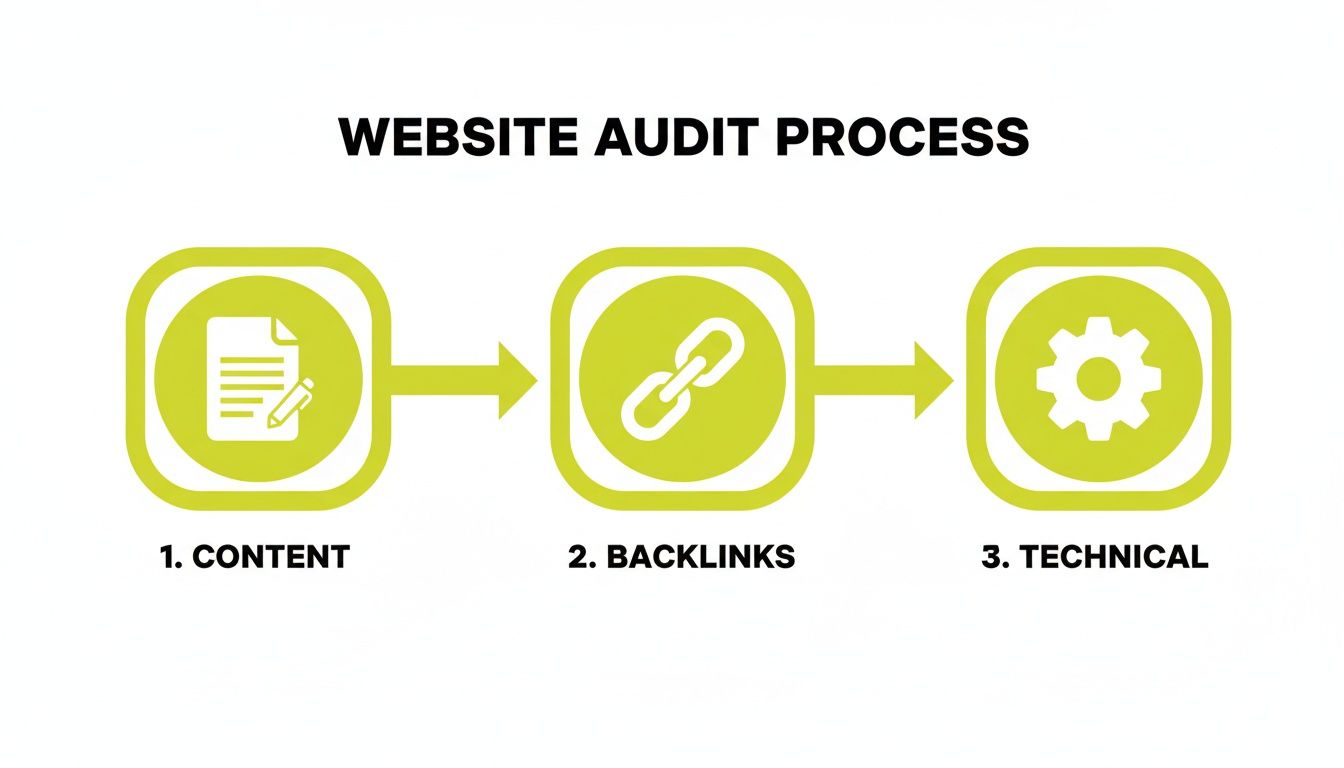
This process is straightforward: start with what you’ve published, analyze who’s linking to you, and finish with a deep dive into the technical nuts and bolts of your site.
Find Your Hidden Content Gems
First up is a content and keyword audit. Dive into your analytics and look for your "hidden gems"—these are pages that are already getting some love from Google but could be doing so much better. For example, you might find a blog post about "beginner's guide to indoor gardening" that ranks at position 12. With a content refresh—adding new tips, updating images, and improving the structure—you could push it onto the first page and significantly increase its traffic.
Imagine a local bakery discovers an old blog post from two years ago, "gluten-free sourdough starter tips," is somehow their third most-visited page. They barely even remember writing it. That one piece of data is gold. It tells them their audience is hungry for gluten-free content, giving them a clear path to creating a whole series of articles they know will perform well.
The whole point of a content audit is to see what your audience actually cares about, not what you think they care about. The data will almost always surprise you and can completely change the direction of your content strategy for the better.
Analyze Your Backlink Profile
Next, you need to see who's linking to your website. Backlinks are basically votes of confidence from other sites, but not all votes are created equal. A tool like Ahrefs or Moz will give you a full picture of your link profile.
You're looking for two things here:
- Identify high-authority links: For instance, if you run an e-commerce store selling hiking gear and discover a popular outdoor adventure blog linked to your "Best Waterproof Tents" article, that's a high-quality link. This tells you that creating more in-depth gear guides is a great way to attract similar valuable links.
- Spot and prune damaging links: On the flip side, you might find links from a dozen spammy, foreign-language websites that have nothing to do with your industry. These can harm your credibility. Finding them lets you disavow them in Google Search Console, which is like cleaning up your site's reputation online.
Check Your Technical SEO Health
Finally, a technical audit makes sure that search engines can actually find, crawl, and understand your site. Technical problems are often invisible to you but can be a huge roadblock for your traffic. One of the biggest offenders I see is slow mobile page speed—it annoys users and is a confirmed Google ranking factor.
For example, a real estate website with large, uncompressed property images might take ten seconds to load on a smartphone. A potential buyer will likely leave before the pictures even appear. Compressing those images could cut the load time to two seconds, preventing that lost traffic. You also need to check for indexing errors (pages that aren't even showing up in Google) and broken internal links that create dead ends for users and search engine bots. Even your hosting matters; if your server is slow, your site will be too. It’s worth learning how to choose the right web hosting for your website to ensure your technical foundation is strong from day one.
If you want an even deeper look at building this foundation, check out a complete guide on increasing website traffic organically. This audit gives you the data-backed starting line you need to build a growth strategy that actually works.
Crafting A Winning Content And Keyword Strategy
Once your audit has shown you where the real opportunities are, it's time to turn those insights into a battle plan. We need to move beyond just chasing random keywords. The real goal is to build a content ecosystem that cements your authority and pulls in a steady stream of organic traffic.
This means creating content that answers questions for people at every stage of their journey—not just when they’ve got their credit card out. A seriously effective way to do this is with the topic cluster model.
The topic cluster model is a way of organizing your content that makes perfect sense to both your visitors and to search engines. It’s built around two key pieces: a central "pillar" page that covers a broad topic, and a bunch of "cluster" articles that dive deep into specific subtopics, all linking back to that main pillar.
Build Your Content With Topic Clusters
Think of a pillar page as your definitive guide on a core topic or service. It’s the big one—comprehensive, authoritative, and it tackles the major questions your audience is asking.
Cluster content, on the other hand, gets into the nitty-gritty. These articles answer the niche questions related to that pillar. This structure does something powerful: it signals to Google that you have deep expertise on a subject, which can boost your rankings for a whole range of related search terms.
Let’s make this real. Imagine a SaaS company selling project management software. They could create a killer pillar page called "The Ultimate Guide to Agile Project Management." This page would cover all the fundamentals of the Agile methodology from top to bottom.
From there, they could build out cluster articles to support it, like:
- How to Run an Effective Sprint Planning Meeting
- A Head-to-Head Comparison of Scrum vs. Kanban
- Top 5 Agile Metrics for Measuring Team Performance
Each of these articles would link back to the main Agile guide, reinforcing its authority. This approach doesn't just organize your content strategy; it also cleans up your site's internal linking, a huge part of the basics of blogging search engine optimization.
Target The Right Keywords For Your Audience
Great topic clusters are built on smart keyword research. Forget just targeting broad, high-competition terms. The real growth comes from understanding what your users are actually trying to do and focusing on long-tail keywords.
Long-tail keywords are just longer, more specific search phrases. They don’t get a ton of search volume, but the people using them have much higher intent. They know exactly what they’re looking for.
Believe it or not, long-tail keywords drive a whopping 70% of all search traffic. While everyone else is fighting over a broad term like "marketing software" (millions of results), a specific search like "email marketing automation for small businesses" has far less competition and is coming from a much more qualified lead. We've seen a regional dental provider boost their organic traffic by 140% year-over-year just by mastering this, enough for them to completely ditch their paid search budget.
Your keyword strategy shouldn't just be a list of terms. It should be a map that connects what people are searching for to the content you create, guiding them from their initial question to the solution you provide.
When you map keywords to the different stages of the buyer’s journey, you ensure your content meets people exactly where they are. This alignment is the secret to attracting and converting organic visitors.
Of course, as you build out your content, you'll eventually wonder about how many keywords to use for SEO in each piece. The trick is to focus on one primary keyword and then naturally weave in related secondary keywords and synonyms. This helps you create truly comprehensive content that search engines love.
Map Keywords To Customer Intent
To make your keyword strategy truly hit home, you need to connect the dots between keyword types, the right content format, and your business goals. This framework ensures every piece of content you create serves a clear purpose in your customer's journey.
Mapping Keywords to Customer Intent
| User Intent | Keyword Example | Ideal Content Format | Business Goal |
|---|---|---|---|
| Informational | "how to start a podcast" | In-depth blog post or guide | Build brand awareness |
| Commercial | "best podcast microphones 2024" | Comparison article or review | Guide purchase decisions |
| Transactional | "buy blue yeti microphone" | E-commerce product page | Drive direct sales |
| Navigational | "blue yeti website" | Homepage or brand page | Retain existing customers |
By building this intentional structure, your website stops being a collection of random pages and becomes a trusted resource. You get off the hamster wheel of chasing fleeting traffic and start building a sustainable engine for organic growth that attracts, engages, and converts your ideal customers.
Executing On-Page and Technical SEO That Matters

Now that you have a solid content plan, it's time to shift from the "what" to the "how." The best content in the world will just sit there if it isn’t packaged in a way that both search engines and actual humans can find and appreciate. This is where on-page and technical SEO come in—it’s all about the execution.
Think of it like cooking a fantastic meal. Your content is the recipe, but the on-page and technical details are the plating and presentation. A world-class dish served on a paper plate is still a letdown. You need to nail the delivery to make the whole thing work.
Crafting The Perfect First Impression In Search Results
Your title tag and meta description are your digital storefront. They’re the first thing people see in the search results, and their entire job is to get someone to click on your link instead of the nine others on the page. I've seen a compelling title at position three steal clicks from the number one spot time and time again.
Your title tag needs to be snappy and informative. Aim for around 60 characters, include your main keyword, and promise a clear benefit. It has to immediately answer the searcher's unspoken question: "What's in it for me?"
For example, a title like "Running Shoes" is dead on arrival. But "Best Running Shoes of 2024 for Every Type of Runner" is specific, timely, and promises comprehensive value. It's infinitely more clickable.
While not a direct ranking factor, your meta description is your 15-second elevator pitch. You've got about 155 characters to expand on the title and give a compelling reason to click through. A good meta description for that running shoe article might be: "Tired of foot pain? We tested 20+ pairs to find the top running shoes for flat feet, high arches, and neutral strides. Find your perfect fit today!"
Your title tag and meta description are your one-two punch in the SERPs. The title grabs their attention, the meta description convinces them to click. Mastering this is non-negotiable for boosting organic traffic.
Optimizing Every Element On The Page
Once they click, the page itself has to deliver on that promise. This is about creating a clear, logical structure that feels intuitive to both your visitor and to Google.
- Header Tags (H1, H2, H3): Your H1 is your main page title—use only one. H2s break up the major sections, and H3s organize the subsections within them. This hierarchy makes your content scannable for readers and helps search engines map out its structure.
- Image Alt Text: Every single image needs descriptive alt text. This isn't just an SEO box to check; it’s critical for accessibility. It's what screen readers use to describe the image to visually impaired users. So instead of "image1.jpg," write something like, "woman lacing up neon green trail running shoes before a race."
- Internal Linking: Don't just publish content and let it become an island. Link strategically to other relevant pages on your website. For example, in a blog post about "how to choose a camera," you could link the phrase "understanding aperture" to a separate, more detailed article you've written on that specific topic. This is huge for SEO and user experience.
Fixing The Technical Issues That Kill Traffic
All the great content and on-page optimization in the world won't matter if your site's technical foundation is a mess. It's like building a beautiful house on quicksand. There are a few technical gremlins you have to exorcise right away.
First up, site speed. This is a big one. Over half of all web traffic is mobile, and those users have zero patience. If your site takes more than a couple of seconds to load, they're gone. Google knows this, which is why page speed has been a ranking factor for years. Use a tool like Google's PageSpeed Insights to see where you stand and get a checklist of what to fix.
Next, you absolutely must have a mobile-friendly site. This is more than just speed. The site has to look good and be easy to use on a small screen—no pinching and zooming required. Since Google switched to mobile-first indexing, the mobile version of your site is what it primarily uses for ranking. A clunky mobile experience is a one-way ticket to the bottom of the search results.
Winning Rich Snippets With Structured Data
Finally, let's talk about one of the most powerful—and often overlooked—technical SEO tactics: implementing structured data, also called Schema markup. Think of it as a special vocabulary you add to your site's code to give search engines more context about your content.
When you get this right, Google might reward you with "rich snippets." These are the eye-catching, enhanced search results that really stand out.
For instance, if you have a recipe blog and add Recipe Schema, your result in Google could show star ratings, cooking times, and calorie counts. Someone searching for a recipe is far more likely to click on a result showing a 4.8-star rating and a 30-minute cook time than a plain blue link, even if the plain one is ranked higher. This is how you can effectively leapfrog your competitors and steal clicks without moving up in the rankings at all.
Give Your Content a Megaphone: Promotion & Backlink Strategy
Creating exceptional content is a huge win, but hitting "publish" is just the start. If you just sit back and wait for the world to discover your masterpiece, you're going to be waiting a very, very long time. To really move the needle on organic traffic, you have to actively get your content out there and earn the kind of backlinks that tell search engines you're a serious player.
Think of it like this: your content is the product, and promotion is the marketing. No matter how great the product is, it'll just gather dust on the shelf without a smart marketing plan. The real goal is to get your content in front of the right eyeballs—the people who will share it, link to it, and give it a life of its own.
Forget Cold Outreach. Earn Your Links.
The old-school approach to link building was a numbers game. You'd scrape a list of emails and blast out hundreds of generic messages begging for a backlink. It’s about as effective as you’d imagine—mostly, it's just annoying.
A far more powerful way to think about this is "link earning." Instead of asking for favors, you create assets so genuinely useful that other people want to link to them. You're not begging; you're providing a resource. This shift in mindset changes everything.
Turn Your Internal Data into a Link Magnet
One of the single most effective ways to earn high-quality backlinks is to publish original research. And no, you don't need a massive budget for a formal study. Often, the most compelling data is already hiding inside your own business.
Here's a real-world example I've seen play out: A B2B software company that makes project management tools for remote teams wanted to build its authority. Instead of cranking out another bland "5 Tips for Remote Work" post, they did something smarter. They surveyed 500 of their own customers about their biggest productivity struggles.
They packaged the findings into a polished "State of Remote Work Productivity" report, complete with sharp infographics and surprising takeaways. That one report was an absolute goldmine.
- Trade publications covering HR and tech immediately picked it up, citing the data and linking back.
- Influential bloggers used their stats to add weight to their own articles, crediting the company.
- Journalists writing about workforce trends used the report to make their stories more credible.
The payoff was huge: dozens of high-authority backlinks from relevant, respected sites. This didn't just boost their rankings; it drove a steady flow of highly qualified demo requests for months. They didn't just make content; they created an asset.
Add Real Value to Existing Conversations
Another fantastic strategy is to become a known expert in the places where your ideal customers already hang out. This isn't about dropping spammy links in forums. It's about genuinely helping people.
Find the relevant subreddits, Quora discussions, or niche industry forums. When someone asks a question you can actually answer, jump in and give them a thorough, thoughtful response right there in the thread. For example, on a subreddit like r/personalfinance, if someone asks "How do I choose a Roth IRA provider?", a financial advisor could write a detailed, unbiased 300-word answer explaining the key factors to consider. Only at the end might they add, "I wrote a detailed guide on this if you want to dive deeper," with a link.
This works because you're leading with value. You've already proven you know your stuff, so the link comes across as a helpful resource, not a sleazy sales pitch.
Repurpose Your Content for Every Platform
Your audience doesn't consume content in just one way. That comprehensive, 3,000-word pillar page is perfect for your blog, but it’s a non-starter on most social platforms. The trick is to repurpose your best work into formats that fit other channels.
Here are a few ways to do it:
- Blog Post to YouTube Video: Take your most popular "how-to" guide and turn it into a follow-along video tutorial. This lets you tap into the massive audience on YouTube that prefers watching over reading.
- Data Report to Infographic: Pull the most compelling stats from your research report and have a designer create a visually engaging, shareable infographic. These are perfect for Pinterest and often get embedded in other blogs (with a credit link back to you, of course).
- Pillar Page to Twitter Thread: Break down the key sections of a long-form article into a punchy, informative Twitter thread. Each tweet can highlight one core idea, sparking conversation and driving clicks back to the full piece.
By giving your content new life on different platforms, you meet your audience on their terms. This multi-pronged approach ensures your hard work gets seen, shared, and linked to, creating a powerful flywheel that keeps bringing new organic traffic back to your site.
Winning Traffic with Local and Niche Platform SEO

Not all organic traffic is created equal, and it certainly doesn't all come from a generic Google search. For a huge number of businesses, the most valuable visitors are searching for solutions right in their own backyard or on platforms that aren't traditional search engines at all.
This is where you can get a serious edge. By focusing on specialized SEO strategies for local and niche platforms, you can open up powerful new streams of high-intent traffic.
If your business relies on local customers, your Google Business Profile (GBP) isn't just a listing; it's your digital front door. A staggering 46% of all Google searches are for local information. Neglecting your GBP is like having a storefront with no sign on the door—you’re invisible to people who are actively trying to find you.
It's not enough to just list your address and hours. You have to actively manage your profile as a dynamic marketing channel to capture local searchers who are ready to buy.
Dominate Your Local Market with Google Business Profile
An optimized GBP can land you right at the top of local search results and put you on the map—literally. The trick is to stop thinking of it as a static listing and start treating it as an active engagement tool.
First things first: encourage every single happy customer to leave a review. Positive reviews are a massive trust signal, both for potential customers and for Google’s algorithm. They’re non-negotiable.
Beyond reviews, make sure you're using every feature Google gives you:
- Google Posts: Share updates, special offers, and news directly on your profile. A local gym could post about a new yoga class with a "Book Now" button, making them instantly visible to anyone searching "yoga classes near me."
- Q&A Feature: Don't wait for people to ask questions—answer them proactively. A plumber could add and answer common queries like, "Do you offer 24/7 emergency services?" This clears up customer concerns before they even have to ask.
- Photos and Videos: Keep your profile fresh with high-quality images of your work, your team, and your location. If you run a restaurant, this means mouth-watering food shots and pictures of a welcoming dining area.
Getting these elements right is crucial. For a deeper dive, it helps to understand the top three things your business listings must have.
Your GBP is often the very first interaction a potential local customer has with your brand. Make it complete, keep it active, and pack it with social proof to turn searchers into visitors and customers.
If you’re a service-area business—think HVAC companies or mobile car detailers—hyperlocal landing pages are a complete game-changer. Don't just target your main city. Build out dedicated pages for specific neighborhoods or suburbs you serve. A page titled "Emergency HVAC Repair in Scottsdale" is infinitely more powerful and likely to capture a high-intent searcher than a generic "Services" page.
Find Your Audience on Niche Platforms
Your ideal customers might not even start their journey on Google. They could be scrolling for inspiration on Pinterest, learning a new skill on YouTube, or looking for professional advice on LinkedIn. Tapping into these platforms can unlock entirely new streams of organic traffic.
The secret is to match your content to the platform's culture and what its users are actually there to do.
A DIY home improvement blog, for example, could create a series of short, snappy video tutorials for YouTube on topics like "How to Fix a Leaky Faucet." These videos can pull in thousands of monthly viewers who have a very specific problem. By dropping a link in the video description back to a more detailed guide on their website, they funnel engaged, problem-aware traffic directly to their blog.
Similarly, a wedding planner could use Pinterest as a massive traffic driver. By creating beautiful, shareable pins like "10 Stunning Outdoor Wedding Themes," they attract an audience of brides-to-be who are in active planning mode. Each pin links back to a blog post, capturing a highly motivated audience at the perfect moment. This strategy is all about meeting your audience where they already are, not just waiting for them to find you.
Answering Your Top Organic Traffic Questions
Diving into SEO always brings up a ton of questions. As you start putting these strategies into practice, it's completely normal to wonder about timelines, what to tackle first, and what really moves the needle.
We're going to cut through the noise and tackle the most common questions head-on. No fluff, just direct insights to help you get past the usual hurdles and focus on what genuinely grows your organic traffic.
How Long Does It Really Take to See SEO Results?
This is the big one, isn't it? The honest-to-goodness answer is that real organic traffic growth is a marathon, not a sprint. While you might see some small, encouraging wins from quick technical fixes, you should plan on seeing truly meaningful results within 4 to 12 months.
Of course, that timeline depends on a bunch of factors—your website's history, how fierce the competition is in your niche, and how consistently you're putting in the work. Think of it like planting a tree. You do a lot of work early on that doesn't show much above the ground, but that effort is what allows the growth to compound over time.
Should I Focus on Content or Technical SEO First?
It's the classic chicken-and-egg problem of the SEO world. The truth is, they are completely codependent. Incredible content on a technically broken website will never be found, and a perfectly engineered site with thin, useless content offers zero value to anyone who finds it.
A winning strategy needs a balance of both. My advice? Start with a technical audit to make sure your foundation is solid. You need to know search engines can actually crawl and understand your site. Once that's locked in, you can build on it with confidence, creating high-quality content that serves your audience.
A technically sound website is the stage, but compelling content is the performance. You can’t have a great show without both. One without the other simply falls flat.
Can I Grow Traffic Without Building Backlinks?
It is possible, especially if you’re in a low-competition niche. By focusing entirely on fantastic content and sharp on-page SEO, you can definitely start ranking for less competitive, long-tail keywords.
However, you will hit a growth ceiling, and it will be much lower than you want. Backlinks are still a massive signal to Google that other sites vouch for your authority. If you want to compete for the high-value, high-traffic keywords that can transform a business, a deliberate backlink strategy isn't just a nice-to-have; it's essential for building the credibility search engines need to see.
Ready to stop guessing and start growing? At Silver Spoon Agency, we turn data-driven insights into measurable revenue. Our AI-powered, omnichannel approach ensures your marketing efforts deliver superior ROAS and sustainable growth. Book a consultation with us today.