


How to Scale a Service Business From Founder to CEO

If you want to scale your service business, you have to break the golden rule you were taught from day one: stop trading your time for money. The only way to truly grow is to package your expertise into repeatable offers, build a predictable system for finding new clients, and automate everything you possibly can.
Escaping the Founder Trap by Building Systems
The biggest hurdle every service business owner hits is making the shift from doing the work to building a business that can run without them. This is the chasm between simple growth and genuine scale. It's the journey from being the star player to becoming the coach and owner of the team.
Think about the marketing consultant who's drowning in client work. Their day is a chaotic mess of custom proposals, endless back-and-forth on revisions, and one-off projects that never feel the same. Each new client means reinventing the wheel. It's exhausting and impossible to scale.
Now, picture an agency that runs on rails. New clients choose from a clear menu of packages (e.g., "SEO Launchpad" or "Content Authority"). The moment they sign, an automated workflow kicks in, onboarding them, creating project folders, and assigning tasks to the team. The owner isn't stuck tweaking ad copy at midnight; they're looking at performance dashboards and plotting the company's next big move. That's the leap we're about to make.
The Three Pillars of a Scalable Service Business
To get out of this "founder trap," you have to build your business on a foundation of systems, not just your own grit and hustle. This guide is your playbook for building out three core pillars:
- Productizing Your Offers: We’ll take your custom, bespoke services and turn them into standardized, packaged-up products with fixed scopes and clear pricing. This makes them ridiculously easier to sell and deliver.
- Building a Client Acquisition Machine: You'll learn how to create a reliable, almost automated system that brings in a steady stream of qualified leads. No more relying on referrals and hoping the phone rings.
- Leveraging Automation and SOPs: We’ll systematize your entire delivery process with the right software and Standard Operating Procedures (SOPs), ensuring every client gets the same high-quality result while freeing you from the day-to-day grind.
This timeline shows you exactly how these stages build on each other over the years.

The big takeaway here? Productizing and acquiring are the first steps, but systematizing everything is the final, critical piece that unlocks true, long-term scale.
The shift from being a hands-on founder to a strategic CEO is one of the hardest transitions to make. It requires a fundamental change in where you spend your time and energy.
The Scaling Mindset Shift From Founder to CEO
| Focus Area | The 'Stuck' Founder | The Scaling CEO |
|---|---|---|
| Time Allocation | Spends 80% on client delivery, 20% on sales. | Spends 80% on strategy & systems, 20% on oversight. |
| Primary Goal | Keeping current clients happy. | Building predictable revenue streams. |
| Sales Process | Custom proposals for every lead. | Standardized packages and funnels. |
| Operations | Relies on personal memory and ad-hoc tasks. | Relies on documented SOPs and automation. |
| Hiring | Hires another "doer" to help with the work. | Hires leaders to own outcomes and manage teams. |
| Technology | Uses basic tools for individual tasks. | Builds an integrated tech stack (CRM, PM). |
| Mindset | "No one can do it as well as I can." | "How can I build a system so anyone can do it?" |
This table isn't just theory; it's the daily reality of scaling. Every decision you make should push you from the left column to the right.
Why Systems Matter More Than Ever
In today's market, you can't afford not to have systems. Consider this: the global digital marketing space is expected to hit $786.2 billion by 2026, which is nearly double what it was in 2020. For agencies and consultants, this boom means client acquisition is no longer a referral game—it’s a systems game. The companies growing the fastest are the ones who treat their marketing and sales as a factory, not an art project.
The ultimate goal is to build a business that serves you, not the other way around. A business built on systems provides freedom, predictability, and the ability to make a bigger impact without burning out.
To make this happen, you have to get everything out of your head and onto paper. Learning How to Write Standard Operating Procedures That Work is non-negotiable; your SOPs become the playbook for your team and your software. This documentation is the blueprint for everything, including building out your tech stack and understanding why things like CRM management and why it matters are so critical for organizing client data and making your workflows hum.
Productize Your Services for Predictable Growth
If you ever want to break free from the founder's trap, you have to stop selling your time and start selling a result. The single biggest leap a service business can make is moving away from the chaos of custom quotes and one-off projects. The secret? Productize your expertise.
This means transforming what you do into standardized packages that are dead simple to sell, deliver, and—most importantly—delegate. It’s the only way to build a business that runs on systems, not just your personal hustle.
Think about a web design agency that spends half its week crafting unique proposals. Every client gets a different scope, timeline, and price. It's a recipe for operational headaches and burnout. Now, imagine that same agency offers a "Startup Launch Pad" package for a fixed price. It includes a 5-page website, basic SEO, and a logo, all delivered in a clean 4-week timeline. It’s predictable for the client and massively more efficient for the agency.

This shift isn't just about making sales easier. When a service is standardized, it becomes a repeatable process. A repeatable process can be documented in a Standard Operating Procedure (SOP), which is the blueprint you need to hire and train a team that can deliver without you.
Defining Your Service Tiers
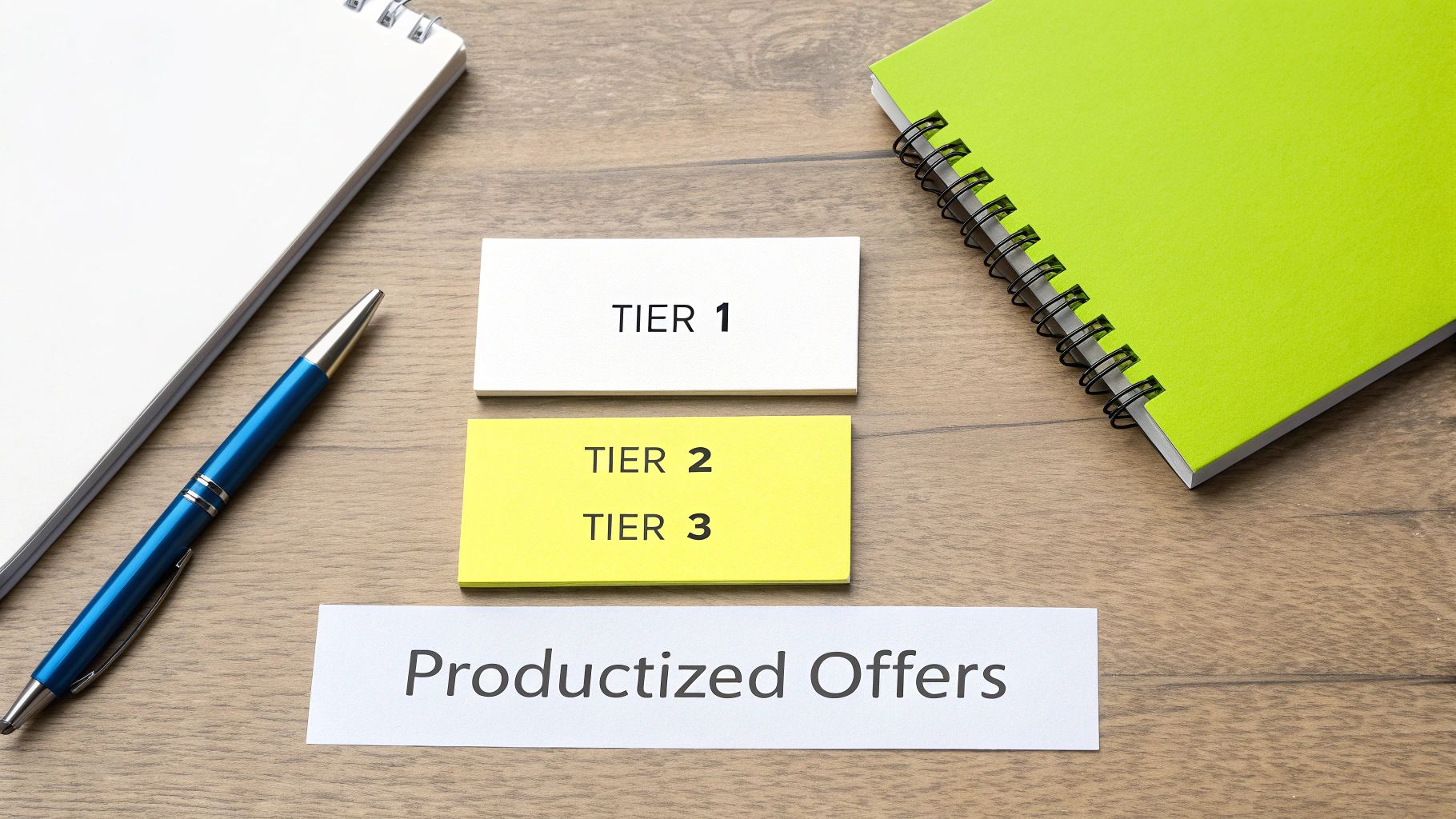
The easiest way to get started is by creating two or three distinct service tiers. This simple structure helps you cater to different client needs and budgets without complicating your delivery. It’s the classic "Good, Better, Best" model, and it works.
Here’s what this looks like in the real world for a content marketing agency:
Tier 1: Content Foundation ($1,500/mo)
- Goal: Get the ball rolling and establish a consistent content presence.
- Deliverables: 2 blog posts per month (up to 1,200 words each), keyword research, and basic on-page SEO.
- Timeline: Monthly retainer.
Tier 2: Growth Engine ($3,500/mo)
- Goal: Actively drive organic traffic and start generating leads.
- Deliverables: Everything in Tier 1, plus 2 more blog posts (4 total), 1 email newsletter, and social media snippets for each article.
- Timeline: Monthly retainer with a 3-month minimum commitment.
Tier 3: Authority Builder ($6,000/mo)
- Goal: Become the go-to expert and dominate a niche.
- Deliverables: Everything in Tier 2, plus 1 in-depth pillar page or whitepaper per quarter, backlink outreach, and a monthly performance report.
- Timeline: Monthly retainer with a 6-month minimum commitment.
Suddenly, the sales conversation changes completely. Instead of a vague, open-ended "What do you need?" you’re guiding prospects toward a clear solution that solves their problem.
Setting Profitable, Value-Based Prices
Once your packages are defined, it's time to price them. And this is where most service businesses get it wrong: they charge based on hours. To truly scale, you have to price your services based on the value and outcome you create for the client.
Stop asking, "How long will this take me?" Instead, ask, "What is this result worth to my client?" If your $3,500 "Growth Engine" package helps a client land a single new customer worth $10,000, your service is an absolute bargain—it's an investment, not an expense.
To get your numbers right, calculate your hard delivery costs (your team's time, software, etc.), then add a healthy profit margin—you should be aiming for 50% or more. Finally, sanity-check that number against the tangible ROI your client can expect. For a deeper dive, this guide on how to price social media marketing services offers a fantastic framework that can be adapted to almost any service.
Creating a Simple Sales One-Pager
Now you need a tool to sell these brilliant new packages. A "one-pager" is a simple, clean document (usually a PDF) that lays out everything a potential client needs to know. It kills confusion and speeds up their decision-making process.
Make sure your one-pager clearly states:
- Package Name: (e.g., "Growth Engine")
- Ideal Client: Who is this for? (e.g., "B2B SaaS companies needing consistent lead flow")
- The Problem It Solves: Get specific about the pain point. (e.g., "Struggling to rank on Google for key buying-intent keywords.")
- Key Deliverables: A simple bulleted list of what they get.
- The Process & Timeline: What happens and how long does it take? (e.g., "Month 1: Strategy & Keyword Mapping. Month 2: Content Creation & On-Page SEO…")
- The Price: No ambiguity. Just the fixed investment.
This document becomes your secret weapon in sales calls. For more great examples, check out these insights on productized services and scaling sales teams from other founders who've walked this path. Nailing this is the first real step in turning your craft into a scalable business.
Building Your Client Acquisition Machine
Let's be honest, relying on word-of-mouth referrals feels great. It's validation. But it's also a passive strategy that puts a hard ceiling on your growth. To really scale a service business, you have to graduate from hoping for new clients to building a predictable machine that brings them to you on demand.
This is the system that turns a freelance hustle into a scalable enterprise.
The whole point is to create a reliable, repeatable process that attracts your ideal clients, shows them the value you provide, and consistently fills your pipeline. This isn't about finding some magic bullet; it's about engineering a multi-step engine that runs whether you're at your desk or not.
Defining Your Ideal Client Profile
Before you spend a dime on ads or an hour creating content, you need crystal clarity on who you're talking to. An Ideal Client Profile (ICP) is a hyper-specific definition of the perfect customer for your productized service. It goes way beyond basic demographics and gets into the real-world headaches and goals of the businesses you help most.
A vague target like "small businesses" is a surefire way to burn through your marketing budget. A sharp ICP like "B2B SaaS companies with 10-50 employees and $1M-$5M in ARR who are struggling to generate qualified demo requests" gives you a clear target to aim for.
Get this right by answering these questions:
- Industry: What specific vertical do you absolutely crush it in? (e.g., B2B SaaS, E-commerce, Healthcare)
- Company Size: What's the sweet spot for employee count or annual revenue? (e.g., 10-50 employees, $1M-$5M ARR)
- Pain Points: What specific, expensive problems are they dealing with that your service erases? (e.g., "Our sales team wastes 10 hours a week on manual data entry.")
- Watering Holes: Where do these people actually hang out online? (e.g., LinkedIn, specific subreddits, industry forums)
Knowing this lets you craft messaging that hits them right between the eyes and show up in the exact places they’re already searching for help. This focus is the first critical piece in building a system that knows how to generate online leads without wasting time or money.
Crafting an Irresistible Lead Magnet
Once you know your target, you need a compelling reason for them to raise their hand and say, "Hey, I'm interested." A lead magnet is just that—a high-value tool or piece of content you give away for free in exchange for their contact info. This is the bait on your hook.
Your lead magnet must solve a small, specific piece of your ICP's much bigger problem. It’s about giving them a quick win that proves your expertise and builds instant trust.
Your lead magnet shouldn't just be interesting; it must be actionable. It has to give the prospect a real result or a new insight that makes them see you as an authority worth listening to.
Here are a few practical examples:
- For a B2B Consulting Firm: A free "5-Point Efficiency Audit" checklist that helps a manager quickly spot the biggest bottlenecks in their team's workflow.
- For an SEO Agency: An "On-Page SEO Scorecard" template that lets a business owner grade their own website's optimization in minutes.
- For a Financial Advisor: A "Retirement Savings Calculator" that helps prospects visualize their financial future based on their current habits.
This initial value exchange is the front door to your entire acquisition machine.
Building Your Traffic and Conversion Funnel
With your ICP defined and your lead magnet ready, it’s time to connect the dots. A simple, effective funnel is the engine that turns strangers into qualified leads. This doesn't have to be some complex, 27-step monstrosity. A basic three-part process is all you need to get rolling.
1. Paid Traffic
Run highly targeted ads on platforms where your ICP actually spends their time. For that B2B consulting firm targeting tech companies, LinkedIn Ads are a no-brainer. You can target by job title ("Operations Manager"), company size (50-200 employees), and industry (Computer Software), ensuring your ad for the "Efficiency Audit" only shows up for relevant decision-makers.
2. The Landing Page
Your ad should never, ever link to your homepage. It needs to drive traffic to a dedicated landing page with one single goal: get the prospect to download the lead magnet. This page needs a punchy headline ("Find and Fix Your Team's Hidden Inefficiencies in 15 Minutes"), a few bullet points explaining the benefits of the audit, and a dead-simple form for their name and email.
3. The Automated Nurture Sequence
The moment someone downloads your freebie, the real work begins. An automated email sequence, delivered through a CRM or email marketing tool, starts building that relationship for you.
- Email 1 (Immediate): Delivers the lead magnet. Simple.
- Email 2 (2 Days Later): Shares a quick case study of a similar company that solved the exact problem the lead magnet addresses. "How Acme Corp. cut project delays by 25% using a similar audit…"
- Email 3 (4 Days Later): Offers another valuable tip or insight related to their problem. No sales pitch. "3 common workflow mistakes most teams make (and how to fix them)."
- Email 4 (7 Days Later): The call to action. Invite them to a no-pressure discovery call to talk about their specific challenges.
This automated system works 24/7 to warm up leads, build your authority, and drive sales conversations. It creates a predictable flow of opportunities for your business.
Don't just take my word for it. The latest industry data confirms that specializing in high-impact, measurable services is what's driving agency growth. The 2025 Digital Agency Industry Report found that firms focusing on performance services, especially those tied to AI, are crushing the generalists. The path to scale is clear. You can dig into more data from Promethean Research’s industry analysis.
Systematizing and Automating Your Delivery
Once you’ve got a steady flow of leads and a solid set of productized offers, a new bottleneck almost always pops up: delivery. This is the moment you have to build the engine that lets your business run without you. The goal is to make sure every client gets the same amazing, high-quality result, every single time.
Without systems, more clients just means more chaos. You're just buying yourself a more stressful job.
Systematizing isn’t about turning your team into robots. It’s about creating bulletproof consistency. This frees up your best people to focus on high-value, strategic work instead of reinventing the wheel on every single project. Your delivery should be so predictable that you could hand the keys to a new hire, and they’d know exactly what to do from day one.
Documenting Everything with Standard Operating Procedures
The bedrock of any delivery process that can actually scale is the Standard Operating Procedure (SOP). Think of an SOP as a detailed, step-by-step playbook for a specific, recurring task in your business. It kills the guesswork and gives your team the confidence to execute flawlessly.
Seriously, you need an SOP for anything that happens more than once. The easiest way to start is by mapping out the entire client journey and documenting each phase.
- Client Onboarding: What are the exact steps right after a contract gets signed? Who sends the welcome email? How is their private project folder set up? Where are the assets stored?
- Project Kickoff: How do you prep for that first call? Is there a standard agenda? What specific information do you absolutely need to get from the client to succeed?
- Core Service Delivery: Break down your main service into its smallest, repeatable parts. For a podcast editing service, this would mean separate SOPs for "Audio Cleanup," "Intro/Outro Mixing," and "Show Note Creation."
- Client Reporting: How are monthly reports compiled and sent? What metrics are always included? Who is responsible for hitting "send"?
Creating SOPs can feel like a chore, but it’s the single most powerful investment you'll make in scaling your company. Don't try to do it all at once. Start with the most frequent and most critical tasks first. A great shortcut is to use a tool like Loom to record a video of yourself doing the task, then have a virtual assistant or a team member document the steps into a written guide.
Building Your Hands-Off Automation Stack
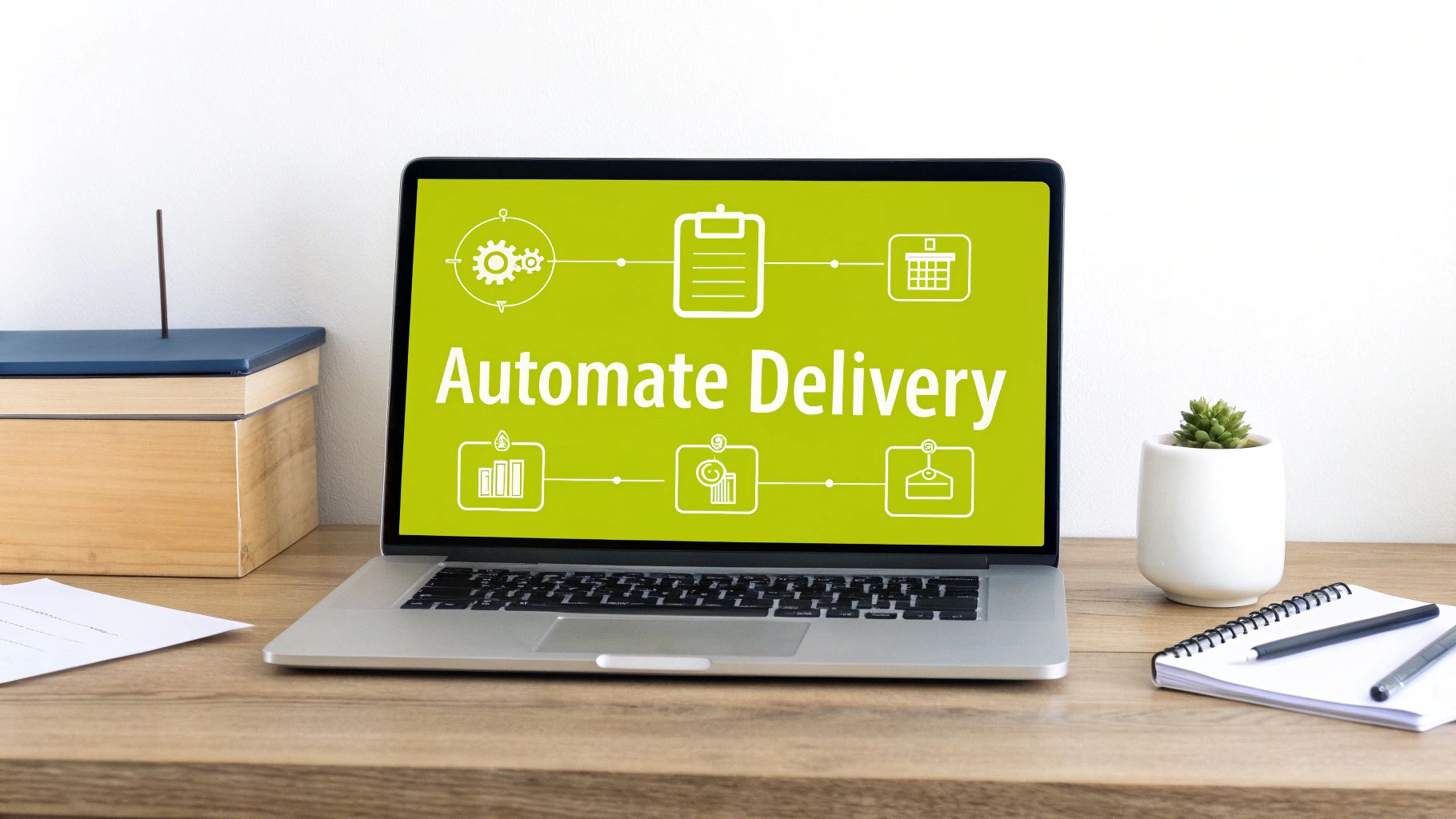
Once your processes are documented, you can bring them to life with technology. Automation is what stitches your SOPs together into a seamless workflow, triggering actions without anyone needing to lift a finger. This is how you really scale a service business—by making software do all the grunt work.
Picture this: a new client signs your proposal. That one action could kick off an entire automated chain reaction.
- The signed proposal in PandaDoc automatically triggers an invoice to be generated and sent from Stripe or QuickBooks.
- Once that invoice is paid, a Zapier integration creates a new project in Asana or ClickUp, pre-loaded with all the necessary tasks from a project template.
- At the same time, the client is added to a "New Client" list in your CRM, and they get an automated welcome email with a Calendly link to book their kickoff call.
This isn't some far-off tech fantasy; it’s a completely achievable setup for any service business today. The magic is in connecting best-in-class tools to handle all the low-value, repetitive tasks that drain your team's time and energy.
The whole point of intentional automation is to magnify human connection by getting rid of the robotic work. When you automate the admin, your team is freed up to focus on the strategic, creative, and relationship-building work that clients are actually paying for.
A Practical Example: The Automated Onboarding Workflow
Let's walk through what this looks like for a fictional social media marketing agency.
The Tech Stack:
The Workflow:
- Step 1: A lead is marked as "Won" in the CRM.
- Step 2 (Automated): This status change triggers a Zap. Instantly, the Zap creates a new client folder in Google Drive, a new project in Asana from the "Social Media Client" template, and a new private channel in Slack.
- Step 3 (Automated): The client receives a pre-written welcome email. It includes their contract, first invoice, and a link to their onboarding questionnaire.
- Step 4 (Automated): The project manager is automatically assigned a task in Asana: "Review Client Onboarding Form." The due date is set for two days after the form is submitted.
In this scenario, over 90% of the administrative side of onboarding is handled by software. This slashes human error, ensures nothing gets missed, and creates a ridiculously professional and smooth experience for the new client from the very first minute. This level of efficiency is the absolute core of a scalable service delivery model.
Hiring a Team to Get Out of the Weeds
The systems you've built are humming along, but they can't run themselves forever. This brings us to the final, and frankly, most important part of scaling a service business: you can't do it alone. It’s time to hire a team that can pull you out of the day-to-day delivery—the "weeds"—so you can finally step into the role of a true CEO.
Hiring isn't just about handing off the tasks you don't like. It's a strategic move to clone your best processes, freeing up your time for the stuff that actually grows the business, like sales, big-picture strategy, and innovation. If you skip this step, you haven't built a business; you've just built yourself a very demanding job.
Making Your First Strategic Hires
The big question isn't just when to hire, but who to hire first. And the answer almost always comes from finding the single biggest bottleneck in your business. Hint: it’s probably you.
Your first hire should take over the most time-consuming, repeatable part of your service delivery. This is the move that lets you focus on getting more clients and actually growing.
- The Specialist: Hire someone to do the thing. If you run a video editing agency, your first hire is a junior editor. If you’re a copywriter, hire another writer. This is the most direct way to increase your capacity to take on more client work.
- The Project Manager: If your delivery process has a lot of moving parts, a project or account manager could be your savior. For example, if you're a marketing agency juggling five clients, a PM can own client communication, chase down assets, and keep projects on track, which frees up a massive amount of your mental energy.
Your first hire isn't about finding a unicorn who can do it all. It's about finding a reliable person who can perfectly execute a process you've already documented. This is exactly why having your SOPs locked down before you even think about hiring is completely non-negotiable.
The Accountability Chart: A Simple Framework for Clarity
Once you start adding people, roles can get messy fast. Overlapping responsibilities lead to confusion and dropped balls. This is where an accountability chart is a lifesaver. It’s way simpler than a traditional org chart because it focuses on outcomes, not just titles.
An accountability chart defines the single person who "owns" each major function of the business. You should map this out even if you're just a team of two.
| Function | Key Accountabilities | Who Owns It? (Name) |
|---|---|---|
| Sales & Marketing | Generate qualified leads, close new clients, manage ad spend. | Founder (Jane Doe) |
| Service Delivery | Manage projects, ensure quality, handle client communication. | Project Manager (John Smith) |
| Operations | Handle billing, manage software, onboard new team members. | Founder (Jane Doe) |
| Finance | Track P&L, manage bookkeeping, handle payroll. | Outsource (ABC Bookkeeping) |
This simple document kills the "I thought you were handling that" chaos before it starts. It makes sure every critical part of the business has a dedicated owner who is on the hook for the results.
Writing Job Descriptions That Attract Top Talent
A great job description does more than just list a bunch of tasks; it sells your vision and filters for the right kind of person. Ditch the generic corporate-speak and focus on the outcomes you expect. Instead of saying "manage social media," try something like "grow client social media accounts by executing our proven content strategy to increase engagement by 15% quarter-over-quarter."
Your job post should have:
- A Compelling Mission: A quick line or two about what your company does and why it matters.
- Outcome-Oriented Responsibilities: Forget the long laundry list of daily to-dos. Focus on the 3-5 key outcomes the role is responsible for.
- Must-Have Qualifications: Be ruthless here. What are the absolute non-negotiable skills and experiences?
- Your Tech Stack: Mention the specific tools they'll live in every day (e.g., Asana, Slack, HubSpot). This is a great filter for candidates who can hit the ground running.
This approach attracts proactive, results-driven people, not just someone looking to check off boxes on a to-do list.
Training New Hires with Your SOPs
Here’s where all that work documenting your processes pays off big time. Onboarding is no longer a massive time suck that pulls you away from your real work. Your library of SOPs is now your new hire's training manual. This is how you delegate with total confidence.
Your onboarding should be a system, just like everything else.
- Day 1: Get them access to all the tools and software they'll need.
- Week 1: Assign them the SOPs for your most common tasks. Have them "shadow" you by watching Loom videos where you walk through the process, then let them try it on a sample project.
- Week 2: Give them their first small, low-risk client task. Review their work against the SOP checklist so you can give specific, actionable feedback.
Think about it: a video editing agency can onboard a new editor by giving them the SOP for "File Organization," another for "Applying Color Grades," and a third for "Final Export Settings." There's zero ambiguity. They have a clear playbook to follow, which means they can produce work that meets your high standards from day one. This systematic training is the key to finally getting out of the weeds for good.
Common Questions We Hear About Scaling
As you start putting these systems into play, you’re going to have questions. That’s normal. Scaling a service business isn't a straight line; hitting a few walls is just part of the process. Here are some of the most common hurdles founders face when they start building beyond themselves.
When Is the Right Time to Hire My First Employee?
The most obvious sign is when you’re consistently burning over 20% of your week on repeatable, low-impact tasks that someone else could easily own. But here's the key: the ideal time to hire is right before you're completely drowning, not after.
If you have steady client demand and the only thing holding back growth is your own calendar, it’s time. A smart way to ease into it is to start with a contractor or freelancer for a specific role, like a copywriter to handle two blog posts per week. This lets you test the waters, validate the role, and fine-tune your SOPs before you commit to a full-time employee, lowering the risk while proving the need.
How Do I Price Productized Services Without Losing Money?
You have to completely rewire your brain to think in terms of value, not hours. Forget asking how long something will take. The only question that matters is, "What's the tangible business outcome I'm delivering for the client?"
Start by calculating your cost of goods sold (COGS) for each package—that means all your direct labor (e.g., 10 hours of a designer's time), software costs (e.g., monthly Adobe subscription), and any associated overhead. Then, tack on your desired profit margin. You should be aiming for at least 50% to keep cash flow healthy enough to fuel more growth.
Most importantly, benchmark your price against the client's ROI. If your $5,000 "Lead Gen Accelerator" package brings in $50,000 in new business for them, your service is no longer an expense. It's an absolute no-brainer investment. Look at what competitors are charging for context, but always anchor your final price to the value you create.
Shifting from time-based billing to value-based pricing is the fundamental leap from a freelancer's mindset to a CEO's. It's how you finally detach revenue from your personal hours, which is the whole point of this playbook.
What Are the Most Critical KPIs to Track When Scaling?
As you grow, you need a simple dashboard that gives you the health of your business at a glance. Drowning in data is just as dangerous as flying blind.
For now, just focus on these five. They tell the real story of whether your business is healthy and truly scalable.
- Monthly Recurring Revenue (MRR): This is the lifeblood of any scalable service business. It creates predictable cash flow and finally ends the feast-or-famine cycle that kills so many agencies.
- Customer Acquisition Cost (CAC): How much, exactly, does it cost you to land a new client? (Total Sales & Marketing Spend ÷ New Customers). Knowing this number and keeping it low is the secret to profitable growth.
- Lifetime Value (LTV): This metric shows the total revenue you can expect from a single client. A high LTV is a clear sign that your clients are happy and your retention game is strong.
- Gross Profit Margin: This tells you how profitable your services are after you cover the direct costs of delivering them. A healthy margin is what gives you the capital to reinvest in your team, tech, and marketing.
- Client Churn Rate: What percentage of your clients are leaving each month or year? A high churn rate is a massive red flag that you have a problem with service delivery or client satisfaction that needs to be fixed immediately.
Tracking these numbers gives you the clarity to make smart, data-driven decisions instead of just guessing. Think of them as the navigation instruments for steering your business to the next level.
Ready to stop guessing and start growing with a predictable, performance-driven marketing system? At Silver Spoon Agency, we build the AI-powered ad campaigns and conversion-optimized funnels that turn your marketing spend into measurable revenue. Let us show you how we can help you scale.