


How to Scale Facebook Ads Without Wasting Your Budget

Scaling Facebook ads isn't about throwing more money at the wall and hoping something sticks. It’s a methodical process that hinges on two things: building a stable, profitable foundation with rock-solid data, and then systematically increasing your budget on campaigns that have proven themselves.
This means you need to stop guessing. Before you even think about pouring more cash into your ads, you need to know your numbers cold—specifically, your break-even ROAS and target CPA. These aren't just metrics; they're your guardrails.
Building a Scalable Foundation for Your Facebook Ads
Trying to scale ads without a solid foundation is like building a skyscraper on sand. It’s a recipe for a very expensive collapse. Before you even touch that budget slider, you have to make sure your entire ad account is structured for growth. This initial phase is less about being aggressive and more about being meticulous.
It all starts with data integrity. Your Meta Pixel and Conversion API are the central nervous system of your entire advertising operation. They feed the algorithm the critical signals it needs to go out and find more of your ideal customers. If that data is junk, you’ll end up scaling campaigns that only look profitable on the surface, which is a fast track to wasted ad spend and a whole lot of frustration.
Verifying Your Tracking and Data Accuracy
Your first job is to put on your detective hat. You need to be absolutely certain that every important action a user takes on your website is being recorded accurately. For an e-commerce brand, this is completely non-negotiable.
Practical Example: An E-commerce Data Audit
Let’s say you run an online store that sells custom pet portraits. You have to ensure the data Meta is receiving actually matches what's happening in your store.
- View Content: When someone clicks on a specific product page, does a "ViewContent" event fire? You can check this in real-time using the Meta Pixel Helper browser extension.
- Add to Cart: A customer adds a portrait to their cart. Does the "AddToCart" event register immediately? And does the value passed with that event match the product's price exactly?
- Initiate Checkout & Purchase: Go through the entire customer journey yourself. Add something to your cart, start the checkout process, and complete a test purchase. Watch your Events Manager to verify that each corresponding event—"InitiateCheckout" and "Purchase"—fires correctly with the right conversion value.
A classic mistake we see all the time is a big discrepancy between Shopify (or whatever backend you use) and what Facebook reports. If Facebook says you got 15 sales but your store only shows 10, your Pixel is likely misfiring—maybe it's firing twice on a thank you page reload. Scaling on that faulty data means you're just lighting money on fire.
Defining Your Key Scaling Metrics
Once your data is clean, you can finally trust your numbers. Now, forget about vanity metrics like clicks or impressions. Scaling is all about profit. You must define these two numbers before you spend another dollar.
- Break-Even Return on Ad Spend (ROAS): This is the ROAS you need to hit just to cover your product costs and ad spend. Anything above this number is pure profit. Knowing how to calculate Return on Ad Spend (ROAS) is fundamental to making smart scaling decisions.
- Target Cost Per Acquisition (CPA): This is the absolute maximum you are willing to pay for a new customer and still remain profitable. It's a simple calculation based on your product’s profit margin.
Practical Example: Finding Your Target CPA
Imagine you sell a skincare product for $100.
- Cost of Goods Sold (COGS): $20 (includes manufacturing, packaging)
- Shipping & Handling: $10
- Total Cost: $30
- Profit Margin Per Sale: $100 – $30 = $70
Your Target CPA must be less than $70. If you aim for a $30 profit per sale, your Target CPA would be $40. This means you can spend up to $40 to acquire one customer and still hit your profit goal.
Achieving Stability Before You Scale
The final piece of the foundation is simply patience. Meta’s algorithm needs a steady stream of data to figure out who your best customers are. This is what's known as the ‘learning phase’.
An ad set typically needs about 50 optimization events (like purchases or leads) within a 7-day window to exit this phase and find its groove.
If you start making significant edits or jacking up the budget before it gets there, you'll just reset the algorithm and force it to start learning all over again. Successful scaling is built on stable, predictable ad sets that are consistently hitting your target CPA. Once you have an ad set that's out of the learning phase and has been humming along profitably for at least 5-7 days, that's your prime candidate for scaling.
For a deeper dive into this and other core strategies, it's always a good idea to ground yourself in established Facebook ads best practices that seasoned advertisers rely on.
So, you've got campaigns that are humming along, consistently hitting your profit goals. Fantastic. Now comes the million-dollar question: how do you pour more fuel on the fire without burning the whole thing down?
Just cranking up the budget on a whim is a classic rookie mistake. It can shock the algorithm, reset all its hard-earned learning, and send your ROAS into a nosedive. The real art of scaling profitably comes down to two core strategies: Vertical Scaling and Horizontal Scaling.
Think of it like this: Vertical scaling is about going deeper with what’s already working. Horizontal scaling is about going wider to find new opportunities. Neither is "better"—they're just different tools for different jobs. The best media buyers I know are masters of both. Knowing when to pull which lever is what separates the pros from the amateurs.
The Art of Vertical Scaling
Vertical scaling is the most straightforward approach. You're simply taking your winning ad sets or campaigns and methodically increasing the daily budget.
This is your go-to move when you have a clear champion—an ad set that's well past the learning phase and has been hitting your target CPA for at least five to seven days straight. The idea is to carefully feed the algorithm more money so it can hunt down more of the same customers it's already proven it can find.
But this requires patience and discipline.
The 20% Rule: A Scaler's Best Friend
To avoid spooking the algorithm and triggering wild performance swings, the golden rule is to increase your budget by no more than 20-25% every 24-48 hours. This slow-and-steady approach gives the system time to adjust without panicking and resetting its progress.
Let's Walk Through a Real-World Example
Imagine a local dental clinic is running a lead-gen campaign for teeth whitening. One of their ad sets, spending $50/day, has been a rockstar, consistently bringing in leads for under their $40 target CPA for a solid week.
Instead of getting greedy and jumping the budget to $250, they play it smart with the 20% rule:
- Day 1: They bump the budget from $50 to $60 (a 20% increase).
- Day 2: They just watch. Performance holds steady, so they don't touch a thing.
- Day 3: With the CPA still looking good, they increase the budget from $60 to $72 (another 20% bump).
- Day 4: Monitor again.
They'll keep repeating this patient, methodical process as long as the numbers hold up. It's how you safely ramp spend and start dominating a local market. Of course, before you even think about scaling, you have to be sure you're ready. This flowchart breaks down the essential checkpoints.
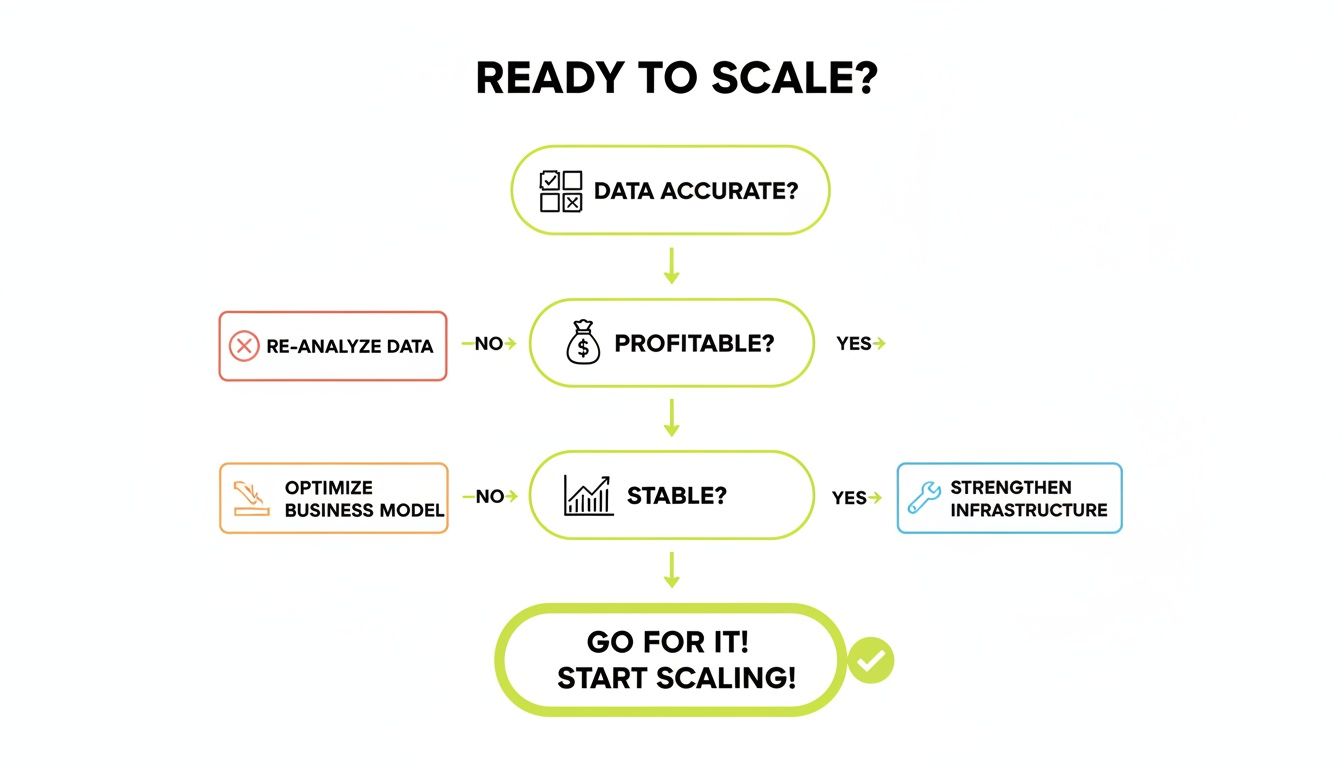
As you can see, scaling is the final step. It’s completely pointless if your data is shaky or your campaign isn't stable and profitable to begin with.
Expanding with Horizontal Scaling
While vertical scaling drills down deeper into a proven audience, horizontal scaling is all about broadening your reach by finding new audiences.
The tactic is simple: you duplicate your best-performing ad set and change one crucial variable, which is almost always the targeting. You're taking a winning ad and a winning message and testing it against a completely fresh group of people.
Horizontal scaling is the perfect play when you notice your vertically-scaled campaign is starting to show signs of fatigue—think rising CPAs or a creeping decline in ROAS. That’s usually a sign that you’re starting to saturate your current audience.
Common horizontal scaling moves include:
- Building New Lookalikes: If a 1% Lookalike of your customers is crushing it, duplicate the ad set and test a 3% or 5% Lookalike to find more people.
- Hunting for New Interests: Take your killer ad and show it to a new, but related, interest group.
- Exploring New Territories: Duplicate the ad set and target a different city, state, or even country.
Here’s How It Looks in Practice
An entrepreneur is selling an online course on public speaking. Their top ad set is targeting a 1% Lookalike audience of past buyers and doing great. To scale horizontally, they duplicate that ad set three times, keeping the ad creative identical but swapping out the audience in each new version:
- Ad Set 2 (New Lookalike): Targets a 1% Lookalike of people who watched 95% of their video ads.
- Ad Set 3 (New Interests): Targets people interested in "Toastmasters," "Public Speaking," and "Dale Carnegie."
- Ad Set 4 (Going Broad): Targets a wide-open audience in their key countries—no interests, no Lookalikes. They let the creative and the Pixel data do the work.
This strategy lets them systematically uncover entirely new pockets of profitable customers. It's a method backed by experience across the industry; as this AdMetrics analysis points out, controlled budget increases tied to strict performance rules are the key to sustainable growth. You avoid shocking the algorithm and build a much more stable, scalable ad account.
Vertical vs Horizontal Scaling At a Glance
To make the decision even clearer, here’s a quick breakdown of when to use each scaling method.
| Attribute | Vertical Scaling | Horizontal Scaling |
|---|---|---|
| Primary Goal | Go deeper into a proven, profitable audience. | Find new, untapped audiences for a proven ad. |
| When to Use It | You have a winning ad set that's been stable and profitable for 5-7+ days. | Your vertically scaled campaign's performance is starting to decline (audience fatigue). |
| Core Tactic | Methodically increase the budget of an existing ad set by 20-25% every 24-48 hours. | Duplicate a winning ad set and test a new audience (Lookalike, interest, geo, or broad). |
| Biggest Benefit | Maximizes potential from your best-performing assets with relatively low risk. | Unlocks new pockets of customers, reduces audience saturation, and diversifies your account. |
| Potential Risk | If done too aggressively, it can reset the learning phase and hurt performance. | Can increase testing costs and complexity; not every new audience will be a winner. |
Ultimately, you need both. Vertical scaling squeezes every drop of value from what you know works, while horizontal scaling is your engine for discovery and long-term growth. Mastering the interplay between the two is what profitable scaling is all about.
Fueling Your Scale with a High-Volume Creative Strategy
Once you've gotten the hang of vertical and horizontal scaling, you’ll quickly find that budgets and audiences are just two pieces of the puzzle. The single biggest lever you can pull for explosive growth in today’s AI-powered ad world is your creative. The old method of finding one "unicorn" ad and riding it into the sunset? It’s dead. To scale sustainably now, you need a completely different mindset.
You have to become a high-volume testing machine. This means building a systematic engine—what I call a “Creative Flywheel”—that’s constantly brainstorming, producing, and testing a ton of different ad variations. It’s not about hunting for one perfect ad anymore; it’s about consistently finding a dozen good ones that keep your campaigns fresh and profitable as you pour more money in.

This constant flow of new assets is exactly what Meta's algorithm needs to find new pockets of customers. The more diverse your creative library is, the more effectively the algorithm can work for you, especially as you crank up the budget and start hitting the inevitable wall of ad fatigue.
Building Your Creative Flywheel
A Creative Flywheel isn’t about random acts of creativity. It's a structured, repeatable process for churning out winning ads at scale. The whole system is built on rapid iteration across a few key variables.
Think of it like this: for every core product or offer, you should be testing multiple angles, hooks, and formats all at the same time.
- Angles: The core benefit or pain point you're hitting. Is it about convenience? Luxury? Solving an embarrassing problem?
- Hooks: The first three seconds of your ad. This could be a bold text claim, a shocking visual, or a question that stops the scroll cold.
- Formats: How you present the ad. We're talking static images, user-generated content (UGC) videos, carousels, slideshows, or slick studio-shot clips.
Practical Example: A DTC Skincare Brand
Let's imagine a direct-to-consumer brand selling an anti-aging serum. Instead of just running one ad and hoping for the best, they build a weekly testing plan to fuel their flywheel:
- Four UGC Videos: Each video features a different customer testimonial. One focuses on results after 30 days, another highlights the easy application, a third talks about sensitive skin, and the fourth is a simple unboxing.
- Four Static Ads: Each image tests a different angle. One highlights the key scientific ingredient, another shows a before-and-after, a third features a "50% off" offer overlay, and the last showcases the product's premium packaging.
- Four Carousels: Each carousel tells a different story. One walks through the product's benefits, another displays press mentions and awards, a third shows different ways to use the serum, and the final one features multiple five-star reviews.
Just like that, this brand is now testing 12 unique creatives every single week. This volume builds a deep library of proven assets, making sure they never run out of fuel for their scaled campaigns.
Why Creative Volume Is the New Scaling Secret
Truth be told, scaling Facebook ads today is less of a budget or targeting problem and more of a creative-volume problem. So many accounts are “chronically under-tested,” trying to scale with just a handful of ads that all look the same. In contrast, agencies that achieve high creative velocity—constantly iterating with 10–20 active creatives per ad set—see far better, more sustainable scalability. To really make your ads pop and perform better as you scale, it’s worth checking out these design hacks to skyrocket your ad click-through rate.
I’ve seen the impact of creative volume firsthand. One creator's cost per conversion shot up to an insane $86. Frustrated, they tossed eight new creatives into the campaign. Within 24 hours, their cost plummeted to $13.87—an 83.9% reduction. All they did was give Meta's AI more options to play with.
This is exactly why Meta’s own tools are built for volume. When you dig into what dynamic creative optimization is, you’ll see it’s designed to let you upload multiple images, videos, headlines, and descriptions so the algorithm can mix and match them to find the winning combinations. For any brand planning a major scaling push, this means you need to prepare creative pipelines in batches of 20–50 assets per month for each core offer. That’s the real secret to sustainable growth these days.
Expanding Your Reach with Advanced Audience Targeting
You can't scale to the moon on a single audience. It’s a classic mistake. Sooner or later, you'll hit a wall of ad fatigue, rising costs, and diminishing returns. To truly scale your Facebook ads, you have to get systematic about finding new, profitable customer segments who have never even heard of you.
This means moving past the comfort of a single, high-performing 1% Lookalike Audience. While that initial audience is a fantastic starting point, it's a finite pool of people. Successful scaling is all about creating a strategic, layered approach to audience expansion, where you're constantly testing new groups while protecting your budget from wasted spend.
Implementing a Tiered Lookalike Strategy
The most reliable way to find new customers is by creating Lookalike Audiences from your best existing data sources. But here’s the thing: not all data is created equal. A tiered approach lets you start with your highest-quality sources and gradually expand outward as you gain confidence.
Think of it as concentric circles of potential customers, with the highest-intent group right at the center.
- Tier 1 (Highest Intent): Start with a 1% Lookalike audience built from your most valuable customer list. This is your gold standard—think your full list of purchasers, high-AOV customers, or repeat buyers. These are people who look just like your absolute best customers.
- Tier 2 (Medium Intent): Once you've found success with Tier 1, it's time to expand to a 1-3% Lookalike. Build this from a slightly broader but still valuable action. Good sources here include people who have initiated checkout, added items to their cart, or spent the most time on your website.
- Tier 3 (Lower Intent): Finally, you can test even broader Lookalikes, like a 3-5% or 5-10% audience. These are built from larger data pools like all your social media page engagers, people who have watched 75% of your video ads, or your entire email list.
This tiered method gives you a logical roadmap for horizontal scaling. It lets you find new pockets of customers with a predictable level of quality, rather than just guessing.
Knowing When to Go Broad with Advantage+
As powerful as Lookalikes are, sometimes the smartest move is to let go of the reins. Meta's Advantage+ audiences are designed to do just that. When you have incredibly strong, high-performing ad creative, you can often trust the algorithm to find customers without narrow targeting getting in the way.
Practical Example: Advantage+ for a Proven Creative
A coffee subscription brand has a video ad that consistently gets purchases for under $20. They've already scaled it to their best Lookalike audiences. To scale further, they create a new Advantage+ campaign, give it the winning video ad, and set the targeting wide open (e.g., USA, ages 25-55). They trust that Meta's AI, armed with historical pixel data and a powerful creative, can find new coffee lovers more efficiently than another narrow Lookalike could.
Advantage+ works best when you give it strong signals—a well-seasoned Pixel with lots of conversion data and ads that you know resonate with people. The algorithm uses this information to go find people likely to convert, often discovering profitable audiences you would have never thought to target yourself. This is a key strategy for scaling once you have a library of proven creative assets.
Using Interest Stacking and Exclusions
While going broad can work wonders, refining your targeting is still crucial for efficiency. Interest stacking is a practical technique where you combine several related interests into a single ad set. The goal is to create a larger, more stable audience.
For example, instead of creating separate ad sets for "Yoga," "Lululemon," and "Meditation," you could stack them together. This gives the algorithm more room to operate and helps prevent audience overlap between your ad sets, which can drive up costs.
Equally important are exclusion audiences. You should always exclude existing customers from your prospecting campaigns. There's no point wasting money showing acquisition-focused ads to people who have already bought from you.
A simple but powerful exclusion list is a custom audience of all purchasers from the last 180 days. For subscription businesses, this is non-negotiable—you must exclude all active subscribers from campaigns promoting your introductory offer.
This tactic also plays a crucial role in your warm-audience campaigns. If you want to learn more, our guide explains in detail what is retargeting in digital marketing and how to use it effectively.
By combining tiered Lookalikes, the strategic use of Advantage+, and smart exclusions, you build a robust audience testing framework. This system ensures you're never reliant on a single audience, giving you a continuous stream of new customers to fuel your growth.
Structuring Your Campaigns for Scalable Growth
A messy, disorganized ad account is the silent killer of growth. You can have the best creatives and the most dialed-in audiences, but you’ll never scale efficiently without a clean, logical campaign structure. This is where you build the operational backbone that supports every single dollar of increased ad spend.
Thinking about your campaign structure really starts with the CBO vs. ABO debate. It's less about which one is "better" and more about which tool is right for the specific job at hand. Your choice here directly impacts how Meta’s algorithm spends your budget and, just as importantly, how it learns.

CBO vs ABO When to Use Each for Scaling
Campaign Budget Optimization (CBO) and Ad Set Budget Optimization (ABO) serve two very different strategic purposes when you’re figuring out how to scale Facebook ads. One gives you manual control, the other hands the keys to the algorithm. Knowing when to use each is a huge unlock.
To make it simple, I've broken down the most common scenarios you'll face.
CBO vs ABO When to Use Each for Scaling
| Use Case | Recommended Structure | Reasoning |
|---|---|---|
| Testing New Creatives | Ad Set Budget Optimization (ABO) | ABO gives you direct, granular control. It forces the budget to be spent on a specific ad set, ensuring your new creatives get enough spend to generate meaningful data, even if they aren't immediate winners. |
| Scaling Proven Winners | Campaign Budget Optimization (CBO) | CBO lets Meta's AI automatically allocate your budget to the best-performing ad sets and creatives in real-time. It's the perfect tool for maximizing efficiency and finding the cheapest conversions once you know what works. |
| Retargeting Campaigns | Campaign Budget Optimization (CBO) | Your retargeting audiences (e.g., website visitors, cart abandoners) vary in size and responsiveness. CBO excels here by dynamically shifting the budget to the warmest, most engaged segments, maximizing your return. |
In short, think of it this way: use ABO for control and testing, and flip the switch to CBO for automation and scaling.
A Battle-Tested Three-Campaign Structure
Top agencies don’t guess; they use a system. One of the most effective and scalable structures I've seen—and used myself—is a simple three-campaign setup that organizes your entire account by its core objective: Test, Scale, and Retarget.
- Testing Campaign (ABO): This is your lab. It's an ABO campaign where you exclusively test new creatives and audiences. By setting budgets at the ad set level, you guarantee each new variable gets a fair shot to prove itself without having its budget stolen by a current winner.
- Scaling Campaign (CBO): This is your workhorse. It's a CBO campaign that contains only your validated, top-performing creatives and audiences. Once an ad proves profitable in your Testing campaign, you "graduate" it to this CBO campaign, where Meta’s algorithm can efficiently pour fuel on the fire.
- Retargeting Campaign (CBO): This campaign focuses solely on your warm audiences. It uses CBO to dynamically serve your best ads to high-intent groups like website visitors, video viewers, and people who have abandoned their carts, keeping your brand top-of-mind and closing sales.
This separation is absolutely critical. It prevents new, unproven ads from siphoning the budget away from your reliable winners, giving you a clear, data-driven system for managing creative performance and scaling budgets with confidence.
Automate Your Growth with Rules
Managing a scaling ad account can feel like a full-time job. This is where Meta's Automated Rules become your secret weapon, letting you manage the account on autopilot based on performance data.
Instead of nervously checking your ads every morning, you can create rules to handle the routine tasks. This saves you a ton of time and, more importantly, prevents emotional, knee-jerk decision-making.
For instance, you can create a rule to automatically increase the budget on your most profitable ad sets. Here’s a ready-to-use template you can set up right now:
- Rule Name: Daily Budget Increase – Profitable Ad Sets
- Apply Rule To: All active ad sets in your "Scaling Campaign"
- Action: Increase daily budget by 15%
- Conditions:
- Cost per Result is less than your target CPA (e.g., $25)
- Spend is greater than $50
- Time Range: Yesterday
- Schedule: Every day at 6:00 AM
With this single rule, you’ll wake up every morning knowing your best ad sets have already received a budget boost. Your money is always working its hardest for you, even before you've had your first cup of coffee.
Got Questions About Scaling Facebook Ads?
Even with the best plan, scaling up your Facebook ads can feel like walking a tightrope. A lot of questions pop up when you start pushing the budget. Let's tackle the most common ones I hear from advertisers so you can move forward with confidence.
How Do I Know It's Really Time to Scale?
This is the big one. The excitement of a good sales day can make you want to dump more money into an ad, but that's a classic mistake. You're ready to scale only when you have stable, profitable results for at least 5-7 consecutive days. One great day is an anomaly; a full week is a trend. The algorithm has found its rhythm, and now you can work with it.
Look for these green lights:
- You're Out of the "Learning" Phase: Your ad set has hit around 50 conversions in the last week and Meta isn't flagging it as "Learning" anymore.
- Your CPA is Behaving: Your Cost Per Acquisition (CPA) is consistently staying under your target. It's not just profitable, it's predictably profitable.
- ROAS is Solidly in the Black: Your Return on Ad Spend (ROAS) isn't just hovering over your break-even point; it's comfortably above it day after day.
What's the Single Biggest Mistake People Make When Scaling?
Scaling too fast. It’s the number one killer of winning campaigns.
It's tempting to see a great ROAS and immediately double or triple the budget, but this shocks the system. The algorithm, which was working so beautifully for you, gets thrown for a loop, often forcing it right back into the learning phase. All that momentum you built? Gone. Performance tanks. Patience is the name of the game here.
Running a very close second is scaling without a pipeline of fresh creatives. Your best ad right now will get old. Audience fatigue is inevitable. If you don't have new, tested ads ready to swap in, you'll have nothing to maintain momentum when your current winner starts to fade.
"Every Time I Increase My Budget, My ROAS Plummets. What Gives?"
A small dip in ROAS as you scale is normal, but it should be a controlled descent, not a nosedive. If your profitability craters every time you bump up the spend, it's a flashing red light that your scaling method is off.
First things first, check your pace. Are you following the 20% rule? You should never increase a campaign's budget by more than 20% every 24-48 hours. This slow-and-steady approach gives the algorithm time to adjust and find new pockets of customers without triggering a complete reset.
If you're already scaling gradually and still seeing a huge drop, you're likely hitting audience saturation. You're showing the same ads to the same people too many times, and they're tuning you out. It's time to give the campaign some fresh fuel.
Here’s the playbook:
- Rotate in new, validated creatives. Swap your tired ads for fresh ones that you've already tested and proven.
- Expand your targeting horizontally. Test a 3% lookalike audience instead of just your 1% lookalike.
- Go broader. Cautiously remove one of your more restrictive targeting layers and give the algorithm more room to explore and find new buyers.
If your ROAS still won't recover after trying these steps, it's time to pull the budget back. Go back to the drawing board and focus on testing completely new offers or finding different customer segments to go after.
Navigating the complexities of scaling requires a data-driven approach and relentless optimization. At Silver Spoon Agency, we turn advertising into measurable growth by combining AI-powered strategies with omnichannel expertise. If you're ready to move beyond guesswork and achieve predictable, scalable results, let's talk.
Discover how we can elevate your campaigns at silverspoonagency.com