


A Practical Guide to Lead Generation for Small Business

Generating leads for your small business isn't about casting the widest net possible. It’s about building a smart, systematic way to attract people who are genuinely interested in what you do and turning them into paying customers. This means ditching the random, sporadic efforts and creating a reliable engine for growth.
Your Blueprint for Sustainable Small Business Growth
For a lot of small business owners, the daily grind feels more like a scramble than a strategy. You might boost a post on social media one week, then send out a few emails the next, but these one-off actions rarely deliver predictable results. Real, sustainable growth comes from an omnichannel approach, where every channel you use works together, guiding potential customers smoothly from discovery to purchase.
This isn't some high-level strategy reserved for giant corporations with monster marketing budgets. Think about a local bakery: they could run a targeted Instagram ad showing off a new cake design, which leads people to a landing page offering a 10% discount in exchange for their email. From there, automated emails can announce weekly specials and new flavors. Every step feels connected, turning a casual Instagram scroller into a loyal, repeat customer.
Building Your Omnichannel Foundation
The whole point is to create multiple touchpoints that reinforce each other. Instead of putting all your eggs in one basket, you build a resilient system. If one channel has a slow month, the others are still working to bring in business. This integrated strategy is the key to generating predictable revenue and scaling your business without the constant stress.
To get started, let’s build out your toolkit.
Your Omnichannel Lead Generation Starter Kit
Here's a quick look at the essential channels every small business should consider and the specific role each one plays in bringing you new customers. This isn’t about doing everything at once, but about understanding how each piece contributes to the bigger picture.
| Channel | Primary Role in Lead Generation | Example Tactic for a Local Business |
|---|---|---|
| Search (SEO & Local SEO) | Capture high-intent leads actively looking for your solution. | A plumber optimizes their Google Business Profile to rank for "emergency plumber near me." |
| Social Media | Build community, generate initial awareness, and drive top-of-funnel interest. | A boutique clothing store uses Instagram Reels to showcase new arrivals, linking to product pages. |
| Email & SMS Marketing | Nurture interested leads, drive repeat business, and build long-term loyalty. | A coffee shop sends a weekly email with a "secret" menu item for subscribers only. |
| AI-Powered Tools | Automate outreach, personalize communication, and optimize campaign performance. | A local gym uses an AI chatbot on its website to answer questions and book free trial classes 24/7. |
Each of these channels on its own has value, but when you make them work together, the results are so much more powerful. You’re creating a seamless experience that meets your customers wherever they are.
An omnichannel strategy ensures your marketing efforts are more than just the sum of their parts. It creates a unified brand experience that meets customers wherever they are, building the trust and familiarity needed for conversion.
For small businesses that are serious about growth but might not have the in-house team to manage it all, looking into outsourcing lead generation services can be a game-changer. It lets you tap into expert knowledge to build and run this engine for you, so you can focus on running your business. This guide will walk you through exactly how to build that system yourself.
Designing a High-Converting Customer Funnel
Having a plan is one thing, but building the actual machine that turns curious onlookers into loyal customers? That's a different game entirely. This machine is your customer funnel—a structured journey you design to guide people from their first "hello" with your business to the moment they pull out their wallet.
It’s not about manipulation; it's about being genuinely helpful every step of the way.
A well-designed funnel is the beating heart of your lead generation. It ensures you don't just attract random traffic but methodically turn that attention into revenue. Each stage has a specific job, and when they all work together, the process feels natural for the customer and is incredibly effective for you. Let's walk through the four critical stages with some practical, real-world applications.
The Awareness Stage: Attracting the Right People
This is the top of your funnel, the wide-open entrance where potential customers first realize you exist. More importantly, they realize you might just have a solution to their problem. The goal here isn't a hard sell. It's to provide real value and attract an audience with relevant, helpful content that solves problems, not just pushes products.
For a small business, this usually means showing up on search engines and social media—precisely where your ideal customers are already looking for answers.
Practical Example: A Local Accounting Firm
Imagine a local accounting firm wants to attract more small business owners. Instead of running ads that scream "Hire Us!", they can create a series of SEO-optimized blog posts on topics their audience is already searching for.
- "5 Common Tax Deductions Small Businesses Miss"
- "A Simple Guide to Understanding Your P&L Statement"
- "Quarterly Tax Deadlines for Freelancers You Can't Ignore"
By publishing this kind of content, the firm positions itself as a knowledgeable expert. When a local entrepreneur searches for tax tips on Google, the firm’s blog pops up. This creates a powerful first impression and makes the searcher aware of their services without a single sales pitch.
This diagram shows a simplified flow of how you can attract, nurture, and convert omnichannel leads.
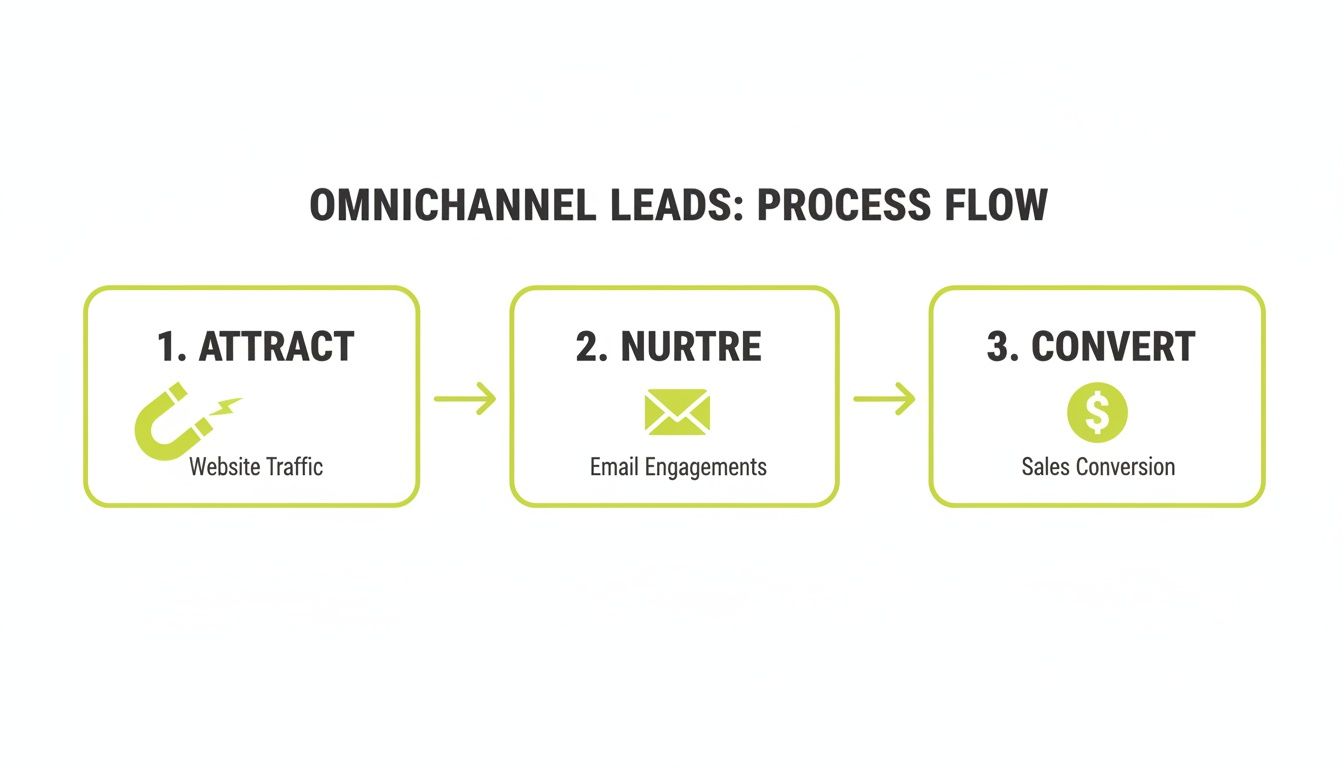
This visual reinforces a key idea: lead generation is a multi-step process, not a single event. A structured funnel is everything.
The Interest Stage: Capturing Contact Information
Okay, you've grabbed someone's attention with great content. Now what? The next challenge is to hold that attention and, crucially, earn the right to contact them again. This is the moment a passive observer becomes an active lead.
The key is to offer something so valuable they're happy to trade their email address for it. We call this a lead magnet, and it has to be the perfect next step from the content they just consumed. It should offer a deeper, more actionable solution to the problem you've already started solving for them.
A great lead magnet doesn't just offer more information; it offers a shortcut. It should be something your audience can use immediately to get a small but meaningful win.
Practical Example: The Accounting Firm's Lead Magnet
After reading the blog post on tax deductions, the visitor is clearly interested in one thing: saving money on taxes. The accounting firm can now offer the perfect next step—a free, downloadable "Small Business Tax Checklist."
This checklist is a killer lead magnet because it's:
- Highly Relevant: It’s a direct follow-up to the blog post's topic.
- Actionable: The business owner can use it right now to review their finances.
- Valuable: It provides tangible value and quietly showcases the firm's expertise.
To get the checklist, the visitor enters their name and email into a simple form on the page. Just like that, a random website visitor has become a qualified lead in the firm's system.
The Decision Stage: Building Trust and Authority
Now that you have their contact information, the relationship-building begins. In the Decision stage, your goal is to build trust and prove why you are the absolute best choice to solve their problem. This is where automated email sequences shine, allowing you to deliver value consistently over time without lifting a finger for each lead.
This isn't the time for a constant barrage of sales pitches. Your focus should be on education and proof. Share case studies, client testimonials, and helpful tips that tackle common objections and build unshakable confidence in your brand. To really nail this, you can explore how to build a marketing funnel in more detail.
Practical Example: The Accounting Firm's Nurture Sequence
The business owner who downloaded the tax checklist now gets a short, automated email sequence over the next couple of weeks.
- Email 1: A client testimonial from another local small business, sharing how the firm helped them save $5,000 on their taxes last year. (Social proof!)
- Email 2: A short video tip from the head accountant explaining a common bookkeeping mistake and how to avoid it. (Demonstrates expertise!)
- Email 3: An invitation to a free webinar on "Financial Planning for Small Business Growth in the Next Quarter." (Offers more value!)
This sequence masterfully builds trust by providing proof and more help, keeping the firm top-of-mind without ever feeling pushy.
The Action Stage: Making it Easy to Buy
Finally, after you’ve provided value and earned their trust, it’s time to ask for the sale. The Action stage is where you present a clear, compelling offer and make it ridiculously simple for the lead to become a customer. Every single element here—from your landing page to your call-to-action (CTA) button—should be designed to remove friction and make saying "yes" a no-brainer.
Your CTA needs to be specific and highlight a benefit. Instead of a generic "Contact Us," try something like "Book Your Free 15-Minute Tax Savings Analysis." See the difference?
Practical Example: The Accounting Firm's Final Offer
The last email in the nurture sequence, as well as the webinar landing page, features a clear and prominent CTA: "Book a Free Consultation."
When a lead clicks that button, they land on a simple page with just a few key elements:
- A concise headline that reiterates the value ("Discover How We Can Optimize Your Business Finances").
- A few bullet points summarizing what they'll get from the consultation.
- A simple calendar booking tool to schedule a meeting instantly.
By making the final step this easy, the firm maximizes its chances of converting a warmed-up, high-interest lead into a paying client. This completes the journey from a curious searcher to a brand-new customer.
Mastering the Most Powerful Lead Channels
So, you've designed your funnel. Now for the million-dollar question: where do you actually find these leads? Pouring time and money into the wrong channels is one of the fastest ways to kill your momentum. Smart lead generation isn't about being everywhere; it's about being in the right places with a message that connects.
Let's break down the channels that consistently deliver the best bang for your buck, with real-world tactics you can put to work today.
Harnessing Social Media for B2B and B2C Wins
Social media is not a monolith. The platform you choose—and how you use it—needs to align perfectly with the audience you're trying to reach. A strategy that crushes it for a local boutique will fall flat for a B2B consultant. The real secret is understanding the user's mindset on each platform.
Practical Example: B2B Consultant on LinkedIn
Imagine a management consultant trying to land corporate clients in the tech industry. Their home turf is LinkedIn, the undisputed king of professional networking. Instead of just posting generic company updates, they should be writing in-depth articles on topics like "Scaling Agile Teams Without Sacrificing Quality."
This approach hits several key objectives:
- It demonstrates deep expertise. They’re proving they understand the specific, nagging challenges their target clients face.
- It attracts decision-makers. VPs of Engineering and CFOs are actively hunting for this kind of insight on LinkedIn.
- It starts real conversations. The articles become a natural icebreaker for connection requests and direct messages.
The goal isn't to go viral; it's to attract a small number of high-value prospects. For a deeper dive, check out our guide on effective LinkedIn lead generation.
Practical Example: Local Boutique on Instagram
Now, let's flip the script. A local fashion boutique needs to drive foot traffic and online sales. Their playground is Instagram, a visual-first space practically built for showing off products. The key here is using Instagram Stories to create urgency and direct engagement.
A killer tactic is a "New Arrivals Tuesday" series. Using short video clips, they can show off new dresses and accessories. By adding interactive polls ("Which color do you love?") and a "DM for size availability" call-to-action, they spark immediate conversations. This approach feels authentic and immediate, turning passive followers into active shoppers.
Winning with Search Engine Marketing
When someone types a question into Google, they often have an immediate, pressing need. This makes search one of the most potent channels for capturing high-intent leads. A smart strategy here is a one-two punch: paid ads for quick wins and organic content for sustainable, long-term growth.
The data doesn't lie. While many businesses spin their wheels, those who get social and search right see huge gains. Recent analysis shows that 68% of marketers generate more leads through social platforms, and LinkedIn alone is credited with driving a staggering 80% of B2B leads. These aren't just vanity metrics; they translate directly into revenue.
Paid Search for Instant Leads
Google Ads can feel like a beast, but a hyper-focused local campaign can deliver results almost overnight. The trick is to bid on keywords that scream commercial intent.
Practical Example: A Landscaping Company
A landscaping business needs to book jobs for the spring season right now. They can run a Google Ads campaign targeting ultra-specific, local keywords:
- "lawn care services near me"
- "landscaper in [Your City]"
- "spring garden cleanup [Your Zip Code]"
The ad sends searchers to a clean, simple landing page with a big phone number and a "Get a Free Quote" form. This strategy cuts through the noise and connects the business directly with people ready to open their wallets today.
Content Marketing for Long-Term Authority
While paid ads give you a quick burst of speed, search engine optimization (SEO) builds a lasting asset. By creating genuinely helpful content that answers your audience's burning questions, you can attract organic traffic for months, even years.
Practical Example: The Same Landscaping Company
Alongside their paid ads, the landscaping company can build long-term authority by publishing SEO-optimized blog posts. Think of a content hub built around "Seasonal Garden Prep," with articles like:
- "When to Plant Tulips in [Your State]"
- "The Ultimate Fall Lawn Care Checklist"
- "5 Drought-Resistant Plants That Thrive in [Your Region]"
This content attracts homeowners who are still in the research phase. They might not be ready to buy today, but the landscaping company has positioned itself as the trusted expert. When it's finally time to hire someone, who do you think they'll call first?
Your long-term SEO strategy builds the foundation, attracting a steady stream of organic traffic. Your short-term paid ads act as the accelerator, capturing immediate demand and driving revenue when you need it most.
Driving Repeat Business with Email and SMS
Your existing customer list is a goldmine. Email and SMS are your direct lines for nurturing those relationships and driving repeat business—often for pennies on the dollar compared to acquiring a new customer. The game is all about delivering timely, relevant, and valuable messages.
A re-engagement campaign is the perfect play to bring lapsed customers back into the fold. It shows you've noticed they're gone and gives them a compelling reason to return.
Practical Example: A Local Coffee Shop
A coffee shop sees that a chunk of its loyalty members hasn't visited in over 30 days. It's time to win them back with a targeted email and SMS campaign.
The Re-Engagement Template
- Email Subject Line: We've Missed You at [Coffee Shop Name]!
- Email Body:
"Hi [Customer Name],
It's been a little while since we've seen you, and the espresso machine is getting lonely! We've been busy brewing up some exciting new seasonal drinks we think you'll love.
As a little nudge to come say hello, your next coffee is on us. Just show this email to your barista." - The Offer: A QR code for one free beverage, valid for the next 7 days.
- SMS Follow-Up (2 days later):
"Hey [Customer Name]! Just a friendly reminder that your free coffee from [Coffee Shop Name] is waiting for you. Don't miss out! Offer expires in 5 days."
This simple, personal campaign makes the customer feel valued. More importantly, it provides an irresistible, low-friction offer to get them back in the door, effectively turning a cold lead warm again.
Using AI and Advanced Tactics for a Competitive Edge
To really get an edge in lead generation, you have to think beyond the standard playbook. This is where you can leapfrog the competition—even with a smaller budget—by grabbing onto accessible technologies that pack a serious punch. These aren't far-off concepts; they're practical tools you can start using today.
Take Artificial Intelligence (AI). It's no longer just for massive corporations. For a small business, the right AI tools can act as your most powerful marketing assistant, helping you personalize campaigns, automate follow-ups, and even get a sense of customer behavior without needing a data science degree.
Imagine you run a busy HVAC company. Calls come in while you're on a job, and every missed call is a lost lead. A game-changer here is an AI phone answering service. This tech ensures every call gets answered 24/7, appointments are booked, and lead info is captured. It turns a potential weakness into a massive strength.
Hyper-Local Strategies with Geofencing
For any business with a physical location, one of the most effective tactics you can pull out is geofencing. This location-based tech lets you create a virtual "fence" around a specific spot. When a potential customer who has your app or has opted into location services walks into that zone, it triggers an action—like sending them a push notification or a text.
This is your chance to deliver the perfect offer at the exact moment a customer is most likely to act on it. It’s direct, immediate, and incredibly relevant.
Practical Example: The Pet Grooming Salon
Let's see this in action. A local pet groomer wants to pull in more customers from a popular dog park just down the street.
- Set the Virtual Fence: They use a geofencing platform to draw a virtual perimeter around the dog park.
- Craft the Offer: They put together a simple, time-sensitive offer: "Enjoying the park? Treat your furry friend! Show this for 15% off a wash & dry today. We're just around the corner!"
- Trigger the Action: When someone with the salon's loyalty app enters the park, the geofence triggers a push notification with the offer, right to their phone.
This is brilliant because it targets people who are literally in the middle of a related activity—playing with their dog—making them incredibly receptive to a grooming offer.

Immersive Experiences with Augmented Reality
Another powerful tool, especially for e-commerce or home goods businesses, is Augmented Reality (AR). AR technology overlays digital information or virtual objects onto the real world through a smartphone. For a customer, this means they can actually see a product in their own space before they buy it.
This immediately knocks down one of the biggest hurdles in online shopping: uncertainty. When someone can see how that new sofa looks in their living room, their confidence to click "buy" goes through the roof. And the best part? You can build lead capture right into the experience.
Practical Example: The Online Furniture Store
An online furniture store is looking to cut down on returns and boost sales for a new line of sofas. They add a simple "View in Your Room" AR feature to their product pages.
- A customer browsing on their phone taps the button.
- Their camera opens, and they can "place" a true-to-scale 3D model of the sofa right in their living room.
- They can walk around it, check the fit, and even swap out the fabric color in real time.
Once they've visualized the product, a pop-up appears: "Looks great, right? Enter your email to save this design and get a free fabric swatch kit." The customer, now highly engaged and invested, happily types in their email. You just turned a passive browser into a hot lead who has already mentally moved your product into their home.
These advanced tools are critical for getting a read on customer intent, which is a key part of modern marketing. You can dive deeper into this by exploring predictive marketing analytics.
By embracing these advanced tactics, you're not just generating leads; you're creating memorable, high-impact experiences that build a stronger connection with your audience and set your business apart from the competition.
Budgeting and Measuring Your Lead Generation ROI
Let's be blunt: a lead generation plan without a budget and clear metrics isn't a strategy—it's just wishful thinking. To get predictable growth, you have to know exactly where your money is going and what it’s bringing back. This is the financial discipline that separates the businesses that scale from those that stagnate.
First things first, how much should you even spend? A solid starting point for most small businesses is to earmark 7-12% of your total revenue for marketing. If you’re pushing hard for growth or dropping a new product, you might need to dial that up. The trick is to see this budget as a flexible tool for discovery, not just another line item expense.
How to Slice Up Your Marketing Budget
Don't just spread your dollars evenly and hope for the best. You need a strategic allocation that matches your goals. Here’s a practical way to think about your mix:
- Immediate Lead Flow (40%): This is your paid advertising budget. Think Google Ads, LinkedIn campaigns, or targeted social ads that get the phone ringing now and give you immediate data to work with.
- Long-Term Asset Building (30%): This is your investment in content. It covers the blog posts, videos, and guides that build your authority, boost your SEO, and pull in organic leads for months and years to come.
- The Tech Stack (20%): You'll need the right tools. This covers your CRM, email marketing platform like Mailchimp, and any analytics or AI software that makes the whole system hum.
- The "What If" Fund (10%): Always, always set aside a piece of the pie for experiments. This is where you test a new ad channel, a different type of creative, or an unproven tactic. Your next big win is probably hiding in this slice.
The Few KPIs That Truly Matter
Once you’re spending money, you need to track the Key Performance Indicators (KPIs) that actually mean something for your bank account. Forget vanity metrics like social media likes. Focus on the numbers that translate directly to revenue.
The single most important number in lead generation is your Cost Per Lead (CPL). It tells you, in plain dollars, what you’re paying to get a single potential customer's contact info. Knowing your CPL is the first real step to building a profitable marketing machine.
Getting a handle on your CPL is critical because costs can be all over the map depending on your industry. Some businesses can get leads for pennies, but the average B2B CPL can hit $310 for paid ads and skyrocket to $385 for IT services.
On the flip side, channels like SEO and retargeting can drop that CPL down to as low as $31. This huge range, detailed in lead gen stats from sources like Keywordseverywhere.com, proves why a balanced, multi-channel approach is so important.
Let's Make This Real: A Practical Example
Imagine you're a freelance graphic designer trying to land new clients. You decide to run a LinkedIn ad campaign.
Here's the breakdown:
- Total Ad Spend: $500
- Leads Generated: 10 (people who filled out your "Request a Quote" form)
The CPL calculation is dead simple:
$500 (Ad Spend) / 10 (Leads) = $50 CPL
Now you know it costs $50 to get one qualified lead from LinkedIn.
If you close 2 of those 10 leads, and each project is worth $1,000, you’ve just turned $500 into $2,000. That's a home run. But if you close zero leads? You know immediately that you need to tweak your ad targeting, your offer, or your landing page. This simple math gives you the power to invest with confidence and see the direct line between your marketing spend and your revenue.
Got Questions About Lead Generation? We’ve Got Answers.
Even the best-laid plans come with questions. When you're diving into lead generation for your small business, it can feel like you're the only one hitting certain roadblocks, but I promise you're not. Thousands of other owners have been in your exact shoes.
Here are some straight, jargon-free answers to the questions that come up most often.
How Much Should a Small Business Spend on Lead Generation?
There's no single magic number here, but a smart place to start is allocating 7-12% of your total revenue. If you're a new business and you're serious about growth, you might even want to push that number a little higher. The real key is to think of your budget as a flexible tool for discovery, not some rigid expense you're locked into.
For instance, you could earmark a small test budget—say, $500—for a month of Google Ads. At the end of the month, look at your Cost Per Lead (CPL) and see how many of those leads actually turned into customers. If you're seeing a positive return, you now have hard data telling you it's safe to scale up. If not? No big deal. Just re-allocate that same budget to test another channel, like targeted social media ads or content marketing.
What Is the Fastest Way to Get Leads for My Local Service Business?
When you need high-intent leads right now, nothing beats Google Local Services Ads and sharply targeted Google Search Ads. These aren't just ads; they're direct lines to people who are actively looking for exactly what you do. Think "emergency plumber in Dallas" or "best rated salon near me." They're practically raising their hands.
To make sure you don't waste this traffic, send them to a dead-simple landing page. It needs a crystal-clear call-to-action and your phone number front and center.
The most critical piece of this puzzle is speed. A lead is never hotter than in the first few moments after they reach out. Your goal should be to respond to every single inquiry within five minutes. That’s how you turn active searchers into booked jobs.
Should I Focus on SEO or Paid Ads First?
This is a classic question, and the most effective answer is to use both, because they do two different jobs that support each other perfectly.
- Paid Ads (PPC): This is your accelerator. It brings in immediate traffic and, more importantly, immediate data. It’s what you use to generate revenue now while learning which messages and keywords actually get people to pull out their wallets.
- Search Engine Optimization (SEO): This is your long-term asset. Think of it like building a piece of real estate. It creates a sustainable, low-cost river of organic leads that flows to you over time.
A really powerful way to combine them is to use your paid ad campaigns as a testing ground. Find out which keywords and offers convert the best, then take those proven winners and bake them into your SEO strategy. You can build blog posts and service pages around those keywords, essentially using your short-term ad spend to build a stronger long-term growth engine.
What Is the Single Biggest Mistake to Avoid?
By far, the most common and costly mistake I see is failing to follow up with leads quickly and consistently. A potential customer's interest is at its absolute peak the very moment they hit "submit" or dial your number.
Study after study has shown that contacting a new lead within five minutes increases your odds of converting them by a massive margin. It doesn't matter if it's an automated email, a quick text, or a direct phone call. Having a system for immediate follow-up is often more important than the channel you used to get the lead in the first place. Don't let your hard-earned leads go cold.
Ready to stop guessing and start growing with a predictable lead generation system? At Silver Spoon Agency, we build data-driven, omnichannel campaigns that turn advertising into measurable revenue. Book a free consultation today and discover how we can deliver a steady stream of qualified leads to your business.