


Your Guide to Lead Generation for Small Businesses

Lead generation is simply the lifeblood of a small business. It's the engine you build to find, attract, and ultimately convert curious onlookers into paying customers. The real goal is to create a reliable, predictable pipeline of quality leads—people who are genuinely interested in what you do. Get this right, and you've got the fuel for sustainable growth.
Your Blueprint for Sustainable Small Business Growth

Putting all your faith in one source for new customers is a disaster waiting to happen. An unexpected algorithm change or a sudden shift in market trends can leave your business high and dry. A modern, resilient approach to lead generation for small businesses means building a diverse system where multiple channels work together, feeding you a steady stream of prospects.
This isn't about chasing every shiny object or getting bogged down in endless tasks. It's about building an efficient machine. The entire idea is to escape the feast-or-famine cycle and establish a revenue engine you can count on. By blending the right strategies, you can consistently attract customers who are actively searching for your solutions, nurture their interest, and gently guide them toward making a purchase.
Why a Multi-Channel Approach Matters
When you spread your efforts across different platforms, you create a powerful safety net and amplify your message at the same time. Think about it: a potential customer might first find you through a specific Google search, see one of your ads on social media a day later, and then decide to sign up for your email list. Each touchpoint builds familiarity and trust, making them far more likely to convert.
This integrated approach isn't just more effective—it's smarter for your budget. In fact, multi-channel marketing campaigns can achieve a 31% lower cost per lead compared to single-channel efforts. With 45% of businesses admitting they struggle to generate enough leads and 42% citing poor lead quality as a major headache, a unified strategy is your key to getting ahead.
To give you a clearer picture, let's break down the most common and effective channels small businesses are using to build their lead generation systems.
Key Lead Generation Channels for Small Businesses
This table provides a quick overview of the top channels, what they're best used for, and the type of business that can benefit most from each one.
| Channel | Best For | Primary Goal |
|---|---|---|
| Search (SEM/SEO) | Capturing high-intent customers actively looking for a solution. | Immediate lead generation, local visibility. |
| Social Media | Building brand awareness, community, and targeting specific demographics. | Top-of-funnel engagement, relationship building. |
| Local Search | Service-area businesses needing to attract nearby customers. | Driving phone calls, appointments, and foot traffic. |
| Email & SMS | Nurturing existing leads and communicating directly with your audience. | Lead nurturing, re-engagement, direct offers. |
Each of these channels plays a unique and vital role. The real magic happens when you get them working together in a coordinated playbook.
The Core Components of Your Playbook
Your strategy will almost certainly be a mix of these channels, each with a specific job to do in your customer's journey.
Search Engine Marketing (SEM): This is where you capture people who are ready to buy. They're actively typing their problems into Google. Think of ads targeting keywords like "emergency plumber near me" or "best accounting software for startups." These are hot leads.
Social Media Marketing: Use platforms like Facebook, Instagram, or LinkedIn to build a community around your brand. It's the perfect place to engage with potential customers, share your expertise, and run highly targeted ad campaigns based on demographics, interests, and online behavior.
Email and SMS Marketing: These direct lines of communication are gold for nurturing relationships. Once you've captured a lead, email and text are how you stay top-of-mind. To really get this right, you need to understand how to use text messaging to generate leads without being intrusive.
The core principle is simple: Don't put all your eggs in one basket. By building a system where search, social, and direct outreach work in harmony, you create a resilient and scalable growth engine for your small business.
Choosing Where to Find Your Best Customers
With a small business budget, every single marketing dollar has to pull its weight. The secret to getting more leads isn't about blasting your message across every platform you can think of. It’s about showing up on the right platforms—the ones where your ideal customers are already hanging out, actively looking for what you offer.
Picking your channels with purpose is the difference between a campaign that flops and one that delivers a steady stream of qualified leads.
Before you even think about running an ad, you need to get laser-focused on who you're trying to reach. A deep, almost obsessive, understanding of your customer's habits, their biggest frustrations, and where they spend their time online is the bedrock of any marketing that actually works. We've put together a detailed guide on how to create buyer personas that will walk you through this process, helping you pinpoint exactly where your audience lives online.
Once you know your customer inside and out, you can start matching their behavior to the strengths of each marketing channel. This isn't a guessing game. It's about making a smart, informed decision based on your specific business goals.
Matching Your Business to the Right Platform
Different channels are built for different jobs. Some are incredible for grabbing the attention of people who are ready to buy right now. Others are better for building a community and nurturing relationships over the long haul.
Let's break down the main players and see where your business fits.
Google Ads (Search): This is your go-to for capturing high-intent leads. Think about it: when someone types a query into Google, they have a problem and they're actively searching for the solution. This makes it a powerhouse for service businesses that solve urgent needs.
- Real-World Example: An electrician in Phoenix wants more emergency calls. They can run a Google Ad campaign targeting keywords like "emergency electrician Phoenix" or "24-hour electrical repair near me." When a homeowner's lights flicker and die at 10 PM, that ad is the first thing they see. The result? An immediate, qualified phone call from someone who needs help now.
Social Media (Facebook, Instagram, LinkedIn): These platforms are perfect for building a community and zeroing in on specific demographics. You can target people based on their interests, recent life events, job titles—you name it. This is gold for e-commerce brands, B2B services, and any business with a strong visual or community vibe.
- Real-World Example: An online shop selling sustainable yoga apparel wants to reach eco-conscious women between 25 and 40. They can run Instagram Story ads showing off their new collection, targeting users who follow well-known yoga instructors and environmental influencers. The "Shop Now" button sends users straight to the product page, creating a frictionless path from seeing the ad to making a purchase.
Your goal isn't to master every single channel. It's to find the one or two that give you the most direct path to your ideal customer, prove you can be profitable there, and then think about expanding.
Maximizing Local and Direct Channels
For so many small businesses, your best customers are right around the corner or already in your contacts. Don't sleep on these incredibly powerful—and often low-cost—channels.
Google Business Profile (GBP)
For any local business, your Google Business Profile is arguably your most important marketing tool. It’s your digital storefront on Google Search and Maps. Keeping it optimized isn't optional; it's essential for grabbing the attention of nearby customers. A well-managed profile can drive phone calls, website visits, and foot traffic without you spending a dime on ads.
Real-World Example: A new coffee shop opens in Austin. By decking out their GBP with high-quality photos, a detailed description, accurate hours, and actively asking for reviews, they quickly start showing up for searches like "best coffee near me." A potential customer sees their 4.9-star rating, gets directions, and walks in the door—all directly from the search results.
Email & SMS Marketing
These are your direct lines of communication. Unlike social media, you own your email and SMS lists. This makes them unbelievably reliable for nurturing leads who’ve already raised their hand and for driving repeat business from happy customers. In fact, some studies show nurtured leads make 47% larger purchases.
- Real-World Example: A local gym uses a "Free 1-Day Pass" offer on their website to collect email addresses. When someone signs up, they're automatically entered into a 3-part welcome email series. The first email delivers the pass, the second shares a client's success story, and the third presents a limited-time discount on a monthly membership. This simple, automated sequence builds trust and gently nudges the prospect toward becoming a paying member.
A Simple Evaluation Framework
Feeling a bit overwhelmed? Use this quick checklist to cut through the noise and make a smart decision about where to invest your time and money.
| Platform Consideration | Questions to Ask Yourself | Best Fit If… |
|---|---|---|
| Customer Intent | Are my customers actively looking for a solution right now? Or do I need to make them aware of it? | High Intent: Google Ads. Awareness: Social Media. |
| Business Model | Am I a local service provider, an e-commerce store, or a B2B company? | Local: Google Business Profile. E-commerce: Instagram/Facebook. B2B: LinkedIn. |
| Budget & Timeline | Do I need leads coming in by tomorrow, or am I building a long-term asset? | Immediate Leads: Paid Ads. Long-Term: SEO/Email. |
| Required Skills | Is my strength in creating stunning visuals, or am I a wizard with words? | Visuals: Instagram. Copywriting: Google Ads/Email. |
Walking through this framework gets you out of the "spray and pray" mindset and into a focused, strategic approach. Start small. Pick one channel that aligns perfectly with your business, master it, measure everything, and only then, move on to the next one.
Building a Sales Funnel That Actually Converts
A click is just a click. A visitor is just a visitor. The real magic happens when you turn that initial flicker of interest into a loyal, paying customer. This transformation doesn't happen by accident; it happens inside a well-designed sales funnel.
Don't let the term "sales funnel" intimidate you. It’s not some complex marketing invention—it’s just a map of the journey a person takes from first hearing about your business to finally pulling out their wallet. For a small business, simple is powerful. A straightforward, effective funnel is always better than an elaborate one that never gets off the ground.
We're going to walk through a practical, three-stage approach that works for almost any business, from a local service provider to an online store. The goal is to build a system that gently guides potential customers from "Who are you?" to "Here's my money."
Stage 1: Attracting Attention With an Irresistible Offer
The very top of your funnel is all about grabbing attention. You need something that stops people mid-scroll and gives them a compelling reason to engage with you. This is where a lead magnet comes in—a valuable piece of content or an enticing offer you give away for free in exchange for an email address or phone number.
Your lead magnet absolutely must solve a specific, immediate problem for your target audience. Generic offers like "Sign up for our newsletter" are dead on arrival. The key is to offer something with high perceived value that delivers a quick win.
Practical Examples of Lead Magnets
- For a Local Yoga Studio: A downloadable PDF titled "5 Simple Stretches to Relieve Back Pain in 10 Minutes." This hits a common pain point for their ideal customer head-on.
- For a B2B Consultant: A free, on-demand webinar on "How to Triple Your LinkedIn Engagement in 30 Days." This offers actionable advice and instantly positions them as an expert.
- For an E-commerce Skincare Brand: A personalized "Skincare Quiz" that provides a custom routine recommendation. It's interactive, valuable, and collects a lead in a fun, engaging way.
The rule is simple: The more specific and valuable your lead magnet is, the more high-quality leads you'll attract. It’s the handshake that starts the relationship.
Once you have your irresistible offer, you need a simple place to deliver it. A landing page is a single webpage with one job: to get visitors to take a specific action, like downloading your lead magnet. Tools like Leadpages or Mailchimp make creating these focused pages incredibly easy, even if you don't have a designer on speed dial.
Stage 2: Nurturing Interest and Building Trust
So, someone has given you their contact information. The real work begins now. You've earned their attention for a moment, but you still need to earn their trust. This middle stage of the funnel is all about building a relationship and demonstrating your value before you ever ask for the sale.
This is where automated email and SMS sequences are absolute game-changers. You can set up a series of messages that are automatically sent to new leads over a few days or weeks, providing value and building a connection without you having to lift a finger for each individual person.
This is the part of the process where you evaluate your channels, select the best ones for your audience, and invest your resources wisely.
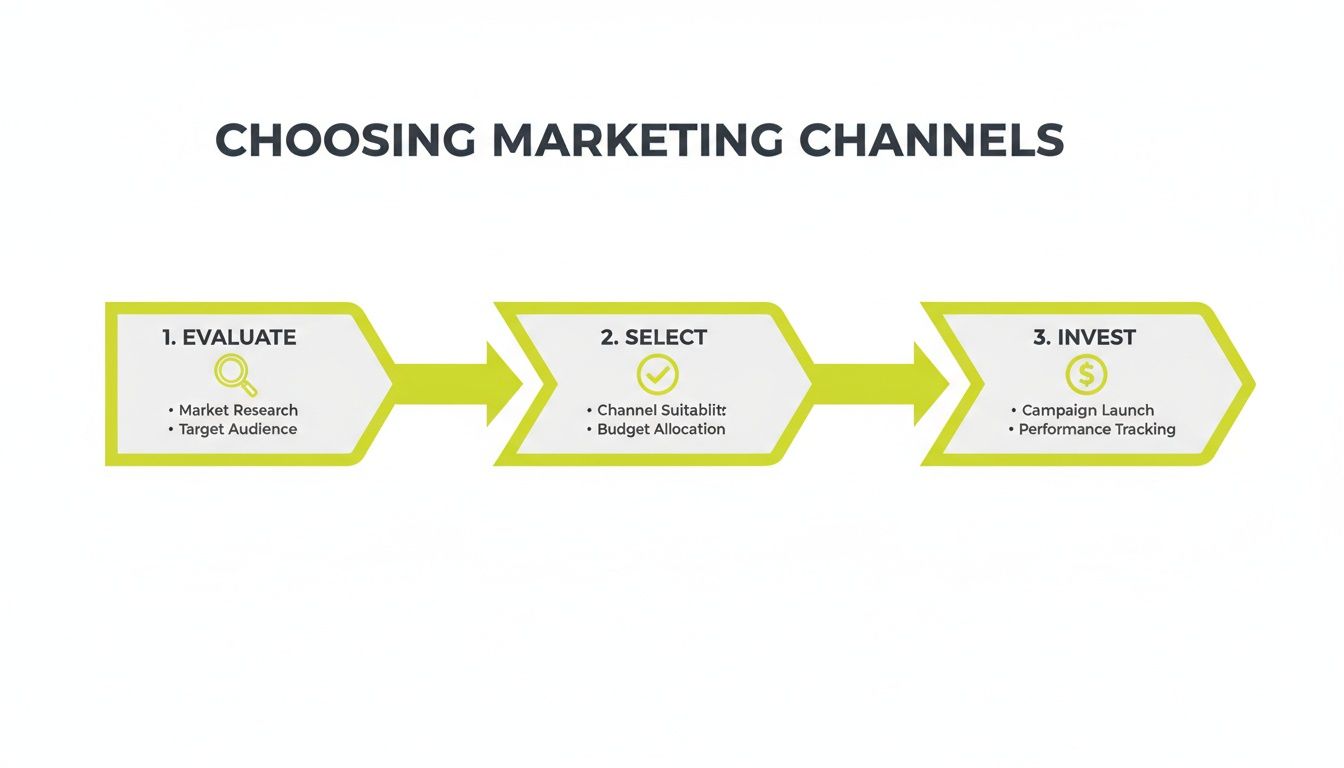
A Real-World Nurture Sequence in Action
Let's circle back to our local yoga studio. They've captured a lead with a "Free Intro Class" offer from a Facebook ad. Here’s what their 3-day automated nurture sequence could look like:
- Day 1 (Immediate Email): The subject line is "Your Free Yoga Class Pass is Here!" The email delivers the pass, thanks them for signing up, and tells them exactly how to book their class. It’s all about immediate value.
- Day 2 (Email): This email is all about social proof. Subject: "See what our students are saying…" It includes a couple of short, powerful testimonials from current members talking about how the studio has helped them. This builds incredible credibility.
- Day 3 (SMS Message): A simple, friendly text: "Hi [First Name]! Just a quick reminder to book your free intro class. We can't wait to see you on the mat! [Link to booking page]." This is a personal, high-impact nudge that cuts through the noise.
This sequence does so much more than just deliver an offer; it builds a story, reduces friction, and makes the new lead feel welcomed and valued. For even more advanced techniques, you can dive into our full guide on sales funnel optimization strategies to really fine-tune each step.
Stage 3: Driving a Clear Decision
The final stage is where you present your core offer and ask for the sale. After you've provided genuine value and built a foundation of trust, your prospect is now "warm." They know who you are and understand the problem you solve. Now is the time to make a clear, compelling offer.
This offer should feel like the natural next step—an invitation, not a hard sell. Critically, it should include a sense of urgency or scarcity to encourage them to take action now, not later.
Examples of High-Converting Offers
- Yoga Studio: After the free class, they present a "New Member Special: Get 50% Off Your First 10-Class Pass (Offer ends in 48 hours!)."
- B2B Consultant: At the end of their webinar, they offer a "Fast Action Bonus" for anyone who books a strategy call within 24 hours.
- Skincare Brand: They follow up the quiz with an email offering a "Starter Kit" of the recommended products at a 15% discount, plus free shipping on the first order.
By structuring this journey, you create a repeatable, predictable system that turns complete strangers into happy customers, forming the backbone of your entire lead generation engine.
Using Social Media for Cost-Effective Leads
Social media is a lot more than a digital billboard for your brand updates and pretty pictures. When you know how to use it, it becomes a powerful—and often surprisingly cheap—engine for generating real, qualified leads for your small business.
The real magic happens when you shift your mindset from simply posting to thinking like a strategist. Forget chasing likes. Your new goal is to spark conversations and build clear, simple pathways for your followers to raise their hands and say, "I'm interested." This isn't a one-size-fits-all game; it's about tailoring your game plan to the specific platforms where your ideal customers hang out.
Platform-Specific Lead Generation Tactics
Every social platform has its own personality and its own rules of engagement. What crushes it on LinkedIn will likely get you crickets on Instagram. The secret is matching the platform's unique strengths to your business goals.
For B2B Consultants on LinkedIn: If you're in the B2B space, LinkedIn is your goldmine. But don't just share articles and hope for the best. The real power move is using LinkedIn Lead Gen Forms. These forms attach directly to your ads and pre-fill with a user's profile information. Someone can sign up for your webinar or request a consultation with just two clicks, all without ever leaving the app. This simple trick slashes friction and can send your conversion rates through the roof.
For E-commerce Sellers on Instagram: Instagram is all about visual discovery, which makes it a paradise for anyone selling a physical product. Start using Instagram Shopping tags to tag products right in your posts and Stories. When a user taps that tag, they instantly see the price and can click straight through to your product page. For a local artisan selling handmade goods, this creates a direct line from a moment of inspiration to a completed sale.
Your social media strategy shouldn't be about trying to be everywhere at once. It's about showing up in the right places, in the right way, with a crystal-clear call to action that makes it ridiculously easy for an interested follower to take that next step.
Driving Leads with Paid Social Ads
Let's be honest, organic reach on social media can feel like an uphill battle. But you don't need a massive budget to see incredible results. A small, surgically-targeted ad spend can deliver a punch way above its weight class. The power is in the targeting—you can get your offer in front of the exact people who are most likely to care.
Think about using different ad formats to tell a quick story and grab that lead.
Video Tour for a Local Coffee Shop: Imagine a punchy, 30-second video ad on Facebook. It shows the cozy vibe of your shop, steam curling up from a freshly poured latte, and customers smiling. The call to action? "Get a Free Coffee on Your First Visit." This leads to a simple landing page where they pop in their email to get the coupon. Simple, effective, and builds your email list.
Carousel Ad for a Digital Course: An Instagram carousel ad is perfect for showcasing the different modules of an online course. Each card can highlight a key lesson or a major benefit. The last card could feature a powerful testimonial and a "Learn More" button that takes them to a page to download a free chapter—in exchange for their email, of course.
Tapping into Influencer and Community Power
You don't always have to build your audience from scratch. Sometimes, the fastest way to get in front of the right people is to borrow someone else's audience. Partnering with local influencers or becoming a trusted voice in relevant online communities can give you instant access to a warm, engaged group of potential customers.
A new local restaurant, for example, could team up with a few local food bloggers. Instead of a huge fee, they might offer a free dining experience for an honest series of Instagram Stories. That kind of authentic, third-party shoutout can be infinitely more convincing than a traditional ad.
Likewise, actively participating (not spamming!) in Facebook Groups related to your industry can establish you as the go-to expert. If you're a financial advisor, dropping genuinely helpful advice in a group for small business owners will naturally attract leads who are seeing your expertise in action.
The data backs this up. Research shows that 68% of marketers find that social media generates more leads, with many seeing a return after just a few hours a week. For B2B businesses, the impact is even more pronounced—LinkedIn is responsible for a staggering 80% of B2B leads. You can discover more insights about these lead generation trends to keep your strategy sharp. By focusing on these practical actions, you can turn your social media profiles from a passive presence into a consistent, cost-effective source of new business.
Turning Your Email List Into a Revenue Engine
Unlike your social media followers, your email and SMS list is an asset you completely own. It's a direct, unfiltered line to your warmest prospects and most loyal customers, making it one of the most powerful tools in your entire lead generation for small businesses toolkit.
When you treat it right, this isn't just a contact list; it's a relationship-building machine that reliably turns subscribers into buyers. The whole process starts with a simple exchange of value—your expertise for their contact info—and blossoms into a conversation that builds trust and drives sales.
Growing Your List With Compelling Offers
Before you can nurture anyone, you need their permission to jump into their inbox. This starts by giving them a fantastic reason to subscribe. Generic "join our newsletter" pop-ups are dead. Your offer needs to solve a real, specific problem for your audience.
- A local landscaper could offer a free PDF guide, "7 Common Lawn Mistakes Phoenix Homeowners Make (And How to Fix Them)."
- An online fitness coach might provide a "5-Day High-Protein Meal Plan" for busy professionals.
- A B2B software company could host a free webinar on improving team productivity.
Each of these offers provides immediate, tangible value. It instantly positions you as an expert and makes the decision to subscribe a no-brainer.
The secret to a healthy email list is simple: offer so much value upfront that prospects feel like they're getting the better end of the deal. This initial generosity sets the stage for a profitable long-term relationship.
Automated Nurture Sequences That Build Fans
Once a new lead subscribes, the clock starts ticking. Your goal is to make a killer first impression and gently guide them toward becoming a customer. This is where automated "nurture sequences" shine, delivering personalized touches at scale without you having to lift a finger. These sequences are so effective that nurtured leads often make 47% larger purchases than non-nurtured ones.
For small businesses, this is a total game-changer. It's no surprise that email marketing is the top channel for 48% of marketers, as it can yield 50% more sales-ready leads at a 33% lower cost. What’s more, 91% of marketers see automation as crucial for success, saving them countless hours. You can discover more insights about these lead generation statistics to see the full picture.
A Practical 5-Day Welcome Series Template
Here’s a simple, effective sequence you can steal and adapt for your business. Let's imagine a new subscriber just downloaded the landscaper's PDF guide. This is how you'd roll out the red carpet for them.
Sample 5-Day Email Nurture Sequence
| Day | Email Focus | Goal |
|---|---|---|
| Day 1 | Deliver the Guide & Welcome | Immediately provide the promised value and set expectations for future emails. |
| Day 2 | Share a Quick, Related Tip | Build on the guide's topic with a simple, actionable tip, further establishing your expertise. |
| Day 3 | Show Off Your Best Work | Send a case study or before-and-after photos of a recent project to build social proof. |
| Day 4 | Answer a Common Question | Address a frequent concern ("How much does professional landscaping cost?") to overcome objections. |
| Day 5 | Make a Soft Offer | Present a low-risk offer, like a "Free 15-Minute Yard Consultation," as a natural next step. |
This flow gradually builds trust before ever asking for a major commitment, warming up the lead naturally. To dive deeper into crafting these automated flows, check out our guide on creating an effective email marketing automation strategy.
Using SMS for High-Impact Moments
While email is perfect for nurturing relationships, SMS is your tool for immediacy. Think of text messages as your express lane for time-sensitive promotions, appointment reminders, and flash sales.
Because of its insane open rates, a well-timed SMS can cut through the noise and drive immediate action. It’s the final piece of the puzzle that turns your contact list into a reliable and direct revenue stream.
Answering Your Biggest Lead Generation Questions
Jumping into lead generation always kicks up a few key questions. If you're like most small business owners, you're probably wondering where to start, what to spend, and what to expect.
Let's cut through the noise and get straight to the practical answers you need to build a strategy that actually works.
How Much Should a Small Business Budget for Lead Generation?
There's no magic number, but a solid rule of thumb is to set aside 5-10% of your total revenue for all your marketing and lead generation activities. The real trick, however, isn't just the amount—it's how you spend it.
Don't make the mistake of spreading your budget too thin across a dozen different platforms. That's a surefire way to get zero results everywhere.
Instead, pick one or two channels that feel like a natural fit and go all-in there first. If you're a local plumber, that's probably Google Ads. Selling a visual product? Instagram is likely your best bet. This focused approach lets you gather real data, figure out what works, and actually see a return on your investment.
Once a channel is bringing in leads at a cost that makes sense for your business, you can start reinvesting your profits to scale things up.
What Are the Most Important Metrics to Track?
It's easy to get distracted by "vanity metrics" like likes, shares, or impressions. They might make you feel good, but they don't pay the bills.
You need to be absolutely relentless in tracking the numbers that connect directly to your bottom line. Ignore everything else and focus on these three:
- Cost Per Lead (CPL): Simple and direct. How much money does it cost you to get one person's contact information? Knowing this number is the first step to understanding if your campaigns are efficient.
- Lead-to-Customer Conversion Rate: This is a big one. Of all the leads you generate, what percentage actually pull out their wallet and become a paying customer? A low number here often points to a problem in your sales or follow-up process, not your ads.
- Customer Acquisition Cost (CAC): This is the final boss of metrics. It's the total cost—marketing and sales included—to land one new customer. Your entire goal is to make sure a customer's lifetime value is way, way higher than your CAC.
How Long Does It Take to See Results?
This really depends on the channels you choose. A smart strategy usually blends a few quick wins with some long-term investments.
Paid advertising platforms like Google Ads or Facebook Ads can bring in leads almost instantly—sometimes within a day or two. But "leads" and "profitable leads" are two different things. It will probably take a few weeks of tweaking and testing to get your campaigns running like a well-oiled machine.
On the flip side, strategies like content marketing and search engine optimization (SEO) are a slow burn. You might not see a huge wave of leads for 3-6 months. But the leads that do come from these efforts are often incredibly high-quality and get cheaper over time as your hard work compounds.
What Is the Biggest Mistake Small Businesses Make?
Hands down, the most expensive mistake I see businesses make is dropping the ball on follow-up. They spend good money getting a lead, and then… crickets. The lead goes cold because nobody reached out quickly enough.
A lead's interest is white-hot in the first five minutes. Studies have shown that getting in touch within that tiny window can skyrocket your chances of converting them.
If you don't have a structured process for nurturing new leads, you're essentially lighting your marketing budget on fire. An automated welcome email and a clear plan for a quick, personal follow-up aren't just nice-to-haves; they are absolutely critical for turning your marketing efforts into actual revenue.
At Silver Spoon Agency, we build AI-powered, omnichannel marketing systems designed to deliver a predictable stream of qualified leads. If you're tired of guessing and ready to grow with a strategy backed by data, let's have a conversation. https://www.silverspoonagency.com