


Lead Generation Lead: Guide to Attract, Qualify, and Convert Prospects

Let's be honest, the word "lead" gets thrown around so much it's lost most of its meaning. It’s a classic source of friction between marketing and sales teams. Is a business card dropped in a fishbowl at a trade show a lead? What about a name on an email list you bought? Not really.
A real lead is a person who has actually shown interest in what your company sells. They've raised their hand, in a way, signaling they might be a potential customer. Unlike some random contact, this person has actively engaged with you—maybe they downloaded a guide, sat through a demo, or signed up for a webinar. That action is everything.
What is a Lead in Lead Generation?
The critical difference between a simple contact and a genuine lead comes down to a single, powerful element: intent. An email address collected from a giveaway is just data. But a person who spends 20 minutes watching your product tutorial? That’s someone with intent.
Think of it like this: a list of contacts is a pile of uncarved stones. They're raw material with potential, but they have no defined shape. The process of lead generation is like a sculptor identifying the stones with the best grain and starting to chisel. A qualified lead is the finished product—a precisely cut key, ready to unlock a potential sale. This distinction is what separates a frustrating, inefficient sales process from a smooth, predictable growth engine.
To bring order to this process, we split leads into a few key categories. Getting this right ensures everyone, from the marketing coordinator to the top sales exec, is speaking the same language.
Marketing Qualified Leads (MQLs) vs. Sales Qualified Leads (SQLs)
Marketing Qualified Lead (MQL): This is someone who has engaged with your marketing but isn't quite ready for a sales call. They might have downloaded an e-book, subscribed to your newsletter, or kept coming back to your pricing page. They look like your ideal customer and they're "warm," but they haven't explicitly asked to talk to sales.
- Practical Example: A marketing manager downloads your "Ultimate SEO Checklist for SaaS Companies." They fit your target demographic (SaaS industry, marketing role) and have shown interest in a topic related to your services, making them a solid MQL.
Sales Qualified Lead (SQL): An MQL graduates to an SQL when they take a high-intent action that screams, "I'm ready to buy!" This could be requesting a custom quote, booking a one-on-one demo, or filling out that "Contact Sales" form. At this point, marketing hands them over to the sales team for direct follow-up.
- Practical Example: That same marketing manager who downloaded the checklist later returns to your site and fills out your "Request a Demo" form. This direct request for a product walkthrough immediately qualifies them as an SQL ready for a sales conversation.
To make this crystal clear, let's break down the journey from a simple contact to a sales-ready lead.
Understanding Lead Quality at a Glance
This table simplifies the key differences between the types of contacts you'll encounter in your pipeline.
| Characteristic | Simple Contact | Marketing Qualified Lead (MQL) | Sales Qualified Lead (SQL) |
|---|---|---|---|
| Level of Interest | None or unknown | Passive interest shown | Active buying intent |
| Engagement Type | Minimal (e.g., email list) | Informational (e.g., downloaded guide) | Transactional (e.g., requested demo) |
| Data Provided | Basic (e.g., name, email) | More context (e.g., company size) | Detailed (e.g., budget, timeline) |
| Readiness to Buy | Cold; not ready | Warm; still researching | Hot; ready for a sales conversation |
| Next Step | Nurture with general content | Nurture with targeted content | Immediate sales follow-up |
This structured approach shows how a lead's quality and readiness evolve, allowing teams to respond appropriately at each stage.
Why This Matters for Your Business
Defining these stages is more than just marketing jargon—it's a fundamental part of an efficient business. It stops your sales team from wasting time on prospects who are just kicking the tires. It also gives your marketing team a clear goal: nurture MQLs with valuable content until they’re primed and ready to become SQLs.
A lead isn't just a name and an email. It's a person who has expressed curiosity in what you offer. The whole point of lead generation is to find these people and guide them toward a solution they need.
This systematic approach has become a non-negotiable part of modern business. The global lead generation market is projected to nearly triple, hitting $9.589 billion by 2028, fueled by a massive 17.5% compound annual growth rate. This explosion shows just how critical a well-oiled lead generation system is for any business that wants to scale.
For companies like Silver Spoon Agency and our clients, mastering this process is the key to predictable revenue. If you want to dig deeper into the numbers, you can explore the key lead generation stats on kanbox.io.
Mapping the Journey From Prospect to Customer
Every potential customer goes on a journey. This path isn't a random walk in the park; it's a predictable sequence of stages that turns a complete stranger into a paying client. Understanding this lifecycle is everything. It allows you to meet people where they are, say the right thing at the right time, and gently guide them to the next logical step.
Think of it like dating. You don't propose on the first date. You start with a simple conversation (Awareness), see if there's any chemistry (Engagement), figure out if you're a good match (Qualification), and only then move toward a real relationship (Customer). Your sales process works the exact same way.
This diagram shows the core stages where a general contact starts to look like a genuine, sales-ready opportunity.
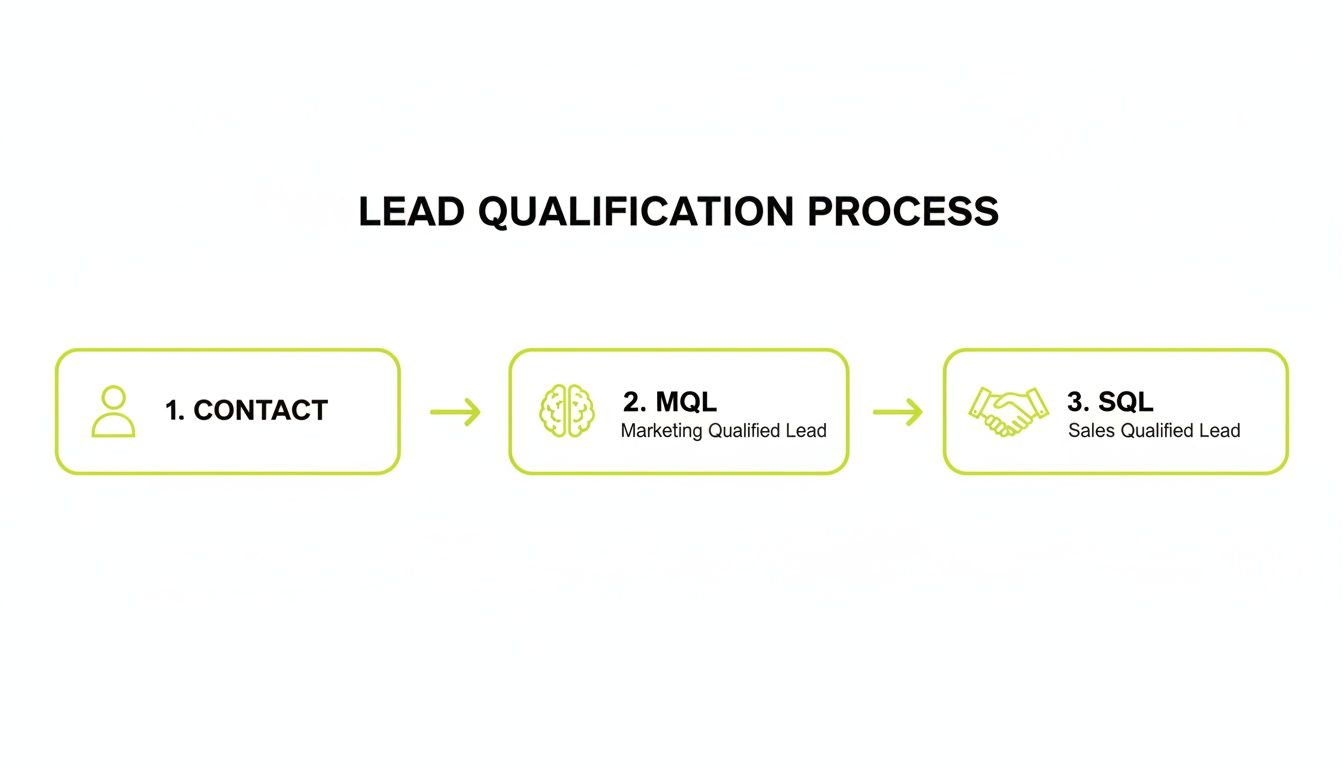
This visual highlights the critical handoff points, where marketing's broad efforts get refined into specific, high-potential leads for the sales team. Let's break down what each stage looks like in the real world.
The Six Stages of a Lead
Mapping this out isn't just a theoretical exercise. It’s a practical way to figure out what's broken in your system. Getting tons of website traffic but no one signs up for your newsletter? Your awareness-stage content is probably missing the mark. MQLs never turning into SQLs? You’ve got a disconnect somewhere in the middle of your funnel.
Let’s walk through the six key milestones in this journey.
1. Awareness: This is the first "hello." A person realizes they have a problem and stumbles upon your brand as a potential solution. They aren't a lead yet, just a visitor checking out your content.
- Practical Example: Someone Googles "how to improve local SEO" and lands on your blog post covering that exact topic. They are now aware your agency exists.
2. Engagement: The visitor takes a small, deliberate action, showing a flicker of real interest. This is the first sign they're moving from a passive browser to an active participant. They're now officially a contact in your system.
- Practical Example: After reading your blog post, that visitor signs up for your email newsletter to get more marketing tips delivered to their inbox.
3. Marketing Qualified Lead (MQL): Now things are getting interesting. The contact shows consistent interest or takes a high-value action that matches your ideal customer profile. Marketing has flagged them as a potential buyer, but they haven't asked to speak to sales just yet.
- Practical Example: Over the next few weeks, this contact opens every email you send, downloads your "E-commerce Growth Checklist," and has visited your pricing page twice.
4. Sales Qualified Lead (SQL): This is the magic moment. The lead raises their hand, signaling they are ready to buy. They are now officially prepared to have a conversation with your sales team.
- Practical Example: The MQL fills out the "Request a Free Consultation" form on your website. This is a direct, explicit request to be contacted by sales.
5. Opportunity: The sales team connects with the SQL, confirms they are a legitimate fit, and identifies a real potential deal. The lead has a clear need, a budget, and a timeline. This person is now a qualified prospect in your sales pipeline.
- Practical Example: Your sales rep has a discovery call, confirms the lead's company needs a new marketing agency within the next quarter, and sends over a formal proposal.
6. Customer: The deal is won! The opportunity signs on the dotted line or makes a purchase, officially becoming a paying customer. The lead generation journey is complete.
- Practical Example: The company signs your proposal and makes their first payment to kick off the new marketing campaign.
A well-defined lead lifecycle stops good prospects from falling through the cracks. It creates a clear system for when and how your marketing and sales teams should engage, turning a chaotic process into a predictable revenue machine.
By visualizing this entire flow, you can start to implement simple automation and lead scoring to nurture people at each step. To really dig into this concept, you can learn more about customer journey mapping in our detailed guide. It's the key to making sure no lead gets left behind.
Choosing Your Best Channels for Quality Leads
Trying to find quality leads without a plan is like fishing in a random puddle and hoping to land a trophy fish. You’d never do that, right? Of course not. You'd go to the lake where you know the big ones are swimming. Lead generation channels work exactly the same way—you have to show up where your ideal customers are already looking for answers.
Not all lead sources are created equal. Some channels might give you a flood of contacts who will never buy, while others deliver a steady stream of people who are genuinely interested and ready to talk. The secret is to pick a few key channels and really master them, instead of spreading yourself thin across a dozen different platforms.

This focused approach saves you time, protects your marketing budget, and ultimately drives way better results by putting your energy where it actually counts.
Finding Where Your Ideal Customers Gather
First things first, you need to pinpoint the digital watering holes your audience loves. A B2B software company selling to enterprise clients is going to find them in very different places than a local yoga studio targeting new moms. The whole game is about matching your channel to your customer's natural behavior.
Here are some of the most powerful channels for generating high-quality leads, with some real-world examples of how businesses put them to work.
Search Engine Optimization (SEO): This is all about showing up on Google when someone types in a problem you can solve. It’s a long-term play, but the leads are incredible because they are actively looking for help.
- Practical Example: A local plumber writes a detailed blog post, "How to Fix a Leaky Faucet in 5 Steps." It ranks on the first page of Google, bringing in homeowners who need help right now and are very likely to call for a pro.
Pay-Per-Click (PPC) Advertising: Platforms like Google Ads let you buy your way to the top of the search results. It’s much faster than SEO and is perfect for grabbing high-intent leads who are ready to make a decision today.
- Practical Example: A business coach runs a Google Ad targeting the keyword "executive leadership coaching services." Their ad shows up at the very top, driving traffic from decision-makers who are specifically looking to hire a coach.
Content Marketing: This means creating genuinely valuable stuff like blog posts, e-books, and webinars that attract and educate your audience. It builds trust and positions you as an expert, making people want to do business with you.
- Practical Example: A financial advisor creates a free PDF guide, "The Ultimate Retirement Planning Checklist." To get it, people have to enter their email, turning them into a nurtured lead for the advisor's services.
Leveraging Social Media for Targeted Leads
Social media isn't just for posting updates; it's a lead generation machine when you use it right. Every platform has its own vibe and audience, so picking the right one is absolutely critical. For B2B businesses, one platform stands head and shoulders above the rest.
LinkedIn's dominance in the B2B world is undeniable. Research shows it generates 80% of all B2B prospects sourced from social media. A massive 95% of B2B marketers use the platform to network and find leads, with 62% of professionals calling it the top platform on the globe. You can dig into more of these LinkedIn lead generation statistics from Snov.io.
Here are a few ways different businesses can make social media work for them:
| Platform | Business Type | Practical Example of a Lead Generation Tactic |
|---|---|---|
| B2B Consulting Firm | The firm publishes a deep-dive article on "The Future of AI in Logistics." They then use LinkedIn's powerful targeting to get it in front of C-suite execs in the supply chain industry, generating highly qualified MQLs. | |
| E-commerce Store | A fashion brand runs a contest asking customers to post photos wearing their clothes with a unique hashtag. They feature the best user-generated content in their ads, which provides authentic social proof and drives traffic straight to product pages. | |
| Local Service Business | A fitness studio uses Facebook Lead Ads to offer a "Free 7-Day Class Pass." The ad form is pre-filled with the user's info, making it incredibly easy for locals to sign up and become a hot new lead. |
The best lead generation channel isn't the most popular one; it's the one where your message resonates most deeply with your specific audience. Focus on one or two channels, understand their nuances, and create campaigns designed to serve that audience's needs.
By choosing your channels wisely, you build a system that attracts the right people from the very start. This focus is the foundation of an efficient lead generation engine. You can discover more about integrating these platforms by exploring our guide to multi-channel marketing strategies.
How to Actually Measure Your Lead Generation Success
Generating a flood of leads feels great, but it’s a vanity metric if those leads never turn into revenue. Let's be honest: the real goal isn't just to be busy; it's to be profitable. To do that, you have to stop guessing and start measuring what actually drives your business forward.
This isn’t about needing a data science degree or getting lost in complex algorithms. It’s about asking simple, powerful questions: How much does it cost to get a new lead? What percentage of those leads actually become customers? And most importantly, how much is each customer worth to us over their lifetime? Answering these questions gives you the clarity to invest your marketing dollars with confidence, not just hope.
The Core Metrics That Matter Most
To get a clear picture of your performance, you need to track a few essential key performance indicators (KPIs). Think of these as the dashboard for your lead generation engine—they show you which parts are firing on all cylinders and which ones need a tune-up.
These are the non-negotiable metrics for any serious business:
Cost Per Lead (CPL): This is the most straightforward metric of all. It answers the simple question, "How much did I spend to get one person to raise their hand?" You calculate it by dividing your total marketing campaign cost by the number of leads you generated. A low CPL is great, but it's not the whole story.
Lead Conversion Rate: This KPI tells you how good you are at turning interested prospects into paying customers. It’s the percentage of leads that complete the final action—like making a purchase or signing a contract. A high conversion rate means your sales process and offers are hitting the mark.
Customer Lifetime Value (CLV): This is the holy grail. It’s the total revenue you can expect from a single customer throughout their entire relationship with your business. Understanding your CLV is critical because it tells you exactly how much you can afford to spend to get a new customer in the first place.
Don't judge a marketing channel by its Cost Per Lead alone. A high CPL for a high-value customer is a brilliant investment. A low CPL for a customer who never buys is a waste of money.
This shift in perspective is what separates amateur marketers from seasoned pros.
A Practical Example: Why High CPL Isn’t Always Bad
Let’s imagine two very different businesses. One is a local coffee shop, and the other is a high-end financial advisory firm.
- The coffee shop runs a Facebook ad. They spend $100 and get 50 leads (people who claim a "free coffee" coupon). Their CPL is a lean $2.00.
- The financial firm runs a LinkedIn campaign. They spend $1,000 and get just 10 leads (people who book a consultation). Their CPL is $100.
At first glance, the coffee shop looks like the clear winner. But when we bring in CLV, the story flips. The coffee shop’s average customer spends $50 over their lifetime. The financial firm’s average client is worth $10,000. Suddenly, that "expensive" $100 lead is an incredible bargain if it converts, while the $2 lead offers a much smaller return.
Knowing Where Your Best Leads Come From
The final piece of the puzzle is knowing exactly where your best leads originate. Was it your SEO efforts, a specific Google Ad, or your email newsletter? Using simple tracking tools like UTM parameters in your links helps you attribute every single lead to its original source.
This data is gold. It shows you which channels deliver the most valuable customers, allowing you to double down on what works and cut what doesn't. We often see this in practice—for instance, data consistently shows that SEO-generated leads have an impressive 14.6% conversion rate, completely dwarfing the 1.7% from outbound leads. It's a clear signal of the power of organic visibility.
To benchmark your own efforts, here's a look at typical conversion rates across different channels.
Lead Source Conversion Rate Benchmarks
This table provides a general overview of average lead-to-sale conversion rates. Use it to get a feel for how your channels are performing against industry averages, but remember that your specific numbers will vary based on your industry, offer, and sales process.
| Lead Source Channel | Average Conversion Rate (%) |
|---|---|
| Referrals | 10-20% |
| SEO (Organic Search) | 10-15% |
| Paid Search (PPC) | 2-5% |
| Email Marketing | 2-5% |
| Social Media (Paid) | 1-3% |
| Outbound Sales | 1-2% |
Seeing these numbers in one place makes it clear that not all lead sources are created equal. High-intent channels like referrals and organic search consistently deliver higher quality leads that are more likely to become paying customers.
By tracking these core metrics, you transform your marketing from a hopeful expense into a predictable, revenue-generating investment. To go even further, check out our guide on measuring marketing effectiveness for a deeper dive into true ROI analysis.
Real-World Lead Generation Examples in Action
Theory is great, but seeing how these concepts actually make a business money is where things get interesting. A great lead doesn't just fall out of the sky; they're the direct result of a smart, well-executed strategy built for a specific audience.
So, let's move from the abstract to the concrete. By looking at how different businesses solve this puzzle, you can see the principles of qualification, channels, and measurement all click into place. These examples prove that the right approach can work for any business model.
The E-commerce Brand Recovering Lost Sales
An online fashion retailer noticed a painful statistic: nearly 70% of their shopping carts were abandoned before checkout. This wasn't just a number; it was a massive pool of highly interested prospects who just needed a final nudge to buy. Instead of letting these hot leads go cold, they built a simple, automated system to bring them back into the fold.
Here’s how they did it:
- Strategy: The mission was to re-engage shoppers who added items to their cart but then bailed. They set up a two-pronged attack using targeted ads and a follow-up email sequence.
- Tools Used: They leveraged the Facebook Pixel to build a custom audience of "cart abandoners." Then, they used an email platform like Klaviyo to trigger an automated email series.
- The Impact: Within an hour of abandonment, the prospect started seeing social media ads featuring the exact product they left behind. At the same time, a three-part email series kicked in: the first was a simple reminder, the second created urgency by mentioning low stock, and the third offered a small, compelling discount. This simple system recovered 15% of otherwise lost sales, directly boosting the bottom line.
The Local Plumber Capturing Emergency Jobs
For a local plumbing company, the most valuable leads are homeowners with a crisis—think a burst pipe at 2 AM. These people aren't casually browsing; they're frantically searching for an immediate fix. The company’s entire strategy was to be hyper-visible at that exact moment of need.
Their approach was brilliantly direct:
- Strategy: Dominate local search results for any and all emergency plumbing services. The goal was to make it incredibly easy for a stressed-out homeowner to find them and book a service call on the spot.
- Tools Used: They enrolled in Google Local Services Ads, which shot their business to the very top of the search results, complete with a "Google Guaranteed" badge that screams trustworthiness. They paired this with a dead-simple booking form on their website.
- The Impact: By showing up first for high-intent searches like "emergency plumber near me," they captured leads who were ready to hire now. The frictionless booking system allowed them to lock in jobs 24/7, even when the office was closed.
The Business Coach Attracting Premium Clients
A business coach with a high-ticket mastermind program needed a way to find and qualify serious entrepreneurs. Cold outreach was a waste of time and energy. Instead, she created a high-value lead magnet designed to attract her ideal client profile and prove her expertise right out of the gate.
A great lead magnet isn't a random giveaway. It's a sample of the value you provide. It should solve a small piece of your ideal client’s biggest problem, giving them a real taste of what it’s like to work with you.
Here’s how she built her client-attraction funnel:
- Strategy: Use a free, in-depth webinar as a tool to both educate potential clients and qualify them at the same time. The topic was hyper-specific: "The 5-Step System to Scale Your Business Past 7 Figures."
- Tools Used: She ran targeted Facebook and LinkedIn ads to promote the webinar, used a landing page tool to handle registrations, and hosted the live event on a webinar platform.
- The Impact: Anyone who stayed for the entire webinar and actively participated in the Q&A was flagged as a promising MQL. At the end of the presentation, she invited these highly engaged viewers to book a one-on-one strategy call, effortlessly turning warm MQLs into high-quality SQLs for her premium program.
The Real Estate Agent Building a Buyer List
Finally, let's look at a real estate agent who wanted to build a list of pre-qualified buyers before a new property even officially hit the market. For more practical ways these concepts apply to this industry, you can check out these 12 real estate lead generation ideas that are crushing it right now.
This agent used modern tech to create an immersive, exclusive experience:
- Strategy: Generate buzz and capture interested buyer leads by offering an exclusive "first look" via a virtual property tour.
- Tools Used: She used a 3D camera to create a stunning virtual walkthrough of the home. She then promoted it with laser-focused Facebook ads aimed at users showing home-buying interest in that specific zip code.
- The Impact: To get access to the tour, users had to provide their name, email, and—most importantly—whether they were pre-approved for a mortgage. This simple gate generated a list of over 50+ pre-qualified buyers before the first open house, creating a competitive bidding environment that drove up the final sale price.
Building Your Own Lead Generation Playbook

Knowing the theory is great, but putting it into practice is what actually drives revenue. Think of a playbook not as a rigid rulebook, but as a flexible framework you design to consistently attract, qualify, and convert your ideal prospects. It’s your strategic map for turning marketing efforts into real, measurable results.
An effective system for generating a high-quality lead generation lead isn't built overnight. It’s a clear, step-by-step process where each part builds on the last, creating a powerful engine that works for you. Let's walk through the five essential actions to build your own.
Define Your Ideal Customer Profile
You can't find your ideal customers if you don't know exactly who they are. Go way beyond basic demographics like age and location. You need to dig into their psychographics—what are their biggest challenges, their professional goals, and their daily frustrations?
A sharply defined Ideal Customer Profile (ICP) acts as your North Star for every single marketing decision you make.
- Practical Example: A B2B SaaS company selling project management software defines its ICP not just as "project managers," but as "Project Managers in mid-sized tech companies (50-250 employees) who are struggling with cross-departmental communication and are currently using multiple spreadsheets to track progress." This level of detail makes every other step incredibly targeted.
Select and Master Your Channels
Don't try to be everywhere at once. It's a classic mistake. Spreading your budget and energy across a dozen platforms is a surefire recipe for mediocre results. Instead, pick one or two primary channels where your ICP actually spends their time and commit to mastering them.
Focus is your superpower in lead generation. Owning one channel is far more profitable than being a tourist in ten.
For instance, if your ICP is a C-suite executive, LinkedIn is probably your home base. If you're a local plumber, then Google Local Services Ads and local SEO are non-negotiable.
Create Irresistible Offers and Lead Magnets
A lead magnet is the value you offer in exchange for a prospect's contact info. It absolutely must solve a specific, urgent problem for your ICP. This is your first real chance to show off your expertise and start building trust.
- Identify the Problem: What's the one nagging issue your ICP wants to solve right now?
- Create the Solution: Package that solution into a digestible format, like a checklist, a template, or a short video training.
- Make it Actionable: Your lead magnet should deliver a quick win, giving the prospect immediate value and a taste of what it’s like to work with you.
- Practical Example: That same B2B SaaS company creates a "Cross-Departmental Communication Template" that project managers can immediately use to streamline their workflow. This directly hits the pain point identified in their ICP.
Establish a Simple Nurturing System
Here's the thing: not every lead generation lead is ready to buy today. A simple nurturing sequence keeps you top-of-mind and builds a relationship over time. An automated three-to-five-part email series can guide prospects with helpful tips and case studies, gently moving them toward a sales conversation without being pushy.
- Practical Example: A prospect downloads your communication template. They immediately receive it via email, followed by two more emails over the next week. The first shares a case study of a similar company's success. The second offers a free 15-minute consultation to discuss their specific workflow challenges. This sequence educates and builds trust before asking for the sale.
Create a Sales and Marketing Feedback Loop
Finally, your system has to learn and adapt. Your sales team has invaluable, on-the-ground insights into lead quality. Schedule regular, brief meetings where sales can share what objections they’re hearing and which leads are converting best. This feedback lets marketing refine its targeting, messaging, and offers, continuously improving lead quality over time. To truly build an effective system for attracting, qualifying, and converting prospects, check out these comprehensive B2B lead generation best practices.
Common Questions About Lead Generation
Even with a solid plan, you're going to hit a few snags. It happens to everyone. Let's tackle some of the most common questions and points of confusion that pop up when you're building a lead generation system from the ground up.
What’s the Difference Between a Lead and a Contact?
Think of it this way: a contact is just a name and an email you picked up somewhere—maybe from a business card or a list. There's no real context or known interest. They're just a name in your database.
A lead, on the other hand, is someone who has actively raised their hand. They’ve shown genuine interest by downloading one of your guides, signing up for a webinar, or repeatedly visiting your services page. That action, that intent, is the key difference. It signals they're a prospect worth your time and attention.
How Long Does It Take to Turn a Lead into a Customer?
This is the classic "it depends" answer, and for good reason. The timeline can swing wildly based on your industry and the price of what you're selling. An e-commerce purchase might happen just minutes after someone sees an ad. On the flip side, a complex B2B software deal could easily take six months or more to navigate through approvals and close.
The goal isn't to rush people through your funnel. It's about mapping out their natural buying journey and using automated nurturing to guide them at their own pace. Build trust first, and the sale will follow.
The “best” lead generation channel is a myth. The most profitable channel is simply the one where your ideal customers are already gathered and actively looking for solutions to their problems.
Which Lead Generation Channel Has the Best ROI?
Everyone wants a silver bullet, but the truth is, the "best" channel is simply wherever your customers are already hanging out. While things like SEO and referrals often have a great ROI because they're low-cost, that doesn't matter if your audience isn't there.
A local restaurant might see massive success with geo-targeted Facebook ads, while a B2B consultant will almost certainly get better traction publishing on LinkedIn. The only way to know for sure is to test a few promising channels, track your results like a hawk, and then double down on what’s actually working for your business.
Ready to stop guessing and start building a predictable system for high-quality leads? The team at Silver Spoon Agency uses an AI-powered, omnichannel approach to turn your advertising spend into measurable growth. We build the funnels and launch the campaigns that attract pre-qualified prospects, so you can focus on closing deals. Schedule a consultation to see how we can build your lead generation engine today.