


Lead Generation Mastery: Build a High-Quality Pipeline Faster

Lead generation is the spark that ignites your sales pipeline. It’s the art and science of finding people who have shown a genuine interest in what you sell and turning that initial curiosity into a real business relationship. Without it, you’re just hoping customers will magically appear.
This is the critical first step in guiding potential customers from "who are you?" to "take my money." It’s the engine that powers sustainable growth, transforming random interest into a predictable flow of sales opportunities.
The Foundation of Business Growth
Ever tried building a fire without kindling? You can have the best logs and a perfect setup, but without that initial spark, you’re left in the cold. That's a business without a solid lead generation strategy—a lot of potential with no way to ignite it.
This isn't about blasting your message to the masses and praying someone listens. Think of it more like a high-tech irrigation system. Instead of flooding the entire field, you deliver just the right amount of water directly to the crops that are ready to flourish. That’s how modern lead generation works; it’s about strategically attracting the right people, not just anyone. For example, a roofer doesn't just advertise "roofing services"; they target homeowners in storm-prone areas with ads about "free hail damage inspections," speaking directly to an immediate need.
Why It's More Than Just Collecting Contacts
At its heart, lead generation makes revenue predictable. When you get it right, growth stops being about luck and becomes a calculated, repeatable process. It’s a powerful mix of psychology, technology, and sharp messaging, all working in concert to keep your pipeline full.
This concept is universal, touching every corner of the business world. From SaaS startups hunting for their next enterprise client to local businesses generating new leads for garage services, the need to attract new customers is a constant. It's the lifeblood of any growing company.
A strong lead generation process doesn't just fill your pipeline; it fills your pipeline with prospects who are more likely to convert, stay longer, and become advocates for your brand.
The numbers don't lie. The global lead generation market is on track to hit an incredible $295 billion by 2027, growing at a blistering 17% each year. This boom shows a massive shift as businesses everywhere pour money into smarter ways to find and win customers. For instance, AI-powered tools are already helping companies slash customer acquisition costs by up to 60% while boosting sales-ready leads by 50%. You can dig into more of these trends and see how businesses are adapting with these key lead generation statistics. The takeaway is clear: investing in a sophisticated lead strategy isn't just an option—it's essential for survival.
Mapping Your Lead Generation Funnel
Think of your lead generation funnel as a customer’s journey. It’s the path someone takes from being a total stranger who’s “just looking” to becoming a qualified lead who is genuinely ready to talk business. This journey isn't a random walk; it's a structured process designed to build awareness, trust, and interest at a comfortable pace.
The whole idea is to match your message to where your prospect is mentally. You wouldn't propose on a first date, right? In the same way, you don't push for a sale the moment someone lands on your blog. A well-mapped funnel ensures you’re delivering the right content at precisely the right time, making the entire experience feel helpful, not salesy.
This kind of thinking is fundamental to growth. Lead generation is the base of the pyramid that supports business growth, which in turn, drives revenue.
This infographic shows how lead generation is the foundation for sustainable business growth and revenue.
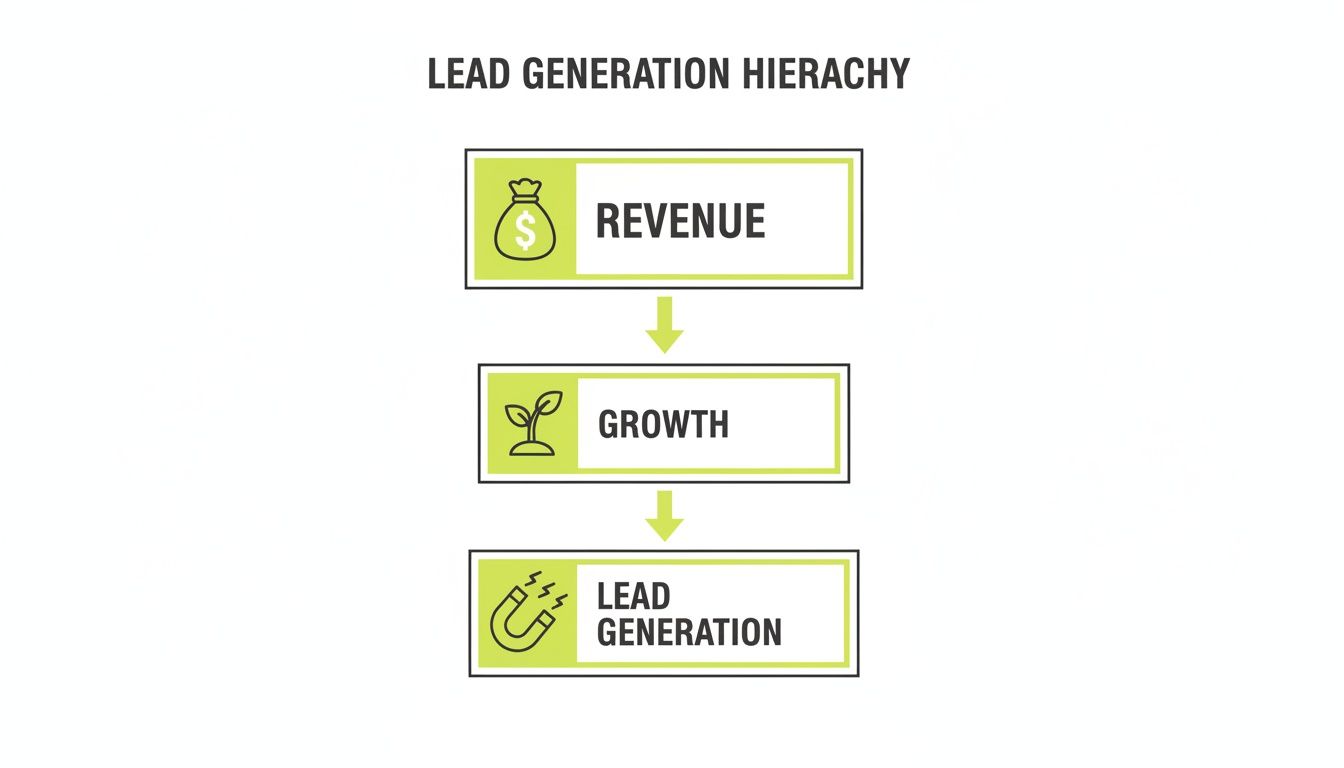
As you can see, without a steady stream of new leads, growth eventually stalls, and revenue dries up. It all starts here.
Top of the Funnel (TOFU): Attracting Awareness
The Top of the Funnel (or TOFU) is all about getting noticed. At this point, your audience isn't even thinking about buying from you. They're just looking for answers or information about a problem they’ve just started to recognize. Your goal is simply to attract a broad audience by providing value, no strings attached.
Your content here should be purely educational and genuinely helpful. You're casting a wide net to catch the attention of anyone who might be interested in your field of expertise.
Practical Example: A B2B Software Company
A company selling project management software might publish a detailed blog post titled "5 Simple Ways to Improve Team Productivity." The article never mentions their product. Instead, it offers practical advice their target audience—project managers and team leads—is actively searching for online. The entire point is to become a trusted resource first.
Middle of the Funnel (MOFU): Building Engagement
Once someone moves into the Middle of the Funnel (MOFU), they know who you are and have shown some interest. Maybe they read your blog post or started following you on social media. Now, your job is to nurture that spark of interest and start building a real relationship.
This is the consideration stage, where prospects are actively weighing their options. They know they have a problem and are now aware that solutions exist. Your content should help them understand why your approach is a good one. It's at this point you can ask for a small commitment—like an email address—in exchange for something even more valuable. You can dive deeper into this process with our detailed guide on how to build a marketing funnel.
- Practical Example: A Life Coach
A life coach who works with professionals experiencing burnout could offer a free, 30-minute webinar on "The 3-Step Framework to Reclaim Your Work-Life Balance." To register, attendees need to provide their email. This "lead magnet" captures contact info from people who are actively looking for a solution, turning anonymous website visitors into actual, identifiable leads.
Bottom of the Funnel (BOFU): Driving Decisions
Finally, we have the Bottom of the Funnel (BOFU). Here, you're dealing with highly qualified leads. These are the people who engaged with your MOFU content and are now seriously thinking about making a purchase. They’re comparing you to your competitors and just need that final nudge to feel confident you're the right choice.
Your content now needs to be super-targeted and persuasive. It should address any last-minute hesitations and make it incredibly easy for them to take the final step. This is where you focus everything on conversion.
- Practical Example: An E-commerce Store
An online shop selling high-end running shoes could send a targeted email to leads who attended their "Choosing the Right Shoe" webinar. This email might include a case study of a marathon runner who improved their time using their shoes, along with a link to book a free virtual fitting session. That final, personalized touch is often what it takes to turn a warm lead into a happy customer.
Choosing Your Lead Generation Channels and Tactics
Once you have a clear map of your customer's journey, the next move is to pick the right roads to guide them down that path. This is where your marketing toolkit really comes into play. Choosing the right lead generation channels isn't about being everywhere at once; it’s about being in the right places with the right message.
Spreading your resources too thin across a dozen different platforms is a classic mistake. The smarter play? Master a few channels that line up perfectly with where your ideal customers already spend their time. This kind of focused effort makes every marketing dollar and every minute you spend work harder to bring in quality leads.

Let's dive into a menu of proven strategies—not just a simple list, but actionable tactics you can start applying to your business today.
Inbound Channels That Pull Customers In
Inbound lead generation is all about creating valuable content and experiences that naturally draw people to your brand. Instead of interrupting their day, you pull them in by offering solutions they're already searching for.
This approach builds trust right from the very first click. When you help someone solve a problem, you become a credible authority in their mind long before you ever ask for the sale.
Search Engine Optimization (SEO): SEO is the art and science of getting your website and content to rank higher in search engine results. For example, a plumbing company could write a blog post optimized for the keyword "how to fix a leaky faucet" to attract local homeowners with a common problem. It's a long-game strategy, but it builds a digital asset that pays dividends month after month by generating a steady flow of organic leads.
Content Marketing: This is where you create and share genuinely useful content—think blog posts, videos, podcasts, and guides—to attract and connect with your audience. The goal is to prove your expertise and build a relationship. For instance, a financial advisor could offer a free download, "The Small Business Owner's Guide to Retirement Planning," to capture leads who are actively looking for that specific advice.
Social Media Marketing: Platforms like Instagram, Facebook, and LinkedIn are fantastic for building a community and driving traffic to your lead magnets. It’s not about just posting updates; it's about starting conversations and sharing content that truly resonates with your followers.
Practical Example: Local Fitness Studio
A yoga studio could create short, instructional video clips for Instagram Reels showing "Three Poses to Relieve Back Pain." In the caption, they invite viewers to download their free "7-Day Beginner's Yoga Challenge" guide by signing up with their email. This tactic gives immediate value and captures a lead who has a clear, demonstrated interest in yoga.
Outbound Tactics for Direct Engagement
Outbound lead generation flips the script and takes a more direct approach. With outbound, you're the one starting the conversation with potential leads you've already identified as a good fit for what you offer. While it can feel more aggressive, modern outbound is about precision and personalization, not spam.
Paid Advertising: Using platforms like Google Ads or Facebook Ads lets you get your message in front of a highly targeted audience, and fast. For example, a daycare center could run Facebook ads targeted at new parents within a 5-mile radius, promoting an upcoming open house.
Email Marketing: This is so much more than just sending newsletters. Email marketing is the perfect tool for nurturing leads. You can build automated sequences that deliver helpful content over time, gently guiding a prospect from curiosity to a point where they're ready to buy. A practical example is a software company sending a 5-day email course on "Mastering Project Management Basics" to new leads who downloaded an e-book.
Geofencing: This is a hyper-local tactic where you draw a virtual "fence" around a specific geographic area. When someone with a smartphone steps inside that zone, they can be served your ad. It's incredibly powerful for local businesses. A real estate agent, for example, could geofence a competitor’s open house to show ads for their own listings to interested buyers in the immediate area.
The data backs it up: a mix of strategies, especially inbound, delivers powerful results. SEO leads, for example, have a 14.6% close rate, which absolutely dwarfs the 1.7% close rate for outbound leads. That really shows you the power of attracting customers who are already looking for you. You can learn more about how different channels stack up by reading these comprehensive lead generation statistics.
Using AI and Omnichannel Marketing to Boost Leads
Having the right channels and a well-defined funnel is a great start, but today's most effective lead generation strategies go one step further. The real magic happens when you connect all those individual pieces into a single, intelligent system that works in perfect harmony. This is where Artificial Intelligence (AI) and omnichannel marketing come together to create something truly powerful.
Think of AI as your marketing team's secret weapon. It doesn't just look at what a customer did yesterday; it predicts what they're likely to do tomorrow. By sifting through massive amounts of data, AI uncovers subtle patterns and buying signals, helping you find your best customers before they even start actively searching for a solution. This is the core of predictive targeting.
Instead of just waiting for someone to type "best running shoes" into Google, AI can identify a user who recently started following fitness influencers on Instagram, visited a few marathon training blogs, and liked a post about running gear. It flags this person as a high-potential lead, letting you get your message in front of them at just the right moment—when they're most receptive.
The Power of Omnichannel Orchestration
This is where AI's predictive insights become a game-changer. Omnichannel orchestration is the art of making all your marketing channels work together like a symphony orchestra. It's about creating a single, continuous conversation with a prospect, no matter where they interact with your brand—be it on social media, email, or your website.
This strategy goes far beyond simply being present on multiple platforms. It ensures the customer’s experience is consistent, connected, and context-aware. An omnichannel approach makes the entire journey feel personal and intuitive, which dramatically increases your conversion rates without ever feeling pushy. To really dig in, you can learn more about building a powerful omnichannel marketing strategy and see how it works for different kinds of businesses.
Practical Example: The Retail Journey
A potential customer sees your Instagram ad for a pair of stylish leather boots but gets distracted and clicks away. A disconnected marketing effort would just end there. But an omnichannel system doesn't give up. The next day, an email lands in their inbox with the subject, "Still thinking about those boots?"—and it includes a 10% discount code. Later that week, a display ad reminds them of the offer while they're reading a news article. This isn't three random ads; it's one cohesive, persuasive conversation unfolding across platforms.
Making Every Marketing Dollar Work Harder
This unified approach is what prevents the disjointed, jarring experiences that kill conversions. Without it, a customer might see an ad for a product they already bought last week, leading to frustration for them and wasted ad spend for you. Omnichannel marketing ensures your messaging adapts in real-time based on what your customer has just done.
This connected ecosystem is what separates good marketing from great marketing. Let's walk through another scenario.
- Step 1: Initial Contact (Social Media): A B2B software company runs a targeted LinkedIn ad promoting a white paper on "Improving Remote Team Workflow." A project manager downloads it, officially becoming a lead.
- Step 2: Nurturing (Email): The system instantly adds them to an email sequence. The first message delivers the white paper, and a few days later, a second email invites them to a webinar that expands on the white paper’s key topics.
- Step 3: Retargeting (Web Ads): After the webinar, the lead starts seeing targeted display ads on industry websites showcasing a free trial of the software. The ad copy is smart—it specifically mentions solving the workflow issues that were discussed in the webinar.
- Step 4: Conversion (Website): Finally, after clicking the ad, they land on a page customized for webinar attendees. The transition from learning about a problem to trying the solution feels completely natural and seamless.
Each touchpoint builds on the last, guiding the lead smoothly through their decision-making process. This intelligent coordination ensures that your marketing budget is spent nurturing genuinely interested prospects, not just shouting into the void.
Measuring the Success of Your Lead Generation
Launching a lead generation campaign without tracking it is like flying a plane with no instruments. You're burning fuel and moving fast, but you have no idea if you're gaining altitude or heading for a nosedive. To make smart, data-driven decisions, you need to look past the vanity metrics like social media likes and zero in on the Key Performance Indicators (KPIs) that actually put money in the bank.
These metrics aren't just numbers on a dashboard; they're the pulse of your marketing's financial health. They tell you what’s working, what's not, and exactly where your next dollar should be spent. To get a handle on what really matters, it's worth taking a look at the essential lead generation KPIs that will make or break your efforts.
Core Metrics That Drive Growth
A few foundational KPIs tell most of the story. When you understand how they work together, you get a crystal-clear picture of your return on investment.
Cost Per Lead (CPL): This is as straightforward as it gets. CPL tells you exactly how much you're paying to get one new person to raise their hand and say, "I'm interested."
- Formula: Total Marketing Spend / Total New Leads = CPL
- Real-World Example: You spend $1,000 on a Google Ads campaign and it brings in 50 new leads. Your CPL is a crisp $20.
Lead-to-Customer Conversion Rate: This is where the rubber meets the road. This KPI shows how good your sales team is at turning those interested leads into paying customers. A high CPL doesn't sting so much if your conversion rate is fantastic.
- Formula: (New Customers / Total Leads) * 100 = Conversion Rate
- Real-World Example: If those 50 leads turned into 5 new customers, your lead-to-customer conversion rate is 10%.
Understanding these core metrics is the first step, but to truly measure profitability, you need to connect them to the entire customer journey. Below is a table that breaks down the most critical KPIs, how to calculate them, and what good looks like.
Essential Lead Generation KPIs and Benchmarks
| KPI | Calculation | What It Measures | Industry Benchmark (Example) |
|---|---|---|---|
| Cost Per Lead (CPL) | Total Marketing Spend / Total New Leads | The cost to acquire a single lead. | SaaS: $50 – $150 |
| Conversion Rate | (Conversions / Total Visitors) * 100 | The percentage of visitors who take a desired action (e.g., fill out a form). | B2B: 2.5% – 5% |
| Lead-to-Customer Rate | (New Customers / Total Leads) * 100 | The percentage of leads that become paying customers. | E-commerce: 1% – 3% |
| Customer Lifetime Value (CLV) | (Avg. Purchase Value) x (Avg. Purchase Frequency) x (Avg. Customer Lifespan) | The total revenue a business can expect from a single customer. | Varies widely by industry |
| Marketing ROI | ((Sales Growth – Marketing Cost) / Marketing Cost) * 100 | The revenue return on a marketing investment. | Aim for 5:1 ratio or higher |
This table provides a snapshot, but the most powerful insights come when you connect these numbers to the big picture—and that means understanding lifetime value.
Seeing the Whole Picture with CLV
While CPL and conversion rates are critical checkpoints, they're not the final destination. The single most important metric for understanding true profitability is Customer Lifetime Value (CLV). This KPI forecasts the total revenue you can expect from a single customer over the entire time they do business with you.
CLV is the lens that brings everything else into focus. It tells you exactly how much you can afford to spend on acquiring a new customer and still come out way ahead.
A $50 CPL might seem steep at first glance. But if your average customer has a CLV of $500, you’re not just making a sale—you’re securing a 10x return on that initial investment.
That's the kind of thinking that separates businesses just spinning their wheels from those building sustainable, long-term growth. When you can track the journey from the first click to the final sale, you can fine-tune every single step. For a more sophisticated view, understanding what multi-touch attribution is helps you see how different channels work together to create that final conversion.
By focusing on these practical KPIs, you can move from guesswork to a predictable system that consistently fuels your company's growth.
Building Your Lead Generation Action Plan
Knowledge without action is just trivia. We’ve covered the funnels, channels, and metrics that drive real growth, but now it’s time to move from theory to practice. This section lays out a clear, step-by-step framework to get your lead generation engine running.
This isn’t about trying to do everything at once. It’s about taking deliberate, high-impact steps. A solid action plan brings focus to your marketing, making sure every dollar and every hour you spend is pushing your business forward. Without one, you’re just guessing.

Step 1: Audit Your Current Lead Sources
Before you can build something new, you need to check the foundation. Where are your leads actually coming from right now? Even if you don’t have a formal strategy, I guarantee they’re trickling in from somewhere.
Grab a notebook or a spreadsheet and list every possible source. Think about word-of-mouth referrals, website contact forms, social media DMs, or even walk-ins if you have a physical location. Get it all down on paper.
Practical Example: A Local Gym
The owner digs in and discovers that 60% of new members come from referrals, 20% from their Google Business Profile, 15% from people sliding into their Instagram DMs, and a final 5% from a local community event. This isn't just data; it's a road map. It screams that referrals and local search are their gold mines.
Step 2: Define Your Ideal Customer Profile
You can't catch the right fish if you don't know what you're fishing for. An Ideal Customer Profile (ICP) is a sketch of the perfect customer for your business—and it needs to be more than just demographics. What keeps them up at night? What are their goals? Where do they hang out online?
Getting this clarity is a game-changer. It lets you craft messages that connect on a deeper level because you’re speaking their language and solving their specific problems.
- For a B2B SaaS company: Your ICP might be a "Marketing Manager at a mid-sized tech company who’s pulling their hair out trying to track campaign ROI."
- For a personal trainer: It could be a "Working professional, age 35-45, who desperately wants more energy but can’t find time for long, grueling workouts."
Step 3: Choose One or Two Channels to Master
Alright, now let’s connect the dots. Take what you learned from your audit (Step 1) and your ICP (Step 2), and pick just one or two channels to go all-in on. The temptation is to be everywhere, but that’s a recipe for burnout and mediocre results. Focus is your friend.
If your audit showed your Google Business Profile is already pulling its weight and your ICP is actively searching for local services, then doubling down on Local SEO isn't just a good idea—it's the obvious next move.
Step 4: Set Up Basic Tracking
Finally, you have to measure what you’re doing. You don’t need a NASA-level analytics dashboard to get started. Just focus on a few simple metrics that tell you if you’re winning or losing.
Start small. Set up a basic goal in Google Analytics to track how many people fill out your contact form. Or, even simpler, use a spreadsheet to manually log where every single new lead came from for the next 30 days. This simple act of tracking gives you the hard data you need to make smart decisions and prove your marketing is actually working.
Your Lead Generation Questions, Answered
Let's tackle some of the most common questions that pop up when businesses start thinking seriously about lead generation. Getting these fundamentals right from the start will save you a ton of headaches down the road.
What's the Real Difference Between a Lead and a Prospect?
Think of it this way: a prospect is someone you’ve identified as a great potential fit for your business. They match your ideal customer profile—maybe they have the right job title, work in the right industry, or run a company of the right size. You’ve got them on your radar, but the interest is one-sided so far.
A lead, on the other hand, has made a move. They've raised their hand and shown genuine interest by taking a specific action. This could be anything from downloading one of your white papers, signing up for a webinar, or filling out a "request a demo" form. They've officially entered the conversation.
How Long Until I Actually See Results?
This is the million-dollar question, and the answer comes down to your strategy. Some channels are built for immediate impact, while others are a long game that pays off with compounding returns.
Quick Wins (Days to Weeks): If you need leads now, paid advertising is your best friend. Campaigns on platforms like Google Ads or Facebook Ads can start driving traffic and conversions almost instantly, often within a few days of launch.
Long-Term Growth (Months): Inbound methods like SEO and content marketing are about building a valuable asset for your business. It generally takes 3-6 months to see meaningful traction from organic search, but once you do, the results are incredibly sustainable and cost-effective over time.
What Are MQLs and SQLs?
These aren't just industry jargon; they’re critical markers that keep your marketing and sales teams working in perfect harmony.
A Marketing Qualified Lead (MQL) is someone who has engaged with your marketing but isn't quite ready for a sales conversation. They might have downloaded a few guides or visited your pricing page, showing clear interest. Marketing's job is to nurture them further.
An SQL (Sales Qualified Lead) is a lead who has been vetted and is officially ready for a direct sales follow-up. They’ve moved past simple curiosity and have a confirmed need, budget, and the authority to make a buying decision. This is where marketing hands the baton to sales.
Remember, the objective isn't just to rack up a high volume of MQLs. The real goal is to consistently mature those MQLs into high-quality SQLs that your sales team can close confidently and efficiently.
How Do I Choose the Right Lead Generation Channels?
Stop chasing every shiny new platform. The best channels are simply where your ideal customers already spend their time. To figure this out, just answer two foundational questions:
- Where do my customers go when they're actively looking for solutions to their problems? (Is it Google, industry forums, specific LinkedIn groups?)
- What format do they prefer for new information? (Do they watch short-form video, read in-depth blog posts, or attend live webinars?)
The answers will point you in the right direction. For a company selling a highly visual B2C product, Instagram and TikTok are no-brainers. But for a B2B SaaS company, a targeted SEO strategy and a strong presence on LinkedIn will deliver far more qualified leads. Nail one or two channels first, then expand.
Ready to stop guessing and start building a predictable pipeline of high-quality leads? Silver Spoon Agency uses an AI-powered, omnichannel approach to turn your advertising into measurable revenue. Book a free consultation today to see how we can build a lead generation system that fuels your growth.