


Unlocking Growth with Marketing Mix Optimization

Marketing Mix Optimization is all about answering one of the toughest questions in business: "Where should I put my next marketing dollar to get the best possible result?" It’s the process of using data to figure out the most effective combination of your marketing channels—whether that's social media, search ads, email, or anything else—to squeeze the highest return out of every dollar you spend.
Understanding Your Marketing Recipe
Think about your marketing budget like a chef's pantry full of ingredients. Every channel you use, from paid search to your blog, is a different ingredient with its own unique flavor profile and cost. Marketing Mix Optimization (MMO) is the art and science of finding the perfect recipe to cook up the most profitable outcome, which we usually measure as Return on Ad Spend (ROAS).
This is a strategic shift that moves your team from guesswork to data-driven confidence. Instead of just going with your gut on which channels feel like they're working, MMO uses your own historical data to prove the actual value of each marketing activity. For example, you might feel your flashy display ads are driving sales, but data might prove your humble email newsletter is actually the powerhouse, delivering a 10x higher return. It helps finally solve that nagging problem of wasted ad spend and makes your company's growth far more predictable.
Why MMO Is a Non-Negotiable Strategy
In a world where you have a thousand different ways to reach a customer, knowing where to focus your energy is everything. MMO cuts through the noise and gives you the clarity to put your resources where they’ll make a real impact. It helps businesses:
- Eliminate Waste: You can quickly spot the channels that are just eating up your budget and re-route those funds to the ones that are proven winners. For instance, you might discover your $5,000 monthly spend on one social media platform only generates two sales, while a $2,000 spend on another brings in fifty. MMO makes that discrepancy impossible to ignore.
- Prove Marketing's Value: Finally, you can draw a straight line from marketing spend to revenue, showing stakeholders a clear, undeniable ROI. Instead of saying, "We spent $50k on marketing," you can say, "Our $50k marketing investment generated $250k in new revenue, and here's the channel-by-channel breakdown."
- Adapt to Market Changes: Instead of waiting for a quarterly review, you can adjust your strategy on the fly based on what the performance data is telling you right now. If you see ad costs on one platform spike, you can immediately shift that budget to a more cost-effective channel for the week.
To really get a handle on this, it's worth understanding the core elements of an AI-powered marketing mix strategy. This modern approach uses technology to fine-tune that "recipe" even faster, turning mountains of data into clear, actionable insights for constant improvement.
The Growing Importance of Smart Budgeting
The push for smarter budget allocation isn't just some passing trend; it's a massive shift in how businesses operate. The global market for Marketing Mix Optimisation, valued at USD 5.4 billion in 2025, is projected to explode to USD 14.8 billion by 2035. You can dig into the specifics of this market forecast on futuremarketinsights.com. This incredible growth highlights how companies are leaning on data to fine-tune their spending, especially as the media landscape gets more fragmented and privacy concerns change the game.
Marketing Mix Optimization isn't just about saving money—it's about investing it smarter. It transforms your marketing budget from a simple expense line into a powerful engine for scalable growth.
Ultimately, by embracing marketing mix optimization, companies build a resilient and highly efficient marketing engine. It's an engine that consistently delivers measurable results, turning marketing from a cost center into a true competitive advantage.
Choosing Your Optimization Model
Once you've committed to perfecting your marketing recipe, the next big question is how you'll actually measure it. Picking the right measurement model is the bedrock of any successful marketing mix optimization effort. It’s the lens you'll use to see what's working and what's not, guiding every single budget decision you make from here on out.
Think of these models as different ways of looking at a landscape. Each gives you a unique perspective, and the best one for you really depends on what you need to see.
The Satellite View: Marketing Mix Modeling
Marketing Mix Modeling (MMM) is like looking at your entire marketing landscape from a satellite. It gives you a top-down, panoramic view, showing you broad patterns and how big-picture forces—like your TV ad spend, seasonality, or even a competitor’s new pricing—are influencing your overall sales. It doesn’t get bogged down tracking individual customers.
For example, a large retailer could use MMM to see that a $1 million investment in TV commercials during the holiday season correlated with a 15% lift in total store sales, even accounting for the natural holiday shopping bump.
The recent shifts in data privacy have kicked off a massive resurgence for this trusted method. In fact, Google Trends shows interest in Marketing Mix Modeling has exploded by over 300% since early 2021. With attribution getting trickier, 56% of U.S. ad buyers are planning to lean more heavily on MMM, joining the nearly half of global marketers who already use it to guide their budgets. You can dig into more data on the rising demand for MMM at Sellforte.com.
The Street-Level View: Multi-Touch Attribution
If MMM is the satellite, then Multi-Touch Attribution (MTA) is like tracking individual cars on a map with GPS. It operates at the user level, following a specific customer's journey and trying to assign credit to the various digital touchpoints they hit before converting—think a Facebook ad click, an email open, and a final Google search.
For instance, an e-commerce store could use MTA to discover that while Instagram ads get the first click, it's the follow-up abandoned cart email that actually clinches 60% of sales from that journey. This tells them both channels are vital and work together.
MTA gives you granular, near-real-time insights into which digital ads are pulling their weight, making it great for tactical, in-the-moment campaign adjustments.
But its greatest strength is also its biggest weakness. MTA is completely dependent on user-level tracking (like cookies), which is becoming less and less reliable as privacy regulations tighten. It also has a massive blind spot when it comes to measuring the impact of offline channels like TV or print ads.
The Live Traffic GPS: AI-Powered Optimization
Finally, AI-powered optimization is the modern GPS with live traffic updates. This approach blends the best of both worlds. It uses machine learning to analyze the big-picture trends of MMM while also pulling in near-real-time signals, much like MTA. It’s essentially a predictive engine.
An AI model doesn't just tell you what worked in the past; it forecasts what will likely happen if you shift your budget tomorrow. It simulates thousands of potential budget scenarios to recommend the optimal mix for future growth.
This little flowchart can help you figure out if marketing mix optimization is your next logical step.
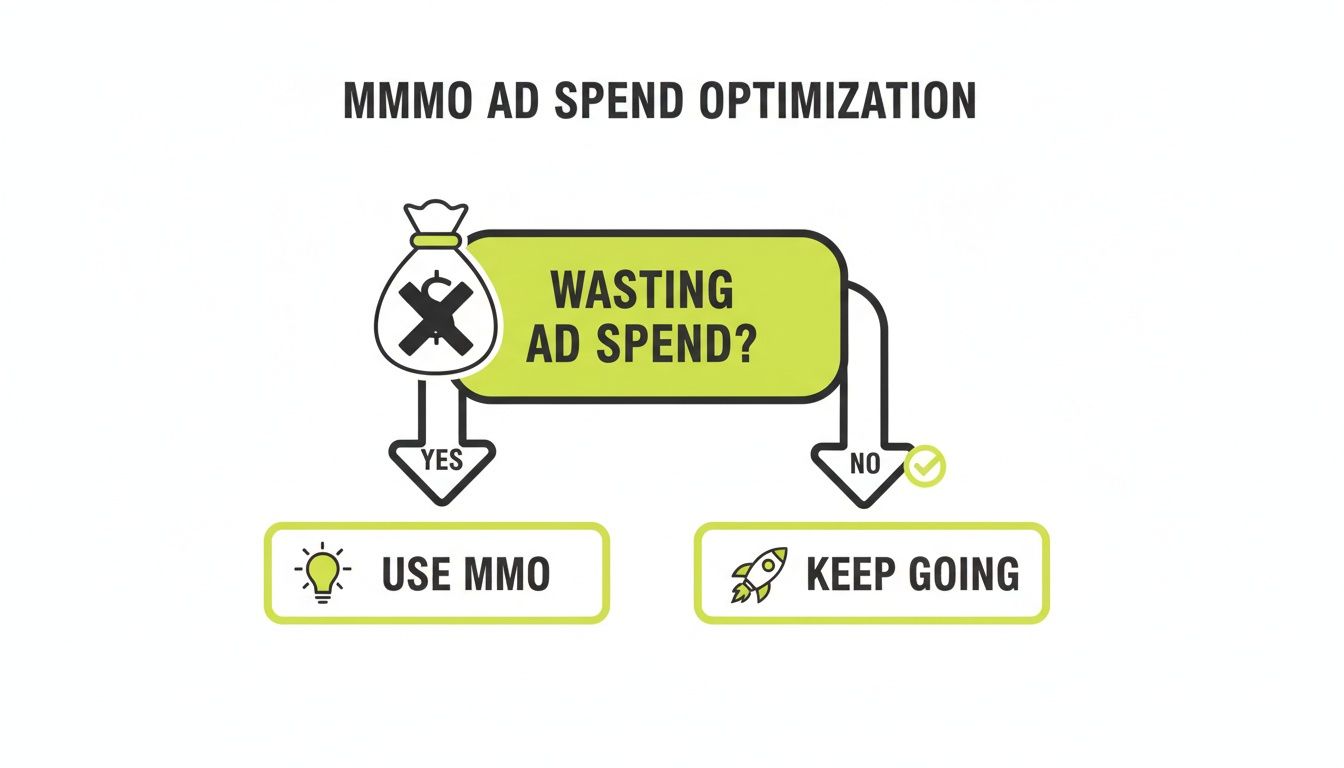
As you can see, if you have a nagging feeling that you’re wasting ad spend, diving into an MMO strategy is the recommended path to better efficiency and higher returns.
Comparing the Three Core Models
Each model really serves a different purpose, and the best choice hinges on your business goals, how mature your data is, and the kinds of questions you need to answer. To make it a bit clearer, here’s a quick rundown of how they stack up.
Comparing Marketing Optimization Models
This table offers a high-level comparison of the three main models to help you figure out which approach might be the right fit.
| Model | Core Approach | Best For | Key Limitation |
|---|---|---|---|
| Marketing Mix Modeling (MMM) | Top-down, aggregated data analysis of all channels and external factors. | Strategic, long-term budget planning and understanding offline channel impact. | Less granular and not real-time, making it slow for daily tactical changes. |
| Multi-Touch Attribution (MTA) | Bottom-up, user-level tracking across digital touchpoints. | Tactical, real-time optimization of digital campaigns. | Increasingly unreliable due to privacy changes; blind to offline channels. |
| AI-Powered Optimization | Hybrid, predictive modeling that combines macro and micro data signals. | Forward-looking scenario planning and dynamic, cross-channel budget allocation. | Requires significant clean data and can be complex to implement initially. |
Ultimately, choosing your model is all about matching your measurement capabilities with your business ambitions. Whether you start with the broad view of MMM, the granular focus of MTA, or the predictive power of AI, the goal is always the same: to make every single marketing dollar work harder for you.
The Essential Data for Effective MMO
A great recipe is useless without high-quality ingredients. For marketing mix optimization, that non-negotiable ingredient is data.
Without clean, comprehensive, and consistent data, any model you build will spit out unreliable insights, leading you straight to poor budget decisions. Think of it as trying to navigate a new city with a blurry, outdated map—you’ll just end up going in circles.
Effective MMO is all about pulling together several distinct categories of information to create a complete picture of your performance. Each category provides a different piece of the puzzle, and only when they’re combined can you see the true drivers of your growth.

The Four Pillars of MMO Data
To get started, you need to collect and organize information from four critical areas. Each one feeds your optimization engine with the context it needs to make smart recommendations.
- Spend Data: This is the most straightforward but crucial input. You need a granular record of every single dollar spent on each marketing channel, broken down by campaign, day, and even creative. For example:
Google Ads, Campaign "Spring Sale," Ad Group "Running Shoes," Date "2023-05-15," Spend "$150.75". - Performance Data: This covers all the top-of-funnel and mid-funnel metrics your campaigns generate. Think impressions, clicks, click-through rates (CTR), and conversions (like form fills or newsletter sign-ups). This data tells you how your audience is interacting with your marketing before a sale happens.
- Sales Data: This is your bottom-line information—transaction volume, revenue per transaction, and customer details. An example record might be:
Order ID #12345, Revenue "$99.99," Date "2023-05-16," Customer "New". Connecting this data back to your marketing activities is the whole key to proving ROI. - External Factors: No business operates in a vacuum. This category includes data on things like seasonality (holiday sales spikes), competitor actions (a major sale), economic trends, and even weather patterns that might influence purchasing. A ski resort, for instance, must include snowfall data in its model.
Connecting Data to Key Business Metrics
Just gathering data is step one. The real value comes from using it to calculate metrics that reflect the true health of your business. These metrics become the vital signs your optimization model uses to gauge success.
For an e-commerce brand, this means tracking things like:
- Return on Ad Spend (ROAS): The most direct measure of profitability for your ads. For every dollar you spend, how many dollars in revenue do you get back? A ROAS of 5:1 means you make $5 for every $1 spent on ads.
- Customer Acquisition Cost (CAC): The total cost to acquire a new paying customer. MMO aims to systematically lower this number by focusing on more efficient channels. If you spend $1,000 on ads and get 10 new customers, your CAC is $100.
- Customer Lifetime Value (LTV): The total revenue a single customer is projected to generate over their entire relationship with your brand. A healthy business needs an LTV that's significantly higher than its CAC.
A local service business, like a gym, would track similar but slightly different metrics. They might focus on cost-per-lead from local SEO or the conversion rate from a geofenced social media ad to a free trial sign-up.
The goal is to move beyond surface-level metrics like clicks and impressions. True marketing mix optimization ties every action to tangible business outcomes like revenue, profit, and customer value.
This focus on holistic measurement is becoming more important than ever. In fact, a whopping 54% of global marketers plan to cut ad spend in 2025 due to economic pressures. Yet, businesses that master MMO are thriving because they can make smarter allocation decisions, even with tighter budgets.
The Non-Negotiable Need for Clean Data
Ultimately, the accuracy of your MMO depends entirely on the quality of your data. Inconsistent campaign naming, broken tracking pixels, or incomplete sales data can completely derail your analysis and lead to flawed conclusions.
Establishing a system for data governance—making sure your data is clean, standardized, and reliable—isn’t just a best practice; it's a prerequisite for success. To truly get a handle on your marketing mix, exploring techniques like those found in this article on 10 Ways AI Predictive Analytics Boosts Ad ROI is essential for spotting your most impactful channels. You can also dive deeper into the technologies behind these insights in our guide to predictive marketing analytics.
A Step-by-Step Roadmap to Implementing MMO
Jumping into marketing mix optimization can feel like a huge undertaking, especially if you don't have a dedicated data science team on standby. But the whole process becomes much more manageable when you break it down into clear, sequential steps. This roadmap will walk you through setting everything up and running a sophisticated, ongoing optimization cycle.

Think of it like building a piece of furniture. You wouldn't just start screwing pieces together at random. You follow the instructions, step-by-step, to build something sturdy and reliable. The same logic applies here.
Step 1: Define Your Core Business Objectives
Before you even think about touching the data, you have to define what success actually looks like. Your MMO model needs a North Star—a single, primary metric it's trying to improve. Are you trying to maximize overall revenue, slash your Customer Acquisition Cost (CAC), or just get more qualified leads into the hands of your sales team?
This single decision will shape the entire process. A startup coach looking to scale might focus on generating high-quality leads for a webinar funnel. On the other hand, a local retail store might care only about increasing foot traffic from their local ad spend.
A clear, measurable goal is the foundation of any successful optimization strategy. Without it, you're just analyzing data without purpose, which is a fast track to wasted time and resources.
Step 2: Consolidate and Clean Your Data
This is almost always the most time-consuming step, but it’s also the most important. Just like making a great meal, you need high-quality ingredients. You'll need to gather, centralize, and clean up the data from all your different sources—ad platforms, your CRM, sales records, and analytics tools.
For many businesses, this is where Customer Data Platforms (CDPs) prove their worth. A CDP acts as a central hub, pulling information from all those scattered sources to create a single, unified view of your customers and marketing performance. To see how these platforms can streamline your efforts, check out our deep dive into how Customer Data Platforms work.
During this phase, make sure everything is standardized. That means using consistent campaign naming conventions across all platforms (e.g., Platform_CampaignType_TargetAudience_Date) and double-checking that your tracking is accurate everywhere. Clean data is trustworthy data.
Step 3: Choose Your Initial Model
You don't need a complex, AI-powered model on day one. Start with an approach that fits your current capabilities and data maturity. For most SMBs, a top-down Marketing Mix Model (MMM) is the most practical place to begin.
An MMM lets you see the big picture without getting bogged down in user-level tracking, which is becoming less reliable anyway. You can start by running a simple regression analysis in a spreadsheet to see how your spending on each channel correlates with your main business goal.
Step 4: Run Your First Analysis and Find Insights
With your goal set, your data clean, and your model chosen, it’s time to run your first analysis. Feed your historical data into the model to see which channels have given you the best return on investment in the past.
The initial results might surprise you. You could discover that your high-spend display ad campaigns have a surprisingly weak link to sales, while those seemingly small podcast sponsorships are bringing in a ton of high-value customers. Look for these patterns—the places where your budget and your results just don't line up.
Step 5: Test Your Recommendations with Small Budget Shifts
Your model’s output is a set of data-backed hypotheses, not commandments set in stone. The next move is to test these ideas in the real world with small, controlled budget adjustments. This approach minimizes risk while you validate what the model is telling you.
- If the model suggests a channel is underperforming: Don't kill its budget overnight. Instead, trim it by 10-15% and reallocate those funds to one of your top-performing channels.
- If the model flags a high-performing channel: Give it a little more fuel by increasing its budget by a similar small percentage.
Watch the results of these shifts closely over a set period—maybe a month or a full sales quarter. Did the changes deliver the lift you expected in your North Star metric?
Step 6: Iterate and Automate for Continuous Improvement
Marketing mix optimization isn’t a one-and-done project; it's a continuous loop of learning and refining. The market is always changing, consumer habits shift, and new channels pop up. Your model and your strategy need to keep up.
Once you’ve validated your initial findings, the goal is to get into a regular rhythm of analysis and adjustment. As you get more comfortable with the process, you can start automating parts of the data collection and reporting to make the cycle more efficient. This iterative process is what turns MMO from a project into a core business function that drives sustainable, data-driven growth.
Practical Examples of MMO in Action
Roadmaps and theory are great, but nothing brings the power of marketing mix optimization to life like seeing it deliver real-world results. When you move from abstract concepts to actual wins, you start to see how businesses are turning data into a serious competitive edge. These stories are where the rubber meets the road.
Let's walk through a few scenarios where MMO wasn't just a number-crunching exercise—it was the key that unlocked major growth and stopped money from going down the drain. This is what happens when you start asking the right questions with the right data.
The E-Commerce Brand and the TikTok Pivot
An online fashion retailer was pouring a huge chunk of their budget into programmatic display ads. On the surface, the numbers looked okay—lots of impressions, plenty of clicks. But their MMO analysis, which connected every dollar spent to actual sales, told a very different, and much harsher, story. The real-world ROAS on these expensive ads was terrible.
The model revealed that while display ads were generating some awareness, they almost never led to a final sale. On the other hand, organic mentions and a tiny, experimental budget on TikTok showed an incredibly high correlation with new customer sales, especially with younger shoppers.
Armed with this insight, the brand made a bold move, but one backed entirely by data.
- The Action: They cut their programmatic display ad spend by a massive 40%.
- The Reallocation: Every dollar saved was funneled into a structured TikTok influencer and paid ads strategy.
- The Outcome: In just one quarter, their overall ROAS shot up by 25%. They were acquiring new customers for less and had uncovered a goldmine of a channel they'd previously dismissed.
The Local Gym and the Lunchtime Rush
A neighborhood fitness center was spinning its wheels trying to get a decent return from its social media campaigns. They were running broad ads targeting nearby residential areas in the evenings, logically assuming that's when people think about working out. The cost per lead was high, and too many of those leads never bothered to sign up for a full membership.
By setting up a simple MMO framework, they started analyzing their ad performance data against two other key points: the exact times new members signed up and the home addresses of their most valuable, long-term members. The data painted a surprising picture. A huge percentage of their highest-LTV members worked in the corporate office parks just a few miles away.
This is a classic case of MMO uncovering a hidden opportunity right under your nose. The gym’s assumptions about their customer's daily routine were completely wrong, but the data showed them the simple, powerful fix.
They immediately tested a new campaign based on this insight. They ran geofenced ads targeting only the corporate parks, and only during lunchtime hours (11 AM to 2 PM). The results were immediate. For the exact same ad spend, the new lunchtime campaigns generated twice the number of qualified leads as the old evening campaigns.
The B2B SaaS Company and the Podcast Proof
A B2B software company was investing heavily in sponsoring several niche industry podcasts. The marketing team was convinced it was building brand authority, but the C-suite was skeptical. Because there were no trackable links, proving a direct ROI with traditional attribution was impossible.
This is where a broader MMO model proved its worth. The model looked at sales data and correlated it with the air dates of their podcast sponsorships. It found a clear, undeniable spike in "direct traffic" and "branded search" queries in the 48 hours right after a new podcast episode dropped.
Even more importantly, the leads coming in from those spikes had a 30% higher conversion rate to high-quality demo requests than leads from any other source. The MMO analysis proved that while podcasts weren't a last-click driver, they were a powerful catalyst for bringing in high-intent prospects. This insight justified the investment and locked in the podcast budget for another year.
These kinds of powerful, real-world examples are becoming the norm as more businesses adopt a smarter approach to their spending. You can find more inspiration by exploring other data-driven marketing examples that show how information creates real impact.
Best Practices for Sustained Growth
Getting your first marketing mix optimization model running is a huge first step, but the real win comes from weaving it into the very fabric of your growth strategy. The goal isn't just to run a one-off analysis. It's to build a system—and a culture—that's always looking for the next smart move.
This is how you turn MMO from a project into a perpetual engine for growth. The best marketing teams I've worked with treat optimization as an "always-on" process, not some dusty report they pull out once a quarter. They create a tight feedback loop: the model spits out an insight, that insight fuels a real-world test, and the results of that test get fed right back into the model to make it even sharper next time.
Foster a Culture of Experimentation
For any of this to stick, your team needs to feel empowered to test new ideas based on data, not just gut feelings. This means encouraging them to look at the model’s outputs, form a hypothesis, and run a small, controlled experiment to see what happens. This "test and learn" mindset is what really separates the good from the great.
A few principles make this work:
- Fail Forward: Not every test is going to be a home run, and that's completely fine. The real goal is learning. A test that shows a new channel doesn't work saves you from investing a large budget there later.
- Empower Action: Give your team the autonomy to shift small percentages of the budget—think 1-2%—to try a new channel or a different creative angle your analysis flagged as promising.
- Share Learnings: Create a central, accessible place where every experiment's results are documented. Wins, losses, and surprises should all be shared openly across the team.
Avoid Common Pitfalls
As you start embedding MMO into your day-to-day, watch out for a few common traps that can easily derail your progress. The biggest one is mistaking correlation for causation. Your model might show a strong link between, say, podcast ads and direct traffic, but that doesn't automatically mean one is causing the other.
A model’s output is a data-backed hypothesis, not an undeniable truth. The real insight comes from testing that hypothesis in the market to prove its causal impact on your bottom line.
Another classic mistake is working with siloed or incomplete data. If your model doesn't know anything about your creative performance, offline campaigns, or promotional calendar, its recommendations will have massive blind spots. For example, if you run a huge 50% off sale, your sales will spike. Without including that promotional data, your model might wrongly attribute the entire sales lift to your regular ads.
Evolve Your Strategy as You Scale
Your MMO strategy can't be set in stone; it has to grow and adapt right alongside your business. A startup’s model will, and should, look completely different from an established enterprise's. As you scale, the complexity and sophistication of your approach should mature, too.
In the early days, you might just be focused on channel-level ROAS. But over time, you can start layering in more granular insights, such as:
- Creative Performance: Which specific images, videos, or ad copy are actually driving results? Integrating this data lets you optimize your messaging, not just your media plan.
- Geographic Nuances: Analyze performance by city, state, or country to tailor your budgets and messaging to local market dynamics.
- Diminishing Returns: Your model can pinpoint the exact moment when pouring more money into a channel stops being efficient. It might show that the first $10k you spend on Google Ads has a great return, but every dollar after $10k delivers less and less, signaling it's time to invest elsewhere.
By embracing these practices, you move beyond just running numbers. You start building a resilient, intelligent marketing operation that consistently finds and funds profitable growth.
Your Top MMO Questions, Answered
Even with the best roadmap, hitting the road with a new strategy always brings up a few questions. Let's tackle some of the most common ones we hear about marketing mix optimization to clear up any confusion and get you moving in the right direction.
How Often Should I Rerun My Model?
There's no single magic number here. The right cadence really depends on your business cycle and how quickly your market shifts. As a solid rule of thumb, a quarterly deep-dive analysis is a great starting point for making those bigger, strategic budget decisions.
But for your fast-moving, high-spend channels like paid search or social media, you’ll want to be more nimble. Checking in on that performance data on a weekly or bi-weekly basis lets you make smart, tactical adjustments without getting whiplash from normal daily ups and downs.
Can MMO Actually Work for a Small Business?
Absolutely. Marketing mix optimization isn't some exclusive club for giant corporations with armies of data scientists. A small business can get incredible value by starting simple, even with a spreadsheet-based regression analysis. The secret is to stay focused. Zero in on your few most important channels and one clear goal, like squeezing the most leads possible from your top three ad platforms.
The core idea of MMO—using data to figure out what’s really working—is universal. You don't need a six-figure software suite to start making smarter, data-backed decisions with your budget.
What's the Single Biggest Mistake Companies Make?
The number one mistake, hands down, is trying to build a model on a foundation of messy, unreliable data. If your conversion tracking is spotty or your campaign naming convention is a chaotic free-for-all, your model’s outputs will be useless. It's the classic "garbage in, garbage out" problem, and it leads to bad recommendations and a total loss of faith in the process.
A close second is diving in without a crystal-clear business objective. If you don't know what you're trying to achieve, the analysis has no direction, making it impossible to pull out any insights you can actually use.
How Does AI Change the Game for Marketing Mix Optimization?
AI takes the whole process and puts it into overdrive. Traditional models are fantastic at explaining what happened in the past. AI models, on the other hand, are built for prediction. They can run thousands of budget simulations in the blink of an eye to tell you the absolute best way to spend your money in the future.
For example, an AI model could simulate scenarios like "What happens to our sales if we move 20% of our Facebook budget to YouTube next month?" and give you a data-backed forecast, something a traditional model can't do. AI also handles a ton of the grunt work, making sophisticated marketing mix optimization faster, more accurate, and more accessible than it has ever been before.
Ready to stop guessing and start growing with a marketing strategy built on data, not hunches? The team at Silver Spoon Agency uses an AI-powered, omnichannel approach to turn your advertising into measurable revenue. Discover how we can optimize your marketing mix for superior ROAS today.