


Choosing a Med Spa Digital Marketing Agency for Growth

A med spa digital marketing agency isn't just another vendor. Think of them as a specialized partner who builds and runs online marketing strategies designed exclusively for aesthetic and wellness practices. Unlike a generalist firm, they live and breathe your world. They get the unique challenges, from patient privacy and regulatory compliance to attracting a steady flow of high-value clients.
Their job is to transform your clinic’s online presence from a static digital brochure into a predictable patient acquisition engine.
The Digital Arms Race in Med Spa Marketing
The med spa industry is absolutely exploding. Projections show it surging from $21 billion in 2024 to an incredible $78.23 billion by 2033. With North America owning about 41% of that pie, local markets have become fierce battlegrounds. You can dig deeper into these industry shifts and what they mean for clinic owners.
This massive growth has created a huge problem for practice owners: being a brilliant clinician with the latest tech is no longer enough to keep the appointment book full. To stand out, you need a deliberate, sophisticated digital strategy.
From Invisible to In-Demand
Running a modern med spa today without a smart digital marketing plan is like throwing an exclusive, high-end party but forgetting to send any invitations. You might have the best injectors, the most advanced lasers, and a gorgeous clinic, but if potential patients can't find you when they search online, you're functionally invisible.
The old "if you build it, they will come" mindset is a recipe for failure, especially when a new competitor opens just a few blocks away. For example, a beautifully designed clinic in Dallas could lose dozens of appointments each month to a smaller practice two streets over simply because that competitor shows up first on Google Maps for "Botox in Dallas."
A specialized med spa digital marketing agency acts as your strategic partner, building a digital bridge that connects your services directly to motivated patients in your area. They don't just "run ads"; they engineer an entire patient acquisition system. The goal is to move beyond sporadic bookings and create predictable, scalable growth for your practice.
The goal shifts from merely "doing marketing" to engineering a reliable process that consistently attracts, nurtures, and converts high-value patients who are actively searching for the exact treatments you provide.
Building Your Patient Acquisition Engine
Think of this partnership as graduating from simple, one-off advertising campaigns to building a powerful, self-sustaining engine for your practice. A dedicated agency creates a cohesive system where every component works together, ensuring you're not just seen, but chosen.
This engine has a few critical parts:
- Attracting the Right Audience: This means using hyper-targeted ads and local SEO to show up when people in your city are searching for "Botox near me" or "CoolSculpting cost." For instance, an ad could target women aged 30-55 living within a 10-mile radius of your spa who have shown an interest in luxury skincare.
- Building Trust and Authority: It's about creating educational content and managing your online reviews to position your clinic as the undeniable premier choice. A practical example is publishing a blog post titled "5 Things to Know Before Your First Morpheus8 Treatment" to answer common questions and establish your expertise.
- Converting Interest into Appointments: This involves designing a seamless online experience that makes it incredibly easy for a website visitor to take the next step and book a consultation. For instance, placing a "Book Your Free Consultation" button prominently on every treatment page.
This integrated approach is the secret to thriving in today's crowded market. It’s how your med spa stops just surviving the competition and starts leading the pack.
The Core Services That Drive Patient Bookings
A specialized med spa marketing agency does more than just run a few ads. They’re the architects behind a complete system designed to turn online curiosity into actual, paying patients in your treatment rooms. To really know if an agency is the right partner, you have to understand what these core services are and how they work together.
Each piece of the puzzle plays a specific part. Some attract new people who live nearby, while others build trust and guide them until they’re ready to pick up the phone and book. When you combine them correctly, you get a predictable engine for patient growth.
This is a great visual for how an agency connects your practice to new patients by strategically deploying these key services.
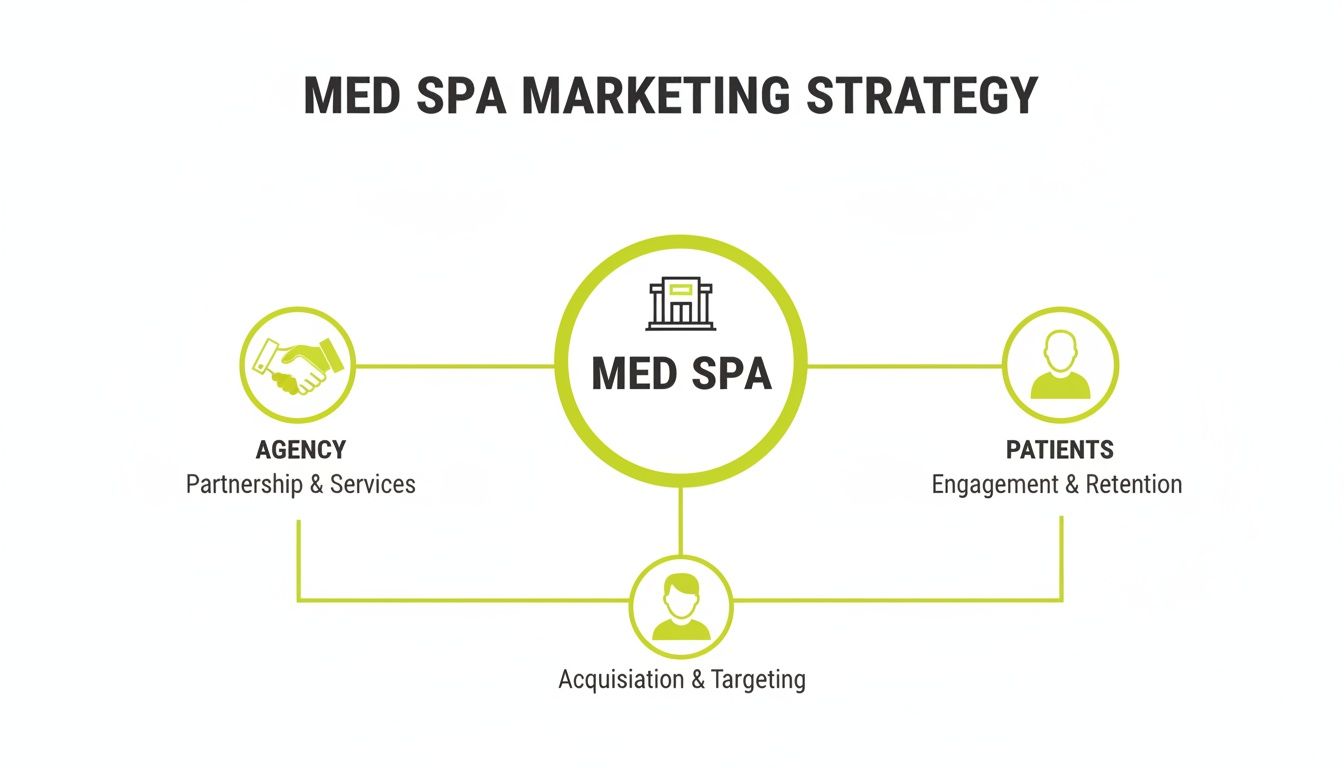
As you can see, it's all about that partnership. The agency's work directly fuels the patient acquisition pipeline, with each service branch playing a crucial role.
The Essential Digital Marketing Services for Med Spas
When you're evaluating a marketing partner, their list of services should read like a blueprint for patient acquisition. It's not just about having the services; it's about how they're used to achieve specific, tangible goals for a practice like yours. Here’s a quick breakdown of the non-negotiables.
| Service | Primary Goal | Practical Example |
|---|---|---|
| Local SEO | Dominate local search results for high-intent keywords | Ranking in the top 3 on Google Maps for "Botox near me," driving direct calls and website clicks. |
| Paid Advertising | Generate immediate, qualified leads | Running a targeted Instagram ad for a "New Client HydraFacial" offer to women aged 30-55 in your zip code. |
| Patient Funnels | Nurture interest and convert leads into bookings | A prospect downloads a "CoolSculpting Guide," receives a follow-up email with a testimonial, then books a consult via a link in the email. |
| Reputation Management | Build trust and social proof with real patient reviews | An automated text message sends a review link to a patient after their appointment, generating a steady flow of 5-star Google reviews. |
| SMS & Email Marketing | Reactivate past patients and nurture new leads | Sending a "We Miss You!" text offer to patients who haven't booked in 6+ months, leading to a spike in re-bookings. |
These services aren't just a checklist; they form an interconnected system. A great review from reputation management makes your paid ads more believable, and strong local SEO brings in traffic that your funnels can then convert.
Hyper-Local SEO for Med Spas
Let’s get specific. When a potential patient in your city pulls out their phone and searches “HydraFacial in Miami,” your med spa needs to be one of the first names they see. That’s what Local Search Engine Optimization (SEO) is all about. It's not about trying to rank for vague, national terms; it’s about owning the search results that signal someone is ready to book, right here, right now.
A top-tier agency will obsess over your Google Business Profile. This is your digital storefront. They’ll make sure your services are listed with the right keywords, upload stunning before-and-after photos, and most importantly, help you get a constant stream of glowing patient reviews.
Here's a real-world example: An agency dialed in a client's profile for "lip filler" and "chemical peel" in their specific city. By helping them generate 15 new 5-star reviews in 60 days, they pushed the clinic into the coveted Google Maps "3-pack." The result? A 30% jump in calls from new patients who found them on their phones.
Paid Advertising for Immediate Results
SEO is the long game—it builds authority over time. But when you need leads now, you turn to Paid Advertising. This means running Pay-Per-Click (PPC) ads on Google and highly targeted ads on social media platforms like Instagram and Facebook where your ideal patients are already scrolling.
A skilled agency doesn't just "boost posts." They build surgically precise campaigns, targeting users by their zip code, their interests (like following luxury beauty brands), and even their online behavior. This focus ensures your ad budget isn't wasted and is spent only on people who are genuinely likely to become patients.
- PPC (Google Ads): These ads are for capturing people with high-intent. Think keywords like "best med spa near me" or "CoolSculpting cost." You're catching them at the exact moment they're looking for what you offer.
- Paid Social (Facebook & Instagram): These ads are fantastic for building awareness and generating leads. You can target users based on demographics (e.g., women aged 35-55 within a 10-mile radius of your spa) or interests (e.g., they follow high-end skincare influencers).
Here's how it plays out: A med spa agency creates an Instagram video ad showing a Morpheus8 treatment in action. It's targeted to users who follow well-known skincare gurus and have even visited competitor websites. The ad promotes a "New Client RF Microneedling Offer" and sends them to a dedicated landing page, which captures 50 qualified leads in the first month alone.
Patient Acquisition Funnels That Convert
A patient acquisition funnel is simply the journey you guide a potential patient on—from the first time they hear about you to the moment they book a consultation. It's not about getting a single click; it’s about building a relationship and establishing trust every step of the way.
Often, this starts with offering something of value. Maybe it's a downloadable guide, a free webinar, or a quiz. This is also where tools like healthcare live chat solutions come into play, answering questions instantly and nudging prospects toward booking. The goal is to nurture that initial spark of interest and position your clinic as the go-to expert.
The Funnel in Action:
- Awareness: A prospect scrolls through Facebook and sees your ad for a free "Guide to Your First CoolSculpting Session."
- Interest: Intrigued, they provide their email to download the guide. They're now in your funnel.
- Nurture: Over the next week, they receive a few automated emails featuring patient testimonials, answers to common questions, and finally, a special offer for a free consultation.
- Conversion: Feeling informed and confident, they click the link in the last email and book their consultation right on your website.
Reputation Management and Social Proof
In the aesthetics world, trust is your most valuable currency. Reputation Management isn't passive; it's the active process of generating, monitoring, and showcasing patient reviews to build undeniable social proof. For many new patients, your reviews are the single most important factor in their decision.
An expert agency will put this on autopilot. They can connect software to your booking system that automatically sends a patient a text or email asking for a review shortly after their appointment. It’s a simple move that turns your happiest patients into your most powerful marketing asset. This is just one of many medical spa marketing ideas that leverages this foundation of trust to drive growth.
This strategic blend of services is where the real growth happens. It's shocking, but while 70% of clients follow spas on social media for promotions, a staggering 52% of practices still invest less than $2,500 monthly in digital marketing. The clinics that get this right—combining SEO, paid ads, and funnels—are the ones pulling away from the pack, often seeing a significant return and measurable results within just 3-6 months.
Marketing Safely Within HIPAA and Ad Regulations
Let's be blunt: marketing a med spa is nothing like marketing a clothing store. You're working at the intersection of commerce and healthcare, a place governed by a labyrinth of rules designed to protect patients and police advertising claims. A top-tier med spa digital marketing agency doesn't just know these rules—they live and breathe them, ensuring every campaign is both powerful and compliant.
The stakes are incredibly high. One wrong move—an unapproved testimonial, a poorly worded ad—can trigger devastating fines, legal nightmares, and a total collapse of the trust you've built with your patients. This is where an expert agency partner shifts from being a vendor to an essential safeguard for your practice.
Navigating HIPAA in Your Marketing
The Health Insurance Portability and Accountability Act (HIPAA) isn't just about locking filing cabinets. Its reach extends directly into your Instagram feed, your website, and your email campaigns. Any patient image, name, or story is considered Protected Health Information (PHI).
A shockingly common mistake is thinking a quick "Is it okay if I post this?" is enough. It's not. Not even close.
To stay on the right side of the law, you absolutely must get a specific, signed HIPAA authorization form from the patient before their information is ever used in marketing. This document has to spell out exactly what you'll use (e.g., photo of their chin), where you'll use it (e.g., Instagram and Facebook), and for how long.
This formal process protects both your patient's privacy and your practice's future. To get a handle on all the moving parts, a detailed HIPAA compliance checklist is an absolute must-have for any practice owner.
Crafting Compliant and Compelling Language
Beyond HIPAA, the claims you make in your ads are under a microscope. The goal is to create desire without making deceptive promises. A specialized agency is a master at walking this tightrope, using language that sells the sizzle without guaranteeing the steak.
Here’s what that looks like in the real world:
- Risky Claim: "This laser treatment eliminates wrinkles forever!" This is an absolute, ironclad promise you can't possibly keep, and it’s an open invitation for a lawsuit or regulatory smackdown.
- Compliant Claim: "This laser treatment helps reduce the appearance of fine lines and wrinkles." This phrasing is honest. It manages expectations and focuses on the real-world outcome without making a false guarantee.
The secret is using "softening" language. Words like "helps," "reduces the appearance of," and "promotes" become your best friends, allowing you to create powerful copy that won't land you in hot water. For a much deeper dive, you can learn more about the nuances of healthcare advertising compliance in our detailed guide.
The Art of the Before-and-After Photo
Before-and-after photos are the single most powerful tool in a med spa's marketing arsenal. Period. But using them correctly is a science, and an experienced agency will enforce a strict protocol to ensure they are both ethical and wildly effective.
Best Practices for Before-and-Afters:
- Consistent Lighting: The lighting setup must be identical in both shots. No shadows to artificially create contour. A practical way to achieve this is by using a ring light and placing tape on the floor to mark where the patient should stand.
- Identical Angles: The patient's pose, their expression, and the camera angle need to be exact duplicates to show a true comparison. For example, have the patient rest their chin on the same spot on a headrest for both photos.
- Clear Disclaimers: Every single post must include a disclaimer like "Individual results may vary." This is completely non-negotiable.
- No Digital Alterations: Other than basic color correction, the photos should never be retouched to "improve" the results. Authenticity is everything.
By sticking to these rules, a med spa digital marketing agency builds a library of social proof that's not just compelling—it's trustworthy. This is what drives consultations and grows your practice safely. This meticulous, disciplined approach is what separates the amateurs from the true professional growth partners.
Measuring Real Growth with the Right KPIs
Likes and follows are nice, but they don’t keep the lights on. A seasoned med spa marketing agency knows the difference between vanity metrics that stroke the ego and performance metrics that actually grow your bottom line. The big question is always: is your marketing making you money?
Let’s cut through the jargon and talk about the numbers that really matter for profitability.
Getting a handle on these core metrics is the first step toward building a predictable growth engine for your practice. When a sharp agency talks about performance, they aren’t just guessing—they’re measuring, analyzing, and optimizing based on this critical data.
From Ad Clicks to Patient Bookings
A successful campaign isn't about getting a flood of clicks; it’s about attracting the right people who will actually book an appointment. A specialized agency obsesses over a few key KPIs that map the journey from a prospect seeing your ad to a new patient sitting in your treatment chair. This is how you separate wasted ad dollars from profitable investments.
Think of these metrics as the vital signs of your marketing strategy:
- Cost Per Lead (CPL): This is your all-in cost to get one new person to raise their hand, whether they fill out a form, call your front desk, or send a direct message. It’s a pure measure of how efficiently you’re generating new opportunities.
- Lead-to-Appointment Rate: This is a huge one. It tells you what percentage of those leads actually show up on the schedule. This metric reveals the quality of your leads and the effectiveness of your front desk.
- Return on Ad Spend (ROAS): The ultimate bottom-line number. For every single dollar you put into your ads, how many dollars in revenue came back out? This is the true test of profitability.
By tracking these numbers like a hawk, an agency can make smart, data-backed decisions instead of just crossing their fingers and hoping for the best.
Key Performance Indicators (KPIs) for Med Spa Marketing
Not all data is created equal. While things like website traffic are worth a glance, the numbers that truly show the health of your patient pipeline are the ones tied directly to cost and conversion. A good agency will set clear benchmarks for these KPIs right from the start, so everyone knows what "success" looks like.
Here's a quick look at the most important metrics you should be tracking, along with some realistic industry benchmarks to aim for.
| KPI | What It Measures | Good Industry Benchmark |
|---|---|---|
| Cost Per Lead (CPL) | The marketing cost to acquire one new patient inquiry. | $50 – $150 (varies by treatment) |
| Lead-to-Appointment Rate | The percentage of qualified leads that book a consultation. | 30% – 50% |
| Return on Ad Spend (ROAS) | The gross revenue generated for every dollar spent on ads. | 3x – 7x (or higher) |
These benchmarks give you a clear target to shoot for and a concrete way to judge how your campaigns are really performing.
A successful campaign might target a Cost Per Lead under $75 for a laser hair removal package promotion. If the agency achieves a 5x ROAS, a $2,000 ad investment would directly generate $10,000 in treatment revenue.
This is the kind of math that builds thriving med spas.
A Mini Case Study in Action
Let's see how this all plays out in the real world. Imagine a med spa launches a new campaign, splitting its budget between Facebook ads for a Botox special and Google Ads targeting people searching for "Botox near me."
After two weeks, their med spa digital marketing agency dives into the data:
- Facebook Ads: The campaign brought in 50 leads at a great CPL of $40. But here's the catch—the Lead-to-Appointment Rate was a dismal 10%. Only 5 people actually booked. The ROAS was barely breaking even at 1.2x.
- Google Ads: This campaign generated fewer leads (20) at a higher CPL of $80. But critically, these were high-intent searchers ready to buy. This resulted in a stellar 50% Lead-to-Appointment Rate, securing 10 booked appointments and an impressive 6x ROAS.
Seeing this clear-cut data, the agency immediately pivots. They reallocate the majority of the budget away from the underperforming Facebook campaign and double down on the highly profitable Google Ads.
By the end of the month, the med spa has doubled its new patient bookings for Botox—all without increasing its total marketing spend. That's the power of tracking the right KPIs.
How Much Do Med Spa Marketing Agencies Cost?
Making the decision to bring on a digital marketing agency is a serious financial step. You need to know exactly where your money is going, and just as importantly, how an agency bills for their work. The pricing structure isn't just a number on an invoice; it's a reflection of the services you're getting, the agency's confidence in their results, and how you both share in the risk and reward.
A great partner will be completely transparent about their fees. Your job is to find the model that fits your med spa's budget, your appetite for growth, and how comfortable you are with different levels of risk. Let's walk through the three most common pricing models you'll run into.
The Monthly Retainer Model
The most common and straightforward model is the monthly retainer. You can think of it like a subscription for your marketing department. You pay a set, flat fee every month, and the agency delivers a pre-defined package of services. This usually covers things like SEO, running your social media, creating content, and sending you performance reports.
This model is all about predictability. Your marketing costs are fixed, making budgeting a breeze, and it ensures your marketing efforts are always on, humming along in the background. It's a fantastic fit for practices that want the benefit of a full marketing team without the salary, benefits, and overhead of hiring in-house.
Real-World Scenario: A med spa agrees to a $4,000/month retainer. In exchange, the agency handles their local SEO, writes two blog posts, manages their Facebook and Instagram presence, and delivers a monthly analytics report. That $4,000 fee stays the same, whether it's a crazy busy month or a slower one.
The Percentage of Ad Spend Model
If your marketing plan is leaning heavily into paid ads—think Google Ads or paid social media on platforms like Facebook—you'll almost certainly see the percentage of ad spend model. It's simple: the agency’s management fee is a slice of your total ad budget. This fee usually lands somewhere between 15-20%.
This structure creates a direct incentive for the agency to make your ad budget work hard and grow your campaigns successfully. As you spend more and see a greater return, their fee grows with you. This is ideal for med spas that are ready to make a serious investment to get leads in the door right now using paid advertising.
- Example Breakdown: Your med spa decides to put $10,000 toward a monthly Google Ads budget.
- Agency Fee: The agency's management fee is 15%.
- Your Total Cost: You'll pay the agency $1,500 (15% of $10,000) to manage the campaign. The other $10,000 goes straight to Google for the ad clicks. All in, your monthly cost for this service is $11,500.
The Performance-Based Model
For the med spa owner who wants to eliminate as much risk as possible, the performance-based model is incredibly appealing. Here, the agency's pay is tied directly to the results they produce. Instead of paying for their time or a list of tasks, you pay for cold, hard outcomes like qualified leads or, even better, appointments booked on your calendar.
This is the ultimate alignment of goals. If you don't get results, they don't get paid. Simple as that. It forces the agency to put their money where their mouth is. While this model carries the lowest risk for you, the cost per result is often higher, because the agency is fronting all the costs and taking on all the risk to get those campaigns running.
Real-World Scenario: You strike a deal to pay an agency $150 for every qualified appointment they generate and book for your clinic. If they deliver 20 appointments in a month, your invoice is $3,000. If they only manage to book 5, you only owe $750. You only pay for what you get.
Your Vetting Checklist for Hiring the Right Agency
Picking a marketing partner is one of the most important business decisions you'll make. The right med spa digital marketing agency can be the rocket fuel for incredible growth. The wrong one? They can burn through your budget with painfully little to show for it.
To help you tell the difference, we’ve put together an actionable checklist. Use these questions during your discovery calls to dig past the sales pitch and find a true growth partner who gets the unique world of medical aesthetics.
This isn’t about asking generic questions. It’s about getting to the heart of what matters.

Questions About Experience and Specialization
First things first: you need to confirm they have legitimate, hands-on experience in our industry. General marketing rules often don't apply to the nuanced world of medical aesthetics, where trust, compliance, and patient safety are everything.
Can you show me a case study from a med spa with a similar service mix to mine?
This is the ultimate proof. Don’t just accept a case study from any med spa—ask to see results for a practice that also focuses heavily on injectables, lasers, or whatever your core treatments are. Look for real numbers on new patient growth and, most importantly, ROAS. A practical example would be asking, "We are launching Semaglutide treatments. Can you show us a case study for another clinic's weight loss program?"What percentage of your clients are in the medical or aesthetics industry?
A high number here (over 50% is a fantastic sign) shows they aren’t just dabbling. It means their team, their tools, and their entire process are already built around the specific needs of a practice just like yours.
Questions About Strategy and Compliance
Next, it's time to probe their strategic thinking. A great agency knows how to balance aggressive growth goals with a deep respect for industry regulations. Their answers will reveal if they’re just technicians or true strategists.
Red Flag Alert: Be extremely wary of any agency that guarantees a #1 ranking on Google. SEO is a complex, constantly shifting game, and no one can honestly make that promise. True experts talk about targeting top positions, not guaranteeing them.
How do you stay current with HIPAA marketing guidelines and ad platform policies?
They should have an immediate, confident answer. They should mention specific protocols for handling patient information, using compliant language in ads, and navigating the notoriously strict ad rules on platforms like Meta (Facebook) and Google. For example, they might describe their process for getting HIPAA-compliant patient consent forms signed before any before-and-after photos are used.What does your reporting dashboard look like, and how often will we meet to review it?
Ask for a sneak peek. They should be able to show you a sample dashboard that’s clear, easy to follow, and focused on the KPIs that actually matter to your bottom line—like Cost Per Lead and ROAS, not just fuzzy metrics like likes and clicks. Monthly or bi-weekly review meetings are the standard.
Questions About Partnership and Results
Finally, you need to get a feel for what it will actually be like to work with them. A good agency acts like an extension of your own team, becoming fully invested in your success. You're looking for signs that they're focused on long-term, sustainable growth, not just a quick win.
How do you measure success beyond initial leads, such as patient lifetime value (LTV)?
This one question separates the simple lead generators from the real growth partners. A top-tier agency will have strategies for not just acquiring that new patient, but also for increasing their long-term value through retention marketing and upselling. For instance, they might suggest an automated email sequence to Botox patients after 3 months, reminding them it might be time for a touch-up.What level of involvement will you need from me and my staff?
This is all about setting clear expectations from day one. A great partnership is collaborative, of course, but the agency should be handling the heavy lifting of campaign management. This frees up you and your team to do what you do best: provide outstanding care to your patients.
Frequently Asked Questions
When you're thinking about bringing on a med spa digital marketing agency, you're bound to have a few questions. It’s a big decision. Here are some straight, practical answers to the things we hear most often from practice owners, designed to help you move forward with confidence.
How Long Until I See Real Results?
This is always the first question, and the answer really has two parts. You should expect to see the needle move on paid advertising—things like Google Ads or targeted social media campaigns—very quickly. We're talking leads and consultation requests coming in within the first 30-60 days. These campaigns are built for speed.
But the foundational work, like local SEO and content marketing, is more like planting a tree. It takes a bit longer to take root but delivers much stronger, more sustainable growth over time. For these strategies, you’ll start seeing a real impact on your organic search rankings and website traffic within 3-6 months. A top-tier agency delivers both the immediate wins and the long-term, foundational growth.
Here’s what that looks like in practice: An agency launches a Google Ads campaign targeting "Botox near me." You could see your first few leads from that campaign within a week. At the exact same time, they're overhauling your Google Business Profile. Three months down the road, you're ranking in the top 3 on Google Maps for that same term, bringing in a steady stream of high-quality traffic every single day—for free.
How Much Involvement Is Needed from My Staff?
While a great agency does the heavy lifting, your team’s involvement is the secret ingredient for success. The good news is, it should be minimal and focused. The single most critical area is lead handling. The agency will generate the leads, but your front desk team needs to be ready to respond quickly and effectively to turn those digital hand-raises into booked appointments. A practical example is having a dedicated staff member responsible for calling new web leads within 5 minutes of their submission.
For things like content, the agency will need occasional access to your clinicians for their expert take on a topic or to approve before-and-after photos. All in all, you should plan for about 1-2 hours per week from your team for reviews, feedback, and quick check-ins, especially during the first month or two.
Is a Specialized Agency Really Better?
Yes. Without a doubt. A generalist marketing firm might know how to run an ad, but a niche agency that lives and breathes aesthetics understands the game you’re actually playing.
- Compliance: They’re fluent in HIPAA and the strict advertising rules of the medical world. They know you can’t use patient photos without a specific marketing release form, protecting you from very expensive mistakes.
- Targeting: They know exactly how to find a high-value patient looking for CoolSculpting versus a younger audience interested in lip fillers. They get the nuances, the language, and the emotional triggers that resonate in aesthetics.
- Strategy: They won't waste your time or money on generic strategies that don't work for med spas. They build every campaign around high-profit treatments and patient lifetime value, not just clicks and impressions.
Hiring a specialized agency means you're not paying them to learn your industry on your dime. You're paying for their proven experience and a playbook that already works.
Ready to stop guessing and start seeing measurable growth? The team at Silver Spoon Agency builds performance-driven marketing engines specifically for practices like yours, turning ad spend into predictable patient revenue. Book your free strategy call today to see how we can fill your calendar.