


10 Multi Channel Marketing Strategies Dominating 2026

In today's fragmented digital landscape, customers don't see channels—they see a single brand. A prospect might discover your local clinic on a TikTok video, get retargeted with client testimonials on Instagram, search for your reviews on Google, and finally book an appointment through an email offer. If these touchpoints aren't connected, you're not just losing efficiency; you're delivering a disjointed experience that erodes trust and wastes precious ad spend. True growth isn't about mastering a single channel; it's about orchestrating all of them into a unified customer journey.
This is where powerful multi channel marketing strategies transform siloed tactics into a cohesive, revenue-generating machine. By unifying messaging, data, and user experiences across platforms, you create a seamless path that guides potential customers from initial awareness to final conversion with precision. The core challenge, however, is managing this complexity without manual overload. To address common pain points of fragmented marketing efforts, exploring effective multi-channel marketing automation solutions is essential for building a cohesive strategy that scales.
This guide moves beyond theory to provide a tactical playbook. We will break down the 10 most impactful multi-channel marketing strategies delivering measurable results for businesses right now. You'll get actionable examples and quick-start checklists to help you implement sophisticated approaches like geofencing, AI-powered lead scoring, and AR-based experiential campaigns. Forget generic advice; it's time to build a connected marketing ecosystem that drives predictable growth and ROI.
1. Omnichannel Attribution & Real-Time Optimization
Among the most powerful multi-channel marketing strategies is the fusion of omnichannel attribution with real-time optimization. This approach moves beyond analyzing channels in isolation and instead provides a complete, unified view of the entire customer journey. It tracks every interaction a customer has with your brand-from a social media ad and an email click to an in-store visit-to understand precisely which combinations of touchpoints drive conversions.

The real power emerges when this attribution data is fed into AI-driven systems for real-time optimization. Instead of waiting for weekly or monthly reports, the system dynamically adjusts bids, creative assets, and messaging on the fly. For instance, if data shows that users who see a TikTok video and then click a Google Search ad convert 30% more often, the AI can automatically increase your Google ad bid for that specific audience segment. This maximizes your Return on Ad Spend (ROAS).
Real-World Examples & Implementation
A prime example is Amazon, which meticulously tracks user behavior across its app, website, and external display ads to inform its ad spend in real time. Similarly, Shopify merchants use Shopify Audiences to gain a full-funnel view, understanding how an initial Pinterest pin may ultimately lead to a purchase initiated through an email campaign. At Silver Spoon, our clients have seen an average of 4X ROAS by implementing unified attribution models that optimize over 120,000 campaigns in real time. Understanding the nuances of different models is key; you can explore the differences between first-touch and last-touch attribution models on Silver Spoon Agency's blog to see which fits your goals.
Actionable Tips for Implementation:
- Consistent UTM Tagging: Implement a standardized UTM parameter structure across all marketing channels (email, social, PPC, etc.) to ensure every touchpoint is trackable. For example, a Facebook ad link might include
utm_source=facebook&utm_medium=cpc&utm_campaign=summer_sale. - Leverage First-Party Data: Use tools like pixel tracking on your website and CRM integrations to build a robust, privacy-compliant attribution model independent of third-party cookies.
- Assign Conversion Values: Set up conversion value tracking in your analytics platform. Assigning different monetary values to various actions (e.g., a newsletter sign-up vs. a completed purchase) allows for more accurate, value-based attribution.
- Establish a Feedback Loop: Create a direct process where insights from your attribution model immediately inform daily and weekly budget allocation decisions, ensuring agility and continuous improvement.
2. Geofencing & Hyperlocal Targeting
One of the most precise multi channel marketing strategies involves leveraging geofencing to deliver hyperlocal advertising. This technique creates virtual geographic boundaries, triggering targeted ads on mobile devices when users enter or exit a specific area, like a store, a competitor’s location, or an event venue. By combining location-based triggers with other channels like social media and search, brands can engage high-intent consumers at the most critical moments of their purchasing journey.
This strategy is exceptionally powerful for driving immediate, real-world action. For example, a local car dealership can set up a geofence around a competitor’s lot. When a potential car buyer enters that area, they can be served a mobile ad on Facebook or a news app with a more competitive offer, like "0% financing this weekend only." It transforms a broad digital campaign into a personalized invitation based on a user's real-time physical context.
Real-World Examples & Implementation
Starbucks effectively uses geofencing to send push notifications about "Happy Hour" deals to users near its cafes, directly boosting foot traffic. Similarly, a real estate agent can set up a geofence around a competitor's open house to serve ads to attendees, capturing highly qualified leads. At Silver Spoon Agency, our local service clients, from fitness centers to medical clinics, have used geofencing to achieve over 120% gains in foot traffic and book high-intent appointments by targeting competitor locations and complementary businesses.
Actionable Tips for Implementation:
- Target Strategically: Define geofence boundaries around high-intent locations like competitor stores, event venues, and complementary businesses, not just your own storefront.
- Layer Audience Data: Combine geofencing with demographic and behavioral data to refine your audience. For example, target users aged 25-45 who have shown interest in fitness near a competitor’s gym.
- Use Sequential Messaging: Engage users with an initial ad when they enter a geofenced zone, then retarget them with a different, compelling offer after they have left the area. For example, an ad saying "Thinking about a new car?" could be followed by "See our test drive offers" a day later.
- Measure Offline Conversions: Track success with metrics that matter for local businesses, such as store visit attribution, appointment bookings, or inbound phone calls, rather than just clicks.
- Test Geofence Radii: Experiment with different geofence sizes (e.g., 100 feet vs. 500 feet) to find the optimal balance between targeted reach and avoiding ad spend waste.
3. Conversion-Optimized Funnel Design (TOFU → BOFU)
A truly effective multi-channel marketing strategy is built around a conversion-optimized funnel that guides customers from initial awareness to a final purchase. This approach orchestrates the customer journey by aligning specific channels and messages to each stage: Top-of-Funnel (TOFU), Middle-of-Funnel (MOFU), and Bottom-of-Funnel (BOFU). It ensures your brand communicates the right message at the right time, preventing premature sales pitches and building a relationship that nurtures leads toward conversion.

At the TOFU stage, the goal is broad awareness, using channels like social media brand ads and SEO-driven content to attract a wide audience. In the MOFU stage, you engage prospects who have shown interest with retargeting ads, educational email sequences, and case studies. Finally, the BOFU stage uses high-intent channels like Google Search ads, direct SMS offers, and personalized outreach to close the deal. This strategic progression maximizes conversion potential at every step.
Real-World Examples & Implementation
Consider an e-commerce brand: it might run a TOFU brand awareness campaign on TikTok, then use MOFU abandoned cart emails to re-engage interested shoppers, and finally send a BOFU SMS with a limited-time discount to trigger the purchase. Similarly, a business coach could offer a free webinar (TOFU), follow up with an educational email nurture sequence (MOFU), and then run retargeting ads for a strategy call to high-ticket prospects (BOFU). At Silver Spoon, our clients have seen conversion lifts of over 150% by implementing these structured, multi-channel funnels. For a deeper dive into this, you can learn more about powerful sales funnel optimization strategies on Silver Spoon Agency's blog.
Actionable Tips for Implementation:
- Map Channels to Funnel Stages: Clearly define which channels serve each stage. Use broad-reach platforms like Facebook and YouTube for TOFU, email and retargeting for MOFU, and direct-response channels like SMS and Google Search for BOFU.
- Segment Landing Pages: Create different landing pages for each funnel stage. A TOFU page should focus on education and building trust, while a BOFU page should emphasize urgency, social proof, and a clear call-to-action.
- Implement Lead Scoring: Use a lead scoring system to automatically identify when a prospect is ready to move to the next stage. For instance, assign +10 points for a webinar sign-up and +5 for an email open. When a lead reaches 50 points, they are automatically moved to a sales-focused campaign.
- Measure Stage-Specific Metrics: Track key performance indicators for each part of the funnel. Monitor cost per lead at TOFU, engagement rates at MOFU, and conversion rates at BOFU to identify and fix bottlenecks.
4. Social Media Channel Orchestration (Platform-Specific Strategy)
Effective multi channel marketing strategies recognize that social media is not a monolith. Social media channel orchestration moves beyond simply cross-posting the same content everywhere and instead deploys platform-specific strategies across Facebook, Instagram, TikTok, LinkedIn, and YouTube simultaneously. This sophisticated approach leverages each platform's unique algorithm, audience demographics, and native content formats to maximize impact and engagement.
Instead of a one-size-fits-all message, orchestration adapts the creative, messaging, and bidding strategies to align with each channel's strengths. A carousel ad that works perfectly for product discovery on Facebook would be ineffective on TikTok, which thrives on authentic, short-form vertical video. By tailoring the approach, brands can expand their reach across diverse audience segments, build deeper platform-native engagement, and mitigate the risk of relying too heavily on a single platform's algorithm.
Real-World Examples & Implementation
Consider an e-commerce brand selling athletic wear. They could orchestrate their social channels by running Facebook carousel ads for product discovery, posting user-generated Instagram Reels to create FOMO, and producing organic TikTok videos showcasing the apparel in fun challenges for brand awareness. Meanwhile, YouTube could host long-form video testimonials from athletes. Similarly, a business coach might use LinkedIn for thought leadership articles, Facebook ads for lead generation, and Instagram DMs for nurturing prospects. At Silver Spoon, we orchestrate social media with search, display, and SMS campaigns, using cross-channel data to optimize which platforms deliver the best ROAS for each specific client segment.
Actionable Tips for Implementation:
- Create Platform-Specific Creative: Design assets for their native environment. This means vertical video for TikTok and Instagram Reels, high-quality images and carousels for Facebook, and professionally produced long-form content for YouTube.
- Segment Audiences by Platform: Use each platform's unique targeting capabilities. For example, leverage Facebook's Lookalike Audiences for high-ROAS campaigns while using TikTok's broad reach for viral brand awareness and top-of-funnel engagement.
- Set Platform-Specific KPIs: Measure success based on the channel's strength. Track ROAS and conversions on Facebook, engagement and direct sales on Instagram, video views and brand lift on TikTok, and watch time and lead quality on YouTube.
- Leverage Native Platform Tools: Maximize efficiency and results by using tools like Facebook's Advantage+ Shopping Campaigns, TikTok Spark Ads to boost organic content, and Instagram Shopping to facilitate seamless purchases.
5. Email & SMS Sequencing with Behavioral Triggers
A cornerstone of modern multi channel marketing strategies is the use of email and SMS sequencing powered by behavioral triggers. This approach moves away from generic, "batch-and-blast" campaigns and instead delivers highly personalized, timely messages based on specific customer actions. Whether a user abandons a cart, signs up for a lead magnet, or makes a purchase, triggered sequences engage them at the precise moment they are most receptive, dramatically increasing conversion rates.
This strategy serves as the retention and conversion backbone for a cohesive customer journey. For example, if a potential customer clicks on a Google Shopping ad for a specific pair of shoes but doesn't buy them, a behavioral trigger can automatically send an email an hour later with the subject line, "Still thinking about these shoes?" This ensures that ad spend isn't wasted and that every touchpoint works in concert to nurture leads effectively.
Real-World Examples & Implementation
E-commerce brands like Klaviyo users excel at this. A typical sequence might involve an abandoned cart email sent one hour after inaction, followed by an SMS reminder with a small discount 24 hours later. For coaching businesses, a sequence could start with a lead magnet download email, followed by an educational email series, and then an SMS invitation to a webinar for highly engaged leads. At Silver Spoon, our clients often see a 4X ROAS, partly driven by high-converting email and SMS funnels that are seamlessly integrated with their paid ad campaigns to create a unified customer experience.
Actionable Tips for Implementation:
- Establish Core Sequences: Set up 3-5 foundational automated sequences: a welcome series for new subscribers, a cart abandonment flow, a post-purchase follow-up, a re-engagement campaign for inactive contacts, and a VIP sequence for high-value customers.
- Use SMS Strategically: SMS has high open rates but should be used sparingly to avoid fatigue. A good rule of thumb is to include 2-3 targeted SMS messages within a longer email sequence for critical reminders or time-sensitive offers.
- Personalize Your Messaging: Go beyond just using a customer's first name. Reference the specific product they viewed, their purchase history, or their location to make the communication feel genuinely one-to-one and highly relevant.
- Coordinate with Ad Channels: Create a feedback loop between your channels. If a user receives an email but doesn't click, add them to a social media retargeting audience with a complementary ad creative to reinforce the message on a different platform.
6. Search + Display Retargeting Ecosystem
One of the most effective multi channel marketing strategies involves creating a synergistic ecosystem between paid search and display retargeting. This powerful combination captures users at different stages of their buying journey. Paid search ads on platforms like Google target users with high, active intent who are searching for specific solutions, while display retargeting re-engages users who have previously interacted with your site, keeping your brand top-of-mind across the web.
The strategy's success lies in its orchestration. When a user clicks a search ad for a specific product but doesn't buy, they are then shown compelling display ads for that exact product on other websites and apps. This integrated approach ensures consistent messaging and offers, amplifying the impact of both channels. The immediate, intent-driven nature of search is complemented by the long-term brand recall and persuasive reminders of display, significantly reducing customer acquisition costs and boosting conversion rates.
Real-World Examples & Implementation
An e-commerce store provides a classic example: a user searches "buy red leather jacket" and clicks a Google Shopping ad. After browsing, they leave without purchasing. Later, they see a display ad on a news website featuring the same jacket, now with a 10% discount offer. Similarly, a service business like a plumber runs search ads for "plumber near me" and simultaneously retargets all website visitors with display ads reinforcing their reliability and 24/7 service. At Silver Spoon, our clients consistently achieve up to 4X ROAS by orchestrating search and display campaigns to create this seamless customer journey.
Actionable Tips for Implementation:
- Segment Retargeting Audiences: Create distinct display audiences based on user behavior. For example, target cart abandoners with a discount code, product page viewers with dynamic ads of that product, and high-value customers with new arrivals.
- Optimize Landing Pages: Ensure your search ad traffic lands on a high-converting, relevant page. Continuously test the headline, value proposition, and call-to-action to maximize lead capture and sales from this high-intent traffic.
- Implement a Sequential Strategy: Design a deliberate ad sequence. For instance, a user sees a search ad first, then a display reminder ad with the same offer within 7 days, followed by an email or SMS message if they are on your list.
- Align Creative & Bidding: Use consistent creative assets and offers across both search and display to build a cohesive brand experience. Leverage automated bid strategies like Target CPA or Target ROAS to let Google's AI optimize spending across the ecosystem.
7. Augmented Reality (AR) Experiential Marketing
Augmented Reality (AR) is a transformative multi-channel marketing strategy that overlays digital information and interactive experiences onto the real world. This technology allows customers to visualize products in their own space, virtually try on items, and engage with brands in an immersive, memorable way. By integrating AR into the customer journey, brands can bridge the gap between digital discovery and physical purchase, significantly boosting engagement, building buyer confidence, and reducing return rates.
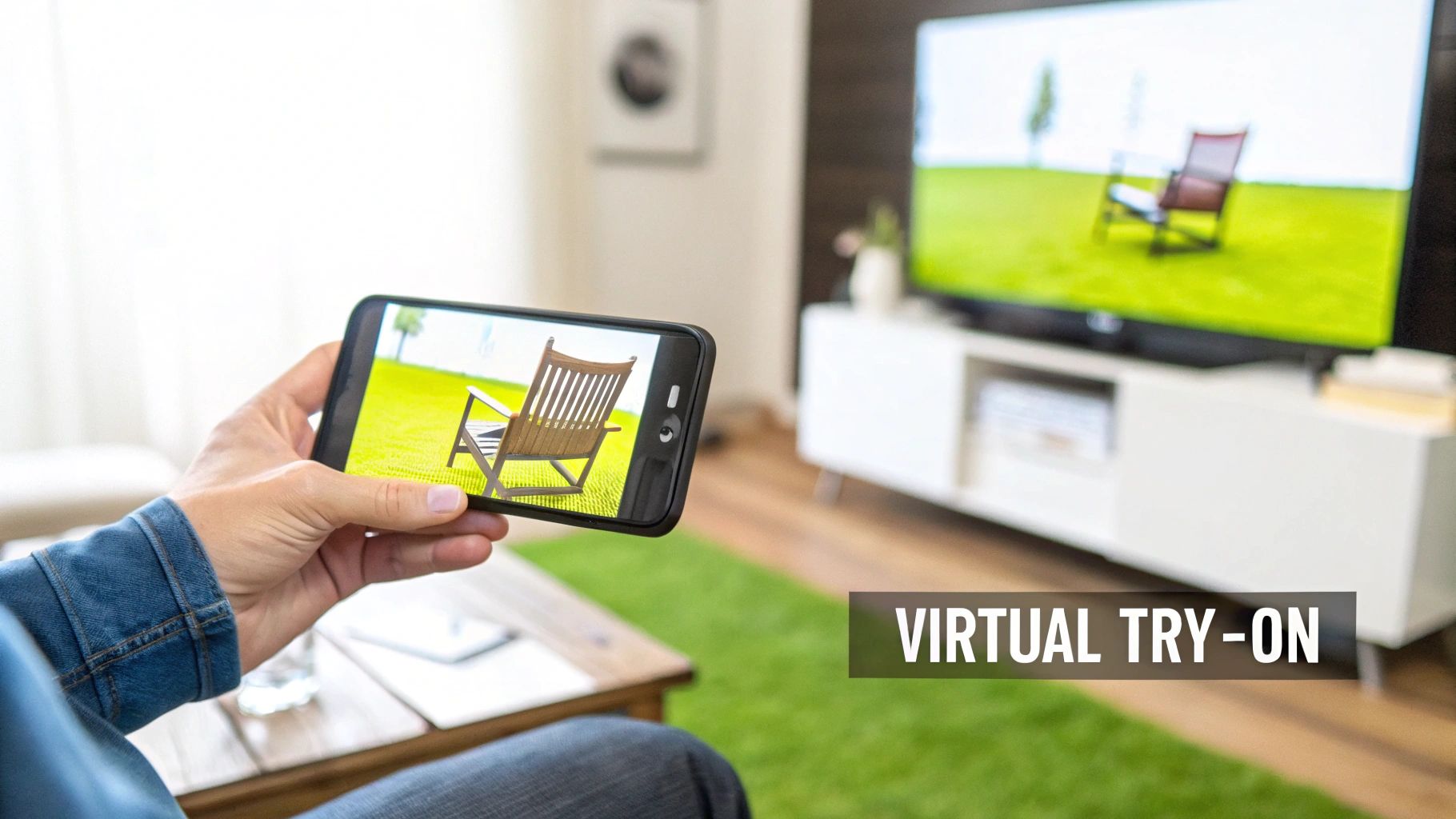
The real strength of AR marketing lies in its ability to turn passive viewers into active participants. For example, a user sees a Facebook ad for a new sofa. Instead of just looking at pictures, they can click a button that opens their phone's camera, allowing them to place a 3D model of the sofa directly in their living room to see how it looks and fits. This powerful visualization tool can be the deciding factor in a high-consideration purchase, dramatically improving conversion rates.
Real-World Examples & Implementation
Leading brands have successfully woven AR into their marketing fabric. IKEA Place allows users to virtually place true-to-scale furniture in their homes, directly addressing the "will this fit?" question and increasing purchase confidence. Similarly, Sephora’s Virtual Artist enables customers to try on thousands of makeup shades, leading to higher engagement and more informed buying decisions. Warby Parker also excels with its virtual try-on for eyewear, a feature that has become a cornerstone of its online customer experience, dramatically reducing returns.
Actionable Tips for Implementation:
- Start with Platform-Based AR: Begin by creating AR filters or effects on existing platforms like Instagram, Snapchat, or TikTok. This is a low-cost way to test concepts and engage your audience before investing in a custom app.
- Promote the Experience: Use paid social and search ads to drive traffic to your AR experience. Create ad copy and visuals that highlight the unique, interactive nature of the feature to pique user interest.
- Integrate and Incentivize: Embed links to your AR experience within email and SMS campaigns. Encourage trial by offering a discount, like "Try it on virtually and get 10% off," to directly link the AR engagement to a conversion.
- Measure Key Engagement Metrics: Track metrics beyond simple views. Focus on completion rates for try-ons, average time spent in the experience, and the conversion lift for users who engaged with AR versus those who did not.
8. Customer Data Platform (CDP) Unified Audience Strategy
A core challenge in multi-channel marketing is managing fragmented audience data. A Customer Data Platform (CDP) directly solves this by consolidating customer information from every touchpoint-website browsing, app usage, social media interactions, CRM entries, and even offline purchases-into a single, unified customer view. This creates a powerful "single source of truth" for all your marketing efforts.
This unified audience strategy allows for hyper-personalized targeting, precise segmentation, and even predictive analytics on a scale that is impossible with siloed data. For example, if a customer buys a specific type of running shoe in-store, the CDP logs this purchase. This data is then used to automatically exclude them from seeing ads for that same shoe online and instead show them ads for complementary products like running socks or apparel.
Real-World Examples & Implementation
Sephora is a master of this, using its CDP to unify online browsing, in-store purchase history, and Beauty Insider loyalty program data. This allows them to send highly personalized product recommendations via email and target social media ads with uncanny accuracy. Similarly, Shopify merchants leverage Shopify Audiences, a CDP-lite tool, to create high-intent lookalike audiences and segment customers based on their purchase history for retargeting campaigns. At Silver Spoon, our clients utilize CDP integrations with platforms like Segment and mParticle to orchestrate unified campaigns, consistently achieving a 4X ROAS by ensuring the right message reaches the right person on the right channel.
Actionable Tips for Implementation:
- Start with Core Data: Begin by integrating your most critical data sources first, such as your website, CRM, and email platform, before expanding to more complex sources.
- Define Smart Segments: Go beyond demographics. Use your unified data to create value-based segments like "high lifetime value customers," "customers at risk of churn," or "users with a high propensity to buy."
- Automate Audience Activation: Set up rules to automatically move customers between segments. For instance, a high-value customer could be automatically excluded from high-frequency ad campaigns and moved into a VIP SMS offer list.
- Continuously Validate Data Quality: Regularly audit your CDP data to check for accuracy, segment overlap, and conversion rate discrepancies. High-quality data is the foundation of a successful unified audience strategy.
9. Predictive Analytics & AI-Powered Lead Scoring
One of the most forward-thinking multi-channel marketing strategies involves leveraging predictive analytics and AI to automatically score leads. This approach moves beyond simple demographic or firmographic qualification. Instead, it uses machine learning models trained on historical customer data to forecast future outcomes, such as purchase probability, churn risk, and potential lifetime value. The AI analyzes thousands of signals to prioritize high-quality leads for sales outreach.
For example, a B2B software company's AI might learn that leads who download a specific whitepaper, visit the pricing page three times, and work at a company with over 50 employees are 80% more likely to convert. The system then automatically flags these leads as "hot" and alerts a sales representative to follow up immediately, while leads with a lower score are placed into an automated email nurturing campaign. This dramatically improves sales efficiency and overall ROAS.
Real-World Examples & Implementation
Salesforce's Einstein platform exemplifies this by using predictive scoring to show sales teams which opportunities have the highest probability of closing. Similarly, HubSpot's lead scoring tools allow businesses to automatically rank leads based on behaviors like email opens, website visits, and content downloads, pushing the hottest prospects to the top of the queue. At Silver Spoon, our predictive models analyze data from over 120,000 campaigns to identify high-LTV customer profiles, allowing us to focus ad spend on acquiring lookalike audiences with the greatest revenue potential. To see how this can be applied, you can discover more about predictive marketing analytics on SilverSpoonAgency.com.
Actionable Tips for Implementation:
- Define Clear Scoring Criteria: Collaborate with your sales team to identify the key behaviors and attributes that define a "sales-ready" lead. This becomes the foundation for your predictive model.
- Feed the Model Comprehensive Data: Integrate all available data signals, including website behavior, email engagement, social media interactions, content consumption, and past purchase history, to create a holistic view.
- Validate and Iterate: Regularly compare your model's predicted scores against actual conversion rates. If the predictions start to diverge from reality, it's time to retrain the model with fresh data.
- Automate Next Actions: Use lead scores to trigger automated workflows. For example, a high-scoring lead could automatically notify a sales rep via Slack, while a lower-scoring lead enters a long-term email nurturing sequence.
10. Influencer & Affiliate Partnerships in Omnichannel Mix
Integrating influencer and affiliate partnerships into your multi-channel marketing strategies is a powerful way to extend your brand's reach through trusted, authentic voices. This approach leverages the credibility of influencers to generate awareness and the performance-based model of affiliates to drive sales. It moves beyond isolated campaigns, embedding these third-party voices directly into the broader customer journey to build social proof and capture high-intent traffic.
When combined with paid social, search, and email marketing, these partnerships act as a significant amplifier. For example, a popular YouTuber reviews your product (influencer marketing). You can then use paid social ads to retarget everyone who visited your website from the YouTuber's link. This synergy transforms a one-off promotion into a cohesive part of your conversion funnel, ultimately reducing customer acquisition costs through authentic endorsements.
Real-World Examples & Implementation
A classic example is how athletic brands like Gymshark use a mix of high-profile fitness influencers and a widespread affiliate program. An influencer’s YouTube video might drive initial interest, while affiliate links in fitness blogs capture bottom-of-funnel buyers. Similarly, a software company might partner with tech bloggers for in-depth reviews (influencer marketing) while offering a commission to industry consultants who refer new clients (affiliate marketing), creating a comprehensive B2B lead generation system.
Actionable Tips for Implementation:
- Create Custom Landing Pages: Provide both influencers and affiliates with unique, co-branded landing pages. This creates a seamless user experience and improves conversion rates by maintaining message consistency from their content to your site.
- Segment Partner Tiers: Don't treat all partners the same. Create tiers based on reach and performance. Offer top-tier influencers exclusive access or higher commissions, while providing emerging affiliates with robust resources and standard rates.
- Integrate Tracking Across Channels: Use unique, trackable links and coupon codes for each partner. This allows you to accurately attribute sales and leads back to specific campaigns and measure their impact on other channels, like branded search lift.
- Align Content with Funnel Stages: Collaborate with influencers to create content for different funnel stages. Use macro-influencers for broad, top-of-funnel awareness campaigns and micro-influencers or affiliates for more targeted, conversion-focused product reviews and tutorials.
10-Point Multichannel Marketing Strategy Comparison
| Strategy | 🔄 Implementation complexity | ⚡ Resource requirements & speed | ⭐ Expected effectiveness | 📊 Expected outcomes / impact | 💡 Ideal use cases & key tip |
|---|---|---|---|---|---|
| Omnichannel Attribution & Real-Time Optimization | High — integrates cross-channel data, real-time models, privacy controls | High — data engineering, CDP/BI, AI models; real-time execution | ⭐⭐⭐⭐ | Unified ROAS gains, reduced wasted spend, faster optimization cycles | E‑commerce, mid‑market & enterprise. Tip: prioritize first‑party data & consistent UTM strategy |
| Geofencing & Hyperlocal Targeting | Medium — geofence design, location provider integrations, compliance | Medium — location data, mobile DSPs; fast local activation | ⭐⭐⭐ | Immediate foot‑traffic lift, measurable store visits/appointments | Local stores, franchises, events. Tip: layer demographic/behavioral filters and test radius sizes |
| Conversion‑Optimized Funnel Design (TOFU→BOFU) | Medium‑High — stage mapping, creative variants, automated flows | Medium — CRO, content, automation tools; iterative testing cadence | ⭐⭐⭐⭐ | Higher conversion rates (50–150%), lower CAC, predictable scaling | E‑commerce, coaches, SaaS. Tip: map channels to funnel stages and A/B test landing pages |
| Social Media Channel Orchestration | Medium — platform‑specific creative & bidding strategies | High — creative production, platform management; rapid testing possible | ⭐⭐⭐⭐ | Diversified reach, improved engagement, reduced platform risk | Consumer brands, personal brands, startups. Tip: create native creative per platform and set platform KPIs |
| Email & SMS Sequencing with Behavioral Triggers | Low‑Medium — sequence logic, trigger setup, privacy & deliverability | Low‑Medium — ESP/SMS provider, copy, segmentation; immediate message delivery | ⭐⭐⭐⭐ | High ROI, improved retention & repeat purchases, lower CAC | E‑commerce, coaches, SaaS. Tip: run 3–5 core sequences; personalize and monitor unsub rates |
| Search + Display Retargeting Ecosystem | Medium — keyword strategy + remarketing lists + sequential creatives | Medium — ad spend, landing pages, dynamic creative; near‑real‑time bidding | ⭐⭐⭐⭐ | Capture high intent + nurture warm audiences; lower CAC, better conversion | E‑commerce, service businesses, SaaS. Tip: target high‑intent keywords and follow with display reminders |
| Augmented Reality (AR) Experiential Marketing | High — AR development, platform compatibility, maintenance | High — dev & creative costs, device support; engagement can be viral but adoption lag | ⭐⭐⭐ | Strong engagement and reduced returns for visual products; brand differentiation | Fashion, beauty, furniture, eyewear. Tip: start with platform AR (Instagram/Snap) before custom builds |
| Customer Data Platform (CDP) Unified Audience Strategy | High — data integration, identity resolution, governance | High — CDP vendor, engineering, ongoing data ops; enables real‑time activation | ⭐⭐⭐⭐ | Single customer view, precise personalization, reduced audience overlap & waste | Multi‑channel e‑commerce, enterprises. Tip: begin with core sources (web, CRM, email) and define segment KPIs |
| Predictive Analytics & AI‑Powered Lead Scoring | High — model building, feature engineering, retraining | High — historical data (6–12 months), ML tooling, monitoring; real‑time scoring possible | ⭐⭐⭐⭐ | Better lead quality, reduced CAC, faster sales cycles, improved LTV | Coaches, SaaS, service businesses. Tip: define 'sales‑ready' criteria and retrain regularly |
| Influencer & Affiliate Partnerships in Omnichannel Mix | Medium — partner vetting, contracts, performance tracking | Medium — partner fees or commissions, creative coordination; timeline longer | ⭐⭐⭐ | Expanded reach, social proof, pay‑for‑performance upside (affiliates) | E‑commerce, lifestyle, personal brands. Tip: vet audience authenticity and use unique tracking for each partner |
From Scattered Tactics to a Unified Growth Engine
The journey through these ten multi-channel marketing strategies reveals a fundamental shift in modern digital engagement. We've moved far beyond the era of siloed campaigns, where a Facebook ad, an email blast, and a Google search campaign operated in their own isolated universes. Today, success is not just about being present on multiple channels; it's about orchestrating them into a single, intelligent, and customer-centric system. The strategies detailed in this article are not a menu to pick and choose from but rather a set of interconnected gears in a larger growth machine.
The core principle that ties everything together is the creation of a seamless and context-aware customer journey. When a Customer Data Platform (CDP) unifies your audience data, it empowers your email and SMS sequences with precise behavioral triggers. When your search and display retargeting ecosystem is properly configured, it amplifies the initial awareness generated by your social media channel orchestration. Each element strengthens the others, creating a powerful compounding effect that isolated tactics can never achieve. This integration is where the real return on investment is found.
Key Takeaways for Immediate Action
To transform this knowledge into tangible results, focus on these pivotal takeaways:
- Data Is the Foundation: Without a unified view of your customer, your multi-channel efforts will remain disjointed. Implementing a CDP or a similar data unification strategy is no longer a luxury for large enterprises; it's a foundational requirement for any business serious about growth.
- The Journey Over the Channel: Stop thinking in terms of "running Facebook ads" or "sending emails." Instead, start mapping the customer journey from their first touchpoint (TOFU) to their final conversion (BOFU). Ask yourself: how does this email move them forward? How does this geofenced notification reinforce the message they saw on Instagram?
- Personalization at Scale: The true power of combining these strategies lies in delivering the right message, on the right channel, at the exact right time. Using AI for predictive lead scoring or triggering AR experiences for engaged users are prime examples of how technology enables hyper-personalized interactions that build trust and drive conversions.
Your Next Steps: From Strategy to Execution
Mastering these concepts is the difference between simply spending your marketing budget and strategically investing it for predictable returns. For many SMBs and growth-focused businesses, the complexity of managing this orchestration can be the biggest barrier to success. The key is to start small but think big.
Begin by auditing your current marketing activities. Identify the two or three channels that are performing best and find ways to integrate them more deeply. For instance, a local service business could connect its Google Ads leads directly into an automated SMS appointment reminder sequence. An e-commerce brand could use data from its social media engagement to create highly targeted display retargeting ads that showcase the exact products a user showed interest in. Building these small bridges between channels is the first step toward a fully integrated system. For businesses looking to integrate their efforts into a cohesive whole, further reading on mastering a multi-channel marketing approach can provide a roadmap.
Ultimately, a well-executed multi-channel marketing strategy transforms your business from a passive advertiser into an active, intelligent conversation partner with your audience. It ensures that every dollar spent is part of a larger, cohesive plan designed to attract, engage, and convert customers for life.
Implementing these advanced multi-channel marketing strategies requires deep expertise, constant optimization, and a cohesive team that understands how to make every channel work together. At Silver Spoon Agency, we specialize in designing and executing these integrated growth engines for businesses ready to scale. If you want to stop juggling disconnected campaigns and start building a predictable system for revenue growth, schedule a consultation with our team today.