


Your Guide to Pay Per Click Management Services

Pay-per-click (PPC) management is what separates businesses that just spend money on ads from those that invest it to generate predictable growth. It’s the difference between blindly throwing darts and having a trained marksman hit the bullseye every single time.
What Are Pay Per Click Management Services
Think of your ad budget like an investment portfolio. You could probably pick a few stocks yourself and see some returns. But a professional financial advisor—or in this case, a pay per click management service—brings expert knowledge, powerful tools, and a tested system to the table, all designed to maximize your gains and cut your risks.
This isn't just about "running some ads." It’s a strategic operation built to plan, execute, and relentlessly optimize your campaigns. The goal is to build a scalable system that delivers real, measurable results, preventing costly mistakes and turning your ad spend into a dependable growth driver for your business.
Moving Beyond Simple Ad Placement
Boosting a post on Facebook or switching on a basic Google Ads campaign isn't management. That's just lighting money on fire and hoping for the best. Professional PPC management is a far more sophisticated and results-obsessed process.
For instance, a local dental clinic might run its own ads targeting the broad keyword "dentist." A management service, however, would dig much deeper. They’d target high-intent phrases like "emergency root canal near me" or "Invisalign consultation [your city]," while actively blocking irrelevant searches like "dentist salary" to ensure every dollar is spent reaching an actual potential patient.
This strategic depth is why businesses are increasingly turning to professionals. Pay per click management services are a specialized form of outsourced lead generation services that provide the expertise needed to win in a crowded market.
The Real Cost of a DIY Approach
Without an expert eye, it's terrifyingly easy to waste a huge chunk of your ad budget. One of the most common mistakes is sending all your ad traffic to your website’s homepage and expecting visitors to figure it out. A professional service, on the other hand, builds or refines dedicated landing pages for each specific campaign.
A PPC management service transforms your advertising from a guessing game into a predictable science. It's about building a system where $1 in ad spend consistently generates $2, $3, or even $4 in return by reaching the right person with the right message at the exact moment they are ready to buy.
Imagine an e-commerce store selling running shoes. A DIY approach might send someone who clicked an ad for "men's trail running shoes" to a generic shoe page, forcing them to start their search all over again. A PPC management service ensures that click leads directly to a page showcasing only men's trail running shoes, dramatically boosting the chance of a sale.
When you look at the scale of search advertising, the stakes become clear. Companies worldwide are on track to spend $351.5 billion on search advertising in 2025. With PPC traffic converting 50% better than organic visitors and the top three paid ads capturing 46% of all clicks, you need an expert to secure those prime spots and capitalize on that high-intent traffic. This level of competition makes professional management a necessity, not just a nice-to-have, for achieving a positive return.
The Core Activities of a Professional PPC Service
Hiring a professional for pay per click management services isn't just about outsourcing a task on your to-do list. It’s about bringing in a team of specialists who run a continuous cycle of research, strategy, and refinement to turn your ad budget into real revenue.
So, what do you actually get for your money? It’s not like hiring a single pilot; it’s more like getting the entire flight crew. You have a strategist mapping the flight path, an engineer fine-tuning the engine mid-air, and a navigator making constant adjustments to ensure a smooth and profitable journey.
Strategic Keyword Research and Targeting
The success of any PPC campaign is built on knowing exactly which search terms your ideal customers are typing into Google. A professional service doesn’t just guess or grab the most obvious, high-traffic keywords. They dig deep to uncover hidden opportunities and, more importantly, to understand the intent behind the search.
Take a boutique hotel, for instance. Anyone can bid on "hotel in New York." But a PPC expert finds the high-value phrases that signal someone is ready to book now.
- "Boutique hotel near SoHo with rooftop bar" shows a user with specific desires and high purchase intent.
- "Last minute hotel deals downtown Manhattan" signals urgency and an immediate need.
- "Family friendly hotel suites NYC" targets a specific customer with a clear problem to solve.
By focusing on these long-tail keywords, the campaign stops wasting money on overly broad, expensive clicks. Instead, every dollar goes toward attracting people who are far more likely to become paying guests. This research phase sets the entire strategy in motion.
Compelling Ad Copywriting and Creative Design
Once you know what people are searching for, you have to write an ad that makes them click. Great ad copy is a mix of art and science. It needs to grab attention, speak directly to the searcher's problem, and give them a powerful reason to choose you—all in just a few lines of text.
A great PPC ad isn't just a description of your service; it's a solution to the searcher's immediate problem. It answers the question "Why should I click this?" before the user even has to ask.
A professional service will constantly A/B test different headlines, descriptions, and calls-to-action to find out what truly connects with your audience. For a personal injury lawyer, they might run two versions of an ad:
- Version A (Feature-focused): "Top-Rated Injury Lawyer. We Handle Car Accidents. Free Consultation."
- Version B (Benefit-focused): "Hurt in an Accident? Get the Compensation You Deserve. No Win, No Fee. Talk to an Attorney Now."
Version B nearly always wins. Why? Because it focuses on the outcome the searcher desperately wants—getting compensation—not just on the firm's services. This non-stop testing is a core activity that drives better and better results over time.
Intelligent Bid Management and Budget Allocation
PPC advertising works like a fast-paced, live auction where you bid against competitors for ad placements. Managing these bids is one of the most complex and critical parts of the job. It’s not a "set it and forget it" task; it's a dynamic process of making thousands of micro-adjustments every single day.
Imagine you run an e-commerce store selling high-end coffee beans. A skilled PPC manager will:
- Bid higher on searches like "buy single origin geisha coffee" because that user knows exactly what they want and is ready to buy.
- Bid lower on broad terms like "coffee beans," which could just be someone doing preliminary research.
- Adjust bids by time of day, spending more during peak morning and weekend shopping hours when people are most likely to purchase.
- Increase bids for users who have visited your site before (this is called remarketing), because they're already familiar with your brand and more likely to convert.
This is where AI-powered systems truly shine, analyzing countless data points to make instant bid adjustments that no human could manage alone. This ensures you're winning the most valuable clicks at the best possible price.
Finally, getting the click is only half the battle. A key part of PPC management is constantly optimizing landing pages for conversions. After all, the landing page is where that click actually turns into a lead or a sale, making or breaking your entire campaign's profitability.
How to Measure PPC Success and ROI
In the world of paid advertising, it’s dangerously easy to get lost in a sea of data. But focusing on the right numbers is what separates wasted ad spend from a truly profitable investment. Professional pay per click management services don't just report on clicks; they zero in on the metrics that directly impact your bottom line, telling a clear story about your campaign’s health and profitability.
To know if your ads are actually working, you have to look past "vanity metrics" like impressions or simple click counts. The real focus needs to be on Key Performance Indicators (KPIs) that connect directly to your business goals. These are the numbers that tell you if you're making money.
Core KPIs That Define PPC Success
Every business is unique, but a handful of core metrics form the bedrock of any successful PPC measurement. Getting a firm grip on these numbers is the first step toward making smart, data-driven decisions.
- Cost Per Acquisition (CPA): This is the total cost you pay to land one new customer. If you spend $500 on ads and get 10 new customers, your CPA is $50. It’s a critical metric for knowing if your customer acquisition costs are actually sustainable.
- Conversion Rate: This is the percentage of people who click your ad and then complete a specific, valuable action—like making a purchase or filling out a contact form. For a plumber, a conversion might be a phone call. For an online store, it’s a completed checkout. If 100 people click your ad and 5 fill out your contact form, your conversion rate is 5%.
- Return on Ad Spend (ROAS): This is the ultimate measure of profitability. It tells you exactly how much revenue you’re earning for every single dollar you spend on ads. If you spend $1,000 and generate $4,000 in sales, your ROAS is 4:1.
These KPIs don't work in isolation; they work together to paint a complete picture. A fantastic ROAS is always the goal, but a low conversion rate or a sky-high CPA can point to serious problems in your funnel that need fixing. You can dig deeper into how to calculate and improve this essential metric in our guide on what is return on ad spend.
The diagram below breaks down the core activities—from keyword research to bid management—that directly influence these key metrics.
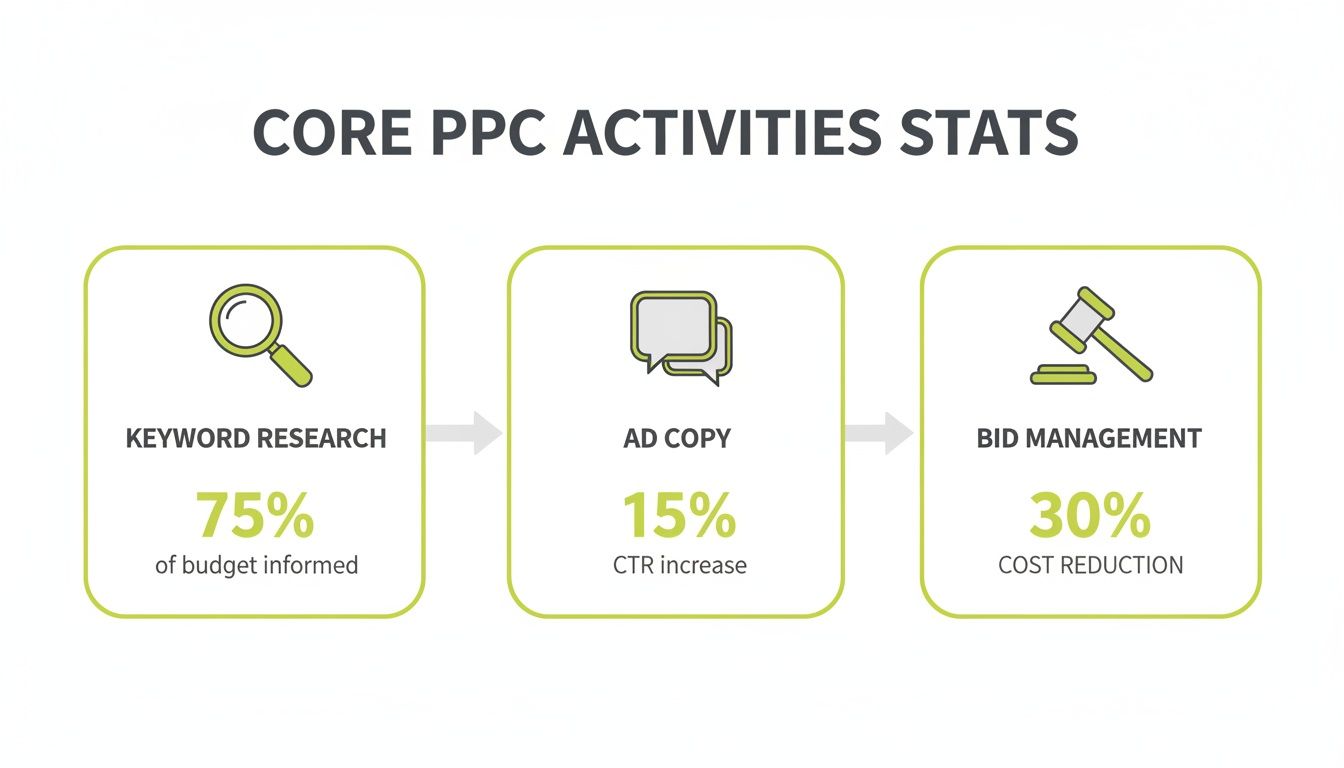
Each of these activities has a direct impact on your campaign's success, making sure your budget is spent as efficiently as possible on the right keywords and the most compelling ad creative.
Interpreting the Story Your Data Tells
Metrics are more than just numbers on a dashboard; they tell a story about what’s really happening with your campaigns. A skilled PPC manager acts as an interpreter, translating that raw data into a clear plan of action.
For instance, a high Click-Through Rate (CTR) combined with a low conversion rate is a classic red flag. It tells you your ad was compelling enough to earn the click, but the landing page failed to deliver on that initial promise. That's not an ad problem; it's a landing page problem. An example would be an ad for "24/7 Emergency Plumber" getting lots of clicks, but the landing page is a generic "About Us" page with no phone number visible, causing users to leave immediately.
Good PPC management is about knowing what to measure, but great PPC management is about knowing what the measurements mean. It’s the difference between just reporting numbers and actually using them to drive strategic growth.
What counts as a "good" number also changes dramatically from one industry to the next. An e-commerce store might shoot for a ROAS of 4:1 or higher, but a law firm generating high-value leads could be thrilled with a 2:1 ROAS because a single new client is worth tens of thousands of dollars. A local service business, on the other hand, might prioritize a very low CPA to stay profitable on smaller jobs.
The financial impact of expert management is undeniable. Optimized campaigns consistently deliver a strong return, yielding an average of $2 in return for every $1 spent—a solid 200% ROI. With average Google Ads conversion rates sitting around 7.52% and the average CTR at 6.66%, having an expert optimize every step is vital. Even as costs climb—with 87% of industries seeing CPC increases—smart management fights back with precise targeting and constant testing to protect your bottom line.
PPC Management in the Real World

While theory and metrics are the blueprints, the real value of professional pay per click management services emerges when you see them solve actual business challenges. A well-run PPC strategy is never a one-size-fits-all template; it’s a custom-built growth engine, meticulously designed for a specific industry and a unique set of commercial goals.
To bridge the gap between abstract concepts and tangible impact, let’s explore how four very different businesses use targeted PPC campaigns to win customers and grow revenue. These examples show just how versatile expert management can be.
Example 1: E-commerce Brand Boosts Sales
An online retailer selling handcrafted leather goods faced a classic e-commerce headache: abandoned carts. They had decent traffic, but a frustrating number of shoppers were leaving without buying, leaking potential revenue every single day.
Their PPC management service rolled out a two-part strategy to plug the leak.
- Google Shopping Ads: First, they optimized the product feed. This made sure the store’s top-selling wallets, belts, and bags showed up with crisp images and sharp pricing, catching the eye of shoppers who were ready to buy right now.
- Dynamic Remarketing: For those who left items in their cart, the agency launched dynamic ads on Facebook and the Google Display Network. These ads weren't generic—they automatically showcased the exact product a person had considered, gently reminding them of their interest and often nudging them over the finish line with a small, time-sensitive discount.
The results were swift. By meeting customers at different points in their buying journey, the brand recovered over 20% of previously lost sales and saw a powerful 6:1 ROAS from their remarketing campaigns alone.
Example 2: Local Dental Clinic Fills Appointments
A new dental practice in a competitive suburb had a straightforward problem: they needed to fill the appointment book, and fast. Word-of-mouth was too slow, and broad, untargeted advertising was just a way to burn cash. The goal was simple: make the phone ring with qualified local patients.
A PPC management agency crafted a hyper-local strategy designed to capture immediate, urgent needs.
For local service businesses, PPC isn't about vague brand awareness. It's about being the very first result someone sees when they have a problem that needs solving now. The mission is to turn a search like "chipped tooth repair near me" into a booked appointment in minutes.
The agency focused on high-intent keywords like "emergency dentist [town name]" and "dental implants [zip code]." They then amplified the ads with powerful extensions that made it incredibly easy for people to take action.
- Click-to-Call Extensions: This allowed mobile users to call the clinic's front desk directly from the ad with a single tap. No friction, no extra steps.
- Location Extensions: An integrated map showed the searcher just how close the clinic was, building instant trust and highlighting convenience.
This geo-targeted approach meant every ad dollar was spent only on people within a 10-mile radius. The outcome? A 40% jump in new patient phone calls in the first three months, with a Cost Per Acquisition (CPA) that was comfortably below the lifetime value of a new patient.
Example 3: B2B Software Company Generates Qualified Leads
A B2B SaaS company with a high-value software product had a different challenge: generating leads for its specialized sales team. Their ideal customer was a C-level executive in the finance industry—a notoriously difficult audience to reach through conventional ads.
Their PPC service smartly sidestepped Google Search and went straight to where their buyers live online: LinkedIn Ads. They understood that their ideal clients used the platform for professional networking and industry knowledge.
The strategy was precise:
- Surgical Targeting: Campaigns were built to target users by their specific job title ("Chief Financial Officer"), company size, and industry ("Financial Services").
- Value-First Content: Instead of a hard sell, the ads promoted something genuinely useful: a downloadable whitepaper titled "The CFO's Guide to Automating Compliance Reporting."
By offering real value upfront, they earned the right to ask for contact information from highly relevant prospects. This approach created a predictable flow of marketing-qualified leads (MQLs) for the sales team, which in turn shortened the sales cycle and dramatically improved demo request rates.
Example 4: Online Coach Sells a High-Ticket Program
A business coach selling a $5,000 mastermind program needed a scalable system to attract a steady stream of committed clients. The solution was a multi-stage funnel powered by Facebook and YouTube ads.
This strategy wasn't about getting a quick click; it was about guiding potential clients on a carefully orchestrated journey.
- Top of Funnel (Awareness): Short, engaging video ads ran on YouTube and Facebook, offering free, valuable tips on business growth. These were targeted to broad audiences interested in entrepreneurship and marketing.
- Middle of Funnel (Consideration): Anyone who watched a significant portion of the initial videos was then retargeted with a new ad—this time, an invitation to a free, in-depth webinar designed to showcase the coach's deep expertise.
- Bottom of Funnel (Conversion): Finally, webinar attendees received a third set of ads. These ads had a clear call to action: book a discovery call to discuss joining the high-ticket mastermind program.
This multi-step process worked beautifully to build trust and qualify leads over time. It ensured that by the time someone got on a sales call, they were already highly interested and understood the value being offered. This funnel allowed the coach to scale their ad spend profitably, turning cold traffic into high-value clients.
How to Choose the Right PPC Management Agency
Picking a partner to manage your ad spend is one of the highest-stakes decisions you can make for your business. It's like hiring a captain for a ship. The right one navigates you toward profitable new lands; the wrong one can steer you straight into a storm.
This decision demands more than just a glance at a slick sales deck. You need to look past the pitch and evaluate an agency's true capabilities. To find a genuine partner, you need a structured evaluation process—because you're not just hiring a vendor, you're entrusting a core piece of your growth engine to their team.
Assess Their Track Record and Industry Experience
An agency’s past work is the single best predictor of your future results. It speaks volumes about their ability to actually deliver on their promises. Don't be afraid to dig deep and ask for specific, verifiable examples of their work.
A great agency won't hesitate to share their victories. Ask for case studies, but make sure they're relevant to your industry and business model. For example, if you run a SaaS business, a case study about a local plumbing company isn't very useful. You need to see that they understand the SaaS sales cycle, trial sign-ups, and customer churn.
Get direct with your questions. For example: "Can you show me a campaign you ran for a business like mine? What was their starting ROAS, and where did you take it after six months?"
Evaluate Their Strategic Process and Transparency
A top-tier agency doesn't just dangle results in front of you; they have a clear, documented process for achieving them. They should be able to walk you through their entire methodology, from keyword research and campaign architecture to ad creation and ongoing optimization.
A great partner's proposal feels less like a sales document and more like the first draft of a strategic battle plan. It should be detailed, customized to your goals, and clearly outline the "how" behind their promises.
This is where transparency becomes non-negotiable. Ask them about their reporting style. How often will you get updates? What specific metrics do they prioritize? If their answers are vague or they fixate on vanity metrics like clicks and impressions, it’s a massive red flag. A practical example of a good report would show not just clicks, but how many of those clicks turned into leads, the cost per lead, and ultimately the revenue generated from those leads.
Ask the Right Questions During Consultation
Your initial calls with potential agencies are your chance to vet them properly. Arm yourself with sharp, specific questions to cut through the fluff and gauge their real expertise. Here's a list of must-ask questions to guide your conversations:
- Technology and Tools: What specific tools do you use for keyword research, competitive analysis, and bid management? Are you using any AI-driven systems for optimization?
- Team Structure: Who, specifically, will be working on my account? What is their level of experience?
- Communication: What does your communication and reporting cadence look like? Will I have a dedicated point of contact?
- Performance: What is a realistic CPA or ROAS for my industry and budget? How do you adapt when a campaign is underperforming?
Choosing the right partner is more critical than ever. The advertising world is bracing for surging costs, with some projections showing Google Search CPCs rising 45% from 2024-2025. With 84% of brands already seeing positive results from PPC—often amplified by personalization—the pressure is on. Agencies must now build sophisticated creative pipelines and first-party audiences just to maintain efficiency.
Making a well-informed decision requires careful thought. If you need more guidance on the vetting process, our guide on how to choose a marketing agency provides a broader framework that perfectly complements these PPC-specific tips, helping you find a true partner for growth.
Partnering for Predictable Growth
Choosing a provider for pay-per-click management services isn't just about outsourcing a task. It's about finding a strategic partner committed to building a reliable, scalable system for generating revenue. A great partnership feels less like a vendor relationship and more like an extension of your own team—one obsessed with predictable growth.
This all begins with a deep-dive discovery call. A top-tier agency won't just ask about your ad budget; they'll want to understand your business inside and out. They'll ask about your profit margins, your customer lifetime value, and your real business goals. This information is the blueprint for a custom-built campaign designed to deliver outcomes, not just clicks.
The Cycle of Optimization and Growth
Once the initial strategy is locked in, the real work begins. This isn't a "set it and forget it" service. It's a continuous cycle of launching, analyzing, optimizing, and reporting, where every piece of data sharpens the next move. Think of it as an ever-improving growth engine.
For instance, imagine a campaign for a local gym starts with ads targeting "fitness classes near me." After a few weeks, the data shows ads mentioning "yoga and pilates" have a 30% higher conversion rate. A great agency partner sees that signal immediately. They double down on that winning angle, shifting budget and refining ad copy to attract more of those high-value members.
A true agency partner doesn’t just manage your ad spend; they manage your growth. They operate with a culture of transparent communication and data-driven results, turning complex reports into a clear roadmap for what's next.
Key Differentiators of a Premier Agency
The agencies delivering exceptional results aren't just running basic campaigns. They bring a more advanced, holistic perspective to the table, using tools and strategies that create a real competitive advantage.
- AI-Powered Optimization: They use artificial intelligence to analyze thousands of data points in real-time. This allows for micro-adjustments to bids and targeting that a human analyst simply can't match, capturing opportunities second by second.
- True Omnichannel Perspective: They understand that search, social, and display ads don't exist in a vacuum. They build cohesive customer journeys that guide potential buyers across every touchpoint, maximizing the impact of your entire marketing ecosystem.
- Conversion-Focused Assets: An agency's job doesn't end at the click. They ensure the entire funnel is primed for results, which means making sure your website is ready for the traffic. You can learn more about this crucial step by reading about how to optimize landing pages.
When you find an agency with these qualities, you're no longer just spending money on ads. You're making a powerful, systemized investment in your company's future.
Frequently Asked Questions About PPC Services
It’s smart to have questions before you invest in PPC management. Getting clear, straightforward answers is the only way to make a decision you feel good about for your business. Let's dig into the questions we hear most often.
How Much Do PPC Management Services Cost?
There's no single price tag for PPC management because the right model depends entirely on your budget, goals, and business size. You’ll generally come across a few common structures.
One popular approach is a percentage of ad spend, where the agency fee is a slice of your monthly advertising budget—typically between 10-20%. For a practical example, if your monthly ad budget is $10,000, a 15% fee would be $1,500. This model scales directly with your advertising efforts.
Another is a flat-fee retainer. You pay a fixed monthly price for the service, which gives you predictable costs no matter how your ad spend might change. This is a great fit for businesses that need steady, ongoing campaign work. Finally, some agencies use a performance-based structure, tying their fee to hitting specific targets like a certain cost per lead or number of sales.
How Long Does It Take To See Results from PPC?
While PPC can deliver traffic almost instantly, achieving real, profitable results is a marathon, not a sprint. As soon as a campaign goes live, data starts rolling in, sometimes within a few hours. This initial feedback is valuable, but it's just the starting line.
Expecting a huge ROI in the first month just isn't realistic. That initial period is all about data collection and learning. Real, optimized performance that generates maximum ROI typically takes shape over 3 to 6 months as your agency gathers enough data to dial in targeting, test ad copy, and perfect its bidding strategies.
This timeline gives your team the space to move past quick wins and build a stable, predictable system for generating leads and sales. A little patience during this ramp-up phase pays huge dividends in the long run.
Can I Just Use Google's Automated Suggestions?
It's definitely tempting to click "apply" on all those automated suggestions from platforms like Google Ads. They pop up constantly, promising easy improvements. But it's crucial to remember who these suggestions are built to serve first: the platform itself, by encouraging you to spend more.
While some automated features like Smart Bidding are powerful tools in an expert's hands, blindly accepting every recommendation is a recipe for a wasted budget. For example, Google might suggest adding a broad keyword like "software" to your campaign for a specific accounting tool. This would attract a flood of irrelevant clicks, draining your budget on users searching for photo editing software or project management tools.
An agency delivers what an algorithm can’t:
- A Custom Strategy: We build campaigns around your business goals, not just Google's.
- Creative Insight: We write compelling ad copy that speaks directly to your customers' needs and emotions.
- Competitive Analysis: We figure out what your competitors are doing and find smart ways to get ahead of them.
A human expert uses automation as a tool—not as a substitute for strategic thinking. That’s how you ensure your budget is invested for maximum return, not just maximum spend.
Ready to turn your advertising into a predictable growth engine? Silver Spoon Agency combines AI-powered optimization with an omnichannel strategy to deliver measurable results. See how our performance-driven approach can elevate your business.