


12 Proven Real Estate Lead Generation Strategies for 2026

In today's competitive market, a generic approach to finding buyers, sellers, and investors is no longer enough. The most successful real estate professionals rely on a diverse toolkit of sophisticated, data-driven real estate lead generation strategies that capture attention and drive conversions across multiple channels. Gone are the days of relying solely on referrals and open houses; modern success demands a blend of hyper-local digital tactics, compelling content, and cutting-edge technology to build a predictable pipeline of qualified leads.
This comprehensive guide moves beyond the basics to provide a prioritized, actionable roundup of 12 proven strategies tailored for today's agents and investors. Each strategy is broken down with step-by-step implementation tips, real-world examples, key performance indicators (KPIs), estimated budgets, and clear guidance on when to use it, empowering you to turn your marketing spend into measurable revenue growth. We will cover everything from Geofencing and Google Local Services Ads to advanced content marketing and immersive AR property tours.
The goal is to provide a clear playbook you can implement immediately to attract higher-intent clients. Of course, generating leads is only half the battle. To ensure that every incoming inquiry from your lead generation efforts is professionally handled and converted, consider implementing a dedicated answering service for real estate to capture and qualify opportunities around the clock. By combining powerful lead acquisition with a seamless response system, you create an unstoppable growth engine for your business. Let's dive into the strategies that will fill your pipeline.
1. Geofencing and Location-Based Targeting
Geofencing is one of the most precise real estate lead generation strategies available today. It uses mobile device GPS to create a virtual "fence" around a specific real-world location. When a potential lead enters or exits this zone, it triggers a pre-designed advertisement on their device, capturing them at a moment of high intent.
This strategy works because it combines location with behavior. An agent can target a competitor's open house, a mortgage broker's office, or even a local home and garden show. The ads are delivered to people who are actively engaged in home-buying activities, making the outreach incredibly relevant and timely. For example, a person attending a home-buying seminar who sees an ad for "Exclusive First-Time Buyer Listings in Your Area" is a highly qualified lead.
Actionable Implementation
- Set Your Fences: Define precise geofences around competitor open houses, new construction sites, and affluent neighborhoods. Practical Example: Set a 500-meter fence around a "Parade of Homes" event and another around a popular local mortgage lender's main office.
- Create Compelling Ads: Design ads that speak directly to the location. For an ad triggered at an open house, use copy like, "Didn't find your dream home? See exclusive listings near you."
- Layer Your Targeting: Combine geofencing with demographic data. Target individuals aged 30-55 with interests in "real estate" and "mortgage loans" who enter your fence for maximum precision.
- Use Retargeting: Once a user has entered your geofence and seen an ad, add them to a retargeting audience. Follow up with a testimonial video ad across social media for the next 7-14 days.
2. Facebook and Instagram Lead Generation Ads
Meta's Lead Generation Ads are powerful real estate lead generation strategies that capture user information directly within Facebook and Instagram. Instead of sending users to an external website, these ads feature an in-app form that pre-fills with the user's profile data, dramatically reducing friction and simplifying the submission process. This seamless experience is key to boosting conversion rates.

This strategy excels by leveraging Meta's vast audience data to target motivated buyers, sellers, and investors with precision. Agents can target users based on behaviors like "likely to move," interests in "Zillow" or "first-time home buyer grants," and detailed demographics. The ads meet potential clients where they are already spending their time, capturing high-intent leads before they land on a competitor's website.
Actionable Implementation
- Segment Your Audiences: Create distinct ad sets for different client types. Practical Example: For seller leads, upload a list of your past clients and create a 1% "lookalike audience" in your state to find people with similar profiles.
- Use Compelling Video: Create short (15-30 second) video tours of a new listing or a testimonial from a happy client. Video ads consistently outperform static images for engagement and lead quality.
- Optimize Your Form and CTA: Keep your lead form simple, asking for only essential information like name, email, and phone number. Test specific Calls-to-Action (CTAs) like "Get a Free Home Valuation" for sellers or "Download Your Buyer's Guide" for buyers.
- Implement Immediate Follow-Up: Connect your ads to a CRM or an automated SMS system. Practical Example: Use a tool like Zapier to instantly send an SMS that says, "Hi [First Name], thanks for your interest in the home valuation. Is now a good time for a quick 5-minute chat?"
3. Google Local Services Ads
Google Local Services Ads (LSAs) are a powerful tool for real estate lead generation, placing you at the very top of search results. These ads are specifically designed for local service providers and appear above traditional paid search ads for queries like "real estate agent in [city]." Unlike pay-per-click, LSAs operate on a pay-per-lead model, meaning you only pay when a pre-qualified prospect contacts you directly through the ad.
This strategy works because it captures high-intent leads at the exact moment they are searching for a real estate professional. The "Google Guaranteed" badge builds immediate trust and credibility, increasing the likelihood of a prospect reaching out. For agents in competitive metro areas, LSAs offer a direct path to qualified buyer and seller leads who are actively looking to hire someone.
Actionable Implementation
- Complete the Vetting Process: Start by signing up for Google Local Services Ads and completing the required background checks and license verification to earn the "Google Guaranteed" badge.
- Optimize Your Profile: Fully populate your LSA profile with high-quality headshots, your service areas, specific services offered (e.g., "Buyer's agent," "Seller's agent"), and business hours.
- Aggressively Collect Reviews: Aim for a minimum of five recent reviews directly on your LSA profile. Practical Example: Send a direct link to your LSA review page to your last three happy clients, asking them to share their experience.
- Set a Competitive Budget: Define your weekly budget and specify the maximum you are willing to pay per lead. Be prepared to adjust this based on lead quality and volume in your market.
- Respond Immediately: The key to LSA success is speed. Answer calls and respond to messages instantly. Mark leads as booked and track your ROI directly within the LSA dashboard to help Google send you more qualified prospects.
4. Google Search Ads and SEMrush Keyword Targeting
Google Search Ads put your real estate business directly in front of buyers and sellers at the exact moment they are looking for properties or agents. This strategy involves bidding on specific keywords, like "homes for sale in downtown Austin," to appear at the top of Google's search results. It's a powerful way to capture high-intent leads who are actively seeking real estate services.
This approach works because it targets users based on their explicit intent, not just their demographic profile. When someone types a search query into Google, they are actively looking for a solution. By aligning your ads with these keywords using tools like SEMrush to find low-competition, high-conversion phrases, you can attract the most motivated leads in your market.
Actionable Implementation
- Structure Campaigns by Intent: Create separate ad campaigns for buyers, sellers, and investors. Practical Example: A buyer campaign could target "condos for sale in Miami," while a seller campaign targets "how much is my house worth in Phoenix."
- Utilize Negative Keywords: Aggressively add negative keywords to your campaigns to avoid wasted ad spend. Exclude terms like 'rentals,' 'jobs,' 'salary,' and 'free' to filter out unqualified searchers.
- Create Specific Landing Pages: Do not send traffic to your homepage. Direct users from an ad for "luxury homes in Scottsdale" to a landing page showcasing only luxury listings in Scottsdale, complete with a lead capture form.
- Monitor Quality Score: Check your Google Ads Quality Score weekly. A higher score (7-10) means Google sees your ads and landing pages as highly relevant, which lowers your cost-per-click (CPC) and improves ad positioning.
5. Content Marketing and SEO (Organic Lead Generation)
Content marketing is among the most powerful long-term real estate lead generation strategies. It involves creating and distributing valuable, relevant content like blog posts, neighborhood guides, and market analyses to attract and retain a clearly defined audience. When combined with Search Engine Optimization (SEO), this content can rank on Google for terms that prospective buyers, sellers, and investors are actively searching for, generating a steady stream of high-intent organic leads without ongoing ad spend.
This approach builds unparalleled trust and authority. By providing answers to questions like, "What are the best school districts in [City]?" or "How do I calculate ROI on a rental property?", you position yourself as the go-to expert. A well-ranking blog post can capture thousands of leads for years, creating a sustainable asset that works for you 24/7. This strategy is foundational for any agent or brokerage aiming for scalable, long-term growth.
Actionable Implementation
- Target Long-Tail Keywords: Focus on specific, multi-word phrases first, such as "how to buy a condo in downtown [City]" or "first-time home buyer programs in [State]." These have less competition and attract highly motivated prospects.
- Create Pillar and Cluster Content: Develop a comprehensive "pillar" guide. Practical Example: Create a "The Ultimate Guide to Relocating to Austin, TX" pillar page. Then, write shorter "cluster" posts like "Best Neighborhoods in Austin for Families" and "Austin Property Tax Guide" that link back to it.
- Audit and Outperform Competitors: Analyze the top-ranking content for your target keywords. Create a superior resource that is more detailed, better organized, and includes unique insights or visuals to earn the top spot on Google.
- Repurpose for Maximum Reach: Turn your top-performing blog posts into YouTube videos, podcast episodes, or infographics. This extends the life of your content and appeals to different audience preferences across multiple platforms.
6. Email Marketing and Nurture Sequences
Email marketing is one of the most reliable and highest ROI real estate lead generation strategies for building long-term relationships. It involves capturing leads through website forms, open houses, or social media and then nurturing them with automated email sequences designed to educate, build trust, and guide them toward a transaction.
This strategy excels because not all leads are ready to buy or sell immediately. By segmenting your audience (e.g., first-time buyers, investors, potential sellers) and delivering tailored content, you stay top-of-mind and position yourself as the go-to expert. Automated platforms like HubSpot or ActiveCampaign allow you to nurture hundreds of leads simultaneously, ensuring no opportunity is missed.
Actionable Implementation
- Segment Your Audience: Create separate lists for buyers, sellers, investors, and past clients. Each group should receive different content that speaks directly to their unique needs and goals.
- Develop a Welcome Sequence: For new subscribers, create a 3-5 email welcome series. Practical Example: Email 1: Delivers the promised buyer's guide. Email 2: Shares your personal story and a client testimonial. Email 3: Offers a free 15-minute home search consultation.
- Provide Consistent Value: Send monthly market reports, neighborhood spotlights, and exclusive property alerts. The key is to provide useful information, not just sales pitches.
- Optimize Subject Lines: Focus on solving a problem. Instead of "Monthly Newsletter," use a subject line like, "Is Now the Right Time to Sell in [Your City]?" or "Tired of Paying Rent? See These Starter Homes."
- Include Social Proof: Regularly feature client testimonials, photos of recently closed deals, and 5-star reviews to build credibility and trust with your subscribers.
7. YouTube and Video Marketing for Real Estate
Video content is one of the most powerful real estate lead generation strategies for building trust and showcasing properties at scale. By leveraging platforms like YouTube, agents can create virtual tours, neighborhood guides, and educational content that attracts high-intent buyers and sellers. This content not only engages viewers but also ranks in both YouTube and Google search results, creating a long-term organic lead-capture asset.
This strategy works because it meets modern consumer demand for visual, on-demand information. A well-produced property tour can generate more qualified interest than a static photo gallery, while a market analysis video establishes an agent's authority and expertise. By creating shareable, valuable video content, you build a loyal audience that views you as the go-to expert in your market, leading to higher-quality inbound leads.
Actionable Implementation
- Optimize for Search: Create video titles and descriptions with target keywords like "[Address] | Modern Home Tour in [City]" or "First-Time Home Buyer Mistakes in [State]".
- Create Structured Playlists: Organize your videos into playlists based on topics. Practical Example: Create playlists named "Luxury Homes in Scottsdale," "Phoenix Neighborhood Tours," and "Arizona Real Estate Market Updates."
- Include Clear CTAs: Add a verbal call-to-action within the first 15 seconds and use YouTube's Cards and End Screens to direct viewers to your website, a lead magnet (e.g., a buyer's guide), or a contact form.
- Repurpose Content: Edit longer videos into 15-60 second vertical clips for YouTube Shorts, Instagram Reels, and TikTok. A single property tour can be turned into five or more short-form videos highlighting different features.
8. LinkedIn Outreach and Professional Networking
LinkedIn is a powerful, yet often underutilized, channel for real estate lead generation, especially for high-value clients and niche markets. This strategy involves using the platform's professional networking tools to target business owners, executives, and accredited investors for commercial properties, luxury homes, and investment opportunities. It shifts the focus from broad consumer advertising to precise, relationship-driven outreach.
Unlike traditional social media, LinkedIn provides detailed professional data, allowing agents to identify and connect with ideal clients based on their industry, job title, and company size. A commercial broker can directly target CFOs of expanding companies, or a luxury agent can connect with C-suite executives in a specific zip code. This makes it an indispensable tool for B2B real estate and high-net-worth client acquisition.
Actionable Implementation
- Build a Targeted List: Use LinkedIn Sales Navigator to create a list of at least 100 ideal prospects. Filter by criteria like "job title" (e.g., CEO, Founder, Physician), "industry" (e.g., Tech, Healthcare), and "geography."
- Personalize Connection Requests: Send connection requests with a personalized note. Mention a mutual connection, a recent company achievement, or a shared group. Practical Example: "Hi John, I saw your company just secured Series B funding—congratulations. As you scale, I imagine executive relocation might be a priority. I'd love to connect."
- Deploy a Value-First Sequence: After a connection is accepted, wait a few days before sending a message. Focus on providing value, not pitching. Share a relevant market insight or an article on a topic like tax deferral strategies or portfolio diversification.
- Establish Authority: Consistently publish articles or long-form posts on LinkedIn about your expertise. Topics could include "Analyzing Commercial Real Estate Deals" or "Trends in the Luxury Housing Market."
9. Influencer and Agent Partnerships (Affiliate Marketing)
Affiliate and partnership marketing is a powerful real estate lead generation strategy that leverages the established audiences and trust of others. Instead of building an audience from scratch, you tap into existing networks of influencers, mortgage brokers, home inspectors, and other agents. These commission-based partnerships create a symbiotic ecosystem where everyone benefits from referring high-quality leads.
This model works by aligning incentives. A mortgage lender is motivated to send pre-approved buyers your way, and you're motivated to send them clients who need financing. The "rising tide lifts all boats" approach is highly scalable and builds a defensible moat of proprietary lead flow around your business. It transforms competitors and adjacent professionals into powerful allies, creating a steady stream of warm, high-intent referrals.
Actionable Implementation
- Formalize Agreements: Develop clear partnership agreements that outline commission structures, lead quality expectations, and responsibilities. This prevents future misunderstandings.
- Create Partner Kits: Make it easy for partners to refer you. Practical Example: Provide your top mortgage broker partner with a co-branded PDF, "5 Steps to a Smooth Closing," that they can give to their clients, which features your contact information.
- Use Unique Tracking: Assign unique tracking links, phone numbers, or promo codes to each partner. This allows you to accurately attribute every lead and calculate ROI for each relationship in your CRM.
- Nurture Top Partners: Schedule monthly check-ins with your most productive partners. Discuss performance, share insights, and ask how you can better support them. Consider creating exclusive opportunities, like first access to off-market deals for an investor partner’s clients.
10. Virtual Tours, AR, and Immersive Property Experiences
Augmented reality (AR) and immersive virtual tours are powerful real estate lead generation strategies that transform passive property viewing into an interactive, engaging experience. These technologies allow potential buyers and investors to walk through a home from anywhere in the world, visualize furniture in empty spaces, and even see renovation potential, significantly reducing friction in the sales process.
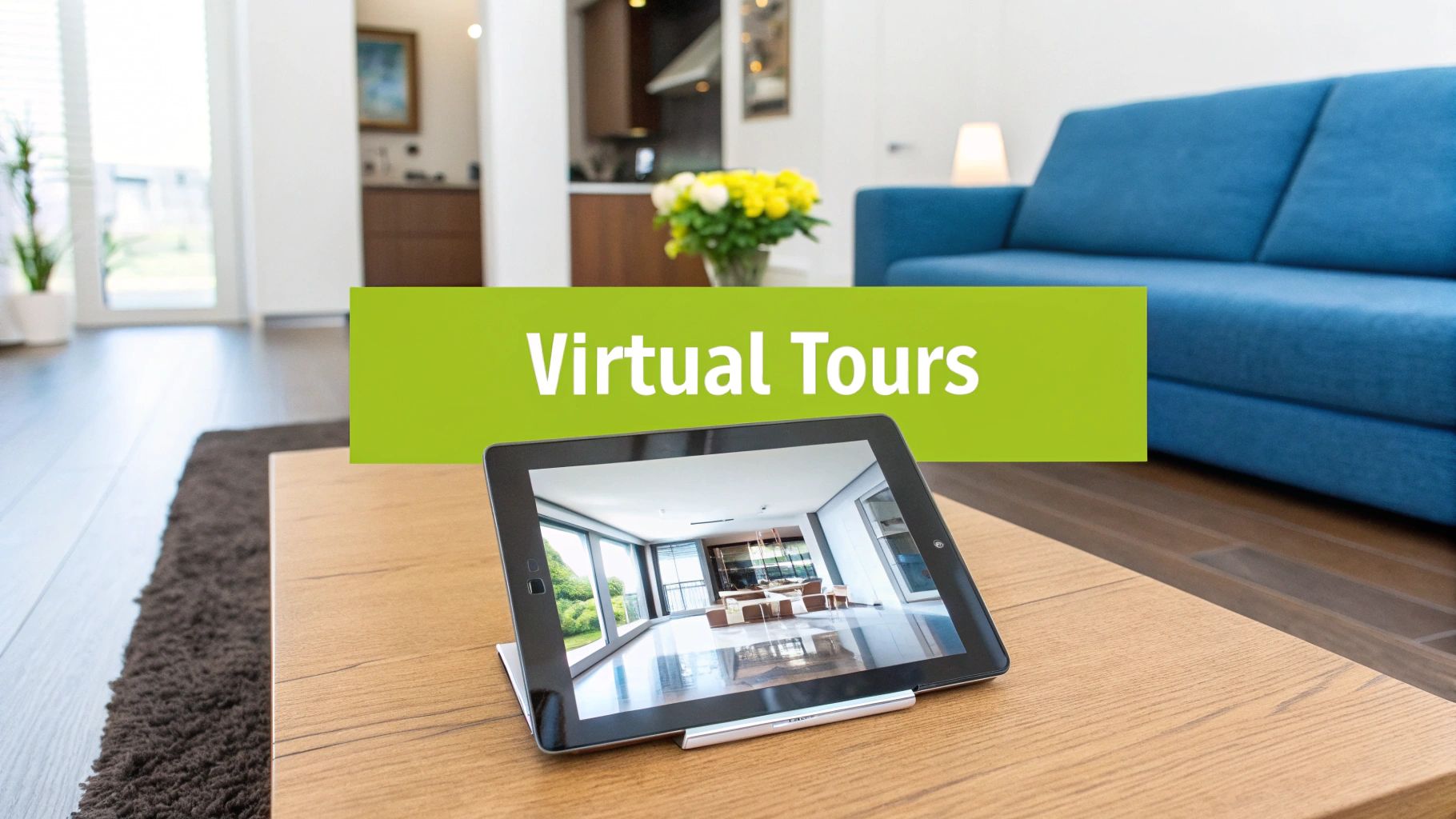
This approach works by qualifying leads more effectively and saving agents valuable time. A buyer who has already taken a 3D tour is far more serious than one who has only seen photos. To truly innovate with these tools, understanding the foundational advancements in AI-driven augmented reality is crucial, as it powers the sophisticated features that make these experiences so compelling and realistic.
Actionable Implementation
- Prioritize High-Value Listings: Invest in Matterport-style 3D tours and AR staging for high-value properties (e.g., over $500K) where the return on investment is highest.
- Show Renovation Potential: Use AR to create "before and after" visualizations for fix-and-flip properties. This helps investors immediately grasp the property's potential value.
- Create Teaser Content: Edit short, 30-60 second highlight reels from your virtual tours and share them as video ads on Facebook, Instagram, and TikTok to capture initial interest.
- Gate Tours for Lead Capture: Embed the tour on a landing page but require an email signup to access the full immersive experience. Practical Example: Use a pop-up after 60 seconds of viewing that says, "Enter your email to unlock the full 3D tour and floor plans."
- Integrate into Social Ads: Run Facebook carousel ads where each card showcases a different room from the 3D tour, creating an interactive ad experience that drives clicks.
11. Webinars and Educational Events (Lead Magnet Strategy)
Hosting educational webinars and workshops is a powerful lead magnet strategy that positions you as an industry authority. By offering valuable information on topics like "First-Time Home Buyer Mistakes to Avoid" or "How to Start Investing in Rental Properties," you attract a highly motivated and self-qualified audience actively seeking real estate guidance. This approach moves beyond a simple sales pitch, building trust and rapport before ever discussing a transaction.
This strategy excels because attendees exchange their contact information for expert knowledge, creating a list of warm, high-intent leads. Unlike cold outreach, these individuals have already raised their hand to learn more about the real estate process. The event itself serves as a platform to demonstrate your expertise, answer pressing questions in real-time, and establish a genuine connection, making the follow-up process significantly more effective.
Actionable Implementation
- Choose a High-Value Topic: Select a title that solves a specific problem for your target audience. Instead of a generic "Home Buying Webinar," use a more compelling title like, "How to Buy Your First Home with Less Than 10% Down in [Your City]."
- Promote Extensively: Begin promoting your webinar 2-3 weeks in advance using a multi-channel approach. Run targeted ads on Facebook and LinkedIn, send email announcements to your database, and post consistently on social media.
- Maximize Attendance: Send automated reminder emails 24 hours, one hour, and five minutes before the event starts. Offer a downloadable "cheat sheet" or resource guide exclusively for attendees to boost engagement and show-up rates.
- Execute a Nurture Sequence: Immediately after the webinar, enroll all registrants into a 3-email follow-up sequence. Practical Example: The first email should provide the recording, the second should offer a free consultation ("Book a no-obligation strategy call"), and the third should share a relevant case study of a client you helped.
12. Keyword Research and SEO Tools (SEMrush, Ahrefs, Google Keyword Planner)
Search Engine Optimization (SEO) is a powerful, long-term real estate lead generation strategy, and it all starts with keyword research. Using tools like SEMrush, Ahrefs, and Google Keyword Planner allows you to uncover the exact phrases buyers, sellers, and investors are typing into search engines. This data-driven approach removes guesswork, helping you create website content, blog posts, and ad campaigns that directly answer your audience's most pressing questions.
This strategy works because it positions you as a helpful authority right when a prospect is actively seeking information. Instead of interrupting them, you provide the value they are looking for, building trust and capturing organic traffic. By analyzing what your competitors rank for and finding gaps in their content, you can strategically claim valuable digital real estate for your own brand, driving consistent, high-intent leads over time.
Actionable Implementation
- Target Long-Tail Keywords: Focus on specific, multi-word phrases with high buyer intent. Instead of "homes for sale," target "three bedroom homes for sale in downtown Austin with a pool." These have lower competition and attract more qualified leads.
- Perform a Competitor Gap Analysis: Use a tool like Ahrefs to see which keywords top agents in your area rank for that you don't. Practical Example: You find a competitor ranks #1 for "moving to Scottsdale with a family," but you don't. This is a clear opportunity for your next blog post.
- Build Local Content Hubs: Identify all the relevant keywords for a specific neighborhood (e.g., "Park Slope schools," "best restaurants in Park Slope," "Park Slope property taxes"). Create a comprehensive "pillar" page for that neighborhood and link out to smaller, more detailed posts.
- Budget PPC with Keyword Planner: Use Google's Keyword Planner to estimate the search volume and cost-per-click (CPC) for seller-focused keywords like "how much is my home worth" or "real estate agents near me" to inform your paid ad budget.
12-Point Real Estate Lead-Gen Comparison
| Channel | 🔄 Implementation complexity | ⚡ Resource requirements | 📊 Expected outcomes | 💡 Ideal use cases | ⭐ Key advantages |
|---|---|---|---|---|---|
| Geofencing and Location-Based Targeting | Medium–High — requires SDKs, mapping, compliance | Mobile user density, higher CPM, geofence management | High‑intent foot traffic & measurable conversions (Estimated ROI 200–400%) | Local agents, multi-location brokerages, open houses | Hyperlocal precision; real‑time optimization |
| Facebook & Instagram Lead Generation Ads | Low–Medium — platform-driven setup, creative refresh needed | Ad budget, creative assets, pixel & CRM integration | High conversion rates; CPL generally low (ROI 150–500% when optimized) | Agents, brokerages, wholesalers, consumer lead capture | In‑app forms reduce friction; instant lead routing |
| Google Local Services Ads | Medium — business verification and category setup | Licensing/docs, pay‑per‑lead budget, GBP integration | Very high intent, pre‑qualified leads; pay‑per‑lead model (ROI 200–350%) | Local agents, property managers, home services | Google badge + pay only for qualified leads |
| Google Search Ads + SEMrush keyword targeting | High — ongoing keyword & bid management, optimization | Skilled PPC, keyword tools, scalable budgets (CPCs high in major markets) | Highly targeted, scalable search conversions; measurable ROI (150–300%) | High‑intent search campaigns, luxury/neighborhood targeting | Precise intent targeting; rapid scale and attribution |
| Content Marketing & SEO (Organic) | Medium–High — strategy, content production, ongoing SEO | Skilled writers/SEO, tools, time (6–12+ month ramp) | Long‑term compounding traffic & highest lifetime ROI (300–800% over time) | Brokerages, brand building, investment platforms | Zero per‑lead cost long term; authority & defensibility |
| Email Marketing & Nurture Sequences | Low–Medium — setup automation and segmentation | CRM/email platform, quality list, copywriting | Consistent conversions and retention; very high ROI (~$42 per $1) | Agents with lists, brokerages, repeat/referral strategies | Personalization at scale; excellent LTV and automation |
| YouTube & Video Marketing | Medium–High — production skills and consistent publishing | Videography, editing, channel management, SEO | Strong engagement and organic reach; ROI 100–400% depending on organic/paid mix | Property tours, luxury listings, education channels | Builds trust quickly; ranks on YouTube & Google |
| LinkedIn Outreach & Networking | Medium — personalized outreach workflows, ABM setup | Sales Navigator, skilled copywriting, time for relationships | High‑quality B2B leads (ROI 150–300% for commercial) | Commercial, multifamily syndication, HNW targeting | Access to decision‑makers; effective for B2B deals |
| Influencer & Agent Partnerships (Affiliate) | Medium — partner recruitment & management | Commission budget, tracking links, partner support | Performance‑based lead flow; ROI variable (100–300%) | Brokerages, multi‑agent teams, mortgage/lender partnerships | Low upfront cost; leverages trusted audiences |
| Virtual Tours, AR & Immersive Experiences | High — 3D capture, AR tools, integration | 3D/AR equipment or vendor, higher production costs ($500–3,000/property) | Much higher engagement; better qualified remote buyers (ROI 100–300%) | Luxury/high‑value properties, remote/international buyers | Reduces showings; premium differentiation |
| Webinars & Educational Events | Medium — content prep, hosting, promotion | Webinar platform, promo budget, presenter expertise | Pre‑qualified leads; evergreen assets from recordings (ROI 150–300%) | Educators, investment platforms, thought leadership campaigns | Establishes authority; captures engaged email leads |
| Keyword Research & SEO Tools (SEMrush, Ahrefs) | Low–Medium — learning curve for advanced features | Tool subscriptions, analyst time | Improved targeting for SEO/PPC; increases campaign ROI indirectly | Content planners, PPC managers, SEO teams | Data‑driven keyword & gap insights; informs all channels |
Choosing the Right Strategies for Sustainable Growth
Navigating the landscape of real estate lead generation can feel overwhelming. We've explored a dozen powerful strategies, from the high-intent immediacy of Google Local Services Ads to the long-term authority building of content marketing and SEO. Each method, whether it's the hyperlocal precision of geofencing or the engaging visual storytelling of YouTube video tours, offers a unique pathway to connect with motivated buyers, sellers, and investors.
The key takeaway is that there is no single "best" strategy; there is only the best strategy for you. Your ideal approach is not a random selection from this list but a carefully constructed system tailored to your specific goals, market dynamics, and budget.
From Strategy to System: Building Your Lead Generation Engine
The most successful agents and investors don't just chase leads; they build a predictable, scalable engine. This means moving beyond a single-channel mindset and embracing a multi-faceted approach. A powerful combination often involves blending short-term wins with long-term investments.
For example, a new agent might lean heavily on Facebook Lead Ads and targeted Google Search Ads to generate immediate conversations and build initial cash flow. Simultaneously, they should begin planting the seeds for future growth by creating valuable blog content about their local market, optimizing their Google Business Profile, and building a simple email nurture sequence to stay top-of-mind with past leads. This dual approach ensures a steady stream of opportunities today while building an asset that will generate organic leads for years to come.
Key Insight: Your goal isn't just to find the next client. It's to build a reliable, repeatable process that consistently attracts your ideal clients, minimizing guesswork and maximizing your return on investment.
Actionable Next Steps: Putting Your Plan in Motion
Mastering these real estate lead generation strategies is the foundation of a thriving business. To turn this knowledge into tangible results, you must take deliberate action. Here are your next steps:
- Audit Your Current Efforts: Before adding anything new, analyze what you’re already doing. Where do your best leads currently come from? Which channels are underperforming? Use data, not feelings, to guide this assessment.
- Identify Your Ideal Client: Are you targeting first-time homebuyers, luxury sellers, or commercial investors? Define this persona clearly. A strategy designed for a millennial buyer using Instagram will look very different from one targeting a retiring seller who responds to local print or highly specific search ads.
- Select Two Strategies to Implement: Don't try to do everything at once. Choose one short-term strategy for quick wins (like Google LSA) and one long-term strategy for sustainable growth (like creating a video series on YouTube). Commit to mastering and optimizing these two before adding more to your plate.
- Set Clear KPIs and a Budget: For each strategy, define what success looks like. Is it Cost Per Lead (CPL), number of appointments booked, or a specific Return on Ad Spend (ROAS)? Allocate a realistic budget and track your performance diligently.
Ultimately, consistent implementation and data-driven optimization are what separate top-performing real estate professionals from the rest. The strategies outlined in this article provide the blueprint; your commitment to execution will build the empire. By moving from a reactive to a proactive lead generation mindset, you create a business that not only survives but thrives in any market condition.
Ready to transform your lead generation from a daily grind into a predictable, automated system? At Silver Spoon Agency, we specialize in architecting and managing data-driven, omnichannel marketing funnels specifically for the real estate industry. Let us help you implement the right strategies to attract high-quality leads and maximize your ROI. Learn more at Silver Spoon Agency.