


A Guide to SEO for Travel Websites in 2026

When it comes to SEO for travel websites, success hinges on a few core things: a lightning-fast technical setup, navigation that’s a breeze for both people and search engines, and content that actually understands what travelers are looking for. Your job is to become the most helpful and easy-to-use resource for someone planning a trip, from that first daydream all the way to clicking "book."
Build Your SEO Foundation for Lasting Growth
A truly effective SEO strategy for any travel brand doesn’t start with flashy content. It starts with a rock-solid technical framework. Think of it like building an airport before you try to land planes—without a solid runway and clear signage, even the best aircraft (your content) will have a rough time. These foundational pieces are what shape user experience and tell search engines your site is a quality destination.
The first checkpoint is always site speed. In the travel world, users are constantly flipping through high-res photo galleries and comparing different tours or hotels. A slow page is a killer. Google’s own data shows that just a 1-second delay in mobile page load time can slash conversion rates by up to 20%. For a travel business, that’s lost bookings, plain and simple.
Prioritize Page Speed and User Experience
We always start by auditing the most important pages—the homepage, key destination guides, and the booking funnel—with a tool like Google's PageSpeed Insights. More often than not, the biggest performance hogs are your beautiful, but massive, images.
- Image Compression: That gallery for your "Tuscan Villa Escape" might have dozens of gorgeous 5MB photos. Using tools like TinyPNG or built-in compression plugins can shrink those file sizes by 70-80% without anyone noticing a difference in quality.
- Next-Gen Formats: Go a step further and convert your JPEGs and PNGs to a modern format like WebP. This one change can cut image file sizes by another 25-35%, helping your pages feel almost instantaneous.
- Lazy Loading: This is a must. Lazy loading only loads images as a user scrolls down the page. It means someone looking at your "Things to Do in Rome" guide sees the top of the page instantly, instead of waiting for every single photo from your "Vatican Museum Photo Tour" section to load first.
A fast website isn't just a technical checkmark; it's a fundamental part of your customer service. When a potential traveler can browse your offerings without frustrating delays, you're building the trust that leads to a booking.
This flow shows how these foundational elements—speed, clean URLs, and global targeting—all work in concert.
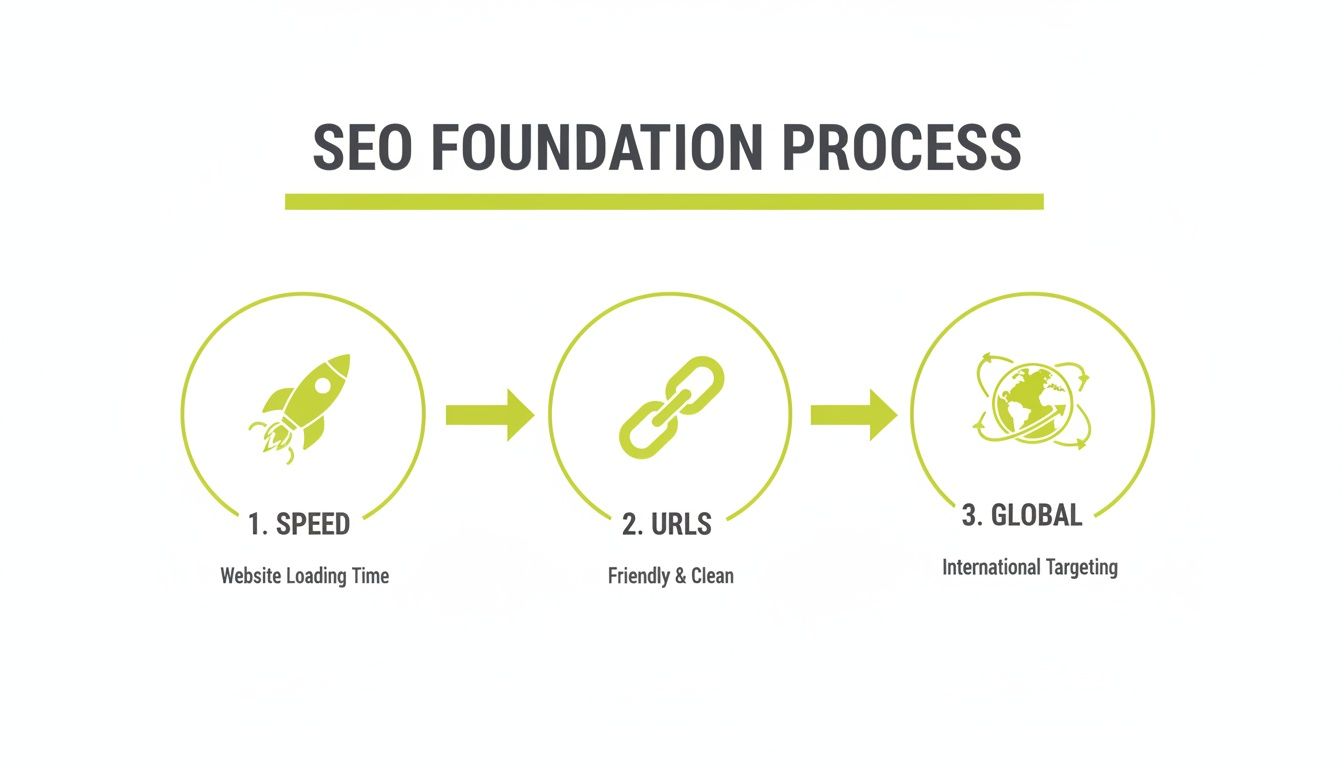
Nailing these three pillars gets your travel site technically sound and ready to compete for the top spots in search results.
Create Clean URLs and Global Targeting
The next piece of the puzzle is your site's architecture. A clean, logical URL structure works like a clear roadmap for search engines and your visitors. For example, a messy, parameter-filled URL like yourtravelsite.com/tours?id=843&loc=eu_it is just confusing. A far better approach is yourtravelsite.com/destinations/italy/rome. The hierarchy immediately tells Google and users exactly what the page is about.
If you're an international travel brand, targeting different regions is non-negotiable. This is where hreflang tags become your best friend. These little code snippets tell Google that you have alternate versions of a page meant for different languages or countries, which helps you avoid getting penalized for duplicate content.
For instance, if you offer a "Paris City Tour" page in English for the U.S. market and in French for the French market, you’d add this to your page’s <head> section:
<link rel="alternate" hreflang="en-us" href="https://yourtravelsite.com/us/tours/paris" /><link rel="alternate" hreflang="fr-fr" href="https://yourtravelsite.com/fr/tours/paris" />
This simple step ensures that users in the U.S. see the English version while those in France get the French one.
To really get this right, you need to understand the nuances of SEO for vacation rentals, as many of these core principles are universal across the travel industry. You can also explore our guide to understand more about the top Google ranking factors that matter for SEO today.
Create Content That Captures Traveler Intent
While a flawless technical setup is your foundation, your content is what actually turns lookers into bookers. The heart of SEO for travel websites isn't about stuffing pages with keywords; it's about becoming an indispensable resource that mirrors how real people dream about, plan, and purchase their trips.
Your mission is to get inside the traveler's head at every stage of their journey. You need to anticipate their questions, from the initial "where should I go this year?" daydreaming to the nitty-gritty "what’s the best way to get from the airport to my hotel?" logistics. In fact, organic search is a massive revenue driver in travel. We've seen brands that master this approach—creating authentic guides on local transport, budgeting, and unique experiences—outperform their competitors by 30-40% in organic rankings. These organic growth strategies are proven to drive travel revenue.
Build Ultimate Destination Guides
Every travel website has destination pages, but the ones that truly rank and convert are built differently. Think of them as a digital concierge, structured to answer a traveler’s questions in the exact order they’d ask them.
Instead of one massive wall of text about a city, break your guides down into logical, question-based sections. This structure not only makes the page scannable but also targets the valuable long-tail keywords that high-intent searchers are typing into Google.
For instance, your ultimate guide to "Rome" should answer practical questions:
- Best Time to Visit Rome: Dig into weather, crowd sizes, and seasonal events. For example, "Visit in October for pleasant weather and fewer crowds, but be aware of higher prices around the Rome Film Festival."
- Navigating Public Transport: Detail the metro, buses, and how to buy tickets. Explain that a "biglietto" ticket is valid for 100 minutes on buses and one metro ride.
- Local Food You Can't Miss: Go beyond "pizza and pasta." Talk about cacio e pepe, supplì, and where to find them. Recommend a specific trattoria like Da Enzo al 29 in Trastevere for authentic Roman dishes.
- Is Rome a Walkable City? Directly address a common concern for first-timers. State that "the historic center is very walkable, but use the metro to get from the Colosseum to the Vatican to save time and energy."
This strategy transforms a basic page into an authoritative resource that search engines love.
By anticipating and answering the practical questions travelers have, you build trust and authority. Your website becomes the go-to source not just for inspiration, but for the essential details that make a trip successful.
Attract Travelers with Experience-Led Content
While destination guides form your foundation, experience-led content is how you capture travelers at the top of the funnel—when they're still exploring options. These articles target specific travel styles, niche interests, and distinct personas, letting you connect with audiences on a much deeper level. To do this right, you need to know exactly who you're talking to. Check out our guide on how to create buyer personas to get started.
Forget writing another generic "Top 10 Things to Do in Costa Rica." Instead, create content that tells a compelling story or solves a real problem for a specific type of traveler.
Practical Examples of Experience-Led Posts:
- For the Solo Adventurer: "A 7-Day Itinerary for Solo Travelers in Costa Rica: From Zip-Lining in Monteverde to Surfing in Tamarindo"
- For the Foodie: "The Ultimate Street Food Tour of Osaka: A Self-Guided Walk Through Dotonbori"
- For the Budget Backpacker: "How to See the Swiss Alps on a Budget: Hostels, Hikes, and Supermarket Picnics"
- For the Family: "Kid-Friendly Activities in London That Aren't Tourist Traps: Beyond the London Eye"
This content resonates because it feels personal. It directly speaks to the unique desires of a specific audience, making your brand far more memorable and trustworthy.
Establish Authority with Topic Clusters
To signal deep expertise to Google, you need to organize your content into topic clusters. This powerful strategy involves creating a broad, central "pillar page" and linking it to more detailed "cluster content" articles. This structure proves to search engines that you have comprehensive knowledge on a subject.
For example, your travel site could build a topic cluster around Japan.
| Role | Content Example | Description |
|---|---|---|
| Pillar Page | The Ultimate Travel Guide to Japan | A comprehensive overview covering geography, culture, and key regions. |
| Cluster Post | A Guide to Tokyo's Nightlife | A deep dive into specific neighborhoods, bars, and clubs. |
| Cluster Post | Exploring the Temples of Kyoto | A detailed guide on major temples, etiquette, and how to get there. |
| Cluster Post | The Best Ramen Spots in Sapporo | A niche article for food lovers focusing on a regional specialty. |
Your main pillar page links out to each cluster post, and every cluster post links back to the pillar. This web of internal links funnels authority to your main guide and helps all the related pages rank higher. It's a fundamental part of organizing your SEO for travel websites and is key to turning passive readers into travelers ready to book their next adventure with you.
Adapt to Generative Engine and Social SEO
The ground is shifting in the world of search. For years, the game was simple: claw your way to the top of Google’s ten blue links. Today, the new frontier for SEO for travel websites is about getting cited directly in AI-generated answers and showing up where trip planning actually begins—which is often on social media.
This means you need to get good at two things, fast: Generative Engine Optimization (GEO) and social search.
The data is telling a stark story. Zero-click searches are on the rise, projected to jump from 22.8% in July 2024 to 26.7% by September 2025. This is driven almost entirely by AI overviews that spoon-feed answers to users. We're already seeing a 30-40% drop in organic traffic for some Destination Marketing Organizations (DMOs).
Phocuswright data shows traditional search engines' role in trip research plummeted from 51% to just 36% in less than a year, while generative AI platforms shot up from 6% to 15%. Discover more insights about these travel industry trends from Phocuswright. The message is clear: adapt or get left behind.
Optimize for AI Answers
Generative Engine Optimization is all about making your content the perfect source for AI models like Google’s Gemini. You want to be the expert the AI trusts and quotes. This requires a fundamental shift away from long, meandering blog posts toward providing sharp, direct answers to common traveler questions.
Think about the specific, almost frantic questions people have when they’re deep in planning mode. Instead of burying the answer in paragraph seven, put it right up front.
Vague Question: "Brazilian visa info"
Specific Question: "What is the visa requirement for Brazil for US citizens?"
Your Clear Answer: US citizens currently need a visa to visit Brazil. The electronic visa (e-visa) can be obtained online and is typically valid for multiple entries over ten years.
Vague Question: "Bali solo female safety"
Specific Question: "Is Bali safe for solo female travelers?"
Your Clear Answer: Yes, Bali is widely considered a safe destination for solo female travelers, particularly in popular areas like Ubud, Seminyak, and Canggu. However, standard safety precautions, such as avoiding walking alone at night and being aware of your surroundings, are always recommended.
Look at how Google’s AI now handles these queries.
The AI pulls information from multiple sources to create a tidy summary. If your data isn't structured for easy parsing, you won't even be in the running.
Win with Social SEO
The very idea of a "search engine" has expanded beyond Google. For a growing slice of travelers—around 19%, to be exact—the search starts on platforms like TikTok and Instagram. This is "social SEO," and it’s about making your brand discoverable inside these highly visual ecosystems.
Traditional, text-heavy SEO tactics won't work here. Social SEO is all about the visuals, the vibe, and the immediate hit of inspiration or a quick, useful tip.
Here’s how you adapt your strategy for the social world:
- Treat Captions Like Meta Data: Your video captions are your new meta descriptions. For a video about a Santorini sunset, use a caption like: "The best spot to watch the sunset in Oia, Santorini! 🌅 Arrive an hour early to beat the crowds. #santorini #greecetravel #oiasunset #traveltips".
- Create Visual-First Guides: Ditch the long blog post. Instead, create a short, punchy video or a carousel titled "3-Day Itinerary for Lisbon." Use on-screen text to call out key activities, restaurants, and sights. For example, Day 1: Explore Alfama & eat pastéis de nata.
- Embrace User-Generated Content (UGC): Actively encourage your customers to tag your hotel, tour, or destination in their travel photos and videos. A hotel could run a contest for the best photo taken at their pool, asking users to post with the tag #YourHotelNameViews. This is more than just social proof; it’s free marketing that taps directly into their trusted networks.
In social SEO, your content isn't just answering a question; it's creating a feeling. A 15-second video of a perfect sunset from a hotel balcony can be more powerful than a 2,000-word article about the property's amenities.
To make sure your travel videos are working as hard as they can, you need to know the fundamentals of video SEO. To get up to speed, take a look at this guide on what is video SEO and how it works. By mastering both GEO and social search, you ensure your travel brand stays visible and relevant, no matter where your audience is looking for their next adventure.
Gain an Edge with Schema Markup and Local SEO
Ranking high on Google is only half the battle. The real challenge is convincing a traveler to click on your link instead of the ten others surrounding it. This is where the more technical side of travel SEO gives you a decisive edge.
Your two most powerful weapons here are schema markup and a razor-sharp local SEO strategy.
Schema markup is a form of microdata you add to your site’s code. Think of it as a translator that tells search engines precisely what your content is about—not just that it’s text, but that it describes a specific hotel, a guided tour, or a multi-day trip. Google then uses this understanding to upgrade your standard blue link into a visually rich rich snippet.
These enhanced listings, complete with star ratings, pricing, and availability, are no longer a nice-to-have. With Google reporting a 25% year-over-year rise in travel-related searches, capturing user attention is critical. As of 2026, this structured data has become a core signal for both search engines and AI, directly influencing how and where you appear.
Implement Essential Schema for Travel
Don't let the term "code" scare you. Implementing schema is usually a matter of adding a small JSON-LD script to your page's HTML. This script acts as a cheat sheet for search engines, helping them parse and display your key information correctly.
For travel sites, a few schema types deliver the most significant impact right away.
We've found these to be the most effective for our travel clients:
HotelSchema: This is a must for any accommodation provider. It can pull in your star rating, price range, and standout amenities like a pool or free breakfast directly into the search results. A listing showing a 4.5-star rating is infinitely more clickable than one without.EventSchema: If you offer time-based activities like walking tours, cooking classes, or festival packages,Eventschema is your best friend. It displays the event name, date, location, and price, attracting users searching for things to do on specific dates.TripSchema: This one is built for multi-part itineraries, such as a "7-Day Amalfi Coast Adventure." It bundles the entire journey—including different destinations and transportation methods—into a clear, structured overview right on the results page.
A rich snippet is like a free billboard in the search results. It grabs attention, builds immediate credibility with reviews and pricing, and can dramatically improve your click-through rate.
Imagine you're promoting a "Foodie Tour of Rome." Without schema, it’s just another result. But with properly implemented Event schema, it could appear with the tour date, a 5-star rating, and the price. You’ve just answered a searcher's three main questions before they even click.
The table below breaks down these core schema types and how you can apply them.
Essential Schema Types for Travel Websites
This table outlines the most impactful schema markups travel websites can implement to earn rich snippets and improve visibility.
| Schema Type | What It Does | Practical Example |
|---|---|---|
Hotel | Displays accommodation details like ratings, price ranges, and key amenities directly in search results. | A boutique hotel in Paris uses Hotel schema to show its 4.8-star rating, "from $250/night" pricing, and "Eiffel Tower view" amenity. |
Event | Highlights time-sensitive offerings such as tours, workshops, or activities with dates, locations, and pricing. | A tour operator in Florence uses Event schema for its "Tuscan Wine Tasting" tour, displaying the date, time, and €75 ticket price. |
Trip | Bundles multi-day, multi-location itineraries, providing a structured overview of a complete journey. | A travel agency promoting a "10-Day Egypt Discovery" tour uses Trip schema to outline the full itinerary, from Cairo to Luxor. |
LocalBusiness | Provides core business information like address, phone number, and opening hours for local map packs. | A bike rental shop in Amsterdam uses LocalBusiness schema to ensure its location and hours are correctly displayed in "near me" searches. |
Implementing these gives Google the structured information it craves, making it far more likely to feature your offerings prominently.
Dominate Local Search Results
For any travel business with a physical footprint—a hotel, a tour operator’s office, a rental car agency—local SEO is what connects you with travelers who are already in your city and ready to book. Your command center for this is your Google Business Profile (GBP).
A fully optimized GBP is often the very first interaction a potential customer has with your brand, especially on mobile.
Transforming your GBP from a simple listing into a customer-generating machine requires consistent effort. Start with the basics: fill out every single field. This means your exact address, service areas, phone number, hours, and website link are all complete and accurate.
From there, put your focus on these high-impact activities:
- Upload Stunning Photos: Don't rely on grainy, outdated images. Post high-resolution, recent photos of your property, your tours in action, and your happy customers. A hotel should post pictures of the rooms, lobby, pool, and breakfast spread. A tour company should show guides leading smiling groups.
- Generate a Stream of Reviews: Actively and systematically ask your happy customers to leave a review. For example, send a follow-up email 24 hours after a tour with a direct link to your GBP review page, saying "Enjoyed your tour? Share your experience with future travelers!"
- Use Location-Specific Keywords: Weave local keywords into your GBP description and business posts. A post could say, "Looking for a guided tour in Florence? We have a few spots left for our 10 AM walking tour tomorrow!"
- Answer Questions Proactively: Use the Q&A feature to preemptively answer common questions. For a car rental agency, common questions might be "Do you offer child seats?" or "What are your after-hours drop-off procedures?" Answer them publicly.
A stellar GBP is the foundation of your local presence, and you can learn more about optimizing your presence with our Google Map SEO service guide. By pairing powerful schema with a dialed-in local SEO plan, you ensure your travel business isn't just visible—it's the most compelling choice when a traveler is ready to book.
Build Authority Through Links and Digital PR
Having incredible content and a technically perfect website gets you to the starting line. But in the hyper-competitive travel space, it won't get you the win. To actually climb the rankings and build a brand that lasts, you need authority. In the language of search engines, that authority is built with high-quality backlinks and savvy digital PR.
Think of backlinks as votes of confidence. When a reputable travel magazine or popular blogger links to your site, they're telling Google you're a trustworthy source. This perceived authority is a massive ranking factor, making your position far more resilient when algorithms inevitably shift.
Collaborate for High-Impact Links
First things first: forget blasting out hundreds of generic, templated emails begging for links. The most powerful link-building strategies in the travel industry are rooted in genuine collaboration and mutual value.
A hugely effective tactic is partnering with established travel bloggers and influencers on their destination guides. Instead of just asking for a handout, offer them something they actually need.
- Provide Expert Insights: You're a tour operator in Lisbon, right? Offer a blogger a unique "insider tip" for their "7-Day Lisbon Itinerary" post. Your on-the-ground knowledge is something they can't get elsewhere, making a link back to your site a natural form of credit. For instance, "Tell your readers the best time to visit the Belém Tower is right at opening to avoid the two-hour queue."
- Co-Create Content: Go bigger. Propose a joint "Local's Guide to Paris" where you cover the best tours and experiences, and they handle the food and cultural spots. This creates a far richer resource for readers and gives you both a compelling reason to cross-promote and link.
This strategy feels less like a transaction and more like a real partnership, which is precisely how you earn the kind of high-quality links that matter.
The best backlinks aren't just given; they're earned. By focusing on providing tangible value to other creators in the travel space, you build relationships that pay dividends in authority and referral traffic.
Create Shareable Assets and Offer Original Media
Another way to attract backlinks organically is by creating assets that other publications want to share. This means developing content so useful, visually striking, or newsworthy that linking to it is a no-brainer for a journalist or blogger on a deadline.
Think beyond the standard blog post. In a visual niche like travel, this is where you can really shine.
Practical Examples of Shareable Assets:
- Data-Driven Infographics: Create something like "The True Cost of a Trip to Southeast Asia," a sharp infographic breaking down daily costs for lodging, food, and activities in Thailand, Vietnam, and Cambodia. This is gold for budget travel blogs and is highly shareable.
- Original Photography: If you have stunning, high-quality photos from a remote hike in Patagonia or a unique cultural festival in India, you're sitting on a valuable asset. Offer these images to online travel magazines for use in an article, in exchange for a clear photo credit and a link back to your website.
Use Digital PR to Become the Source
Digital PR takes this a step further. It's about proactively creating newsworthy stories that position your brand as an authority on emerging travel trends. This means using your own data or expertise to generate insights, then pitching those findings to the media.
Even a small-scale survey of your own audience can yield incredible results. You could poll your email list or social media followers about a trend like "The Rise of Solo Female Travel" or "The Most In-Demand 'Workation' Destinations."
Once you have your data, you publish the findings on your blog. A post titled "Our Data Shows 65% of Travelers Now Prioritize Sustainable Experiences" is instantly newsworthy.
Then, you craft a concise pitch to travel journalists and bloggers, summarizing your key findings and offering your report as a source for their upcoming stories. When a major publication like Condé Nast Traveler or Travel + Leisure cites your study and links to you, you've earned a top-tier backlink. More importantly, you've established your brand as a go-to expert, building the kind of reputation that drives real, sustainable success in travel SEO.
Common Questions About SEO for Travel Websites
Even a well-defined SEO playbook can leave you with questions. It’s natural. The world of travel SEO is nuanced, and the best strategies often require a bit of seasoned perspective. Here, we'll tackle some of the most frequent questions we get from travel brands to give you that expert clarity.
How Long Does It Take to See Results from Travel SEO?
This is always the first question, and for good reason. Unlike a paid ad that delivers instant traffic, SEO is an asset you build over time. The timeline for seeing a real return depends on your website's history, the fierceness of your competition, and the consistency of your execution.
You can generally expect to see some early traction from technical and on-page fixes within 3 to 6 months. This usually looks like better rankings for long-tail keywords or a noticeable uptick in organic visitors finding your niche content. For example, your new blog post "best family-friendly restaurants in Florence" might start ranking on page two or three in this timeframe.
But if you’re aiming for the top spots for high-stakes terms like "luxury hotels in Bali" or "best tours in Italy," you're in a marathon, not a sprint. Building the kind of authority and backlink profile needed to win those battles takes time—anywhere from 6 to 12 months and often longer.
The crucial thing to remember is that SEO results are cumulative. Every optimized page and every new backlink stacks on top of the last, building a powerful, self-sustaining engine for organic traffic that will pay you back for years.
What Are the Most Important KPIs to Track?
It’s easy to get mesmerized by big traffic numbers, but most of that data is just noise. To truly gauge the success of your travel SEO, you need to zero in on the Key Performance Indicators (KPIs) that tie directly to your bottom line.
These are the metrics that actually matter:
- Organic Bookings & Conversions: This is your north star. Are more people booking tours, reserving rooms, or buying packages because of your SEO efforts? This is the ultimate measure of ROI.
- Keyword Rankings for "Money" Terms: Keep a close eye on your rankings for high-intent keywords that signal a user is ready to pull out their wallet, like "boutique hotels in Paris" or "guided tour of the Colosseum."
- Organic Click-Through Rate (CTR): A high CTR means your titles and descriptions are cutting through the clutter on the search results page and compelling people to click. It’s a direct measure of how well you're capturing attention.
- Branded vs. Non-Branded Traffic: A steady increase in non-branded search traffic is a definitive sign that your SEO is working to attract new audiences who had never heard of you before.
- Assisted Conversions: SEO is often the first touchpoint in a long customer journey. Track how often your blog posts or destination guides play a role in a sale, even if they aren't the final click before the conversion. For example, a user might read your "Best Time to Visit Japan" blog post, leave, and then come back a week later through a direct search to book a tour. The blog post gets credit for an assisted conversion.
Should I Focus on New Blog Posts or Optimizing Existing Pages?
This is a classic resource allocation puzzle. The answer isn't one or the other—it's both. The key is to prioritize your efforts based on where you can make the biggest impact right now.
Your first move should always be to lock down your core "money" pages. These are the pages that directly drive your revenue: your destination landing pages, tour descriptions, and booking portals. Get them technically perfect, user-friendly, and laser-focused on their primary keywords before you do anything else. For a hotel, this means optimizing the yourhotel.com/rooms page is more important than writing a new blog post.
Once your foundational pages are solid, you can pivot to creating new, supportive content like blog posts and travel guides. These assets serve a different but equally vital purpose. They build your site's topical authority, capture searchers at the beginning of their planning process, and create a powerful web of internal links that funnels authority back to your money pages.
A great framework to follow is the 80/20 rule. Spend about 80% of your time creating new, high-value content that establishes your expertise and attracts a wider audience. Use the remaining 20% to continually refresh and re-optimize your most important existing pages, ensuring they stay sharp and maintain their peak performance. For instance, each year you should update your "Best Restaurants in Rome" post with new openings and remove any that have closed.
Ready to turn your travel website into a revenue-generating powerhouse? The team at Silver Spoon Agency specializes in creating performance-driven marketing campaigns that deliver measurable growth. Learn how our AI-powered, omnichannel approach can elevate your brand and maximize your ROI.