


What does a digital marketing agency do? A Clear Guide to Growth

At its core, a digital marketing agency is your outsourced growth department. They’re a dedicated crew of specialists—strategists, creatives, data nerds, and tech wizards—all laser-focused on one thing: measurable business growth.
Their job is to manage and accelerate your entire online presence, making sure your brand connects with the right people on the right channels at the right time. But it’s so much more than just running a few ads or posting on Instagram.
Your Outsourced Growth Team Explained
Think of an agency as a team of experts who plug directly into your business. Their whole mission is to build a complete system that turns your marketing dollars into predictable revenue and, most importantly, profit. They wrestle with the complex, always-shifting digital world so you can get back to what you do best—running your business.
The partnership kicks off with a deep dive into your business. They want to know your goals, your numbers, and exactly who your ideal customer is. From there, they map out a cohesive strategy designed to hit specific targets, whether that’s building brand awareness from scratch, capturing ready-to-buy leads, or getting existing customers to come back for more. A great agency gives you a clear roadmap.

Why Agencies Are Essential Today
The need for agencies has exploded for a simple reason: that's where the customers are. Attention and ad budgets have decisively moved online.
Consider this: the global digital ad market was valued at around $350 billion in 2020 and is on track to hit nearly $786.2 billion by 2026. For most businesses, building an in-house team with all the necessary data, creative, and media buying skills is just not feasible. Agencies bridge that gap, turning those massive market shifts into tangible results you can track.
An agency’s real value is in translating broad market trends into specific, actionable growth plans for your company. They connect the dots between global ad spend and your local bottom line.
So, what does this look like in the real world?
A local plumbing company might work with an agency to run geofencing ads targeting homeowners in a new subdivision, driving immediate service calls. An e-commerce brand could have an agency build an email automation sequence that recovers abandoned carts, instantly boosting sales by 15% without a single extra dollar in ad spend.
These practical, results-driven applications are what a good agency is all about. You can learn more about how an ad agency works and the specific processes they use in our detailed guide. They handle the technical weeds and strategic heavy lifting, allowing you to reap the rewards of expert-led growth.
Here’s a quick breakdown of the core roles an agency plays in your business.
Core Functions of a Digital Marketing Agency
| Function | What It Means for Your Business | Practical Example |
|---|---|---|
| Strategy & Planning | They build the roadmap, defining goals, target audiences, and the channels to reach them. | Deciding to target 35-50 year old male homeowners on Facebook and Google Search for a landscaping business. |
| Creative Development | They design the ads, write the copy, and create the content that grabs attention. | Creating a short video ad showing a lawn transformation with the headline "Get Your Dream Yard This Weekend." |
| Media Buying & Execution | They manage your ad budget across platforms like Google, Facebook, and TikTok to get the best results. | Allocating 60% of a client's budget to Google Ads for high-intent searches and 40% to Instagram for brand awareness. |
| Data Analysis & Optimization | They track what's working (and what's not) and constantly tweak campaigns for better performance. | Noticing an ad's click-through rate is low, and changing the image to improve engagement. |
| Technical Management | They handle the complex tech—from website code to tracking pixels—so you don't have to. | Installing the Meta Pixel on a client's website to track purchases and retarget visitors with ads. |
Ultimately, these functions combine to create a powerful engine for your business, turning strangers into customers and customers into fans.
The Core Services an Agency Delivers
While the end goal is always growth, an agency gets you there using a specific set of tools and disciplines. These core services are the building blocks of any solid marketing system, each designed to connect with customers at different points in their journey. Think of it like a master mechanic’s workshop—every tool has a specific job, but they all work together to build a high-performance engine.
An agency's real value isn't just in executing isolated tasks; it’s about weaving these services into a single, cohesive plan. The best digital marketing strategies blend several of these elements to create a powerful, unified approach to winning and keeping customers.
Paid Ad Management for Immediate Impact
Paid ad management, often called pay-per-click (PPC), is hands-down the fastest way to get your brand in front of potential customers. An agency manages your budget on platforms like Google, Meta (Facebook and Instagram), and TikTok to capture the attention of people who are actively looking for what you sell, right now.
- Practical Example: A local plumber’s agency can run Google Ads that only show up when someone in their service area searches "emergency plumber near me." This kind of hyper-targeting drives qualified leads in real time. For a B2B software company, an agency might run LinkedIn ads targeting users with "Director of IT" in their job title.
Search Engine Optimization for Long-Term Growth
Search Engine Optimization (SEO) is the art and science of getting your website to rank at the top of search engines organically—that is, for free. Unlike paid ads that disappear the moment you stop paying, SEO builds a sustainable asset that generates consistent, high-quality traffic for the long haul.
- Practical Example: An e-commerce brand selling handmade leather goods would work with an agency to create content and build authority around search terms like "full-grain leather messenger bag." Over a few months, as their site climbs the rankings, they start attracting a steady stream of ready-to-buy customers without paying for every single click. To do this right, agencies use a whole suite of advanced tools, including the best SEO software for agencies, to manage client campaigns and track progress.
Email and SMS Marketing for Nurturing Relationships
So, what happens after someone visits your site or buys something? That’s where email and SMS marketing come in. These are the go-to channels for nurturing those relationships, turning one-time buyers into repeat customers and curious leads into loyal fans. An agency designs and automates these communications to squeeze every drop of value out of your customer list.
A perfect example is an abandoned cart sequence. When a shopper leaves items in their cart, an automated email can pop into their inbox a few hours later with a friendly reminder or a small discount, recovering what would have been lost revenue.
- Practical Example: For a local restaurant, an agency could set up a weekly email newsletter featuring the chef's specials and a link to make a reservation, driving repeat business during slower midweek periods.
Conversion-Optimized Web Development
A beautiful website is completely useless if it doesn't turn visitors into customers. Agencies specialize in building or refining websites with one goal in mind: getting people to take action. This involves strategic design, crystal-clear calls-to-action, lightning-fast load times, and a smooth user experience that naturally guides visitors toward making a purchase or filling out a form.
- Practical Example: An agency redesigns a client's checkout process, reducing it from five steps to two and adding trust badges like "Secure Payment." This simple change can decrease cart abandonment and increase the overall sales conversion rate.
The industry is also getting smarter, with AI playing a bigger role. In fact, 68% of agency leaders now predict paid advertising will be the most effective channel in 2025, and a massive 89% say PPC is their core offering. This reflects a bigger trend where 71% of marketers plan to invest at least $10 million in AI over the next three years, showing a huge belief in its power to fine-tune performance across all of these services. You can discover more insights in the 2025 Digital Agency Industry Report.
How Agencies Turn Strategy Into Tangible Results
An agency’s real magic isn't just the list of services they offer; it's the process they use to turn a great plan into actual profit. Without a structured workflow, even the most brilliant marketing ideas can fall flat. This process is what translates your business goals into something real and measurable, ensuring every dollar you spend is pulling its weight.
A huge part of what a digital marketing agency does is take all your separate marketing channels and weave them into a single, cohesive customer journey. This is something tons of businesses struggle with internally. In fact, research shows that a staggering 77% of marketers say internal silos make it tough to get everyone on the same page. But here's the kicker: "organized marketers" are 397% more likely to report success. This is exactly why companies bring in agencies—to build and enforce that unified strategy. You can dive deeper into how strategy impacts marketing success on mediavalet.com.
The agency process usually boils down to three distinct, cyclical phases.
Phase 1: The Strategy and Discovery Deep Dive
Everything kicks off with a deep analysis of your business. Before a single ad gets built or a piece of code is written, a good agency gets obsessed with your market, your competitors, and most importantly, your ideal customer. They'll build out detailed customer avatars, map the entire buyer’s journey, and run a full audit of your current digital footprint.
This phase doesn't end with a vague promise. It produces a data-backed growth plan—a detailed roadmap that clearly lays out:
- Key Performance Indicators (KPIs) that actually line up with your business goals (e.g., "Achieve a 4:1 ROAS on all campaigns").
- Target Channels where your audience really spends their time (e.g., "Focus on Instagram Reels for under-30s and Google Search for older demographics").
- Budget Allocation designed to squeeze the most out of every dollar (e.g., "$5,000 for top-of-funnel awareness, $10,000 for bottom-of-funnel sales ads").
- Messaging Frameworks that will genuinely connect with your ideal customers (e.g., "Use messaging focused on 'convenience' for busy parents and 'luxury' for high-earners").
Phase 2: The Execution and Implementation
Once you’ve signed off on the strategy, the agency shifts into execution mode. This is where the plan comes to life. Creative teams start designing eye-catching ad visuals, copywriters get to work crafting persuasive messages, and the technical specialists lock in all the necessary tracking and analytics. Campaigns get launched across the chosen channels, from Google Ads to email newsletters.
This is where you see how different services like paid ads, SEO, and email marketing have to work together.
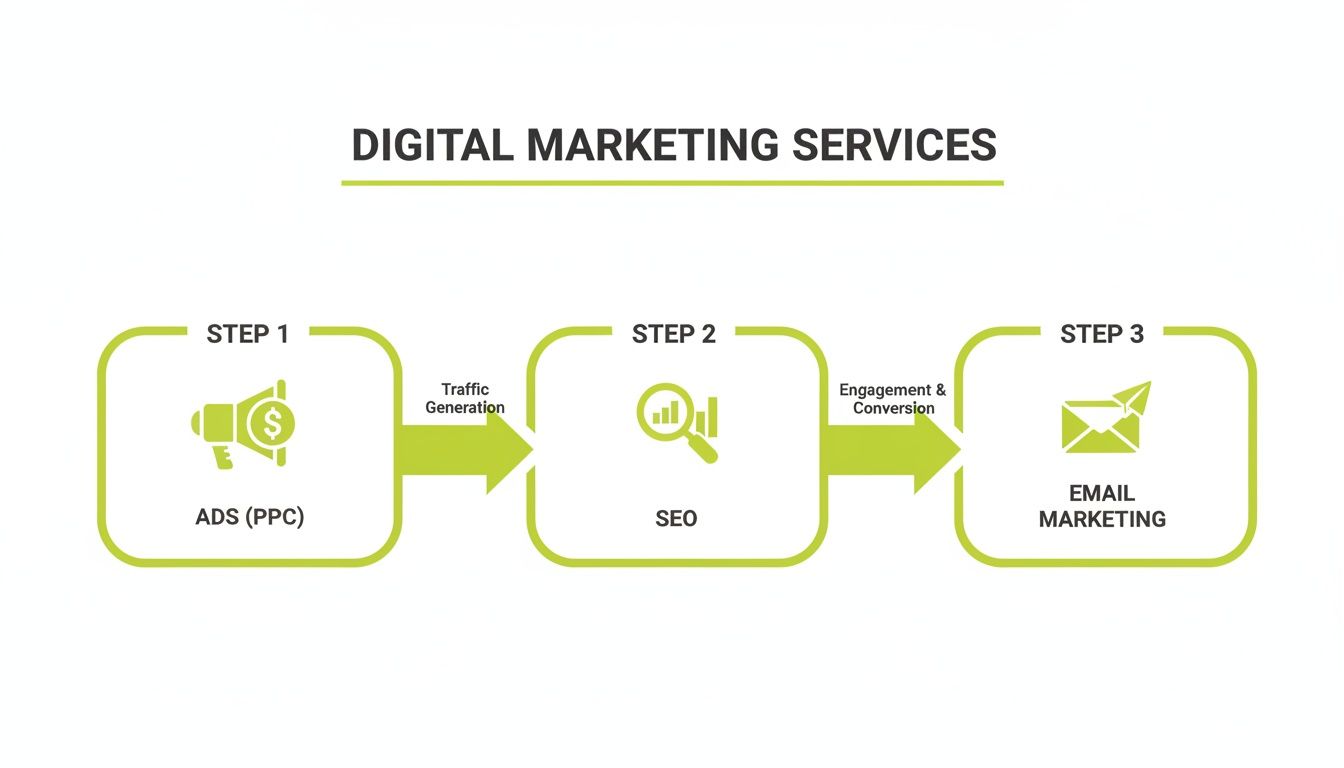
- Practical Example: A user clicks a Facebook ad for a new running shoe, lands on a product page, but doesn't buy. The agency's setup ensures they are retargeted with a video testimonial ad on YouTube the next day. If they still don't buy, they get an email two days later offering 10% off. This coordinated effort maximizes the chance of a sale.
Phase 3: The Optimization and Refinement Loop
Launching the campaigns is just the start. The real work—and where the best results come from—is in the third phase: optimization. Think of it as a continuous feedback loop of testing, learning, and refining.
An agency’s commitment to optimization is what separates the good from the great. It’s the relentless pursuit of improvement that ensures your marketing budget works smarter over time, not just harder.
- Practical Example: An agency might A/B test two different ad headlines to see which one pulls in more clicks. For an e-commerce store, they might notice ads targeting men are performing 50% better than those targeting women, so they shift more of the budget toward the better-performing audience. This data-driven process of constant improvement is what ultimately drives superior results and a much higher return on your investment.
Measuring Success with Metrics That Actually Matter
An agency can talk a big game about strategy and execution, but none of it means a thing without cold, hard numbers to back it up. Clicks, impressions, and follower counts might look nice on a report, but they don't pay the bills. This is where Key Performance Indicators (KPIs) come in.
KPIs are the metrics that draw a straight line from your marketing spend to your bank account. They answer the only question that truly matters: "Is this working?"
Understanding these numbers is what separates a good client-agency relationship from a bad one. It’s how you hold your partners accountable for actual financial results, making sure they’re focused on growth, not just busywork. Ultimately, a great agency proves its value through clear, undeniable calculating overall marketing ROI, and these KPIs are the building blocks of that proof.

It’s easy to get lost in a sea of data. To help you focus, we've put together a quick comparison of the metrics that actually drive business versus the ones that just stroke egos.
Key Agency KPIs vs. Vanity Metrics
| Meaningful KPI (What to Track) | Why It Matters | Common Vanity Metric (What to Ignore) |
|---|---|---|
| Return on Ad Spend (ROAS) | Directly measures the profitability of your ad campaigns. It's your money-in, money-out scoreboard. | Impressions/Reach |
| Customer Acquisition Cost (CAC) | Tells you exactly what it costs to get a new paying customer, crucial for budgeting and scaling. | Follower Count |
| Lifetime Value (LTV) | Reveals the long-term worth of a customer, helping you make smart decisions about acquisition costs. | "Likes" or "Shares" |
| Conversion Rate | Shows how effectively your website and ads turn visitors into leads or customers. It’s a measure of efficiency. | Website Traffic (alone) |
| Sales/Lead Volume | The bottom-line count of what your marketing produced: actual sales or qualified leads for your team. | Click-Through Rate (CTR) |
Sticking to the KPIs on the left keeps your conversations with an agency productive and focused on what will actually move the needle for your business. Let's dig into the most important ones.
Return on Ad Spend (ROAS)
If you're running paid ads, Return on Ad Spend (ROAS) is your north star. It's the simplest, most powerful measure of an ad campaign's profitability. The formula is blunt: for every dollar you put into ads, how many dollars of revenue did you get back? A ROAS of 4:1 means you're generating $4 in revenue for every $1 spent. It doesn't get much clearer than that.
- Practical Example: An e-commerce brand spends $2,000 on Google Shopping ads in a month. Those ads directly generate $10,000 in sales. Their ROAS is a healthy 5:1 ($10,000 ÷ $2,000). That’s not just a good number; it’s a bright green light telling the agency to scale that campaign.
Customer Acquisition Cost (CAC) and Lifetime Value (LTV)
Think of these two metrics as a pair. They tell a powerful story about the long-term health and sustainability of your business. Customer Acquisition Cost (CAC) is the total price you pay to get one new customer. Lifetime Value (LTV) is the total revenue you can expect to earn from that customer over their entire relationship with you.
Sustainable growth only happens when your LTV is significantly higher than your CAC.
A healthy business model requires your LTV to be at least 3x your CAC. If it costs you $100 to acquire a customer, that customer should be worth at least $300 to your business over their lifetime.
- Practical Example: A local gym spends $150 in Facebook ad costs to sign up one new member. That's their CAC. The member pays $50/month and stays for an average of 18 months, making their LTV $900. Since the LTV ($900) is 6x the CAC ($150), the agency has built a profitable and scalable growth engine for the gym.
Conversion Rate
Your Conversion Rate is the percentage of people who take the specific action you want them to take. It could be making a purchase, filling out a form, or signing up for a webinar. This metric is all about efficiency. Small tweaks here can lead to massive gains in revenue without spending a single extra dollar on traffic.
Tracking this accurately gets tricky when customers interact with your ads, emails, and website multiple times before buying. That’s why understanding different measurement methods, like first touch vs. last touch attribution models, is so critical for getting the real story.
- Practical Example: An online coach drives 1,000 visitors to a webinar landing page, and 50 people sign up. Their conversion rate is 5%. The agency A/B tests a new headline and changes the button color. The next 1,000 visitors result in 80 sign-ups—an 8% conversion rate. That one simple change boosted leads by 60% from the exact same amount of traffic.
How to Choose the Right Agency and Avoid Red Flags
Picking a digital marketing agency is a massive decision. It’s not just about hiring a vendor; it’s an investment in your company’s future. Finding a true partner requires a careful evaluation process to separate the real experts from the empty suits selling snake oil.
A great agency acts as an extension of your own team, becoming deeply invested in your growth. The right partner will always start by asking about your business goals—your revenue targets, profit margins, and long-term vision—not just your marketing budget. They’ll be transparent, data-driven, and focused on building a strategy that connects directly to your bottom line.
Key Questions to Ask Any Potential Agency
Before you even think about signing a contract, you need to come prepared with questions that cut right through the sales pitch. Their answers will tell you everything you need to know about how they operate and whether they're the right fit for you.
Here are the essentials you need to ask:
- Can you share a case study from a client with similar goals? Look for proven success in your industry or with a similar business model. Vague success stories don't count. Ask for specific numbers.
- How do you measure and report on campaign success? Their answer should immediately revolve around KPIs that matter to your business, like ROAS, CAC, and LTV—not just vanity metrics like clicks and impressions.
- What does your communication and reporting cadence look like? You're looking for a partner who provides regular, clear updates and is easy to get ahold of to discuss strategy and results. A weekly email and a monthly call is a common, effective rhythm.
- Who, specifically, will be working on my account? You need to understand the experience level of the team that will be in the trenches managing your campaigns day-to-day, not just the senior person who sold you the contract.
An agency focused on partnership will be excited to answer these questions. They'll see it as an opportunity to build trust and show off their expertise, not as an interrogation.
Major Red Flags to Watch Out For
Just as important as knowing what to look for is knowing what to run away from. Certain promises and behaviors are dead giveaways of an agency that’s more interested in your money than your results.
Keep a sharp eye out for these significant warning signs:
- Guaranteed Results: This is the single biggest red flag. No one can guarantee a #1 ranking on Google or a specific ROAS. The digital world is far too dynamic for those kinds of certainties. Anyone who tells you otherwise is lying.
- Vague Strategies: If they can’t explain their plan with clear KPIs and a logical, step-by-step process, it’s because they don’t have one. A good strategy is specific, measurable, and makes sense.
- High-Pressure Sales Tactics: A confident agency doesn’t need to pressure you into a quick decision. They let their results, case studies, and strategic process speak for themselves. If you feel like you're being rushed into a "limited-time offer," it's time to hang up.
- Lack of Transparent Reporting: If they are hesitant to give you direct access to your ad accounts or provide clear, detailed performance reports, walk away. Fast. True partners have absolutely nothing to hide.
Common Questions About Working with an Agency
Even after you understand what an agency does, it's totally normal to have a few questions before signing on the dotted line. Bringing in a marketing partner is a big decision, and getting on the same page from day one is the secret to a great relationship.
Let's walk through some of the most common things business owners ask.
"How Long Until I See Results?"
This is always the first question, and the answer really depends on the service you choose. Think of it like this: some channels are built for speed, others for endurance.
For fast results: Paid advertising on platforms like Google or Meta can start driving traffic and leads almost immediately—sometimes within the first week of a campaign going live. This is all about making an instant impact.
For long-term growth: Search Engine Optimization (SEO) is a marathon, not a sprint. You're building a valuable, long-term asset. It generally takes a good 4-6 months to see significant traction, but the results compound over time, creating a reliable source of leads that you don't have to pay for with every click.
"What Kind of Agency Do I Actually Need?"
Another great question. You might hear terms like "digital agency" and "creative agency" thrown around. A digital marketing agency is laser-focused on performance—think leads, sales, and your Return on Ad Spend (ROAS). Their success is tied directly to your bottom line.
A creative agency, on the other hand, typically concentrates more on the big-picture branding, visual identity, and high-end video or photo production. Many modern agencies, like us, blend both, but the primary goal should always be growth you can measure.
"What Do I Need to Have Ready Before We Talk?"
To make your first conversation as productive as possible, it helps to have your ducks in a row. Before you even hop on a call, try to get clear on three things:
- Your Business Goals: What does success look like? Is it "increasing online sales by 20%" or "generating 50 qualified leads per month"?
- Your Target Customer: Who are you trying to reach? A basic profile goes a long way. For example: "Women, aged 25-40, who live in suburban areas and are interested in organic skincare."
- Your Marketing Budget: Having a realistic number in mind helps the agency build a strategy that's actually achievable.
This groundwork lets an agency skip the guesswork and start building a strategy that fits your business right from the start.
"Do I Still Need an In-House Marketing Person?"
Yes, absolutely. In fact, having an internal point person makes the partnership stronger. This person acts as the bridge between your day-to-day operations and the agency's strategy.
They can get approvals done quickly, provide feedback based on what's happening on the ground, and ensure the agency's work is perfectly aligned with your internal goals. It makes communication smoother and the entire process far more effective.
Ready to see how an agency can turn your advertising into predictable revenue? Silver Spoon Agency combines AI-powered precision with an omnichannel strategy to deliver measurable growth and superior ROAS. Learn more about our approach.