


What is a Conversion Funnel: A Guide to Turning Visitors into Customers

So, what exactly is a conversion funnel?
Think of it less like a dry marketing term and more like a predictable, step-by-step journey your customers take. It’s the path from "Who is this company?" all the way to "Take my money!" and, ideally, "I'm coming back for more." The name "funnel" is pretty literal—you start with a wide group of potential customers at the top, and as they move through each stage, the group narrows down to the most committed buyers.
Unpacking The Conversion Funnel Concept
Let’s use a real-world analogy. Imagine you own a popular local coffee shop. The conversion funnel is happening all day long, right in front of you.
The journey starts when someone walks past your shop and the smell of freshly ground coffee pulls them in. That’s the very top of your funnel—the Awareness stage. They weren't necessarily planning to stop, but your social media posts, a positive Yelp review, or just a great sign caught their attention. Your goal here is simply to get on their radar.
Once inside, they start looking at the menu, maybe checking out the pastries in the display case. This is the Consideration stage. They’re no longer just aware; they’re actively thinking about making a purchase. They might be comparing your latte to the one down the street or deciding if they really need that croissant.
Then comes the moment of truth. They step up to the counter and place an order. This is the Decision stage, where they commit to the purchase. Online, this is your checkout page. Your job is to make this moment as smooth as possible—no confusing buttons, no surprise shipping fees. For a deeper look at this framework, this guide on What Is a Conversion Funnel and How Does It Work? provides excellent context.
But the experience isn't over. As you hand them their coffee, you stamp their loyalty card and mention your "buy ten, get one free" offer. That’s the Retention stage. It’s all about encouraging that one-time visitor to become a regular who tells their friends about your amazing cold brew.
A conversion funnel isn't just a theoretical model; it's a strategic blueprint for turning casual visitors into loyal customers. By understanding each stage, you can identify where users drop off and optimize the journey to improve results.
To break it down even further, here’s a simple table mapping out the core of each stage.
The Four Core Stages of a Conversion Funnel
| Funnel Stage | Customer's Question | Business Goal | Practical Example |
|---|---|---|---|
| Awareness | "What is this brand and what problem does it solve?" | Attract attention and generate broad interest. | A Facebook ad targeting new homeowners with a discount for lawn care services. |
| Consideration | "How does this solution compare to others?" | Nurture interest and provide detailed information. | A downloadable e-book comparing different types of investment strategies. |
| Decision | "Is this the right choice for me, right now?" | Make the purchase process seamless and compelling. | A well-placed "Buy Now" button on a product page with customer testimonials. |
| Retention | "Did I make a good choice? Should I come back?" | Foster loyalty and encourage repeat business/advocacy. | A follow-up email after a purchase offering a 10% discount on their next order. |
This structured approach gives you a clear framework for systematically guiding people toward a specific goal. Whether you want a sale, a newsletter sign-up, or a booked consultation, the funnel helps you map out the steps to get there.
Breaking Down the Stages of a High-Performing Funnel
A conversion funnel isn’t some abstract marketing theory; it’s a practical roadmap for guiding potential customers from "Who are you?" to "Here's my credit card." To turn a casual browser into a loyal fan, you have to meet them where they are and give them exactly what they need at each step.
Let's walk through the journey.
This visual breaks down the core process, showing how you guide a wide audience through the essential stages of awareness, consideration, and decision.
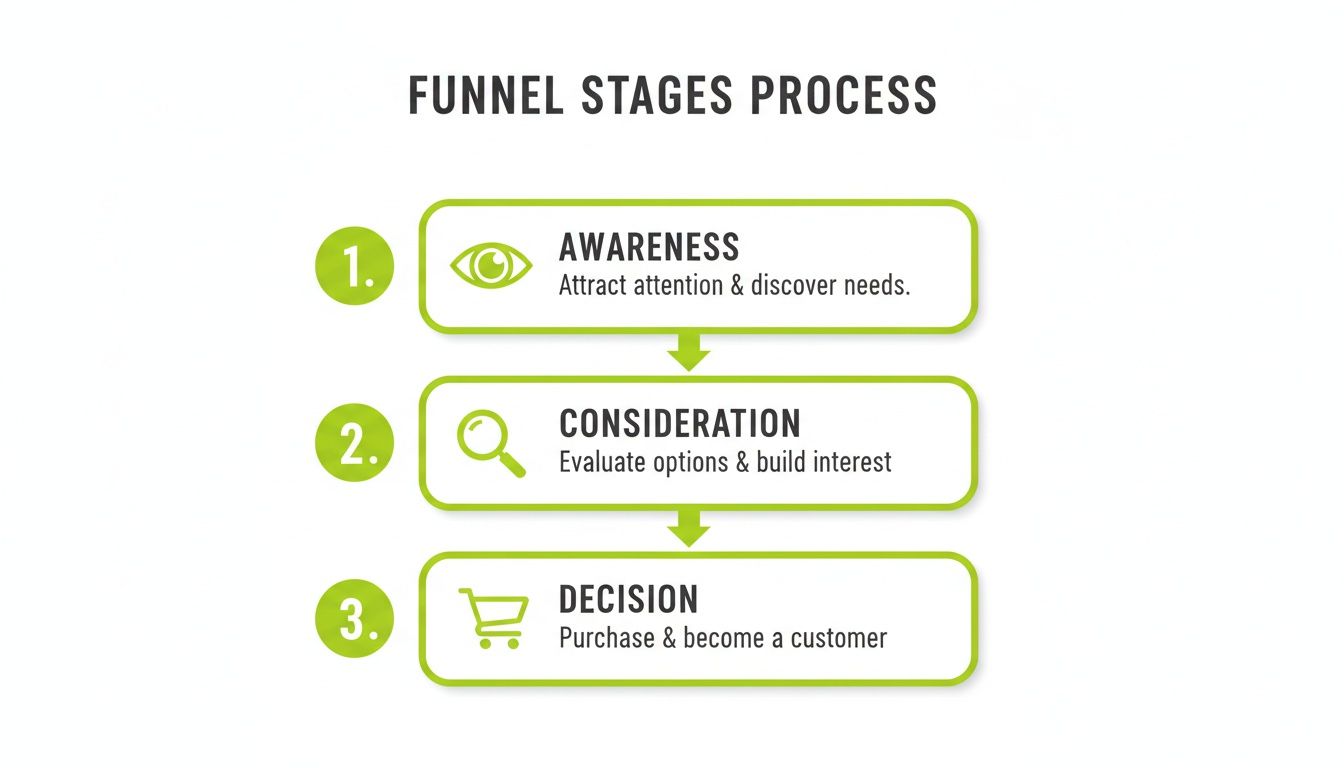
As you can see, each phase has a totally different goal. You start by grabbing attention and end by driving a specific, valuable action.
Awareness: The Top of the Funnel (TOFU)
This is your first impression. The goal here isn’t to sell—it’s to attract and educate. You’re casting a wide net to catch the attention of people who have a problem your business can solve, even if they don’t know it yet.
Practical Example: Imagine an e-commerce brand selling sustainable workout gear. Their TOFU game plan would look something like this:
- SEO-Optimized Blog Posts: Articles like "5 Eco-Friendly Fabrics Changing the Game for Athletes" pull in organic traffic from people already searching for related topics.
- Engaging Social Media: Short, dynamic videos on Instagram or TikTok showing the gear in action, with zero hard-sell tactics. Just cool content.
- Targeted Ads: Running broad awareness campaigns on platforms like Facebook to reach users interested in fitness, wellness, and environmentalism.
The key is to provide value with no strings attached. You’re positioning your brand as a helpful expert, not just another company trying to sell something.
Consideration: The Middle of the Funnel (MOFU)
Okay, you’ve got their attention. Now it’s time to build trust and show them why your solution is the right one. People at this stage are actively researching and comparing their options. Your job is to nurture that initial spark of interest and establish your brand as the clear authority.
Practical Example: For our sustainable activewear brand, MOFU tactics are all about deepening the relationship:
- Email Newsletters: They might offer a discount for signing up, then follow up with content that highlights product quality, ethical manufacturing, and real customer stories.
- In-Depth Guides: A downloadable guide like "How to Build a Sustainable Wardrobe" showcases the brand's philosophy and the real-world benefits of their products.
- Webinars or Live Q&As: Hosting an Instagram Live with the founder to talk about the brand’s mission and answer audience questions directly builds immense trust.
This is where you set yourself apart. You’re moving past general awareness and giving prospects solid, compelling reasons to choose you. For a deeper dive, check out our guide on how to build a marketing funnel that really nurtures leads.
Decision: The Bottom of the Funnel (BOFU)
This is it—the moment of truth. Your prospect is ready to buy. They’ve done their homework and are just about to make their final choice. Your only goal now is to remove every last bit of friction and doubt, making it ridiculously easy for them to convert.
Practical Example: Here’s how our e-commerce brand seals the deal:
- Compelling Testimonials: They plaster glowing reviews and user-generated photos all over their product pages. Social proof is everything.
- Limited-Time Offers: A "24-hour flash sale" or a "free gift with purchase" creates a sense of urgency that pushes people over the finish line.
- Frictionless Checkout: A simple, one-page checkout with multiple payment options and crystal-clear shipping info. No surprises, no hassle.
This final stage is especially tricky for local service businesses like a gym or a dental clinic. Industry data is brutal: local service businesses often see a staggering 70-80% abandonment rate on their lead forms. That means only a tiny fraction of interested visitors actually follow through.
This just hammers home how critical every single detail is. From hyper-local ads in the awareness stage to ensuring your landing pages load in a snap—because 53% of mobile users will bounce if a site takes more than three seconds to load. By understanding what truly drives action at this stage, you can turn high-intent visitors into paying customers.
How to Measure Your Funnel's Success
A conversion funnel without data is really just a series of hopeful guesses. If you want to stop hoping and start engineering real results, you absolutely have to track the right metrics. Think of these Key Performance Indicators (KPIs) as your funnel’s vital signs—they tell you exactly where it’s healthy and where it needs urgent attention.
The most fundamental metric is your Conversion Rate. It's a simple calculation: (Total Conversions / Total Visitors) x 100. This number tells you what percentage of people who entered your funnel actually completed the goal you set. For example, if 1,000 people hit your landing page and 50 sign up, you've got a 5% conversion rate. It’s the ultimate report card on your funnel’s overall efficiency.
But a killer conversion rate doesn't automatically mean you're profitable. For that, we need to look at the numbers that involve cost.
Tracking Your Most Important KPIs
To get the full story, you have to look beyond that final conversion number. Several interconnected metrics work together to diagnose your funnel's health from different angles, helping you understand both how efficient it is and, more importantly, how profitable it is.
Cost Per Acquisition (CPA): This one’s straightforward: take the total cost of your marketing campaign and divide it by the number of conversions. It tells you exactly how much you’re spending to land one new customer. For example, if you spend $500 on ads and get 10 new customers, your CPA is $50. A low CPA is a sign of efficient, well-targeted marketing.
Customer Lifetime Value (CLV): This metric is a game-changer. It predicts the total revenue you can reasonably expect from a single customer over the entire course of their relationship with you. When you compare CLV to CPA, you can finally see if you’re acquiring customers profitably for the long haul.
Return on Ad Spend (ROAS): This measures the gross revenue you generate for every single dollar you put into advertising. A 4X ROAS—meaning you earned $4 for every $1 spent—is a key benchmark that shows your ad campaigns are not just working, but thriving.
Understanding these metrics is the first step toward optimization. Without clear data on what it costs to acquire a customer and what that customer is worth, you're essentially flying blind.
Understanding Industry Benchmarks
Knowing your own numbers is great, but context is everything. How do your results actually stack up against everyone else in your industry?
Recent benchmarks show just how massive the performance gap can be. While the global average landing page conversion rate hovers around 2.35%, the top-performing funnels are hitting an incredible 11.45%. The difference almost always comes down to small, data-driven tweaks at critical stages—a core part of measuring marketing effectiveness.
This data also shines a light on common drop-off points. For instance, a staggering 60% of users abandon a funnel at the consideration stage simply because the pricing isn't clear. With U.S. e-commerce brands losing an estimated $18 billion every year to cart abandonment, plugging these leaks isn't just a small fix—it's a massive revenue opportunity. To see more of this data, you can read the full analysis from Unbounce.
Practical Funnel Examples You Can Learn From
Theory is great, but seeing a conversion funnel in action is where the concepts really click. To bring this framework to life, let's trace the customer journey through two distinct, practical examples: an e-commerce clothing store and a local med spa.
Each business is chasing a different audience with a unique goal, but the underlying funnel structure is exactly the same. The magic is in how they tailor their tactics for each stage.
These examples show how a digital journey guides someone from that first moment of discovery to a final, valuable action—whether it’s buying a product or booking a service.
The E-Commerce Clothing Store Funnel
Imagine a boutique online clothing store that specializes in sustainable fashion. Their whole world revolves around driving online sales. Here’s what their conversion funnel might look like, step by step.
Awareness Stage: A potential customer, let's call her Sarah, is scrolling through her Facebook feed. She stops on a visually striking video ad showcasing the brand's new summer collection. The ad isn't pushy or asking for a sale; it’s designed to capture attention and introduce the brand’s unique aesthetic. Just like that, Sarah is now aware the brand exists.
Consideration Stage: Intrigued, Sarah clicks the ad and lands on a product page for a linen dress. She browses photos, reads the detailed description highlighting its organic materials, and scans the customer reviews. A pop-up offers 15% off her first order if she signs up for their newsletter. She does.
Decision Stage: The discount code hits her inbox. That little nudge is all it takes. Sarah returns to the site, adds the dress to her cart, and heads to checkout. The process is seamless, with guest checkout options and multiple payment methods, making the purchase as frictionless as possible.
Retention Stage: A week after her purchase, she gets a follow-up email. It’s simple: a thank you for her order, a request for a review, and a personalized discount for her next purchase. This small action encourages her to come back and starts building real brand loyalty.
The Local Med Spa Funnel
Now, let's switch gears to a local service business—a med spa looking to book more appointments for facials. Their funnel is all about generating qualified leads and getting them on the calendar.
- Awareness Stage: Mark is searching for a gift for his partner and Googles "facials near me." The med spa's website pops up at the top of the search results, thanks to killer local SEO. He clicks the link, officially entering the top of their funnel.
For local businesses, the Awareness stage is often driven by high-intent searches. Showing up prominently in local search results is the digital equivalent of having the best location on main street.
Consideration Stage: Mark lands on a clean, professional landing page. It clearly outlines the benefits of their signature facial, showcases glowing testimonials, and features a big, friendly call-to-action: "Book a Free Consultation." This low-commitment offer is designed to move him forward without any pressure.
Decision Stage: He clicks the button and is taken to a dead-simple online scheduling tool. He can see all the available dates and times, pick a slot that works for him, and confirm his booking in less than a minute. He just converted from a website visitor into a scheduled appointment.
Retention Stage: Immediately after booking, Mark gets an email confirmation, followed by automated appointment reminders via SMS. After the treatment, the spa sends a follow-up email with skincare tips and an exclusive offer for a future service, nurturing the relationship and paving the way for repeat business.
Fixing Common Leaks in Your Conversion Funnel
Let’s be honest: no conversion funnel is perfect. Every single one has "leaks"—those frustrating spots where potential customers bail before taking the action you want. The most successful businesses aren’t the ones with magically flawless funnels; they're the ones who are masters at finding and plugging these leaks. Fast. This isn’t just about tweaking your site; it’s about turning lost opportunities directly into revenue.
Think of yourself as a detective. Your mission is to use analytics and user behavior tools to pinpoint exactly where people are exiting the journey, and then start asking the hard question: why?
Diagnosing and Patching High-Traffic Leaks
The earliest and often biggest leak happens right at the top. If your landing page has a high bounce rate, it’s a red flag that your first impression is falling flat, causing visitors to hit the back button almost instantly.
Common Problem Areas (with Practical Examples):
- Confusing Headline: An ad promises "50% Off Running Shoes," but the landing page headline says "Welcome to Dave's Sports." This mismatch creates confusion and mistrust.
- Slow Page Speed: You click a link to a recipe, but the page takes five seconds to load all the ads and pop-ups. You give up and hit the back button.
- Poor Mobile Experience: You try to fill out a form on your phone, but the text fields are tiny and the "submit" button is cut off. You abandon the process out of frustration.
Another classic drop-off point is the lead capture form. If you're asking for their life story or the form just looks sketchy, you can bet submission rates will nosedive. The fix? Keep it simple. Ask only for what you absolutely need and sprinkle in trust signals like customer testimonials or security badges to put people at ease. To get this right, you need to dig into solid Conversion Rate Optimization strategies.
Solving the Cart Abandonment Crisis
For any e-commerce business, cart abandonment is the ultimate bottom-of-funnel heartbreak. It’s like a customer walking to the register with a full cart and then just leaving it there. Research from the Baymard Institute shows a staggering global average cart abandonment rate of 69.8%. That means nearly seven out of ten shoppers are bailing at the last second, very often because of high shipping costs (55%) or other nasty surprise fees.
A high cart abandonment rate is a clear signal of friction in your checkout process. Every extra step, every unexpected cost, and every confusing field is another reason for a motivated buyer to leave.
To fight back, your entire focus should be on creating a checkout experience that is as smooth and painless as possible.
Proven Solutions (with Practical Examples):
- Offer Free or Flat-Rate Shipping: Amazon’s "Free shipping on orders over $35" is a classic example. It sets a clear expectation and incentivizes larger orders.
- Streamline the Checkout Process: Instead of a multi-page checkout, use a single page where customers can enter their shipping and payment info without clicking "next" multiple times. Offering a guest checkout option is a must—don’t force people to create an account.
- Provide Multiple Payment Options: Include popular choices like PayPal, Apple Pay, and Google Pay for a fast, one-click experience. This allows a customer to pay without having to find their wallet and type in their credit card number.
When you systematically find and fix these friction points, you can make a huge impact on your final conversion numbers. For a deeper dive into more advanced tactics, check out our guide on sales funnel optimization strategies.
Let's Build a Funnel That Actually Drives Revenue
Knowing what a conversion funnel is gives you the blueprint, but building and tuning one is where real, predictable growth actually happens. Think of a well-built funnel as the engine of your entire marketing strategy—a system designed to turn prospects into profitable, long-term customers, again and again.
This is exactly what we do at Silver Spoon Agency.
We don’t just build funnels; we engineer high-performance revenue systems that deliver results you can see on your P&L. Our approach isn't about guesswork or chasing the latest trends. It's a data-first process, informed by an omnichannel strategy that meets your ideal customers exactly where they are.
Our Process is Proven to Deliver Results
The proof is in the numbers. We consistently deliver remarkable outcomes for our clients because we focus on the entire customer journey, not just isolated tactics.
- Serious Conversion Lifts: We’ve boosted conversion rates by up to 150% by finding and fixing the critical leaks that were costing our clients money every single day.
- Impressive ROAS: We drive an average of 4X Return on Ad Spend (ROAS), making sure every dollar you invest in marketing works smarter and harder for your business.
At Silver Spoon Agency, our goal is to turn your marketing from a frustrating expense into a predictable revenue machine. We handle the complex work of building and optimizing the system that fuels your growth.
This lets you get back to what you do best: running your business. Forget the complexities of funnel design, audience targeting, and endless optimization. We take that off your plate, creating a seamless customer journey that directly impacts your bottom line.
If you’re ready to stop guessing and start building a marketing system that delivers consistent, measurable revenue, it’s time for us to talk. Let’s build the engine that will drive your business forward.
Got Questions? We've Got Answers.
Even with the clearest roadmap, putting a conversion funnel into practice for your own business always brings up a few questions. It’s completely normal. Here are the answers to the questions we hear most often, designed to give you that extra bit of clarity you need to move forward.
How Long Does It Take to Build a Conversion Funnel?
The honest answer? It depends. A straightforward lead generation funnel—think a simple landing page, a contact form, and a basic email follow-up sequence—can often be up and running in about a week.
But if you’re talking about a more complex e-commerce funnel with multiple ad campaigns, layered retargeting ads, and detailed analytics tracking, you’re likely looking at 3-4 weeks to build, test, and launch it correctly. The key thing to remember is that the initial build is just the starting line. The real magic happens in the ongoing testing and tweaking based on what the data tells you.
The goal isn't just to build a funnel fast; it's to build a funnel that actually works. Taking the time to set it up and test it properly is what separates a leaky bucket from a cash-generating machine.
What Is the Difference Between a Sales Funnel and a Conversion Funnel?
People throw these terms around interchangeably all the time, but there’s a small, important difference. A conversion funnel is a broad term for any customer journey designed to get a user to take a specific action.
That action could be anything:
- Signing up for your newsletter (a lead generation funnel)
- Downloading a free guide (a content marketing funnel)
- Booking a consultation (a service-based funnel)
- Filling out a "get a quote" form (a B2B funnel)
A sales funnel is just one specific type of conversion funnel where the final goal—the big conversion at the end—is always a purchase. So, think of it this way: all sales funnels are conversion funnels, but not all conversion funnels are sales funnels.
Can I Build a Conversion Funnel on a Small Budget?
Absolutely. An effective funnel is built on smart strategy, not just a mountain of cash. You can get started by focusing on organic traffic sources like SEO and content marketing to fill the top of your funnel without spending a dime on ads.
For a practical example, you could write a series of blog posts optimized for search terms your ideal customers use. In those posts, offer a free, downloadable checklist in exchange for an email address. This creates a simple, low-cost funnel that generates leads you can nurture over time.
When it comes to the middle and bottom stages, there are plenty of low-cost tools for building landing pages and setting up email automation. While paid advertising can definitely speed things up and give you data faster, a well-designed funnel built on a foundation of organic traffic can be incredibly powerful—and it’s something you can scale up as your business grows.
Ready to stop guessing and start building a high-performance system that drives predictable growth? The team at Silver Spoon Agency specializes in creating and optimizing conversion funnels that deliver measurable revenue. Let's build the engine that will drive your business forward.