


Guide to what is cross channel marketing: Boost Engagement Across Touchpoints

Cross channel marketing is all about connecting your various marketing platforms—like email, social media, and mobile ads—so they work together to create one seamless customer conversation.
What Exactly Is Cross Channel Marketing?

Think of it like having a conversation that flows naturally from one room to the next without ever dropping the thread. That’s the heart of cross-channel marketing. It's a strategy where each of your channels—social, email, SMS, your website—are all talking to each other, sharing data and context.
Instead of shouting separate, disconnected messages from different platforms, you're weaving a single, coherent story for your customer. The experience they have on Instagram should inform the email they get next, which in turn might influence the ad they see on their phone later. You're moving from separate monologues to a truly connected dialogue.
The Power of a Connected Journey
Many businesses have a multi-channel strategy, which simply means they're present on different platforms. They have a Facebook page, send out an email newsletter, and maybe run some SMS campaigns. The problem is, these channels often operate in their own little silos, completely unaware of what the others are doing. A customer might see a promo on Facebook, only to get a totally unrelated email a few minutes later. It feels disjointed.
Cross-channel marketing is the fix for that disconnect. It’s about orchestrating the handoffs between platforms so the customer glides through their journey.
- Practical Example: A customer, Mark, browses for hiking boots on an e-commerce website. He adds a pair to his cart but gets distracted and leaves. A smart cross-channel workflow is triggered. An hour later, an email arrives with the subject "Still trekking?" showing the exact boots he abandoned. He opens the email but doesn't buy. The next day, as he scrolls through Instagram, an ad appears featuring those same boots, along with a "10% Off Your First Order" offer. This sequence is intelligent and works as a team to guide Mark toward a single goal.
Key Takeaway: The whole point of cross channel marketing is to make the customer journey so logical and intuitive that the user doesn't even notice the transitions between platforms. It just feels seamless, personal, and relevant.
To really get a handle on how this works at scale, it's worth exploring the latest advancements in Cross Channel AI Marketing. This is where technology steps in to automate and refine these complex customer conversations.
Core Principles of Cross Channel Marketing at a Glance
To make this concept crystal clear, the table below breaks down the fundamental elements that define a true cross-channel marketing strategy. These aren't just buzzwords; they are the pillars that support a seamless customer experience.
| Principle | Description | Practical Example |
|---|---|---|
| Data Integration | Channels share data to inform actions across the board. | A user's click on a Facebook ad for "running shoes" triggers a personalized email featuring your top-rated running shoe models. |
| Cohesive Messaging | The brand story and offers remain consistent across all touchpoints. | The "20% Off Spring Sale" is promoted with the same visuals and messaging on social media, email, and your website banner. |
| Customer-Centric Flow | The journey is designed from the customer's perspective, not the channel's. | After a customer attends your webinar, they receive a follow-up email with the recording, not a generic sales pitch. |
Ultimately, mastering these principles is what separates a disjointed marketing effort from one that feels like a helpful, continuous conversation with your customer.
Cross Channel vs Omnichannel Marketing
It’s easy to get cross-channel and omnichannel marketing mixed up. After all, they both use multiple platforms to create a better experience for the customer. But the strategic difference between them is massive, and it affects everything from your campaign goals to the technology you need to pull it off.
Getting this distinction right is crucial for picking the approach that actually fits your business.
Think of cross-channel marketing as a planned, guided tour. Your brand is the tour guide, carefully designing a specific route (a campaign) with connected stops (your channels) to lead a customer to a single destination. That destination might be making a purchase or signing up for a webinar. The channels work together, in a specific sequence, to hit a clear business goal.
On the other hand, omnichannel marketing is like an open-world theme park. The customer is in total control of their journey. They can start at any ride (channel), move to another in any order they please, and the experience is perfectly consistent and connected everywhere they go. The goal isn’t to steer them down one specific path but to make sure the entire park—your whole brand ecosystem—feels like one seamless world.
A Focus on Strategy vs Experience
The core difference really comes down to perspective. Cross-channel is brand-centric; it’s all about running a campaign across channels to meet a business objective. The brand is the one orchestrating the entire journey. For example, a travel company might run a cross-channel campaign starting with a social media ad for a "Hawaiian Vacation Package." When a user clicks, they land on a page and sign up for more info. This action triggers a follow-up email with a detailed itinerary and a special offer.
Omnichannel, however, is completely customer-centric. It puts the customer at the absolute center of the strategy. It ensures that no matter how they choose to interact—in your store, on your mobile app, or through a call center—their experience is continuous and personalized. For instance, a customer could browse for a product on their mobile app, go to the physical store to see it, and then receive a push notification on their phone with a coupon for that exact item while they are still in the store. To go a bit deeper, you can learn more about the omnichannel customer experience and see how it truly shapes how users perceive a brand.
A cross-channel strategy might connect a customer's online cart to their email. An omnichannel strategy connects their online cart to their email, their mobile app, the in-store kiosk, and even the sales associate's tablet on the floor.
Understanding the Practical Differences
The level of integration and the underlying business goals for each approach are worlds apart. Cross-channel is about getting a few key channels to play nicely together for a specific campaign. Omnichannel is a holistic business philosophy that integrates every single customer touchpoint.
To make the strategic differences crystal clear, let's break it down.
Cross Channel vs Omnichannel: A Strategic Comparison
This table highlights the core distinctions to help you decide which path makes the most sense for your business right now.
| Aspect | Cross Channel Marketing | Omnichannel Marketing |
|---|---|---|
| Primary Focus | The Campaign: Channels are linked to guide a customer through a specific marketing flow. | The Customer: All channels are integrated to create a single, persistent customer profile and experience. |
| Integration | Channel-to-Channel: Select channels share data for a specific campaign (e.g., website behavior triggers an email). | Total Ecosystem: All channels (online and offline) are unified and update a central customer profile in real time. |
| Business Goal | To optimize a specific marketing campaign and guide customers toward a conversion. | To create a completely seamless and consistent brand experience that increases customer lifetime value. |
| Complexity | Moderate: Requires connecting a few marketing platforms and automating a workflow. | High: Requires deep integration of marketing, sales, support, and inventory systems across the entire business. |
Ultimately, choosing between them boils down to your resources and objectives. Cross-channel is a fantastic, achievable starting point for creating more connected and effective campaigns. Omnichannel is the ultimate goal, a true north for businesses aiming to build a completely unified, customer-first world.
Why a Connected Strategy Drives Real Business Growth

Let's be blunt: a well-built cross-channel strategy does a lot more than just make your marketing platforms talk to each other. It directly feeds your bottom line. When your channels work in concert, they stop being a collection of random touchpoints. They become a single, fluid journey that puts the right message in front of the right person at exactly the right time.
This synergy is what turns your marketing spend from a hopeful expense into a predictable engine for growth.
Think about it. By connecting the dots between a customer's scroll on social media, the email they just opened, and what they’re doing on your website right now, you create a seamless experience. This consistency isn't just a nice-to-have for the customer—it actively pulls them forward, making it easier for them to convert.
Boosting Customer Retention and Lifetime Value
One of the biggest wins from a connected strategy is its impact on customer loyalty. When customers feel like you get them, no matter where they interact with you, their relationship with your brand goes from transactional to personal. This isn't just a hunch; the data is screaming it from the rooftops.
The numbers are staggering. Companies with strong cross-channel strategies see an average 89% customer retention rate. Compare that to the paltry 33% retention for businesses with weak, disconnected efforts.
On top of that, customers who engage with a brand across multiple channels also spend about 30% more on average. This directly boosts their lifetime value (LTV) and shows the clear financial upside of getting your channels in sync.
Achieving Smarter Personalization and Higher ROAS
When your marketing operates in silos, you’re flying blind. Your email team knows one part of the story, your social media manager knows another, and your web team has a completely different piece of the puzzle. The result? Generic, one-size-fits-none messaging and a lot of wasted ad spend.
A cross-channel strategy demolishes those silos by creating one unified stream of data. All of a sudden, you have a rich, 360-degree view of your customer’s behavior, their preferences, and what they're likely to do next.
The Big Picture: Imagine knowing a customer just browsed hiking boots on your website. Instantly, you can tailor the ad they see on Instagram and tweak the subject line of their next email. That kind of real-time relevance is impossible when your channels aren't talking.
This unified data is the secret sauce for personalization that actually works. You can segment audiences with surgical precision and deliver messages that feel like they were written just for them. Unsurprisingly, this leads to a much higher Return on Ad Spend (ROAS) because you stop guessing and start responding to actual, demonstrated behavior. Digging into the benefits of marketing automation makes it even clearer how a connected strategy fuels this kind of growth.
Tangible Business Benefits at a Glance
Putting a real cross-channel plan into action translates into measurable wins across your business. You're turning a bunch of fragmented actions into a coordinated machine that delivers predictable results.
Here are the main advantages you can expect:
- Enhanced Customer Engagement: By showing up with relevant content on the right channels, you keep customers tuned in and interacting with your brand.
- Improved Conversion Rates: A smooth, consistent journey removes the friction that causes people to drop off, guiding them more effectively toward a purchase.
- Increased Customer Lifetime Value (LTV): Better retention and experiences that feel personal encourage customers to stick around and spend more over time.
- Superior Data and Insights: A complete view of the customer journey reveals powerful patterns that lead to smarter, more effective marketing decisions.
- Maximized Marketing ROI: When you target smarter and waste less, every dollar you put into your marketing works harder and brings back a better return.
Real World Cross Channel Marketing Examples
Theory is great, but seeing a concept in action is where it really clicks. A masterful cross-channel strategy isn't about blasting your message on every platform you can find. It’s about using the right channels, in the right order, to create a customer journey that feels logical, personal, and compelling.
Let's step away from the abstract and look at how this plays out in the real world. These examples show how different businesses use connected channels to guide people from a flicker of interest to a final conversion, with each channel intelligently handing off the conversation to the next.
E-commerce: Turning a Scroller into a Buyer
Picture Sarah, a potential customer, casually scrolling through her Instagram feed. She’s not actively shopping, but a slick video ad from an online clothing boutique catches her eye—it's showcasing a new spring dress. This is touchpoint number one.
Social Media Ad (Discovery): Sarah taps the ad. Smartly, the link doesn't dump her on the homepage; it takes her straight to the product page for that exact dress. The experience is seamless. She loves it, adds it to her cart, but then a text from a friend pulls her away and she closes the browser.
Abandoned Cart Email (Re-engagement): About an hour later, an automated email lands in her inbox. The subject line is friendly and low-pressure: "Did you forget something?" Inside is a picture of the very dress she left behind. This isn’t a generic blast; it’s a personalized nudge that rekindles her initial excitement.
SMS Offer (Conversion): Sarah saw the email but still hasn't pulled the trigger. The system waits a full 24 hours. Because she showed strong intent—adding to the cart and opening the reminder email—it's time for a more direct approach. She gets an SMS: "Hi Sarah! That dress you liked is almost sold out. Here’s a 15% off code to complete your order today: SPRING15."
This powerful sequence—visual discovery on social media, a personal email reminder, and a timely SMS offer with a clear incentive—works in perfect harmony. Each step builds on the last, guiding Sarah from passive browsing to an enthusiastic purchase.
Local Gym: Attracting and Securing New Members
Now, let's think about a local fitness studio, "Urban Fit," trying to sign up new members from the neighborhood. Their specific goal is getting nearby residents to book a free trial class.
Geofenced Mobile Ad (Awareness): Urban Fit creates a digital "fence" around a two-mile radius of their location. When people inside this zone use ad-supported apps, they see a simple, punchy display ad: "Live near downtown? Get your first week at Urban Fit FREE." This hyperlocal targeting ensures every ad dollar is spent on the most relevant audience.
Landing Page (Lead Capture): A user taps the ad and is taken to a dedicated landing page. There are no distractions here—just a clean design and one clear call-to-action: "Claim Your Free Trial Pass." To get it, they pop in their name and email. Just like that, an anonymous ad viewer becomes a qualified lead.
Email Nurture Sequence (Relationship Building): The moment they hit submit, a three-part automated email sequence kicks off.
- Email 1 (Instant Delivery): Delivers the free trial pass right away and prompts them to book their first class.
- Email 2 (Two Days Later): Shares member testimonials and highlights the gym's most popular classes, building social proof.
- Email 3 (Five Days Later): A "last chance" reminder that their free pass is about to expire, creating a gentle sense of urgency.
This flow masterfully uses mobile ads for local awareness, a focused landing page to capture intent, and an email series to build a relationship and drive the final action—getting them through the door.
The Takeaway: The magic in these examples isn't the technology; it's the responsiveness. Each step is a direct reaction to what the customer did (or didn't do) before. It’s an intelligent conversation, not just a series of disconnected announcements.
B2B Software: Generating and Converting High-Value Leads
Finally, let’s look at a B2B software company selling project management tools. Their sales cycle is much longer, so the strategy here is all about education and building trust over time. While B2B is a different beast, seeing how others approach their funnel can spark fresh ideas for your own multi-channel marketing strategies.
LinkedIn Article (Lead Generation): The company publishes a deep-dive thought leadership article on LinkedIn titled, "5 Project Management Bottlenecks Costing Your Company Money." They promote it to a finely tuned audience of project managers and operations directors. At the bottom of the article, there’s a call-to-action to download a free, in-depth guide on the topic in exchange for an email address.
Personalized Email (Nurturing): Once a prospect downloads the guide, they enter an email workflow. A day later, a personalized email arrives from a sales rep. It’s not a hard pitch. Instead, it references the guide they just read and asks if they're personally experiencing any of the bottlenecks mentioned. It ends with a soft offer for a no-pressure "15-minute strategy call" to talk through solutions.
Retargeting Ads (Building Authority): For leads who downloaded the guide but haven't replied to the email, a new set of ads starts appearing in their LinkedIn feed. These aren't salesy ads pushing a demo. Instead, they feature compelling video testimonials and short case studies from similar companies that solved their PM problems using the software.
This B2B journey uses high-value content to attract the right people, personalized email to start a relevant conversation, and targeted social proof to build credibility and stay top-of-mind until the prospect is ready to talk.
How to Build Your First Cross Channel Campaign
Alright, let's move from theory to action. This is where the fun begins. Building your first cross-channel campaign might feel like a huge undertaking, but it’s really just a logical, step-by-step process. If you break it down into manageable chunks, you can orchestrate a powerful journey that guides customers smoothly toward a specific goal.
The big mindset shift here is to stop thinking about individual channels. Instead, think about the customer’s complete experience. Every touchpoint should feel like a natural continuation of the last, creating one seamless conversation.
Define Your Goal and Select KPIs
First things first: you absolutely must know what success looks like. What is the one, primary action you want a customer to take? Without a clear destination, your campaign will drift aimlessly, and you'll have no way to measure its impact.
Your goal needs to be specific and measurable. For example, instead of a vague goal like "increase sales," get granular. Aim for something like "500 sign-ups for our upcoming webinar" or "drive $10,000 in revenue from a specific product line."
Once your goal is locked in, pick the Key Performance Indicators (KPIs) that will track your progress. These should tie directly back to your main objective.
- For a sales goal: Keep your eyes on Conversion Rate, Average Order Value (AOV), and Return on Ad Spend (ROAS).
- For a lead generation goal: Focus on Cost Per Lead (CPL), Landing Page Conversion Rate, and your Lead-to-Customer Rate.
- For an engagement goal: You'll want to monitor metrics like Click-Through Rate (CTR), Time on Page, and Email Open Rate.
Map the Customer Journey and Identify Touchpoints
Now it's time to put yourself in your customer's shoes. How do they realistically get from discovering your brand to completing the action you want them to take? Mapping this journey is how you'll spot the critical touchpoints where you can influence their decisions.
This e-commerce journey visualizes a simple but incredibly effective flow. It kicks off with discovery on social media, moves to email for re-engagement, and seals the deal with a time-sensitive SMS offer.
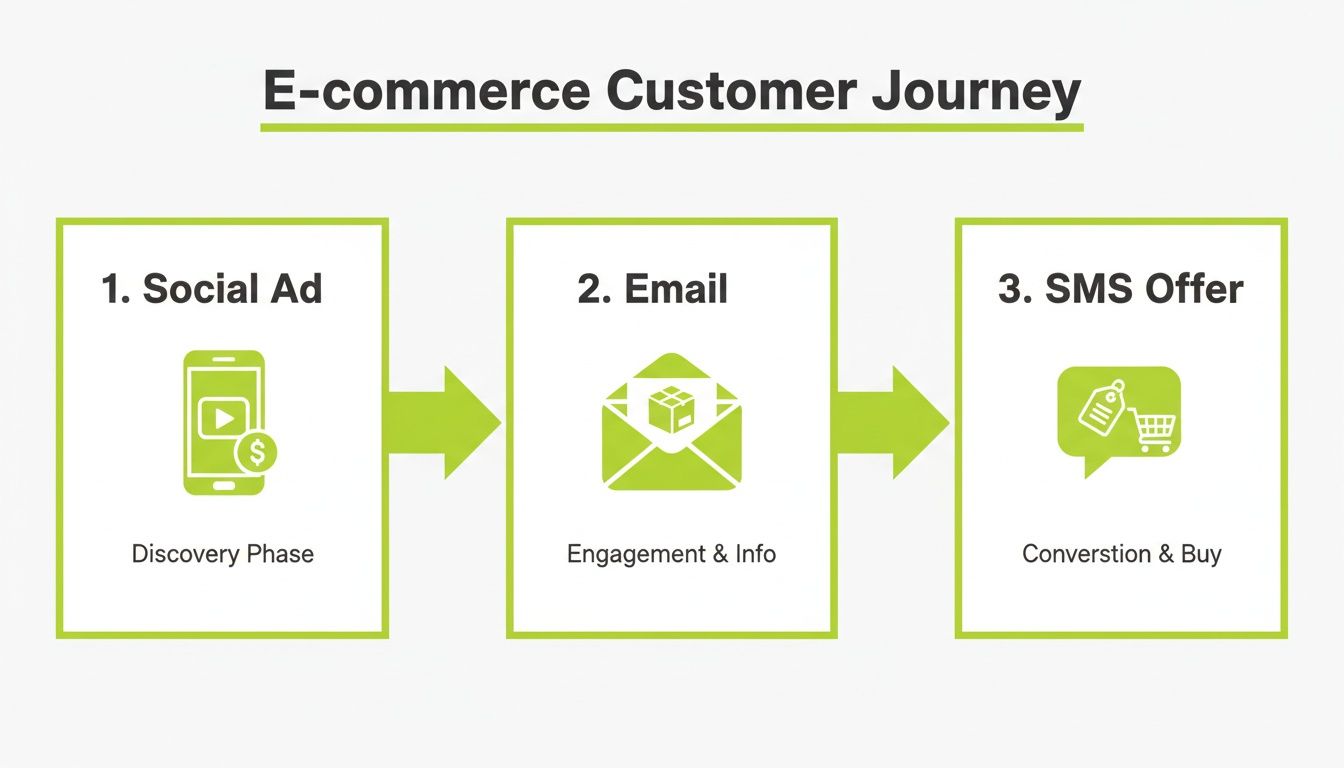
See how each channel builds on the last? It creates a connected path that guides the user right toward a purchase.
Don't overcomplicate this stage. Start with a simple, logical sequence. A common path for an e-commerce brand might look something like this: Social Media Ad -> Product Page Visit -> Abandoned Cart -> Email Reminder -> Purchase Confirmation.
Key Insight: The magic of cross-channel marketing isn't just being on multiple platforms. It's in orchestrating the handoffs between them. Your journey map is the blueprint for making those handoffs absolutely seamless.
Select Channels and Create Cohesive Messaging
With your journey mapped out, it's time to choose the channels that best fit each stage. Pick platforms where your audience actually hangs out and that connect logically. A common rookie mistake is trying to be everywhere at once. Focus on a few channels that work well together.
Your messaging needs to be consistent, but you also have to adapt it for each channel. The core offer—like "20% Off Your First Order"—should be the same everywhere, but the delivery has to change.
- Instagram Ad: Visually stunning, with very little text.
- Email: More detailed, personalized, and focused on the benefits.
- SMS: Short, urgent, and with a crystal-clear call-to-action.
The connection between these platforms is what drives jaw-dropping results. Businesses that commit to cross-channel strategies see 166% higher engagement rates compared to single-channel efforts. What's more, these integrated approaches deliver 24% higher conversion rates and 23% greater revenue growth. With 90% of consumers expecting consistent interactions by 2025, a connected strategy is no longer a nice-to-have. You can discover how to win with cross-channel marketing and explore more of these trends.
Integrate Tech and Prepare for Launch
Finally, you need to make sure the tech is in place to make it all happen. You'll need a system—often a CRM or a marketing automation platform—that can track user behavior on one channel and then trigger actions on another. This is the technical backbone of your entire campaign.
Before you go live, test everything. Click every link, check every automation, and follow every workflow. Make sure the data is passing correctly between your platforms. Once you're confident it's all working as it should, it's time to launch. But remember, the work doesn't stop there. Launch is just the beginning of a continuous cycle of measuring, learning, and optimizing based on real performance data.
The Essential Tech Stack for Cross Channel Success
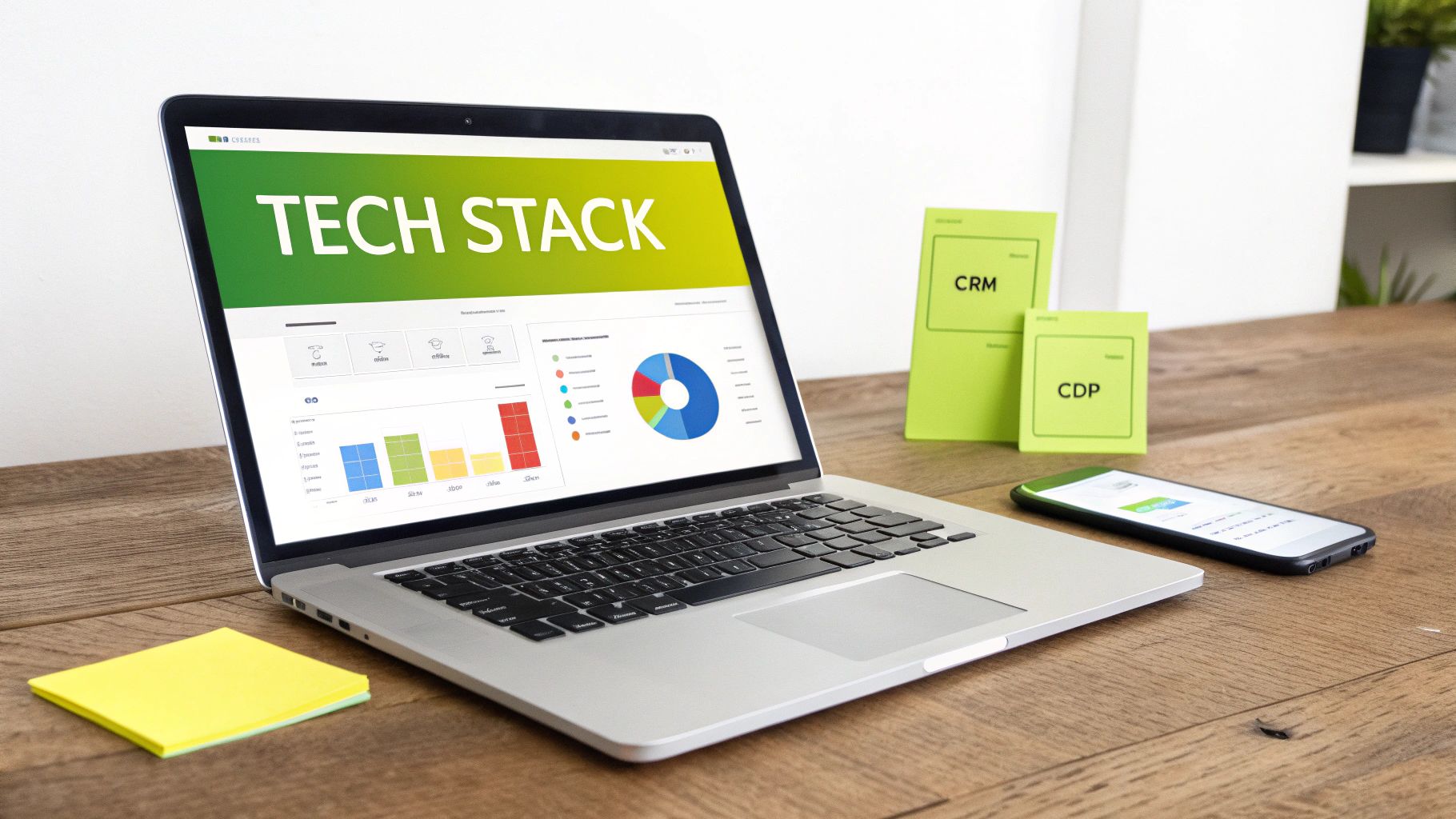
Let’s be honest, a powerful cross-channel strategy doesn't run on good intentions. Trying to orchestrate a seamless, responsive customer journey by hand is a recipe for disaster. This is where a smart, integrated technology stack comes into play. These tools are the engine that connects your channels, shares data in real time, and automates the workflows that make the magic happen.
Think of your tech stack as the central nervous system of your entire marketing operation. Each piece of software has a specific job, but they all need to talk to each other to create a coordinated, intelligent response. Without this technological backbone, your channels will inevitably drift back into their silos, and that perfect customer experience you designed will crumble.
The Core Components of Your Marketing Stack
Building a solid stack isn't about collecting dozens of tools; it's about choosing the right ones that handle core functions while playing nicely together. You're looking for platforms that master data management, automation, and analysis.
Here are the absolute essentials you'll need to power your cross-channel efforts:
- Customer Relationship Management (CRM): This is your central command for all customer data. A CRM is the home for contact information, interaction history, and purchase records, giving you a foundational view of every relationship.
- Marketing Automation Platform: This is the workhorse of your strategy. Automation software lets you build the "if this happens, then do that" logic that triggers actions across channels—like sending an abandoned cart email or a follow-up SMS.
- Analytics and Reporting Tools: These platforms are your eyes and ears, tracking user behavior across every channel and measuring how your campaigns are performing. They are critical for seeing what’s working, proving ROI, and finding new opportunities to improve.
The Rise of Customer Data Platforms (CDPs)
For businesses that are serious about creating a truly unified customer view, a Customer Data Platform (CDP) is quickly becoming a non-negotiable tool. A CDP’s main job is to pull in data from all your sources—your website, app, CRM, even in-store systems—and stitch it together into a single, persistent profile for each customer. You can explore more about how Customer Data Platforms work and why they're so crucial for modern marketing.
A CRM tells you who your customer is. A CDP tells you everything they’ve ever done and what they might do next, across every single channel. It’s the key to unlocking truly advanced personalization.
The Game-Changing Role of Artificial Intelligence
Artificial Intelligence (AI) isn't just a buzzword anymore; it's a practical, powerful layer that sits on top of your entire tech stack. AI can sift through massive amounts of data flowing through your channels to find patterns and make predictions a human could never spot.
This is where your strategy shifts from being reactive to proactive. AI helps you:
- Personalize Messaging in Real Time: AI can instantly adjust content and offers based on what a user is doing right now.
- Predict Customer Behavior: Machine learning models can flag customers who are likely to churn or make a purchase, letting you step in with the perfect message.
- Optimize Ad Spend Automatically: AI algorithms can shift your budget to the best-performing channels and audiences on the fly, making sure you get the most bang for your buck.
The market for these tools is exploding, which proves just how critical this integrated approach has become. For B2C marketers, channels like email (82.4%), social media (66.7%), and the mobile web (58%) are now table stakes, with most businesses using at least five different platforms to run effective campaigns.
Frequently Asked Questions
Jumping into the world of connected campaigns can feel a little daunting. Let's clear up a few common questions that pop up for businesses just getting started, so you can build a cross channel strategy that works.
How Can a Small Business Start on a Budget?
You don't need a huge budget to get going. The trick is to start small and be smart about it, focusing on the marketing channels you already own and understand well.
- Start with Two Channels: The most powerful and cost-effective pair is often your email and your website. You can use what people do on your site—like which pages they visit or if they abandon a cart—to trigger personalized, automated emails that bring them back.
- Layer in Social Retargeting: Once that's running smoothly, add some low-cost social media retargeting into the mix. This lets you show specific ads to people who have already visited certain pages on your site or even opened a particular email from you.
This approach creates a really simple but effective loop, and you don't need a bunch of expensive new software to pull it off.
What’s the Best Way to Measure ROI?
Measuring the ROI of a cross channel campaign means you have to look beyond the metrics of a single channel. Relying on "last-click attribution," where all the credit goes to the very last touchpoint, will give you a completely skewed picture.
Instead, you need to zero in on customer journey analytics. Track how your customers actually move between your different channels before they make a purchase. Use a model like multi-touch attribution, which gives a piece of the credit to every channel that played a part in the sale. This paints a far more accurate picture of how your channels are working together to make you money.
The goal is to see which combinations of channels are most profitable, not just which channel got the final click.
What Is the Most Common Mistake to Avoid?
The single biggest mistake we see is failing to unify customer data. So many businesses run campaigns across multiple channels but keep all the data locked away in separate silos. When your email platform has no idea what’s happening on your website, you can't create a truly connected customer experience.
This siloed approach leads to inconsistent messaging and a ton of missed opportunities. Before you launch anything, make sure you have a central hub—like a CRM—where the data from all your key channels can flow together and tell the full story.
Ready to build a cross-channel strategy that drives real growth? At Silver Spoon Agency, we turn disconnected marketing into revenue-producing campaigns powered by AI. We orchestrate seamless customer journeys across every touchpoint to deliver superior ROAS and predictable results. Learn how our performance-driven approach can elevate your brand today.