


What Is Dynamic Creative Optimization and How Does It Work

Imagine showing every single customer an ad built just for them, at the exact moment they see it. That's the core promise of Dynamic Creative Optimization (DCO), a technology that automatically assembles personalized ads for each viewer in real time. It’s a massive leap beyond generic, one-size-fits-all messages, creating experiences that feel genuinely unique and relevant.
The End of One-Size-Fits-All Advertising
Think of a traditional static ad like a billboard on the highway. It has one message, one image, and one call to action for everyone who drives by. It might catch the eye of a few people, but for the vast majority, it's just noise. This old-school approach is not just inefficient; it leads straight to ad fatigue, where people simply tune out repetitive, impersonal brand messages.
Now, let's contrast that with DCO. Dynamic creative optimization is more like having a personal shopper for every customer online. This "shopper" knows their style, their budget, and the exact pair of shoes they just looked at. Instead of a generic billboard, it presents a perfectly curated offer that lines up with that person’s immediate interests.
What is Dynamic Creative Optimization Really?
At its heart, DCO is an ad technology that uses a few smart components to build and deliver the most relevant ad creative to each user. It's an intelligent, automated system that replaces the slow, manual work of creating dozens of ad variations.
The whole process boils down to three key parts:
- Data Feeds: This is your library of creative "ingredients"—product names, images, prices, promotions, and anything else you might want to show. For a travel company, this could be a list of destinations, flight prices, and hotel images. For a retailer, it’s a product catalog.
- Creative Templates: Think of these as flexible ad layouts with designated slots for your ingredients, like a recipe that can be adapted on the fly. You design a single ad shell, and the system populates it with different headlines, images, and buttons.
- An AI 'Brain': This is the decisioning engine that analyzes user data (like browsing history, location, or time of day) to pick the perfect combination of ingredients and build the final ad instantly.
DCO fundamentally shifts advertising from a broadcast model (one-to-many) to a conversational one (one-to-one). It’s all about showing the right person the right product, with the right message, at the exact right moment.
A quick comparison really highlights the fundamental differences between the old way of doing things and the DCO approach.
Static Ads vs. Dynamic Creative Optimization
| Feature | Static Ads | Dynamic Creative Optimization (DCO) |
|---|---|---|
| Creative Process | Manual, one-off design | Automated, real-time assembly |
| Personalization | One message for everyone | 1:1 personalization for each user |
| Scalability | Limited by manual effort | Nearly infinite variations |
| Testing & Learning | Slow, requires new campaigns | Continuous, real-time optimization |
| Relevance | Broad and generic | Highly specific and contextual |
| Performance | Lower engagement, higher fatigue | Higher CTR, better conversion rates |
As you can see, DCO isn't just a small step forward; it's a completely different way of thinking about advertising creative.
For example, an e-commerce brand can use DCO to show someone an ad featuring the exact blue running shoes they viewed yesterday, complete with a "10% off" banner. A restaurant chain could automatically promote a rainy-day soup special to users in cities where it's currently pouring.
This level of personalization isn't just a nice-to-have anymore; customers expect it. The overwhelming demand for relevant ad experiences is a major growth driver, with studies showing that personalized ads generate a 34% increase in click-through rates compared to their static counterparts. You can explore more insights about DCO performance on GurkhaTech.com.
By embracing this technology, marketers are finally moving away from guesswork and toward a data-driven system that builds real connections and drives tangible business results.
How the DCO Personalization Engine Really Works
To get what DCO is all about, you have to look under the hood. It’s a powerful combination of three core parts working together, each one critical for turning raw data into an ad that feels like it was made just for you. Think of it like a high-tech kitchen that whips up a custom meal for every single guest, all in real time.
This flow shows how these pieces come together, taking a generic static ad and morphing it into a dynamic, personal one with the help of data and AI.
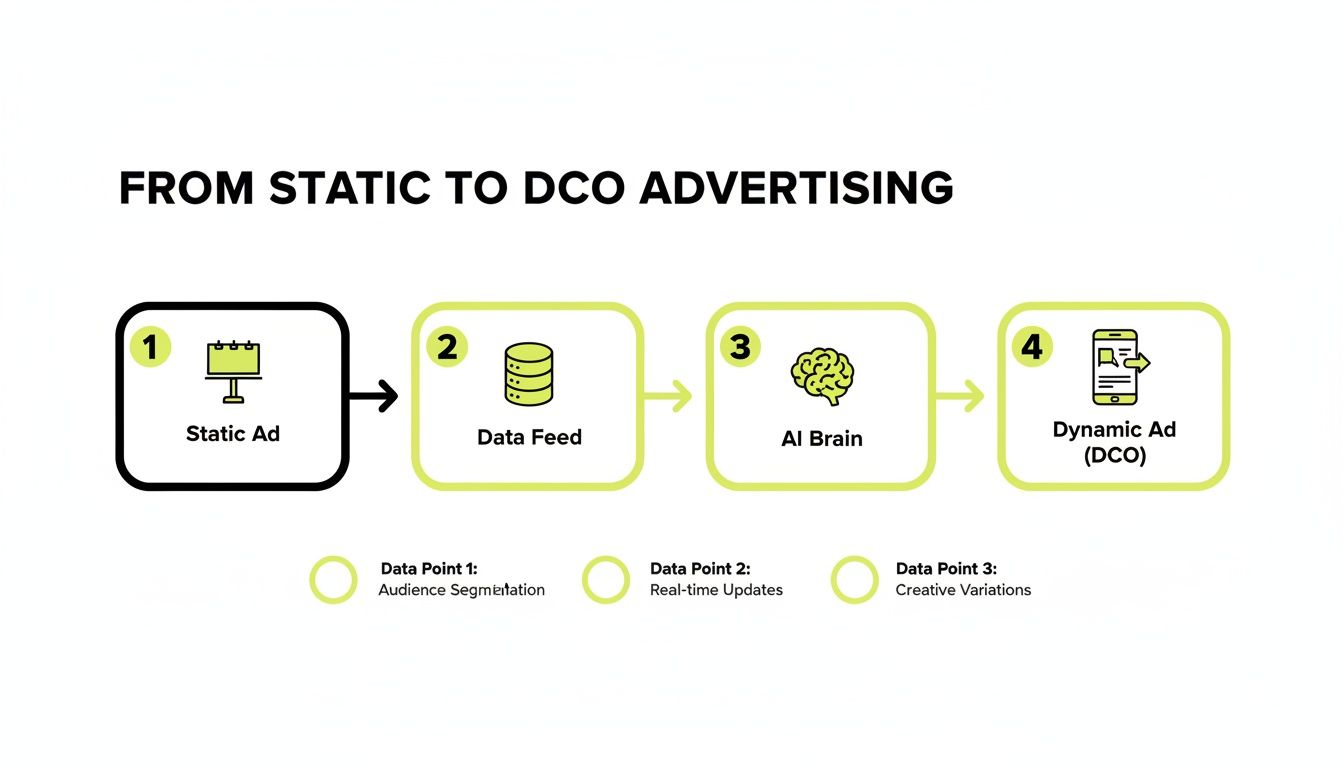
This process is the jump from a one-size-fits-all broadcast to a one-to-one, data-driven conversation with every single customer.
The Key Ingredients: Data Feeds and Creative Templates
First things first, every DCO campaign needs its ingredients. That’s where the data feed comes in. It’s basically a neatly organized library of all the creative pieces you might want to show someone. This isn't just a simple list; it's a detailed catalog holding everything you need:
- Product Information: Names, SKUs, descriptions, and up-to-the-minute prices.
- Visual Assets: High-quality images or video clips for every item.
- Promotional Details: Specific discounts, sale info, or special offers.
- Contextual Data: Things like store locations, opening hours, or event dates.
Next up is the creative template. If the data feed is your pantry full of ingredients, the template is your master recipe. It’s a flexible ad framework built with designated slots for each dynamic element—the image, the headline, the price, and the call-to-action button. The design is smart, ensuring that no matter which components are swapped in, the final ad always looks polished and perfectly on-brand.
The Master Chef: The AI Decisioning Engine
The final, and most impressive, component is the AI decisioning engine. This is the master chef that instantly sizes up all the available information to decide which ingredients from the data feed should go into the creative template for that specific user, right at that moment.
This powerhouse relies on advanced Artificial Intelligence and Machine Learning to do its job. Dynamic Creative Optimization tools use viewer data available the instant an ad is served—like pages they've viewed, products they’ve added to a cart, or forms they've filled out—to change creative components on the fly. By reading these signals, the engine can switch out images, text, backgrounds, and calls-to-action in a blink.
This real-time assembly is what makes DCO so incredibly effective. The ad isn't just pre-made for a segment; it's constructed for an individual in the milliseconds it takes for a webpage to load.
This engine crunches a massive amount of information, often tapping into customer data platforms to get a complete picture of user behavior. Getting a handle on these platforms is a game-changer for anyone serious about personalization; you can check out our guide on what they are and their role in marketing here: https://silverspoonagency.com/customer-data-platforms/.
DCO Examples in Action
Seeing this engine at work is what really makes the concept click. Let’s walk through two common scenarios where DCO creates a hyper-relevant experience that just works.
1. The E-commerce Retargeting Scenario:
A shopper is browsing an online store and spends some time looking at a specific pair of blue running shoes, but they bounce without buying.
- Data Trigger: The website pixel flags the user's interest in Product SKU #12345 (the blue running shoes).
- AI Decision: Later, when that same user is reading a news site, the DCO engine recognizes them. It immediately pulls the image, name, and price for SKU #12345 from the data feed. It might even grab a "Free Shipping" offer to sweeten the deal.
- Result: The ad template is populated instantly, showing the user the exact blue running shoes they were just looking at. It’s a powerful and timely nudge.
2. The Localized Weather-Based Promotion:
A national restaurant chain wants to get more people through the door on slow days.
- Data Trigger: The DCO platform sees a user is in a city where the forecast calls for cold, heavy rain.
- AI Decision: The engine selects creative assets tied to "comfort food." It pulls a picture of hot soup, a headline like "Rainy Day Special," and the address of the nearest restaurant from the data feed.
- Result: A user in a rainy city sees a comforting, location-specific ad, while someone in a sunny city might see an ad for iced tea instead.
By combining these components, DCO stops guessing what an audience wants and starts delivering exactly what each individual is looking for.
The Real Business Impact of Using DCO
Knowing how Dynamic Creative Optimization (DCO) works is one thing, but seeing its direct impact on the bottom line is what really gets people excited. Let’s move past the technical jargon. The real "why" behind DCO is all about delivering measurable results that can turn your advertising from a necessary expense into a powerful revenue engine. This isn't just about making ads look better; it's about making them work harder and smarter for your business.

The clearest benefit of a solid DCO strategy is a major lift in your campaign performance. By serving up hyper-relevant ads tailored to each individual, brands see immediate and quantifiable improvements right where it counts.
Boosting ROI and Lowering Acquisition Costs
For any marketer, the two metrics that matter most are Return on Ad Spend (ROAS) and Cost Per Acquisition (CPA). DCO hits both of these head-on by cutting out the wasted spend on generic, one-size-fits-all creative. Instead of shouting the same message to a million people, it whispers the perfect message to each one, which dramatically increases the likelihood of a conversion.
This kind of precision pays off. We’ve seen real-world campaigns using DCO report incredible performance gains, with some showing up to a 58% increase in ROAS and 30% reductions in CPA.
In one standout case, a major fashion retailer saw a massive 73% increase in ROAS, a 72% lift in purchases, and a 50% reduction in CPA after rolling out DCO. Those aren't small numbers.
When every single ad impression is optimized for relevance, your budget naturally shifts toward the highest-potential conversions. It drives profitability and makes every marketing dollar go further.
This efficiency is especially critical for channels like programmatic display ads, where finding the right user in a vast sea of inventory is the name of the game. DCO takes the guesswork out of it. You can learn more about how DCO elevates this channel in our deep dive into programmatic display ads.
The table below breaks down some of the most common KPIs that see a significant lift from a well-executed DCO strategy, based on data from various industry case studies.
| Key Performance Indicator (KPI) | Typical Improvement with DCO | Business Implication |
|---|---|---|
| Return on Ad Spend (ROAS) | +20% to +70% | More revenue generated for every dollar spent on advertising. |
| Cost Per Acquisition (CPA) | -15% to -50% | Acquiring new customers becomes significantly more cost-effective. |
| Click-Through Rate (CTR) | +50% to +150% | Higher ad relevance leads to more people engaging with your creative. |
| Conversion Rate (CVR) | +30% to +100% | Personalized landing pages and offers turn more clicks into sales. |
| Ad Engagement Rate | +40% to +120% | Users interact more with ads that are personally meaningful to them. |
As you can see, the impact isn't isolated to just one metric. DCO creates a positive ripple effect across the entire marketing funnel, from initial engagement all the way to the final sale.
Accelerating Creative Production and Learning
Beyond the immediate performance boost, DCO offers a huge strategic advantage by breaking the creative production bottleneck. The old way of manually creating, launching, and analyzing A/B tests is painfully slow, expensive, and limited in what it can actually teach you. A team might spend weeks just to test a handful of ad variations.
Dynamic Creative Optimization completely flips that model on its head.
Instead of testing a few options by hand, DCO lets marketers automatically test thousands of creative variations at the same time, all in a live environment. The platform's AI engine is constantly learning which combinations of headlines, images, offers, and CTAs work best for different audience segments.
This automated process delivers a few game-changing benefits:
- Saves Time and Resources: It frees up your creative team from the grind of repetitive production tasks, letting them focus on bigger-picture strategy and new concepts.
- Accelerates Learning: You get actionable insights in days, not months. This helps you understand what resonates with your audience on a much deeper level, much faster.
- Increases Agility: Marketers can pivot quickly to respond to changing market trends or consumer behaviors without having to build entirely new campaigns from scratch.
Think about a telecom company launching a new phone plan. With DCO, they can simultaneously test hundreds of messaging angles—highlighting data speeds for gamers, family plans for parents, and cost savings for students—all within a single campaign. The system will automatically figure out which message works for each group and optimize delivery.
That level of speed and insight is just not possible to achieve manually. It makes DCO a competitive necessity for any brand that's serious about growth.
Alright, let's get down to brass tacks. You see the potential of Dynamic Creative Optimization, but how do you go from theory to actually making it happen? It can feel like a huge leap, but breaking it down into a practical roadmap turns a mountain into a series of manageable hills.
This is your playbook for building a DCO campaign from the ground up, making sure every move you make is built on a solid foundation.
Step 1: Define Your Goals and KPIs
Before you even think about creative assets or data feeds, you have to answer one crucial question: What does a "win" look like for this campaign? A DCO campaign without clear objectives is just an expensive experiment. Are you trying to drive sales, capture leads, get more app downloads, or pull more people into your physical stores?
Your answer will directly shape your Key Performance Indicators (KPIs). For example:
- Goal: Move more products online. KPIs: Return on Ad Spend (ROAS), Conversion Rate, Average Order Value.
- Goal: Fill the sales pipeline. KPIs: Cost Per Lead (CPL), Lead-to-Customer Rate.
- Goal: Get your brand name out there. KPIs: Reach, Ad Recall Lift, Engagement Rate.
Setting these benchmarks first is non-negotiable. They are the north star that will guide every decision you make down the line, from creative choices to the tech you use.
Step 2: Get Your Foundational Assets in Order
With your goals locked in, it’s time to assemble the two core ingredients that make DCO work: your data feed and your creative templates. Getting these right is everything. They are the engine of the entire operation.
First up is the data feed. Think of this as a highly organized spreadsheet containing all the moving parts of your ads. It needs to be clean, structured, and consistently updated. This is where you’ll list things like:
- Product SKUs
- Headlines and descriptions
- Image URLs
- Prices and sale prices
- Calls-to-action (CTAs)
- Destination URLs
Next are your modular creative templates. These aren't finished ads. They're flexible frameworks with designated "slots" for the dynamic pieces from your feed. The trick is to design templates that are both beautiful and bulletproof—they need to look great no matter which combination of assets gets pulled in. Steer clear of rigid designs that fall apart if a headline runs a little long or a product image has a different aspect ratio.
Step 3: Choose the Right DCO Platform
Not all DCO platforms are built the same. The right one for you will depend on your specific goals, how much technical muscle you have in-house, and your budget. Some platforms are all-in-one solutions, while others are specialists in one part of the process.
When you're kicking the tires on different platforms, focus on how easy they are to use, how well they play with your other tools, and what kind of support they offer. The best platform is the one your team will actually use and that connects smoothly to your existing marketing stack, like your CRM or DMP.
Make sure to ask potential vendors about their decisioning logic. How does their algorithm decide which creative version to show to which person? What signals can it use? You need to ensure their tech can deliver the kind of personalized experiences you’re aiming for.
Step 4: Launch, Monitor, and Never Stop Optimizing
Now for the fun part: launching the campaign and stepping into the continuous cycle of monitoring and optimizing. A huge mistake people make is to "set it and forget it." DCO isn't a crockpot meal; its real power comes from its ability to learn and adapt on the fly.
Once you’re live, keep a close watch on the KPIs you defined back in Step 1. Start looking for patterns to emerge:
- Are certain product images outperforming others by a wide margin?
- Do specific headlines really connect with one audience segment but not another?
- Does a simple green CTA button crush a blue one?
The DCO platform will handle a lot of this automatically, shifting budget to the winning combinations. But your job is to take those learnings and apply them to your bigger marketing strategy. The insights you get from a DCO campaign can tell you profound truths about what really motivates your customers, giving you gold that extends far beyond a single ad campaign. This is where the real growth happens.
DCO in Action: Real-World Industry Examples
Theory is one thing, but seeing Dynamic Creative Optimization in action is what makes its power click. The best way to really wrap your head around DCO's impact is to look at how it's being used in the wild, across completely different industries. These scenarios show how data-driven creative goes way beyond basic e-commerce retargeting to solve unique business challenges with incredible precision.
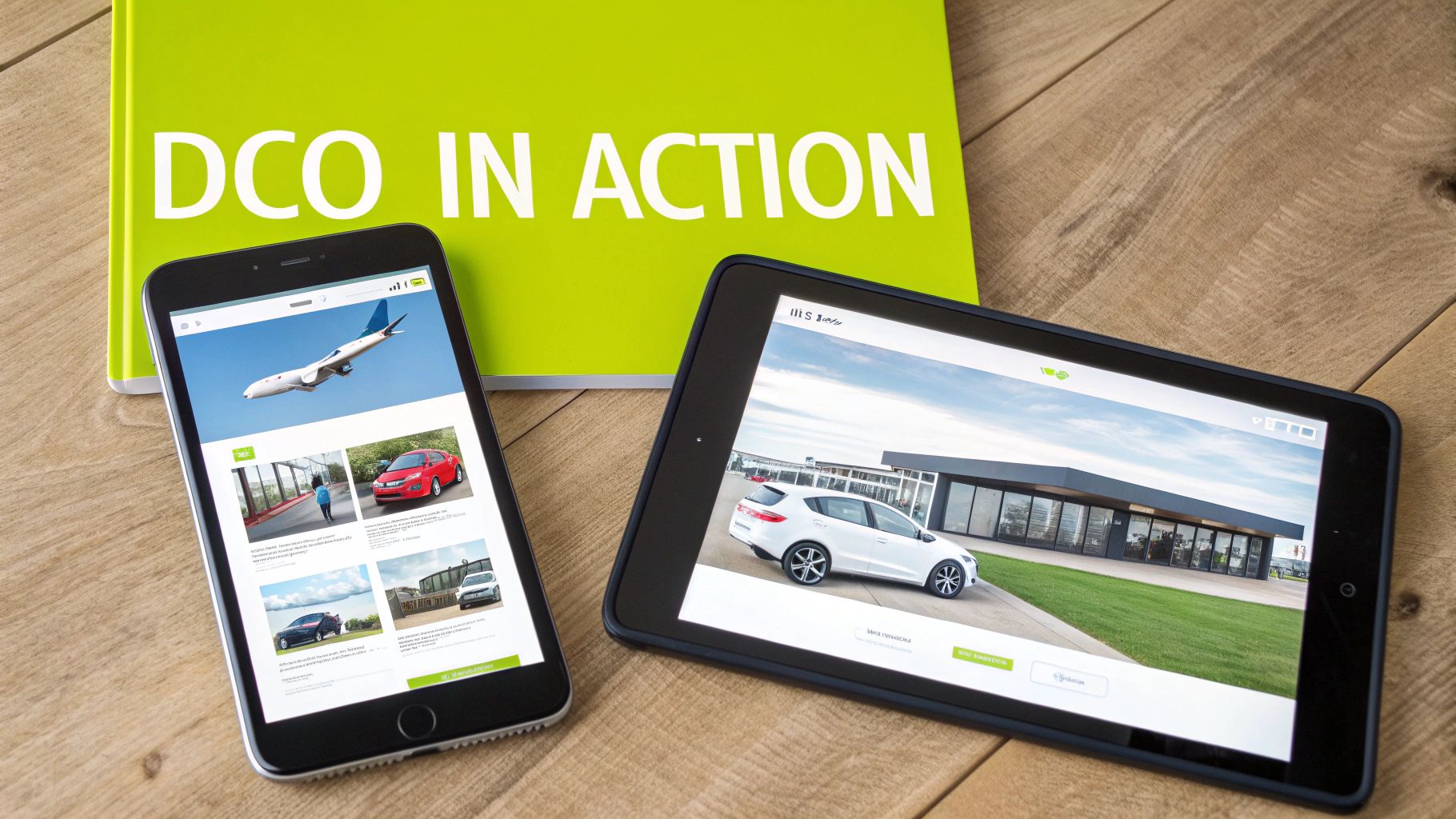
Let’s start with a travel company trying to fill empty seats on flights. Instead of a generic "Fly with us!" ad, they put DCO to work. The system flags a user who just searched for flights from New York to Miami. It then instantly builds an ad showing the current lowest price for that exact route—pulled straight from their live data feed. The result is a highly compelling and perfectly timed offer.
Tailoring Ads to Local Conditions and Intent
This level of specificity is an absolute game-changer for local businesses. Imagine a regional car dealership with too many SUVs on the lot. Their DCO campaign can be set up to show ads for those specific SUVs—complete with local pricing and inventory numbers—but only to users within a 20-mile radius who are flagged as in-market car buyers.
It's not just about location; it's about context. A national fast-food chain can tap into live weather data feeds to fuel its DCO strategy.
- On a sweltering summer day in Phoenix, users see ads for refreshing iced coffee.
- At the exact same time, on a chilly, rainy afternoon in Seattle, users are shown a promotion for hot chocolate.
This automated relevance makes the ads feel helpful instead of intrusive, which dramatically boosts how well they perform.
The core idea is simple yet powerful: stop showing people ads and start showing them solutions. DCO makes this possible by connecting a user’s immediate context—their location, the weather, their recent searches—to the most relevant product or offer.
The tech’s effectiveness isn’t limited to just a few sectors; we've seen it proven across multiple industries. For instance, a major telecom client, Telekom Slovakia, slashed its CPA by 50% using dynamic product ads. Meanwhile, fashion retailer Fashion&Friends saw a 50% CPA reduction, a 62% lift in website purchase conversions, and a massive 73% boost in ROAS. You can find more details about these DCO outcomes on Hawky.ai.
Case Study: Air Serbia's Personalized Journey
A standout example comes from Air Serbia, which was looking to drive more conversions by delivering truly personal travel offers. Using DCO, they created ads that dynamically pulled in flight routes and pricing based on a user's browsing history and location.
The results were impressive. By showing potential travelers relevant, bookable deals in real time, they made the path from seeing an ad to buying a ticket almost seamless. This is a perfect illustration of how DCO transforms advertising from a generic broadcast into a personalized service. By building a better experience with tailored messaging, you can create more effective personalized advertising campaigns that connect with your audience.
These examples all point to the same thing: when creative is built to respond to individual needs and contexts, the results will follow. Dynamic Creative Optimization provides the engine to make that one-to-one connection happen at a massive scale.
Where Do We Go From Here? The Future of DCO and AI
Dynamic Creative Optimization isn't some static piece of tech—it's alive, constantly pushing the limits of what digital advertising can do. When we look at what's coming next, the real story is how DCO is merging with advanced artificial intelligence. We're about to move from marketing that reacts to what people did to marketing that anticipates what they need, sometimes before they even know it themselves.
The next wave of DCO algorithms won't just look at a user's last click. Fueled by deep learning, they'll be able to spot subtle patterns in browsing habits, contextual clues, and historical data to actually forecast what someone wants. This isn't just about showing an ad for a product they viewed; it's about serving an ad for the solution they'll need next, making the customer journey feel seamless and genuinely helpful.
DCO Is Breaking Out of the Banner Ad
For years, DCO has been the undisputed king of display advertising. But its future isn't confined to a single box on a webpage. The real magic is happening as DCO's principles—real-time, data-driven creative—start showing up across every channel, creating one unified experience for the customer.
We’re already seeing this shift in a few key areas:
- Connected TV (CTV): Picture this: you're streaming your favorite show, and a commercial appears for a trip to a destination you were just researching online. The ad even shows pricing based on your local airport. That’s DCO at work in your living room.
- Digital Out-of-Home (DOOH): Those digital billboards you see in Times Square or on the highway? They can now change their ads on the fly based on traffic, the weather, or even the general demographics of the crowd walking by. For example, a billboard could promote breakfast specials during morning commute hours and switch to dinner deals in the evening.
- Personalized Audio: Streaming music or a podcast, you might hear an ad that mentions your city or a local concert. That’s DCO assembling an audio ad that feels like it was made just for you, not for millions.
The rise of AI that can turn simple text into engaging video will completely change the game for DCO campaigns, making them faster and more scalable than ever. To see how this is unfolding, check out some of the best Text to Video AI tools available today. This cross-channel thinking ensures your brand is having one consistent, personal conversation with customers, no matter where they are.
DCO is graduating from a niche tool for display ads to a core strategy for all modern, omnichannel marketing. It’s the engine that will win customer attention in an increasingly fragmented world.
Winning in a Privacy-First World
With the slow death of the third-party cookie, you might think personalization is on its way out. Think again. DCO is adapting to this new, privacy-focused reality by getting smarter about context instead of just tracking individuals.
The focus is shifting away from cookie-based profiles and toward data that's more reliable and respectful.
Instead, the DCO of tomorrow will lean heavily on:
- First-Party Data: Information customers willingly give you when they interact with your brand. For instance, a logged-in user on a retail site could see ads based on their past purchase history.
- Contextual Signals: The actual content of a webpage, the time of day, a user’s general location, or the weather. An automotive brand could show an ad for an electric vehicle on an article about climate change.
This shift isn't a limitation; it's an opportunity. It means we can keep delivering relevant, effective ads without compromising user privacy. It’s about building trust. DCO is becoming the essential engine for advertising that is intelligent, respectful, and still drives incredible performance.
Got Questions About DCO? We've Got Answers.
Jumping into Dynamic Creative Optimization can feel a little complex at first, and it's natural to have a few questions. We get these all the time, so here are some straightforward answers to help you get a clear picture of what DCO is, what it costs, and what it can really do for your business.
DCO vs. Dynamic Retargeting: What's the Difference?
It’s easy to get these two mixed up, but the distinction is actually pretty simple once you see the big picture.
Think of dynamic retargeting as one specific play in a much larger playbook. It’s the classic move of showing someone an ad for the exact product they just looked at on your site. Useful? Yes. The whole story? Not even close.
Dynamic Creative Optimization (DCO) is the entire playbook itself. It's the powerful technology engine that makes dynamic retargeting—and countless other strategies—possible. DCO is what assembles creative elements in real time to power prospecting, brand awareness, and localized campaigns, not just retargeting.
In short, dynamic retargeting is just one thing you can do with DCO.
Is DCO Expensive to Implement?
That's the million-dollar question, isn't it? The cost of DCO can vary, but it's far more scalable than most people assume. Pricing models differ from platform to platform; some might charge a percentage of your media spend, while others have a flat licensing fee.
Sure, enterprise-level solutions can be a significant investment. But many DCO providers now offer tiered packages that put the technology within reach for smaller and mid-sized businesses.
The key is to stop looking at it as a cost and start seeing it as an investment. DCO’s proven ability to boost ROAS and slash acquisition costs often means the technology more than pays for itself through sheer efficiency and performance gains.
How Quickly Can I See Results from DCO?
You'll start seeing things happen faster than you might think. Modern DCO platforms get to work right away, so you'll often notice initial performance shifts within the first few days as the system starts learning which ad combinations are getting traction.
However, to get to full-blown optimization, you'll need a little patience. It typically takes about 7-14 days for the algorithms to gather enough data to reliably identify the true winning creative combinations and start allocating your budget for maximum impact. You can get more details on DCO market trends and performance benchmarks to see how you stack up.
Can DCO Be Used for Brand Awareness Campaigns?
Absolutely. While DCO built its reputation as a powerhouse for direct-response and conversions, it’s an incredibly effective tool for top-of-funnel brand awareness, too. Instead of just cycling through products, you can use DCO to tailor high-level brand messaging to different audience segments.
Imagine a sustainable clothing brand using DCO. They could automatically show:
- An ad highlighting its eco-friendly materials to an audience known for its interest in environmental causes.
- A completely different ad focusing on durability and timeless style to a more fashion-conscious segment.
This approach ensures your brand story connects on a much deeper level, no matter where a person is in their journey with you.
Ready to stop wasting ad spend on generic creative? The team at Silver Spoon Agency uses AI-powered DCO to build campaigns that adapt to every customer, driving measurable growth and superior ROAS. Start turning your advertising into revenue today.