


Learn what is location based marketing: Boost Local Reach with Geofencing

Location-based marketing is one of those ideas that sounds incredibly futuristic, but it's already happening all around us. At its core, it’s all about using a person's physical location—gleaned from their smartphone—to send them incredibly relevant ads and messages.
Think of it as rolling out a digital welcome mat for potential customers the second they step into your orbit. It transforms a generic ad blast into a timely, personal conversation, reaching the right person, in the right place, at the exact moment they might need you.
Understanding Location Based Marketing
Imagine you’re strolling past your favorite coffee shop and your phone buzzes. It's a notification: "Hey! Pop in for 20% off your next latte in the next 10 minutes." That’s the magic of location-based marketing (LBM) in a nutshell.
It’s the bridge between the digital world and the real, physical one. By using a customer's real-time or even past location data, businesses can send out promotions, content, and experiences that are immediately useful. Instead of casting a wide, impersonal net, LBM lets you focus your efforts with almost surgical precision. It's a fundamental shift from shouting at a crowd to having a one-on-one chat, making it a cornerstone of any modern, ROI-focused strategy.
To get a clear, high-level view, let's break down the key components.
Location Based Marketing at a Glance
| Concept | Description | Primary Technology |
|---|---|---|
| Core Idea | Delivering personalized marketing based on a user's physical location. | GPS, Wi-Fi, Bluetooth Beacons, IP Address |
| Main Benefit | Hyper-relevance, reaching customers with high purchase intent. | Mobile Advertising, Push Notifications |
| Key Goal | Drive foot traffic, increase engagement, and boost local sales. | Geofencing, Geo-conquesting |
This table simplifies the concept, but the real power comes from seeing how it applies directly to your business goals and connects with customers in meaningful ways.
Why It Matters for Your Business
For any business with a physical address or a defined service area—think retail stores, restaurants, real estate agents, or local clinics—LBM isn’t just a nice-to-have anymore. It's becoming essential for winning over local customers. It's how you connect with people who are right there and showing every sign that they're ready to buy.
The results speak for themselves. An incredible 90% of marketers report that location-based advertising directly boosted their sales. On top of that, 86% saw their customer base grow, and 84% noted much higher consumer engagement. To really see how this fits into a bigger picture, it helps to explore various local business marketing strategies and see how LBM acts as a powerful amplifier.
Location-based marketing isn't about tracking people; it's about understanding context. It's the difference between shouting an ad to a crowd and whispering a helpful tip to someone who is actively looking for a solution right around the corner.
Practical Examples in Action
To make this tangible, let's look at how it plays out in the real world:
- A retail store: A clothing boutique sets up a "geofence" around the mall it's in. The moment a shopper with their app enters the mall, they get a push notification about a flash sale.
- A restaurant: A pizzeria targets ads for its lunch special to people working in office buildings within a five-block radius, but only between 11 AM and 1 PM on weekdays.
- A car dealership: The service center sends a maintenance reminder to a past customer when their phone’s GPS data shows they are driving near the dealership.
Each of these examples uses location to offer real value at the perfect moment, which dramatically increases the odds of a customer walking through the door. This is what makes the strategy so powerful—it turns simple proximity into actual profitability.
Understanding the Core Technologies Driving LBM
Location-based marketing might sound like something out of a sci-fi movie, but it all runs on a handful of core technologies that are surprisingly straightforward. Think of them as different tools in a toolbox, each one designed for a specific job—whether you need to cast a wide net over an entire city or zero in on a single aisle in your store.
Let's pull back the curtain and look at the tech that makes these timely, relevant customer connections possible.
This infographic breaks down the core principle of LBM, showing how it connects the right person with the right offer in the right place, at exactly the right moment.
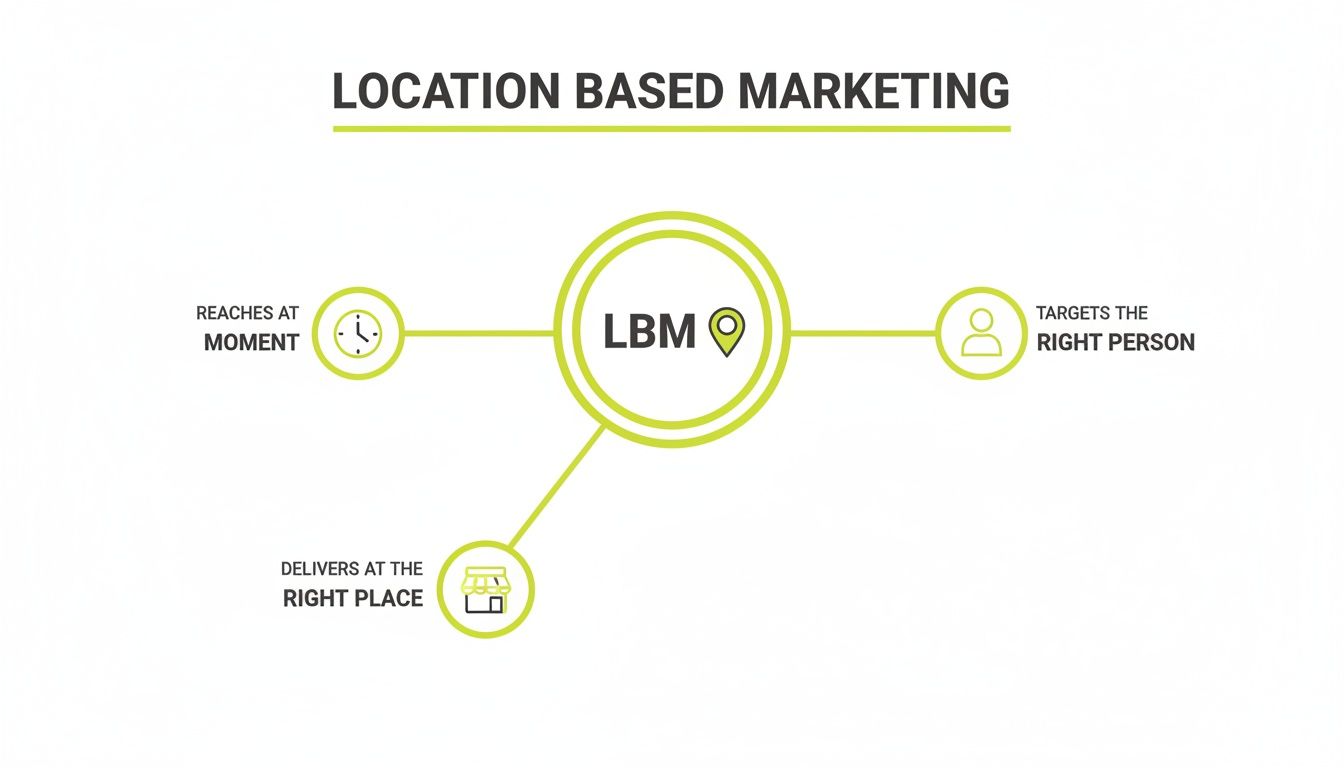
As you can see, successful LBM happens at the intersection of audience, location, and timing. It’s about turning simple proximity into a powerful opportunity to connect.
Geotargeting: Your Digital Flyer Distributor
Geotargeting is one of the broadest and most common tools in the LBM kit. Imagine you’re handing out flyers for your new restaurant. Instead of giving one to every person on the street, you only hand them to people who live in a specific zip code or neighborhood. That’s geotargeting, but for the digital world.
It uses a device's IP address to figure out a user's general location—like their city, state, or postal code. This lets you serve digital ads, emails, or social media content to people within that defined geographical area. It’s perfect for campaigns that need to hit a regional audience without needing pinpoint accuracy.
Practical Example: A regional bank wants to promote a new mortgage offer. Using geotargeting, they can display ads exclusively to users located in the specific counties they serve. This ensures their ad budget isn't wasted on people living outside their service area.
Geofencing: Drawing Invisible Boundaries
While geotargeting covers wide areas, geofencing is all about precision. It lets you create virtual boundaries around specific real-world locations. Picture drawing an invisible circle or polygon on a map around your store, a competitor’s business, or a local event.
When a user who is part of your target audience (and has location services enabled) enters or exits this "fence," it triggers a pre-programmed action—like sending a push notification, an SMS message, or a targeted ad. This technology typically relies on GPS to detect a device’s location. The market for geofencing is expected to jump from $1.47 billion in 2023 to $4.19 billion by 2028, a clear sign of how valuable real-time engagement has become.
Key Insight: Geofencing shines when you need to capture a customer's attention at the exact moment of high intent—like when they are near your store, checking out a competitor, or attending a relevant event.
Here are a few ways businesses put it to work:
- Driving Foot Traffic: A local gym sets up a geofence around a popular park. When joggers enter the park, they get an ad for a free trial class at the gym just a few blocks away.
- Geo-Conquesting: A new cafe geofences the Starbucks across the street. When a customer enters the Starbucks, they receive a push notification with a "50% off your first coffee" offer from the new cafe.
- Event-Based Marketing: A conference organizer geofences the entire event venue. As attendees walk the floor, they receive timely reminders about upcoming sessions or special offers from exhibitors.
Beacons: The Lighthouses of In-Store Marketing
If geofencing is for the neighborhood, beacons are for the individual aisles inside your store. Beacons are small, low-energy Bluetooth devices that you place in physical locations. They act like tiny digital lighthouses, constantly broadcasting a signal. When a smartphone with a specific app and Bluetooth enabled comes within range, the beacon triggers an action.
This technology is incredibly precise, enabling "proximity marketing" on a micro-level. Because they use Bluetooth Low Energy (BLE), their batteries can last for years, and they don't need a Wi-Fi or cellular connection to do their job.
Practical Example: A large home improvement store places beacons in the paint section. A customer browsing colors who has the store's app receives a notification on their phone offering a 15% off coupon for a specific brand of paint or a link to a helpful "How to Choose the Right Paint Finish" guide. This in-the-moment assistance can be just the nudge they need to make a purchase.
Wi-Fi and IP Targeting: Reaching Captive Audiences
Another powerful method involves tapping into Wi-Fi networks and IP addresses associated with specific venues. When someone connects to the public Wi-Fi at a location like an airport, coffee shop, hotel, or convention center, marketers can identify their presence in that specific place.
This allows businesses to deliver targeted ads to devices connected to that network. It’s a fantastic way to reach captive audiences who are likely to be receptive to offers relevant to their current location and what they're doing.
Practical Example: A ride-sharing service targets users connected to the airport's public Wi-Fi. As these travelers browse the web on their phones while waiting for their bags, they see ads promoting a discount on their ride from the airport, encouraging them to book a trip right then and there.
Proven Location-Based Strategies That Drive Real Results
Knowing the tech behind location-based marketing is one thing. Actually using it to grow your business is another game entirely. It’s about moving past the what—like defining geofencing—and getting to the how: using these tools to hit real business goals.
These aren't just theories; they're battle-tested tactics for turning a person's physical location into tangible revenue.
One of the sharpest tools in the shed is geo-conquesting. Think of it as a clever, ethical way to catch the attention of customers right when they’re standing on your competitor's turf. It’s like getting a chance to whisper a better offer in their ear just as they’re about to make a purchase from the other guy.
By drawing a virtual fence around a competitor, you can send targeted ads to anyone who steps inside. It’s a direct line to someone whose buying intent is peaking.
Master Geo-Conquesting to Win Over Competitor Traffic
Geo-conquesting is basically a friendly interception. You're giving a customer who is actively shopping a better, more timely option. This isn't about playing dirty; it's about showing your value at the most critical moment in their decision-making journey.
Imagine a local coffee shop drawing a geofence around the Starbucks down the street. The second a customer pulls into the Starbucks parking lot, their phone buzzes with a notification: "Tired of the same old brew? Get a handcrafted latte for 50% off, just two doors down!"
Geo-conquesting works because it capitalizes on immediate intent. The customer is already out, ready to spend money on a specific product or service, making them highly receptive to a superior offer. This is a primary driver of why 80% of marketers confirm location-based efforts yield higher response rates than traditional methods.
The real magic of location-based marketing is its incredible precision—something 40% of marketers call its top benefit. This accuracy lets you trigger ads at the exact moment a consumer shows high intent, like when they’re physically near a competitor.
Build Smarter Segments with Location Data
Beyond one-off triggers, location data lets you build incredibly powerful audience segments for your ongoing campaigns. By analyzing foot traffic patterns, you can create nuanced customer groups based on how they move around in the real world, going far beyond simple demographics.
This strategy lets you tailor your messaging with surgical precision. You can communicate differently with people based on how often they visit, how long they stay, or even which competitor they hang out at the most.
Here are a few high-value segments you can create:
- Frequent Visitors: These are your regulars. Reward their loyalty with exclusive offers, early access to new products, or special thank-you discounts.
- Lapsed Customers: Target people who used to visit but haven't been back in a while. A simple "We Miss You!" offer can be surprisingly effective at winning them back.
- Competitor Loyalists: Build a list of people who are always at your competitor’s location but never yours. This group is perfect for a sustained geo-conquesting campaign designed to convert them over time.
- Event Attendees: Reach people who attended a specific concert, trade show, or local festival relevant to your industry, catching them when they’re already in a receptive mood.
When you develop segments like these, your marketing stops being a series of one-off promotions and becomes a continuous, relevant conversation. For more inspiration, check out our guide on geofencing advertising examples.
Amplify Your Local SEO with Location Signals
Here’s a powerful but often overlooked strategy: using location signals to beef up your Local SEO. Search engines like Google want to serve up the most relevant local results, and nothing says "relevant" quite like real-world foot traffic.
When customers physically visit your store, check in on social media, or leave a review from your location, they’re sending strong positive signals to search engines. This "foot traffic attribution" validates your business's importance in a specific geographic area.
Practical Example: A local cafe encourages customers to check in on Instagram with a special hashtag in exchange for a 10% discount. Each check-in from their physical address tells Google that the cafe is a popular, active local spot, which can help it rank higher in "coffee near me" searches.
This link between your physical and digital presence can give your Google Maps visibility a serious boost. A business with consistent, verifiable foot traffic is simply more likely to rank higher in "near me" searches, which in turn drives even more organic discovery. For instance, targeted SMS marketing for real estate can use location data not only to send timely messages but also to encourage actions like on-site check-ins that fuel local search visibility.
How Different Industries Win with Location Based Marketing
The real power of location-based marketing comes alive when you see it in action. These strategies aren't just abstract concepts; they are practical, hard-working tools that solve real-world business challenges every single day.
This is where proximity becomes profitability. From getting hungry lunch-goers into a restaurant to helping a real estate agent catch a serious homebuyer's eye, location data is the secret ingredient. Let's dig into how different industries are using these tactics to hit their goals.
Retailers Driving Foot Traffic and In-Store Sales
For any retailer, the game is twofold: get people through the front door, then guide them to the checkout counter. Location-based marketing is a natural fit, acting as both a digital doorman and a helpful in-store assistant.
Picture a clothing boutique trying to liven up a slow weekend. They can use geofencing to draw a virtual line around their store and the nearby mall. The second a shopper who has opted-in crosses that line, they get a push notification with an irresistible offer: "25% off all new arrivals, this weekend only!" Suddenly, a casual mall-goer is now a motivated potential customer.
But the work doesn't stop once they're inside.
- Beacons to Reduce Cart Abandonment: By placing small beacons in different departments, the boutique can send hyper-relevant messages. If someone is lingering in the shoe section for a few minutes, a beacon could trigger a notification with a "buy one, get one 50% off" deal on footwear. It's the perfect nudge.
- Targeted In-Aisle Assistance: A customer staring at the denim wall might get an alert linking to a style guide on finding the perfect fit. This adds instant value and helps them make a confident purchase decision.
Restaurants Filling Tables During Off-Peak Hours
For restaurants, timing is everything. A packed dinner rush is fantastic, but true success often comes from filling seats during those quieter times, like weekday lunches. This is where location-based marketing shines, letting restaurants reach potential diners precisely when they're nearby and hungry.
Imagine a downtown bistro. They can geofence a five-block radius targeting local office buildings. Between 11:30 AM and 1:30 PM, they push out targeted ads on social media to people inside that zone.
The Message: "Escape your desk! Grab our soup and sandwich lunch special for just $12. Order ahead in our app for quick pickup."
This strategy speaks directly to a specific audience (busy professionals) with a perfect solution (a fast, affordable lunch) at the exact right moment. It’s a precision tool for turning nearby workers into regulars. To learn more about making your business a local standout, explore the benefits of hyperlocal advertising for a deeper dive.
Real Estate Agents Capturing High-Intent Leads
In the cutthroat world of real estate, getting the attention of a serious buyer is gold. Agents can use geofencing to zero in on people who are actively showing interest in a specific property or neighborhood.
Think about an open house. An agent can set up a geofence around a competitor's open house just down the street. When a potential buyer walks into that event, they can receive a subtle ad on their social media feed showcasing the agent's own listing nearby. The ad might highlight a better price, a bigger yard, or a recent renovation—intercepting that buyer's interest when it matters most.
This approach ensures the marketing budget is spent only on individuals showing the strongest possible signs of purchase intent.
Service-Based Businesses Attracting Local Clients
Location is just as crucial for service providers like dental clinics, auto repair shops, and hair salons. These businesses live and die by their ability to attract clients from the immediate community. Geotargeting lets them focus their advertising dollars exclusively on the neighborhoods they serve.
For example, a new dental clinic can run a campaign that shows ads only to users within a five-mile radius. The ads can promote an introductory offer for a cleaning and check-up, hitting home the convenience of a local, trusted provider. This stops them from wasting ad spend on people who live too far away to become patients, ensuring every dollar works to build a loyal local client base.
Measuring Your Success and Respecting Customer Privacy
A brilliant strategy is only as good as the results it delivers. Launching a location-based marketing campaign without a way to measure its impact is like sailing without a compass—you're moving, but you have no idea if you're getting closer to your destination.
Here, we'll break down the metrics that truly matter and the absolute necessity of earning customer trust through privacy. This isn't a choice between one or the other; effective marketing is ethical marketing. In the world of LBM, success is built on a foundation of respect for the customer's data.
Key Metrics to Track in LBM
To really know what's working, you have to look beyond surface-level numbers. The real magic of location-based marketing is its power to connect digital actions to real-world outcomes. Vague metrics won't cut it. You need to track specific performance indicators that show a clear return on your investment.
These are the essential KPIs for any location-based campaign:
- Foot Traffic Attribution: This is the holy grail of LBM. It measures how many people physically walked into your store after seeing one of your ads. This metric draws a direct line from your digital ad spend to in-person visits.
- Click-Through Rate (CTR) on Offers: This tells you how compelling your location-specific promotions are. A high CTR means your message is hitting the right note with people in that specific area, at that exact moment.
- Dwell Time: This tracks how long a person stays at your location after being prompted by an ad or notification. Longer dwell times can signal higher engagement and a much greater likelihood of a purchase.
- Return on Ad Spend (ROAS): This is the ultimate bottom-line metric. It calculates precisely how much revenue you generated for every single dollar spent on your LBM campaign, giving you a crystal-clear picture of profitability.
By focusing on these metrics, you shift from guessing to knowing. You get the hard data you need to refine your campaigns for maximum impact.
Building Trust Through Privacy and Transparency
Let's be clear: location data is personal. Using it effectively requires an unwavering commitment to customer privacy. People are more aware than ever of how their data is being used, and a clumsy or opaque approach can destroy trust in an instant. The key is to treat privacy not as a limitation, but as a competitive advantage.
Transparency is the currency of trust. When you clearly explain why you need location data and what value the customer will receive in return, you transform a potentially intrusive request into a mutually beneficial agreement.
This is where permission-based marketing becomes non-negotiable. Always ask for explicit consent before tracking a user's location and make it incredibly easy for them to opt out at any time. This approach not only aligns with regulations like GDPR and CCPA but also builds the kind of long-term customer loyalty that lasts. To dive deeper, check out our guide on developing privacy-focused advertising strategies to ensure your campaigns are both effective and compliant.
The growth in this field is undeniable. The geofencing sector alone is projected to rocket from $1.47 billion in 2023 to $4.19 billion by 2028. This boom is fueled by marketers seeing real results: over 90% attribute revenue gains to these strategies, while 86% credit them with customer base expansion. For businesses like local retailers and real estate agents, this highlights a massive opportunity to use hyper-local tactics to drive tangible growth. You can discover more insights about these location-based marketing trends and their impact.
Launching Your First Location-Based Marketing Campaign
Moving from idea to execution can feel like a huge leap, but launching your first location-based marketing campaign is a lot more manageable than you might think. The trick is to break it down into a simple, logical roadmap. This isn't about some massive, complicated rollout; it's about starting with a well-defined pilot program that delivers real results and teaches you what works.
Think of it as starting small, staying focused, and building on your wins. By following a clear path, you take the guesswork out of the equation and start connecting with customers in the physical world, right where it counts.
Step 1: Define Your Primary Goal
Before you even think about the technology, you have to know what you’re trying to achieve. A fuzzy goal like "get more customers" just won't cut it. You need a single, crystal-clear, and measurable objective that will steer every other decision you make.
A solid goal acts as the North Star for your entire campaign, making it dead simple to see if your efforts are actually paying off. This clarity is absolutely essential for understanding your return on investment and knowing what to tweak down the line.
Here are a few examples of sharp, focused goals:
- Increase weekend foot traffic by 15% over the next month.
- Boost lunch special sales among local office workers by 20% on weekdays.
- Generate 10 new leads from a competitor's open house event this Saturday.
Step 2: Identify Your Audience and Locations
Once you have that clear goal, the next question is: who are you trying to reach, and where do they physically spend their time? You need to think beyond basic demographics and get into their real-world routines. Where do they work, shop, eat, or hang out?
This is where you start connecting your ideal customer profile to actual pins on a map.
Key Insight: The success of your campaign comes down to targeting locations where your audience's intent is highest. Someone standing near your competitor's storefront is a far more valuable target than someone who just happens to be in the same zip code.
Practical Example: If your goal is to boost weekday lunch sales, your target locations aren't just random points in your city. They're the specific office buildings, business parks, and university campuses within a one-mile radius of your restaurant.
Step 3: Choose the Right Technology Mix
Now you can pick the tools that best fit your goal and budget. For driving foot traffic to a specific store, geofencing is almost always the perfect place to start. If your goal is to engage customers inside your venue, beacons are the answer. Need broader awareness across a whole neighborhood or city? Geotargeting is your tool.
The key here is not to overcomplicate things. For your first campaign, pick one primary technology that directly supports the goal you set in step one. You can always layer in more tools as you get more experience and see what really moves the needle for your business.
Practical Example: For the goal of increasing weekend foot traffic by 15%, geofencing is the clear choice. You would set up geofences around nearby shopping centers, local parks, and competitor locations. For the goal of boosting lunch sales, you would use geofencing around those office buildings you identified.
Answering Your Questions About Location Based Marketing
Diving into a new marketing strategy always brings up a few questions. Let's tackle the most common ones we hear from business owners before they jump into location-based campaigns.
How Much Does a Geofencing Campaign Cost?
This is the big one, and the good news is that geofencing is more accessible than most people think. The cost can swing pretty widely depending on the scale of your campaign, but the pricing model itself is straightforward. Most platforms use a Cost Per Mille (CPM) model, which just means you pay a set rate for every thousand times your ad is shown inside the virtual fences you've created.
Typically, you'll see CPM rates anywhere from $3.50 to $15. A small, local business targeting a few competitor storefronts for a month might spend a few hundred dollars. A larger, multi-location brand running a major campaign could invest thousands. The smartest way to start? Carve out a modest test budget, see what the initial return looks like, and scale from there.
Is Location Based Marketing Effective for B2B?
Absolutely. While it’s easy to picture location-based marketing in a retail setting, it's a seriously powerful tool for B2B companies. The strategy is the same—reaching the right people in the right place—but the "places" are just different. Instead of targeting shopping malls, you're targeting professional hubs.
Think about it:
- Trade Shows and Conferences: You can serve ads directly to attendees at a major industry event, promoting your software or service while they're completely immersed in that world.
- Competitor Headquarters: Want to get on the radar of decision-makers at a rival company? You can target their corporate office.
- Business Districts: It's possible to reach entire office parks or commercial zones where your ideal clients work every day.
The core principle holds true, whether you're trying to sell a latte or a SaaS subscription.
How Do I Get Access to Location Data?
You don't have to worry about collecting raw location data yourself—that would be a massive headache. Instead, you tap into an existing ecosystem through specialized advertising platforms and their data partners. They've already done the heavy lifting.
When you launch a campaign, you're using anonymized location data that has been aggregated from mobile apps where users have already given their permission. Any reputable platform handles all the technical and privacy compliance details behind the scenes. This frees you up to focus on what really matters: your strategy, your target locations, and the compelling offer that will bring people through your door.
Ready to turn proximity into profit with expert guidance? The team at Silver Spoon Agency specializes in creating high-ROAS geofencing and omnichannel campaigns that drive measurable foot traffic and sales. Learn more and book a consultation today.