


What Is Multi Touch Attribution A Guide to Real ROI

Of course. Here is the rewritten section, crafted to sound completely human-written and natural, following all your specific instructions.
Multi-touch attribution is a way of looking at your marketing that gives credit to multiple touchpoints a customer interacts with before they buy something. Instead of dumping 100% of the credit on one single interaction, it acknowledges that a whole series of efforts—that ad, the blog post, the email—all worked together to get that sale across the line.
The Hidden Story Behind Every Sale
Picture this: a customer finally buys your product. If you're only using a last-click attribution model, you're giving all the glory to the final Google ad they clicked right before checkout. But that’s like giving the game-winning trophy only to the player who scored the final goal, completely ignoring the midfielders and defenders who made the crucial passes to get the ball down the field.
What about that social media post that first caught their eye last month? Or the genuinely helpful blog post they bookmarked a week ago? Those early interactions were vital, but single-touch models are blind to their contribution. This leads to a dangerously incomplete picture and, even worse, bad budget decisions. You might end up cutting funding for the very channels that are quietly building awareness and trust.
Seeing the Full Picture
This is exactly the problem multi-touch attribution (MTA) solves. Think of it as the instant replay for your entire marketing game. It’s a framework that reveals the hidden story behind every conversion, assigning fair credit to each marketing touchpoint that nudged the customer along. Suddenly, you have a complete and accurate picture of what’s really driving growth.
A real customer journey rarely happens in one step. It usually looks more like this:
- Touchpoint 1: They see a TikTok video about your brand (Awareness).
- Touchpoint 2: A few days later, a Facebook retargeting ad pops up (Consideration).
- Touchpoint 3: They search for your brand on Google and read a few reviews (Research).
- Touchpoint 4: A promotional email lands in their inbox, and they finally click to buy (Conversion).
With multi-touch attribution, you can finally see how each channel supported the others. The TikTok video started the conversation, the Facebook ad kept you top-of-mind, and the email gave them the final nudge they needed.
Getting a handle on this sequence is fundamental to building a smart, effective strategy. It helps you appreciate that different channels play different roles at different times. To get a better sense of how all these interactions fit together, it’s worth learning more about crafting a detailed customer journey mapping strategy. This complete view empowers you to invest your marketing budget far more intelligently, making sure every player on your team gets the credit they deserve for the win.
Choosing The Right Attribution Model For Your Business
Once you realize you need to see the entire customer journey, the next big question is: which lens should you use to look at it? Multi touch attribution isn't a one-size-fits-all tool. Think of it more like a toolbox, with each model telling a slightly different story about how your marketing is really working.
Picking the right model is a huge deal. It directly shapes which channels you value, where you put your budget, and how you measure success. Your business goals are your North Star here. Are you trying to build brand awareness from scratch, or are you pushing for quick, promotional sales? Your answer will point you straight to the best model for the job.
This decision tree shows the fundamental choice every marketer faces: do you give all the credit to the last click, or do you zoom out and analyze the whole path?
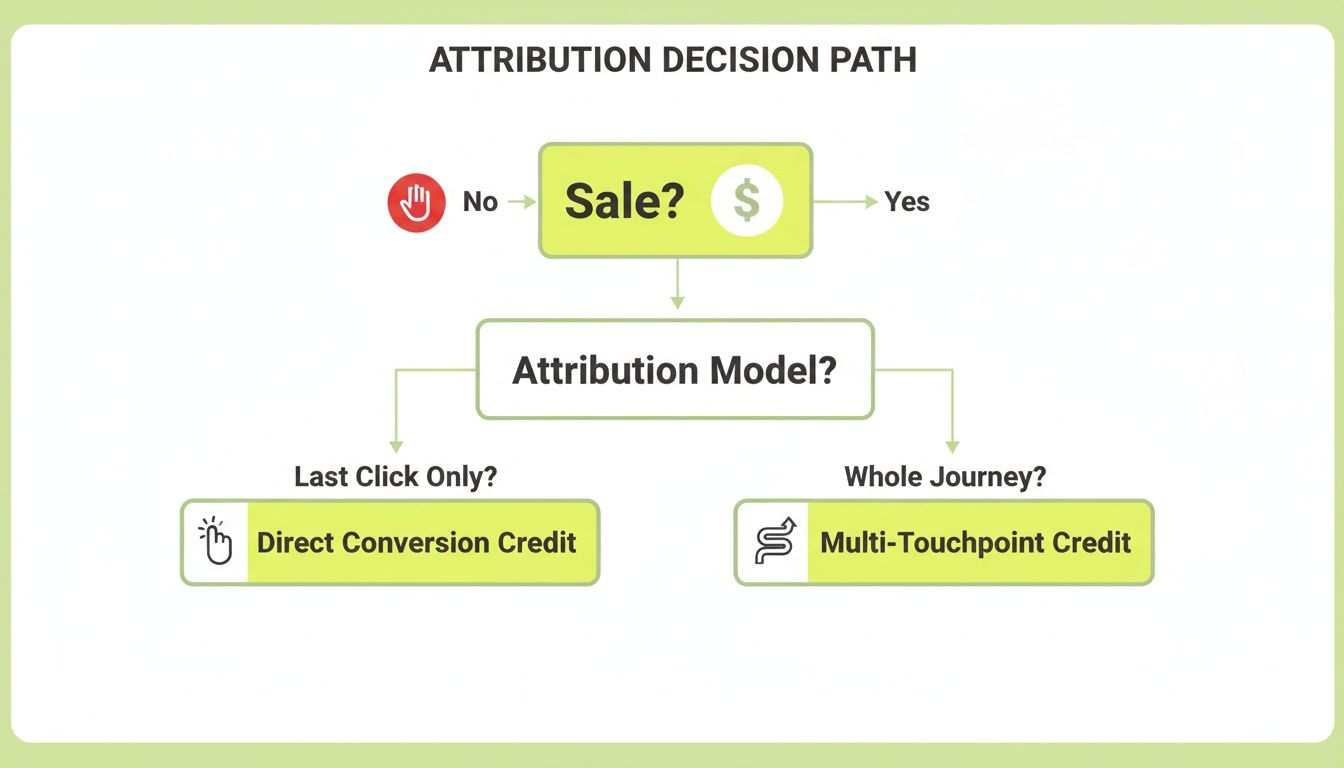
This visual really gets to the heart of MTA—it's about shifting from a simplistic, single-point view to a comprehensive, panoramic one.
How Common Multi Touch Attribution Models Work
Let's unpack how a few of the most popular models work in the real world. Imagine a customer converts after four interactions: they saw a Facebook Ad, read a Blog Post, clicked a Google Search Ad, and finally, made a purchase from an Email.
Each attribution model would slice up the credit for that sale differently. Here’s a quick breakdown of how the most common ones assign value and which business goals they align with best.
| Attribution Model | How It Assigns Credit | Best For Business Goals Like |
|---|---|---|
| Linear | Spreads credit evenly across all touchpoints. In our example, each of the four touches gets 25%. | Valuing every single interaction equally in a long-term nurturing campaign. |
| Time-Decay | Gives more credit to touchpoints closer to the sale. The final email gets the most credit, the first ad gets the least. | Short sales cycles, like an e-commerce flash sale, where recent actions have the biggest impact. |
| U-Shaped (Position-Based) | Heavily weights the first and last touches. It assigns 40% to the first touch, 40% to the last, and splits the remaining 20% among the middle touches. | Longer sales funnels (think B2B) where both lead generation and closing the deal are critical. |
As you can see, the model you choose directly reflects what your business values most in the customer's journey. Is it the initial spark of interest? The final push over the finish line? Or the whole winding path?
Picking a model isn’t just a technical setting you flip a switch on—it’s a strategic decision. It’s a statement about what your business believes are the most important moments in a customer's journey.
For instance, time-decay models are perfect for e-commerce because a timely discount email that seals the deal deserves more credit. Some formulas can give that last touch nearly 3x more weight than the first. On the flip side, U-shaped models correctly reward both the marketing that brought the lead in the door and the sales effort that closed them, making it a favorite for B2B companies.
If you're interested in going deeper on the foundational models, our guide on first-touch vs last-touch attribution is a great next step. By aligning your attribution model with your unique sales cycle, you'll unlock far more accurate and actionable insights.
How Multi-Touch Attribution Works in the Real World
Theory is great, but seeing how multi-touch attribution actually plays out is what makes the concept really click. Let's step away from the abstract models and look at some tangible examples of how businesses use MTA to make smarter decisions and spend their money more effectively. These scenarios are perfect for showing how MTA pulls back the curtain on the true value of each marketing channel.

In the real world, these models are incredibly powerful for making sense of the modern customer journey. This is especially true in the bustling ecommerce industry, where a single sale is almost always the result of multiple channels working together in concert.
The Journey of a New Pair of Sneakers
Let's follow a customer named Alex who's in the market for new running shoes. Without MTA, a brand might only see the final click that led to the sale. The real story, however, is much more interesting.
- Awareness (TikTok Ad): Alex first spots the sneakers in a cool video from a fitness influencer on TikTok. This plants the seed, but he doesn't click or buy just yet.
- Consideration (Retargeting Banner): A few days later, he’s reading a tech blog and sees a display ad for those same sneakers. This retargeting ad serves as a gentle nudge, keeping the brand fresh in his mind.
- Conversion (Email Discount): Finally, an email lands in his inbox with a 15% off welcome offer. That's the final push he needs. He clicks the link, adds the shoes to his cart, and checks out.
A simple last-click model would give 100% of the credit to that email campaign. But MTA would spread the credit around, revealing that the TikTok ad was essential for discovery and the retargeting banner was crucial for keeping his interest alive. This insight helps the brand justify its investment in top-of-funnel awareness, not just the tactics that close the deal.
Signing Up a New Dental Patient
Now, let's switch gears to a local service business—a dental clinic. A new patient, Maria, needs to book a cleaning. Her path to becoming a patient is different but just as layered.
- Initial Search: Maria starts by Googling "best dentist near me" and clicks on the clinic's website, which shows up near the top thanks to solid local SEO.
- Social Proof: Later that day, she sees a targeted Facebook ad showcasing the clinic's stellar patient reviews and modern, clean office.
- Final Nudge: After she books her appointment online, she gets an SMS reminder. This simple text solidifies her commitment and makes a no-show far less likely.
In this journey, SEO kicked things off, Facebook built trust, and the SMS locked in the appointment. Multi-touch attribution proves that all three were smart investments, preventing the clinic from mistakenly cutting its SEO budget just because it wasn't the "last click."
These stories show how MTA reveals the teamwork behind every single conversion. It gives you the full picture, helping you put your ad spend where it will have the biggest impact.
The Power of AI-Driven Attribution
While rules-based models are a massive step up from last-click, they still have one big limitation: they’re based on our assumptions about what's important. This is where the next evolution of attribution comes in, powered by artificial intelligence and machine learning. This approach is often called algorithmic or data-driven attribution.

These sophisticated systems don't follow a set of pre-programmed rules. Instead, they churn through huge datasets, analyzing thousands of different customer paths—including both the journeys that ended in a sale and all the ones that didn't. By comparing these successful and unsuccessful paths, the AI uncovers complex patterns that even the sharpest human analyst would likely miss.
Uncovering Hidden Patterns
Let’s say your data shows a common path: a customer sees a Facebook ad, gets an email a few days later, and finally clicks a Google ad before converting. An algorithmic model can dig much deeper. It might find that this specific sequence is 30% more effective only when the Facebook ad is a video and the customer falls into a particular demographic. That's a level of detail a standard model just can't provide.
This is the real magic of AI in attribution: it strips away our human biases and assumptions, revealing the subtle, interconnected relationships between touchpoints that genuinely drive conversions.
This isn't just about getting a more accurate report card for your marketing. This technology allows for real-time campaign optimization. Instead of waiting for a monthly summary, you can shift your budget on the fly to the channels and creatives that are actually working right now, giving your ROI a serious boost. Studies show algorithmic models can outperform traditional rules-based methods by 25-35% in accuracy simply by figuring out how each touchpoint truly increases the probability of a conversion.
To really get a handle on how AI impacts your sales and ensure your models are delivering real value, it's crucial to understand the principles of Mastering AI ROI. By embracing the full capabilities of data science in your marketing efforts, you can finally move from making educated guesses to making precise, data-backed decisions.
Your First Steps to Implementing Multi Touch Attribution
Ready to move from theory to action? Great. But before you can analyze the customer journey, you need to be able to see it—clearly, from the very first touch to the final sale. Implementing multi-touch attribution isn't a quick fix; it's about building a rock-solid data foundation first. This all starts with consistent and comprehensive tracking across every single one of your channels.
The most critical first step is getting your tracking in order. I'm talking about a unified system where every single campaign link—from your social media ads and email newsletters to that influencer collab you just launched—uses UTM parameters. Think of these little tags on your URLs as digital breadcrumbs. They tell you exactly where each visitor came from and which campaign brought them to your door. Without them, your data is a messy, incomplete puzzle.
Building Your Data Hub
Once your tracking is standardized, the next goal is to knock down your data silos. Right now, your marketing data probably lives in a bunch of different places: Google Analytics, your email platform, your CRM, and various ad managers. The key is to pull all these scattered sources into a central hub where every touchpoint can be seen in one place.
This central hub could be a platform like Google Analytics 4, a dedicated attribution tool, or a customer data platform (CDP). Centralizing your data is absolutely non-negotiable if you want an accurate, cross-channel view of what’s actually working.
Implementing multi-touch attribution is less about flipping a switch and more about building a reliable data pipeline. Your insights will only ever be as good as the data you feed into the system.
Multi-touch attribution gives credit across multiple interactions instead of just focusing on the final click. While 60-70% of marketers have historically leaned on simpler single-touch models, MTA distributes fractional credit using frameworks like position-based or linear models to paint a far more accurate picture. For a deeper dive, you can explore this practical guide to B2B multi-touch attribution for more details on these models.
Ultimately, a successful rollout requires a shift in mindset. It’s about committing to meticulous tracking, unifying your data, and choosing a model that truly reflects how your customers actually interact with your brand.
Common Questions About Multi Touch Attribution
Once you start digging into marketing metrics, a lot of questions pop up. Let's clear the air and tackle some of the most common things people ask about multi touch attribution and how it actually works.
What’s the Real Difference Between Multi Touch and Last-Click Attribution?
Think of it this way: last-click attribution is like giving all the credit for a Super Bowl win to the player who scored the final touchdown. It assigns 100% of the credit for a conversion to the very last thing a customer did before buying.
Multi touch attribution, on the other hand, recognizes the whole team played a part. It spreads the credit across multiple touchpoints in the customer’s journey, giving you a far more accurate picture of what actually led to the sale. It sees the value in the social media ad that first caught their eye, not just the final email that sealed the deal.
Do I Need to Buy Expensive Software to Get Started?
Not at all. While there are some powerful dedicated platforms out there, you can start exploring multi touch attribution with tools you probably already have.
The best place to start is Google Analytics 4, which has its own built-in attribution modeling tools. The most important thing is getting your tracking straight—like using UTM parameters consistently across all your campaigns—to make sure your data is clean and reliable from the get-go.
Nailing this foundational step allows you to gather the data you need to test different models and see which touchpoints are pulling their weight, all without a hefty upfront investment.
How Do I Figure Out Which MTA Model Is Right for My Business?
The best model is the one that mirrors your unique business cycle and marketing goals. There’s no magic bullet here, just the model that makes the most sense for how your customers buy.
- For businesses with short sales cycles, like e-commerce, a Time-Decay model is often a great fit. It gives more credit to the interactions that happened just before the purchase, which is usually how those quick decisions are made.
- For longer B2B sales cycles, a U-Shaped model is a popular choice. It puts the most value on the first touch (generating the lead) and the last touch (closing the deal), acknowledging the importance of both starting and finishing the race.
The best advice? Experiment. Try out a few different models and see which one gives you the most logical and actionable insights for your specific business.
Ready to stop guessing and start seeing the full story behind your sales? Silver Spoon Agency uses a data-driven, omnichannel approach to turn your advertising into measurable growth. We build campaigns that work together, ensuring every touchpoint gets the credit it deserves for a superior ROAS.