


What Is Omnichannel Customer Experience A Complete Guide

Imagine browsing for a new coffee maker on a company's website, adding one to your cart, but then getting pulled away. Later that evening, you see an ad for that exact coffee maker on Instagram. You click it, and it takes you to the mobile app, where your cart is waiting. You complete the purchase in two taps. That seamless, connected journey is the heart of an omnichannel customer experience—a strategy where every channel works in concert as one cohesive unit.
What Is An Omnichannel Customer Experience
An omnichannel customer experience isn’t just about being on multiple channels; it’s about weaving them together into a single, continuous conversation between your brand and your customers. Think of it less like a collection of separate storefronts (a website, an app, a physical store) and more like one interconnected ecosystem. Every interaction, no matter where it happens, builds on the last one.
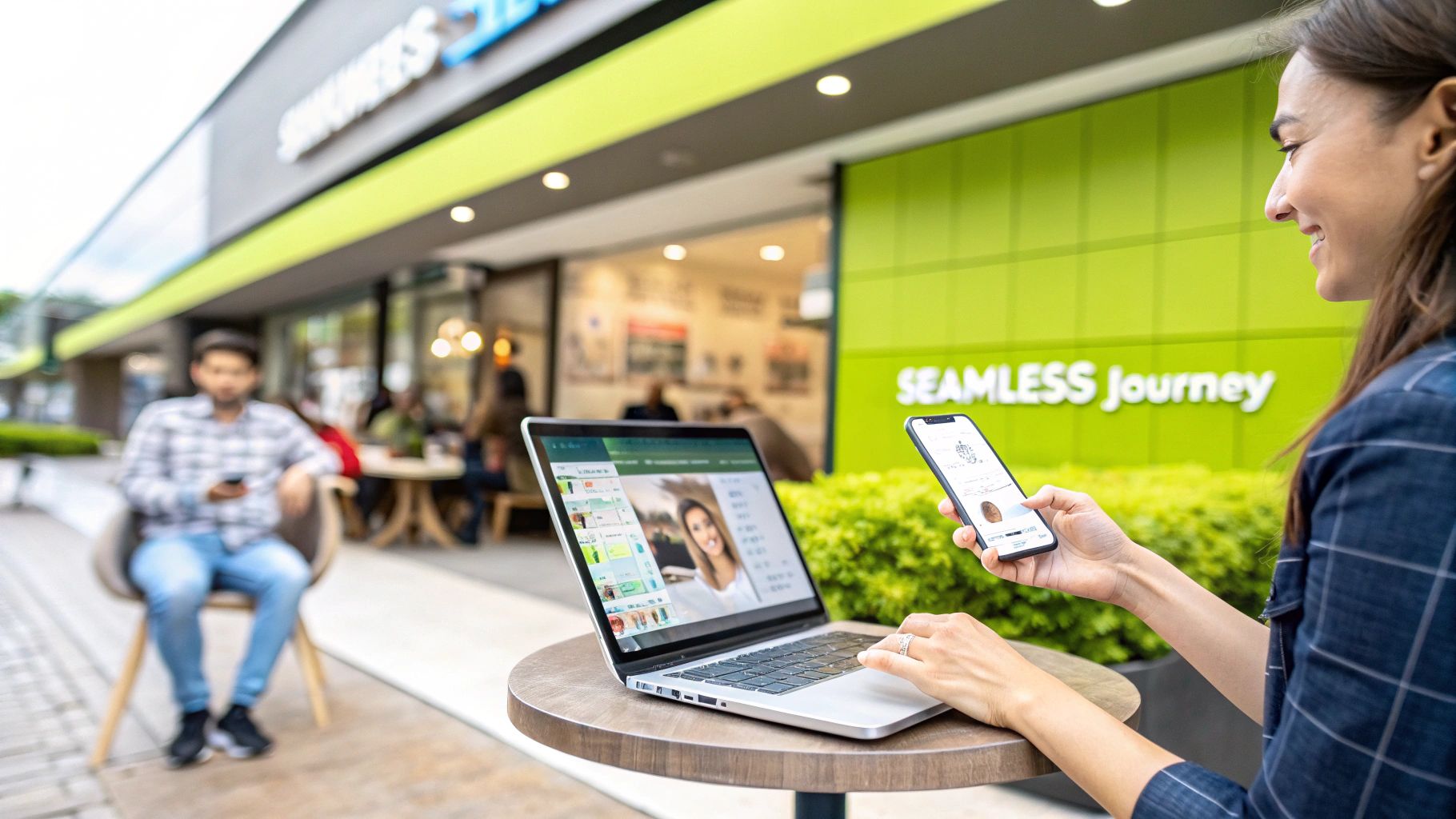
This approach puts the customer at the absolute center of everything. Whether they’re scrolling through your social feed, using a feature in your mobile app, or talking to a representative in person, their context and history travel with them. For example, if a customer starts a chat on your website about a delivery issue, then calls your support line later, the phone agent can see the entire chat history without the customer having to repeat a single detail. This continuity wipes out frustration and makes the customer feel heard.
A Simple Analogy: The Relay Race
To really get it, picture a relay race. In a poorly managed team (that's your typical multichannel approach), each runner operates in a silo. When one finishes their leg, the baton handoff is clumsy and awkward. The next runner has to slow down, maybe even stop, just to get going again. The flow is broken, and all momentum is lost.
Now picture a perfectly executed omnichannel handoff. The next runner is already in motion, anticipating the baton and grabbing it without ever breaking stride. The race becomes one fluid, powerful motion. That’s how omnichannel works. The "baton" of customer context gets passed flawlessly from one channel to the next, creating a journey that’s smooth, efficient, and feels completely natural. This unified strategy is a core part of effective omnichannel marketing.
Omnichannel vs. Multichannel: A Head-to-Head Comparison
While both strategies use multiple channels to engage with customers, their philosophies and execution are worlds apart. The critical difference is integration. Multichannel is about being present on various platforms; omnichannel is about connecting those platforms into a single, intelligent system that revolves around the customer.
At its core, the omnichannel customer experience is about transforming the entire journey. You can dig deeper into some of the practical strategies to enhance customer experience in retail.
The table below breaks down the fundamental differences.
| Attribute | Omnichannel Approach | Multichannel Approach |
|---|---|---|
| Customer Focus | Provides a single, unified journey centered on the customer. | Focuses on providing access to the brand on multiple channels. |
| Channel Integration | All channels are deeply integrated and share data in real time. | Channels operate independently in silos with little to no data sharing. |
| Consistency | Delivers a consistent brand message and experience everywhere. | Messaging and experience can vary significantly from one channel to another. |
| Data Usage | Uses a unified customer profile to personalize every interaction. | Customer data is often fragmented and specific to each channel. |
Ultimately, multichannel gives customers options, but omnichannel gives them a truly seamless and intelligent experience. One is a collection of parts; the other is a fully functioning machine.
Why An Omnichannel Strategy Drives Real Business Growth
Let's be clear: adopting an omnichannel approach isn't just a fancy upgrade for your customer service department. It's a fundamental shift in how you operate that directly fuels business growth. When you engineer a seamless, interconnected customer journey, you’re not just making people happier—you’re actively shaping their buying habits in ways you can actually measure.
It all comes down to consistency. When a customer’s experience is fluid and recognizes them everywhere—from a social media ad to an in-store visit—it builds a powerful sense of trust and systematically removes friction. This unified strategy simply makes it easier for them to buy, return, and engage with you, which naturally leads to them spending more, more often.
Boosting Customer Lifetime Value
One of the biggest financial wins you'll see is a dramatic spike in Customer Lifetime Value (LTV). An omnichannel strategy is built to nurture long-term relationships by making every single interaction count. Instead of each channel operating in its own little world, they share data to build a complete picture of each customer.
Picture a modern retailer like Sephora. A customer uses the mobile app's "Virtual Artist" feature to try on a new lipstick shade. Later, she walks into a physical store. A store associate, equipped with a tablet, can pull up her profile, see the shade she was interested in, and offer her a physical sample. The very next day, a personalized email lands in her inbox with a special offer based on that exact product, which she can use online or back in the store.
This interconnected loop is designed to encourage repeat business. The customer feels seen and understood, making them far more likely to stick with your brand for the long haul. And that’s where the numbers get really interesting.
The data is consistent and compelling: shoppers who engage with a brand across multiple, integrated channels are wildly more valuable. They deliver a 30% higher lifetime value compared to customers who only shop through a single channel.
That’s not a small bump. It's a substantial, long-term revenue multiplier for every customer you bring in.
Driving Higher Purchase Rates And Order Values
Beyond just loyalty, a true omnichannel approach gives your immediate sales metrics a serious boost. It turns out, the more channels a customer uses, the more they spend. Research shows that omnichannel shoppers have purchase rates up to 287% higher than their single-channel counterparts. Why? Because a connected experience systematically dismantles the barriers that stop a sale from happening.
For example, a customer might browse products on your website, add them to a wishlist, and later get a push notification on their phone when an item is back in stock. They can then choose to "buy online, pick up in-store" to get it that same day. This convenience doesn't just lock in the sale—it often leads to additional impulse buys once they're in the store, increasing the Average Order Value (AOV) by as much as 13%. This seamless flow turns casual browsing into confident buying far more effectively than siloed channels ever could.
The proof is undeniable: companies that successfully integrate three or more channels see engagement rates skyrocket by about 250% compared to single-channel businesses. Better yet, organizations with strong omnichannel strategies retain around 89% of their customers—a stark contrast to the dismal 33% retention for companies with weak cross-channel support. You can dive deeper into these omnichannel statistics and their impact on revenue.
This powerful link between an integrated experience and financial results proves that investing in a true omnichannel strategy isn't just a good idea; it's essential for any business serious about scalable, predictable growth.
Your Practical Roadmap To Building An Omnichannel Strategy
Knowing that an omnichannel experience drives growth is one thing; actually building one is a whole different ballgame. Moving from a clunky, disconnected multichannel setup to a truly integrated system demands a clear, step-by-step plan. This roadmap breaks that journey down into manageable chunks that any business can follow to create the seamless experience modern customers don't just want—they expect.
This isn't about flipping a switch and hoping for the best. It’s a methodical process of layering data, technology, and strategy to build a foundation that puts the customer at the absolute center of every decision you make. Each step builds on the last, getting you closer to a unified view of your audience and the power to deliver consistent, personalized interactions no matter where they find you.
Step 1: Map The Customer Journey
Before you can build a seamless experience, you have to understand the journey your customers are already taking. This means mapping out every single touchpoint, from the first time they hear about your brand to the moment they become a loyal fan.
The goal here is to hunt down the friction points and sniff out the opportunities. Where do handoffs between channels feel clumsy? Do customers have to repeat themselves? Are there dead ends in the buying process? For example, you might discover that customers frequently browse on your mobile app but then switch to a desktop to purchase because the mobile checkout process is too complicated. This insight immediately tells you where to focus your efforts.
Visualizing this path gives you incredible insights. A proper map will expose the biggest pain points that are costing you sales and loyalty. To dig deeper, you can explore detailed guides on effective customer journey mapping.
Step 2: Unify Your Customer Data
A true omnichannel strategy is dead in the water without a single, unified view of the customer. The biggest roadblock is almost always data fragmentation—that’s when customer info is trapped in separate systems like your email platform, e-commerce backend, and CRM. You have to break down those silos.
The solution is to centralize your data into a single source of truth. This is often done with a Customer Data Platform (CDP) or a well-integrated CRM. These tools suck in data from every channel and stitch it all together to create a 360-degree profile for each customer, including things like:
- Purchase History: What they've bought, when, and on which channel.
- Browsing Behavior: Pages they've visited, products they've viewed, and content they've downloaded.
- Interaction Logs: A record of every email opened, support ticket sent, and chat conversation had.
With this unified profile, every department finally has the full story. A support agent can see a recent purchase, and the marketing team knows about a recent support ticket, making sure every conversation is relevant and helpful.
Step 3: Integrate The Right Technology Stack
Once your data is in one place, the next move is to make sure your technology stack can actually talk to each other. Your tools for marketing, sales, and service must be integrated to share information in real time. This is what makes those smooth, seamless handoffs possible.
Think about a SaaS company for a second. A prospect downloads a whitepaper (marketing), then joins a webinar (marketing), and finally books a demo (sales).
In an integrated system, the sales rep sees that entire history before the demo call even starts. They know exactly what topics interest the prospect and can tailor the conversation perfectly, which massively boosts the odds of closing the deal. That level of context only happens when the tech stack works as one.
This visualization shows exactly how improving customer engagement with an omnichannel approach directly leads to more revenue and lasting loyalty.
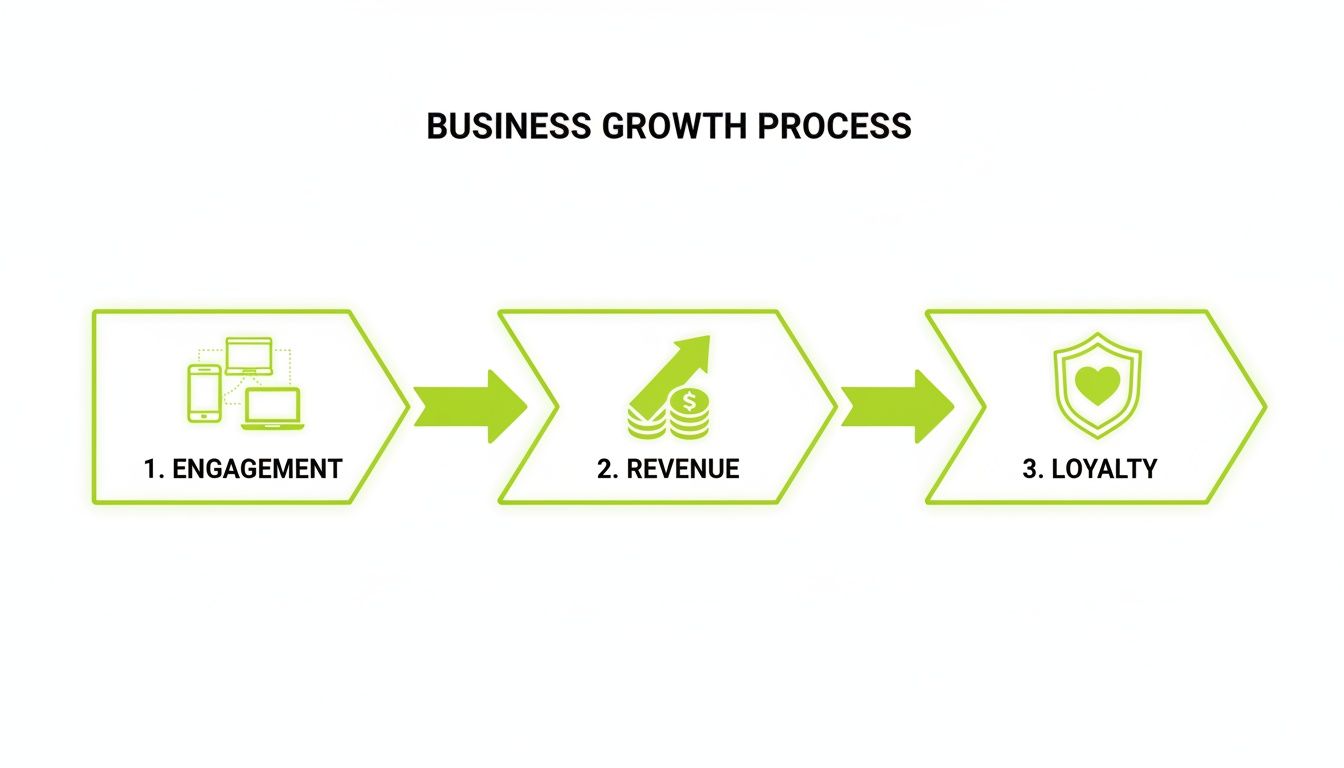
The flow makes it clear: a connected experience isn't just a "nice-to-have" metric; it's the engine that powers real, measurable business growth.
Step 4: Orchestrate And Personalize Campaigns
The final step is to put your unified data and integrated tech to work by orchestrating consistent, personalized campaigns across all your channels. This means saying goodbye to generic, one-size-fits-all messages for good.
With a complete customer view, you can create hyper-targeted segments and automated journeys. If a customer adds an item to their cart on your website but doesn’t check out, you can trigger a follow-up email, an SMS reminder with a small discount, and even a social media ad showing them that exact product. This is a practical example of orchestration in action.
This is more than just marketing automation; it's intelligent orchestration. Each message builds on the last, gently guiding the customer toward a purchase without being repetitive or annoying. This thoughtful, context-aware communication is the hallmark of a world-class omnichannel strategy.
Real-World Examples Of Omnichannel Excellence
Theory is one thing, but seeing omnichannel in action is what really makes the concept click. When a brand nails it, the entire customer journey feels completely effortless and intuitive. These companies don't just sell things; they conduct finely tuned experiences that blur the lines between their digital and physical worlds, turning simple transactions into unshakable loyalty.
Let's break down the strategies of a few brands that have truly mastered this art. We'll see how they connect different channels to create one continuous, intelligent conversation with their customers.
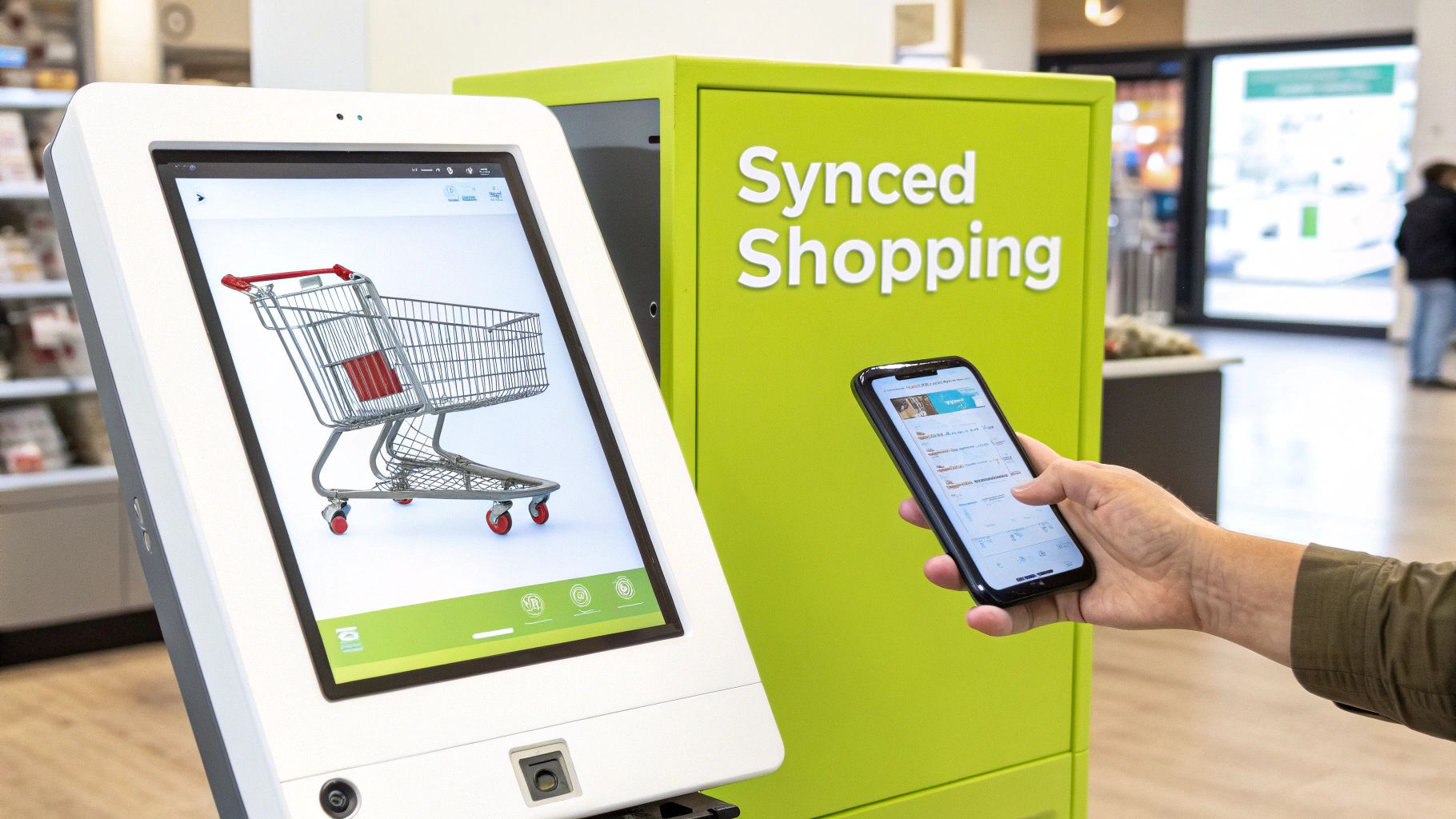
These examples go way beyond just offering multiple ways to shop. They're about making sure the customer's context—their history, preferences, and what they want right now—travels with them from one touchpoint to the next. It’s this seamless flow that makes the whole process feel personal and cohesive.
Retail: A Perfectly Synced Shopping Journey
Top-tier retailers are setting a high bar for omnichannel excellence. Their whole approach is built on a simple yet incredibly powerful idea: a customer's shopping cart is their cart, no matter where they are or what device they're using.
Picture a shopper named Alex. Here’s how his journey might play out:
- Mobile Discovery: On his morning commute, Alex is browsing the retailer's app and adds a new pair of running shoes to his cart. He gets busy and forgets about it.
- In-Store Exploration: Later that day, he walks into a physical store. He finds the shoes and uses an in-store kiosk to scan the barcode. It immediately pulls up his account and shows the shoes are already in his cart. The kiosk confirms his size is in stock and even suggests a pair of moisture-wicking socks.
- Desktop Completion: Back home, Alex logs into his account on his laptop. The running shoes and the recommended socks are right there waiting for him. He applies a loyalty discount he'd forgotten about and completes the purchase, choosing to pick it up in-store the next day.
This entire sequence is buttery smooth because the retailer’s systems are totally integrated. The cart syncs in real-time across all devices, and the inventory data is accurate and accessible everywhere. For Alex, it wasn't three separate shopping trips; it was one single, uninterrupted journey built around his convenience.
Banking: A Modern, Frictionless Application Process
The financial world has also jumped on the omnichannel train, especially to kill off the repetitive and frustrating paperwork that used to define processes like applying for a loan. Modern banks now orchestrate a journey that actually respects the customer's time and effort.
Think about a client applying for a mortgage:
- Online Start: She begins the application on the bank's website, filling out her initial personal and financial information from her couch.
- Mobile Document Upload: The next day, she gets a secure text message with a link. She uses it to upload required documents, like pay stubs and tax forms, just by snapping pictures with her phone.
- In-Person Finalization: She schedules a meeting at her local branch. When she arrives, the loan officer pulls up her complete, pre-filled application. There are no redundant questions. The officer simply verifies the details and discusses the final terms.
This approach transforms a traditionally agonizing process into a streamlined, collaborative effort. The customer never has to enter the same information twice, and the loan officer has all the context needed to provide expert guidance, building trust and confidence from the get-go.
These examples show the true power of an omnichannel strategy. It's not just about being available everywhere; it's about making all those channels work together intelligently to create a single, superior customer experience.
The Technology Powering A Seamless Customer Experience
Behind every great omnichannel experience, there’s a powerful technology stack doing the heavy lifting. These aren’t just fancy add-ons; they are the essential engine and nervous system connecting every channel to make a single, continuous customer journey possible.
Without the right tech working in harmony, a true omnichannel strategy is little more than a frustrating pipe dream. This section breaks down the core tools that make seamless integration a reality and shows how they create the personalized, context-aware interactions that customers now expect.
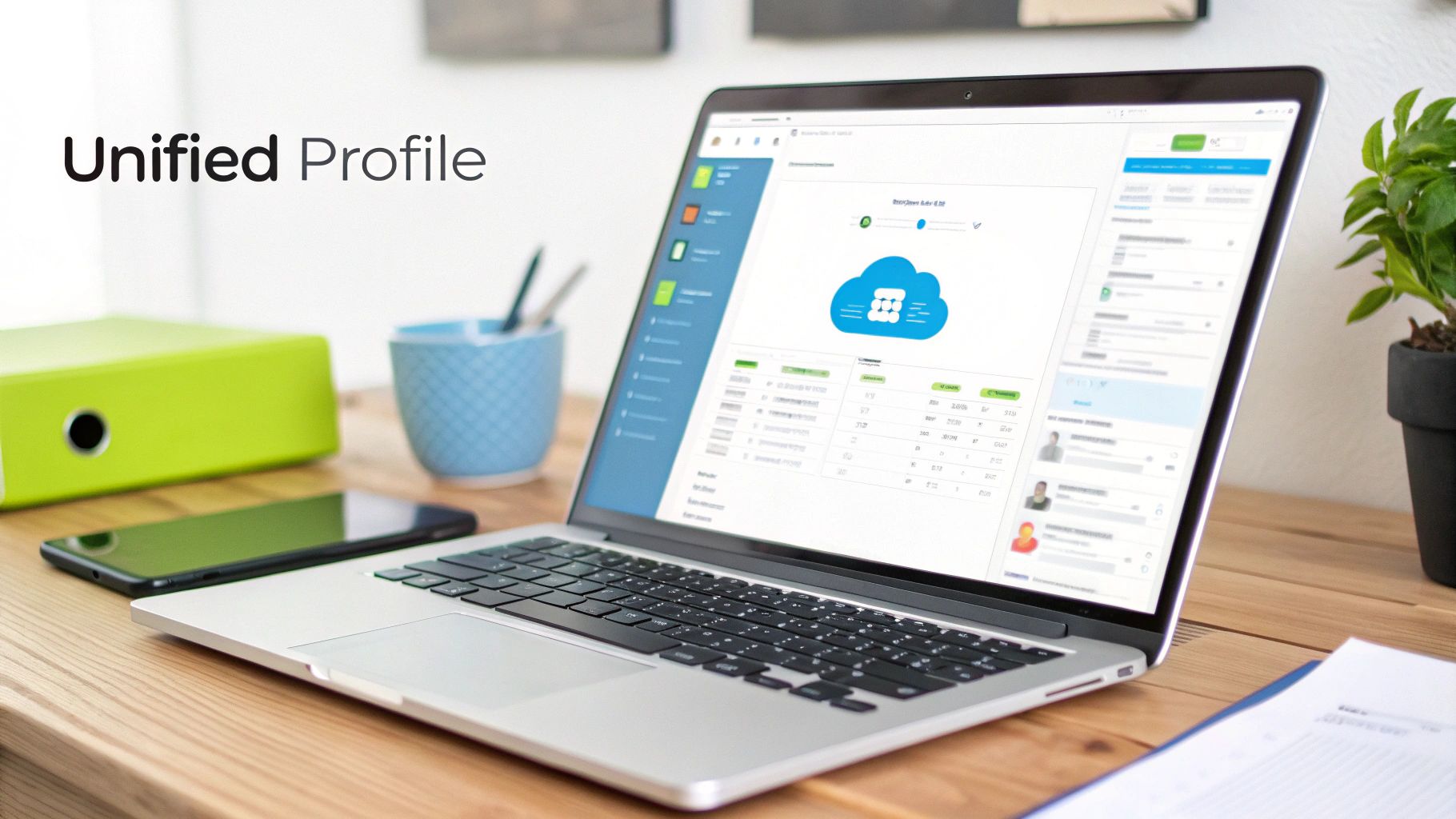
The Central Brain: Customer Data Platforms (CDP)
At the heart of any effective omnichannel setup is the Customer Data Platform (CDP). Think of it as the central brain of your entire operation. Its primary job is to collect customer data from every single touchpoint—website visits, mobile app usage, in-store purchases, support tickets, social media interactions—and stitch it all together.
The result is a unified customer profile, a single, comprehensive view of each person's history and behavior. This profile eliminates the data silos that plague less connected systems, where the marketing team has one version of the customer and the support team has another.
With a CDP, every department sees the same complete picture. For a detailed breakdown of how these platforms function as the core of modern marketing, check out our complete guide to Customer Data Platforms. This unified view is the non-negotiable foundation for delivering a consistent experience.
The Power of Artificial Intelligence in Omnichannel
If the CDP is the brain, then Artificial Intelligence is the supercharger for your omnichannel engine. AI takes the unified data and puts it into intelligent action, enabling a level of personalization and efficiency that’s simply not possible to do manually.
Here’s how AI makes a tangible difference:
- Predictive Personalization: AI algorithms analyze past behavior to predict what a customer might want next. For example, Netflix analyzes your viewing history to suggest movies you’ll probably love, keeping you engaged on their platform.
- Intelligent Chatbots: Forget the clunky bots of the past. AI-powered chatbots can handle complex queries, access a customer's order history, and provide instant, 24/7 support that actually helps.
- Optimized Messaging: AI helps figure out the best channel and time to contact each customer. It learns that one user responds best to SMS alerts in the morning, while another is more likely to open an email in the afternoon, ensuring your messages always land with maximum impact.
A crucial AI capability is the seamless handoff. An AI-powered chatbot can manage a customer's initial inquiry, gather all the necessary context, and then smoothly transfer the entire conversation to a human agent if the issue becomes too complex. The agent gets the full transcript and can pick up right where the bot left off, eliminating customer frustration.
How The Tech Stack Works Together
These technologies don't operate in isolation; their real power comes from how they integrate. A typical flow might look something like this:
- A customer browses a product on your mobile app. The CDP logs this activity.
- The customer abandons their cart, triggering a workflow.
- AI analyzes the customer's profile and determines the best next step. It decides against an immediate email and instead opts to show a targeted ad on social media an hour later.
- The customer clicks the ad, returns to the website, and starts a chat with a question.
- An AI chatbot answers the initial query. When the customer asks something more nuanced, the bot seamlessly transfers them to a live agent, who already has the full chat history and browsing context.
This kind of orchestration ensures the right message reaches the right person on the right channel at precisely the right moment. It's how you maximize ROI and create a customer experience that feels effortlessly helpful.
Common Omnichannel Pitfalls And How To Avoid Them
While a flawless omnichannel experience is the dream, the path to get there is littered with predictable roadblocks. Too many businesses stumble over the same hurdles, turning a promising strategy into a frustrating mess for both customers and their own teams. Knowing what these traps are ahead of time is the first step to sidestepping them entirely.
The most common and damaging mistake? Departmental data silos. This is what happens when your marketing, sales, and service teams are all operating from their own private islands of customer information. Nothing talks to each other. The result is a broken journey where a customer has to repeat their story at every single touchpoint, which completely defeats the whole point of omnichannel.
Breaking Down Internal Barriers
To tear down those silos, you need a single source of truth. The technical fix is a shared Customer Data Platform (CDP) that creates one unified profile for every customer, accessible to everyone. But tech alone won't solve it. You also have to build a culture of collaboration, creating cross-functional teams who are all aiming for the same customer-centric goals.
Another huge pitfall is inconsistent brand messaging. A customer gets an email with a special offer, but the in-store staff knows nothing about it. Your social media has a friendly, casual vibe, but calling support feels like talking to a robot reading a script. These disconnects don't just create confusion; they erode trust and make your brand feel unreliable.
A unified brand voice is non-negotiable. Every channel must reflect the same values, promises, and personality. This requires crystal-clear brand guidelines and regular training to get everyone from marketers to cashiers on the same page.
Aligning Technology and Operations
Tech gaps and clunky integrations will also cripple your omnichannel efforts. You might have great tools, but if your e-commerce platform doesn't sync with your inventory system in real-time, you're setting customers up for disappointment. A classic example is showing an item as "in-stock online" only for the customer to find it's not actually there—that's why understanding and preventing stockouts is so critical for a smooth journey.
Finally, internal resistance can quietly sabotage the entire strategy. If individual teams are rewarded for their own channel's performance instead of the overall customer journey, they'll hoard their data and refuse to collaborate. The fix is to redefine what success looks like. Shift from channel-specific metrics to goals that measure the quality of the end-to-end customer experience.
Avoiding these pitfalls isn't just about making customers happy; it directly hits your bottom line. Research shows companies with strong omnichannel engagement retain around 89% of their customers. Compare that to the dismal 33% retention rate for companies with weak, siloed approaches. Successfully navigating these challenges transforms your customer experience from a series of disconnected interactions into a powerful engine for loyalty and growth.
Got Questions About Omnichannel? We've Got Answers.
Even the clearest roadmap can have a few bumps. It’s only natural to have some practical questions pop up when you’re thinking about shifting to an omnichannel customer experience. Let's tackle some of the most common ones head-on.
What's the Real Difference Between Omnichannel and Multichannel?
If you remember just one word, make it integration.
Multichannel is about having multiple outposts. You’re on social media, you have an email list, you might have a physical store. But those outposts don’t talk to each other—they're operating in silos. For example, a customer service agent on the phone has no idea you just abandoned your online shopping cart.
Omnichannel, on the other hand, connects all those outposts into a single, intelligent network. The customer's history, context, and preferences travel with them, creating one continuous conversation with your brand. Think of it this way: multichannel gives customers options, but omnichannel gives them a unified journey.
I'm a Small Business. How Can I Possibly Afford an Omnichannel Strategy?
This is a big one, but the answer is simpler than you think: you don't have to boil the ocean. An omnichannel strategy doesn’t demand a massive, all-at-once investment. The secret is to start small and scale smart.
Instead of trying to launch and integrate every channel from day one, pick the two or three your customers already live on.
For a small e-commerce brand, that might mean focusing on connecting website chat, email support, and Instagram DMs. Using an affordable, integrated CRM or a modern customer service platform, you can unify conversations from these key touchpoints. You solve the biggest friction points first, delivering a better experience where it counts without breaking the bank.
What Are the Most Important KPIs for Measuring Omnichannel Success?
When your channels are working together, your metrics need to reflect that bigger picture. Ditch the siloed, channel-specific stats and focus on KPIs that measure the entire customer journey. The ones that truly matter are:
- Customer Lifetime Value (LTV): Is your integrated experience building real loyalty? A rising LTV tells you customers are sticking around and spending more over time.
- Customer Satisfaction (CSAT) Score: You need to measure this across all your channels. If you're seeing consistently high scores everywhere, your seamless experience is working.
- Customer Effort Score (CES): How easy is it for customers to get what they need? A low effort score is one of the strongest indicators of a well-oiled omnichannel machine.
- Retention Rate: This is the ultimate proof. A rising retention rate means your unified experience is giving customers compelling reasons to stay with you.
Ready to turn your customer journey into a revenue-generating machine? At Silver Spoon Agency, we specialize in building powerful, AI-driven omnichannel strategies that deliver exceptional results and a superior ROAS. Discover how we can help you scale your business.