


How to Hire a Med Spa Marketing Company for Real Growth

So, what exactly is a med spa marketing company? Think of them as a hyper-specialized extension of your team. This isn't your corner-shop agency that markets a plumber one day and a pizzeria the next. A true specialist lives and breathes the aesthetics industry, understanding everything from advertising compliance for medical treatments to the subtle art of attracting high-value patients who book, not just browse.
Their entire strategy is built around one thing: generating qualified leads that turn into booked appointments, not just vanity metrics like website clicks. For example, instead of celebrating 10,000 website visitors, they focus on generating 50 high-quality consultation requests for a high-margin service like CoolSculpting.
Why Specialized Med Spa Marketing Is No Longer Optional

The med spa industry is absolutely booming. The global market, valued at a staggering $18.6 billion in 2023, is on track to hit an incredible $49.4 billion by 2030. With over 10,500 med spas now operating in the US alone, the fight for patient attention has become incredibly intense.
This is precisely why a generic, one-size-fits-all marketing plan is a recipe for wasted money. A general agency might know how to run a Facebook ad for a local boutique, but do they understand the nuances of promoting Botox without getting your ad account shut down by Meta? It’s highly unlikely.
The Problem with Cookie-Cutter Marketing
Generalist marketing firms often apply the same tired playbook to every client. They'll suggest a few social media posts, sprinkle in some generic Google Ads, and hope something sticks. This approach completely misses the mark for the unique challenges of the aesthetic market.
For a med spa, effective marketing is about so much more than just getting your name out there. It’s about:
- Building Deep Trust: Patients aren't buying a t-shirt; they're making personal, often emotional, decisions about their appearance and health. Your marketing has to radiate professionalism, expertise, and safety. A practical example is using video testimonials from real patients (with consent) instead of just stock photos.
- Attracting High-Value Patients: The real goal isn't just a flood of leads. It's about attracting the right clients—the ones looking for high-ticket services like CoolSculpting or a series of Morpheus8 treatments. For instance, an ad campaign could specifically target users who have shown interest in luxury travel and high-end skincare brands.
- Navigating Strict Compliance: The aesthetics world is governed by a maze of rules about how you can advertise medical procedures, what claims you can make, and how you can use patient photos or testimonials. An ad saying "Erase your wrinkles!" will get flagged, but an ad saying "Soften the appearance of fine lines" is compliant.
A specialized med spa marketing partner arrives on day one already fluent in this world. They don't need to spend your ad budget learning the ropes. They come equipped with proven funnels, compliant ad copy, and a deep-seated understanding of your ideal patient’s mindset.
The Specialist Advantage in Action
Let’s look at a real-world example. A general agency might set up a Google Ads campaign targeting a broad, top-of-funnel keyword like "beauty treatments." The result? A lot of clicks from people who aren't serious buyers, such as teenagers looking for DIY facial masks.
A specialist, on the other hand, builds a laser-focused campaign around high-intent, transactional keywords like "Botox deals near me" or "microneedling for acne scars in Dallas." They know the specific terms that signal someone is ready to book an appointment. Understanding the unique role of a dedicated Med Spa SEO agency is a huge piece of this puzzle.
A specialist knows the patient journey inside and out. They understand that a lead asking about a HydraFacial has a completely different motivation—and requires a different nurturing sequence—than someone inquiring about a non-surgical facelift. This insight is the secret to converting leads into loyal, high-LTV patients who come back again and again.
To help you vet potential partners, let’s break down exactly what services you should expect them to master. We've put together a quick-glance table to summarize the core competencies that truly move the needle for a med spa.
Core Services Your Med Spa Marketing Partner Should Master
| Core Service | Why It's Critical for Med Spas | Expected Outcome |
|---|---|---|
| Paid Ads & Funnels | Targets high-intent users on platforms like Google, Meta, and TikTok, guiding them from awareness to a booked consultation. | A predictable flow of qualified leads and booked appointments. |
| Search Engine Optimization (SEO) | Captures organic traffic from patients actively searching for the treatments you offer in your specific geographic area. | Higher rankings on Google, increased website traffic, and more organic leads. |
| Local Targeting & Geofencing | Reaches potential patients within a specific radius of your med spa, targeting competitor locations or complementary businesses. | Increased local brand awareness and foot traffic from your immediate area. |
| AR Try-On Features | Allows potential patients to virtually "try on" aesthetic results, reducing hesitation and increasing conversion rates. | Higher engagement on your website and social media, and more confident leads. |
These aren't just buzzwords; they are pillars of a comprehensive strategy. A great agency won't just offer one of these—they'll know how to weave them together into a cohesive plan that drives real, measurable growth for your practice.
The Modern Med Spa Marketing Toolkit
So, you know you need a specialist. That’s a great first step. The next, and arguably more important, is understanding what a high-performance med spa marketing company actually does. Their toolkit isn't just about "running some ads"—it’s a sophisticated, multi-channel system built to attract, engage, and convert high-value patients.
Forget vague promises about "more exposure." A top-tier agency brings a specific, measurable, and integrated set of services to the table. Let’s pull back the curtain on the essential components you should expect and the real-world results they ought to deliver.
Precision-Targeted Paid Advertising
Paid advertising is the fastest way to get your med spa in front of people actively looking for the services you offer. Success here, however, hinges on surgical precision, not just a big budget. A skilled agency won't just throw money at broad keywords; they build campaigns that zero in on specific demographics, locations, and user behaviors.
Take a campaign for CoolSculpting, for instance. Blasting ads across an entire city is a waste of money. A savvy agency will use Meta's and Google's powerful targeting tools to focus your ad spend on affluent zip codes where residents have higher disposable income and a proven interest in body contouring or luxury wellness. For example, they might target women aged 35-55 within a 10-mile radius of your spa who follow pages like Vogue and Equinox.
This granular approach ensures your marketing dollars are spent on prospects who are most likely to book, which dramatically improves your Return on Ad Spend (ROAS).
High-Intent Search Engine Optimization
While ads get you immediate traffic, Search Engine Optimization (SEO) is all about building your long-term, organic pipeline of new patients. It's the art of making sure your med spa shows up at the top of Google right when a potential patient is ready to make a decision.
A proficient med spa marketing company focuses on what we call high-intent keywords. These are the specific phrases people type in when they’ve moved past the research phase and are ready to schedule an appointment.
Think about the difference:
- General Keyword: "acne treatments" (This is broad, indicating low buying intent).
- High-Intent Keyword: "microneedling for acne scars in Atlanta" (This is a specific service for a specific problem in a specific location—this person is ready to book).
Ranking for these specific, localized phrases is what fills your calendar with qualified leads, not just window shoppers. It's the difference between attracting casual browsers and attracting your next loyal patient.
Conversion-Focused Landing Pages
Driving traffic to your website is only half the battle. If that hard-won traffic lands on a confusing homepage, those potential leads will simply click away. This is where conversion-focused landing pages become absolutely critical.
An expert agency will create dedicated, streamlined pages for each of your core services and ad campaigns. These pages are designed with one single, clear goal: to get the visitor to take a specific action, whether that's booking a consultation or calling your front desk.
A well-designed landing page for a Morpheus8 campaign won't just list the features. It will include compelling before-and-after galleries, patient testimonials, an FAQ section addressing common concerns, and a prominent, easy-to-use form to request a consultation. This pre-qualifies and educates the lead before they even speak to your staff.
Hyper-Local Geofencing and Targeting
Geofencing is an incredibly powerful tool for reaching potential patients out in the physical world. It lets you draw a virtual "fence" around a specific geographic area, allowing you to deliver targeted ads to people who enter that zone.
A strategic med spa marketing company can use this ethically and with huge effect. Imagine setting up a geofence around:
- Competitor Locations: Reaching individuals who have just visited a rival med spa with an ad like, "Still deciding? Get a free consultation at [Your Spa Name] this week."
- Complementary Businesses: Targeting patrons of high-end salons, luxury fitness centers, or pilates studios with an offer for a "post-workout HydraFacial."
- Upscale Neighborhoods: Making sure your brand stays top-of-mind for residents in your key demographic areas.
This hyper-local approach puts your message directly in front of the right audience at exactly the right time, maximizing relevance and all but eliminating wasted ad spend. For a deeper dive into the specific strategies that drive patient growth, you can find valuable insights in our comprehensive guide on marketing for med spas.
AI-Powered Campaign Optimization
The most forward-thinking agencies are now using Artificial Intelligence to get results that were unthinkable just a few years ago. AI algorithms can analyze thousands of data points in real time to optimize campaigns far more efficiently than a human ever could.
This technology can automatically:
- Adjust Bids: If an ad campaign for facials performs best on Tuesdays at 10 AM, the AI will automatically bid higher during that window to maximize visibility.
- A/B Test Creative: Rapidly identify which ad images, headlines, and calls-to-action generate the most leads. For instance, testing a photo of the treatment room vs. a patient's results to see which one gets more clicks.
- Predict Audience Behavior: Uncover new audience segments that are likely to be interested in your services.
The outcome is a continuous cycle of improvement that steadily lowers your cost per lead and increases the overall profitability of your marketing. When you're vetting an agency, be sure to ask them how they use data and automation to optimize performance. Their answer will tell you a lot about their capabilities.
Decoding the Numbers: KPIs and Realistic ROAS
When you hire a med-spa marketing company, you're not just buying services—you're making a direct investment in financial outcomes. Success isn't measured in likes, shares, or a flurry of website visits. It's measured in profitable growth.
That means you need to track the key performance indicators (KPIs) that actually impact your bottom line.
A top-tier agency will immediately shift the conversation away from "vanity metrics" and toward the numbers that truly matter. These are the metrics that give you a clear, unfiltered view of your marketing's financial health and its direct contribution to your practice.
KPIs That Actually Drive Profitability
Forget about obsessing over follower counts. Your marketing partner should build their entire strategy and reporting around a core set of financial KPIs. For any med spa that wants to scale predictably, these three are non-negotiable.
Here’s what you need to focus on:
- Cost Per Lead (CPL): This tells you exactly how much you're spending to get one new inquiry from a potential patient. If you spend $2,000 on Meta ads and get 40 new form submissions, your CPL is a straightforward $50. A great agency will constantly be working to get this number down.
- Cost Per Acquired Patient (CPA): This is the ultimate metric. It tracks the real cost of getting a new, paying patient through the door. If those 40 leads turned into 8 new patients, your CPA is $250. This number connects your marketing spend directly to actual revenue.
- Patient Lifetime Value (LTV): This metric projects the total revenue a single patient is likely to generate throughout their entire relationship with your med spa. For example, a patient who comes for Botox quarterly ($500 x 4 = $2,000/year) and then adds a series of Morpheus8 treatments ($3,500) has a much higher LTV than a one-time facial client.
Understanding these numbers is the key to making data-driven decisions. You'll stop wondering if your marketing is working and start knowing precisely how much revenue each dollar of ad spend is generating.
A common mistake is getting fixated on a low Cost Per Lead. A CPL of $10 looks fantastic on paper, but if those leads are low-quality and never book an appointment, you've just wasted your money. A higher CPL of $75 that consistently produces high-value, paying patients is infinitely more valuable.
Understanding Agency Pricing Models
Once you're speaking the same financial language, it's time to dig into how a med-spa marketing company will charge for its services. Pricing structures can vary, but they usually fall into a few common buckets. Knowing the difference will help you choose a partner whose model aligns with your growth goals.
Monthly Retainer
This is the most common model you'll see. You pay a fixed fee each month for a defined scope of services, like SEO, ad management, and content creation. It gives you predictable budgeting and allows the agency to dedicate consistent resources to building your brand.
- Realistic Price Range: Expect retainers to start around $3,000 to $7,000+ per month, not including your actual ad spend. The final cost will depend on the scope of work and the agency's level of expertise.
Performance-Based Model
In this model, the agency's fee is tied directly to the results they generate. This could be structured as a fee per lead, a fee per booked appointment, or even a percentage of the revenue generated from their campaigns. The beauty of this model is that it perfectly aligns the agency's incentives with your own.
- Realistic Price Range: This is highly variable, but you might see rates of $50-$150 per qualified lead or a percentage of sales. It does require sophisticated tracking on both sides to work effectively.
Setting Realistic ROAS Expectations
Finally, let's talk about the most important acronym in performance marketing: ROAS (Return on Ad Spend). This metric measures the gross revenue generated for every single dollar you spend on advertising. It's the clearest indicator of whether your campaigns are profitable.
A healthy target ROAS for a med spa is typically between 3x and 5x. This means for every $1 you spend on ads, you should be generating $3 to $5 in revenue.
Here’s a practical example: If your monthly ad spend is $5,000 and you hit a 4x ROAS, your campaigns should generate $20,000 in new patient revenue. This is the kind of clear, measurable outcome that separates a true growth partner from a typical marketing vendor.
If you're interested in mastering this metric, our team put together a detailed guide on how to calculate your Return on Ad Spend.
Choosing the right marketing partner is, without a doubt, the single biggest decision you'll make for your med spa's growth. Get it wrong, and you're looking at torched budgets and months of lost momentum. But get it right? You unlock predictable, profitable expansion. Vetting a potential med spa marketing company means you have to cut through the slick sales pitch and really scrutinize their expertise.
This whole process starts with knowing the classic warning signs of an agency that’s all sizzle and no steak. Be wary of any firm that promises you the world without showing you a realistic map of how they'll get you there.
Spotting the Red Flags Early
Some agencies are absolute masters of the proposal document but fall apart when it comes to execution. They’ve memorized all the right buzzwords but can't actually back them up with proven, industry-specific strategies.
Here are the big red flags I tell every med spa owner to watch for during those initial calls:
- "Guaranteed" #1 Rankings: Let's be clear: nobody can guarantee a top spot on Google. SEO is a living, breathing thing influenced by hundreds of factors. Anyone making that promise is either lying or fundamentally misunderstands how search engines actually work.
- Vague, "Cookie-Cutter" Strategies: If their proposal feels like it could be for a dentist, a lawyer, or a plumber, run. A real specialist will be talking about patient acquisition for services like CoolSculpting or Morpheus8, not just generic "social media management."
- A Glaring Lack of Med Spa Case Studies: Ask to see their portfolio. If all they can show you are results for an e-commerce brand or a local pizza shop, they don't have the specific experience needed to navigate patient privacy compliance and attract high-value aesthetic clients.
To help you quickly sort the good from the bad, I've put together a little checklist. Think of it as your field guide to spotting a great partner versus one that will cause you headaches down the road.
Agency Vetting Checklist Red Flags vs Green Flags
| Red Flag (Warning Sign) | Green Flag (Positive Indicator) |
|---|---|
| Promises guaranteed #1 rankings or specific results. | Sets realistic expectations and focuses on data-driven goals. |
| Presents a generic, one-size-fits-all proposal. | Customizes the strategy to your specific services and local market. |
| Cannot provide recent, relevant med spa case studies. | Eagerly shares detailed case studies with clear KPIs and ROI. |
| Focuses on vanity metrics like clicks and impressions. | Centers the conversation around CPL, CPA, and patient revenue. |
| Lacks a clear process for tracking patient acquisition. | Can clearly explain their attribution model and tracking software. |
| The team members you meet have no aesthetics experience. | The team has demonstrable experience marketing for med spas. |
| They avoid tough questions or give vague, evasive answers. | They welcome detailed questions and provide confident, specific answers. |
| High-pressure sales tactics and "today-only" offers. | A consultative sales process focused on fit and long-term partnership. |
This table isn't exhaustive, but it covers the major points that separate the professionals from the pretenders. A great agency won't just tick the boxes on the right; they'll embody those principles in every conversation you have with them.
Asking Tough Questions That Reveal True Expertise
A great agency won’t just tolerate your tough questions—they’ll be excited to answer them. Their confidence is born from a track record of delivering real, tangible results. Your job is to push past the surface-level stuff and dig into the nitty-gritty of their process and performance.
The quality of their answers will quickly separate the contenders from the pretenders. If you get a lot of "we'll figure that out" or "it depends," that's a clear warning sign.
A top-tier med spa marketing company should be able to walk you through their entire patient acquisition process, from the very first ad click all the way to the final booking confirmation. If they can't articulate how they track results and prove their value, they can't effectively manage your investment.
To get you started, here are some pointed questions you should ask every single agency you talk to. For an even more exhaustive list of questions, you can check out our complete guide on how to choose a marketing agency.
- Can you walk me through a successful patient acquisition funnel you built for a clinic offering services similar to mine? This question forces them out of the theoretical and into a practical example of their work.
- How do you attribute new patients back to specific marketing campaigns? Their answer here is critical. It will show you how sophisticated their tracking and analytics are, which is the only way to truly prove ROI.
- What's your process for A/B testing ad creative and landing pages? This reveals if they have a systematic approach to optimization or if they just "set it and forget it."
- How will you report on performance, and which KPIs will you focus on? You want to hear them talk about metrics that matter to your bottom line, like Cost Per Lead (CPL) and Cost Per Acquired Patient (CPA), not vanity metrics like impressions or clicks.
Analyzing Their Past Work and Verifying References
The final piece of the puzzle is to verify their claims. Don't just take their slickly designed case studies at face value—ask to speak directly with their clients.
When you get a reference on the phone, ask about the agency’s communication, their proactivity, and most importantly, the financial results they delivered. Were they a true partner, or just another vendor? A great question is, "Can you give me an example of a time the agency proactively identified a problem and fixed it?"
Marketing investment is a major divider in the med spa industry. We've seen data showing that 52% of practices spending under $2,500 a month on marketing tend to stagnate, while the top performers pull way ahead with data-backed strategies. The ones who partner with specialized agencies have seen incredible results, like a +191% increase in monthly leads and +440% growth in top keyword rankings. This just hammers home how critical it is to choose a partner that can execute at a high level.
As you research potential partners, you might come across firms like gethukt that specialize in this space. A thorough review of their website, client testimonials, and online reviews can give you another layer of insight into their capabilities before you even pick up the phone. This is the kind of due diligence that protects your investment and puts your med spa on the fast track to scalable success.
Your First 90 Days: What to Expect After You Hire
You’ve signed the contract. The marketing agency you chose looks promising, and you're ready for the phone to start ringing. This is where the real partnership begins, but it’s critical to set the right expectations.
The first 90 days aren’t about an immediate flood of new patients. Instead, this is the foundational period where you and your new partner build the engine for sustainable, long-term growth. A methodical start is crucial; it ensures everyone is aligned on goals, strategy, and communication from day one.
The Critical Onboarding Phase
Before a single ad goes live, a thorough onboarding process has to happen. This is where your new agency gets the keys to your digital kingdom and truly learns the ins and outs of your business. Think of it as their residency in your med spa's brand.
This phase is a two-way street and needs your active participation. Your agency should give you a clear checklist of what they need, which will almost always include:
- Granting Administrative Access: They’ll need access to your Google Analytics, Google Business Profile, Meta Business Suite (for Facebook and Instagram ads), Google Ads account, and your website’s backend. This is non-negotiable for proper tracking and campaign management.
- Defining Ideal Patient Personas: You'll collaborate to build detailed profiles of your ideal patients. For instance, a Morpheus8 persona might be a 45-year-old woman concerned with skin laxity, living in an affluent suburb, and who follows Dr. Lara Devgan on Instagram. A laser hair removal persona could be a 28-year-old professional looking for convenience before a big vacation.
- Establishing Communication Protocols: You'll set the meeting cadence (weekly or bi-weekly is common), define the primary points of contact, and agree on how and when reports will be delivered. For example, you might agree to a weekly 30-minute Zoom call for updates and a monthly PDF report detailing all KPIs.
This initial setup might feel like a lot of administrative work, but it’s the bedrock of everything to come.
The visual decision tree below can help frame your thinking as you finalize your agency choice, reinforcing the need to focus on niche expertise and proven results.
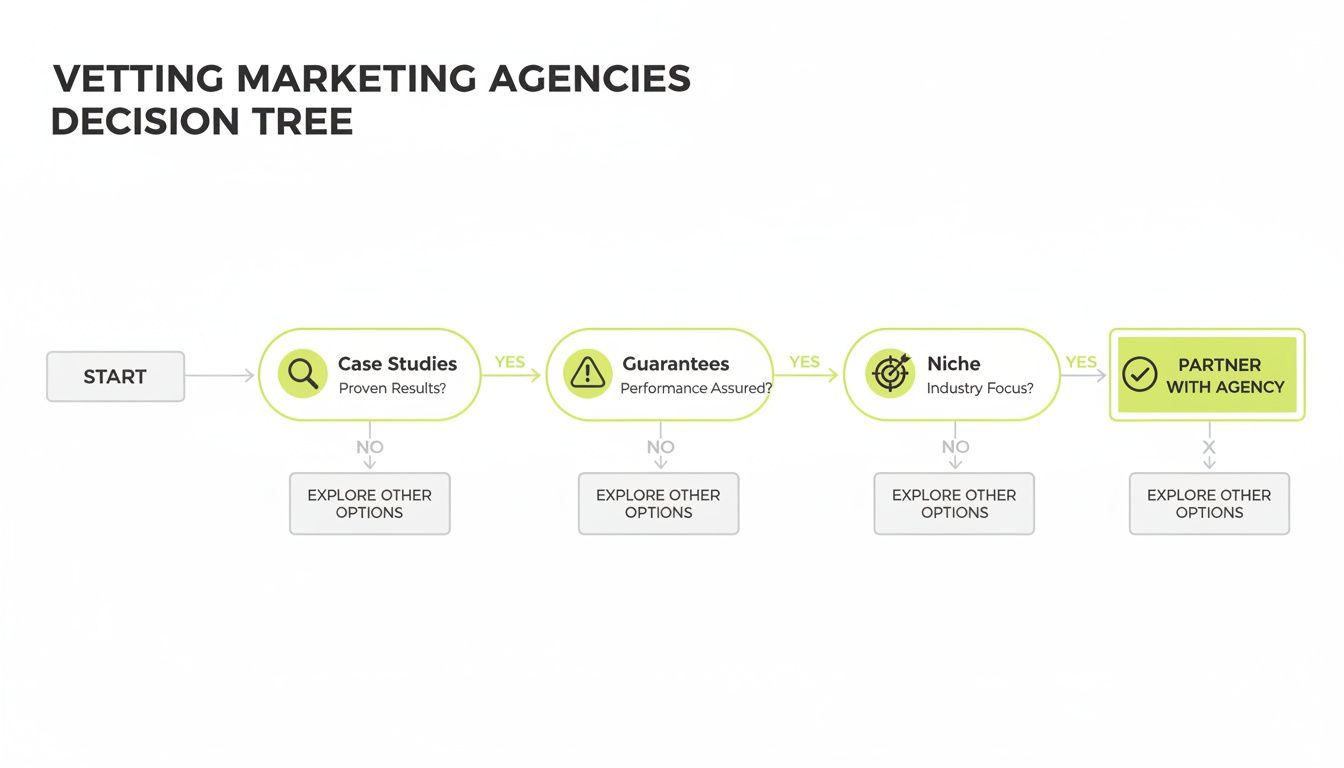
This graphic drives home a key point: a solid evaluation process—one that prioritizes niche focus and verifiable case studies while being skeptical of unrealistic guarantees—is your surest path to a successful partnership.
Month 1: The Strategy and Discovery Period
The first 30 days are all about deep research, technical setup, and hammering out the strategy. Your agency isn't just waiting around; they're meticulously building the engine before they even think about turning the key.
Here’s what they should be busy with:
- Technical Audits: Conducting comprehensive SEO and website audits to sniff out any technical glitches that could sabotage performance, like a slow page load speed on your booking page.
- Keyword Research: Identifying the high-intent keywords your ideal patients are actually typing into Google, like "best CoolSculpting provider in Austin" or "Semaglutide for weight loss near me."
- Competitive Analysis: Digging into what your top competitors are doing, what's working for them, and where you can carve out your own market share. They might discover your competitor ranks #1 for "HydraFacial" but has no content about Morpheus8, revealing a clear opportunity.
- Creative Development: This is when they start drafting ad copy, designing visuals, and building out the first round of landing pages for your campaigns.
By the end of Month 1, you should have a finalized marketing strategy, a clear campaign plan, and all the necessary tracking pixels and codes installed correctly on your website.
Month 2: The Launch and Data Gathering Phase
With the foundation poured, Month 2 is for execution. This is when your first campaigns go live and your agency starts gathering that crucial initial performance data. It's an exciting time, but manage your expectations.
Not every ad will be a home run out of the gate. The goal this month is not maximum profitability; it's maximum learning. Your agency will be glued to the metrics, figuring out which audiences are responding, what ad creative earns the clicks, and which landing page variations are converting.
Don’t panic if the early results look mixed. For example, your first set of Facebook ads might have a high CPL of $120. This is a completely normal part of the process. A good agency uses this initial data to test new images or headlines to bring that cost down in the next phase.
Month 3: The Optimization and Scaling Stage
By the time you hit Month 3, your marketing partner should have enough data to start making intelligent, data-backed decisions. This is where you truly start to see the value of hiring experts. They’ll begin systematically refining and improving every piece of the puzzle.
Key activities this month include:
- Scaling What Works: Funneling more ad spend into the campaigns, ad sets, and creative that are clearly delivering the best results. For example, if a video testimonial ad is generating leads at a $45 CPL, they'll increase its daily budget.
- Pausing Underperformers: Ruthlessly turning off the ads and strategies that aren't pulling their weight or delivering a positive return, such as an image-based ad with a CPL of $150.
- Reporting on Early KPIs: By the end of this month, you should see a consistent flow of qualified leads and receive a clear report on initial KPIs like Cost Per Lead (CPL) and click-through rates.
This 90-day roadmap doesn’t just get you started; it ensures you and your agency are perfectly aligned for a productive, results-driven partnership. It transforms marketing from a guessing game into a methodical process of growth.
Clearing the Air on Med Spa Marketing
Even the most detailed guide can leave you with a few nagging questions. When you’re on the verge of making a significant investment in your practice’s growth, you need straight answers. Here are the most common questions we hear from med spa owners, answered with the kind of clarity you only get from experience.
How Much Should a Med Spa Realistically Spend on Marketing?
For a practice that’s serious about growth, the benchmark is allocating 7-15% of your gross revenue toward marketing. If your med spa grosses $1 million annually, that's a marketing budget of $70,000-$150,000 for the year. If you’re just opening your doors or you’re up against heavy competition in a major city, you might need to push that closer to 15-20% just to carve out your initial market share.
The biggest mental shift is to stop seeing this as an expense. It's a direct investment in acquiring new, high-value patients.
A competent med spa marketing partner should generate a return that makes your monthly spend feel like a bargain. But be realistic—if your total budget (that’s agency fees plus ad spend) is less than $3,000-$5,000 per month, you'll struggle to compete effectively in most markets and see any significant return.
What Is a Realistic Timeline for Seeing Actual Results?
Sustainable growth is a process, not an event. You need to plan for a 90-day ramp-up period with any new marketing partner. This isn’t a delay tactic; it’s the time required to build a predictable patient acquisition machine the right way.
- Month 1: This is all about strategy and foundation. We're talking deep market research, technical setup, and crafting the initial campaigns. No ads are running yet.
- Month 2: The campaigns go live. The agency starts collecting crucial performance data. The goal here is learning and gathering intel, not immediate profitability. You might get 15-20 leads this month as the agency tests different approaches.
- Month 3: Armed with a few weeks of real-world data, the optimization begins. Your agency will start scaling what’s working and cutting what isn't. This is when you should begin to see a consistent, predictable flow of qualified leads, perhaps doubling to 40-50 leads this month.
Be extremely skeptical of any firm promising you a flood of new patients in the first 30 days. Real, scalable growth is built methodically.
Can't I Just Hire a General Digital Marketing Agency?
While it might seem like a way to save money, hiring a generalist is one of the biggest risks you can take. The aesthetics industry is a different world, full of compliance hurdles and advertising regulations that a generalist agency simply doesn't know how to navigate. For example, they might run a Facebook ad with a before-and-after photo of a Botox treatment, which is a direct violation of Meta's ad policies and will get your account shut down.
A specialized med spa marketing company hits the ground running. They already have proven playbooks for your exact services and know how to speak the language of your ideal patient. That expertise dramatically shortens the learning curve and delivers far more dependable results, faster.
What's the Single Most Important Metric I Should Track?
Lots of metrics matter, but if you can only track one, make it your Cost Per Acquired Patient (CPA). This number cuts through all the noise—clicks, leads, impressions—and tells you exactly how much marketing spend it takes to put a new, paying patient in your treatment chair.
It’s the metric that connects your marketing spend directly to your bank account. For example, if you spend $5,000 on marketing in a month and acquire 20 new paying patients from those efforts, your CPA is $250. This tells you if acquiring that patient was profitable.
A great agency won't just track leads; they will have a clear system for tracking CPA, often by integrating their campaign data with your practice's patient management software. Your CPA is the ultimate measure of profitability. It tells you, without a shadow of a doubt, if your marketing engine is truly scalable.
Ready to stop guessing and start growing with a data-driven partner? The team at Silver Spoon Agency specializes in building predictable patient acquisition systems for med spas just like yours. Book a call today to see how our proven strategies can fill your calendar with qualified patients.