


How to Increase Average Order Value with 9 Proven Strategies

When you want to know how to increase average order value, it really boils down to a handful of core tactics that have been proven time and time again: product bundling, upselling complementary items, and setting minimum order thresholds for perks like free shipping. These aren't just random ideas; they are specific strategies designed to nudge customers into adding more to their carts before they click "buy," which is how you directly pump up the value of every single transaction.
Why AOV Is Your Smartest Growth Lever
While chasing a constant stream of new customers feels like the most obvious path to growth, it's almost always the most expensive one. Honing in on your Average Order Value (AOV) is a much smarter, more cost-effective way to scale.
It’s all about generating more revenue from the customers you already have. This shift doesn't just look good on paper; it directly improves your return on ad spend (ROAS) and overall profitability.
Think about it. Acquiring a brand-new customer means paying for ads, pouring effort into marketing campaigns, and building trust from absolute zero. On the other hand, convincing a customer who is already on your site and ready to buy to add one more item to their cart? That’s a much, much smaller hill to climb. This simple change in focus is a total game-changer for building a sustainable business.
Calculating Your Average Order Value
Before you can start improving your AOV, you've got to know where you stand. The formula couldn't be simpler:
AOV = Total Revenue / Number of Orders
So, if your store pulled in $50,000 in revenue from 500 orders last month, your AOV is $100. That number is your starting line—the metric you’re officially trying to beat.
By tracking AOV, you gain immediate, powerful insight into what your customers are actually doing. A rising AOV is a clear signal that your pricing, promotions, and product suggestions are hitting the mark, leading directly to healthier profit margins.
The Impact on Your Bottom Line
A higher AOV creates a powerful ripple effect that touches every part of your business. This isn't just a vanity metric; it’s a core pillar of a resilient financial strategy.
Here’s a quick rundown of the benefits:
- Improved Profitability: When you sell more per transaction, your profit margins naturally increase. Your fixed costs, like marketing and operations, get spread across a larger revenue base. For example, if your profit on an $80 order is $20, but a customer adds a $20 high-margin accessory, your profit on that single $100 transaction might jump to $35.
- Higher Return on Ad Spend (ROAS): If each customer you acquire spends more, the return you get on your initial ad investment skyrockets. Suddenly, your marketing budget is working a lot harder for you.
- Enhanced Customer Lifetime Value (LTV): Customers who make larger initial purchases tend to be more engaged. They're often the ones who come back for more, which boosts their long-term value to your business.
Industry trends back this up completely. The global e-commerce average order value hit a record $144 in 2024 and is projected to climb to between $150-$180 by the end of 2025. This growth isn't happening by accident; it's being driven by smart tactics like upselling and free shipping incentives.
This isn't just a number to glance at. It's solid proof that customers are willing—and often eager—to spend more when presented with the right offers at the right time. For a deeper dive into scaling your online store, you should explore these proven ecommerce growth strategies.
Mastering Upsells and Cross-Sells at Checkout
While there are plenty of ways to nudge a customer's final cart total, upselling and cross-selling are the most direct tactics you can deploy. When done right, they don't just pump up your revenue; they genuinely make the customer's experience better by helping them find products that solve their problem more completely.
The real key is to make these suggestions feel like a helpful recommendation from an expert, not a pushy sales pitch. Get this right, and you transform a simple transaction into a value-added service, building trust and encouraging larger orders.
The Art of the Strategic Upsell
An upsell is all about guiding a customer to a more premium, feature-rich, or larger version of the product they're already looking at. You’re showing them a better solution to the problem they're trying to solve. The goal isn't to get them to spend more, it's to highlight superior value.
A perfect practical example comes from the travel industry. When a customer selects a standard hotel room, a well-timed upsell would be a pop-up showing them a "Room with a View" for just $20 more per night. The pitch isn't just "spend more," it's "get a better experience."
This plays out in services, too. A SaaS company like a project management tool might show a user on their free plan a prompt highlighting the paid tier's benefits—like unlimited projects or advanced analytics—right when they try to create their sixth project.
The sweet spot for an upsell is when a customer has high purchase intent but hasn't fully committed. This is usually on the product detail page or as they review their cart, where the value proposition of an upgrade is easiest to compare and justify.
These moments are your best chance to show how a slightly higher investment leads to a significantly better outcome, which is the core principle behind increasing your average order value.
Perfecting the Cross-Sell Opportunity
Cross-selling is about recommending complementary products that pair well with something the customer has already decided to buy. It’s the digital version of asking, "Would you like fries with that?"—a classic AOV-boosting move.
A skincare brand could nail this by displaying a "Frequently Bought Together" module under a moisturizer, suggesting a matching facial serum and eye cream. Suddenly, a single-item purchase becomes a complete skincare routine, directly bumping up the cart size.
Likewise, an online clothing store can recommend a belt and shoes that perfectly match the pair of trousers a customer just added to their cart. For instance, a Shopify store could use an app that automatically suggests a specific leather belt from its catalog whenever a user adds a pair of chinos to their cart. This works because it simplifies the shopping process and helps the customer visualize a complete look, adding value that goes beyond the individual items.
Implementation Playbook for Checkout Offers
Bringing these strategies to life requires smart placement and timing. The checkout funnel is a delicate environment, but it offers several prime opportunities to present relevant offers without creating friction.
- Cart Page Suggestions: Before the final payment step, use a visually distinct section to display items that "complete the look" or are "essentials for your new purchase." A great example is Amazon’s “Customers who bought this item also bought” section directly on the cart page.
- One-Click Post-Purchase Offers: The 'thank you' page is an underutilized goldmine. After a customer has completed their purchase, their trust is at a peak. Present a special, one-time offer for a related product they can add to their order with a single click. A popular implementation is offering a digital download, like an e-book guide for the product just purchased, for a few extra dollars.
- 'Frequently Bought Together' Modules: This is a non-negotiable for product detail pages. By showing what other customers have purchased alongside an item, you're tapping into social proof to validate the cross-sell recommendation.
These tactics consistently drive growth. Smart upselling and cross-selling strategies have been shown to propel average order values upward, with businesses often seeing 10-30% revenue increases. Post-purchase offers, in particular, can tack on an extra 10-15% to your revenue at a much lower acquisition cost.
Ultimately, mastering these techniques is central to optimizing your entire sales process. For a deeper dive into structuring your customer journey for maximum value, take a look at these sales funnel optimization strategies.
Creating Irresistible Bundles and Incentives
While upsells and cross-sells are solid tactics, they aren't the only way to convince customers to spend a little more. You can get just as far by tapping into a couple of fundamental psychological triggers: our love for a good deal (perceived value) and our innate desire to reach a goal (goal completion).
This is where product bundles and minimum order incentives come into play.
These strategies expertly shift the customer's focus from "How much does this cost?" to "Look how much I'm saving!" or "What do I get if I spend just a bit more?" This simple reframing is the secret to boosting AOV without coming across as pushy. When a customer feels like they're getting a bargain or earning a reward, adding more to their cart feels like a personal win.
Crafting High-Value Product Bundles
Product bundling does two things brilliantly: it simplifies the buying decision for your customer and it increases the units per transaction for you. Instead of making them hunt around for complementary items, you present a complete, ready-to-go solution in one package—usually at a slight discount.
The real magic of a great bundle is that it feels curated and thoughtful. If you sell coffee, this isn't just about moving more beans. It’s about creating a "Home Barista Starter Kit" with espresso beans, a milk frothing pitcher, and a set of nice glass mugs. This kind of bundle speaks directly to a customer's aspiration to level up their coffee game at home.
Here are a few more real-world examples to get the ideas flowing:
- For a BBQ Store: Put together a "Complete Grill Master Set" with a high-quality spatula, tongs, a meat thermometer, and your signature BBQ sauce. This solves the immediate problem of needing all the right tools for a weekend cookout.
- For a Skincare Brand: Offer a "Morning Routine Kit" that includes a cleanser, vitamin C serum, and a moisturizer with SPF. You’re not just selling products; you’re guiding the customer toward an effective, complete regimen.
- For a Tech Retailer: Package a new gaming console with an extra controller and a hot new game. This creates a perfect "play right out of the box" experience.
Beyond physical products, service and software businesses can see huge gains by implementing a smart tiered pricing strategy. This naturally encourages customers to select higher-value plans, directly bumping up your AOV.
A well-designed bundle does far more than just move inventory—it dramatically increases perceived value. In fact, studies show that bundling can lift AOV by as much as 55% and revenue per user by 86%. Customers stop focusing on the cost of individual items and instead see the incredible value of the overall package.
Motivating Shoppers with Minimum Order Incentives
One of the most dependable ways to nudge that order value up is to give customers a clear, attainable goal. Set a spending target and offer a reward for hitting it. This is a powerful motivator that often convinces them to add just one more item to their cart to unlock the prize.
The undisputed champion of incentives? Free shipping. With unexpected shipping costs being one of the top reasons people abandon their carts, offering to waive that fee is a massive draw.
The key is setting your free shipping threshold strategically—don't just pull a number out of thin air. A simple but effective formula is to set it 15-20% above your current AOV. So, if your average order is $80, a free shipping offer at $100 feels totally achievable and prompts shoppers to find that extra $20 item.
But free shipping isn't your only play. You can use thresholds to unlock all sorts of valuable perks.
Popular Threshold Incentives
| Incentive Type | Description | Practical Example |
|---|---|---|
| Free Gift | Offer a desirable, often smaller, product for free once a spending minimum is met. | A beauty brand offers a free travel-size moisturizer on all orders over $75. |
| Tiered Discounts | Increase the discount percentage as the cart value grows. | "Spend $100, get 10% off. Spend $150, get 15% off." |
| Exclusive Product | Unlock the ability to purchase a limited-edition or special item after hitting a threshold. | A collectible toy store gives access to a rare figure on orders over $200. |
By using smart bundles and compelling incentives, you create a shopping experience where customers feel rewarded for spending more. They walk away with more value, and you walk away with a healthier bottom line. It’s a true win-win that consistently lifts your AOV.
Using Personalization to Drive Higher Order Values
Let's be blunt: generic, one-size-fits-all offers are the fastest way to get ignored. If you really want to bump up your average order value, you have to move past broad promotions. It’s all about presenting offers that feel like they were made for that specific customer, right at that moment.
That’s where personalization comes in. By tapping into your customer data—their purchase history, what they've been clicking on—you can serve up dynamic product suggestions that are genuinely helpful. It’s the difference between an annoying, random popup and a timely recommendation that feels like a personal shopper just stepped in to help.
Leveraging Customer Data for Smarter Offers
Good data is the bedrock of personalization. Every click, every past purchase, every abandoned cart tells a story about what your customer actually wants. Using that information is how you create a shopping experience they'll remember.
Imagine someone just bought a new digital camera from your store. Instead of just showing them your best-sellers, you could dynamically recommend a compatible high-speed memory card and a protective lens filter. For example, your website could use a personalization engine to display a "Don't Forget These!" section at checkout, showing only accessories compatible with the exact camera model in their cart. That offer isn't just relevant; it adds immediate, tangible value to their main purchase, making it an incredibly easy "yes."
This approach turns a simple transaction into a curated moment. You're anticipating their next need before they even think of it, which builds trust and naturally grows their cart size.
Personalization is so much more than sticking a first name in an email subject line. It's about creating a one-to-one dialogue where your offers directly reflect a customer's individual journey, making them feel seen and understood.
Implementing Behavior-Triggered Upsells and Cross-Sells
To take it a step further, you can use real-time behavior to trigger specific, automated offers. These are incredibly effective because they capture interest at its absolute peak.
Think about this scenario: a user has visited the product page for a high-end gaming laptop three times this week. Those repeat visits signal strong interest, but also hesitation. Maybe it's the price, or maybe they're worried about reliability.
This is the perfect moment for a behavior-triggered popup to offer an exclusive two-year extended warranty at a special price. The offer directly addresses a likely concern and adds a layer of security, making that high-ticket purchase feel much safer and more justifiable.
Here are a few more practical ways to put this into action:
- Shopping Cart Abandonment: A customer ditches a cart with a specific pair of running shoes. An hour later, an automated email hits their inbox. It could feature a short guide on "Choosing the Right Running Shoe" and suggest adding performance socks to their order to hit your free shipping threshold.
- Category Interest: Someone who constantly browses the "women's dresses" category could be shown a "Complete the Look" module featuring a handbag and jewelry that pair perfectly with the items they've viewed.
- Post-Purchase Follow-Up: A week after a customer buys a new coffee machine, a follow-up email offers a subscription for compatible coffee pods at a 15% discount. Simple, relevant, and effective.
The data backs this up. In 2025, U.S. ecommerce brands that got serious about behavior-based automated emails saw a stunning 22% rise in average order value. Even more telling, shoppers who engaged with these emails showed 51% higher buying intent. It’s proof that relevant, timely offers just plain convert better.
To get these strategies off the ground, many businesses rely on specialized ecommerce personalization software. These platforms help automate data collection and the deployment of dynamic offers, making it much easier to scale your efforts. And for a deeper dive into grouping customers for these targeted campaigns, check out our guide on audience segmentation strategies.
AOV Experimentation Roadmap
Getting started with AOV optimization can feel overwhelming. The key is to be systematic. Instead of trying everything at once, build a testing roadmap. This allows you to isolate variables, measure impact accurately, and build on your wins.
Below is a sample roadmap that outlines a few high-impact experiments you could run. Think of it as a starting point to inspire your own testing plan.
| Experiment Idea | Hypothesis | Primary Metric | Channel |
|---|---|---|---|
| Product Page Cross-Sell | Displaying "Frequently Bought Together" items below the main product will increase the number of items per order. | Units Per Transaction | On-Site (Product Page) |
| Free Shipping Threshold | Adding a dynamic "You're $X away from free shipping!" message in the cart will encourage customers to add more items. | Average Order Value | On-Site (Cart/Checkout) |
| Post-Purchase Upsell | Offering a one-click upsell for a related product immediately after checkout will increase customer lifetime value. | Customer Lifetime Value (LTV) | On-Site (Thank You Page) |
| Tiered Discount Email | A "Spend $100, Save 15%; Spend $150, Save 25%" email campaign will incentivize larger purchases. | Average Order Value |
This structured approach transforms AOV growth from a guessing game into a repeatable process. Each test provides valuable data—even the ones that don't "win"—that informs your next move, creating a cycle of continuous improvement.
Don't Stop at "Buy": Using Loyalty and Post-Purchase Offers to Drive AOV
Think the opportunity to grow your average order value ends when a customer clicks “Complete Purchase”? Think again. In fact, some of the most potent AOV levers are pulled right after the sale is made and in the quiet moments between purchases. This is where you graduate from a one-off transactional mindset to a long-term relational one.
By zeroing in on smart loyalty programs and well-timed post-purchase offers, you catch customers when their excitement and trust are peaking. These tactics aren't about squeezing another dollar out of a single sale. They're about rewarding commitment and creating an extended customer journey, which naturally leads to higher spending over the long haul.
The AOV Snowball: Rewarding Spenders with Tiered Loyalty Programs
A well-built loyalty program does a lot more than just nudge people toward a second purchase—it actively incentivizes them to spend more right now. A simple points-per-dollar system is a decent start, but tiered programs are where you really start to influence buying habits and pump up your AOV.
The psychology is straightforward: the more a customer spends, the higher their status and the juicier the perks. It gamifies the shopping experience, giving customers a clear goal to aim for.
Let's look at a beauty brand with a three-tier system:
- Bronze Tier: Customers are in after their first purchase. They earn 1 point per dollar. Standard stuff.
- Silver Tier: Spend $250, and you unlock early access to sales and start earning 1.25 points per dollar.
- Gold Tier: At the $500 level, you’re getting exclusive free products, double points on everything, and a special annual gift.
This kind of structure creates a powerful psychological pull. A customer sitting with $220 in their cart is seriously tempted to add a $30 serum just to hit that Silver Tier. Boom—you’ve instantly boosted that order's value. The desire to unlock better rewards becomes a prime motivator for a bigger cart.
Here's the kicker: Data consistently shows that the most effective loyalty programs can boost average order value by as much as 75%. Customers in those top tiers aren't just buying more; they feel like valued insiders, which strengthens their bond with your brand and makes them far more receptive to your next offer.
The "One More Thing" Moment: Mastering the Post-Purchase Offer
The moment right after a purchase is golden. Your customer has already jumped through all the hoops—they’ve overcome buying friction, their payment info is saved, and their trust in you is at an all-time high. This is the absolute perfect time to slide in a low-friction, high-relevance post-purchase offer.
This isn't about jamming another pop-up into the checkout flow. No, this happens on the 'thank you' page and in the order confirmation email. It’s an exclusive, often time-sensitive, upsell or cross-sell.
Let's See It in Action:
Picture these scenarios:
- The Perfect Pairing: A customer just bought a new pair of hiking boots. On the confirmation page, a one-click offer pops up for high-performance wool socks at a 20% discount. The catch? It’s only good for the next 10 minutes.
- The "Complete the Look" Offer: Someone buys a single piece from a new dinnerware collection. Their confirmation email contains an exclusive deal: buy the other three place settings now and save $50 compared to buying them one by one.
These offers work because they are contextually perfect. The customer doesn't have to re-enter their credit card or shipping info. A single click adds the item to the order they just placed.
Post-purchase offers are shockingly effective. Some campaigns see open rates 217% higher than typical marketing emails. By capitalizing on this peak moment of engagement, you can add an extra 5-10% to your revenue with zero additional customer acquisition cost, directly pumping up the value of that initial sale.
Your Path to More Profitable Growth
We've covered a lot of ground, and you now have a complete playbook for turning your store into a more profitable, resilient business. We’ve walked through the core tactics—from strategic upsells and irresistible bundles to data-driven personalization and powerful post-purchase offers. Each one is a tool ready to help you increase your average order value.
But here’s the real secret: boosting AOV isn't just about implementing a checklist of strategies. At its heart, it's about creating a better, more intuitive customer experience. When you offer relevant add-ons, create genuinely valuable bundles, and reward loyalty, you aren't just selling more—you're serving your customers better.
This simple flow visualizes how all the pieces fit together into a customer-centric journey.
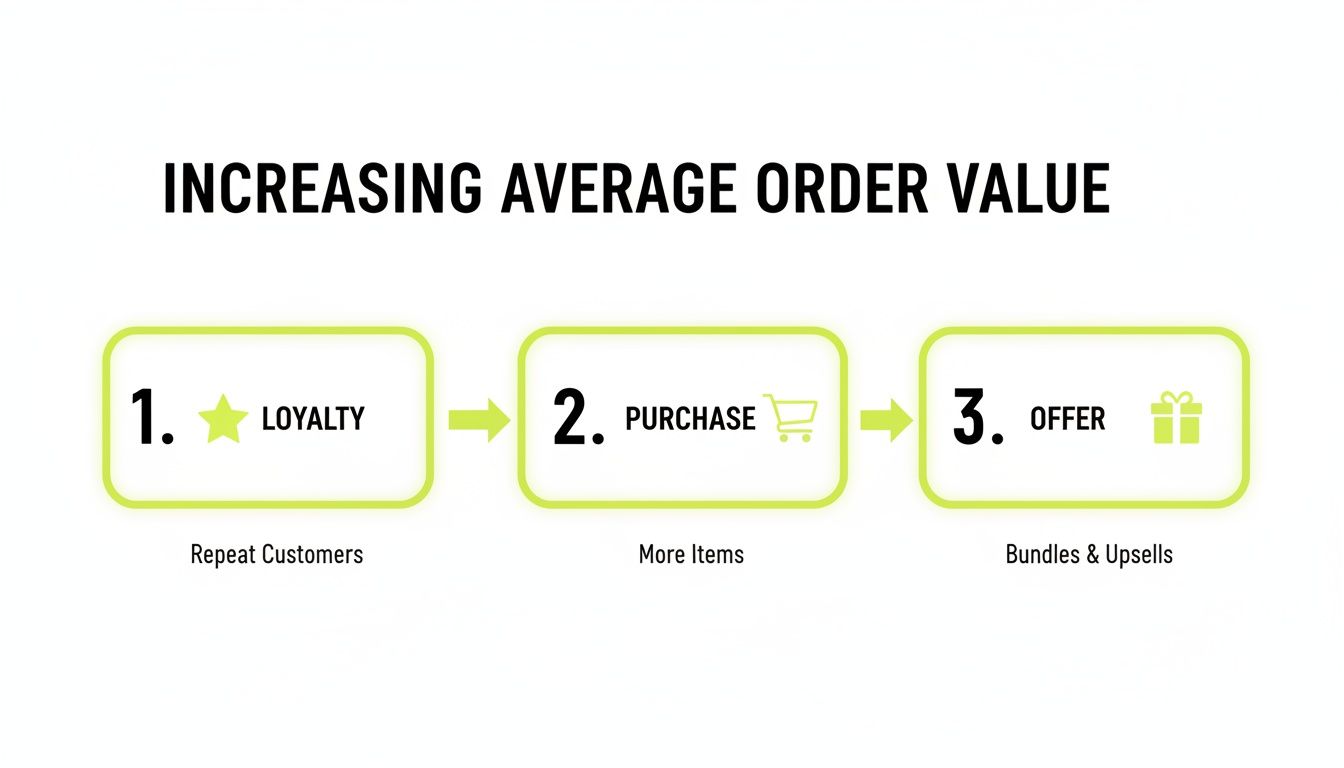
As the graphic shows, growth starts by rewarding loyalty. That encourages more frequent purchases, which creates the perfect opportunity to present a valuable offer. It's a simple, repeatable cycle that acts as the engine for sustainable AOV growth.
Your First Step Forward
Feeling overwhelmed is normal. The key is to avoid trying to boil the ocean. Instead, pick one or two strategies from this playbook that feel like the lowest-hanging fruit for your business right now.
- Could you easily create a "starter kit" bundle? Start there.
- Is your AOV just below a round number? Test a free shipping threshold 15-20% above your current average.
- Do you have an obvious complementary product? Set up a simple post-purchase offer.
Don't chase perfection. Your goal is to launch, measure, and iterate. Implement a single tactic, track the impact on your AOV over the next month, and let the data tell you what your customers respond to. This is how you build real momentum.
Optimizing your average order value isn't a one-time project; it's an ongoing practice of listening to your customers and refining their journey. It’s one of the most direct paths to stronger profitability and more sustainable growth. You have the map—now it’s time to take that first step.
Common Questions About Boosting AOV
As you start putting these tactics into play, some questions are bound to pop up. Getting a handle on the finer points of average order value helps you set goals you can actually hit and sidestep any bumps in the road.
Let's dig into some of the most common ones I hear from clients.
What’s a "Good" AOV for My Industry?
This is easily the question I get asked the most, but honestly, there's no magic number. AOV is all over the map depending on the industry. A luxury furniture store might see an AOV of $1,500, while a fast-fashion brand could be happy with $85.
Instead of getting hung up on broad industry averages, your focus should be internal. A "good" AOV is one that’s consistently climbing. Your own baseline is the only benchmark that truly matters.
The best way to measure success is to benchmark against yourself. Aim for a steady 5-10% lift in AOV each quarter by testing the strategies we've covered. That internal growth is a much stronger signal of a healthy business than any industry report.
How Long Until I See a Real Impact?
The timeline really depends on which plays you run and how well you execute them.
- Quick Wins (Days to Weeks): Simple tweaks can deliver surprisingly fast results. Things like adding a free shipping threshold or a "Frequently Bought Together" widget can move the needle almost overnight. You can often spot a measurable lift in less than a week.
- Longer-Term Plays (Months): More ambitious strategies take time to marinate. If you're building a tiered loyalty program from scratch or dialing in a sophisticated personalization engine, you need time to collect data and actually change customer habits. Give these bigger initiatives one or two quarters to fully pay off.
Do These Tactics Work for Service-Based Businesses?
Absolutely. The core idea behind increasing AOV is universal, even if you’re selling services instead of products. The execution just looks a little different.
Here’s how it can play out for service providers:
- Bundling: A marketing agency could package an "SEO Audit + Content Strategy" service, offering a better deal than if a client bought each one separately.
- Upselling: A personal trainer could upsell a client from a basic monthly package to a premium one that includes nutritional coaching and weekly check-ins.
- Tiered Incentives: A consultant might offer a discount on a follow-up project if the initial contract hits a certain dollar amount, nudging clients toward a larger upfront commitment.
At the end of the day, the goal is the same whether you're shipping a box or delivering a service: pack more value into a single transaction.
Ready to stop guessing and start growing? At Silver Spoon Agency, we specialize in building data-driven marketing funnels and ad campaigns that turn every customer interaction into a revenue opportunity. We orchestrate comprehensive strategies that not only attract traffic but systematically increase its value. If you want a partner to help you implement these AOV-boosting tactics and achieve measurable growth, we should talk. See how we can elevate your strategy at https://www.silverspoonagency.com.